
Why this Conservative Evangelical Stopped Supporting the Death Penalty


    I used to support the death penalty.  After all, that’s what good Christians did, right?  Murderers received what they had measured out to others.  The death penalty was in the Bible and that was good enough for me.  But as the years went by, I began to wrestle with facts and ideas that didn’t fit.  It took time, years, even decades before I realized that I was changing my mind.  Even then, as a member in, and then as a pastor of, conservative congregations, I didn’t talk much about it. 

    I was troubled as I wondered how grace and mercy were served by the death penalty.  I was also troubled as I heard more about the costs of a death penalty conviction.  I suppose the last straw was when I first heard about the number of convictions being thrown out as DNA testing was first being used in the legal system.  Over the years, the evidence piled up until I had to surrender a notion that I once thought was reasonable.  I am not any different than I used to be.  My political and religious leanings are not significantly different than they ever were but I now believe that it is both logical and reasonable to oppose the death penalty from both a practical and a religious point of view.  Here’s why…
The Death Penalty is Not a Deterrent–Crime statistics in places where there is a death penalty are not statistically different from places where there is not.
Cost – It costs more to incarcerate a death row inmate.  Prisoners convicted under a death penalty statute are granted mandatory appeals and that process is expensive.  Estimates are that a death penalty inmate costs 2 to 5 times more over his or her lifetime than one who is incarcerated for life.
Fairness and Justice – The scriptural standard of evidence, particularly for murder, was from the beginning (Deuteronomy 17), two eyewitnesses.  In our modern world, having two witnesses is rare.  Mistaken identity is now one of the leading causes of error in our legal system.   Add a host of other errors, and suddenly a lot of people find themselves wrongly convicted.  For the last decade or so, an average of 18 death row residents per year were cleared by DNA evidence.  It’s so bad, that nationwide, a Columbia University study found serious errors in 68% of all death penalty cases and 2 out of 3 death penalty cases were overturned on appeal.  Of those overturned, 82% were retried on lesser charges.  Granted, no system is foolproof, but when ours is so messed up that we get it wrong 2 out of 3 times, its time to try something else.
Consistency – The church is usually among those who proclaim the sanctity of all life and declare to the world how God loves all people.  If we really believe that, then why is the life of a murderer not just as sacred?  Does God love murderers less? 
Grace, Forgiveness and Redemption – If we believe (and I do) that the Gospel message is all about grace, forgiveness and redemption, how do we justify the state sponsored killing of incarcerated criminals?  Where’s the grace and forgiveness in that?  How can God do a work of redemption in someone’s life when they’re already dead?  If we believe that God can change the hearts of human beings, then why are we so quick to assume that these men and women are unredeemable?
    As I wrestled with these questions, I realized that I didn’t have any answers that could make my continued support of the death penalty make any logical or spiritual sense.  That doesn’t mean that there isn’t a part of me that thinks the perpetrators of particularly horrible crimes shouldn’t die in some particularly painful way.   
What it means, I think, is that I’m beginning to understand the difference between retribution and justice.

Called to a Different Path


“Do not go where the path may lead, go instead where there is no path and leave a trail.” – Ralph Waldo Emerson 

    I am a Cleveland Indians fan.  I follow the Indians, not because they their winning record (obviously), but by accident of geography. I grew up in Northeast Ohio, went to high school in Akron, and my first job after college sent me to Cleveland for ten years.  As a Cleveland fan, Boston is considered to be an evil empire second only to the New York Yankees.  This week’s attack on the Boston Marathon (a very different thing than baseball) stirs in me the sort of protective feelings that siblings have for one another.  Feelings such as, “Nobody messes with my brother but me.” We don’t yet know who committed this horror, but the reaction of most Americans is, like mine, anger.  This is, I think, a natural and instinctive reaction, but a dangerous one as well.  As Christians, we need to carefully gauge our reactions so that our emotions do not draw us away from the path we have been called to follow.
    Anger is not evil.  Nor is it wrong or sinful to feel angry, but how we allow anger to motivate us, in what direction we allow anger to push us, may well be.  Anger over the attack on Pearl Harbor drew the United States into a war with Japan.  Anger over the attacks of September 11th provided support for wars against Iraq and Afghanistan.  These may, or may not, be proper if we judge them as a means of seeking justice or resisting aggression, but we cross a line when we allow hatred and revenge to become our motivation.
    As a follower of Jesus Christ, I do not believe, as some of my friends do, that we have been called to a path of non-violence or pacifism.  I do believe, however, that we have been called to a different path, a direction different than our instincts alone would lead us.
    In Leviticus, a book often noted for its violence, we find a warning that revenge will lead us astray.
“Do not seek revenge or bear a grudge against anyone among your people, but love your neighbor as yourself. I am the Lord.”  Leviticus 19:18
 
    But what if the perpetrator of this horror is not “among our people” but someone else?  Well, Jesus had something to say about that…
27 “But to you who are listening I say: Love your enemies, do good to those who hate you, 28 bless those who curse you, pray for those who mistreat you. 29 If someone slaps you on one cheek, turn to them the other also. If someone takes your coat, do not withhold your shirt from them. 30 Give to everyone who asks you, and if anyone takes what belongs to you, do not demand it back. 31 Do to others as you would have them do to you.
    This is hard.  Jesus wants us to do good to people who insist upon doing us harm.  Why?  Every fiber of my being wants to hit back when I am hit, to hurt the guy that hurts my family and to put the smack-down whoever did this thing to the people of Boston.  But that isn’t what Jesus had in mind.  Our calling is to a different path.  If you read the rest of the passage I just interrupted we get a few more details…
 “If you love those who love you, what credit is that to you? Even sinners love those who love them. 33 And if you do good to those who are good to you, what credit is that to you? Even sinners do that. 34 And if you lend to those from whom you expect repayment, what credit is that to you? Even sinners lend to sinners, expecting to be repaid in full. 35 But love your enemies, do good to them, and lend to them without expecting to get anything back. Then your reward will be great, and you will be children of the Most High, because he is kind to the ungrateful and wicked. 36 Be merciful, just as your Father is merciful. – Luke 6:27-28
    This is hard.  Why should we do good to those who seek to harm us?  Why should we be merciful?  Because we are called to follow a different path, a radical path, a path that calls us to love not only those who love us back, but everyone, whether they love us or not.  We are called to love the way that Jesus loved.
    Paul echoes these same feelings in his letter to the church in Rome and summarizes it by saying, “Do not be overcome by evil, but overcome evil with good.” (Romans 12:21)
    I don’t think that any of this means that we cannot protect ourselves or seek justice, only that we must guard ourselves from seeking revenge and retribution instead of justice, and being driven by hatred and vengeance instead of mercy and compassion.  
This isn’t the place our instincts would lead us.
We are called to follow a different path.

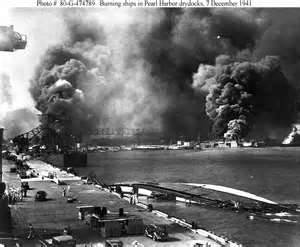
Pearl Harbor – A Story of Forgiveness and Salvation?

    Seventy-one years ago today the Japanese navy, led by 36 year-old “top gun” pilot of his day, Mitsuo Fuchida, attacked Pearl Harbor, Hawaii.  The surprise was nearly total and the destruction was immense both physically as well as to the psyche of the United States.  The Japanese admiralty expected that such devastation would compel the United States to sue for peace and stay out of their plans for expansion in the Pacific.  Instead, our nation was filled with a “terrible resolve.”  Our reaction was not to surrender but to get even.  The death and destruction (on all sides) that spread across the Pacific and around the world was nearly incalculable.  Tens of thousands, even hundreds of thousands of men and women went to their deaths for reasons that, even now, are difficult to explain.


    For his part, Mitsuo Fuchida, was plagued by the death that he had witnessed and that which he had been a part of and he struggled to find a way to bring a message of peace to the world.  A friend who had been a prisoner of war in the United States, told him an amazing, almost impossible, story that revealed a way toward peace.  Later still he encountered the message of Jacob DeShazer, a B-25 bombardier captured by the Japanese after the Doolittle raid.  DeShazer, despite being treated horrifically during his imprisonment, had learned an amazing lesson as well during his confinement.  He traveled to Japan and spoke in venues across the country telling of the peace that he had found in their POW camp.

    Nathan Naversen has written a great story about this and I used it as a devotion at the Fellowship of Christian Athletes meeting this morning.  It is an amazing story of peace and forgiveness that grew out of ome of history’s greatest periods of death and destruction.  How is this possible?  Read the whole story here:

From Pearl Harbor to Golgotha

September 11, 2001 – 10 years later

Help us overcome, Lord, this evil which has descended
Help us understand, Lord, why so many lives too soon have ended

Help us heal, Lord, as we recover from the pain
Help us cope, Lord, show us sunshine after the rain

We put our trust in you, Lord, as you watch us from on high
Help us grieve, Lord, and hold us while we cry

Written by Jim Lane
Fair Oaks, CA , September 2001

This morning in church we remembered.  Many in our congregation could remember exactly where they were and what they were doing on the day that Pearl Harbor was attacked and the same applies to the days that John F. Kennedy was assassinated, Ronald Reagan was shot, and Challenger exploded.  Likewise we remember where we were ten years ago today during the events of September 11, 2001.  Although  we will likely never forget, I pray that God will continue to bring healing to all those who were wounded both physically, mentally and spiritually.  Similarly, I pray that we will learn the right lessons of September 11th.  There are many messages but I pray that we hear the messages taught to us in scripture, messages of love, forgiveness, healing and hope and not the messages that we sometimes hear that play to our baser instincts to hate, destroy and seek revenge and retribution.

This morning’s worship service began by reading together from the Psalms and remembering that we find strength in God’s tower and not in towers of our own making.  The opening prayer was the one I have included above.  It was written by a fellow rocketry hobbyist and an online friend, Jim Lane in 2001 after the events of September 11th.  It sums up many of the feelings that we had then and feelings that have resurfaced this week as we remember.  I include it here with his kind permission.  Thank you Jim.

My message this morning was a story of remembrance but also a reminder that the thing that makes followers of Jesus Christ different is our calling to love and forgive our enemies.  This is not an easy thing, in fact, it may well be one of the hardest things that we can do but Jesus tells us that our own forgiveness depends upon it.

Sunday’s message, September 11, 2011 – a service of remembrance and reminder.