

Moving on Up… to Caesarea
I remember watching situation comedy, “The Jeffersons” on television in the late 1970’s. The show was a spin-off of All in the Family and centered around the lives George and Louise Jefferson after George builds a chain of dry cleaners and his newfound upper-middle class income allows him to move into a luxury high-rise apartment instead of the old neighborhood in which he had grown up. The show was reliably funny but, for me and many others, one of the memorable things that stuck with us was the theme song, “Moving on Up.” (I hope you’ll forgive me if you get that song stuck in your head for the rest of the day.)
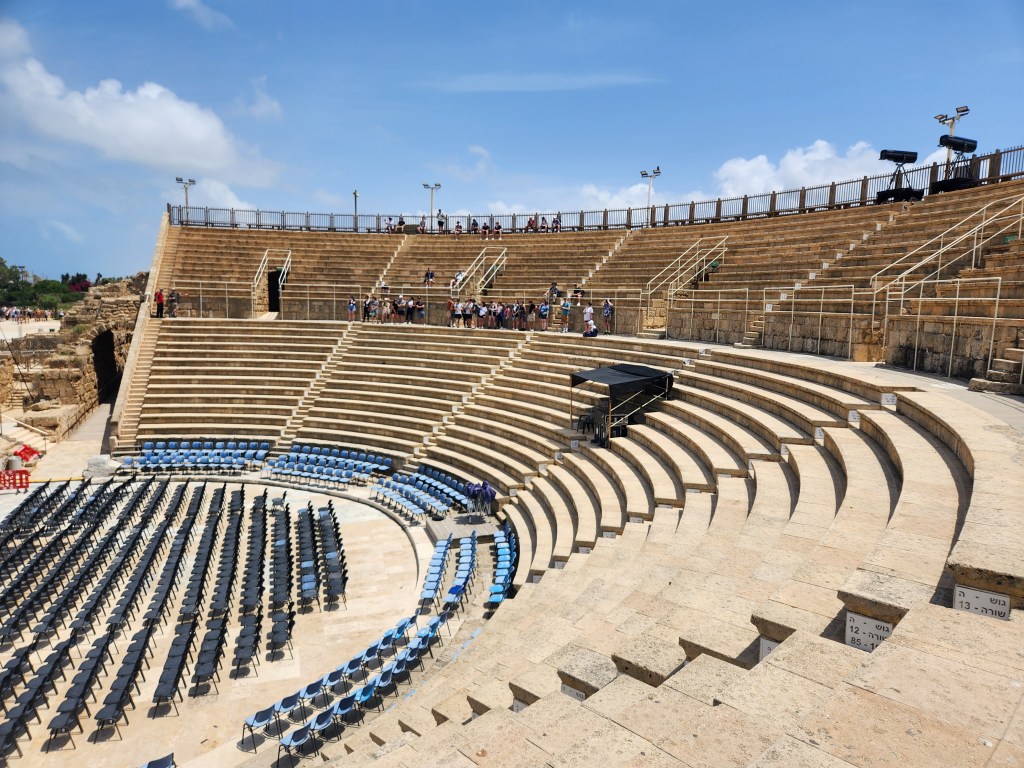
It was that song that has been stuck in my head as I think about the things that I saw in Caesarea by the Sea, or Caesarea Maritima, on the shores of the Mediterranean Sea in Israel. I had been there before but having spent a significant amount of time over the last couple semesters reading and studying, seeing it all again from this new perspective, and touring those ruins with other students, led by our professor,Dr. David deSilva, I saw many things differently. But while travel always changes us, we can’t always anticipate how we will be changed.
During this visit, the thing that struck me at many of the sites we visited, but particularly at Caesarea, was the incredible gulf that existed between the rich and the poor before, and during, the New Testament period. I’d read about it, and I thought that I understood it, and prior to this trip I certainly could have explained and even preached about it. But this time something was different.

Certainly, Caesarea has a lot going for it and King Herod had every reason to want to build a city, and a palace, here. Being on the sea it has a beautiful view, and an agreeable climate, and with the construction of one of the ancient world’s largest seaports, Caesarea became a center of trade and travel, a center of government, and along with those things became quite wealthy. Caesarea had a beautiful theater, concert hall (an Odeon), an almost impossibly enormous temple of Augustus that dominated the city, an oval track for horse (or human) racing (known as a circus), and even a 10 mile (15 km) long aqueduct to fill the ornate public fountains, flush the toilets, and make sure that no one would ever run out of drinking water. Many buildings were architecturally, over the top gorgeous, and some were known to be covered in imported marble. Fish, wine, and delicacies imported from around the known world were available.

Herod built his palace on a spit of land protruding into the sea just around the corner from the theater and had every luxury available including a cold pool, sauna, and an almost Olympic sized, freshwater swimming pool that was carved out of solid bedrock. After Herod’s death, his palace was used by the governors, procurators of the Judaea Province. Among these were the prefect Pontius Pilate, and Governor Antoninus Felix, that we read about during Paul’s trial in Acts 23, and Governor Porcius Festus who heard Paul’s defense there in Acts 25.

It was the goal for local and provincial elites to move up to places like Caesarea. There was an enormous disparity between the “haves” and the “have nots” and even between the “wealthy” and “average.” Most of the population were rural peasants that eked out a subsistence level of survival, farming, and fishing in rural areas like Nazareth. There, it wasn’t uncommon for a house to only have one room for an entire family, while larger families might have two, or even four. In Jerusalem, the home of an important, and somewhat wealthy person, might have four rooms and possibly a little larger. Wealthy rulers and government officials made up only 2 percent of the population. Perhaps another 5 percent were “retainers,” career military, lower government functionaries, and household servants for the 2 percent. Merchants and most of the priestly class were basically just “less poor” than peasants, but not anything close to wealthy, and artisans may have had even less income than the peasants.[1]
While we might consider the accommodation in Caesarea to be primitive, and they certainly would not meet our standards of sanitation, many of us would still find it to be nicer than many twenty-first century cities. Caesarea was the place that important and wealthy people dreamed of living. But the lifestyle of the wealthy was so far removed from the experience and expectation of the average person, that it wasn’t even a dream. There was no “middle” class. Two percent were fabulously wealthy and lived a life of luxury, five percent lived well in service to those wealthy people, and everyone else barely made enough money to eat. There was no upward mobility. There was no “moving on up.”
There was only grinding poverty.
Seeing that, understanding that, and grappling with what that means, changes the way that we read the gospels, the stories of the New Testament, and all of scripture.
Please LIKE and SHARE!
Click here to subscribe to Pastor John’s blog.
Click here if you would like to subscribe to Pastor John’s weekly messages.
Click here to visit Pastor John’s YouTube channel.
[1] Sakari Häkkinen, Poverty in the first-century Galilee, Department of New Testament Studies, Faculty of Theology, University of Pretoria, South Africa
 Pastor Partridge