
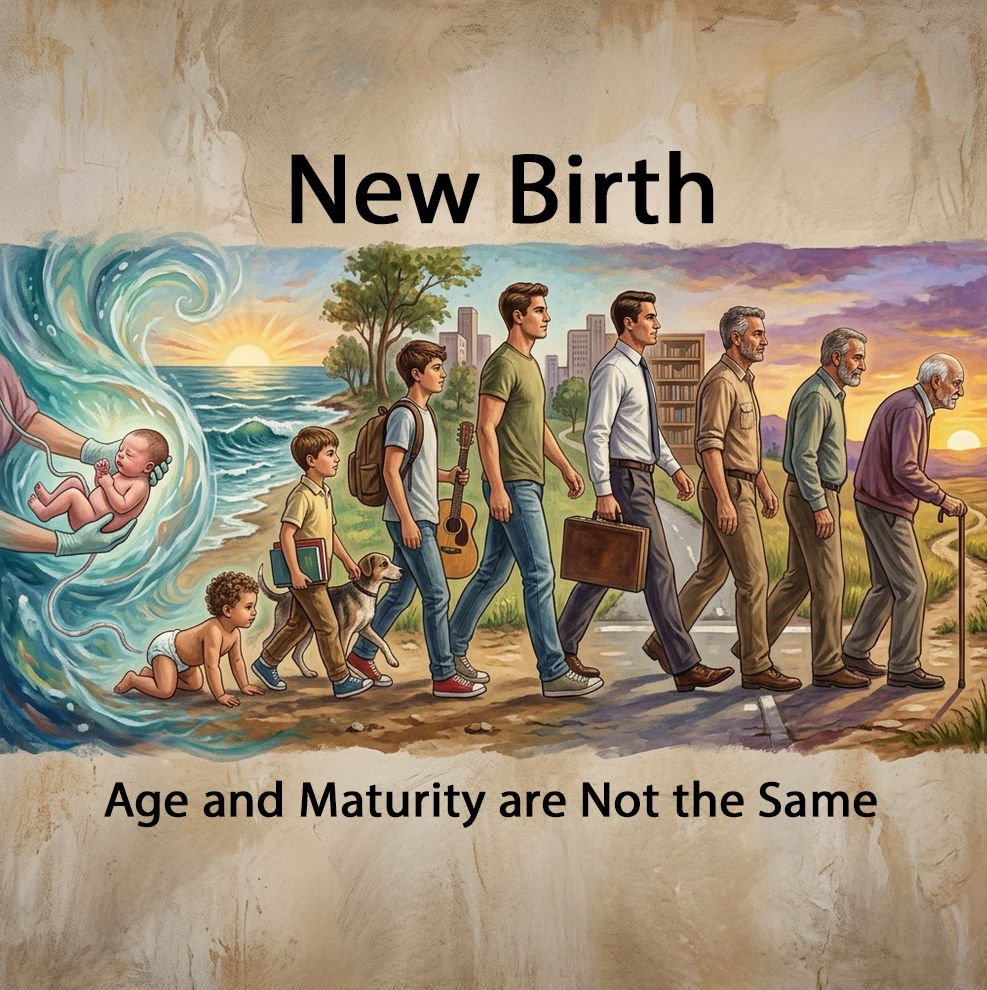
New Birth

New Birth

Age and Maturity are Not the Same

October 2026

by John Partridge

In this Sunday’s bulletin, we welcomed three new babies (children, grandchildren, and great-grandchildren) to our extended church family. And, especially since one of those is my own grandson, this got me thinking about new birth in a spiritual sense as well as in the physical sense. Physical new birth is easy to understand because we can see it, touch it, feed it, and hear it cry when it’s hungry. But spiritual new birth is trickier. Unless we are physically present when someone puts their faith in Jesus (and even then, only if they did so out loud), we don’t automatically know that anything happened. Being born of the spirit doesn’t present physical evidence. No one’s hair changes color, Hebrew or Greek symbols or tattoos don’t magically appear, nor any other outward and visible sign.

This can be a problem because when visitors come to our church, and when those visitors return and become regular in attendance, we can’t determine how grown up or mature they are spiritually simply by looking at them. And because we can’t, we often assume that visitors and new members are more mature than they really are. If we knew that they were only exploring the idea of faith, or that the had only recently chosen to follow Jesus, or had little spiritual teaching or education, we might guide them to appropriate classes, books, and other resources. But often, because many of us grew up in church, we assume a level of spiritual maturity based on their apparent physical maturity, because that is our lived experience. That assumption of maturity then causes us to miss the opportunity to offer guidance, and the lack of guidance can cause new Christians to feel overwhelmed or lost and drift away or lose their faith.

But the trouble isn’t just that newborn spiritual babies don’t look like babies. It’s that our spiritual growth isn’t tied to our physical growth at all. So, not only are we ignorant of the spiritual maturity of our visitors, but we are also similarly ignorant of the people in the church that we’ve known for years. Just because someone grew up in the church, went to Sunday school and youth group, doesn’t necessarily mean that they developed spiritually as they developed physically.

At the beginning of my career as a pastor, someone asked me why I build so much scripture into the text of my sermons rather than just referencing the appropriate scripture and then preaching on it. My answer, both then and now, is that although earlier generations may have been able to assume that church members read the Bible at home and knew the stories, my experience is that many folks today simply do not. When I taught the morning children’s message, I occasionally turned to the congregation and asked the adults if they knew this or that story, and most often, a great many did not. And so, rather than assume that the congregation knows the stories well enough to skip them with a passing reference, I prefer to teach it all, build up foundations for those who need it, and reinforce older learning for those who do not.

So, how do we become spiritually mature?

It really isn’t that difficult in principle. We grow in our faith much as we do physically. We eat healthy food, exercise, live in a healthy environment, and growth comes naturally. But doing those things spiritually is not as straightforward as doing them physically. Physically, when we aren’t eating often enough, we get hungry. And when we fill ourselves with food that isn’t healthy, we get tired, sluggish, and out of shape. But there are no obvious signs if we cut corners spiritually. We don’t get physically hungry when we don’t eat spiritual food regularly and we don’t notice that we’re out of shape when we continually fill up on spiritual junk food. And that disconnection is why many churches are filled with physically mature, spiritual children.

How do we avoid becoming one of those?

Easy. And not so easy. To grow, and become spiritually mature, we need to be just as diligent with our personal growth, as the mother of newborn is with their baby’s physical growth. We need to make sure that we eat regularly by going to church, attending Sunday school or Bible study, and going beyond that to read scripture and spend time with God more often than once each week. We wouldn’t dream of trying to eat dinner after church and then skipping dinner until the following Sunday, but “eating” once a week spiritually won’t work either.

When I was an engineer, I discovered that if tuned my radio to Moody Bible Institute, I could listen to Bible teachers in my office all afternoon as I worked. And so, while Patti and I regularly attended church, attended a weekly Bible study in the home of a friend, and read the Bible, suddenly I was at least half-listening to two or three Bible lessons every day. Obviously, that isn’t going to work for everyone, but that was a period of significant growth for me. Even though it only lasted for two or three years, it was only a few years after that when I recognized a call to ministry and began attending seminary.

As I said, that formula isn’t going to work for everyone. And clearly, not everyone is going to hear God calling them into full-time ministry. The point is, that each of us needs to find what works for them and recognize that spiritual maturity doesn’t “just happen” any more than children grow and become responsible adults by accident. We are deliberate in how we raise our children. We feed them on a regular schedule, make sure that they get an adequate amount of sleep, play, cuddle time, and we structure their development in many other ways as well.

Growing into spiritual maturity is no different. It needs structure and deliberate action.

Maybe it’s time for a checkup. Is your soul growing and thriving? Or is it struggling, starving, and barely getting by?

What will we choose?


Please LIKE and SHARE!

Click here to subscribe to Pastor John’s blog.

Click here if you would like to subscribe to Pastor John’s weekly messages.

Click here to visit Pastor John’s YouTube channel.

A New Name, A New Purpose

A New Name, A New Purpose

January 19, 2025*

By Pastor John Partridge

Isaiah 62:1-5 John 2:1-11                1 Corinthians 12:1-11

Names mean something.

Most of us can name several large American corporations that have changed their names to better reflect their business. The National Cash Register Corporation long ago stopped manufacturing cash registers and is now known as NCR, “Brad’s Drink” became Pepsi-Cola, “Pete’s Super Submarines” became Subway, “Kibble” became Netflix, Kentucky Fried Chicken is now officially just KFC so that there isn’t so much emphasis on the word “fried” in a culture that is more health conscious, International Business Machines sells software and other services as well as computers, and so their legal name is now just IBM.

But people do the same thing. Women, and sometimes men, change their names when they get married, I know a number of people who legally changed their names because the names that their parents had given them didn’t match their personality, and we all know a few people who have chosen to go by their middle names, or nicknames, instead of the first name on their birth certificate. Cassius Clay changed his name to Muhammad Ali when he changed religions and so have many others. Thousands of immigrants have changed their names to fit into the culture of their new homeland and to let everyone know that they belonged here and had left their past behind. And, of course, none of that counts the people who are in the witness protection program or who have changed their names so that they can run away from their past or to hide from abusive spouses.

Whether it is a corporation or a person, changing your name is a statement to the world that something different is happening. Either your original name didn’t match your personality, or it doesn’t match your present reality, or you want your name to better reflect your goals, purpose, and future mission. In ancient times, and in the world of magic and mysticism, names were often seen as the heart of a person’s power and an insight into their soul. And all those ideas are at play as we read Isaiah’s message to the nation of Israel in Isaiah 62:1-5 when God says:

62:1 For Zion’s sake I will not keep silent, for Jerusalem’s sake I will not remain quiet,
till her vindication shines out like the dawn, her salvation like a blazing torch.
2 The nations will see your vindication, and all kings your glory;
you will be called by a new name that the mouth of the Lord will bestow.
3 You will be a crown of splendor in the Lord’s hand, a royal diadem in the hand of your God.
4 No longer will they call you Deserted, or name your land Desolate.
But you will be called Hephzibah,
[Hephzibah means my delight is in her]


    and your land Beulah;
[Beulah means married]
for the Lord will take delight in you, and your land will be married.
5 As a young man marries a young woman, so will your Builder marry you;
as a bridegroom rejoices over his bride, so will your God rejoice over you.

God says that he will not keep silent until Jerusalem is vindicated, and the world sees the truth of God’s blessing and the glory that he has given to Israel. When that happens, God says, Israel will be given a new name from God to reflect its goals, purpose, mission, and connection to God. Once, Jerusalem was called deserted and desolate, but on that day, it will be known as the delight and the bride of God himself because God rejoices over her in the same way that a groom rejoices over his beloved.

With that in mind, we move to John 2:1-11, where we see Jesus beginning for the first time, to move and to live into the purpose for which he had been born and to the mission to which God had called him and sent him into the world.

2:1 On the third day a wedding took place at Cana in Galilee. Jesus’ mother was there, 2 and Jesus and his disciples had also been invited to the wedding. 3 When the wine was gone, Jesus’ mother said to him, “They have no more wine.”

4 “Woman [Greek usage here denotes no disrespect], why do you involve me?” Jesus replied. “My hour has not yet come.”

5 His mother said to the servants, “Do whatever he tells you.”

6 Nearby stood six stone water jars, the kind used by the Jews for ceremonial washing, each holding from twenty to thirty gallons.

7 Jesus said to the servants, “Fill the jars with water”; so, they filled them to the brim.

8 Then he told them, “Now draw some out and take it to the master of the banquet.”

They did so, 9 and the master of the banquet tasted the water that had been turned into wine. He did not realize where it had come from, though the servants who had drawn the water knew. Then he called the bridegroom aside 10 and said, “Everyone brings out the choice wine first and then the cheaper wine after the guests have had too much to drink; but you have saved the best till now.”

11 What Jesus did here in Cana of Galilee was the first of the signs through which he revealed his glory; and his disciples believed in him.

Even though Jesus tells his mother that the time of his ministry has not yet come, Mary knows that God has sent him for a purpose. Did Mary know that Jesus could perform a miracle? I don’t think so. Did she know that Jesus could do… something? I think yes, but I doubt that she had any idea what that something would be. In any case, Mary, who must have been well known and respected in the household and by the household servants, simply instructs the servants to do whatever Jesus tells them to do. And so, Jesus changes 120 to 180 gallons of water into wine. That’s a lot. It must have been a big party, but still, that’s a lot. Think about that in terms of containers that are more familiar to us. That’s between two and a half to three and a half 55-gallon drums full of wine. Or, more than two hundred refrigerator wine boxes, or nine hundred standard size wine bottles. Again, that’s a lot.

But more to the point of today’s message, this moment, as the Apostle John notes, is the first time that Jesus performs a sign that reveals who he really is. And this is a suitable time for a quick refresher about the meaning of Jesus’ name. In Hebrew, Jesus’ name is Yeshua, which is the same Hebrew name that we translate as Joshua. But, in Hebrew, Yeshua means “Yahweh saves,” or “God saves.” And so, at this moment, Jesus not only reveals who he is and begins his earthly ministry, but he begins to live into the meaning of his name.

Remember that I said, names mean things.

And that brings us to the present day and to our relationship with God and with Jesus Christ. What does all this naming, and calling, and purpose stuff mean for us? And much of this is explained by Paul in his first letter to the church in Corinth as he explains some of the gifts that God gives to those who love him. Reading from 1 Corinthians 12:1-11, we hear this:

12:1 Now about the gifts of the Spirit, brothers and sisters, I do not want you to be uninformed. 2 You know that when you were pagans, somehow or other you were influenced and led astray to mute idols. 3 Therefore I want you to know that no one who is speaking by the Spirit of God says, “Jesus be cursed,” and no one can say, “Jesus is Lord,” except by the Holy Spirit.

4 There are different kinds of gifts, but the same Spirit distributes them. 5 There are different kinds of service, but the same Lord. 6 There are different kinds of working, but in all of them and in everyone it is the same God at work.

7 Now to each one the manifestation of the Spirit is given for the common good. 8 To one there is given through the Spirit a message of wisdom, to another a message of knowledge by means of the same Spirit, 9 to another faith by the same Spirit, to another gifts of healing by that one Spirit, 10 to another miraculous powers, to another prophecy, to another distinguishing between spirits, to another speaking in different kinds of languages, and to still another the interpretation of languages. 11 All these are the work of one and the same Spirit, and he distributes them to each one, just as he determines.

Paul says that the gifts that God gives are not all the same. Each of us was made differently by God and as such we have each been given different gifts that suit our lives, our personalities, and the mission and calling that God has put upon our lives. Some of us have been given gifts of wisdom, some knowledge, and some faith, others are given discernment, or gifts of languages but all the gifts come from God. But Paul is clear that the reason that we have been given gifts is not simply to satisfy our curiosity, or to provide an income, or to make us rich, or famous, or powerful, or influential. The reason that we have been given gifts by the Spirit of God is for the common good. Just as Jesus was called by God to rescue others, and to save the world, we are called to use our gifts for the common good and to make the world a better place.

If you think about it, it wouldn’t make a lot of sense for a company to have a name like the National Cash Register Corporation if they didn’t make cash registers any longer. Having a name that matches your mission makes much more sense. It is the same reason that many people change their names. They want their names to match their personalities, to let the world know that they have a new life as a married person, or that they’ve changed their religion. And we should include ourselves among that last one even if our name has stayed the same. When we chose to follow Jesus, then we identified our lives with Jesus, with his mission, and with his purpose. If you want to think of it that way, at the moment we chose to follow Jesus our name changed. Where it once was John Doe or Jane Doe, it became John Doe Christ Follower or Jane Doe Christ Follower.

And with our new name, we received gifts from the Spirit of God, a new mission, and a new purpose. We are called to use the gifts that we have been given for the common good, to help the people around us, to make life better for everyone in our community, and to make the world a better place. We have been called to change the world.

Let us live into our purpose and live into our new name. As John Wesley said, “Do all the good you can, by all the means you can, in all the ways you can, in all the places you can, at all the times you can, to all the people you can, as long as ever you can”.


Please LIKE and SHARE!

Click here to subscribe to Pastor John’s blog.

Click here if you would like to subscribe to Pastor John’s weekly messages.

Click here to visit Pastor John’s YouTube channel.


*You have been reading a message presented at Christ United Methodist Church on the date noted at the top of the first page.  Rev. John Partridge is the pastor at Christ UMC in Alliance, Ohio.  Duplication of this message is a part of our Media ministry, if you have received a blessing in this way, we would love to hear from you.  Letters and donations in support of the Media ministry or any of our other projects may be sent to Christ United Methodist Church, 470 East Broadway Street, Alliance, Ohio 44601.  These messages are available to any interested persons regardless of membership.  You may subscribe to these messages, in print or electronic formats, by writing to the address noted, or by contacting us at secretary@CUMCAlliance.org.  These messages can also be found online at https://pastorpartridge.com .  All Scripture quotations, unless otherwise indicated, are taken from the Holy Bible, New International Version®, NIV®. Copyright ©1973, 1978, 1984, 2011 by Biblica, Inc.™ Used by permission of Zondervan. All rights reserved worldwide. www.zondervan.comThe “NIV” and “New International Version” are trademarks registered in the United States Patent and Trademark Office by Biblica, Inc.™

Photo by Henkster on Freeimages.com

Moving on Up… to Caesarea

View of the Mediterranean Sea from Caesarea

Moving on Up… to Caesarea

I remember watching situation comedy, “The Jeffersons” on television in the late 1970’s. The show was a spin-off of All in the Family and centered around the lives George and Louise Jefferson after George builds a chain of dry cleaners and his newfound upper-middle class income allows him to move into a luxury high-rise apartment instead of the old neighborhood in which he had grown up. The show was reliably funny but, for me and many others, one of the memorable things that stuck with us was the theme song, “Moving on Up.” (I hope you’ll forgive me if you get that song stuck in your head for the rest of the day.)

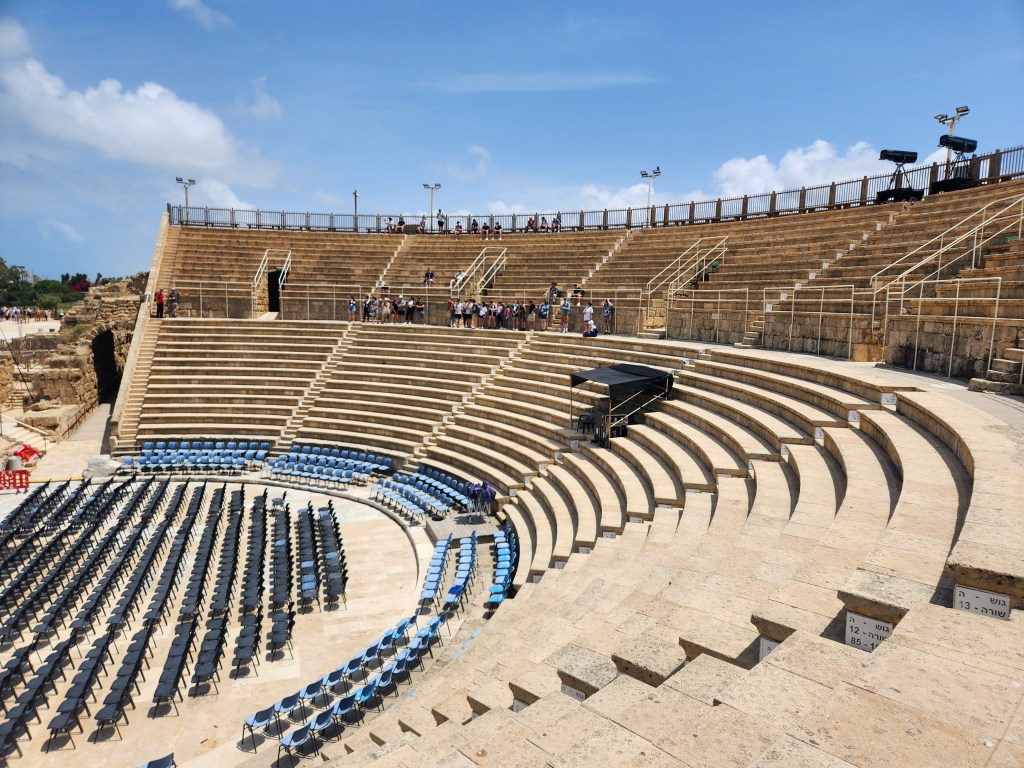
Theater at Caesarea

It was that song that has been stuck in my head as I think about the things that I saw in Caesarea by the Sea, or Caesarea Maritima, on the shores of the Mediterranean Sea in Israel. I had been there before but having spent a significant amount of time over the last couple semesters reading and studying, seeing it all again from this new perspective, and touring those ruins with other students, led by our professor,Dr. David deSilva, I saw many things differently. But while travel always changes us, we can’t always anticipate how we will be changed.

During this visit, the thing that struck me at many of the sites we visited, but particularly at Caesarea, was the incredible gulf that existed between the rich and the poor before, and during, the New Testament period. I’d read about it, and I thought that I understood it, and prior to this trip I certainly could have explained and even preached about it. But this time something was different.

The inner harbor at Caesarea by the Sea

Certainly, Caesarea has a lot going for it and King Herod had every reason to want to build a city, and a palace, here. Being on the sea it has a beautiful view, and an agreeable climate, and with the construction of one of the ancient world’s largest seaports, Caesarea became a center of trade and travel, a center of government, and along with those things became quite wealthy. Caesarea had a beautiful theater, concert hall (an Odeon), an almost impossibly enormous temple of Augustus that dominated the city, an oval track for horse (or human) racing (known as a circus), and even a 10 mile (15 km) long aqueduct to fill the ornate public fountains, flush the toilets, and make sure that no one would ever run out of drinking water. Many buildings were architecturally, over the top gorgeous, and some were known to be covered in imported marble. Fish, wine, and delicacies imported from around the known world were available.

Caesarea Aqueducts

Herod built his palace on a spit of land protruding into the sea just around the corner from the theater and had every luxury available including a cold pool, sauna, and an almost Olympic sized, freshwater swimming pool that was carved out of solid bedrock. After Herod’s death, his palace was used by the governors, procurators of the Judaea Province. Among these were the prefect Pontius Pilate, and Governor Antoninus Felix, that we read about during Paul’s trial in Acts 23, and Governor Porcius Festus who heard Paul’s defense there in Acts 25.

Ruins of Herod’s Palace with mosaic floors and pool.

It was the goal for local and provincial elites to move up to places like Caesarea. There was an enormous disparity between the “haves” and the “have nots” and even between the “wealthy” and “average.” Most of the population were rural peasants that eked out a subsistence level of survival, farming, and fishing in rural areas like Nazareth. There, it wasn’t uncommon for a house to only have one room for an entire family, while larger families might have two, or even four. In Jerusalem, the home of an important, and somewhat wealthy person, might have four rooms and possibly a little larger. Wealthy rulers and government officials made up only 2 percent of the population. Perhaps another 5 percent were “retainers,” career military, lower government functionaries, and household servants for the 2 percent. Merchants and most of the priestly class were basically just “less poor” than peasants, but not anything close to wealthy, and artisans may have had even less income than the peasants.[1]

While we might consider the accommodation in Caesarea to be primitive, and they certainly would not meet our standards of sanitation, many of us would still find it to be nicer than many twenty-first century cities. Caesarea was the place that important and wealthy people dreamed of living. But the lifestyle of the wealthy was so far removed from the experience and expectation of the average person, that it wasn’t even a dream. There was no “middle” class. Two percent were fabulously wealthy and lived a life of luxury, five percent lived well in service to those wealthy people, and everyone else barely made enough money to eat. There was no upward mobility. There was no “moving on up.”

There was only grinding poverty.

Seeing that, understanding that, and grappling with what that means, changes the way that we read the gospels, the stories of the New Testament, and all of scripture.


Please LIKE and SHARE!

Click here to subscribe to Pastor John’s blog.

Click here if you would like to subscribe to Pastor John’s weekly messages.

Click here to visit Pastor John’s YouTube channel.

[1] Sakari Häkkinen, Poverty in the first-century Galilee, Department of New Testament Studies, Faculty of Theology, University of Pretoria, South Africa