
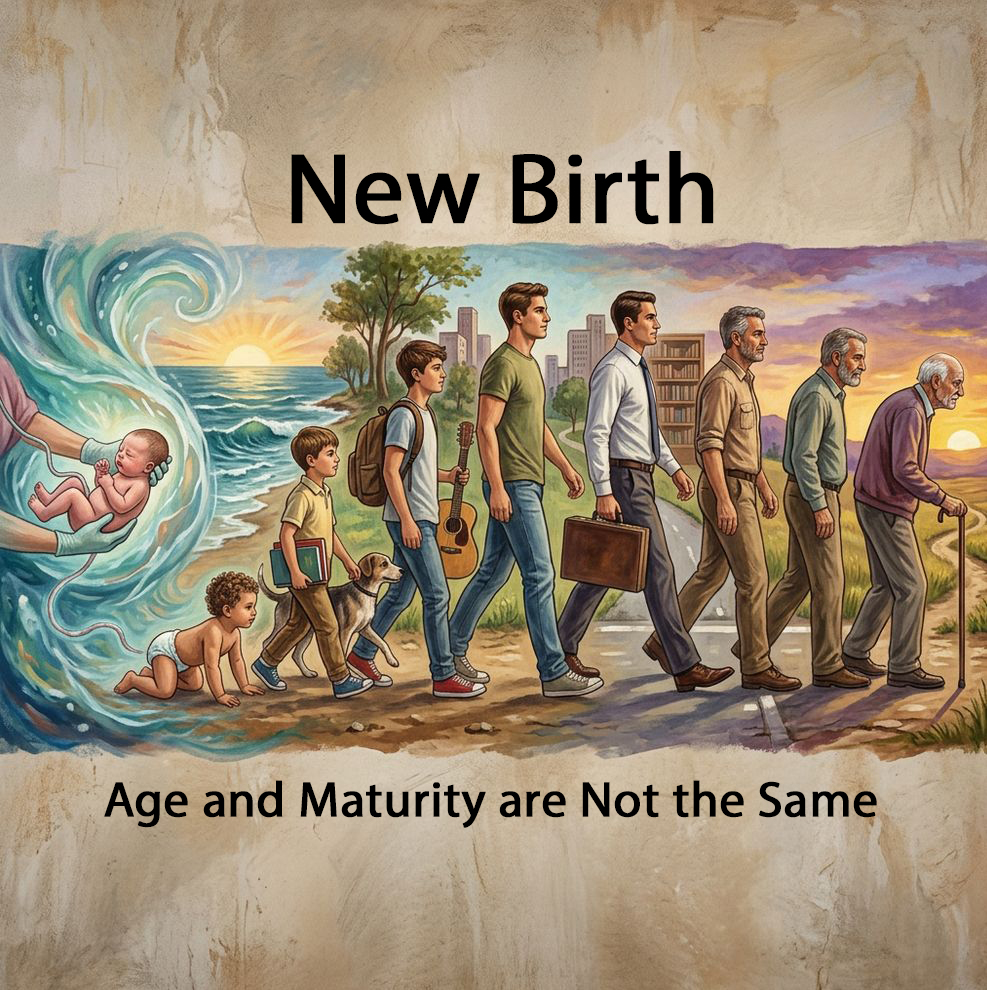
New Birth
Age and Maturity are Not the Same
October 2026
by John Partridge
In this Sunday’s bulletin, we welcomed three new babies (children, grandchildren, and great-grandchildren) to our extended church family. And, especially since one of those is my own grandson, this got me thinking about new birth in a spiritual sense as well as in the physical sense. Physical new birth is easy to understand because we can see it, touch it, feed it, and hear it cry when it’s hungry. But spiritual new birth is trickier. Unless we are physically present when someone puts their faith in Jesus (and even then, only if they did so out loud), we don’t automatically know that anything happened. Being born of the spirit doesn’t present physical evidence. No one’s hair changes color, Hebrew or Greek symbols or tattoos don’t magically appear, nor any other outward and visible sign.
This can be a problem because when visitors come to our church, and when those visitors return and become regular in attendance, we can’t determine how grown up or mature they are spiritually simply by looking at them. And because we can’t, we often assume that visitors and new members are more mature than they really are. If we knew that they were only exploring the idea of faith, or that the had only recently chosen to follow Jesus, or had little spiritual teaching or education, we might guide them to appropriate classes, books, and other resources. But often, because many of us grew up in church, we assume a level of spiritual maturity based on their apparent physical maturity, because that is our lived experience. That assumption of maturity then causes us to miss the opportunity to offer guidance, and the lack of guidance can cause new Christians to feel overwhelmed or lost and drift away or lose their faith.
But the trouble isn’t just that newborn spiritual babies don’t look like babies. It’s that our spiritual growth isn’t tied to our physical growth at all. So, not only are we ignorant of the spiritual maturity of our visitors, but we are also similarly ignorant of the people in the church that we’ve known for years. Just because someone grew up in the church, went to Sunday school and youth group, doesn’t necessarily mean that they developed spiritually as they developed physically.
At the beginning of my career as a pastor, someone asked me why I build so much scripture into the text of my sermons rather than just referencing the appropriate scripture and then preaching on it. My answer, both then and now, is that although earlier generations may have been able to assume that church members read the Bible at home and knew the stories, my experience is that many folks today simply do not. When I taught the morning children’s message, I occasionally turned to the congregation and asked the adults if they knew this or that story, and most often, a great many did not. And so, rather than assume that the congregation knows the stories well enough to skip them with a passing reference, I prefer to teach it all, build up foundations for those who need it, and reinforce older learning for those who do not.
So, how do we become spiritually mature?
It really isn’t that difficult in principle. We grow in our faith much as we do physically. We eat healthy food, exercise, live in a healthy environment, and growth comes naturally. But doing those things spiritually is not as straightforward as doing them physically. Physically, when we aren’t eating often enough, we get hungry. And when we fill ourselves with food that isn’t healthy, we get tired, sluggish, and out of shape. But there are no obvious signs if we cut corners spiritually. We don’t get physically hungry when we don’t eat spiritual food regularly and we don’t notice that we’re out of shape when we continually fill up on spiritual junk food. And that disconnection is why many churches are filled with physically mature, spiritual children.
How do we avoid becoming one of those?
Easy. And not so easy. To grow, and become spiritually mature, we need to be just as diligent with our personal growth, as the mother of newborn is with their baby’s physical growth. We need to make sure that we eat regularly by going to church, attending Sunday school or Bible study, and going beyond that to read scripture and spend time with God more often than once each week. We wouldn’t dream of trying to eat dinner after church and then skipping dinner until the following Sunday, but “eating” once a week spiritually won’t work either.
When I was an engineer, I discovered that if tuned my radio to Moody Bible Institute, I could listen to Bible teachers in my office all afternoon as I worked. And so, while Patti and I regularly attended church, attended a weekly Bible study in the home of a friend, and read the Bible, suddenly I was at least half-listening to two or three Bible lessons every day. Obviously, that isn’t going to work for everyone, but that was a period of significant growth for me. Even though it only lasted for two or three years, it was only a few years after that when I recognized a call to ministry and began attending seminary.
As I said, that formula isn’t going to work for everyone. And clearly, not everyone is going to hear God calling them into full-time ministry. The point is, that each of us needs to find what works for them and recognize that spiritual maturity doesn’t “just happen” any more than children grow and become responsible adults by accident. We are deliberate in how we raise our children. We feed them on a regular schedule, make sure that they get an adequate amount of sleep, play, cuddle time, and we structure their development in many other ways as well.
Growing into spiritual maturity is no different. It needs structure and deliberate action.
Maybe it’s time for a checkup. Is your soul growing and thriving? Or is it struggling, starving, and barely getting by?
What will we choose?
Please LIKE and SHARE!
Click here to subscribe to Pastor John’s blog.
Click here if you would like to subscribe to Pastor John’s weekly messages.
Click here to visit Pastor John’s YouTube channel.

