Why I Spend Two Weeks Outdoors

Why I Spend Two Week Outdoors

July 2026

by John Partridge

Most of you know that I am involved in Scouting. I was a scout in my youth but did not pursue it the way that my two Eagle Scout brothers did but that doesn’t mean that I didn’t like it. I came back to scouting when our sons were old enough to join Cub Scouts, and I have remained active in scouting since then. And, once we came to Christ Church and the incredible leaders (and scouts) of Troop and Pack 50, I am once again, attending weekly and even joined them at scout camp last year.

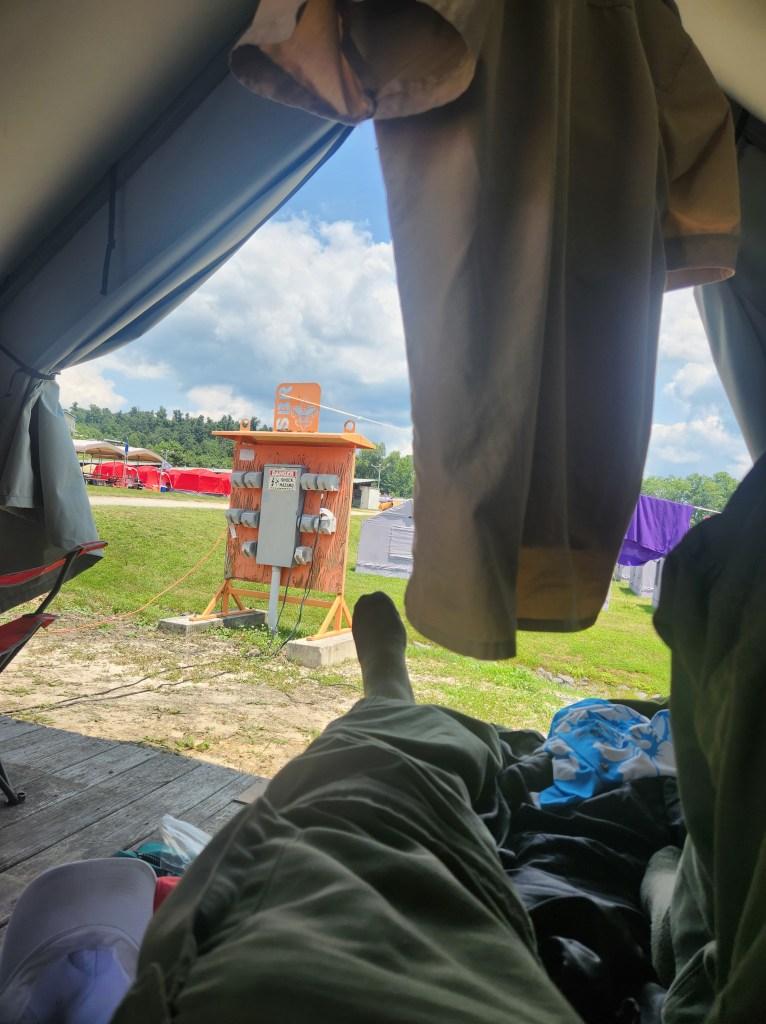
Cold Showers and Tent Camping

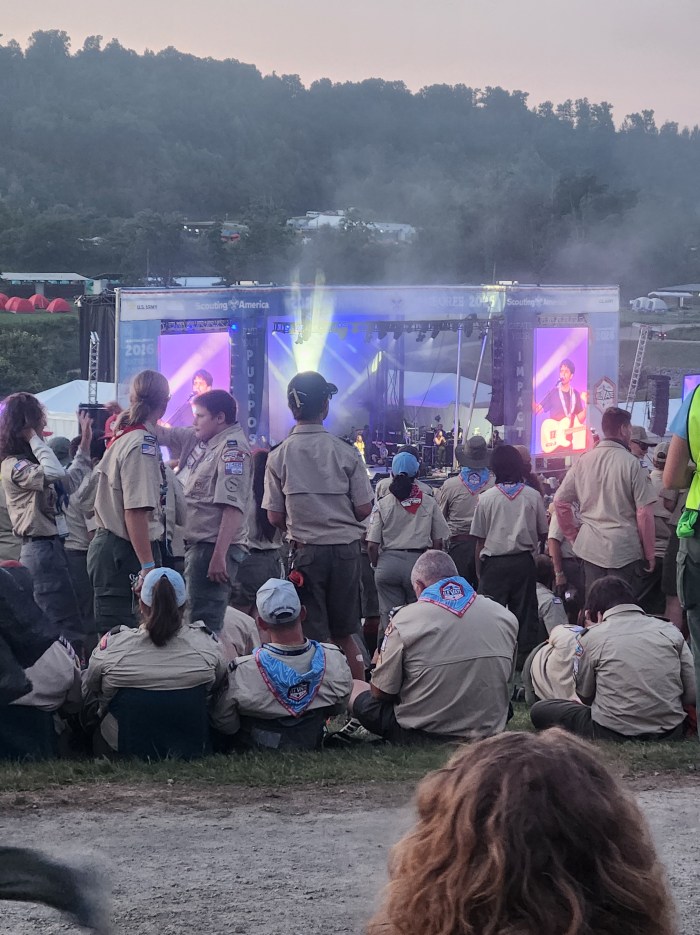
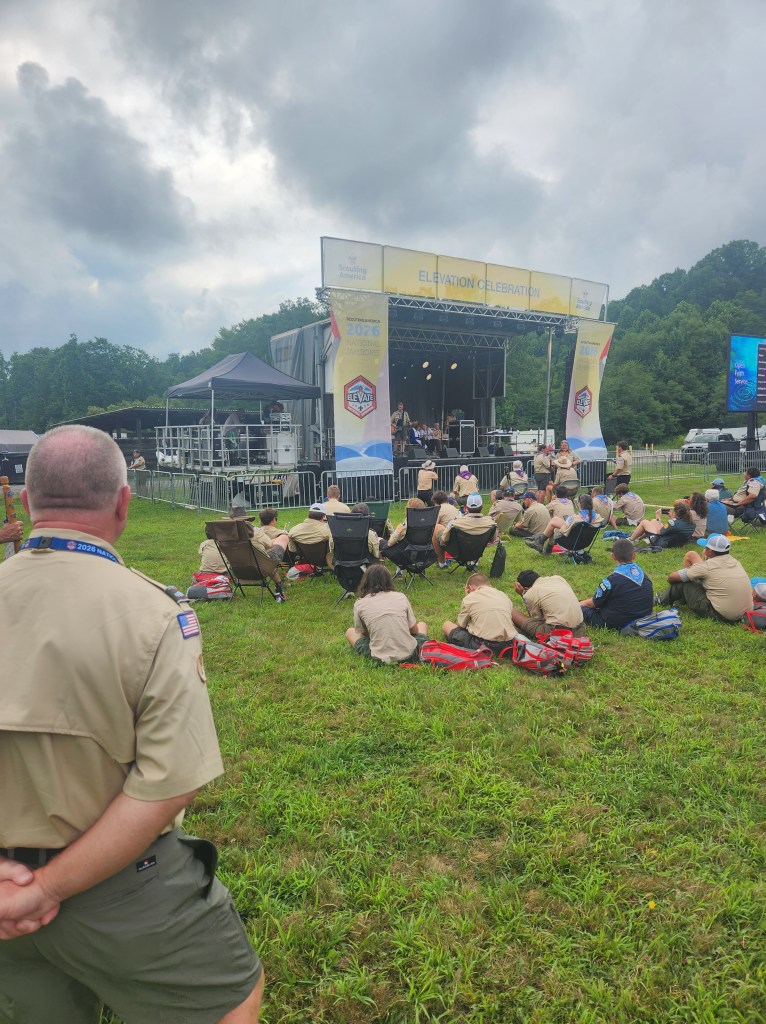
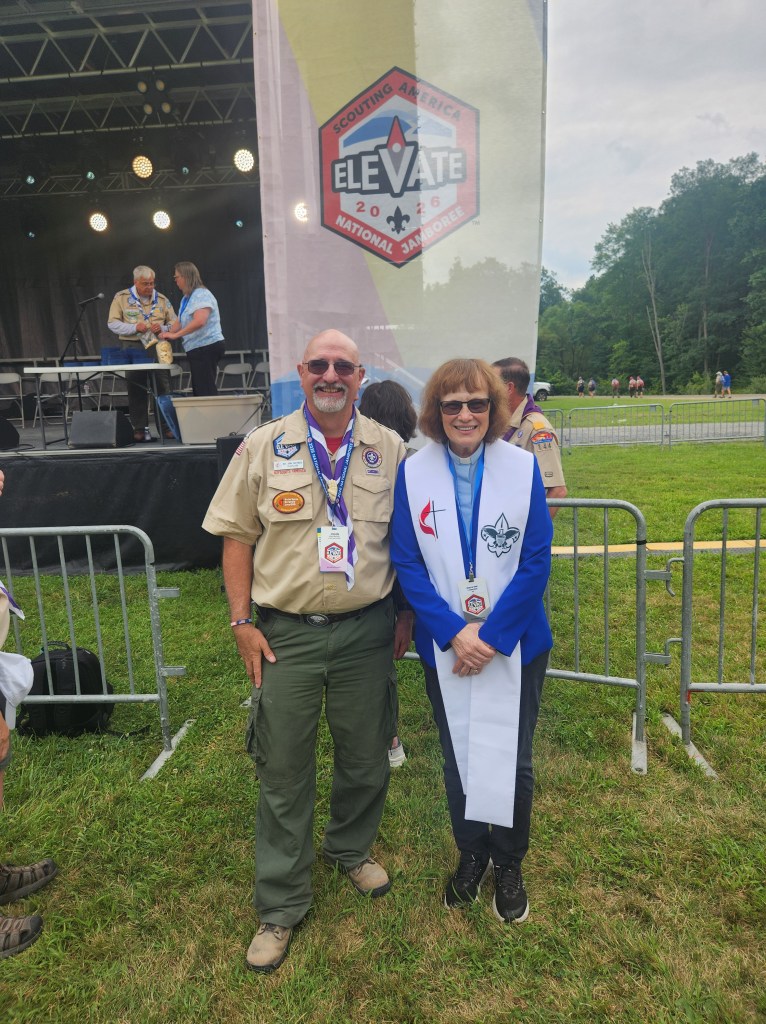
But even so, some of you may not understand why I occasionally serve on the staff of the National Scout Jamboree or what it is that I do when I am there. At a fundamental level, from my earliest days of scouting as a youth, things like the Philmont Scout Ranch, other high adventure camps, the National Scout Jamboree, and the World Jamboree were unattainable, unaffordable, dreams. I left scouting too soon as a youth, but our family could not afford such a thing in any case. But, in 2015 or 2016, the United Methodist Men, who function as our denomination’s liaison with scouting, issued a plea for pastors to serve on the chaplain’s staff for the 2017 National Jamboree and I jumped at the chance to fulfill a truly “bucket list” item.

Was it primitive? Of course. It’s called scout “camp” and not scout “hotel” for a reason. But I camped with scouts in my youth, camped with my family on vacation both as a child and as a parent, camped in the military, camped at Annual Conference, and even camped on vacation. Camping doesn’t bother me. I *like* camping, even if the ice-cold showers are not my favorite thing. But what happened at the 2017 Jamboree, and every subsequent event of that kind, was so deeply worthwhile that I keep spending my own money to go back.

And yes, the staff pay to go to the Jamboree. Many of the scouts, and even leaders, assume that what they pay to attend covers the cost of the staff as well as the cost of the Jamboree itself. But no, the staff pays as much, or more, than the participants themselves. And, although there are repeated promises that the staff will get designated “days off” to attend some of the available activities, everyone knows that, while the intentions are good, there are rarely more than a few hours that we can sneak off to see some of the sights.

But What Do You Do?

Much like scout camp, the chaplains at the Jamboree fill several roles. Our primary responsibility, of course, is to being a spiritual leader. But at scout camp that doesn’t always look like what we do at church. We do, as a group, organize and officiate worship services for the staff as they arrive on Sunday evening, and then for the entire camp the following week, but with several dozen chaplains, many of them Protestant, I am unlikely to preach, although the Bishop serving West Virginia might be asked to say a few words at the Methodist worship service. At these services I have passed out music, offered prayer, assisted with the serving of communion, or shared a brief meditation.

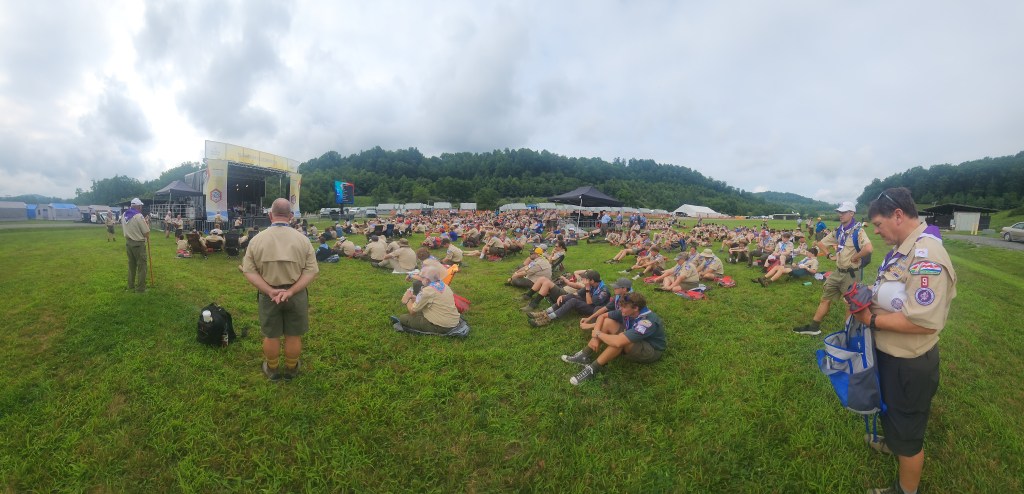
During the week, chaplains take shifts so that someone is always on hand at the field hospitals to minister to both patients and doctors, as well as to work with mental health professionals if needed. Chaplains also help medical staff to watch for scouts who might be at risk for heat injury while sitting outdoors for hours at large events. Early in the week we will introduce ourselves to all the troop leadership in our subcamp (this year there will be 40 troops with approximately 2,000 scouts) so that they can call on us to talk with campers for everything from homesickness to a crisis at home such as divorce or the loss of a parent. We also have occasionally functioned as mediators between adults who can get a little frayed at the edges after a week or two of cold showers, lack of sleep, and herding cats.

But when we’re not doing chaplain things, our second (third?) role is to do whatever needs doing for the regular subcamp staff. We help to greet and guide troops on arrival day, when hundreds of Greyhound buses disgorge thousands of scouts in a handful of hours, and the reverse on departure day. In between, the logistics of overseeing two thousand scouts and 80 or 90 adult leaders can be formidable. This scout needs an escort to the medical tent, someone else needs the key to get their daily allotment of propane, another lost his identification, or needs directions, or other staff have done these things and they just need someone to staff the office (tent) while they are gone, or a thousand other things.

On the few hours during the week that I break away, or pass by traveling from one place to another, there are many interesting things to see and do in the merit badge tents, informational displays put on by environmental and conservation groups, military units, national parks, coal mining companies (it *is* in West Virginia after all), automobile manufacturers, the Rotary Club, and many others. I have, in different years, gone rock climbing, ziplining, mountain biking, watched Scottish Highland games, talked to someone in Colorado via Ham radio, and met wonderful people from every corner of our nation, Canada, and around the world.

Yes, I do have a little fun, but I also learn something every day, work from breakfast to bedtime, and am effectively the pastor of a small-town of two thousand people comprised mostly of young adults. I am thankful that Christ Church recognizes that this is not a vacation but simply ministry in a different location. By the end of these two weeks, I will be exhausted, sunburned, and a little dehydrated, but although every single day, and every jamboree is different, I will also be helping youth and adults to have an amazing experience. Without question, the work is hard, but it is also remarkably fulfilling and rewarding.

And that is why I spend two weeks outdoors, sleep in a tent, and take cold showers.

Thank you all for allowing me the opportunity to do this.

Blessings,

Pastor John

Beware: The Summer Slump

Beware: The Summer Slump

June 2026

by John Partridge

It’s coming.

The school year is fast coming to an end, families are making vacation plans, our church has scheduled our Sunday worship in the park and time in our air-conditioned fellowship hall. Warm weather is already teasing us enough that we aren’t always certain whether we will need a jacket or not.

Soon, summer will be upon us.

But beware, along with summer, we risk facing… the summer slump.

Church leaders know exactly what that means. As soon as families take time off for summer vacation and church members make plans to enjoy the warm weather fishing, camping, and other outdoor activities, church attendance, and often church finances, will see a twenty to thirty percent reduction. We know it’s coming, we plan for it, but even so, it can be discouraging to see (more) empty seats, fewer friendly faces, and struggling finances that were on good footing the month before.

But the summer slump goes deeper than empty pews and slim spreadsheets.

The summer slump is personal and has a very real spiritual component. As we begin to prioritize family, vacation, and summer fun (and that’s not a bad thing), we often neglect to spend time with God. For many of us, Sunday morning is the only time we spend in study, worship, and prayer and when we skip it, often for weeks at a time, our spiritual health suffers and, unintentionally, we drift away from God. Every week we spend away from church makes it just a little easier to skip yet another week. Every missed moment in God’s presence, in study, worship, prayer, or meditation, draws us closer to the world, to the values of its culture, and farther away from the values that God wants to teach us.

As we make plans for the summer, we should also make plans to avoid the summer slump. Whenever possible, honor God by planning to be in church and trust that God will honor the sacrifice of your time by allowing you to work efficiently and accomplish your goals and beyond with the time that remains. But when your schedule forces you to miss your time with God on Sunday, commit to setting aside another time during the week to read scripture, pray, or work through a bible study of some kind. Do what you can to prevent your summer busyness from causing a summer slump and wandering from your relationship with God.

It’s coming.

Beware; the summer slump.

Called to Doubt and Skepticism

Doubt. Test. Be Skeptical.

May 2026

by John Partridge

There is an internet meme that says, “Don’t believe everything you read on the internet” and is then sarcastically “signed” by Abraham Lincoln. While obviously false, the admonition is justifiably accurate. We are constantly reminded to doubt what we have read on the internet, to check for the accuracy of the sources of information, and to double check the information before reposting or ranting about what we thought we knew. Several recent stories have been widely misinterpreted and misrepresented by political partisans on both sides rather than admitting uncomfortable truths. There really isn’t any point in saying which ones that I saw, because next week, and next month, there will be different stories and different truths that have been similarly abused. The reminder, however, remains true, we should remain skeptical, doubt everything, check sources, and then double check.

I have heard secular friends make similar accusations about what we teach at church. They have said things like, “The church just twists the truth for their own profit.” Or “Scripture is interpreted and twisted however it best benefits the church and the clergy.” As disappointing as this is to hear, the accusations aren’t new, or even secular. Charlatans and unscrupulous churches and clergy have twisted and misinterpreted scripture since before the Bible was collected into a unified whole. As a result, when Paul writes to the church in Thessalonica, he tells them to “Test everything” and “hold fast to what is good” (1 Thessalonians 5:21). And Luke praises the Berean church above the Thessalonians because they “examined the Scriptures every day to see if what Paul said was true” (Acts 17:11). This is consistent with what Paul said as well in his letter to the church in Galatia when he declared that “even if we or an angel from heaven should preach a gospel other than the one we preached to you, let them be under God’s curse! (Galatians 1:8)

Jesus himself said that his followers should “Watch out for false prophets. They come to you in sheep’s clothing, but inwardly they are ferocious wolves. By their fruit you will recognize them.” (Matthew 7:15-16) Jesus knew that people would come who acted as if they spoke for God, but who only spoke words that would gain them an advantage, profit, or power. For these, Jesus said, we should watch to see what “fruit” was produced for their ministry. Did they raise lots of money? Then what did they do with it? Did they spend money so that the false prophets could live in luxury? Or did they feed the hungry, clothe the naked, speak for the voiceless, and do the work that God’s people have been called to do?

It may be true that sometimes the clergy or the church twists the truth for their own profit. But that isn’t anything new. The Old Testament prophets knew it, the disciples knew it, Paul knew it, and Jesus knew it. And just as it is today with the internet, they all warned us to be skeptical of everything and everybody. Test everything your teachers preach against the scriptures. Check sources. Double check. Then watch to see what kind of fruit is produced and look to see if the work of God’s kingdom is being accomplished.

We must follow Jesus We must be faithful. But we must also doubt, test, and be skeptical.

As Jesus said, “I am sending you out like sheep among wolves. Therefore, be as shrewd as snakes and as innocent as doves.” (Matthew 10:16)

Death and Taxes

Death and Taxes

April 2026

by John Partridge

It is said that the only two certain things in life are death and taxes.

And, since this month is the deadline for filing our federal income taxes, that seems like an appropriate topic. But, maybe not in the way that you might think. Our taxes, local, state, and federal, are things that we, as a society, have chosen to do together, though often they are also things that our elected representatives have decided that we should do and added that burden onto us as well. Regardless of our complaints to the contrary, these are burdens that we have, one way or another, chosen for ourselves.

As United Methodists, I have sometimes heard our conference apportionments described as taxes, but that language is not only officially discouraged, it’s wrong. Despite the feeling that our apportionments are levied on us from afar and, much like taxes, we do have the ability to elect representatives that vote on these things, a fundamental difference remains. While taxes are most often spent on things that we want for ourselves, such as defense, healthcare, highway, sanitation, parks, and so on, our apportionments are largely dedicated to helping others, doing the work of God’s kingdom, and sharing the Good News of Jesus Christ outside the four walls of our church. Occasionally, we are on the receiving end of that giving pipeline when local churches apply for grants to do projects that benefit their communities. When that happens, other churches in our connection are helping us to reach for, and to accomplish, projects that would otherwise have been far too big for us to attempt on our own.

But that brings us to what is often an even more misunderstood idea in the church, and that is… the tithe. Several of you, if not more, just grumbled. But most, if not all, of that is why I say that the tithe is misunderstood. First, gifts to God, and gifts to the church… are not tithes. Whenever scripture mentions these things together, they are two separate things, tithes… and offerings. Offerings are just what they sound like. A gift that is presented to God. These gifts, biblically, could be an expression of thanks for what God has done, or as a part of a vow to God, or the fulfillment of a ritual. But regardless, they are gifts that are in addition to, or outside the scope of, an ordinary tithe.

So, what is the tithe?

Scripturally, the Old Testament said that when God gave the people freedom, blessings, land, and abundance, that his people were to return one tenth of what they had gained each year to God in obedience and in appreciation for what God had done for them. A big part of that was directed to the priests of God who, unlike the other eleven tribes of Israel, did not receive an inheritance of land but who relied upon the tithes of the other tribes for food, shelter, and survival. Tithes that were in excess of what was needed by the priesthood maintained the temple and were to be used by the temple leaders to care for widows, orphans, the poor, and anyone who legally, or financially, couldn’t care for themselves.

While this still sounds a lot like a tax, there are several things that are different. First, while God commanded that this was something that his people were to do, it is one of the few, if not the only, command that had no penalty for failing to obey. God never said that failing to do so was a sin, or that he would bring calamity upon those who didn’t or couldn’t tithe. From the beginning, this was an aspirational command, something that God’s people were called to do, but with the understanding that people in poverty wouldn’t be able to do give that much. Second, while God people are often warned never to test God, and there are plenty of stories in which people are chastised or punished for testing God, this is the single and only thing about which God openly invites and challenges his people to test him. In Malachi 3:10, God says:

“Bring the whole tithe into the storehouse, that there may be food in my house. Test me in this,” says the Lord Almighty, “and see if I will not throw open the floodgates of heaven and pour out so much blessing that there will not be room enough to store it.”

Unlike government taxes that we pay out of obligation, self-interest, and fear of retribution, God asks that we give back a small portion of what he has given to us out of gratitude, devotion, and love. Moreover, God promises that if we dare to test him by giving him these gifts, he will pour out even more abundant, even amazing, blessings upon us, not to mention even defeating death and granting us eternal life.

They say that the only certain things in life are death and taxes.

But for the followers of Jesus Christ, we can only be certain of taxes.

And tithes are not one of them.


Please LIKE and SHARE!

Click here to subscribe to Pastor John’s blog.

Click here if you would like to subscribe to Pastor John’s weekly messages.

Easter and Kermit the Frog

Easter and Kermit the Frog

by John Partridge

As I began thinking about what to say as we celebrate Easter and see the end of the Lenten season, it occurred to me that we should challenge ourselves to remember the regular appearance of Kermit the Frog on Sesame Street. Frequently, Kermit, in addition to his many other vignettes, Kermit would appear in various sketches asking the question, “What happens next?” In each case, there was a Rube Goldberg (some of you will have to look that up) contraption that Kermit would examine and repeatedly, ask, “What happens next?” And, I think, that’s where we find ourselves as we come to the end of Lent and the beginning of Eastertide.

During the season of Lent, we spent time in private study, Zoom devotionals with Pastor Chris, and both Sunday morning and evening opportunities for worship. In many, if not all of these, we spent time in self-examination considering our sins, our relationship with God, and with one another. But as we reach the end of this season, celebrate Easter, the resurrection of Jesus, and the beginnings of Eastertide and Spring, we should be asking ourselves the question that Kermit has asked so many times, “What happens next?”

It isn’t enough for us to go to school and get an education. All of us, as we approach graduation, whether from high school, undergraduate, or graduate education, must ask ourselves, “what happens next?” Will we continue our education? Will we pursue a job and a career? Will we take a “gap year” and travel? Eventually, life will force us into a decision, but choosing our course and making plans for what happens next is always better than stumbling forward and allowing others to choose for us.

Easter is no different. We have spent six weeks in self-reflection, but what have we learned about ourselves? And, more importantly, what are we going to do about it? I had a professor in seminary who taught classes on how to preach, and to do it well. And in his classes, he was fond of reminding us that while a well-prepared sermon was important, we should often, at the end of each message, answer the question, “So what?” We have spent hours studying, writing, preparation, and rehearsal, the scattered congregation has gathered and listened, but so what? It isn’t enough to do all those things if the congregation departs without knowing what they should do with the information and instruction that they have been given.

After all our study and time of self-reflection, what have we discovered about ourselves? As this season ends and another begins, what will we do with what we have learned?

Have we learned what triggers, or leads us into sin?

Have we considered choices and behaviors that cause us to wander away from, rather than closer to God?

Have we discovered habits and resources that are useful in building and maintaining a richer, fuller, relationship with Jesus?

After spending a season in self-reflection, what have we learned? And, what will we do with that information?

We should do something.

And so, as Kermit often asked…

… “What happens next?”

Blessings,

Pastor John

Are You Marble, Sponge, or Tea?

Are You Marble, Sponge, or Tea?

by John Partridge

As we pass through the seasons of Lent and Easter, and move ever closer to spring and warm weather, it is worthwhile for us to consider what we will do with what we have learned. After spending time during Lent in contemplation of our need for forgiveness, and celebrating the arrival of that opportunity at Easter, we must consider what we will do with what we have learned, and more importantly who we will be, as we go forward.

A visual analogy that has stuck with me for many years has been to ask the question of whether you are a marble, a sponge, or tea. If we imagine that the world and the culture which surrounds us is a big pot of water, lemonade, or soup, what happens because we are in it? If we are marbles, we take up space, we displace the water, but our presence changes nothing. If we are sponges, then we absorb so much of what surrounds us that we take on the flavor and essence of what surrounds us. But, if we are tea, what we are, and who we are, steeps into every drop and every crevice of the culture around us so that its flavor is irreversibly changed to reflect our morals, ethics, and values.

According to scripture, our calling is to be tea. Or, in the language of the bible, salt.

In Matthew 5:13-16, Jesus said:

“You are the salt of the earth. But if the salt loses its saltiness, how can it be made salty again? It is no longer good for anything, except to be thrown out and trampled underfoot. “You are the light of the world. A town built on a hill cannot be hidden. Neither do people light a lamp and put it under a bowl. Instead, they put it on its stand, and it gives light to everyone in the house.

If we are salt, we don’t just take up space, or absorb the culture around us, but our saltiness flows the other way, like tea, and flavors the world around us. Likewise, as the people of light, we don’t just take up space, or even navigate through a world filled with darkness, we bring light into the darkness. By our presence, and the light that we bring, we show the people around us where the pitfalls lie and reveal a path of safety as we move forward together.

As we consider the lessons of Lent and Easter, and think about who God calls us to be, both as a church and as individuals, let us think about who we will be in the days ahead.

Will we be marbles, sponges, or tea?

 Blessings,

Pastor John

Photo by Ablestock.com on FreeImages

An Invitation to Lent

Our season of Lent begins this coming Wednesday, February 18th.

But what does that mean?

The season of Lent is a time that we have set aside as a season of preparation.  It is a time to remember and to reflect.  We will soon celebrate Jesus’ resurrection at Easter but also, like any of life’s significant endeavors, to do something well, we must take the time to prepare. 

Lately, I’ve been reading some adventure fantasy fiction with swords and dragons and things like that. But despite the many differences between the stories, one of the common threads that crop up somewhere is about preparation. The good adventurers, the ones that are more likely to survive their encounters with monsters, are the ones that spend the time preparing themselves and their equipment. They spend their time away from the adventure sharpening swords, refilling magic potions, packing bandages, and other “boring” things that might not be needed, but will save their lives if they are.

Although Easter may not seem to be quite so “life and death,” our preparation is still of significant importance. Easter is the biggest event of the church year and is a bookend to the Christmas story.  For that reason, both emotionally and spiritually, we don’t want to show up unprepared.  We don’t want to show up on Easter morning and hope that our equipment and whatever preparations are leftover from the last time are going to be good enough.  Instead, let us commit to a season or preparation so that we will arrive on Easter morning properly prepared, with our hearts renewed, our souls properly exercised, and fully open to the joy, wonder, excitement, and the calling of God.

Join us so that our team can prepare together during this season of anticipation.

Blessings,

Pastor John

Christ United Methodist Church

Still They Endured

Still They Endured

December 2025

by John Partridge

15:4 For everything that was written in the past was written to teach us, so that through the endurance taught in the Scriptures and the encouragement they provide we might have hope.

May the God who gives endurance and encouragement give you the same attitude of mind toward each other that Christ Jesus had,so that with one mind and one voice you may glorify the God and Father of our Lord Jesus Christ. (Romans 15:4-6)

***********

Dear Friends,

As I was reading the scripture from our devotional guide today, I thought how important it was to our understanding of Christmas. In Romans 15:4-6, Paul says that every scripture that has been written was given to us to teach us that through the endurance taught by scripture, and the encouragement that we find there, we might find hope. Those are, honestly, not the words that we expected. We expect to hear that our hope comes from our faith in Jesus Christ, or from a future home in heaven, or from our confidence in an all-powerful, all-knowing God. But Paul teaches us that the entire purpose of the Old Testament (and we can include the New Testament as well) was to teach us that hope comes from the endurance that we witness in the people of the Bible and the encouragement that we find as we begin to understand it.

But why? How do we find hope in the stories of endurance that we find in scripture?

It’s simple when you think about it. I have often said that one thing that becomes obvious as we read history and scripture, is that human beings haven’t changed much. For as much as we pride ourselves on our enlightenment, knowledge, education, and technology, the things that motivate human beings, and the way that they behave, haven’t changed much, we are just as motivated by love, lust, money, greed, power, and pleasure as we were three thousand years ago. As much as we like to think that humanity has changed, it seems more like we’ve repainted the cover of the book and left the contents unchanged.

And that’s why we are encouraged by the endurance of the people that we find in the ancient writings of scripture. When we read the stories, we find people who are just like us. Sure, they lived in an entirely different culture but the desire for love and for children, the need for parents to provide for, and to protect their families, and many of the other emotion driven stories all resonate with us. It isn’t difficult at all for us to put ourselves in the place of the heroes and heroines that we find there. They seem familiar because in many ways they look just like us.

And that’s when we notice that the heroes of the Bible didn’t have perfect lives. Their entire world often was set against them. They weren’t perfect people. They had flaws. They struggled. They had everything they had taken away from them. And they waited, sometimes for times that must have seemed like forever.

And still they endured.

The greatest desire of Abraham and Sarah was to have children. And they waited for almost one hundred years to get one. Jacob fell in love with Leah and agreed to work for seven years to pay off her bride price. But he was tricked by his uncle and ended up working for fourteen years instead. David was anointed as the king of Israel when he was fifteen years old but didn’t actually become king until he was thirty. And much of that time, he was a fugitive that lived in the wastes of the desert as King Saul, and his entire army hunted him so that they could take his life. Over and over again we see the great heroes and heroines of scripture struggle, stumble, fall, wait, and endure.

And as we see their imperfections, their struggles, their endurance, and their faith, we are encouraged because we see that our struggles and failures aren’t new or unique. God’s people have been where we are before. They have felt what we feel. They have passed through the same trials in their lives that we face in our own.

And yet they endured.

Even in the Christmas story, the lives of Elizabeth, Zechariah, Mary, Joseph, and even Jesus, were far from perfect. They were poor, they were powerless, they struggled, and they endured. As Paul said, as we read these stories, we are encouraged by the endurance of the people that look just like us. And as we encouraged by their endurance…

…we find hope.

May we find hope, together, as we welcome the birth of the Prince of Peace this Christmas.

Blessings,

Pastor John


Please LIKE and SHARE!

Click here to subscribe to Pastor John’s blog.

Click here if you would like to subscribe to Pastor John’s weekly messages.

Click here to visit Pastor John’s YouTube channel.


Photo by Comstock on Freeimages.com

What Does “Clothe Yourself” Mean?

What Does “Clothe Yourself” Mean?

by John Partridge

In a recent worship service, we read a scripture in which Paul urged the church to “clothe yourselves with the Lord Jesus Christ.” (Romans 13:14) And, as we concluded the service, I offered the following story to expand our understanding of that phrase.

Marie Chapian’s book Of Whom the World Was Not Worthy (Bethany House, 1980). The book follows the Yugoslavian Christian church’s suffering under a corrupt church hierarchy:

One day an evangelist by the name of Jakov arrived in a certain village. He commiserated with an elderly man named Cimmerman on the tragedies he had experienced and talked to him of the love of Christ. Cimmerman abruptly interrupted Jakov and told him that he wished to have nothing to do with Christianity. He reminded Jakov of the dreadful history of the church in his town, a history replete with plundering, exploiting, and indeed with killing innocent people.

“My own nephew was killed by them,” he said and angrily rebuffed any effort on Jakov’s part to talk about Christ. “They wear those elaborate coats and crosses,” he said, “signifying a heavenly commission, but their evil designs and lives I cannot ignore.”

Jakov, looking for an occasion to get Cimmerman to change his line of thinking, said, “Cimmerman, can I ask you a question? Suppose I were to steal your coat, put it on, and break into a bank. Suppose further that the police sighted me running in the distance but could not catch up with me. One clue, however, put them onto your track: they recognize your coat. What would you say to them if they came to your house and accused you of breaking into the bank?”

“I would deny it, ” said Cimmerman.

“‘Ah, but we saw your coat,’ they would say,” retorted Jakov. This analogy quite annoyed Cimmerman, who ordered Jakov to leave his home.

Jakov continued to return to the village periodically just to befriend Cimmerman, encourage him, and share the love of Christ with him. Finally, one day Cimmerman asked, “How does one become a Christian?” Jakov taught him the simple steps of repentance for sin and of trust in the work of Jesus Christ and gently pointed him to the Shepherd of his soul. Cimmerman bent his knee on the soil with his head bowed and surrendered his life to Christ. As he rose to his feet, wiping his tears, he embraced Jakov and said, “Thank you for being in my life.” And then he pointed to the heavens and whispered, “You wear His coat very well.”

We are called to be ambassadors for the kingdom of God and to “clothe ourselves” in Jesus Christ.

How well are you wearing his coat?

.


Please LIKE and SHARE!

Click here to subscribe to Pastor John’s blog.

Click here if you would like to subscribe to Pastor John’s weekly messages.

Click here to visit Pastor John’s YouTube channel.

Pastor’s Report 2025

Pastor’s Report 2025

Each year during our Charge Conference, we report on the activities and accomplishments of the year to the East Ohio Annual Conference. What follows is what I reported. As is often the case, I am proud of what the people of Christ Church have accomplished, and I continue to be optimistic for our future.

__________________________________

In 2025, Christ Church continues to be committed to keeping our mission statement in front of our awareness and keeping our focus on reaching out to our community by using our gifts to do what we can to meet the needs of the people around us. Our committees are challenging themselves to find ways that we can be a visible presence in our community rather than just “hiding out” inside the four walls of the church.

This year, after forty years of participation in the Alliance Carnation Days in the Park with our burger booth, Christ Church made the decision to pass the baton and hand off the booth, and the accompanying income stream, to our youth ministry through Scout Troop 2050. Troop 50, aided by some of the veterans of Christ Church’s previous experience, did extremely well and was able to raise funds that are greater than their anticipated operating costs for the year. Their hope is that with this additional funding will give them additional opportunities for growth, training, previously unaffordable excursions, and even, in future years, the possibility of high adventure camps out of state.

We continued our goal to offer training to members and leaders that will equip us to do the work of Jesus in our community. Toward that end, we held an afternoon seminar, led by Rev. Dr. Chris Martin, on usher and greeter training and began what we hope will be a continuing conversation, involving all our church committees, about hospitality. We hope that this conversation will create an environment that is welcoming to visitors and encourages them to choose Christ Church as their spiritual home. Further, next month Christ Church will host a training event in the use of Automatic Electronic Defibrillators (AED) led by one of our city firefighters. This training has been announced and has invited our scout leaders as well as the members of the Alliance Chamber of Commerce.

Christ Church also is continuing to pursue the development of a more active presence and ministry on the campus of the University of Mount Union UMU). After failing to develop a productive relationship with the Coalition for Christian Outreach (CCO) due to a shortage of staffing on their part, we have now partnered with Rev. Tim Morrison, the UMU Chaplain, in his successful application for grants, and the development of three Resident Spiritual Life Assistants (RSLA) who now live in the freshmen dormitories. Partnered with each of these RSLA’s are married partners from Christ Church who will serve as Community Mentors. These mentors will attend bible studies on campus, at least monthly, offer fresh baked treats, and build relationships and friendship with students.

Once again, Christ Church had a presence at the summer concerts in downtown Alliance where we gave out popcorn, water, and ice cream in exchange for donations to Habitat for Humanity. This allowed us to increase our gifts and sponsorship of this year’s Apostle Build house that is funded, in large part, by many churches in and around Alliance. We also continue our collections in support of the Alliance Community Food Pantry, the Salvation Army, and the Alliance of Churches as well as our monthly children’s “noisy can” offering which is directed to the Alliance of Churches bread ministry and the Salvation Army food pantry. Christ Church also continues its ministry of offering Thanksgiving dinners, in partnership with the First Christian Church and others, to deliver over 1400 meals on Thanksgiving morning to members of our community.

We continue to have two Sunday school classes for children and have now begun offering a small youth group meeting for our middle school students. Likewise, our youth ministry through scouting which connects us to nearly one hundred local families between our Scout troop and Cub Scout pack.

Though we experienced a substantial summer drop in attendance, our membership remains stable. Though we lost three members, (two to death and one to transfer), we also added two new members. We are hopeful that our increased emphasis on hospitality will aid us in attracting more new members in the year ahead. Additionally, while our endowment income has insulated us somewhat, we have seen a decrease in giving over the last two years, likely due to the death of longtime members and as a result, we have decreased our budget for next year to compensate. Even so, I remain optimistic that we are laying the groundwork for future growth, and I believe that there is much life left in this community of faith, its mission to the people of our community, and our part in the work of Jesus Christ in this place.

Blessings,

Pastor John Partridge