
A Reason For Rejoicing

“A Reason for Rejoicing”
December 24, 2015
(Christmas Eve)
By John Partridge

Scripture: Isaiah 9:2-7     Titus 2:11-14     Luke 2:1-20

Eight hundred years before the birth of Jesus, the prophet Isaiah proclaimed, “The people walking in darkness have seen a great light; on those living in the land of deep darkness a light has dawned.” (Isaiah 9:2-7)

Today we say things like, “It was as if someone had flipped a switch.” Or talk about how “a light went on” when we discover great new ideas or hear news that might transform our lives. That is exactly the idea that Isaiah was trying to communicate. A light would come into the darkness and the world would be transformed. Joy was increased, people celebrated as if it was Thanksgiving or the end of a war, people threw off the burdens that had weighed them down, soldiers retired and burned their boots and their blood stained clothes. It would be a day of unimaginable celebration and it came because a child was born who would be a Mighty God and the Prince of Peace.

And for eight hundred years the people of Israel remembered God’s promises and they waited… and hoped.

And then, as we read in the gospel of Luke, God came to earth as a baby wrapped in swaddling clothes and laid in a manger. And the angels sang, “Glory to God in the highest, and on earth, peace, goodwill, toward men.” (Luke 2:1-20)  The shepherds rejoiced at the news and went into town to see for themselves and as they returned, they glorified God and lifted up praises for the things that they had seen and heard.

It was a moment that changed the world.

The creator of the universe came to earth and put on humanity, became one of us, so that we could be rescued, saved, purified, perfected, and made fit for heaven. God came to do what we could never do for ourselves, he came to sacrifice himself so that we could be transformed and, through his power and sacrifice, made good enough to enter into his perfect home.

In Titus 2:11-14, it says…

11 For the grace of God has appeared that offers salvation to all people. 12 It teaches us to say “No” to ungodliness and worldly passions, and to live self-controlled, upright and godly lives in this present age, 13 while we wait for the blessed hope—the appearing of the glory of our great God and Savior, Jesus Christ, 14 who gave himself for us to redeem us from all wickedness and to purify for himself a people that are his very own, eager to do what is good.

God came to earth so that he could pour out mercy and grace upon the earth for all people.

It is the coming of Jesus and his sacrifice for us that teaches us to say “no” to our culture, to say “no” to the corrupt desires that pull us away from God, and that gives us the strength to live lives of godliness. Just as Israel did before the coming of the Messiah, today it is our turn to wait… and hope. But as we do we remember not only the promise, but we also remember the reason for our hope.

Jesus, the Son of God, the rescuer of all humanity, the creator of the universe, who put on human flesh and sacrificed himself so that we could be rescued from ourselves, purified, and transformed into something greater than we could have ever imagined.

Tonight we remember that night long ago, that silent night that brought joy to the world.

Tonight we remember… not just a baby in a manger.

We remember that tiny baby gave all of humanity… a reason for rejoicing.
————-
Did you benefit from reading this?
Click here if you would like to subscribe to these messages.

————–

 You have been reading a message presented at Trinity United Methodist Church on the date noted on the first page. Rev. John Partridge is the pastor at Trinity of Perry Heights in Massillon, Ohio. Duplication of this message is a part of our Media ministry, if you have received a blessing in this way, we would love to hear from you. Letters and donations in support of the Media ministry may be sent to Trinity United Methodist Church, 3757 Lincoln Way E., Massillon, Ohio 44646. These messages are available to anyone regardless of membership. You may subscribe to these messages by writing to the address noted, or by contacting us at subscribe@trinityperryheights.org. To subscribe to the electronic version sign up at http://eepurl.com/vAlYn. These messages can also be found online at http://www.scribd.com/Pastor John Partridge. All Scripture references are from the New International Version unless otherwise noted.

 

Top Ten 2011 Blog Posts


    I know I’m a year late, but as I began to assemble the top ten blog posts of 2012, I realized that there were a few from 2011 that still had value and might well be worth a second look.  Here they are, more or less in order of popularity.
1) God Will Destroy the Fat Cats – November 29, 2011 – A Blog about God’s desire to destroy the rich, well, not really… but sort of.
2) Laws of Man and God – Are guns evil? Part 1 – February 9, 2011 – Part 1 of 4 – The first in a series that I wrote after the shooting of Gabriel Giffords.  Not really pro-gun or anti gun, just asking a lot of questions and thinking out loud.    The first two installments made the year’s top ten, but while part 3 was moderately popular, almost no one made it to part 4.  My lesson?  Even broken into pieces, this was just too long.
3) Happy Birthday Mr. Shea! – February 2, 2011 – A tribute to George Beverly Shea           on his 102nd birthday.  
4) Laws of Man and God – Are guns evil? Part 2– February 10, 2011 – Part 2 of 4
5) Living Together, No Harm No Foul? – April 27, 2011 – Is living together normal, healthy, moral and responsible?  I’m sure you can find lots of people who think it’s a good idea, but, well, no. 
6) Seeing God in the World Around You – March 25, 2011 – A man I never met, weeps during my talk, wondering how I knew so much about his life.  I didn’t.  But God did.
7) 20/20 Blindness – March 31, 2011 – A blind man is thrown out of a restaurant because of his guide dog.  Apparently, humans are just as blind today as the Pharisees that Jesus knew.            
8) Christmas in January – January 4, 2011- I explain why our family still leaves our Christmas decorations us until the first week in January.  Not everyone celebrates Christmas on December 25th you know.
9) Too Busy for God? – May 25, 2011 – Do you plans for the summer, or for the New Year, include church.  If church is important to you, don’t allow it to happen by accident.

    In reality, there was a three or four way tie for tenth place.  Instead of picking one of those, or using all of them, I jump to the blog that comes after the tie because, even though it was read less often, it had more comments than any other blog of the year.  That’s worth something mentioning, I think.

10) A New Digital Divide – Who wins, who loses? – January 19, 2011 – As we become an increasingly technological society, we cannot allow ourselves to forget the people who are being left behind.
Honorable Mention) The Nightmare of Democracy? – February 14, 2011 – I include this, a blog that was written at the very beginning of what we now call the Arab Spring.  In it, I worried that the revolution in Egypt might not be such a great thing.  In the two years since, attacks on Coptic Christians and on the Coptic Church have increased and the government has shown little interest in preventing it.  Events are still unfolding in the Middle East and as they do, out brothers and sisters in Christ will continue to be in need of our prayers.

The Christmas Manger – Born to Die?


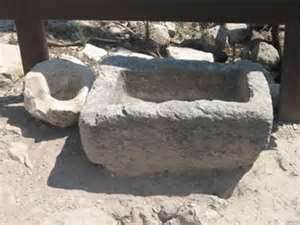
    During our Advent Bible Study, a few people were surprised when we saw an image that looked a lot like this one.  It is a feeding trough, a manger, from the part of the world where Jesus lived.  For many of us who grew up in northern woodlands, this is not at all what we have been taught or expect.  For most of our lives we have grown up with the idea that the manger in which Mary and Joseph placed the baby Jesus was a wooden thing made with boards nailed into an ‘X’ on each end and this doesn’t quite seem right.  For us, a people who are accustomed to being surrounded by trees, building things from stone seems unnecessarily difficult.  Where we live, trees grow wild and we have to mow, trim, cut and work to keep them from growing where we don’t want them.  Israel (and all of the Near East) is a different place.  Take a look at the pictures and videos that are available, look at the pictures you can find in books about Israel.  You will likely notice that in much of the country, trees are not common and often, where they are more common, they are tended and cultivated as food producing crops, not as building materials.  In that part of the world, stone is a much more common building material… for many things.  Stone is used not because it is easier or cheaper (it isn’t) but because it’s what they have.
    I saw this image a year or two ago and I have had conversations about Near Eastern building materials before so this didn’t really surprise me.  What struck me however came later when I opened this month’s issue of Biblical Archaeology Review and read an article on the Tomb of Pharaoh’s Daughter in Jerusalem.  There, included in the article, were photographs of stone sarcophaguses (sarcophagi?) found in and near Jerusalem.  I could not get copies of these pictures but they are similar to this one.

    Before the front wall of this was broken out, it would have looked strikingly like a stone manger.
An argument could be made that tombs that contain this sort of sarcophagus were built only for the rich and powerful of Israel’s elite.  Jesus would never have been buried in such a tomb… and yet… far more common in that time, even for middle class and poorer folks were burials in stone ossuaries, bone boxes, in which the remains of a buried person were re-buried. 

Jesus came to earth to sacrifice his life and die on the cross for our sins.   
Was his death and burial foreshadowed by the manger in which he slept on the day of his birth, or was it an accident? 
 Either way, it makes you think.

Christmas in January

    In my neighborhood I see it, they’re talking about it after church, a lot of my Facebook friends and even some of my extended family is doing it.  They’re all taking down their Christmas decorations.  Okay maybe this isn’t news to most of you, but I’m planning on leaving ours up for a while longer.   The reason? 
Christmas isn’t over yet.
    I know that the calendar says that Christmas was on December 25th and I know that there are a lot of people who start hauling the Christmas tree to the curb on December 26th, but I’m not one of them.
    There are several reasons.  First, it suits my natural tendency to procrastinate but second, since it takes me a while to get into the Christmas spirit, I like to leave our decorations up and enjoy them while I can.  Third, it’s the way things were always done in our house when I grew up.  You see, not everyone celebrates Christmas in December.  Sure our church did, and in fact all of the churches in the Protestant and Catholic traditions do, but that isn’t everybody in our big Christian family.  Many of us forget that those Christians who are connected to the Eastern Orthodox tradition (Serbian Orthodox, Russian Orthodox, etc.) celebrate Christmas, not in December but closer to the time that the rest of us celebrate Epiphany.  The Eastern churches follow the old Gregorian calendar for their holidays and not the newer Julian calendar that was adopted by most of us in the early 20th century.  As a result, Christmas falls not on December 25th but on January 7th.
    So why do I, a Methodist, a profoundly Protestant guy, observe a tradition of a church to which I have no apparent connection?  Because our family is still connected.  When I was growing up our family lived in East Akron on Brittain Road.  On one side our neighbors were the Gryvnak’s and on the other, the Sasenicki’s (I can’t find them in the phone book, but this is our family’s best guess at spelling forty years later).  Both families were Russian Orthodox and while we would go next door and sing Christmas carols in December, they would come to our house and sing carols in January.  As a token of friendship and neighborliness, our family began to leave our decorations up until holiday celebrations were over for all of us.  While these folks haven’t been my neighbors in the last eleven dorms, apartments and houses I’ve lived in over the last few decades, the tradition (or habit) of leaving our decorations up has persisted.  I guess for me it has become a way to remember my childhood but also a way to remember that as followers of Jesus, we are not all that there is. 
As brothers and sisters of Jesus Christ, our family is bigger than just the name on the front of the church. 
    Leaving our decorations up a little longer is a simple way for us to remember that we’re all connected and it’s also a way to be good neighbors to our brothers and sisters who do things a little differently than the rest of us.