An Accidental Ministry: Passing 50,000


    Last month, Scribd, the webpage where I post sermons online, indicated that I had surpassed 50,000 ‘reads’ on the 187 documents that I have posted.  One sermon a week, times about 50 weeks each year (I do take time off once in a while) and we can see that I have been posting there for a little less than four years.  In fact, as I dig back through the records, I find that the first file was uploaded in September 2009.  Since then, people from around the world have found their way, by a variety of means, often through Google or other search engines, to read the words that I have written.  And it was all an accident.

    Ten years ago when I first began in ministry, I was more of an engineer than a pastor.  I knew that I could not simply open a Bible and preach without notes, or even preach from a stack of 3×5 cards.  If I was going to talk for 20 minutes and sound even remotely coherent, I knew that I would have to prepare better than that.  And so, each week, I would type my entire sermon, word for word, and then, on Sunday, deliver it from the pulpit.  I had enough experience in High School Theater and in other dramatic productions that I don’t think I ever just stood there and read to people in a monotone voice, although there have been a few folks who accused of something close to that.  I’m sure I could have done better with more training and experience, which is what happened (I hope) over my years as a student pastor, a seminary student and as a full-time pastor.
    After some time had passed, someone suggested that since the sermon was already typed up, that we could make copies and provide them outside the sanctuary for those who had missed the previous week.  From there this thing grew.  People started asking for copies to take to our shut-ins, and then email copies to college students and others, and then, finally, a friend suggested that we might launch a discussion forum on Facebook for folks to ask questions.  When we launched the discussion forum (which never really caught on) we needed a place to post copies of the sermons online and so I searched the Internet for a service that was similar to YouTube, but for text instead of video.  That is how I found Scribd.com. 
    On Scribd, I discovered an online community of readers and writers.  There, people could subscribe to what I was writing, and I could subscribe to theirs.  I had intended to create a place for the people of our community to read and discuss the weekly message but, within weeks discovered that I had subscribers from China to Africa to Pakistan.  There were people who were reading the sermon of a little country church in Ohio because there was no local church near them that spoke English, or because the message of Jesus Christ was considered subversive in the places that they lived.  Now, nearly four years later, nearly 60 people read one of these messages every day.
    I have no illusions that each of those 50,000 mouse-clicks means someone read all the way through something, but I continue to be amazed and humbled by what God is doing with the words that he has given to me. 
    I have never believed that people were reading these things because I was a great writer, nor do I think that Billy Graham or Bill Hybels have need to fear from my speaking ability.  Every time I look at these numbers I remember God’s words in Isaiah 55:10-11:
 As the rain and the snow
    come down from heaven,
and do not return to it
    without watering the earth
and making it bud and flourish,
    so that it yields seed for the sower and bread for the eater,
11 so is my word that goes out from my mouth:
    It will not return to me empty,
but will accomplish what I desire
    and achieve the purpose for which I sent it.
And Paul’s words in 2 Corinthians 12:9:
But he said to me, “My grace is sufficient for you, for my power is made perfect in weakness.” Therefore I will boast all the more gladly about my weaknesses, so that Christ’s power may rest on me.
God took my weaknesses and is using them to reveal his message to the world.   
I am simply amazed and humbled at what he is doing.

Top Ten 2011 Blog Posts


    I know I’m a year late, but as I began to assemble the top ten blog posts of 2012, I realized that there were a few from 2011 that still had value and might well be worth a second look.  Here they are, more or less in order of popularity.
1) God Will Destroy the Fat Cats – November 29, 2011 – A Blog about God’s desire to destroy the rich, well, not really… but sort of.
2) Laws of Man and God – Are guns evil? Part 1 – February 9, 2011 – Part 1 of 4 – The first in a series that I wrote after the shooting of Gabriel Giffords.  Not really pro-gun or anti gun, just asking a lot of questions and thinking out loud.    The first two installments made the year’s top ten, but while part 3 was moderately popular, almost no one made it to part 4.  My lesson?  Even broken into pieces, this was just too long.
3) Happy Birthday Mr. Shea! – February 2, 2011 – A tribute to George Beverly Shea           on his 102nd birthday.  
4) Laws of Man and God – Are guns evil? Part 2– February 10, 2011 – Part 2 of 4
5) Living Together, No Harm No Foul? – April 27, 2011 – Is living together normal, healthy, moral and responsible?  I’m sure you can find lots of people who think it’s a good idea, but, well, no. 
6) Seeing God in the World Around You – March 25, 2011 – A man I never met, weeps during my talk, wondering how I knew so much about his life.  I didn’t.  But God did.
7) 20/20 Blindness – March 31, 2011 – A blind man is thrown out of a restaurant because of his guide dog.  Apparently, humans are just as blind today as the Pharisees that Jesus knew.            
8) Christmas in January – January 4, 2011- I explain why our family still leaves our Christmas decorations us until the first week in January.  Not everyone celebrates Christmas on December 25th you know.
9) Too Busy for God? – May 25, 2011 – Do you plans for the summer, or for the New Year, include church.  If church is important to you, don’t allow it to happen by accident.

    In reality, there was a three or four way tie for tenth place.  Instead of picking one of those, or using all of them, I jump to the blog that comes after the tie because, even though it was read less often, it had more comments than any other blog of the year.  That’s worth something mentioning, I think.

10) A New Digital Divide – Who wins, who loses? – January 19, 2011 – As we become an increasingly technological society, we cannot allow ourselves to forget the people who are being left behind.
Honorable Mention) The Nightmare of Democracy? – February 14, 2011 – I include this, a blog that was written at the very beginning of what we now call the Arab Spring.  In it, I worried that the revolution in Egypt might not be such a great thing.  In the two years since, attacks on Coptic Christians and on the Coptic Church have increased and the government has shown little interest in preventing it.  Events are still unfolding in the Middle East and as they do, out brothers and sisters in Christ will continue to be in need of our prayers.

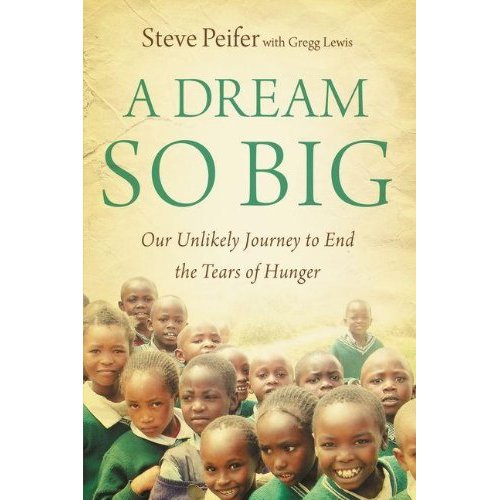
A Dream So Big


    My wife, Patti, and another member of our church first met Steve Peifer during a trip to visit Keith and Jamie Weaver, missionaries sent by our church to the people of Kenya.  There, Patti met Steve and worked with this beautiful wife Nancy in the library at Rift Valley Academy.  I first met Steve at my home church when we invited him to come and tell us about his efforts to feed hungry school children that he describes in A Dream So Big.  Since then Patti and I have answered a call to pastoral ministry and have not only followed Steve’s adventures through his regular emails, but have, on several occasions, invited him to speak in the churches where we were serving.  I don’t think that his story has ever failed to astound his listeners. 

     
    Steve is an average, middle class guy whose life was turned upside down and who, through no particular plan of his own, ended up in Kenya, Africa seeing things that most of us cannot imagine, and doing things that we would be afraid to do.  Throughout this story, Steve insists that he is not an amazing man, just a man through whom, God is doing amazing things. 
 
    In A Dream So Big, we meet Steve, Nancy, and their family before the adventure began, at home, in Texas.  We walk with them through one of the most difficult times that a parent can imagine, the loss of their child, Steven, and then follow them as they head to Africa.  At first, their African adventure is intended to be just a year away to sort things out and to process the pain and the trauma of losing a child, a time for their family to be together and to heal.  But, as Steve often points out, Africa changes a person.  After a year in Kenya, the Peifers feel called, if not compelled, to return on a more permanent basis, and it is then that the real adventure begins.  
    Not content to see children lying in the dirt at school because they are weak from hunger, Steve sets out to change the world, or at least his little corner of it.  Steve asks, and with the help of his friends and supporters in the United States, begins to provide lunches for two schools nearby.  Two schools become four, and then ten, and by the end of the book become a truly extraordinary number.  Providing food not only allows the children to be free from hunger, but gives them the strength to get an education and an incentive to stay in school.  Even with these successes, Steve is not content.  Building on the feeding program, Steve and his friends begin to build solar powered computer centers.
    Just because I said the word computer, do not be tempted to think that this is just another story about wealthy, white Americans swooping in to “rescue” Africa.  Those stories are old and they often are the picture of “Ugly Americans” with all the cultural insensitivity that you might expect.  That is not Steve’s story.  Steve builds a program in which the villages take ownership of their schools and their computer centers.  The parents know that when these children finish school and head into the city to find work, as most of them do, that they will find good paying, skilled jobs instead of living in the slums fighting with untold thousands of others for a handful of unskilled jobs.  The school children, their parents, and many others have seen Steve’s vision, and it is a vision that can break the back of poverty in Africa.  It is a vision that can change the world.
    I highly recommend A Dream So Big.  As you follow Steve, Nancy and their family on this amazing adventure, you will laugh out loud at the ridiculous situations in which Steve finds himself.  But you will also weep at the poverty and hopelessness that he sees all around him.  A Dream So Big invites you, not only to follow along, but to be a part of this incredible adventure.  I have no doubt that Steve Peifer is changing the world, one child at a time.  When you read this book, you will discover that you can too.
Steve’s book, A Dream So Big will be released next week and can be found on Amazon here: A Dream So Big.

Christians are Wrong; Atheists are Right

    This week, in the span of twenty four hours, I received two invitations; one from an Atheist friend, and a second from a good Christian friend.  The atheist invitation was for International Blasphemy Rights Day (held on September 30th of each year) which “is a day to promote the rights to freedom of belief and expression and stand up in a show of solidarity for the liberty to challenge reigning religious beliefs without fear of murder, litigation, or reprisal.”  The Christian invitation was to sign a petition to force Youtube to stop a video that was blasphemous to the name of Jesus Christ. 

Wow.  

    It isn’t often that this sort of thing drops into my lap.  What’s more rare, is a situation in which I agree so strongly  with the atheists and so clearly disagree with the (well-intentioned) Christians.  To me, the atheists ‘get it’ and these particular Christians just don’t (however well-intentioned) particularly in light of recent events in Egypt, Libya and elsewhere in the Middle East.

   
    The United States is an amazing place.  Our Constitution guarantees freedom of religion and freedom of speech like nowhere else in the world and that gives us, as Christians, an unprecedented opportunity to compete in the arena of ideas.  I believe, as the Apostle Paul did, that Christianity is absolutely able to stand on its own in any such competition if it is given the ability to speak clearly.  Our freedom allows us to do exactly that.  My atheist friends may disagree with me on matters of faith but they understand that this same freedom allows them to disbelieve without fear of punishment or reprisal, whether from Christians, or Muslims, or anyone else.  My Christian friends want someone to protect Jesus from being defamed when, I believe, Jesus doesn’t need protecting.  First of all, Jesus is completely able to defend himself if he chooses to do so and second, Jesus chose not to defend himself when his accusers defamed him face to face.
  
    In recent days the entire Middle East has been in an uproar over a video produced by an American and released on YouTube.  In it, the Muslin prophet, Mohammad, is presented in a negative light.  This, the Islamists claim, is blasphemous.  They demand that YouTube remove the video, that the United States government require that the video be removed from the Internet and pass blasphemy laws preventing such things from happening in the future (sound familiar?).  Free speech on the other hand requires that none of this happen.  Free speech allows any of us to say things, to present a range of ideas, even offensive ones, without fear of punishment or reprisals.  If the government were to prohibit us from blaspheming Jesus, then why not do the same for Mohammad? 

    Already our friends in Canada have passed hate speech laws that make it illegal for Christian pastors to preach what the Bible says about homosexuality (even if preached compassionately and not being deliberately inflammatory)  but that same speech, unpopular or not, is still legal in the United States.  If free speech is constrained to protect Christians today, it may very well be used to harm us tomorrow.  I don’t like it when people burn flags, but I believe that it is a protected form of free speech that I am willing to protect.  I don’t like it when the KKK or other hateful groups march and spout their venom from the public square, but it too is an important example of free speech.  Just because I don’t like it isn’t a good reason to make it stop.  After all, I have things to say that other people don’t like very much and I wouldn’t want someone to decide that my speech was no longer legal.

 In this case, I think the Christians are wrong and the atheists are right.
 
Jesus is not threatened by the people who oppose him.  Christianity doesn’t need the law to protect us from blasphemy.  Jesus is more than able to compete in the arena of ideas.
The atheists are right. 
Free speech is far more valuable…
                                                           …for all of us.

Is It Time to End Spousal Benefits?

    This week there was yet another blow-up about spousal benefits for domestic partners.  Specifically, sparked by the recent death of astronaut Sally Ride, many have been talking about the unfairness of how, even though they were together for 27 years her partner will receive no benefits whatsoever because they weren’t a “family” in the way that our society (and her employers) have defined it.  Look at this idea of family, or birth family, as we currently define it, and the benefits that we receive from our employers and, later, from the government.  
    Many will frame this as a homosexual issue, but it is not.  It is a fairness issue that just happens to affect homosexual partners as well as many others who do not “fit” the current definitions of “family.”  In my opening, I deliberately chose the words “domestic partners” because there are many in our society that share their lives but cannot claim possession of benefits that should, rightly, belong to them.  Obviously, this affects the lifelong partner of Sally Ride and others like her but it also affects heterosexuals. 
    Before I was married, I shared a house with my brother.  At the time we lived together, my brother had a good job but he has been unemployed (and as far as I know, without insurance) for three years.  He is, by birth, a member of my family.  But if we were two bachelors with no other family in the world, neither our health benefits nor our pensions, nor our Social Security benefits in retirement would allow us to care for one another.
    When my wife and I were first married, we moved in with our Aunt Gladys and we lived there for a couple years until we could afford to buy our own home.  Years later, Aunt Gladys came down with a serious and life threatening illness.  Thankfully, Aunt Gladys has good insurance, but what if she didn’t?  We owe her a lot and over the years she’s been good to us, but none of our benefits could be extended to her, ever.  
    What about unmarried, retired couples?  Both are retired.  Both have lost a spouse.  Both receive a pension from a deceased spouse as well as Social Security benefits.  Both would lose so many benefits from legally marrying that they would be destitute.  I have heard serious discussions among pastors about performing church weddings without any legal paperwork so that couples like this can be married in the eyes of God and in the eyes of the church regardless of the opinion of the state regarding the legality of their marriage.
    The problem that we are having with benefits is a fairnessproblem and an ownership problem not simply a homosexual problem.  Homosexuals are clearly caught up in this, but even an official or legal recognition of homosexual relationships would only fix a part of the problem.  Regardless of our sexual orientation, we need to reassess who “owns” our employee and government based benefits.  Perhaps the idea, as old as it is, of ‘spousal’ or even ‘family’ benefits needs to be redefined to better reflect the way that we live today.  The era of the nuclear family, where three (or more) generations live together as a family unit and care for one another is long past.  Perhaps pension and retirement benefits should be redesigned so that they are more like an IRA, where your employer (and government) makes deposits into an account in your name and the funds in that account belong to you and to your heirs, whomever they may be.  Perhaps health benefits should just eliminate the idea of spousal benefits entirely and instead just allow you to list persons that ‘belong’ to your ‘family.’  I know there would have to be some practical limit, but if employers will cover a family with twenty biological children, surely there is a viable solution somewhere.
 
What do you think?

What’s the Big Deal About Sex?


    Early this month a group of Secret Service Agents as well as military personnel (presumably male), were in Columbia as a part of President Barack Obama’s trip there for a multinational conference.  As most of us have seen in the news, these individuals had a grand time partying with prostitutes after hours prior to the President’s arrival.  Once they returned home, this exploded into a scandal of epic proportions.  But so what?  From the perspective of faith and the church, I could easily make a list of why this was not a good thing for these men to do, but I really wonder if Congress’ shock at the behavior of the Secret Service is only for show during an election year.  After all, what’s the big deal about sex?  Here are a few questions that are being raised:
    Whose money did they spend?  Congressman Peter King wants to know if the money these men spent was taxpayer per diem.  So what if it was?  Per Diem (literally, per day) is money paid to persons who are on special duty or special assignment.  It is, simply, a paycheck.  If these men were paid per diem, it is because they were working on a job where they earned it.  If Congressman King believes that we the people have a right to control how someone spends a government paycheck then he is going to have an awful lot his fellow representatives looking over their collective shoulders.
    They work for the government.  So what?  They were not ‘at work,’ it was after hours, they were on their own time.  How often have we heard that what we do on our personal time is nobody’s business?
    It’s illegal.  No it isn’t.  Prostitution might be illegal in most places here in the United States, but it isn’t in Columbia.  Besides the financial transaction, this was simply an arrangement between consenting adults.
    It’s immoral.  What?  We in the church have been told loudly and often that we shouldn’t force our moral values on others.  In our modern culture, we are told, it is perfectly acceptable and normal for adults to determine their own morality.  In that environment, who should judge whether the behavior of these men is immoral or not?  Besides, in recent decades Congress seems to have made a hobby of turning a blind eye to the moral and sexual indiscretions of their peers.  Judge not, lest ye be judged, right?
    What these men did certainly violates many of the teaching of Christianity but with increasing regularity we are reminded that the United States is increasingly multi-cultural, multi-religious and increasingly non-religious.  Even the President said “Whatever we once were, we are no longer just a Christian nation; we are also a Jewish nation, a Muslim nation, a Buddhist nation, a Hindu nation, and a nation of nonbelievers.” (Barack Obama, June 28, 2006)  And so again I ask, so what?
    Certainly I realize that there are national security concerns that come with allowing our Secret Service personnel to cavort with prostitutes but historically, one major concern was that such behavior would result in blackmail.  In this era of new morality, why is that a concern either?  If these men are free to dictate their own morality and what they were doing was perfectly legal, then what leverage remains for blackmail?
    I don’t doubt that there were rules in place both by the Secret Service and by the military and I don’t doubt that rules were broken.  But if we, as an enlightened and liberated society, have refused to legislate morality and if we have cast off the bonds of propriety, allowing morals to be defined by every individual, then all that we have left to guide us are rules, and frankly, rules aren’t much to count on as the underpinning of an entire society.
    I want to be clear, I don’t agree with what these men did.  What they did was both wrong and stupid, but I say these things to make a point.  It may indeed be true that we are no longer a Christian nation, but once we have cast off the lines that tie our culture to a fixed and immovable standard of decency and morality, the coastline can get pretty fuzzy.

Women in Ministry

Most likely, anyone reading this knows that the United Methodist Church (and many others) not only allows women to teach in church but also to be ordained as pastors and bishops.  I have had many wonderful conversations about this subject with friends and colleagues from other denominations over the years but I have also been asked questions by folks from our own denomination and even from my own congregation.  Today I found this neat 7 minute video by Dr. Ben Witherington III, who is a leading New Testament scholar and United Methodist.  In this video from Asbury Seminary, Dr. Witherington sorts through much of the reasoning and theology without forcing you to resort to an hour-long lecture or to read a lot of books or attend a theology class.  There is enough information here to satisfy most casual questions but also enough meat to keep you looking things up for a while if you are so inclined.

..

God Will Destroy the Fat Cats – A word about the Occupy Wall Street movement

    As I prepare sermons each week, I download and read the scriptures called out in the Common Lectionary, a three year plan that walks us through most major teachings in the Bible.  I don’t always use every selection but as I was reading these scriptures recently I was struck by a passage in Ezekiel that would, on the surface, seem to be a rallying place for the Occupy Wall Street movement and I was, frankly, surprised that it had not already been used to proclaim that GOD WILL DESTROY THE FAT CATS’.  On the surface, this  seems to be the message but that didn’t seem quite right, and it bothered me.  Before we go any farther, here is Ezekiel 34:16 (NIV)

 I will search for the lost and bring back the strays. I will bind up the injured and strengthen the weak, but the sleek and the strong I will destroy. I will shepherd the flock with justice.
    God says that he will bind up the injured and strengthen the weak but he will destroy the strong and the sleek. Many translations declare that God will destroy the strong and the fat.  That certainly sounds like a condemnation of the Wall Street bankers, politicians in Washington, and most other ‘fat cats’ but, as I noted earlier, something about that bothered me and it didn’t take too long to figure out why.  The Bible is full of sheep/shepherd imagery. God, kings and church leaders are often compared to shepherds and the people of God are likened to sheep under God’s care.  This imagery is common because it was (and still is) a good picture of how we relate to God and most people who read the story understand how sheep (and shepherds) act.  The problem that I have with this particular passage is that destroying strong sheep and fat sheep is not what shepherds would normally do.  Most responsible shepherds want strong sheep and fat sheep.  Breeding for these characteristics improves the flock as a whole and makes it both stronger and more valuable.  It would be irresponsible for any shepherd to destroy his best breeding stock, so what is it that Ezekiel is trying to tell us?
    As is often the case, the key to interpreting this is found not simply in reading to find what seems to agree with your cause, but in reading more of the passage to put things in context.  Knowing the analogy, that a good and wise shepherd would not normally destroy his best breeding stock is a good start and ignites our curiosity to look deeper.  If we keep reading from Ezekiel we discover these verses as well:
18 Is it not enough for you to feed on the good pasture? Must you also trample the rest of your pasture with your feet? Is it not enough for you to drink clear water? Must you also muddy the rest with your feet? 19Must my flock feed on what you have trampled and drink what you have muddied with your feet?
And this:
See, I myself will judge between the fat sheep and the lean sheep. 21 Because you shove with flank and shoulder, butting all the weak sheep with your horns until you have driven them away, 22 I will save my flock, and they will no longer be plundered. I will judge between one sheep and another. 
    If we read what comes prior to verse 16, we discover that the entire section is a condemnation upon the leaders of God’s people, the shepherds who have neglected their duty to God and have scattered the sheep.  It is these fat sheep that God condemns.  Unlike some in the Occupy movement, God does not declare that wealth equates with evil, that all rick and powerful people are bad, or that they should be destroyed.  God’s proclamation is that wealth and power are given along with a responsibility to care for those that have been entrusted to you.  God condemns Israel’s leaders because they have not brought back the strays or searched for the lost and they have ruled harshly and brutally while enriching themselves.
Simply put, the strong and the fat are not condemned because they are strong and fat, but because they used their strength to abuse the weak instead of using it to care for them.  

    In my ministry I have had the good fortune to meet several people who have significant wealth, but many of them are also kind, compassionate and generous followers of Jesus Christ who treat their employees well and who use their wealth to care for others as well as the church.  In these words of Ezekiel we do not find a broad condemnation of everyone with wealth and power, but only those who do not use what they have been given in a responsible way.  This is not a condemnation of wealth and power, but a caution to all of us who lead others, whether as pastors, doctors, lawyers, employers, shop foremen, teachers, committee chairpersons or any other position of responsibility. God does not intend to destroy the ‘fat cats’ but he will do whatever he needs to do to protect his flock.  

    All of God’s people are expected to heal the sick, strengthen the weak, bind the wounds of the injured, clothe the naked, feed the hungry, and to lead with tenderness and compassion.  If we fail to do that, then we are in serious trouble regardless of our relative wealth or power.

Are You Afraid?

Are you afraid?   
    Every day we open the newspaper or we turn on the radio or the television and we hear bad news.  Our economy is not in great shape.  Our government is spending more than it can afford.  Unemployment is at near historic levels and showing no sign of getting better soon.  We hear reports of doom and gloom almost constantly. 
How has this constant barrage of bad news affected you?
    As I have been reading reports from churches and other charities across the country the reports seem to share a common thread.  Fear.  After listening to the constant cries of disaster and doom people begin to grow afraid for their future.  When people are afraid, they begin to act in ways that reflect their fear.  When we are afraid, we become far more conservative financially, our worries for the future cause us to spend less, pay down credit cards and even save a little more in the bank.  When we are afraid, sometimes without even being consciously aware of it, we pull back and prepare for a rainy day; we are, as a society, waiting for the other shoe to drop.  This mentality is widespread.  The stock markets react violently to even the tiniest piece of bad news and only hesitantly move forward when there is good news.  Retail sales and other measures of consumer spending are not especially good at least partially because people are not confident of how things will be next month, or next year.  People are afraid.
The funny thing is that most of us have no real reason to be afraid.  
    Most of us have the same jobs that we had last year and the year before that.  Many of us have continued to get the same sorts of raises that we have always gotten.  Except for what we seem to be spending on gasoline, our expenses are not significantly changed from what we have been accustomed to for a long time.  Obviously there are exceptions.  One of my brothers has been out of work for more than two years and he is not alone.  Many folks are hurting.  The rest of us however, are living pretty much the same lives that we were living before the recession began several years ago.  For us, our fear has little or no basis in reality.  We are afraid, only because the evening news seems to tell us that we should be and something about that is not right.  

Why should we act as if we are afraid if we have no real reason to actually be afraid?

    As Christians we have another, even better, reason to resist this kind of fear.  Our fear seems to come from our worries about what the President or the Congress will or will not do.  Our fear seems to come from our worries about the economy and other things far outside out control or understanding.  Instead of allowing these worrisome times to make us afraid, we should remember who is in control.  Psalm 20:7 reminds us that “Some trust in chariots and some in horses, but we trust in the name of the LORD our God.”  And if we even momentarily considered putting our trust in our bank accounts or in our government, Job is there to remind us that “What they trust in is fragile what they rely on is a spider’s web.  They lean on the web, but it gives way; they cling to it, but it does not hold.”  Nahum 1:7 tells us that “The LORD is good, a refuge in times of trouble. He cares for those who trust in him.”  Just because we are people of faith, does not mean that we are immune to fear, but the when fear springs up inside of us we remember this: “When I am afraid, I put my trust in you.  In God, whose word I praise, in God I trust and am not afraid.  What can mere mortals do to me?” (Psalm 56:3-4)
    As followers of Jesus Christ we are called to put our trust in him and not in the fluctuations of economies and governments that we cannot control.  All of these things are under his command and it is our job to trust in him.  Daniel was literally thrown to the lions but we should remember that “when Daniel was lifted from the den, no wound was found on him, because he had trusted in his God.” (Daniel 6:23) 
    We hear bad news every day and honestly, I have begun to listen to the news less often because of it.  I am not hiding from the truth, but I don’t need to be constantly beaten with it either.  I hope that you will remember that we have no need to fear.  Whenever we are tempted to be afraid, we need to ask ourselves a single important question…
Who do you trust?

September 11, 2001 – 10 years later

Help us overcome, Lord, this evil which has descended
Help us understand, Lord, why so many lives too soon have ended

Help us heal, Lord, as we recover from the pain
Help us cope, Lord, show us sunshine after the rain

We put our trust in you, Lord, as you watch us from on high
Help us grieve, Lord, and hold us while we cry

Written by Jim Lane
Fair Oaks, CA , September 2001

This morning in church we remembered.  Many in our congregation could remember exactly where they were and what they were doing on the day that Pearl Harbor was attacked and the same applies to the days that John F. Kennedy was assassinated, Ronald Reagan was shot, and Challenger exploded.  Likewise we remember where we were ten years ago today during the events of September 11, 2001.  Although  we will likely never forget, I pray that God will continue to bring healing to all those who were wounded both physically, mentally and spiritually.  Similarly, I pray that we will learn the right lessons of September 11th.  There are many messages but I pray that we hear the messages taught to us in scripture, messages of love, forgiveness, healing and hope and not the messages that we sometimes hear that play to our baser instincts to hate, destroy and seek revenge and retribution.

This morning’s worship service began by reading together from the Psalms and remembering that we find strength in God’s tower and not in towers of our own making.  The opening prayer was the one I have included above.  It was written by a fellow rocketry hobbyist and an online friend, Jim Lane in 2001 after the events of September 11th.  It sums up many of the feelings that we had then and feelings that have resurfaced this week as we remember.  I include it here with his kind permission.  Thank you Jim.

My message this morning was a story of remembrance but also a reminder that the thing that makes followers of Jesus Christ different is our calling to love and forgive our enemies.  This is not an easy thing, in fact, it may well be one of the hardest things that we can do but Jesus tells us that our own forgiveness depends upon it.

Sunday’s message, September 11, 2011 – a service of remembrance and reminder.