Making Your World Bigger: A Challenge

Making Your World Bigger

January 2025

by John Partridge


Several times this past year, I was reminded of one of my favorite quotes. In his book, The Innocents Abroad, Mark Twain once said,

“Travel is fatal to prejudice, bigotry, and narrow-mindedness, and many of our people need it sorely on these accounts. Broad, wholesome, charitable views of men and things cannot be acquired by vegetating in one little corner of the earth all one’s lifetime.”

Despite not traveling anywhere notable this year, I was reminded of this on several occasions when I heard, or read, people self-righteously offering opinions about people they had never met or places that they had never visited. But whenever that happens, I remember a trip that I took to Honduras, courtesy of the United States Army. At the time, I was in my early twenties and still in college, or maybe just barely out of college. And, while we didn’t interact much with the local population, that trip forever changed my views on poverty, the third world, and world missions.

Reading about the poor is one thing. But watching a family of five being fed on one soldier’s uneaten lunch is a different experience entirely. It was common for children to approach us and beg for handouts, but the order of their requests was almost always the same. First, they would beg for food, second for candy, and third for pencils. The first two made sense, but we were puzzled by the third until we asked the civil affairs guys that arrived shortly before our departure. They explained that the government schools provided teachers but not school supplies. And as such, many children could not go to school because their families could not afford luxuries… like pencils.

Again, while I didn’t do any traveling, I felt similar emotions this year when I heard some of the opinions expressed about immigrants and immigration, the poor, the homeless, and others about whom political commentators, and internet bloggers like to pontificate. Of course, it’s okay for people to disagree, but often in these sorts of things, while the speakers and writers have lots of opinions, few of them have any actual experience with the people they are talking about.

And so, with these things in mind, I want to offer a challenge for the new year. I’ve never really liked the concept of making resolutions and since so few people keep their resolutions, please don’t think that this is what I am suggesting. Instead, in the spirit of Mark Twain, I encourage you to make your world bigger. I want you to challenge your opinions and preconceived notions about the people around you.

Instead of simply assuming things about the people around you, I encourage you to commit time (do not just resolve) weekly or monthly, to meeting, interacting, and helping those people. Rather than assuming that the poor and the homeless are in that situation because they are lazy, I encourage you to volunteer at a food pantry, at our bread ministry, Tuesday dinner, at the Clothed in Righteousness ministry outreach on Main Street, or someplace similar. Again, don’t just show up once for an hour to make yourself feel good, but commit to being there often enough to build relationships with the people there, learn about them, and hear their stories.

Instead of believing some of the nonsense that is spewed on television and the internet about immigrants and immigration, commit to volunteering weekly, or monthly, with ministries or agencies that work with immigrants. Again, spend enough time there to build relationships, make friends, and know them as people rather than as the caricatures that are often depicted in the media.

Of course, my invitation isn’t exclusive to these few examples. It could apply to any number of other groups of people from Scouting America (formerly the Boy Scouts) to university students and many others. You could take the time to visit our friends at Red Bird mission in the Kentucky mountains and meet some of our friends there, or travel with a group from our East Ohio Conference to Liberia, or Mexico, or any one of our other overseas missions.

While Mark Twain’s quote about travel is one of my favorites, I think that a part of it is wrong.  Yes, I believe that travel can be fatal to prejudice, bigotry, and narrow-mindedness, but not by itself. I know too many people who are prejudiced, bigoted, and narrow minded despite having traveled extensively. The key is not just the act of traveling; it is in having conversations and building relationships during your travels. The change inside of yourself occurs when you can no longer refer to Africans, or the poor, the homeless, immigrants, or any other group of people without thinking about the names and faces of the friends that you have made.   

And that is why my challenge for 2025 is to get out of your comfort zone and commit to spending an hour a week, or even just an hour a month, volunteering and being present with people that you might have previously thought of only as a group. This is a challenge to confront your biases, or just to get out of the house and expand your horizons. Because whenever you spend enough time with people to build relationships…

that is when your world gets bigger.


Please LIKE and SHARE!

Click here to subscribe to Pastor John’s blog.

Click here if you would like to subscribe to Pastor John’s weekly messages.

Click here to visit Pastor John’s YouTube channel.


*You have been reading a message presented at Christ United Methodist Church on the date noted at the top of the first page.  Rev. John Partridge is the pastor at Christ UMC in Alliance, Ohio.  Duplication of this message is a part of our Media ministry, if you have received a blessing in this way, we would love to hear from you.  Letters and donations in support of the Media ministry or any of our other projects may be sent to Christ United Methodist Church, 470 East Broadway Street, Alliance, Ohio 44601.  These messages are available to any interested persons regardless of membership.  You may subscribe to these messages, in print or electronic formats, by writing to the address noted, or by contacting us at secretary@CUMCAlliance.org.  These messages can also be found online at https://pastorpartridge.com .  All Scripture quotations, unless otherwise indicated, are taken from the Holy Bible, New International Version®, NIV®. Copyright ©1973, 1978, 1984, 2011 by Biblica, Inc.™ Used by permission of Zondervan. All rights reserved worldwide. www.zondervan.comThe “NIV” and “New International Version” are trademarks registered in the United States Patent and Trademark Office by Biblica, Inc.™

Six Degrees of Social Media Separation


    In the last few decades, there has been much talk about “Six Degrees of Separation,” which is the idea that any person in the world can be introduced to any other person in the world, by being introduced through our networks of friends.  Statisticians have demonstrated that anyone in the US can be introduced to almost anyone else in the US by going through only two or three friends.  But as often as we hear such things, it is still amazing when it happens “in real life.”
    This week I received a private message on Facebook from a woman I never met.  And that was the beginning (or possibly the end) of an unusual series of connections through my life and through social media.  To understand the connections that led to this message, let me go back in time to high school.
    After my eighth grade year, my parents moved to the south side of Akron, Ohio.  At our new church I met Keith and Jamie Weaver, who would, within the next few years, depart for Kenya, East Africa as missionaries through Africa Inland Missionwhere they would serve for twenty five years.  After I graduated from college and began working in Cleveland, I was back at that same church and reconnected with Keith and Jamie during their occasional visits home. 
    When the time came for them to consider a return to the states, our church realized that no one (other than their children) had ever had the opportunity to visit them in Kenya.  Two women, Sandi, and my wife, Patti, volunteered and along with our missions committee, we decided that we would raise the funds to send them. 
    While Patti and Sandi were in Kenya visiting Keith and Jamie, they met Steve and Nancy Peifer.  Nancy was the librarian at Rift Valley Academy; Steve was the guidance counselor and also ran a feeding program at local Kenyan schools (Kenya Kids Can).
    With that as background, we return to the funeral preparations for my father.  As soon as it was available, I posted his obituary on my Facebook page and many friends, including Steve Peifer, posted their condolences. 
    The next day I had a private message.  The woman who sent that message acknowledged that we had never met. She had seen my name pop up when Steve had written on the link to my father’s obituary and it had seemed familiar.  She followed the link, read the obituary, realized who my father was, printed it, and showed it to her parents.
    What we discovered was that our fathers had sung together in college, he had been the best man in my parent’s wedding and my father had been the best man in theirs.  Our parents had exchanged letters and cards, but over the years had lost touch with one another.  She sent me a current photo of her parents to give to my mother, and I sent a current address so that they could send their condolences and reconnect.  My Mom was a little stunned when I handed her the photo and explained who it was.
    I know that we live in a connected world, but it was still exciting to see old friends reconnect because of two children on the Internet, two missionaries to Africa, an obituary, and social media.

—————————————————————————————————

To receive email updates to the Crossfusion blog, click here.

We *Are* Making a Difference


    I have friends who like to say that the world would be better off without the church.  Today, 2,400,000 Africans would disagree with them.  If it had not been for the United Methodist Church (and her partners) many of those 2.4 million people, most of them children…

…would be dead.
    In 2010, children in sub-Saharan Africa were dying from malaria at a rate of one every 30 seconds.  Today that rate has dropped to one every 60 seconds.  The difference?  Our church’s campaign to eliminate malaria.  In 2008, we had “Nothing but Nets” which partnered with the NBA as well as the Bill and Melinda Gates Foundation.  Then in 2010 this effort became “Imagine No Malaria.”  Imagine No Malaria still has the support of the Gates Foundation but also the World Health Organization, The Global Fund to fight AIDS, Tuberculosis and Malaria, and the United Nations Foundation.  Since 2008, The United Methodist Church has raised $40 million dollars toward our goal of $75 million.  Together, we have distributed 1.2 million insecticide treated bed nets and trained 5400 community health workers to distribute bed nets, train families in their use, and track usage rates.  The results are obvious.  In the last three years we have reduced the childhood death rate (from malaria) by half.
    Why us?  Why is the church important if the NBA, Bill Gates, the UN, and these other big names are already involved?  Is it just because eleven million United Methodists can raise money?  That is undeniably a part of it, but helping the poor has been a part of our United Methodist DNA from the very beginning.  For 200 years we have built and maintained hospitals and schools all across the continent of Africa.  When this project was conceived, everyone knew that while Americans can often be generous, and some are great at publicity, someone had to be the “boots on the ground.”  United Methodists were already there, all across the continent of Africa.  Over two centuries we have built relationships with governments, leaders and decision makers in many of those nations and we established a reputation as being genuinely interested in the welfare of their people, as well as trustworthy.
    Of course, we can’t rest yet.  The job isn’t done.  We haven’t reached our goals and one child every sixty seconds is still way too many.  The goal of Imagine No Malaria is the total elimination and eradication of malaria from the face of the earth.  That’s a long way off, but we’re headed in the right direction.
    I don’t pretend that United Methodists have a monopoly on compassion.  Clearly our story is just one of many.  Imagine No Malaria is just one way, that one church, is making a difference.  And so, to all those who think we would be better off without the church, I say this:
The people of Africa would like to disagree with you…
…because today their children are not dead.

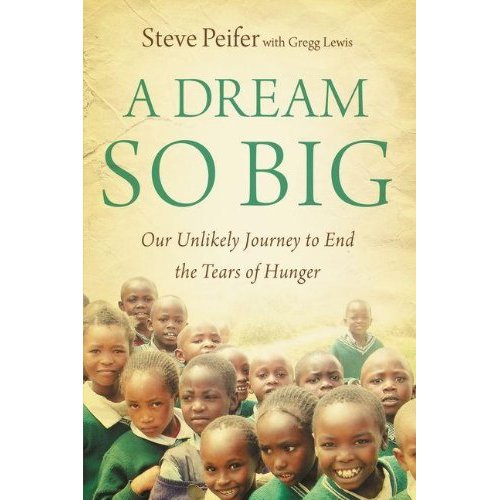
A Dream So Big


    My wife, Patti, and another member of our church first met Steve Peifer during a trip to visit Keith and Jamie Weaver, missionaries sent by our church to the people of Kenya.  There, Patti met Steve and worked with this beautiful wife Nancy in the library at Rift Valley Academy.  I first met Steve at my home church when we invited him to come and tell us about his efforts to feed hungry school children that he describes in A Dream So Big.  Since then Patti and I have answered a call to pastoral ministry and have not only followed Steve’s adventures through his regular emails, but have, on several occasions, invited him to speak in the churches where we were serving.  I don’t think that his story has ever failed to astound his listeners. 

     
    Steve is an average, middle class guy whose life was turned upside down and who, through no particular plan of his own, ended up in Kenya, Africa seeing things that most of us cannot imagine, and doing things that we would be afraid to do.  Throughout this story, Steve insists that he is not an amazing man, just a man through whom, God is doing amazing things. 
 
    In A Dream So Big, we meet Steve, Nancy, and their family before the adventure began, at home, in Texas.  We walk with them through one of the most difficult times that a parent can imagine, the loss of their child, Steven, and then follow them as they head to Africa.  At first, their African adventure is intended to be just a year away to sort things out and to process the pain and the trauma of losing a child, a time for their family to be together and to heal.  But, as Steve often points out, Africa changes a person.  After a year in Kenya, the Peifers feel called, if not compelled, to return on a more permanent basis, and it is then that the real adventure begins.  
    Not content to see children lying in the dirt at school because they are weak from hunger, Steve sets out to change the world, or at least his little corner of it.  Steve asks, and with the help of his friends and supporters in the United States, begins to provide lunches for two schools nearby.  Two schools become four, and then ten, and by the end of the book become a truly extraordinary number.  Providing food not only allows the children to be free from hunger, but gives them the strength to get an education and an incentive to stay in school.  Even with these successes, Steve is not content.  Building on the feeding program, Steve and his friends begin to build solar powered computer centers.
    Just because I said the word computer, do not be tempted to think that this is just another story about wealthy, white Americans swooping in to “rescue” Africa.  Those stories are old and they often are the picture of “Ugly Americans” with all the cultural insensitivity that you might expect.  That is not Steve’s story.  Steve builds a program in which the villages take ownership of their schools and their computer centers.  The parents know that when these children finish school and head into the city to find work, as most of them do, that they will find good paying, skilled jobs instead of living in the slums fighting with untold thousands of others for a handful of unskilled jobs.  The school children, their parents, and many others have seen Steve’s vision, and it is a vision that can break the back of poverty in Africa.  It is a vision that can change the world.
    I highly recommend A Dream So Big.  As you follow Steve, Nancy and their family on this amazing adventure, you will laugh out loud at the ridiculous situations in which Steve finds himself.  But you will also weep at the poverty and hopelessness that he sees all around him.  A Dream So Big invites you, not only to follow along, but to be a part of this incredible adventure.  I have no doubt that Steve Peifer is changing the world, one child at a time.  When you read this book, you will discover that you can too.
Steve’s book, A Dream So Big will be released next week and can be found on Amazon here: A Dream So Big.