
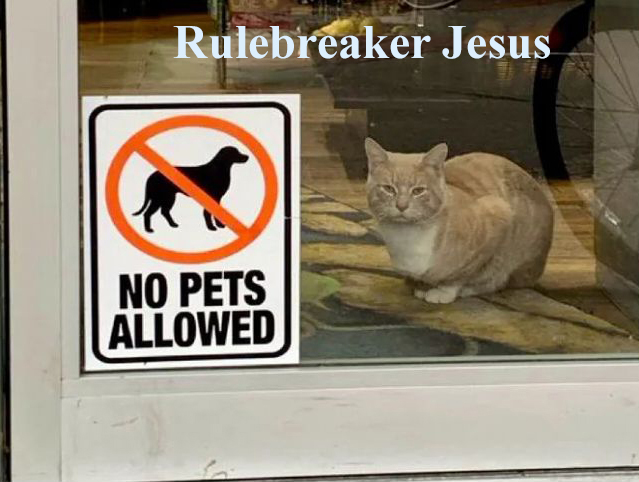
Rulebreaker Jesus

Rulebreaker Jesus

February 25, 2024*

By Pastor John Partridge

Hosea 2:14-20            Mark 2:13-22                         2 Corinthians 3:1-6

What are Christians known for in our communities and in our world today?

In the first through the third centuries, Christians were not popular, and their critics often attacked them for the ways that the Christian community went against the prevailing culture and community standards. Christians (and Jews) were seen as atheists because they did not participate in holy day celebrations at the temples of various gods and goddesses, they were accused of practicing cannibalism for the sharing of communion, they were mocked for their belief in resurrection, for following and worshiping a criminal who had been crucified, and other ways that folks just found to be odd, irregular, unusual, and rude. But as much as Christians were criticized and even persecuted, their critics recognized that there were things for which Christians were known and remembered, and most of those things, at least today, would be thought of as good things.

David Bentley Hart, in his book “The Story of Christianity,” lists the characteristics of Christians that were used by pagan critics to describe early followers of Jesus. Christians were described as sober, gentle, faithful to their spouses without exploitation or abuse, caring for the poor, willing to nurse the gravely ill, even at significant risk to themselves, such as during a time of plague, and the ability to exhibit virtues such as self-control and courage, which were thought to be impossible for anyone who was poor or who was not philosophically trained.

But even though Christianity’s critics may have grudgingly admitted that the movement had some positive points, and even though some of those we listed were presented as ridicule and not praise, Christians were still known, and often rejected, for the ways that their new religion made them break the rules of the culture and of the empire. But that shouldn’t surprise us when the founder of our movement, and the object of our worship, was, from the beginning, a ruler breaker. But before we get to that, let’s begin in the Old Testament book of Hosea in Hosea 2:14-20, where we hear God describing how he will win back a morally wandering Israel, and describe what he desires to provide for his people. God says…

14 “Therefore I am now going to allure her;
    I will lead her into the wilderness
    and speak tenderly to her.
15 There I will give her back her vineyards,
    and will make the Valley of Achor a door of hope.
There she will respond as in the days of her youth,
    as in the day she came up out of Egypt.

16 “In that day,” declares the Lord,
    “you will call me ‘my husband’;
    you will no longer call me ‘my master.’
17 I will remove the names of the Baals from her lips;
    no longer will their names be invoked.
18 In that day I will make a covenant for them
    with the beasts of the field, the birds in the sky
    and the creatures that move along the ground.
Bow and sword and battle
    I will abolish from the land,
    so that all may lie down in safety.
19 I will betroth you to me forever;
    I will betroth you in righteousness and justice,
    in love and compassion.
20 I will betroth you in faithfulness,
    and you will acknowledge the Lord
.

The story of Hosea is one in which Israel goes astray from God in a spectacular way and, through Hosea’s marriage to an unfaithful lady of the evening, God describes Israel as a prostitute who has sold herself for foreign gods. But here, God declares that he is going to win his bride back. God intends to allure her, speak tenderly to her, give her back her vineyards, and give her hope. Once again, Israel will return to God and forget the idols of her past so that God can give her a life of righteousness, justice, compassion, faithfulness, and peace. But those are the things that God has always wanted for his people. The problem has never been with God, it has been with the unfaithfulness of his people. And that is what is at the heart of the rule breaking Jesus that we meet in Mark 2:13-22. When the culture of God’s people, or any culture, values other things more than the things of God, then people of faith are compelled to break the rules. And that’s what we see as Jesus meets the tax collector Levi, who we also know as the disciple Matthew:

13 Once again Jesus went out beside the lake. A large crowd came to him, and he began to teach them. 14 As he walked along, he saw Levi, son of Alphaeus, sitting at the tax collector’s booth. “Follow me,” Jesus told him, and Levi got up and followed him.

15 While Jesus was having dinner at Levi’s house, many tax collectors and sinners were eating with him and his disciples, for there were many who followed him. 16 When the teachers of the law who were Pharisees saw him eating with the sinners and tax collectors, they asked his disciples: “Why does he eat with tax collectors and sinners?”

17 On hearing this, Jesus said to them, “It is not the healthy who need a doctor, but the sick. I have not come to call the righteous, but sinners.”

18 Now John’s disciples and the Pharisees were fasting. Some people came and asked Jesus, “How is it that John’s disciples and the disciples of the Pharisees are fasting, but yours are not?”

19 Jesus answered, “How can the guests of the bridegroom fast while he is with them? They cannot, so long as they have him with them. 20 But the time will come when the bridegroom will be taken from them, and on that day they will fast.

21 “No one sews a patch of unshrunk cloth on an old garment. Otherwise, the new piece will pull away from the old, making the tear worse. 22 And no one pours new wine into old wineskins. Otherwise, the wine will burst the skins, and both the wine and the wineskins will be ruined. No, they pour new wine into new wineskins.”

Jesus, in defiance of custom and propriety, sits down to dinner with a roomful of outsiders and outcasts, people that the religious leaders believe to be contemptable sinners and therefore a contaminating influence on people of good character. Worse, sharing a meal was seen as an intimate act that was only done with family, friends, and people of quality. In addition, Jesus is accused of ignoring a traditional time of fasting when the religious leaders and even the followers of John the Baptist are observing that cultural tradition.

But Jesus responds to the accusations and criticisms of the Pharisees by reminding them that what is appropriate sometimes varies. No one would expect wedding guests to fast regardless of the tradition of the religious leaders and Jesus equates his presence among his disciples as qualifying for the same kind of exemption. The comparison of the wineskins is the same sort of thing. New wineskins, made of sheepskin, can stretch when the new wine in them begins to ferment, but old wineskins have already stretched, and using them for new wine would only cause them to burst. And so, again, Jesus is reminding everyone that we don’t always adhere to strict rules, but instead make judgements on what is appropriate for the occasion.

But why does that matter to us?

Even though we are the followers of Jesus, he is not physically with us, so why are we having a discussion of what is, and is not, culturally appropriate?

And, in addition to the story of the first century church with which we began, we gain some focus as we read Paul’s letter to the church in Corinth in 2 Corinthians 3:1-6 as Paul explains how the people around us view our actions. Paul says…

3:1 Are we beginning to commend ourselves again? Or do we need, like some people, letters of recommendation to you or from you? You yourselves are our letter, written on our hearts, known and read by everyone. You show that you are a letter from Christ, the result of our ministry, written not with ink but with the Spirit of the living God, not on tablets of stone but on tablets of human hearts.

Such confidence we have through Christ before God. Not that we are competent in ourselves to claim anything for ourselves, but our competence comes from God. He has made us competent as ministers of a new covenant—not of the letter but of the Spirit; for the letter kills, but the Spirit gives life.

Paul describes us, the people of the church and the followers of Jesus Christ, as individual letters, from Jesus, to our communities and to the people around us. Many people will never read a bible, but they will read the life that you live. You are a sign to the community that tells the story of Jesus and the story of our church, and in you, and in us, they will read the story of Jesus and find the truth about our faith the work that we do. Paul says that “the letter kills, but the Spirit gives life.” And by this, Paul explains to the people of the church, that the message of Jesus isn’t all about following a strict interpretation of a bunch of rules, but instead is about a life that is lived in love.

What God wants is a life of righteousness, justice, compassion, faithfulness, and peace but far too often, when unbelievers read the story of Jesus that Christians live out in their lives, what they see is anger, prejudice, greed, violence, arrogance, abuse, and the admiration of, if not a complete alliance with, worldly power.

When Jesus broke the rules of his culture, he broke them so that he could show love and compassion to others. When the Christians of the first century behaved strangely, and broke the rules of their culture, they still earned the respect of their critics because they were sober, gentle, faithful to their spouses, cared for the poor, nursed the gravely ill even at risk to themselves, and exhibited virtues such as self-control and courage.

And so, we return to the question with which we began. What are Christians known for in our communities and in our world today?

Every day, the people around you, people that may never read a bible or set foot in a church, will read a letter from Jesus in the life that you live.

Will they read a message of love and compassion?

Or will they find something else?


Please LIKE and SHARE!

Click here to subscribe to Pastor John’s blog.

Click here if you would like to subscribe to Pastor John’s weekly messages.

Click here to visit Pastor John’s YouTube channel.


*You have been reading a message presented at Christ United Methodist Church on the date noted at the top of the first page.  Rev. John Partridge is the pastor at Christ UMC in Alliance, Ohio.  Duplication of this message is a part of our Media ministry, if you have received a blessing in this way, we would love to hear from you.  Letters and donations in support of the Media ministry or any of our other projects may be sent to Christ United Methodist Church, 470 East Broadway Street, Alliance, Ohio 44601.  These messages are available to any interested persons regardless of membership.  You may subscribe to these messages, in print or electronic formats, by writing to the address noted, or by contacting us at secretary@CUMCAlliance.org.  These messages can also be found online at https://pastorpartridge.com .  All Scripture quotations, unless otherwise indicated, are taken from the Holy Bible, New International Version®, NIV®. Copyright ©1973, 1978, 1984, 2011 by Biblica, Inc.™ Used by permission of Zondervan. All rights reserved worldwide. www.zondervan.comThe “NIV” and “New International Version” are trademarks registered in the United States Patent and Trademark Office by Biblica, In

The Mark of the Feast

The Mark of the Feast

May 09, 2021*

(Mothers’ Day)

 By Pastor John Partridge

John 15:9-17                          Acts 10:44-48                         1 John 5:1-6

With today being Mother’s Day, I thought that I would start by thinking about what it is that many of our Mother’s taught us.  But right up front, I want to recognize that not everyone has had a positive experience with their mothers.  Some of the people we know, and some of you who are reading this, experienced verbal, mental, or physical abuse and for that, or other reasons, you do not have a positive association with Mother’s Day.  Similarly, I want to recognize that Mother’s Day is a source of pain for some of you who wanted children, but either couldn’t have them, or lost them.  I get it.  We made friends with many people who shared these kinds of experiences and walked with us, and encouraged us, along our adoption journey.  But for all of you for whom Mothers’ Day is a day to be avoided, as well as for all of you who have fond and loving associations with this day, I hope that you will bear with me and not avoid today’s message because while a loving mother is a human ideal, it is just part of our human experience that God uses to point to something better.

When mothers do their jobs well, we remember them for teaching us how to dress ourselves, for our sense of fashion and style, for teaching us values, and although it takes a while for us to realize it, for demonstrating the value of sacrificing ourselves to meet the needs of others.  Our mothers taught us how to cook, how to clean, how to count, how to share, how to be nice, and a host of other things that we learned by demonstration, rote learning, osmosis, and sometimes mind-numbing repetition, but when motherhood is done well, one of the things we remember most… is love.

And that leads us to the first of today’s scriptures where, in John 15:9-17, Jesus explains why demonstrating love to others is important:

“As the Father has loved me, so have I loved you. Now remain in my love. 10 If you keep my commands, you will remain in my love, just as I have kept my Father’s commands and remain in his love. 11 I have told you this so that my joy may be in you and that your joy may be complete. 12 My command is this: Love each other as I have loved you. 13 Greater love has no one than this: to lay down one’s life for one’s friends. 14 You are my friends if you do what I command. 15 I no longer call you servants, because a servant does not know his master’s business. Instead, I have called you friends, for everything that I learned from my Father I have made known to you. 16 You did not choose me, but I chose you and appointed you so that you might go and bear fruit—fruit that will last—and so that whatever you ask in my name the Father will give you. 17 This is my command: Love each other.

Jesus says that God loved him, and because of God’s love for him, Jesus showed his love to us.  But just to be sure that we know what love is, Jesus offers us a block of instruction.  First, we are encouraged to stay inside of Jesus’ love and the requirement to do that, is to obey the commands of Jesus.  That seems straightforward, but to be sure that we understand, Jesus explains further saying that our obedience isn’t intended to make us slaves, but to bring us joy.  And the command that we are supposed to obey, is this: Love each other in the way that Jesus loved us.  Jesus says that he chose us and appointed us to go out into the world and bear fruit that will last for eternity.  And finally, Jesus repeats his definition and his instruction for clarity and for emphasis, “This is my command: Love each other.”

Out of all the commands of God, and all the teachings of scripture, that Jesus could have highlighted, and out of all the things to which our relationship with God might have been connected, Jesus doesn’t choose anything that we could judge to be oppressive, or onerous, or burdensome but instead summarizes all the commands of God necessary for our rescue as salvation as simply, “love each other.”

At some point, someone in our lives showed us what love looked like.  For many of us, it was our mothers, but even if it wasn’t, Jesus says that love is something that we learn from experience, and something that we pass on to others.  God loved him, so Jesus loved us, and now it’s our job to pass that love on to the people, and to the world, around us.

But as simple as that is, the disciples had a problem understanding what it meant to love the people around them.  The Jewish tradition, at that time, was that the promises of God, and virtually all of God’s instructions, were intended for the Jews, and for the Jews alone.  When God said to love your neighbor, the traditional understanding of many people was that God meant that you should love your Jewish neighbor, that while it was important to love the person that belonged to your church, or that belonged to your religion, it wasn’t necessary to love the people that didn’t go to church, or that belonged to a different religion.  But that wasn’t what Jesus taught, and although it took a while for it to sink in, the disciples began to understand what that meant.  In Acts 10:44-48, Peter is preaching to a group of people who are both Jewish and non-Jewish and as he does, something unexpected happens…

44 While Peter was still speaking these words, the Holy Spirit came on all who heard the message. 45 The circumcised believers who had come with Peter were astonished that the gift of the Holy Spirit had been poured out even on Gentiles. 46 For they heard them speaking in tonguesand praising God.

Then Peter said, 47 “Surely no one can stand in the way of their being baptized with water. They have received the Holy Spirit just as we have.” 48 So he ordered that they be baptized in the name of Jesus Christ. Then they asked Peter to stay with them for a few days.

When Peter is speaking, the Jewish believers witness the Holy Spirit of God as it enters into everyone, both Jew and Gentile, the insiders, and the outsiders, and they were astounded.  They were sure that the Gentiles didn’t count.  For their entire lives they had been taught by their church leaders that the rules and God’s promises only applied to them and not to the outsiders.  But their eyes told them something different.  It was clear that when God said everyone, God meant… everyone, and so Peter invites the Gentiles to be baptized.  This is an important point. Because that was a big deal.  While circumcision was the mark that said a man belonged to God’s people, the people of Israel, the Jews, baptism was the mark, the symbol, that signified that people belonged to Jesus, and to his church, and to the people that would become known as Christians.  Baptism was the mark of belonging, and the mark of being invited.  Rather than calling it the mark of the beast, it was the mark of the feast, because it revealed to the world that you belonged to Jesus.

And if that wasn’t clear enough, John amplifies and clarifies that message in his letter to the church in Asia in 1 John 5:1-6 where he says:

5:1 Everyone who believes that Jesus is the Christ is born of God, and everyone who loves the father loves his child as well. This is how we know that we love the children of God: by loving God and carrying out his commands. In fact, this is love for God: to keep his commands. And his commands are not burdensome, for everyone born of God overcomes the world. This is the victory that has overcome the world, even our faith. Who is it that overcomes the world? Only the one who believes that Jesus is the Son of God.

This is the one who came by water and blood—Jesus Christ. He did not come by water only, but by water and blood. And it is the Spirit who testifies because the Spirit is the truth.

John says that everyone (there’s that word again) that believes that Jesus is the savior and rescuer of the world is a child of God and the way that we show our love for God is to carry out his commands and love his children.  But John wants to be even clearer.  He says that Jesus was born into the world both by water and by blood.  Both “by water” and “by blood” are metaphors.  Saying that Jesus came by water is a reference to Jesus being born as a human being to a human mother and that makes Jesus like us.  But John also reminds us that Jesus came into the world “by blood” which is saying that Jesus was born into the world through death.  While we generally think of death as how we leave this world, Jesus rose from the dead and lives for eternity, so John is saying that just as we are born to our mothers in this life, Jesus was born into a new life by passing through death.

But what does that mean, and what difference does it make?

What it means, is that when we are born to a mother, we are born into a family and born into this earthly life.  But when we meet Jesus and accept him as the savior and rescuer of the world, we are born into something bigger than our earthly family.

And it makes a difference because while the example of sacrificial love that good mothers demonstrate for their families is important, it is only part of the story.  When we put our faith and trust in Jesus and accept him as the savior and rescuer of the world, we are born into a new, bigger, and more important family that will last forever.  As much as good mothers might model sacrificial love, Jesus is the better example of real and perfect love.

Everyone is invited to belong, the insiders, the outsiders, the imperfect, the screw-ups, the loving, the unloving, the church people, the people that have never set foot in a church, and everyone that ever needed a second chance.  Everyone means everyone.

We are all invited to belong, to receive the “Mark of the Feast” if you will, and to be baptized and demonstrate to the world that you belong to Jesus.

Jesus chose you and has given you the task of going out into the world and bearing eternal fruit.

And along the way Jesus commands us to do one thing…

Love each other.

Because everyone means… everyone.


You can find the video of this worship service here: https://youtu.be/GolLW9LrWsQ

Did you enjoy reading this?

Click here if you would like to subscribe to Pastor John’s weekly messages.

Click here to subscribe to Pastor John’s blog.

Click here to visit Pastor John’s YouTube channel.


*You have been reading a message presented at Christ United Methodist Church on the date noted at the top of the first page.  Rev. John Partridge is the pastor at Christ UMC in Alliance, Ohio.  Duplication of this message is a part of our Media ministry, if you have received a blessing in this way, we would love to hear from you.  Letters and donations in support of the Media ministry or any of our other projects may be sent to Christ United Methodist Church, 470 East Broadway Street, Alliance, Ohio 44601. These messages are available to any interested persons regardless of membership.  You may subscribe to these messages, in print or electronic formats, by writing to the address noted, or by contacting us at secretary@CUMCAlliance.org.  If you have questions, you can ask them in our discussion forum on Facebook (search for Pastor John Online).  These messages can also be found online at https://pastorpartridge.wordpress.com/. All Scripture references are from the New International Version unless otherwise noted.