
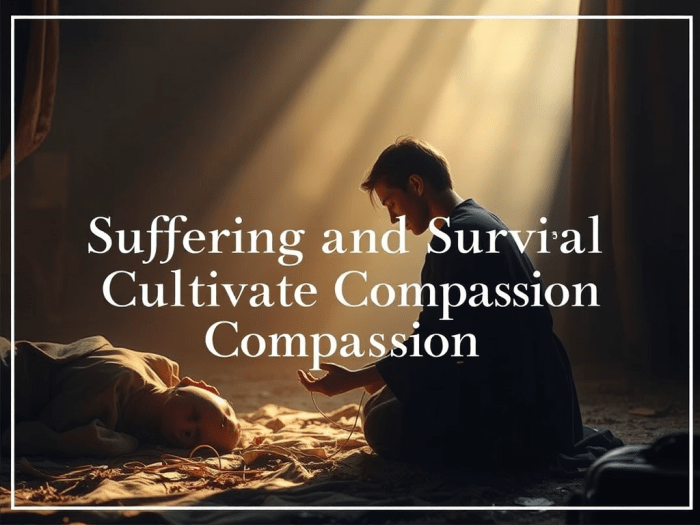
Suffering and Survival Cultivates Compassion
(First Sunday after Christmas)
December 28, 2025*
By Pastor John Partridge
Isaiah 63:7-9 Matthew 2:13-23 Hebrews 2:10-18
If I were to ask you what experience in your life that you would hope to never repeat and, for that matter, would pray that your children and grandchildren would never have to experience, what is the first thought that comes to your mind? I can almost guarantee that nearly all of us over forty took less than a second or two to think of one, and probably several different difficult, and even traumatic, life experiences. Life is like that. We don’t make it through life without struggles and we bear the scars of the things that we have survived. But, at the same time, once you have chosen one of those things, if I were to ask you what you learned from that experience, and how it changed you, I have little doubt that you would be able to tell me a story about how that experience, as terrible as it might have been, has shaped your life and, at least in part, made you who you are today.
I have a friend from seminary who, as a rule, will not attend church on Mothers’ Day because she has few, if any, positive memories of her mother and chooses not to be reminded of that part of her life. But, as I have watched her life for the last twenty-five years that we have been friends, it is clear that she has worked tirelessly to be the most loving wife, mother, and grandmother that she could be. I have no doubt that the trauma of her childhood and early adulthood has motivated her to give her children and grandchildren the experiences and memories that she never had herself.
And that is something that I want you to look for as we read our scriptures this morning and remember the prophecies of Israel’s messiah, the fulfillment of those prophecies in the story of the holy family in their flight to Egypt, and then as we consider what that means to our ongoing relationship with Jesus. We begin this morning once again by reading the words of the prophet Isaiah as he reminds the people of Israel of the things that God has done for them in Isaiah 63:7-9, saying:
7 I will tell of the kindnesses of the Lord,
the deeds for which he is to be praised,
according to all the Lord has done for us—
yes, the many good things he has done for Israel,
according to his compassion and many kindnesses.
8 He said, “Surely they are my people,
children who will be true to me”;
and so he became their Savior.
9 In all their distress he too was distressed,
and the angel of his presence saved them.
In his love and mercy, he redeemed them;
he lifted them up and carried them all the days of old.
Isaiah tells the people to just look at all the things that God has done for them and to judge God by his actions as well as by his words. Just look at the compassion and the kindness that God has shown us, and the many times that God has saved us in our times of distress. Look at the times that God has rescued us, carried us, shown mercy to us, and loved us. God’s actions, Isaiah says, reveal his feelings toward us.
And then, in Matthew 2:13-23, we witness God’s compassion and mercy toward Mary and Joseph and his own son, Jesus:
13 When they had gone, an angel of the Lord appeared to Joseph in a dream. “Get up,” he said, “take the child and his mother and escape to Egypt. Stay there until I tell you, for Herod is going to search for the child to kill him.”
14 So he got up, took the child and his mother during the night, and left for Egypt, 15 where he stayed until the death of Herod. And so was fulfilled what the Lord had said through the prophet: “Out of Egypt I called my son.”
16 When Herod realized that he had been outwitted by the Magi, he was furious, and he gave orders to kill all the boys in Bethlehem and its vicinity who were two years old and under, in accordance with the time he had learned from the Magi. 17 Then what was said through the prophet Jeremiah was fulfilled:
18 “A voice is heard in Ramah,
weeping and great mourning,
Rachel weeping for her children
and refusing to be comforted,
because they are no more.”
19 After Herod died, an angel of the Lord appeared in a dream to Joseph in Egypt 20 and said, “Get up, take the child and his mother and go to the land of Israel, for those who were trying to take the child’s life are dead.”
21 So he got up, took the child and his mother, and went to the land of Israel. 22 But when he heard that Archelaus was reigning in Judea in place of his father Herod, he was afraid to go there. Having been warned in a dream, he withdrew to the district of Galilee, 23 and he went and lived in a town called Nazareth. So was fulfilled what was said through the prophets, that he would be called a Nazarene.
Because of God’s warning, Joseph and his family are able to escape and flee to Egypt before Herod’s soldiers arrive in Bethlehem and kill all the male children. Herod was widely known to be incredibly paranoid, and that paranoia was well fed by several genuine plots to overthrow him or to take his life. Herod allowed no one, even relatives, to live long enough to threaten his life or his power. But, because of God’s warning, Mary, Joseph, and Jesus leave the country, live as aliens for some years in Egypt, and then return home and, in the process, fulfill yet another prophecy that the Messiah would be known as a Nazarene.
But why does that matter to us and to our relationship with Jesus?
And the answer is, it matters a great deal, and we see this as we read the words of the writer of the letter to the Hebrews in Hebrews 2:10-18 when he says:
10 In bringing many sons and daughters to glory, it was fitting that God, for whom and through whom everything exists, should make the pioneer of their salvation perfect through what he suffered. 11 Both the one who makes people holy and those who are made holy are of the same family. So, Jesus is not ashamed to call them brothers and sisters. 12 He says,
“I will declare your name to my brothers and sisters;
in the assembly I will sing your praises.”
13 And again,
“I will put my trust in him.”
And again, he says,
“Here am I, and the children God has given me.”
14 Since the children have flesh and blood, he too shared in their humanity so that by his death he might break the power of him who holds the power of death—that is, the devil— 15 and free those who all their lives were held in slavery by their fear of death. 16 For surely it is not angels he helps, but Abraham’s descendants. 17 For this reason he had to be made like them, fully human in every way, in order that he might become a merciful and faithful high priest in service to God, and that he might make atonement for the sins of the people. 18 Because he himself suffered when he was tempted, he is able to help those who are being tempted.
First, the writer makes it plain that, as we have put our faith in Jesus Christ, we have become not just followers, but family members. And, because we have been adopted into God’s family, God’s plan included a path for Jesus to share our humanity, to put on human flesh and become one of us, and to experience the suffering, grief, trauma, and daily survival that all of us have experienced. And, just as we have been, God allowed Jesus to be shaped by those experiences. Jesus’ life experience of trauma as an infant and young child, fleeing to Egypt, living there as a resident alien, and then returning home but settling in a new community away from his extended family, as well as his other experiences during his life, death, and resurrection, all came together to make him a merciful and faithful high priest that genuinely understands his people and their humanity. The writer of Hebrews says that because Jesus suffered when he was tempted, he is able to help those who are being tempted. And we can easily understand that, in the same way, because Jesus suffered, he understands our suffering. Because he experienced grief, loss, and fear, Jesus understands ours and he is able to walk beside us and comfort us.
In short, the message we need to hear is that Jesus is like us. And, because he is like us, he understands what it is, and what it means, to suffer and to survive. The gods that were known the ancient world, the gods of the Greeks, the gods of the Mesopotamians, the gods of Egypt, and the gods of Rome, were all known to be selfish, capricious, uncaring, and even cruel to their human worshipers. But the God of Israel, was known to be different. And, because Jesus put on human flesh and lived among us, as one of us, he understands us, cares about us, loves us, and has invited us to become his family and be adopted by God as his brothers and sisters. We are told that Jesus was fully human in every way so that he could become a merciful and faithful high priest.
The message is that Jesus is like us.
He lived a human life. He experienced the same emotions, temptations, pain, suffering, and grief that we do.
And, like us, those experiences shaped him and helped to make him merciful, compassionate, and loving in ways that would never be understood by the worshipers of other gods.
As we celebrate, let us remember that Christmas isn’t just the announcement of the birth of the savior and rescuer of humanity, but also an invitation to become a member of his family.
Please LIKE and SHARE!
Click here to subscribe to Pastor John’s blog.
Click here if you would like to subscribe to Pastor John’s weekly messages.
Click here to visit Pastor John’s YouTube channel.
*You have been reading a message presented at Christ United Methodist Church on the date noted at the top of the first page. Rev. John Partridge is the pastor at Christ UMC in Alliance, Ohio. Duplication of this message is a part of our Media ministry, if you have received a blessing in this way, we would love to hear from you. Letters and donations in support of the Media ministry or any of our other projects may be sent to Christ United Methodist Church, 470 East Broadway Street, Alliance, Ohio 44601. These messages are available to any interested persons regardless of membership. You may subscribe to these messages, in print or electronic formats, by writing to the address noted, or by contacting us at secretary@CUMCAlliance.org. These messages can also be found online at https://pastorpartridge.com . All Scripture quotations, unless otherwise indicated, are taken from the Holy Bible, New International Version®, NIV®. Copyright ©1973, 1978, 1984, 2011 by Biblica, Inc.™ Used by permission of Zondervan. All rights reserved worldwide. www.zondervan.comThe “NIV” and “New International Version” are trademarks registered in the United States Patent and Trademark Office by Biblica, Inc.™
 Pastor Partridge