

2 Samuel 5:1-5, 9-10 Mark 6:1-13 2 Corinthians 12:2-10
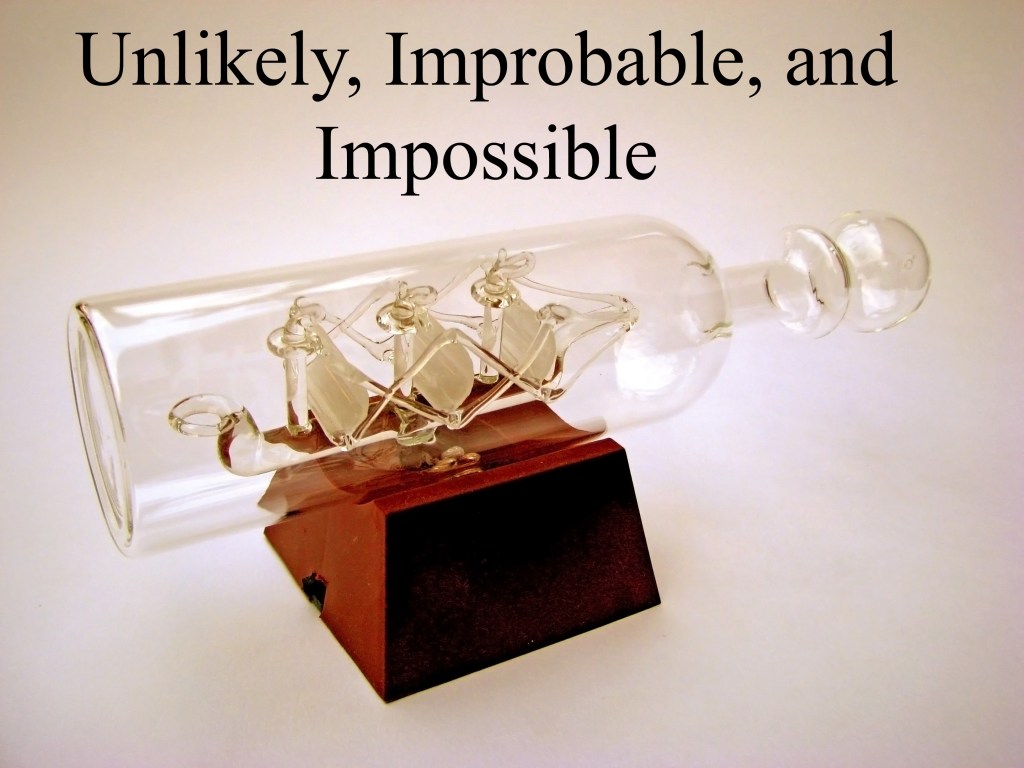
If you look at today’s sermon title, you will see three words of interest: Unlikely, Improbable, and Impossible. So, what, you might ask, is the difference? And to describe the difference, at least for us to have a starting point, let me give you some examples.
First, although I can, technically, choose to retire, or outright quit, any time that I want to do so, it is unlikely that I will do so anytime in the next couple of years. Although I can, I am not likely to do so unless something significant were to change. Second, since I have been here at Christ Church for six years, and have been in ministry for twenty, and the bishop of the East Ohio Conference has never once set foot in my church on a Sunday morning, it is improbable that our bishop would unexpectedly arrive to worship with us this morning. It is, of course, possible, since our bishop can choose to attend church anywhere that she wants to, but given our experience, it is improbable that it would happen today. And finally, since she lacks the ability to speak in a human language, it is impossible for our German Shepherd, Natasha, to arrive at church and preach today’s sermon. It isn’t just that it is unlikely for Patti to drive, or even walk, Natasha to church on a Sunday morning, or that it is improbable that Natasha would have any interest in preaching, but since she cannot speak English, let alone with any significant vocabulary, we understand that such a thing would be impossible.
Looking at these words from another perspective, Arthur Conan Doyle through his character, Dr. Watson, once asked Sherlock Holmes how he could have reached his conclusion and solved the mystery from the few facts that were in evidence. In answer, Sherlock famously said, “Once you eliminate the impossible, whatever remains, no matter how improbable, must be the truth.”
And so, with the impossible in mind, let us return once again to the story of Israel’s great King David. You will remember that in our scripture lesson last week, we read of the death of King Saul, and the subsequent mourning of David and the entire nation of Israel. But this week, we see something new as both the tribes of Israel, and the tribe of Judah, come together to anoint David as their king. This didn’t happen right away. After the death of Saul and Jonathan, the southern tribe of Judah anointed David as their king, but the northern tribes of Israel followed Saul’s surviving son, Ishbaal. What followed was something like a civil war with tensions and violence between the two, but finally Ishbaal was assassinated by two of his own officers, who were later put to death by David for Ishbaal’s murder. But after the death of Ishbaal, we come to 2 Samuel 5:1-10 and hear this:
5:1 All the tribes of Israel came to David at Hebron and said, “We are your own flesh and blood. 2 In the past, while Saul was king over us, you were the one who led Israel on their military campaigns. And the Lord said to you, ‘You will shepherd my people Israel, and you will become their ruler.’”
3 When all the elders of Israel had come to King David at Hebron, the king made a covenant with them at Hebron before the Lord, and they anointed David king over Israel.
4 David was thirty years old when he became king, and he reigned forty years. 5 In Hebron he reigned over Judah seven years and six months, and in Jerusalem he reigned over all Israel and Judah thirty-three years.
6 The king and his men marched to Jerusalem to attack the Jebusites, who lived there. The Jebusites said to David, “You will not get in here; even the blind and the lame can ward you off.” They thought, “David cannot get in here.” 7 Nevertheless, David captured the fortress of Zion—which is the City of David.
8 On that day David had said, “Anyone who conquers the Jebusites will have to use the water shaft to reach those ‘lame and blind’ who are David’s enemies.” That is why they say, “The ‘blind and lame’ will not enter the palace.”
9 David then took up residence in the fortress and called it the City of David. He built up the area around it, from the terracesinward. 10 And he became more and more powerful, because the Lord God Almighty was with him.
And thus, in this short reading, we see David being anointed for the third time, the first when he was a young man about 15 years of age by the prophet Samuel, again by the tribe of Judah after the death of Saul, and now by the other 11 tribes as Israel returns to what is referred to as the United Monarchy when all 12 tribes joined together. That journey, from shepherd boy to king, was seen, even by David’s family, as impossible. And yet, because God was in it, the impossible became reality. Next, was the story of how the united nation of Israel, captured the city of Jerusalem, which was so well constructed, and so well defended, that it was thought to be impossible to capture. And yet, Israel does so.
Still more impossibilities become reality in the account of Jesus and the disciples found in Mark 6:1-13 where we hear this:
6:1 Jesus left there and went to his hometown, accompanied by his disciples. 2 When the Sabbath came, he began to teach in the synagogue, and many who heard him were amazed.
“Where did this man get these things?” they asked. “What’s this wisdom that has been given him? What are these remarkable miracles he is performing? 3 Isn’t this the carpenter? Isn’t this Mary’s son and the brother of James, Joseph, Judas, and Simon? Aren’t his sisters here with us?” And they took offense at him.
4 Jesus said to them, “A prophet is not without honor except in his own town, among his relatives and in his own home.” 5 He could not do any miracles there, except lay his hands on a few sick people and heal them. 6 He was amazed at their lack of faith.
Then Jesus went around teaching from village to village. 7 Calling the Twelve to him, he began to send them out two by two and gave them authority over impure spirits.
8 These were his instructions: “Take nothing for the journey except a staff—no bread, no bag, no money in your belts. 9 Wear sandals but not an extra shirt. 10 Whenever you enter a house, stay there until you leave that town. 11 And if any place will not welcome you or listen to you, leave that place, and shake the dust off your feet as a testimony against them.”
12 They went out and preached that people should repent. 13 They drove out many demons, and anointed many sick people with oil, and healed them.
First, as Jesus preaches in his hometown, the people are offended that Jesus preaches with wisdom and authority because they cannot imagine that someone that they know could possess such amazing gifts from God. They knew, or at least they believed, that such a thing was impossible. Such things just didn’t happen. But it did.
Second, as Jesus sends his disciples out to preach, teach, and cast out demons in the surrounding villages, he takes particular care that none of them are equipped with anything that could support them in their work. They took a walking stick, but no money, no food, no change of clothing, and not even an empty sack that they might use to save leftovers. The result was that they did what was humanly impossible. They preached without education, they drove out demons, and they healed the sick. In other words, they did things that only God could do and by doing so, demonstrated that God was with them.
And that is exactly the point that Paul makes about his own ministry, as well as ours in 2 Corinthians 12:2-10. Rather than protest, as many of us do, that we can’t do this thing, or that thing because we aren’t properly educated, or haven’t had time to prepare, or that we don’t have enough money, or some other excuse, Paul says that our weaknesses are exactly the point. He says…
2 I know a man in Christ who fourteen years ago was caught up to the third heaven. Whether it was in the body or out of the body I do not know—God knows. 3 And I know that this man—whether in the body or apart from the body I do not know, but God knows— 4 was caught up to paradise and heard inexpressible things, things that no one is permitted to tell. 5 I will boast about a man like that, but I will not boast about myself, except about my weaknesses. 6 Even if I should choose to boast, I would not be a fool, because I would be speaking the truth. But I refrain, so no one will think more of me than is warranted by what I do or say, 7 or because of these surpassingly great revelations. Therefore, in order to keep me from becoming conceited, I was given a thorn in my flesh, a messenger of Satan, to torment me. 8 Three times I pleaded with the Lord to take it away from me. 9 But he said to me, “My grace is sufficient for you, for my power is made perfect in weakness.” Therefore, I will boast all the more gladly about my weaknesses, so that Christ’s power may rest on me. 10 That is why, for Christ’s sake, I delight in weaknesses, in insults, in hardships, in persecutions, in difficulties. For when I am weak, then I am strong.
Paul says that all sorts of unlikely, improbable, and impossible things happened to him and the only explanation that he can offer is, much like Sherlock Holmes, having eliminated the impossible, the only reasonable conclusion that is left is the truth that God must have done it.
For the youngest son, of an unimportant man, from an unimportant tribe, to become the king, was impossible but David did it.
For anyone to capture Jerusalem, was physically, militarily, tactically, geographically, and topographically impossible but Israel did it.
For the son of a carpenter, without the benefit of higher education, to preach, teach, heal, and cast out demons was impossible, but Jesus did it.
For uneducated fishermen and the other followers of Jesus to go into the countryside without food, or clothing, or any assistance at all, and to preach, teach, cast out demons, and heal the sick was impossible, but the disciples did it.
For Paul to accomplish what he did, in the face of insults, hardships, persecutions, arrests, beatings, and imprisonment was impossible, but he did it.
Too often we focus on what we think we need to do the job, but our God delights in our weakness because it is in our shortcomings where the world sees God pulling the strings behind the curtain. We don’t need faith when we see the Cleveland Clinic heal people, armed with thousands of doctors, and tens of millions of dollars in laboratories, technicians, tools, machines, and other medical whiz-bangery. But watch an ordinary lay person, lay hands on a sick person, pray, and bring about their healing, and we stand amazed because we know that we have witnessed the hand of God.
We are all called by God to do his work and, regardless of who we are, or how unprepared we might feel, we must act and do what God is calling us to do. Because, at the end of the day, we see God most clearly when, with his help, we accomplish the unlikely, the improbable, and the impossible.
________________________________________________
Please LIKE and SHARE!
Click here to subscribe to Pastor John’s blog.
Click here if you would like to subscribe to Pastor John’s weekly messages.
Click here to visit Pastor John’s YouTube channel.
*You have been reading a message presented at Christ United Methodist Church on the date noted at the top of the first page. Rev. John Partridge is the pastor at Christ UMC in Alliance, Ohio. Duplication of this message is a part of our Media ministry, if you have received a blessing in this way, we would love to hear from you. Letters and donations in support of the Media ministry or any of our other projects may be sent to Christ United Methodist Church, 470 East Broadway Street, Alliance, Ohio 44601. These messages are available to any interested persons regardless of membership. You may subscribe to these messages, in print or electronic formats, by writing to the address noted, or by contacting us at secretary@CUMCAlliance.org. These messages can also be found online at https://pastorpartridge.com . All Scripture quotations, unless otherwise indicated, are taken from the Holy Bible, New International Version®, NIV®. Copyright ©1973, 1978, 1984, 2011 by Biblica, Inc.™ Used by permission of Zondervan. All rights reserved worldwide. www.zondervan.comThe “NIV” and “New International Version” are trademarks registered in the United States Patent and Trademark Office by Biblica, Inc.™
Photo by mwookie on Freeimages.com


 Pastor Partridge