
Proverbs 22:1-2, 8-9, 22-23 Mark 7:24-37 James 2:1-17
In some circles, the following statement can be controversial, but it is generally true as well as scripturally true.
Sometimes, faith is not enough.
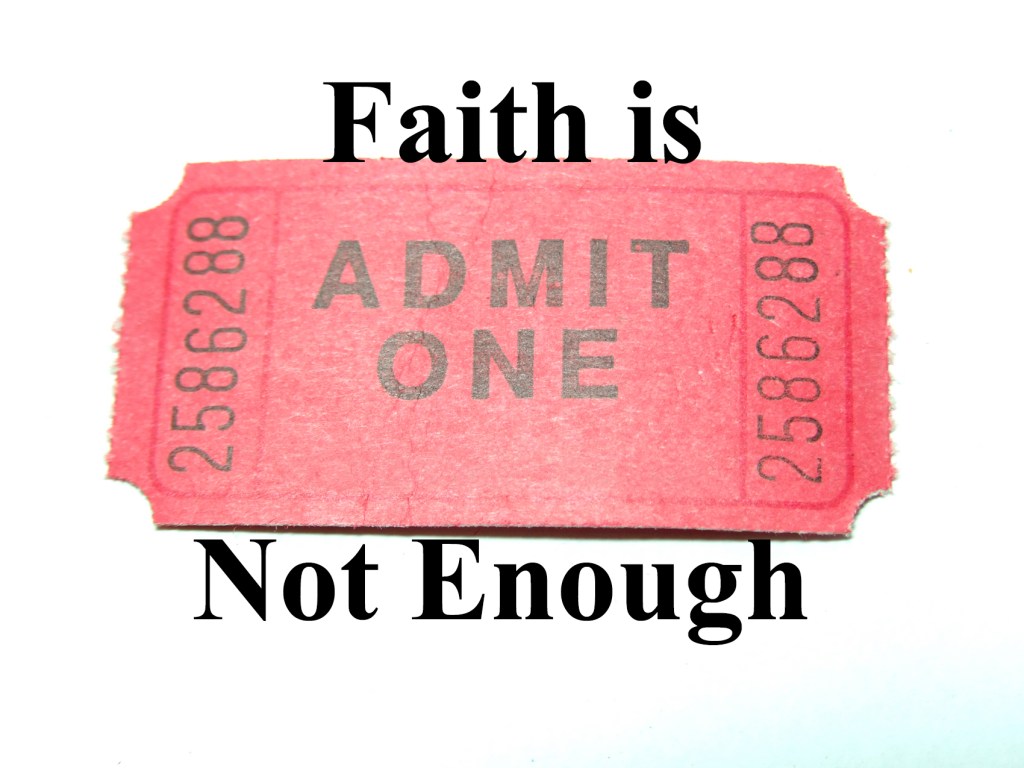
If you have ever attended a concert, or traveled by train, plane, or even Uber, buying a ticket, and having absolute faith that the ticket that you own in genuine and will allow you to be admitted to the concert, or onto the train is still not an absolute guarantee that you will see that concert or reach your desired destination. Something else, beyond the holding of a valid ticket, and beyond your faith in that ticket, is still required. Some of you may have figured out why, and others of you might be puzzled, but I will explain why this is true before we finish.
For now, let’s begin with words of instruction on the value of wealth from Proverbs 22:1-2, 8-9, 22-23, which says:
22:1 A good name is more desirable than great riches; to be esteemed is better than silver or gold.
2 Rich and poor have this in common: The Lord is the Maker of them all.
8 Whoever sows injustice reaps calamity,and the rod they wield in fury will be broken.
9 The generous will themselves be blessed,for they share their food with the poor.
22 Do not exploit the poor because they are poorand do not crush the needy in court,
23for the Lord will take up their case and will exact life for life.
From the beginning, we see that what is valuable is not what wealth we have, but the reputation that we have. And, if we think about that for a moment, and consider how we get a reputation, it isn’t from what we have, but what we do with what we have. God made both the rich and the poor and will bring justice to whomever abuses others but will bless those who are generous. And here again, we see that it isn’t about having, or not having wealth. You don’t have to be rich to be generous. It isn’t about how much wealth that we have, it’s about what we do with what wealth that we have.
Keeping that in mind, I want you to listen for what Jesus does with the wealth that he has. We know that Jesus didn’t have money but listen for how he shared what he had as we read Mark 7:24-37.
24 Jesus left that place and went to the vicinity of Tyre. He entered a house and did not want anyone to know it; yet he could not keep his presence secret. 25 In fact, as soon as she heard about him, a woman whose little daughter was possessed by an impure spirit came and fell at his feet. 26 The woman was a Greek, born in Syrian Phoenicia. She begged Jesus to drive the demon out of her daughter.
27 “First let the children eat all they want,” he told her, “for it is not right to take the children’s bread and toss it to the dogs.”
28 “Lord,” she replied, “even the dogs under the table eat the children’s crumbs.”
29 Then he told her, “For such a reply, you may go; the demon has left your daughter.”
30 She went home and found her child lying on the bed, and the demon gone.
31 Then Jesus left the vicinity of Tyre and went through Sidon, [traveled south] down to the Sea of Galilee and [then east] into the region of the Decapolis. 32 There, some people brought to him a man who was deaf and could hardly talk, and they begged Jesus to place his hand on him.
33 After he took him aside, away from the crowd, Jesus put his fingers into the man’s ears. Then he spit and touched the man’s tongue. 34 He looked up to heaven and with a deep sigh said to him, “Ephphatha!” (which means “Be opened!”). 35 At this, the man’s ears were opened, his tongue was loosened and he began to speak plainly.
36 Jesus commanded them not to tell anyone. But the more he did so, the more they kept talking about it. 37 People were overwhelmed with amazement. “He has done everything well,” they said. “He even makes the deaf hear and the mute speak.”
In the first part of that story, Jesus explains to the Syrian gentile woman that he had been sent by God to minister to the needs of the Jews, but even so, she demonstrates her faith in Jesus by explaining that the thing for which she asks is nothing more to him than the crumbs that fall from the table. Later, Jesus heals the man who was deaf with impaired speech. In each case, Jesus shares what he has, which was, and is, the power of God. Jesus performs miracles and shares acts of mercy. But miracles and mercy are actions. Just like we heard in Proverbs 22, Jesus’ reputation didn’t come from who he was or what he had, Jesus’ reputation was established, and grew, because of what he did with what he had.
And that is what Jesus’ brother James emphasizes throughout his letter to churches everywhere, but today we find it specifically in James 2:1-17 as he also teaches us about the difference between the rich and the poor, about favoritism, mercy, and faith.
2:1 My brothers and sisters, believers in our glorious Lord Jesus Christ must not show favoritism. 2 Suppose a man comes into your meeting wearing a gold ring and fine clothes, and a poor man in filthy old clothes also comes in. 3 If you show special attention to the man wearing fine clothes and say, “Here’s a good seat for you,” but say to the poor man, “You stand there” or “Sit on the floor by my feet,” 4 have you not discriminated among yourselves and become judges with evil thoughts?
5 Listen, my dear brothers and sisters: Has not God chosen those who are poor in the eyes of the world to be rich in faith and to inherit the kingdom he promised those who love him? 6 But you have dishonored the poor. Is it not the rich who are exploiting you? Are they not the ones who are dragging you into court? 7 Are they not the ones who are blaspheming the noble name of him to whom you belong?
8 If you really keep the royal law found in Scripture, “Love your neighbor as yourself,” you are doing right. 9 But if you show favoritism, you sin and are convicted by the law as lawbreakers. 10 For whoever keeps the whole law and yet stumbles at just one point is guilty of breaking all of it. 11 For he who said, “You shall not commit adultery,” also said, “You shall not murder.” If you do not commit adultery but do commit murder, you have become a lawbreaker.
12 Speak and act as those who are going to be judged by the law that gives freedom, 13because judgment without mercy will be shown to anyone who has not been merciful. Mercy triumphs over judgment.
14 What good is it, my brothers and sisters, if someone claims to have faith but has no deeds? Can such faith save them? 15 Suppose a brother or a sister is without clothes and daily food. 16 If one of you says to them, “Go in peace; keep warm and well fed,” but does nothing about their physical needs, what good is it? 17 In the same way, faith by itself, if it is not accompanied by action, is dead.
James is clear that, as the church, two of the gifts that we have are hospitality and access, and how we use those gifts matters. If we give better access and hospitality to someone who is rich or who dresses well, then we have openly discriminated against the poor person wearing filthy old clothes. What’s worse, James condemns this sort of discrimination, not just as bad, but as both sinful and evil. God has chosen the poor to be rich in faith and to inherit the kingdom that he has promised, and James reminds us that it is the rich that drag us into court, exploit us, and speak blasphemy against Jesus.
Showing favoritism, James says, is the opposite of following God’s command to love our neighbor, and he reminds us that since no single sin is greater than any other, we will be judged for favoritism just as much as we would be judged for adultery or murder. Instead of judgement, James says, we should show mercy. Instead of showing favoritism, we should show mercy. While our faith is important, everything boils down to the actions that we take. It doesn’t do any good to offer kind words of peace, warmth, and food to someone who is distressed, cold, and hungry. Instead, it is our actions, and our acts of mercy, which make a difference.
And that’s where we circle back to where we started. Having a ticket to a concert won’t get us in the door if we don’t get out of our seats and go to the concert. Having faith that the airline will accept our plane ticket won’t get us to our destination if we don’t pack a bag, go to the airport, present the ticket, and get on the airplane. Unless we act, our plane ticket is just a piece of paper. And James says that faith in Jesus Christ is like that.
Faith, without action, is dead.
As important as faith is, the people around us will not see our faith, they will only see our actions. The hungry will not be fed by our faith, they will be fed by our actions. It isn’t enough to have meetings, or preach sermons about poverty, hunger, homelessness, or the needs of widows, orphans, alcoholics, foreigners, immigrants, and everyone else that is in need. It isn’t enough to have faith.
And this is the place where some folks will argue that what James and I are preaching is “works righteousness” (that we are saved by our works), and that’s absolutely not true. What James is saying is that just like a coin has both heads and tails, you can’t have one without the other. A ticket isn’t any good if you don’t go to the concert or to the airport. A ticket isn’t really even a ticket if we don’t act on it and use it. And James says that it’s the same with faith. Faith that doesn’t result in action is dead faith and isn’t really faith at all.
Solomon said that our reputation doesn’t come from what we have, but what we do with what we have.
Jesus’ reputation didn’t come from who he was or what he had, Jesus’ reputation was established, and grew, because of what he did with what he had.
Faith, alone, isn’t enough.
Faith without action, is dead.
The people around us will not see our faith, and will not see Jesus in us, until we act.
And so, the question that each of us must answer today is, “How will we show our faith to the people around us?”
Please LIKE and SHARE!
Click here to subscribe to Pastor John’s blog.
Click here if you would like to subscribe to Pastor John’s weekly messages.
Click here to visit Pastor John’s YouTube channel.
*You have been reading a message presented at Christ United Methodist Church on the date noted at the top of the first page. Rev. John Partridge is the pastor at Christ UMC in Alliance, Ohio. Duplication of this message is a part of our Media ministry, if you have received a blessing in this way, we would love to hear from you. Letters and donations in support of the Media ministry or any of our other projects may be sent to Christ United Methodist Church, 470 East Broadway Street, Alliance, Ohio 44601. These messages are available to any interested persons regardless of membership. You may subscribe to these messages, in print or electronic formats, by writing to the address noted, or by contacting us at secretary@CUMCAlliance.org. These messages can also be found online at https://pastorpartridge.com . All Scripture quotations, unless otherwise indicated, are taken from the Holy Bible, New International Version®, NIV®. Copyright ©1973, 1978, 1984, 2011 by Biblica, Inc.™ Used by permission of Zondervan. All rights reserved worldwide. www.zondervan.comThe “NIV” and “New International Version” are trademarks registered in the United States Patent and Trademark Office by Biblica, Inc.™
Photo by Avolore on Freeimages.com

 Pastor Partridge