
Exodus 12:1-4, (5-10), 11-14
John 13:1-17, 31b-35
1 Corinthians 11:23-26
What is it that makes your family, your church, your civic organization, or your community unique? What is the story that you tell others about how you started, or about your mission, that explains who you are and what you do? As I was growing up, I often heard that while we were encouraged to try new things, Partridges did not quit. If we tried something new, we had to give it a fair trial. Learning to play an instrument is difficult, and so was wrestling when I only weighed seventy-two pounds. But I wasn’t allowed to quit until I had, at least, completed a year or two of band and at least a full season of wrestling. I stayed in band until my second or third year in college and stayed in wrestling for two seasons until I finished junior high school. Patti and I sent the same message to our children when they were growing up. We encourage you to try new things, but once you start, you cannot quit until you’ve given it a fair chance. Every group, and every family, has similar stories that shape the character of the organization as well as the character of its members. And for the people of Israel, and later for the followers of Jesus Christ, one of those formative and defining stories is the story of the first Passover that we find in Exodus 12:1-4, (5-10), 11-14.
12:1 The Lord said to Moses and Aaron in Egypt, 2 “This month is to be for you the first month, the first month of your year. 3 Tell the whole community of Israel that on the tenth day of this month each man is to take a lamb for his family, one for each household. 4 If any household is too small for a whole lamb, they must share one with their nearest neighbor, having taken into account the number of people there are. You are to determine the amount of lamb needed in accordance with what each person will eat. 5 The animals you choose must be year-old males without defect, and you may take them from the sheep or the goats. 6 Take care of them until the fourteenth day of the month, when all the members of the community of Israel must slaughter them at twilight. 7 Then they are to take some of the blood and put it on the sides and tops of the doorframes of the houses where they eat the lambs. 8 That same night they are to eat the meat roasted over the fire, along with bitter herbs, and bread made without yeast. 9 Do not eat the meat raw or boiled in water, but roast it over a fire—with the head, legs, and internal organs. 10 Do not leave any of it till morning; if some is left till morning, you must burn it. 11 This is how you are to eat it: with your cloak tucked into your belt, your sandals on your feet and your staff in your hand. Eat it in haste; it is the Lord’s Passover.
12 “On that same night I will pass through Egypt and strike down every firstborn of both people and animals, and I will bring judgment on all the gods of Egypt. I am the Lord. 13 The blood will be a sign for you on the houses where you are, and when I see the blood, I will pass over you. No destructive plague will touch you when I strike Egypt.
14 “This is a day you are to commemorate; for the generations to come you shall celebrate it as a festival to the Lord—a lasting ordinance.
The Passover story declares to everyone that all of Israel, from the least to the greatest, is a family and that everyone is included. It is also a story of God’s rescue and his love for his people.
And it is with this background in mind that we enter the story of Jesus’ betrayal, arrest, and crucifixion found in John 13:1-17, 31b-35 and hear this:
13:1 It was just before the Passover Festival. Jesus knew that the hour had come for him to leave this world and go to the Father. Having loved his own who were in the world, he loved them to the end.
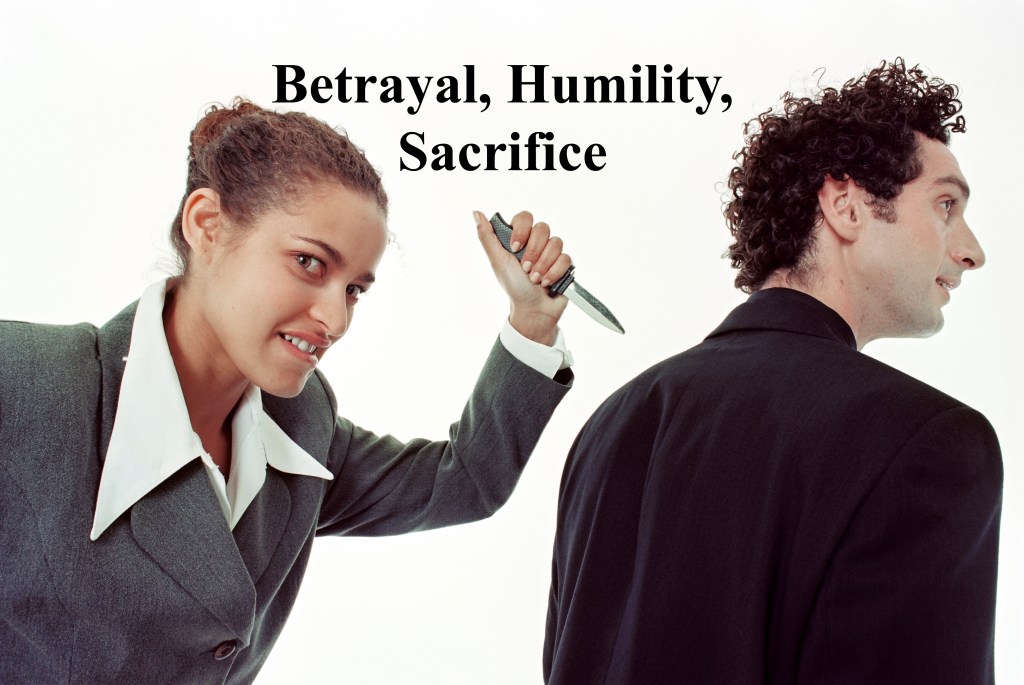
2 The evening meal was in progress, and the devil had already prompted Judas, the son of Simon Iscariot, to betray Jesus. 3 Jesus knew that the Father had put all things under his power, and that he had come from God and was returning to God; 4 so he got up from the meal, took off his outer clothing, and wrapped a towel around his waist. 5 After that, he poured water into a basin and began to wash his disciples’ feet, drying them with the towel that was wrapped around him.
6 He came to Simon Peter, who said to him, “Lord, are you going to wash my feet?”
7 Jesus replied, “You do not realize now what I am doing, but later you will understand.”
8 “No,” said Peter, “you shall never wash my feet.”
Jesus answered, “Unless I wash you, you have no part with me.”
9 “Then, Lord,” Simon Peter replied, “not just my feet but my hands and my head as well!”
10 Jesus answered, “Those who have had a bath need only to wash their feet; their whole body is clean. And you are clean, though not every one of you.” 11 For he knew who was going to betray him, and that was why he said not every one was clean.
12 When he had finished washing their feet, he put on his clothes and returned to his place. “Do you understand what I have done for you?” he asked them. 13 “You call me ‘Teacher’ and ‘Lord,’ and rightly so, for that is what I am. 14 Now that I, your Lord, and Teacher, have washed your feet, you also should wash one another’s feet. 15 I have set you an example that you should do as I have done for you. 16 Very truly I tell you, no servant is greater than his master, nor is a messenger greater than the one who sent him. 17 Now that you know these things, you will be blessed if you do them.
31 When he [Judas] was gone, Jesus said, “Now the Son of Man is glorified, and God is glorified in him. 32 If God is glorified in him. God will glorify the Son in himself, and will glorify him at once.
33 “My children, I will be with you only a little longer. You will look for me, and just as I told the Jews, so I tell you now: Where I am going, you cannot come.
34 “A new command I give you: Love one another. As I have loved you, so you must love one another. 35 By this everyone will know that you are my disciples, if you love one another.”
Jesus knew that these were his last hours on earth and, rather than fleeing to save his own life, Jesus followed the pattern of God, of Israel, and of the Passover, by placing love, family, and rescue ahead of his own wellbeing. Jesus takes on the role of the lowest ranking servant and humbles himself as he washes the feet of those who follow him. Jesus says that just as every person who belongs to the nation of Israel is a part of the family, every person who follows him must be humble enough to wash feet and serve others. The distinguishing character of Jesus’ followers will not only be family but also love and humility. Jesus says, “By this everyone will know that you are my disciples, if you love one another.” This can’t be the ordinary love that we see among families and friends, but it must be so extra-ordinary, so singularly distinctive, that people will see it and know that we belong to Jesus.
But there is another thing that makes our community unique and shapes the character of the organization and its members, and it goes beyond who we are and how we act. In 1 Corinthians 11:23-26, the Apostle Paul explains it this way:
23 For I received from the Lord what I also passed on to you: The Lord Jesus, on the night he was betrayed, took bread, 24 and when he had given thanks, he broke it and said, “This is my body, which is for you; do this in remembrance of me.” 25 In the same way, after supper he took the cup, saying, “This cup is the new covenant in my blood; do this, whenever you drink it, in remembrance of me.” 26 For whenever you eat this bread and drink this cup, you proclaim the Lord’s death until he comes.
Paul says that he was passing what he knew forward to new generations and that this was a key part of his mission. It was important that he passed on to others the knowledge and teaching that he had received from God. He passed on the importance of sharing a meal at the Lord’s table and remembering Jesus’ last supper, but he emphasizes that each time we share that meal together, we proclaim the message of Jesus’ sacrifice, death, and resurrection and teach others about him. Our celebration of the Lord’s table, or the Eucharist, or Communion, is a reminder to us, and a reminder to the world, of the gift that Jesus gave to all of us. And, like Paul, our mission is not to keep that gift to ourselves, but to share it with others and pass it forward to new generations.
*You have been reading a message presented at Christ United Methodist Church on the date noted at the top of the first page. Rev. John Partridge is the pastor at Christ UMC in Alliance, Ohio. Duplication of this message is a part of our Media ministry, if you have received a blessing in this way, we would love to hear from you. Letters and donations in support of the Media ministry or any of our other projects may be sent to Christ United Methodist Church, 470 East Broadway Street, Alliance, Ohio 44601. These messages are available to any interested persons regardless of membership. You may subscribe to these messages, in print or electronic formats, by writing to the address noted, or by contacting us at secretary@CUMCAlliance.org. These messages can also be found online at https://pastorpartridge.com . All Scripture quotations, unless otherwise indicated, are taken from the Holy Bible, New International Version®, NIV®. Copyright ©1973, 1978, 1984, 2011 by Biblica, Inc.™ Used by permission of Zondervan. All rights reserved worldwide. www.zondervan.com The “NIV” and “New International Version” are trademarks registered in the United States Patent and Trademark Office by Biblica, Inc.™
 Pastor Partridge