An Accidental Ministry: Passing 50,000


    Last month, Scribd, the webpage where I post sermons online, indicated that I had surpassed 50,000 ‘reads’ on the 187 documents that I have posted.  One sermon a week, times about 50 weeks each year (I do take time off once in a while) and we can see that I have been posting there for a little less than four years.  In fact, as I dig back through the records, I find that the first file was uploaded in September 2009.  Since then, people from around the world have found their way, by a variety of means, often through Google or other search engines, to read the words that I have written.  And it was all an accident.

    Ten years ago when I first began in ministry, I was more of an engineer than a pastor.  I knew that I could not simply open a Bible and preach without notes, or even preach from a stack of 3×5 cards.  If I was going to talk for 20 minutes and sound even remotely coherent, I knew that I would have to prepare better than that.  And so, each week, I would type my entire sermon, word for word, and then, on Sunday, deliver it from the pulpit.  I had enough experience in High School Theater and in other dramatic productions that I don’t think I ever just stood there and read to people in a monotone voice, although there have been a few folks who accused of something close to that.  I’m sure I could have done better with more training and experience, which is what happened (I hope) over my years as a student pastor, a seminary student and as a full-time pastor.
    After some time had passed, someone suggested that since the sermon was already typed up, that we could make copies and provide them outside the sanctuary for those who had missed the previous week.  From there this thing grew.  People started asking for copies to take to our shut-ins, and then email copies to college students and others, and then, finally, a friend suggested that we might launch a discussion forum on Facebook for folks to ask questions.  When we launched the discussion forum (which never really caught on) we needed a place to post copies of the sermons online and so I searched the Internet for a service that was similar to YouTube, but for text instead of video.  That is how I found Scribd.com. 
    On Scribd, I discovered an online community of readers and writers.  There, people could subscribe to what I was writing, and I could subscribe to theirs.  I had intended to create a place for the people of our community to read and discuss the weekly message but, within weeks discovered that I had subscribers from China to Africa to Pakistan.  There were people who were reading the sermon of a little country church in Ohio because there was no local church near them that spoke English, or because the message of Jesus Christ was considered subversive in the places that they lived.  Now, nearly four years later, nearly 60 people read one of these messages every day.
    I have no illusions that each of those 50,000 mouse-clicks means someone read all the way through something, but I continue to be amazed and humbled by what God is doing with the words that he has given to me. 
    I have never believed that people were reading these things because I was a great writer, nor do I think that Billy Graham or Bill Hybels have need to fear from my speaking ability.  Every time I look at these numbers I remember God’s words in Isaiah 55:10-11:
 As the rain and the snow
    come down from heaven,
and do not return to it
    without watering the earth
and making it bud and flourish,
    so that it yields seed for the sower and bread for the eater,
11 so is my word that goes out from my mouth:
    It will not return to me empty,
but will accomplish what I desire
    and achieve the purpose for which I sent it.
And Paul’s words in 2 Corinthians 12:9:
But he said to me, “My grace is sufficient for you, for my power is made perfect in weakness.” Therefore I will boast all the more gladly about my weaknesses, so that Christ’s power may rest on me.
God took my weaknesses and is using them to reveal his message to the world.   
I am simply amazed and humbled at what he is doing.

Top Ten 2011 Blog Posts


    I know I’m a year late, but as I began to assemble the top ten blog posts of 2012, I realized that there were a few from 2011 that still had value and might well be worth a second look.  Here they are, more or less in order of popularity.
1) God Will Destroy the Fat Cats – November 29, 2011 – A Blog about God’s desire to destroy the rich, well, not really… but sort of.
2) Laws of Man and God – Are guns evil? Part 1 – February 9, 2011 – Part 1 of 4 – The first in a series that I wrote after the shooting of Gabriel Giffords.  Not really pro-gun or anti gun, just asking a lot of questions and thinking out loud.    The first two installments made the year’s top ten, but while part 3 was moderately popular, almost no one made it to part 4.  My lesson?  Even broken into pieces, this was just too long.
3) Happy Birthday Mr. Shea! – February 2, 2011 – A tribute to George Beverly Shea           on his 102nd birthday.  
4) Laws of Man and God – Are guns evil? Part 2– February 10, 2011 – Part 2 of 4
5) Living Together, No Harm No Foul? – April 27, 2011 – Is living together normal, healthy, moral and responsible?  I’m sure you can find lots of people who think it’s a good idea, but, well, no. 
6) Seeing God in the World Around You – March 25, 2011 – A man I never met, weeps during my talk, wondering how I knew so much about his life.  I didn’t.  But God did.
7) 20/20 Blindness – March 31, 2011 – A blind man is thrown out of a restaurant because of his guide dog.  Apparently, humans are just as blind today as the Pharisees that Jesus knew.            
8) Christmas in January – January 4, 2011- I explain why our family still leaves our Christmas decorations us until the first week in January.  Not everyone celebrates Christmas on December 25th you know.
9) Too Busy for God? – May 25, 2011 – Do you plans for the summer, or for the New Year, include church.  If church is important to you, don’t allow it to happen by accident.

    In reality, there was a three or four way tie for tenth place.  Instead of picking one of those, or using all of them, I jump to the blog that comes after the tie because, even though it was read less often, it had more comments than any other blog of the year.  That’s worth something mentioning, I think.

10) A New Digital Divide – Who wins, who loses? – January 19, 2011 – As we become an increasingly technological society, we cannot allow ourselves to forget the people who are being left behind.
Honorable Mention) The Nightmare of Democracy? – February 14, 2011 – I include this, a blog that was written at the very beginning of what we now call the Arab Spring.  In it, I worried that the revolution in Egypt might not be such a great thing.  In the two years since, attacks on Coptic Christians and on the Coptic Church have increased and the government has shown little interest in preventing it.  Events are still unfolding in the Middle East and as they do, out brothers and sisters in Christ will continue to be in need of our prayers.

The Church vs. Education?


    I have a few atheist friends who seem fond of bashing religion on their Facebook pages.  While their attacks most often reflect a pitiable ignorance of what religion, specifically Christianity, is about, one meme that is often repeated irritates me more than most of the others.  The theme of these irritating (and wrongheaded) attacks revolves around a perception that religion and education are mutually exclusive or, that somehow, religion is opposed to “real” education.  Not only is this way of thinking just wrong, both historically and in a contemporary setting, but,  I find this accusation particularly offensive as a United Methodist, a church whose core DNA has always included support and encouragement of education.

    Obviously, a blog is not the place for a lengthy treatise on education, but let’s look at a few facts.  Two thousand years ago when education belonged to the rich, it was the Jewish high priest who mandated that schools should be opened (in 64 AD) because the Torah required literacy and study.  These schools were not particularly successful, but the literacy rate was still triple that of neighboring Egypt (3% vs. 1%).[1]   A thousand years after that, it was again the church, this time the Roman Catholic Church, which, in 1179 mandated that free education be provided for the poor.  In fact, until 1600 nearly all universities in Europe were built, taught, and funded by the church and, during the “Dark Ages” it was the monasteries that preserved the wisdom and knowledge of the ancient world.  Had it not been for the church, what we know of Socrates, Plato and many others would have been lost.   In the Islamic world, education was supported and funded by the government, but, Islam being a theocratic system of government, this too was, essentially the church.  Throughout the Reformation, the majority of universities remained church supported organizations.
    In the American Colonies, and then the newly birthed United States, there was little or no opportunity for higher education unless one returned to Europe.  When it became obvious that institutions of higher learning should be built, who do you suppose it was who raised the money and built them?  The church.  What schools did the church build?  You might have heard of some of them: Harvard, William & Mary, Yale, College of New Jersey (which is now Princeton), Columbia, Dartmouth, Georgetown, Oberlin, Fordham, Duke and host of others.  In fact, between 1636 and 1861 nearly 800 colleges were founded, and of these, 182 still survive.  Of the 182 surviving colleges and universities, only 21 were built by states or municipalities, the rest were built by the church through a variety of denominations. [2]
    As for us United Methodists, our founder, John Wesley, started building schools in 1739 in Bristol for the children of coal miners and in the United States we authorized the construction of our first college in 1784, eight years before we even held our first General Conference in 1792.  In 1820 and again in 1824 our General Conference instructed each Annual Conference to establish schools, literary institutions and colleges and they did.  By the time of the American Civil War, the Methodist Church had established over 200 such institutions.  Our Evangelical United Brethren brothers were a smaller church but they still managed to build eight colleges by the middle of the twentieth century.[3]  In 1968 these two churches merged to form The United Methodist Church and together we are now connected to 122 colleges and universities in the Untied States including research universities, seminaries, historically Black colleges and universities (including a medical school), and two-year colleges, as well as 358 post-secondary institutions outside the United States.  If we were to include elementary schools and others, this number would be absolutely astounding.
    I’m sorry friends, if you think that people of faith don’t believe in education you’re ignoring the facts.  But if you think that atheists can do better, I invite you to go ahead and prove it. 
But first, you have a whole lot of catching up to do.


[3]Robert A. Williams, From the Beginning: a School-Related Church, Interpreter Magazine, March/April 2013

Westboro is NOT Winsome

    I have probably mentioned this before, but the folks from Westboro Baptist Church really burn my cookies.  Last night at our youth group meeting we watched a segment of Adam Hamilton’s “When Christians Get it Wrong” and were discussing how well-meaning church people often chase unbelievers away from the church instead of attracting them.  When I was much younger, we were always taught that the Christian faith should be “winsome.”  I wasn’t sure what that meant, but from the way it was used, it sounded as if it ought to be something that looked and sounded attractive.  According to the American Heritage online dictionary it does, in fact, mean charming. 

The followers of Jesus Christ are called upon to tell the world about the Good News of reconciliation, that God has done everything possible to repair our relationship with him and to demonstrate his love for us.  I have to think that demonstrating respect and love for others, for their religion, for their opinions, for their culture and for their existence would have to be the first step in doing that.  Showing up at a child’s funeral or anywhere else with signs that say “God Hates Fags,” “God Killed Your Sons,” or worst of all, “God Is Your Enemy” is definitely going in completely the wrong direction.  First of all these statements tell unbelievers that the church is out of touch and that it is full of bigoted idiots that have no desire (or ability) to understand their situation.  Worse than that, these things are all lies.  There is nothing in scripture that could lead someone to believe that God hates you or that God is your enemy.  the whole point of scripture, especially the message of the Gospel, is entirely the opposite, that God loves you more than you can know.

That doesn’t meant that God is making any compromises about things that he considers wrong, but that a message of love cannot be communicated by being hateful and hurtful.  In his book, When Christians Get it Wrong, Adam Hamilton, correctly, points to the Apostle Paul.  I have used Paul as an example for years, and so have many others.  Paul was a Pharisee.  He was incredibly well educated.  He had studied under some of the most noted Rabbis in history.  Paul knew sin and he wasn’t afraid to point out the sins of others.  Paul had often warned the churches of the evils of idol worship, particularly in those places under the influence of the Romans and Greeks (which we, pretty much everywhere), but that isn’t how he started a conversation with people who actually worshiped idols.  When Paul visited Athens, a city full of idols and temples of numerous false gods and goddesses, Luke tells us that “he was greatly distressed to see that the city was full of idols.”  Even so, Paul didn’t launch into a tirade about how evil they all were.  He went into the synagogue and and into the marketplace reasoned with the people. His reasoning was sound enough that he was asked to go to Mars Hill and explain his views further and even there, he didn’t condemn them.  Instead, Paul said:

“People of Athens! I see that in every way you are very religious.  For as I walked around and looked carefully at your objects of worship, I even found an altar with this inscription: to an unknown god. So you are ignorant of the very thing you worship—and this is what I am going to proclaim to you. (Acts 17:22-23)

Paul began by expressing his admiration for their care in pursuing the truth even though their worship of idols distressed him.  No one will believe you if you tell them you love them while you are beating them over the head.  Telling someone that God hates them is not winsome… or loving. 

It’s just wrong.

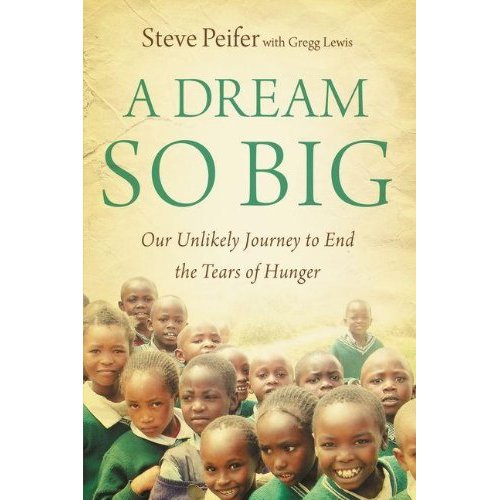
A Dream So Big


    My wife, Patti, and another member of our church first met Steve Peifer during a trip to visit Keith and Jamie Weaver, missionaries sent by our church to the people of Kenya.  There, Patti met Steve and worked with this beautiful wife Nancy in the library at Rift Valley Academy.  I first met Steve at my home church when we invited him to come and tell us about his efforts to feed hungry school children that he describes in A Dream So Big.  Since then Patti and I have answered a call to pastoral ministry and have not only followed Steve’s adventures through his regular emails, but have, on several occasions, invited him to speak in the churches where we were serving.  I don’t think that his story has ever failed to astound his listeners. 

     
    Steve is an average, middle class guy whose life was turned upside down and who, through no particular plan of his own, ended up in Kenya, Africa seeing things that most of us cannot imagine, and doing things that we would be afraid to do.  Throughout this story, Steve insists that he is not an amazing man, just a man through whom, God is doing amazing things. 
 
    In A Dream So Big, we meet Steve, Nancy, and their family before the adventure began, at home, in Texas.  We walk with them through one of the most difficult times that a parent can imagine, the loss of their child, Steven, and then follow them as they head to Africa.  At first, their African adventure is intended to be just a year away to sort things out and to process the pain and the trauma of losing a child, a time for their family to be together and to heal.  But, as Steve often points out, Africa changes a person.  After a year in Kenya, the Peifers feel called, if not compelled, to return on a more permanent basis, and it is then that the real adventure begins.  
    Not content to see children lying in the dirt at school because they are weak from hunger, Steve sets out to change the world, or at least his little corner of it.  Steve asks, and with the help of his friends and supporters in the United States, begins to provide lunches for two schools nearby.  Two schools become four, and then ten, and by the end of the book become a truly extraordinary number.  Providing food not only allows the children to be free from hunger, but gives them the strength to get an education and an incentive to stay in school.  Even with these successes, Steve is not content.  Building on the feeding program, Steve and his friends begin to build solar powered computer centers.
    Just because I said the word computer, do not be tempted to think that this is just another story about wealthy, white Americans swooping in to “rescue” Africa.  Those stories are old and they often are the picture of “Ugly Americans” with all the cultural insensitivity that you might expect.  That is not Steve’s story.  Steve builds a program in which the villages take ownership of their schools and their computer centers.  The parents know that when these children finish school and head into the city to find work, as most of them do, that they will find good paying, skilled jobs instead of living in the slums fighting with untold thousands of others for a handful of unskilled jobs.  The school children, their parents, and many others have seen Steve’s vision, and it is a vision that can break the back of poverty in Africa.  It is a vision that can change the world.
    I highly recommend A Dream So Big.  As you follow Steve, Nancy and their family on this amazing adventure, you will laugh out loud at the ridiculous situations in which Steve finds himself.  But you will also weep at the poverty and hopelessness that he sees all around him.  A Dream So Big invites you, not only to follow along, but to be a part of this incredible adventure.  I have no doubt that Steve Peifer is changing the world, one child at a time.  When you read this book, you will discover that you can too.
Steve’s book, A Dream So Big will be released next week and can be found on Amazon here: A Dream So Big.

Sometimes Right is Wrong


    Not long ago my wife, Patti, and I attended a seminar with Dr. Terry Wardle at Ashland Seminary.  During one session Dr. Wardle noted that sometimes the question is not whether something is right or wrong, but whether it is loving or unloving.  This idea struck me and I immediately wrote it in my notebook.  While this may not always be the case, this is a wonderful lens by which we can examine our choices as we live out our faith.  Checking to see if our actions are loving or unloving is a great way to get closer to deciding, “What would Jesus do?” 
   
    Some will object that Jesus was the perfect man and lived his life without sin, and so, he could not have done wrong.  And yet, he did.  During his ministry, Jesus seemed often to be at odds with the Pharisees, men who devoted their lived to following “the rules” and, in fact, devised rules stricter than those contained in the Law so that, by following these ‘new and improved’ rules, they would never, even accidently, violate the Law.  Simply put, the Pharisees made it their business never to break a rule.  They were devoted to living that was always right and never wrong but if this is so, why were they so often at odds with Jesus?
    The Pharisees began to hate Jesus and plot for his humiliation and, ultimately, his destruction when Jesus repeatedly revealed their hypocrisy and the failure of their rules-based morality.  Jesus pointed out that what they had achieved was like white washing a tomb; it looked pretty on the outside bur remained full of corruption on the inside.  The Pharisees were known to tithe from everything they earned, every increase that God granted to them, even to the point of giving ten percent of the growth from their herb gardens and yet some of them had elderly parents whom they allowed to starve.  They justified their actions by saying that all their money was “Corban” or, dedicated to God.  They had followed one rule so vigorously, that they missed the bigger ideas of “love your neighbor” and “honor your father and mother.”  They had done what was “right” but had failed to be loving.  As Jesus saw it, they had missed the point.
    At the same time, the Pharisees attacks against Jesus revolved around what they perceived as his wrongdoing.  Jesus and his followers were rule breakers.  Jesus sat down with sinners, tax collectors, prostitutes, outcasts, and ate with them.  No self respecting, rule-following, religious person would be seen socializing, let alone sharing food, with “those people,” and yet, Jesus did.  As Jesus and his followers were walking through a field on the Sabbath, they were hungry and the disciples began to pick heads of grain, rub them between their hands to remove the chaff, and eat them.  The Pharisees asked Jesus why he allowed them to do wrong. Clearly they were harvesting on the Sabbath, and everyone knew that harvesting was work and work was not permitted on the Sabbath.  They made the same accusation against Jesus when he healed a man on the Sabbath.  Since healing was “work,” obviously Jesus had done wrong.  Again, as Jesus saw it, they had missed the point.
    In each case, the Pharisees wanted to follow the rules, to do what was right, but Jesus wasn’t as concerned with right and wrong as he was with being loving.  Jesus believed that the Pharisees had missed the point when following “the rules” caused them to be unloving.
    If we see ourselves in the mirror held up by the Pharisees, we should.  The Pharisees weren’t bad people; they were the church leaders and teachers of their day.  Like the Pharisees, I think sometimes we get so focused on “the rules” that we miss the point.  When people of faith debate issues like homosexuality, abortion, capital punishment and other “religious” issues in the public square we often carve out positions that we believe are “right” and yet, at the same time, fail miserably at being loving.  That doesn’t mean that we have to accept sin, Jesus didn’t, but Jesus found a way to be loving even if it broke a few rules.
    As we enter the public square we must ask ourselves if our arguments are right, but also if they are loving.  Because…
Sometimes, right is wrong.

Why the Russian Adoption Ban is a Disaster in Slow Motion

    By now most of you have heard about the adoption ban put into law in Russia.  It all began with an attempt by our United States government to rein in human rights violations in Russia.  President Obama signed the Magnitsky Act, which provides sanctions against Russian citizens deemed by the US to have violated human rights.  Prior to this, the Russian government was concerned about the abuse some Russian children have received at the hands of their adoptive parents in the United States but had only recently, in November, 2012, signed a new treaty designed to provide greater access for Russian officials who desired to review the treatment of adopted children.  This new agreement was only in place for eight weeks before the adoption ban was signed by President Putin.

    The Russian government claims that the adoption ban was necessary because they were not getting access to the documents that the new treaty was supposed to give them and the American government claims that the whole thing is just retaliation for passing the Magnitsky Act.  Whichever is true, it is neither the American nor the Russian government that is the big loser.  The big losers remain the children who will remain in Russian orphanages instead of in loving homes.
    I know something about this.  Our family includes two children who were adopted from a Russian orphanage.  The trauma that they suffered in their first year of life has been a real education.  Before we witnessed it firsthand, I never would have believed that children could be so damaged in their first year of life.  We were always told that “Love heals all wounds,” and “Love conquers all,” and things like that.  We genuinely believed it when people told us that all we had to do was take them home and love them.  But sometimes love isn’t enough.  Thankfully, the problems that our children have, though not insignificant, are not nearly what other parents, whom we’ve met, live with every day.  Some of the neurological, emotional and psychological problems that grow out of living in an orphanage, even for a few months, are frightening. 
 
    While I could not ever condone abuse, I have seen enough to understand how parents of some of these children could reach a point where they simply don’t know what else to do.  Many parents do not abuse these damaged children but recognize that they cannot cope with the behaviors of their children and choose to dissolve or disrupt the adoption.  That means what it sounds like; they go in front of a judge and declare that they are no longer the parents.  This frees them, but makes the children orphans yet again and turns their care over to the state in which they live, or to yet another set of adoptive parent and cause still more emotional and psychological damage.
    Children from former Eastern bloc countries (primarily Russia and Ukraine) bear a higher risk for behavioral problems and eventual adoption disruption.  We don’t completely know why, but although similar problems are seen in children from other nations, these children see higher rates of disruption than any others.  I cannot quote any particular sources but I have heard estimates as high as 10-20 percent.  That means that even with the resources of wealthier American parents, even with parents who love them, even with access to modern medical and psychological care, between one in ten and one in five of these kids have real, serious problems.   Do the Russians have a right to be concerned about what is happening to their children?  Certainly.  But what happens if they don’t come here, don’t have parents, and don’t have access to care?  Russia does not have a history of adoption.  Adoption is not a part of their culture.  While adoption does happen, fewer Russian children are adopted by Russians than by Americans, and we are just one country among many who has, until now, been able to adopt from Russia.  Children who remain in Russian orphanages are likely to stay there until they “age out,” until they are old enough that the Russian government turns them loose on the streets with no support whatsoever.  The majority of children who age out of Russian orphanages will end up dead or in prison within two years.
    Yes, these children can be scarred and damaged by even a few months in an orphanage.  Yes, we should strive with all that is within us to do a better job than we are doing.  No.  No child should suffer abuse at the hands of their parents regardless of their behavior.  But the Russian government needs to look in the mirror as well.  Our system may not be perfect, but an adoption ban that prohibits these children from coming home to loving parents doesn’t fix the problem and in reality only makes it worse.

As usual, when grown-ups fight, the ones who lose… are the children.

The Christmas Manger – Born to Die?


    During our Advent Bible Study, a few people were surprised when we saw an image that looked a lot like this one.  It is a feeding trough, a manger, from the part of the world where Jesus lived.  For many of us who grew up in northern woodlands, this is not at all what we have been taught or expect.  For most of our lives we have grown up with the idea that the manger in which Mary and Joseph placed the baby Jesus was a wooden thing made with boards nailed into an ‘X’ on each end and this doesn’t quite seem right.  For us, a people who are accustomed to being surrounded by trees, building things from stone seems unnecessarily difficult.  Where we live, trees grow wild and we have to mow, trim, cut and work to keep them from growing where we don’t want them.  Israel (and all of the Near East) is a different place.  Take a look at the pictures and videos that are available, look at the pictures you can find in books about Israel.  You will likely notice that in much of the country, trees are not common and often, where they are more common, they are tended and cultivated as food producing crops, not as building materials.  In that part of the world, stone is a much more common building material… for many things.  Stone is used not because it is easier or cheaper (it isn’t) but because it’s what they have.
    I saw this image a year or two ago and I have had conversations about Near Eastern building materials before so this didn’t really surprise me.  What struck me however came later when I opened this month’s issue of Biblical Archaeology Review and read an article on the Tomb of Pharaoh’s Daughter in Jerusalem.  There, included in the article, were photographs of stone sarcophaguses (sarcophagi?) found in and near Jerusalem.  I could not get copies of these pictures but they are similar to this one.

    Before the front wall of this was broken out, it would have looked strikingly like a stone manger.
An argument could be made that tombs that contain this sort of sarcophagus were built only for the rich and powerful of Israel’s elite.  Jesus would never have been buried in such a tomb… and yet… far more common in that time, even for middle class and poorer folks were burials in stone ossuaries, bone boxes, in which the remains of a buried person were re-buried. 

Jesus came to earth to sacrifice his life and die on the cross for our sins.   
Was his death and burial foreshadowed by the manger in which he slept on the day of his birth, or was it an accident? 
 Either way, it makes you think.

Pearl Harbor – A Story of Forgiveness and Salvation?

    Seventy-one years ago today the Japanese navy, led by 36 year-old “top gun” pilot of his day, Mitsuo Fuchida, attacked Pearl Harbor, Hawaii.  The surprise was nearly total and the destruction was immense both physically as well as to the psyche of the United States.  The Japanese admiralty expected that such devastation would compel the United States to sue for peace and stay out of their plans for expansion in the Pacific.  Instead, our nation was filled with a “terrible resolve.”  Our reaction was not to surrender but to get even.  The death and destruction (on all sides) that spread across the Pacific and around the world was nearly incalculable.  Tens of thousands, even hundreds of thousands of men and women went to their deaths for reasons that, even now, are difficult to explain.


    For his part, Mitsuo Fuchida, was plagued by the death that he had witnessed and that which he had been a part of and he struggled to find a way to bring a message of peace to the world.  A friend who had been a prisoner of war in the United States, told him an amazing, almost impossible, story that revealed a way toward peace.  Later still he encountered the message of Jacob DeShazer, a B-25 bombardier captured by the Japanese after the Doolittle raid.  DeShazer, despite being treated horrifically during his imprisonment, had learned an amazing lesson as well during his confinement.  He traveled to Japan and spoke in venues across the country telling of the peace that he had found in their POW camp.

    Nathan Naversen has written a great story about this and I used it as a devotion at the Fellowship of Christian Athletes meeting this morning.  It is an amazing story of peace and forgiveness that grew out of ome of history’s greatest periods of death and destruction.  How is this possible?  Read the whole story here:

From Pearl Harbor to Golgotha

Politicians, Rape and Bad Theology (Part 2)


The answer is that God doesn’t want that. 

Just because God loves life doesn’t mean that he intends for every person to come into being. 
Wait. 
What? 
Just because God loves life doesn’t mean that he intends for every person to come into being.
    Some people will read that and conclude that if God does not intend for some people to be born, then some people are not wanted by God.  Nothing could be further from the truth but in order to see why, we have to think carefully.
    Consider this example: If a birthmother chooses to give up her baby for adoption, it has nothing at all to do with the goodness of the child.  Many of those children will assume they were adopted because their birthmother didn’t want them or that they weren’t good enough, or that something was wrong with them.  Many suffer for years until they understand that their birthmother wasn’t keeping them even if they wereperfect.  Birthmothers give up their children because they are unwilling or unable to be a parent.  Their choice has nothing to do with the perceived “goodness” of their child.  Often, birthmothers would like nothing more than to keep their child but understand that, for a variety or reasons, they cannot. 
    Giving a child up for adoption has nothing to do with being “wanted” and neither does rape.  Just because God doesn’t intend for a woman to become pregnant as a result of rape, doesn’t mean that God will not love the child that is produced.  
He does.  
    I am the fourth child in my family.  I was born five years after my next older brother.  It is well known that my parents thought they were done having children.  I was an accident.  My existence is unintended but I have never had any doubt that my parents welcomed me, wanted me and loved me since the moment that they knew I was coming.
    God does not want women to be raped nor does he want them to suffer the emotional trauma that will follow them through an unexpected and unwanted pregnancy.  Even so, that does not mean that he does not love and value that child from the moment of its conception.  
He does. 
    What’s left to us, is an unwanted choice between two unpleasant outcomes.  We must choose between the emotional and psychological pain and suffering that will inevitably come with the pregnancy, and the destruction of that unique and valuable life that has been created as well as the emotional and psychological pain and suffering follows that choice.   
Neither choice is a good one.
This is a complicated and difficult theological problem. 
When politicians try to oversimplify it, they sound stupid.

(Click here to go back to Part 1)