
Ezekiel 34:11-16, 20-24 Matthew 25:31-46 Ephesians 1:15-23
Early in our ministry, probably the winter of 2004 or 2005, there was a workday at Steam Corners, one of the two churches to which I had been appointed. It was cold, and so I put on boots, warm clothes, and my Carhartt overalls, loaded a rake, a shovel, and some other tools in the back of my truck, and went to church. I was met with smiles and a few surprised faces, but someone later told me that in more than 20 or 30 years, no one could remember a pastor showing up, at all, for a workday, and if they had, it was just to stop by in a dress shirt and tie to see how things were going. It was my turn to be surprised because I didn’t see my actions as anything unusual.
It was how I was raised. If the people of the church were working, you worked. My father was a pastor, and it wasn’t at all uncommon to see Dad in jeans and a t-shirt working alongside the church trustees doing whatever needed to be done, and I had been told that when Dad had served rural churches, having grown up on a farm, Dad was sometimes known to help a church member bale hay if they were shorthanded. After that workday at Steam Corners, I have referred to this simply as “the ministry of showing up.” And, while I admit that with the many things that happen at Christ Church, I have been a little more selective, I still try to show up and participate because I firmly believe that pastors are not above the church, but as leaders, we are called to walk, and work, alongside the church.
That idea, I think, will help us to see the point that is being made in our scriptures this morning. We begin reading a message from God that was delivered to the people of Israel by the prophet Ezekiel in
Ezekiel 34:11-16, 20-24:
11 “‘For this is what the Sovereign Lord says: I myself will search for my sheep and look after them. 12 As a shepherd looks after his scattered flock when he is with them, so will I look after my sheep. I will rescue them from all the places where they were scattered on a day of clouds and darkness. 13 I will bring them out from the nations and gather them from the countries, and I will bring them into their own land. I will pasture them on the mountains of Israel, in the ravines and in all the settlements in the land. 14 I will tend them in a good pasture, and the mountain heights of Israel will be their grazing land. There they will lie down in good grazing land, and there they will feed in a rich pasture on the mountains of Israel. 15 I myself will tend my sheep and have them lie down, declares the Sovereign Lord. 16 I will search for the lost and bring back the strays. I will bind up the injured and strengthen the weak, but the sleek and the strong I will destroy. I will shepherd the flock with justice.
20 “‘Therefore this is what the Sovereign Lord says to them: See, I myself will judge between the fat sheep and the lean sheep. 21 Because you shove with flank and shoulder, butting all the weak sheep with your horns until you have driven them away, 22 I will save my flock, and they will no longer be plundered. I will judge between one sheep and another. 23 I will place over them one shepherd, my servant David, and he will tend them; he will tend them and be their shepherd. 24 I the Lord will be their God, and my servant David will be prince among them. I the Lord have spoken.
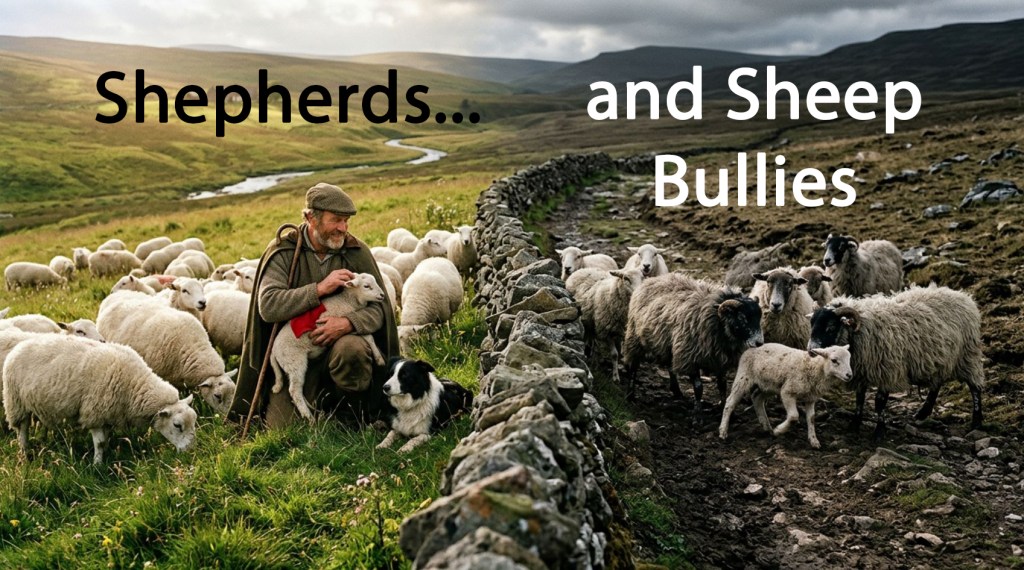
God begins this passage by describing nine things that he will do for his people. God will search for his sheep, look after his sheep, rescue them, bring them out from where they have been scattered, bring them home, give them pasture, tend them in good grazing land, bind up the injured, strengthen the weak, and shepherd the flock with justice. But after saying these things, God makes a distinction between two types of sheep. God describes those that are injured and weak, but also those that are sleek and strong, which is, at first, a little confusing because, while being strong would seem like a good thing, God says that he will destroy the strong. Then, God says that he will judge between the fat sheep and the lean sheep, which is still confusing, until it clears up in the next sentence. God describes the sheep who are sleek, strong, and fat as those who have been shoving with flank and shoulder, butting the weak with their horns and driving them away.
And suddenly it becomes clear that these sheep are not just strong and sleek, not just fat, but that they are the bullies that have abused and plundered the other sheep. Instead of the strong leading and protecting the weak, they have been sheep bullies who used their strength to steal from the weak and amass wealth and power at their expense. Instead of these poor leaders, God declares that he will place a shepherd over them who will tend them and, since Ezekiel wrote four hundred years after King David, we know that this shepherd will come from the family line of David.
And we see the same division between two types of sheep in the prophecy given by Jesus in Matthew 25:31-46, when he says:
31 “When the Son of Man comes in his glory, and all the angels with him, he will sit on his glorious throne. 32 All the nations will be gathered before him, and he will separate the people one from another as a shepherd separates the sheep from the goats. 33 He will put the sheep on his right and the goats on his left.
34 “Then the King will say to those on his right, ‘Come, you who are blessed by my Father; take your inheritance, the kingdom prepared for you since the creation of the world. 35 For I was hungry and you gave me something to eat, I was thirsty and you gave me something to drink, I was a stranger and you invited me in, 36 I needed clothes and you clothed me, I was sick and you looked after me, I was in prison and you came to visit me.’
37 “Then the righteous will answer him, ‘Lord, when did we see you hungry and feed you, or thirsty and give you something to drink? 38 When did we see you a stranger and invite you in, or needing clothes and clothe you? 39 When did we see you sick or in prison and go to visit you?’
40 “The King will reply, ‘Truly I tell you, whatever you did for one of the least of these brothers and sisters of mine, you did for me.’
41 “Then he will say to those on his left, ‘Depart from me, you who are cursed, into the eternal fire prepared for the devil and his angels. 42 For I was hungry and you gave me nothing to eat, I was thirsty and you gave me nothing to drink, 43 I was a stranger and you did not invite me in, I needed clothes and you did not clothe me, I was sick and in prison and you did not look after me.’
44 “They also will answer, ‘Lord, when did we see you hungry or thirsty or a stranger or needing clothes or sick or in prison, and did not help you?’
45 “He will reply, ‘Truly I tell you, whatever you did not do for one of the least of these, you did not do for me.’
46 “Then they will go away to eternal punishment, but the righteous to eternal life.”
Jesus says that the Son of Man, the Messiah, will sit on the throne and separate the people just as a shepherd separates the sheep from the goats. In other words, the Messiah will sit in judgement between two types of people, those who are blessed by God, and those who cursed and cast out of the kingdom of God. But when Jesus explains why, he paints with a finer brush than we heard in the words of Ezekiel. In Ezekiel, God said that he was sending a new shepherd that would bring justice to his flock and eliminate the sheep bullies that had plundered them. But Jesus’ explanation gives us a better understanding of how we will be judged. Jesus says that the people who will be blessed by God are the people who did something when they saw people around them who were hungry, thirsty, sick, without clothes, without friends, or in prison. And the people whom God condemns will be those who saw the same suffering… but did nothing about it. Jesus doesn’t say that the people in his story are Jews, or Christians, only that they were suffering. Jesus draws a line from the Old Testament to the present day and says that the people who ignored the suffering of those around them are the sheep bullies that God condemned in Ezekiel.
But in both scriptures, we see that it is the Messiah, Jesus, who is on the throne. It is the Messiah who will sit in judgment on the day of his return, and who God has appointed as the Chief Shepherd over all his people. And Paul emphasizes this same point in his letter to the church in Ephesus, as we read from Ephesians 1:15-23:
15 For this reason, ever since I heard about your faith in the Lord Jesus and your love for all God’s people, 16 I have not stopped giving thanks for you, remembering you in my prayers. 17 I keep asking that the God of our Lord Jesus Christ, the glorious Father, may give you the Spirit of wisdom and revelation, so that you may know him better. 18 I pray that the eyes of your heart may be enlightened in order that you may know the hope to which he has called you, the riches of his glorious inheritance in his holy people, 19 and his incomparably great power for us who believe. That power is the same as the mighty strength 20 he exerted when he raised Christ from the dead and seated him at his right hand in the heavenly realms, 21 far above all rule and authority, power and dominion, and every name that is invoked, not only in the present age but also in the one to come. 22 And God placed all things under his feet and appointed him to be head over everything for the church, 23 which is his body, the fullness of him who fills everything in every way.
Paul’s prayer is that God would give wisdom and revelation to the people of the church so that we would know Jesus better, that our eyes might be opened so that we can know the hope that Jesus gives, the amazing wealth that has been given to us as the children of God, and the unimaginable power that is at our disposal because we follow him. Paul reminds the people that God has appointed Jesus to rule over all creation and has appointed him to oversee everything for the church. It is appropriate to pause for a moment here and explain one word in this translation, and that is the word we read in English as “church.” In Greek this is the work ekklesia, and while we translate this as “church” it is not a religious word. In Greek it means, simply the assembly of the people, a congregation, or for a public meeting, ekklesia would be simply a gathering of citizens. It does not mean Methodist, or Catholic, or any other denomination. It simply means that God has appointed Jesus Christ as the chief shepherd over all who gather to worship him.
We should also note, from our reading of Ezekiel, that God did not begin with his announcement that he would send the Messiah to be our shepherd. God began that announcement by giving examples of how shepherds should act by listing the things that he himself has done, and will do, for his people. God will search for his sheep, look after his sheep, rescue them, bring them out from where they have been scattered, bring them home, give them pasture, tend them in good grazing land, bind up the injured, strengthen the weak, and shepherd the flock with justice. Our understanding is further expanded when we remember that God condemns those who use their strength to abuse, plunder, and profit from those who are weaker or less politically powerful than they are, and that Jesus has taught us that we will be blessed by God when we care, show compassion, and use our gifts to ease the suffering of others, and we will be cursed when we ignore the suffering and the needs of the people around us.
Let us rejoice that we serve Jesus, the great Chief Shepherd, who judges and watches over us with justice.
And let us strive to always live by his example, so that we will be good under-shepherds by caring and showing up for the people around us.
Please LIKE and SHARE!
Click here to subscribe to Pastor John’s blog.
Click here if you would like to subscribe to Pastor John’s weekly messages.
Click here to visit Pastor John’s YouTube channel.
*You have been reading a message presented at Christ United Methodist Church on the date noted at the top of the first page. Rev. John Partridge is the pastor at Christ UMC in Alliance, Ohio. Duplication of this message is a part of our Media ministry, if you have received a blessing in this way, we would love to hear from you. Letters and donations in support of the Media ministry or any of our other projects may be sent to Christ United Methodist Church, 470 East Broadway Street, Alliance, Ohio 44601. These messages are available to any interested persons regardless of membership. You may subscribe to these messages, in print or electronic formats, by writing to the address noted, or by contacting us at secretary@CUMCAlliance.org. These messages can also be found online at https://pastorpartridge.com . All Scripture quotations, unless otherwise indicated, are taken from the Holy Bible, New International Version®, NIV®. Copyright ©1973, 1978, 1984, 2011 by Biblica, Inc.™ Used by permission of Zondervan. All rights reserved worldwide. www.zondervan.comThe “NIV” and “New International Version” are trademarks registered in the United States Patent and Trademark Office by Biblica, Inc.™

