
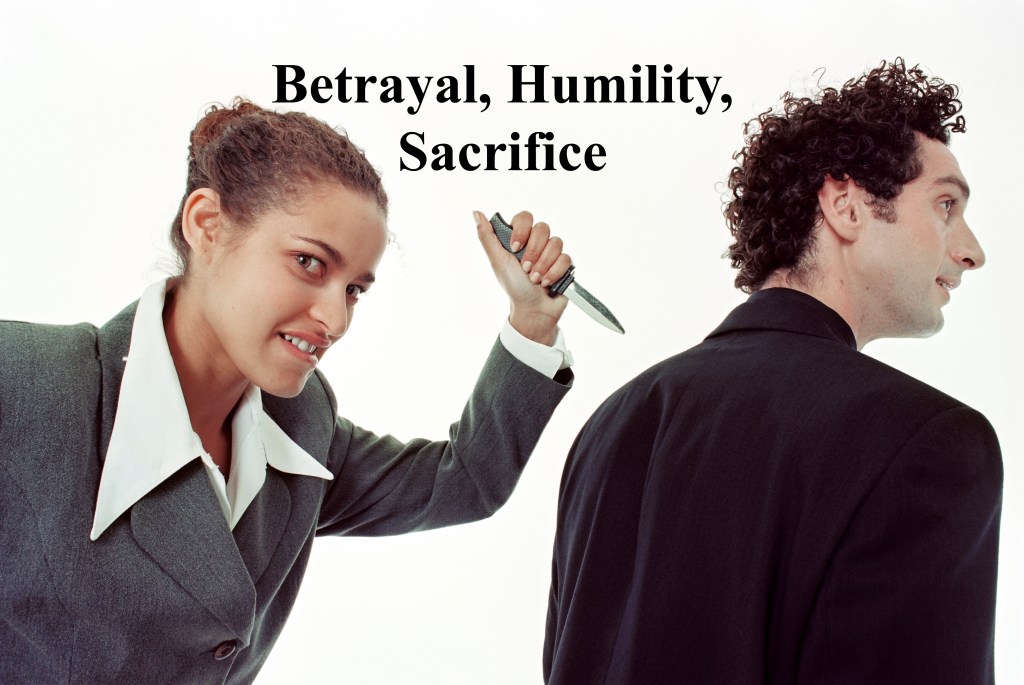
Betrayal, Humility, Sacrifice

Betrayal, Humility, Sacrifice

April 02, 2026*

(Holy Thursday)

By Pastor John Partridge

Exodus 12:1-4, (5-10), 11-14            

John 13:1-17, 31b-35           

1 Corinthians 11:23-26

What is it that makes your family, your church, your civic organization, or your community unique? What is the story that you tell others about how you started, or about your mission, that explains who you are and what you do? As I was growing up, I often heard that while we were encouraged to try new things, Partridges did not quit. If we tried something new, we had to give it a fair trial. Learning to play an instrument is difficult, and so was wrestling when I only weighed seventy-two pounds. But I wasn’t allowed to quit until I had, at least, completed a year or two of band and at least a full season of wrestling. I stayed in band until my second or third year in college and stayed in wrestling for two seasons until I finished junior high school. Patti and I sent the same message to our children when they were growing up. We encourage you to try new things, but once you start, you cannot quit until you’ve given it a fair chance. Every group, and every family, has similar stories that shape the character of the organization as well as the character of its members. And for the people of Israel, and later for the followers of Jesus Christ, one of those formative and defining stories is the story of the first Passover that we find in Exodus 12:1-4, (5-10), 11-14.

12:1 The Lord said to Moses and Aaron in Egypt, “This month is to be for you the first month, the first month of your year. Tell the whole community of Israel that on the tenth day of this month each man is to take a lamb for his family, one for each household. If any household is too small for a whole lamb, they must share one with their nearest neighbor, having taken into account the number of people there are. You are to determine the amount of lamb needed in accordance with what each person will eat. The animals you choose must be year-old males without defect, and you may take them from the sheep or the goats. Take care of them until the fourteenth day of the month, when all the members of the community of Israel must slaughter them at twilight. Then they are to take some of the blood and put it on the sides and tops of the doorframes of the houses where they eat the lambs. That same night they are to eat the meat roasted over the fire, along with bitter herbs, and bread made without yeast. Do not eat the meat raw or boiled in water, but roast it over a fire—with the head, legs, and internal organs. 10 Do not leave any of it till morning; if some is left till morning, you must burn it. 11 This is how you are to eat it: with your cloak tucked into your belt, your sandals on your feet and your staff in your hand. Eat it in haste; it is the Lord’s Passover.

12 “On that same night I will pass through Egypt and strike down every firstborn of both people and animals, and I will bring judgment on all the gods of Egypt. I am the Lord. 13 The blood will be a sign for you on the houses where you are, and when I see the blood, I will pass over you. No destructive plague will touch you when I strike Egypt.

14 “This is a day you are to commemorate; for the generations to come you shall celebrate it as a festival to the Lord—a lasting ordinance.

The Passover story declares to everyone that all of Israel, from the least to the greatest, is a family and that everyone is included. It is also a story of God’s rescue and his love for his people.

And it is with this background in mind that we enter the story of Jesus’ betrayal, arrest, and crucifixion found in John 13:1-17, 31b-35 and hear this:

13:1 It was just before the Passover Festival. Jesus knew that the hour had come for him to leave this world and go to the Father. Having loved his own who were in the world, he loved them to the end.

The evening meal was in progress, and the devil had already prompted Judas, the son of Simon Iscariot, to betray Jesus. Jesus knew that the Father had put all things under his power, and that he had come from God and was returning to God; so he got up from the meal, took off his outer clothing, and wrapped a towel around his waist. After that, he poured water into a basin and began to wash his disciples’ feet, drying them with the towel that was wrapped around him.

He came to Simon Peter, who said to him, “Lord, are you going to wash my feet?”

Jesus replied, “You do not realize now what I am doing, but later you will understand.”

“No,” said Peter, “you shall never wash my feet.”

Jesus answered, “Unless I wash you, you have no part with me.”

“Then, Lord,” Simon Peter replied, “not just my feet but my hands and my head as well!”

10 Jesus answered, “Those who have had a bath need only to wash their feet; their whole body is clean. And you are clean, though not every one of you.” 11 For he knew who was going to betray him, and that was why he said not every one was clean.

12 When he had finished washing their feet, he put on his clothes and returned to his place. “Do you understand what I have done for you?” he asked them. 13 “You call me ‘Teacher’ and ‘Lord,’ and rightly so, for that is what I am. 14 Now that I, your Lord, and Teacher, have washed your feet, you also should wash one another’s feet. 15 I have set you an example that you should do as I have done for you. 16 Very truly I tell you, no servant is greater than his master, nor is a messenger greater than the one who sent him. 17 Now that you know these things, you will be blessed if you do them.

31 When he [Judas] was gone, Jesus said, “Now the Son of Man is glorified, and God is glorified in him. 32 If God is glorified in him. God will glorify the Son in himself, and will glorify him at once.

33 “My children, I will be with you only a little longer. You will look for me, and just as I told the Jews, so I tell you now: Where I am going, you cannot come.

34 “A new command I give you: Love one another. As I have loved you, so you must love one another. 35 By this everyone will know that you are my disciples, if you love one another.”

Jesus knew that these were his last hours on earth and, rather than fleeing to save his own life, Jesus followed the pattern of God, of Israel, and of the Passover, by placing love, family, and rescue ahead of his own wellbeing. Jesus takes on the role of the lowest ranking servant and humbles himself as he washes the feet of those who follow him. Jesus says that just as every person who belongs to the nation of Israel is a part of the family, every person who follows him must be humble enough to wash feet and serve others. The distinguishing character of Jesus’ followers will not only be family but also love and humility. Jesus says, “By this everyone will know that you are my disciples, if you love one another.” This can’t be the ordinary love that we see among families and friends, but it must be so extra-ordinary, so singularly distinctive, that people will see it and know that we belong to Jesus.

But there is another thing that makes our community unique and shapes the character of the organization and its members, and it goes beyond who we are and how we act. In 1 Corinthians 11:23-26, the Apostle Paul explains it this way:

23 For I received from the Lord what I also passed on to you: The Lord Jesus, on the night he was betrayed, took bread, 24 and when he had given thanks, he broke it and said, “This is my body, which is for you; do this in remembrance of me.” 25 In the same way, after supper he took the cup, saying, “This cup is the new covenant in my blood; do this, whenever you drink it, in remembrance of me.” 26 For whenever you eat this bread and drink this cup, you proclaim the Lord’s death until he comes.

Paul says that he was passing what he knew forward to new generations and that this was a key part of his mission. It was important that he passed on to others the knowledge and teaching that he had received from God. He passed on the importance of sharing a meal at the Lord’s table and remembering Jesus’ last supper, but he emphasizes that each time we share that meal together, we proclaim the message of Jesus’ sacrifice, death, and resurrection and teach others about him. Our celebration of the Lord’s table, or the Eucharist, or Communion, is a reminder to us, and a reminder to the world, of the gift that Jesus gave to all of us. And, like Paul, our mission is not to keep that gift to ourselves, but to share it with others and pass it forward to new generations.


*You have been reading a message presented at Christ United Methodist Church on the date noted at the top of the first page.  Rev. John Partridge is the pastor at Christ UMC in Alliance, Ohio.  Duplication of this message is a part of our Media ministry, if you have received a blessing in this way, we would love to hear from you.  Letters and donations in support of the Media ministry or any of our other projects may be sent to Christ United Methodist Church, 470 East Broadway Street, Alliance, Ohio 44601.  These messages are available to any interested persons regardless of membership.  You may subscribe to these messages, in print or electronic formats, by writing to the address noted, or by contacting us at secretary@CUMCAlliance.org.  These messages can also be found online at https://pastorpartridge.com .  All Scripture quotations, unless otherwise indicated, are taken from the Holy Bible, New International Version®, NIV®. Copyright ©1973, 1978, 1984, 2011 by Biblica, Inc.™ Used by permission of Zondervan. All rights reserved worldwide. www.zondervan.com The “NIV” and “New International Version” are trademarks registered in the United States Patent and Trademark Office by Biblica, Inc.™


Paradigm Proclamation

Paradigm Proclamation

March 28, 2024*

(Holy Thursday)

By Pastor John Partridge

Exodus 12:1-4, (5-10), 11-14             John 13:1-17, 31b-35            1 Corinthians 11:23-26

As we gather for the celebration of Holy Thursday, or Maundy Thursday, we remember the story of the last supper but also the history of the people of Israel and the tradition that was likely being celebrated by Jesus and the disciples. If the meal that we know as the last supper was, in fact, the celebration of remembrance for the exodus of Israel from Egypt, none of the gospel writers explicitly say so.  We can be sure that it was during the week of Passover because John’s gospel points to it being the day before the official Passover celebration. In any case, this is the reason that these two events are traditionally connected.

And so, tonight, as we read the scriptures that relate to these two events, I want to highlight a consistent theme that flows through all of them, and that theme, is the proclamation of God’s message through the way that his followers, in other words all of us gathered here, live their lives. We begin this evening with the story of Israel’s departure from Egypt and the beginning of their journey to freedom and we read that story in Exodus 12:1-4, 11-14:

12:1 The Lord said to Moses and Aaron in Egypt, “This month is to be for you the first month, the first month of your year. Tell the whole community of Israel that on the tenth day of this month each man is to take a lambfor his family, one for each household. If any household is too small for a whole lamb, they must share one with their nearest neighbor, having taken into account the number of people there are. You are to determine the amount of lamb needed in accordance with what each person will eat. 11 This is how you are to eat it: with your cloak tucked into your belt, your sandals on your feet and your staff in your hand. Eat it in haste; it is the Lord’s Passover.

12 “On that same night I will pass through Egypt and strike down every firstborn of both people and animals, and I will bring judgment on all the gods of Egypt. I am the Lord. 13 The blood will be a sign for you on the houses where you are, and when I see the blood, I will pass over you. No destructive plague will touch you when I strike Egypt.

14 “This is a day you are to commemorate; for the generations to come you shall celebrate it as a festival to the Lord—a lasting ordinance.

You will notice that God commands two groups of people, those in the time of Moses, and all the future descendants of that group of people. God declares that these are the instructions for the people, and then declares that this is a day that should be celebrated as a festival forever.

This is God’s paradigm proclamation in which God says that those who follow him should establish a new normal, and a new tradition, which shall be done both now and forever.

We see this again when Jesus meets with his disciples for what we now name as the last supper. We read that story in John’s gospel in John 13:1-17, 31b-35 where it says:

13:1 It was just before the Passover Festival. Jesus knew that the hour had come for him to leave this world and go to the Father. Having loved his own who were in the world, he loved them to the end.

The evening meal was in progress, and the devil had already prompted Judas, the son of Simon Iscariot, to betray Jesus. Jesus knew that the Father had put all things under his power, and that he had come from God and was returning to God; so he got up from the meal, took off his outer clothing, and wrapped a towel around his waist. After that, he poured water into a basin and began to wash his disciples’ feet, drying them with the towel that was wrapped around him.

He came to Simon Peter, who said to him, “Lord, are you going to wash my feet?”

Jesus replied, “You do not realize now what I am doing, but later you will understand.”

“No,” said Peter, “you shall never wash my feet.”

Jesus answered, “Unless I wash you, you have no part with me.”

“Then, Lord,” Simon Peter replied, “not just my feet but my hands and my head as well!”

10 Jesus answered, “Those who have had a bath need only to wash their feet; their whole body is clean. And you are clean, though not every one of you.” 11 For he knew who was going to betray him, and that was why he said not every one was clean.

12 When he had finished washing their feet, he put on his clothes and returned to his place. “Do you understand what I have done for you?” he asked them. 13 “You call me ‘Teacher’ and ‘Lord,’ and rightly so, for that is what I am. 14 Now that I, your Lord and Teacher, have washed your feet, you also should wash one another’s feet. 15 I have set you an example that you should do as I have done for you. 16 Very truly I tell you, no servant is greater than his master, nor is a messenger greater than the one who sent him. 17 Now that you know these things, you will be blessed if you do them.

31 Jesus said, “Now the Son of Man is glorified, and God is glorified in him. 32 If God is glorified in him, God will glorify the Son in himself, and will glorify him at once.

33 “My children, I will be with you only a little longer. You will look for me, and just as I told the Jews, so I tell you now: Where I am going, you cannot come.

34 “A new command I give you: Love one another. As I have loved you, so you must love one another. 35 By this everyone will know that you are my disciples, if you love one another.”

Jesus declared, in the setting of the last supper, another paradigm proclamation that all who would follow him should do, and remember, forever. The first of these is foot-washing. Most churches, including ours, see this as a figurative command that we should serve the people that we lead, the people that work alongside, and the people around us. But some churches, such as our brethren friends, periodically celebrate a literal foot-washing service at church because they understand this command to be both literal and figurative. In either case, service to others, especially service to those under your authority, is something that Christians should do as a matter of habit and have in mind, and live out by example, regularly and perpetually.

The second of these is to love one another. The love that the followers of Jesus Christ have for the people in their church, in their communities, and all the people around them should be a mark of distinction. Christians aren’t called to simply be kind in the way that everyone in a culture is expected to be kind and polite to one another. Christians are called to be so loving that people who don’t know you would guess that you are a Christian because your love for others is so far above what is ordinarily seen. Folks, I have to say that that is certainly a high bar and a demanding standard, but that is exactly what Jesus expects us to do.

The third thing that came out of Jesus’ last supper with his disciples isn’t found directly in his words, but in those of Paul and are found in his first letter to the church in Corinth in 1 Corinthians 11:23-26, where he says:

23 For I received from the Lord what I also passed on to you: The Lord Jesus, on the night he was betrayed, took bread, 24 and when he had given thanks, he broke it and said, “This is my body, which is for you; do this in remembrance of me.” 25 In the same way, after supper he took the cup, saying, “This cup is the new covenant in my blood; do this, whenever you drink it, in remembrance of me.” 26 For whenever you eat this bread and drink this cup, you proclaim the Lord’s death until he comes.

Obviously, this is the one that you all expected me to talk about tonight. Although Jesus never specified that the last supper was to be a lasting ordinance or as a perpetual remembrance, it didn’t take long at all for the disciples and the followers of Jesus to decide that he had implied it and that they must remember it just as the people of Israel remembered the Passover.

These things that I have referred to this evening as “paradigm proclamations” are the things that God has called us to do conscientiously, regularly, and faithfully to remind us of who we are, to remember where we came from, to be the kind of people that God wants us to be, and to reveal God’s love to the world. The celebration of the Passover was something that marked Jewish believers and Jewish families as being Jewish. Likewise, if we are to be faithful followers of Jesus Christ, the people around us should know that we regularly celebrate communion when we meet together, that we serve the people that we lead and treat them like we would want to be treated, that we are committed to serving the others, and that our love is so distinctive, so… excessive, that we stand out from the ordinary kindness of our culture.

When we say that we are the followers of Jesus Christ, these are the things to which we have committed ourselves.

And, if we’re honest, we have work to do if we want to meet those high standards.


Please LIKE and SHARE!

Click here to subscribe to Pastor John’s blog.

Click here if you would like to subscribe to Pastor John’s weekly messages.

Click here to visit Pastor John’s YouTube channel.


*You have been reading a message presented at Christ United Methodist Church on the date noted at the top of the first page.  Rev. John Partridge is the pastor at Christ UMC in Alliance, Ohio.  Duplication of this message is a part of our Media ministry, if you have received a blessing in this way, we would love to hear from you.  Letters and donations in support of the Media ministry or any of our other projects may be sent to Christ United Methodist Church, 470 East Broadway Street, Alliance, Ohio 44601.  These messages are available to any interested persons regardless of membership.  You may subscribe to these messages, in print or electronic formats, by writing to the address noted, or by contacting us at secretary@CUMCAlliance.org.  These messages can also be found online at https://pastorpartridge.com .  All Scripture quotations, unless otherwise indicated, are taken from the Holy Bible, New International Version®, NIV®. Copyright ©1973, 1978, 1984, 2011 by Biblica, Inc.™ Used by permission of Zondervan. All rights reserved worldwide. www.zondervan.comThe “NIV” and “New International Version” are trademarks registered in the United States Patent and Trademark Office by Biblica, Inc.™

What Should We Remember?

Click here to listen to the podcast

Click here to watch the sermon: https://youtu.be/hrQ0XQN1qtA


What Should We Remember?

April 06, 2023*

(Holy Thursday)

By Pastor John Partridge

Exodus 12:1-4, 11-14                         John 13:1-17, 31b-35            1 Corinthians 11:23-26

Even a cursory glance at our history books reminds us that there are a great many things that we are supposed to remember.  We have been told that we should “Remember the Alamo,” “Remember the Maine,” “Remember the Lusitania,” remember Pearl Harbor, remember 9-11, and those don’t even count the movies that asked us to “Remember the Titans,” or political slogans like “Remember the Dreamers.”  Probably a good percentage of the people in this room could not tell me why we’re supposed to remember the Maine and even less what we should remember about the Lusitania even though most of those things happened less than 100 years ago and all of them happened within the last 200 years.

But some of the things that we are called upon to remember in church happened two thousand years ago, and others closer to 3500 years ago.  So, what is it that we should remember?  Specifically, as it relates to Holy Week and Easter, the first, and oldest, of these things is found in the story of Passover and the rescue of the people of Israel from their slavery in Egypt, roughly speaking depending on whether you believe in an early or a late date, around 1300 BCE.  We find God’s command to remember that event in Exodus 12:1-4, 11-14.

12:1 The Lord said to Moses and Aaron in Egypt, “This month is to be for you the first month, the first month of your year. Tell the whole community of Israel that on the tenth day of this month each man is to take a lambfor his family, one for each household. If any household is too small for a whole lamb, they must share one with their nearest neighbor, having taken into account the number of people there are. You are to determine the amount of lamb needed in accordance with what each person will eat.

11 This is how you are to eat it: with your cloak tucked into your belt, your sandals on your feet and your staff in your hand. Eat it in haste; it is the Lord’s Passover.

12 “On that same night I will pass through Egypt and strike down every firstborn of both people and animals, and I will bring judgment on all the gods of Egypt. I am the Lord. 13 The blood will be a sign for you on the houses where you are, and when I see the blood, I will pass over you. No destructive plague will touch you when I strike Egypt.

14 “This is a day you are to commemorate; for the generations to come you shall celebrate it as a festival to the Lord—a lasting ordinance.

After Israel is rescued from eight hundred years of slavery in Egypt, God commands them to celebrate that rescue every year so that they can remember it forever.

But then, more than a thousand years later, while Jesus and his disciples were celebrating Passover, Jesus gave them a new thing to remember.  We find that command in the story found in John 13:1-17, 31b-35.

13:1 It was just before the Passover Festival. Jesus knew that the hour had come for him to leave this world and go to the Father. Having loved his own who were in the world, he loved them to the end.

The evening meal was in progress, and the devil had already prompted Judas, the son of Simon Iscariot, to betray Jesus. Jesus knew that the Father had put all things under his power, and that he had come from God and was returning to God; so he got up from the meal, took off his outer clothing, and wrapped a towel around his waist. After that, he poured water into a basin and began to wash his disciples’ feet, drying them with the towel that was wrapped around him.

He came to Simon Peter, who said to him, “Lord, are you going to wash my feet?”

Jesus replied, “You do not realize now what I am doing, but later you will understand.”

“No,” said Peter, “you shall never wash my feet.”

Jesus answered, “Unless I wash you, you have no part with me.”

“Then, Lord,” Simon Peter replied, “not just my feet but my hands and my head as well!”

10 Jesus answered, “Those who have had a bath need only to wash their feet; their whole body is clean. And you are clean, though not every one of you.” 11 For he knew who was going to betray him, and that was why he said not every one was clean.

12 When he had finished washing their feet, he put on his clothes and returned to his place. “Do you understand what I have done for you?” he asked them. 13 “You call me ‘Teacher’ and ‘Lord,’ and rightly so, for that is what I am. 14 Now that I, your Lord and Teacher, have washed your feet, you also should wash one another’s feet. 15 I have set you an example that you should do as I have done for you. 16 Very truly I tell you, no servant is greater than his master, nor is a messenger greater than the one who sent him. 17 Now that you know these things, you will be blessed if you do them.

31 Jesus said, “Now the Son of Man is glorified, and God is glorified in him. 32 If God is glorified in him, God will glorify the Son in himself, and will glorify him at once.

33 “My children, I will be with you only a little longer. You will look for me, and just as I told the Jews, so I tell you now: Where I am going, you cannot come.

34 “A new command I give you: Love one another. As I have loved you, so you must love one another. 35 By this everyone will know that you are my disciples, if you love one another.”

Jesus didn’t repeal God’s command to remember Passover, he added to it.  Jesus said that just as they remembered God’s grace and the rescue of Israel from slavery, his followers should always remember how much he loved them.  But the way that they should remember his love was to love the people around them the way that Jesus had loved, to love with such an extravagant love, that everyone would know that they were his followers.

But that wasn’t the only thing that Jesus asked them to remember.  In 1 Corinthians 11:23-26, the Apostle Paul remembers something else that Jesus wanted his people to remember forever.  Paul says…

23 For I received from the Lord what I also passed on to you: The Lord Jesus, on the night he was betrayed, took bread, 24 and when he had given thanks, he broke it and said, “This is my body, which is for you; do this in remembrance of me.” 25 In the same way, after supper he took the cup, saying, “This cup is the new covenant in my blood; do this, whenever you drink it, in remembrance of me.” 26 For whenever you eat this bread and drink this cup, you proclaim the Lord’s death until he comes.

And so, much like “Remember the Alamo,” but far more urgent and enduring, God commands us to remember. What God wants us to remember is that although it took longer than they expected, God never stopped loving his people and rescued them from their slavery and distress.  God wants us to remember that his Son loved the people around him, and us, with an extravagant kind of love.  Jesus calls all of us who follow him to remember how much he loved, and calls us to love the people around us with the same extravagant, costly, even life-threatening love with which Jesus loved.  And finally, in place of sharing an annual Passover meal, Jesus asks us to regularly share this meal, the Eucharist, or communion, to remind us of all these things.  We share this meal together to remember the life, death, resurrection, and crazy, extravagant, costly, love of Jesus Christ and to remember that the love with which Jesus loved us, is the love to which he calls us to love others.

And that, is what we are supposed to remember.


Please LIKE and SHARE!

Click here to subscribe to Pastor John’s blog.

Click here if you would like to subscribe to Pastor John’s weekly messages.

Click here to visit Pastor John’s YouTube channel.


*You have been reading a message presented at Christ United Methodist Church on the date noted at the top of the first page.  Rev. John Partridge is the pastor at Christ UMC in Alliance, Ohio.  Duplication of this message is a part of our Media ministry, if you have received a blessing in this way, we would love to hear from you.  Letters and donations in support of the Media ministry or any of our other projects may be sent to Christ United Methodist Church, 470 East Broadway Street, Alliance, Ohio 44601.  These messages are available to any interested persons regardless of membership.  You may subscribe to these messages, in print or electronic formats, by writing to the address noted, or by contacting us at secretary@CUMCAlliance.org.  These messages can also be found online at https://pastorpartridge.com .  All Scripture quotations, unless otherwise indicated, are taken from the Holy Bible, New International Version®, NIV®. Copyright ©1973, 1978, 1984, 2011 by Biblica, Inc.™ Used by permission of Zondervan. All rights reserved worldwide. www.zondervan.comThe “NIV” and “New International Version” are trademarks registered in the United States Patent and Trademark Office by Biblica, Inc.™