
The Future and Fear

The Future and Fear

(Sixth Sunday after Easter)

June 01, 2025*

By Pastor John Partridge

John 14:23-29                        Acts 16:9-15               Revelation 21:10, 22 – 22:5

Where is your “safe place?”

Many creatures, including humans, have a safe place to which they retreat when they are frightened or stressed. Our cats can usually be found in predictable places, our dogs vary a little but, depending on the dog, it might be in their crate, or under the bed, under our feet in the living room, or on the sofa pressed as close to Patti’s lap as possible. Horses will often head for the barn, birds will huddle in their nests, rabbits in their underground warrens. For us humans, our safe place is usually somewhere at home, but it might also be in a boat out on the water, hiking in the woods, somewhere out on the golf course, or somewhere else. For each if us it’s the place where we retreat from the world, put our problems and fears behind us, and where we can just be comfortable being ourselves.

The trouble is that our safe places of retreat from the world do not protect us from our fears of the future. When we retreat to our bedroom, close the door, and hide under the covers of our bed, we still cannot shut out our fears of homelessness, financial ruin, sickness, violence, and other concerns. But what if there was such a place where our fears could be erased? What if there was a way to put our concerns and fears aside and know that our future was going to be okay after all?

The good news for today, and always, is that scripture tells us that there is such a place, and there is a way to know the future. We begin this morning reading the words of Jesus found in John 14:23-29 where John tells us this:

23 Jesus replied, “Anyone who loves me will obey my teaching. My Father will love them, and we will come to them and make our home with them. 24 Anyone who does not love me will not obey my teaching. These words you hear are not my own; they belong to the Father who sent me.

25 “All this I have spoken while still with you. 26 But the Advocate, the Holy Spirit, whom the Father will send in my name, will teach you all things and will remind you of everything I have said to you. 27 Peace I leave with you; my peace I give you. I do not give to you as the world gives. Do not let your hearts be troubled and do not be afraid.

28 “You heard me say, ‘I am going away and I am coming back to you.’ If you loved me, you would be glad that I am going to the Father, for the Father is greater than I. 29 I have told you now before it happens, so that when it does happen you will believe.

Jesus begins by describing an “if-then” transaction, if you love me, then you will obey my teaching. But, if you love me and obey me, then God will love you, his spirit will enter into you and make his home with you. And the gift that we receive when the Holy Spirit comes to live in us is a gift of peace, and a heart free from worry, concern, and fear. My friends, we worship a God who goes before us and prepares a way for us. An example of how God goes before us can be found in Acts 16:9-15 in which God calls Paul and his companions to travel to Macedonia. Paul doesn’t know how he will get there, who he will meet, how he will find them, where he will stay, what he will eat, or anything else that we would normally worry about, and yet, God has it all covered.

During the night Paul had a vision of a man of Macedonia standing and begging him, “Come over to Macedonia and help us.” 10 After Paul had seen the vision, we got ready at once to leave for Macedonia, concluding that God had called us to preach the gospel to them.

11 From Troas we put out to sea and sailed straight for Samothrace, and the next day we went on to Neapolis. 12 From there we traveled to Philippi, a Roman colony and the leading city of that districtof Macedonia. And we stayed there several days.

  13 On the Sabbath we went outside the city gate to the river, where we expected to find a place of prayer. We sat down and began to speak to the women who had gathered there. 14 One of those listening was a woman from the city of Thyatira named Lydia, a dealer in purple cloth. She was a worshiper of God. The Lord opened her heart to respond to Paul’s message. 15 When she and the members of her household were baptized, she invited us to her home. “If you consider me a believer in the Lord,” she said, “come and stay at my house.” And she persuaded us.

In this example, Paul’s primary concern is obedience to God, but we remember the message that we just read in John where Jesus says, if they obey by teaching, then God will love them, and the Holy Spirit will go with them. Paul receives a call from God and sets out to obey. I am certain that he still had questions about where he was going but he goes anyway. They eventually arrive, spend a few days in the district of Macedonia and then find their way to river to pray on the Sabbath. Because it was the practice of the Jews to bathe, if possible, in living water, or moving water, as a means of purification, it was common for the followers of God in distant places to gather by rivers and other streams of water. And so, on the Sabbath, Paul and his companions find their way to the river to worship and pray, and to seek out any others in that place who might also share their faith in God. And so it is that they meet Lydia, a businesswoman, and as they share the gospel message of Jesus’ life, death, and resurrection, Lydia believes, and she, and her entire household, are baptized. And, having done so, Lydia invites Paul, and his companions, to stay in her home and to eat her food while they are in Macedonia.

Paul heard God’s call and was obedient even though he had no idea what he would do, where he would live, or much of anything else. But even before God called him, God was already preparing a way for Paul and his companions and, by the time Paul arrived, there was a heart that was open to hear, a place to stay, and food to eat. The example of scripture tells us that we can trust God if only we have the faith to be obedient to his calling on our lives. But what about the future? What can we know about our eternal destination? In the end, God isn’t just calling us to ministry in Macedonia, but to a lifetime of faithfulness. Jesus promises us a life of peace without fear, but death, and what lies beyond the veil of death is a source of fear for many people and our worry about what comes next can destroy our peace. So, what can we know about what awaits us on the distant shore of eternal life? In Revelation 21:10, 22 – 22:5, John was able to see our future home and he described his experience this way:

10 And he carried me away in the Spirit to a mountain great and high, and showed me the Holy City, Jerusalem, coming down out of heaven from God.

22 I did not see a temple in the city, because the Lord God Almighty and the Lamb are its temple. 23 The city does not need the sun or the moon to shine on it, for the glory of God gives it light, and the Lamb is its lamp. 24 The nations will walk by its light, and the kings of the earth will bring their splendor into it. 25 On no day will its gates ever be shut, for there will be no night there. 26 The glory and honor of the nations will be brought into it. 27 Nothing impure will ever enter it, nor will anyone who does what is shameful or deceitful, but only those whose names are written in the Lamb’s book of life.

22:1 Then the angel showed me the river of the water of life, as clear as crystal, flowing from the throne of God and of the Lamb down the middle of the great street of the city. On each side of the river stood the tree of life, bearing twelve crops of fruit, yielding its fruit every month. And the leaves of the tree are for the healing of the nations. No longer will there be any curse. The throne of God and of the Lamb will be in the city, and his servants will serve him. They will see his face, and his name will be on their foreheads. There will be no more night. They will not need the light of a lamp or the light of the sun, for the Lord God will give them light. And they will reign for ever and ever.

Every city that has been built with walls for protection has included gates that could be closed to prevent the enemies of the people from entering. It was common, even normal, for the gates to be closed after dark when the guards were unable to see well enough to defend them properly. But John says that the gates of the new Jerusalem will never be shut because the light of God’s glory illuminates the city so well that it is always in daylight. Moreover, it is always safe in God’s city, no enemy, no impurity, no shame, deceit, or anything else will never enter it so that all who dwell within its walls will always live in peace and safety.

But John also tells us that the source of the river of life, which we heard about last week when Jesus said that all who are thirsty will drink the water of life. The source of life, John says, flows out from the throne of God and, as the river flows through the center of the street, the food from the tree of life grows abundantly, the leaves of the trees are able to heal the nations so that all may live together in peace, all curses are removed, and God’s people will be purified, forgiven, fed, healed, and blessed so that they can live without fear in safety and freedom for all time as they serve God.

Jesus said, “Anyone who loves me will obey my teaching.” And, anyone who is obedient, will be blessed by God, in both this life and in the next. God will dwell within us, prepare a way for us in this life, and prepare a home without fear for us in the next. We need not have any fear for our future; we only need to listen for God’s voice and obey his call on our lives.


Please LIKE and SHARE!

Click here to subscribe to Pastor John’s blog.

Click here if you would like to subscribe to Pastor John’s weekly messages.

Click here to visit Pastor John’s YouTube channel.


*You have been reading a message presented at Christ United Methodist Church on the date noted at the top of the first page.  Rev. John Partridge is the pastor at Christ UMC in Alliance, Ohio.  Duplication of this message is a part of our Media ministry, if you have received a blessing in this way, we would love to hear from you.  Letters and donations in support of the Media ministry or any of our other projects may be sent to Christ United Methodist Church, 470 East Broadway Street, Alliance, Ohio 44601.  These messages are available to any interested persons regardless of membership.  You may subscribe to these messages, in print or electronic formats, by writing to the address noted, or by contacting us at secretary@CUMCAlliance.org.  These messages can also be found online at https://pastorpartridge.com .  All Scripture quotations, unless otherwise indicated, are taken from the Holy Bible, New International Version®, NIV®. Copyright ©1973, 1978, 1984, 2011 by Biblica, Inc.™ Used by permission of Zondervan. All rights reserved worldwide. www.zondervan.comThe “NIV” and “New International Version” are trademarks registered in the United States Patent and Trademark Office by Biblica, Inc.™
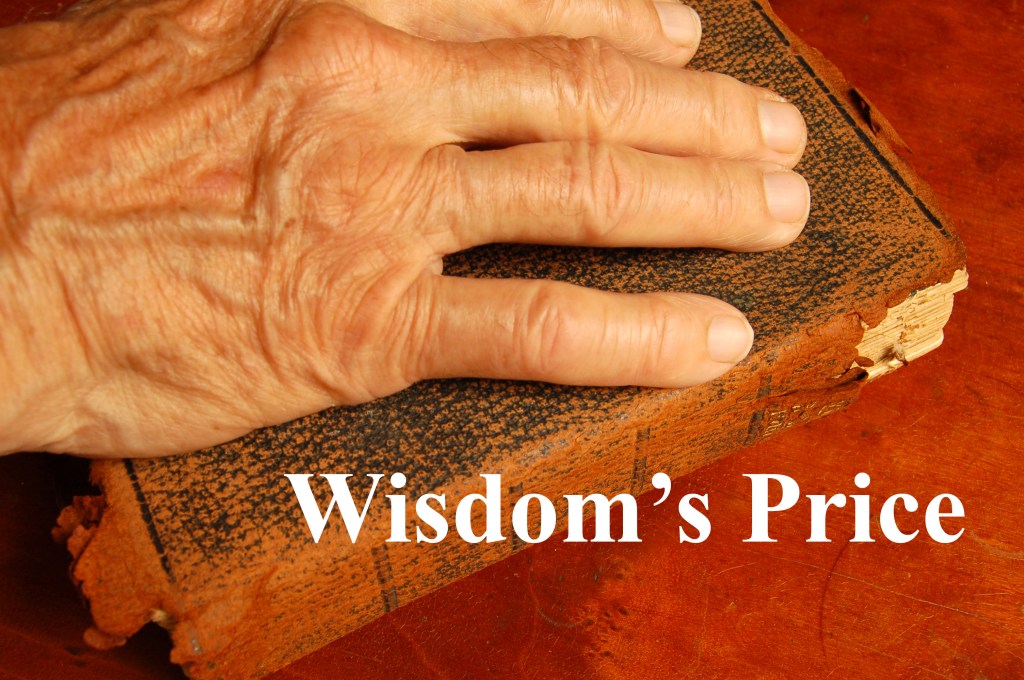
Wisdom’s Price

Wisdom’s Price

September 15, 2024*

By Pastor John Partridge

Proverbs 1:20-33                   Mark 8:27-38                         James 3:1-12

There is a downside to freedom.

I don’t know why we are surprised by that. In several movies and books there is a speech, usually by one of the villains, justifying why it is good, or why people like it, when they become powerful dictators and take away people’s freedom. The argument, they say, is that freedom means having the freedom to do evil, but under their benevolent dictatorship, people will no longer be free to do evil, so everyone will be safe. People are often willing to give away their freedom in order to feel as if they are safe even if doing so makes them less safe in the long run. That’s why Benjamin Franklin once said: “Those who would give up essential liberty, to purchase a little temporary safety, deserve neither liberty nor safety.”

As much as we don’t like it, real freedom includes the freedom to choose evil.

Similarly, there is a price to be paid for our ability to choose wisdom simply because the freedom to choose means that not everyone will choose to be wise. We begin this this morning by reading from Proverbs 1:20-33 where we hear wisdom ask how long people will choose ignorance.

20 Out in the open wisdom calls aloud,
    she raises her voice in the public square;
21 on top of the wall she cries out,
    at the city gate she makes her speech:

22 “How long will you who are simple love your simple ways?
    How long will mockers delight in mockery
    and fools hate knowledge?
23 Repent at my rebuke!
    Then I will pour out my thoughts to you,
    I will make known to you my teachings.
24 But since you refuse to listen when I call
    and no one pays attention when I stretch out my hand,
25 since you disregard all my advice
    and do not accept my rebuke,
26 I in turn will laugh when disaster strikes you;
    I will mock when calamity overtakes you—
27 when calamity overtakes you like a storm,
    when disaster sweeps over you like a whirlwind,
    when distress and trouble overwhelm you.

28 “Then they will call to me but I will not answer;
    they will look for me but will not find me,
29 since they hated knowledge
    and did not choose to fear the Lord.
30 Since they would not accept my advice
    and spurned my rebuke,
31 they will eat the fruit of their ways
    and be filled with the fruit of their schemes.
32 For the waywardness of the simple will kill them,
    and the complacency of fools will destroy them;
33 but whoever listens to me will live in safety
    and be at ease, without fear of harm.”

Wisdom, who is here portrayed as a person, cries out from the public square and from the city gate, and asks how long people will hate knowledge and choose ignorance. But, since the people refuse to listen to wisdom, she will laugh when the avoidable disaster comes upon them. When calamity and disaster come, it will be too late to learn wisdom and to call upon the wise to save them. Since the people hated knowledge, they did not follow God, and their waywardness would kill them. In contrast, the people who listened to wisdom would live in safety without fear of harm.

The point is that there is a price for rejecting wisdom.

Oddly enough, that is the same point being made when Peter tries to rebuke Jesus for teaching about his death and resurrection in Mark 8:27-38 where we hear this:

27 Jesus and his disciples went on to the villages around Caesarea Philippi. On the way he asked them, “Who do people say I am?”

28 They replied, “Some say John the Baptist; others say Elijah; and still others, one of the prophets.”

29 “But what about you?” he asked. “Who do you say I am?”

Peter answered, “You are the Messiah.”

30 Jesus warned them not to tell anyone about him.

31 He then began to teach them that the Son of Man must suffer many things and be rejected by the elders, the chief priests, and the teachers of the law, and that he must be killed and after three days rise again. 32 He spoke plainly about this, and Peter took him aside and began to rebuke him.

33 But when Jesus turned and looked at his disciples, he rebuked Peter. “Get behind me, Satan!” he said. “You do not have in mind the concerns of God, but merely human concerns.”

34 Then he called the crowd to him along with his disciples and said: “Whoever wants to be my disciple must deny themselves and take up their cross and follow me. 35 For whoever wants to save their lifewill lose it, but whoever loses their life for me and for the gospel will save it. 36 What good is it for someone to gain the whole world, yet forfeit their soul? 37 Or what can anyone give in exchange for their soul? 38 If anyone is ashamed of me and my words in this adulterous and sinful generation, the Son of Man will be ashamed of them when he comes in his Father’s glory with the holy angels.”

Jesus rebukes Peter for rejecting his teaching that he must die and rise again. Although that was not his intent, Peter is openly rejecting wisdom and Jesus describes it as putting selfish human concerns ahead of the concerns of God.

And finally, in James 3:1-12, Jesus’ brother shares the challenge that we have with our freedom to speak. He reminds us that we are judged for what we teach, but even speaking in our everyday lives is complicated because we are prone to say things that we should not say. James says…

3:1 Not many of you should become teachers, my fellow believers, because you know that we who teach will be judged more strictly. We all stumble in many ways. Anyone who is never at fault in what they say is perfect, able to keep their whole body in check.

When we put bits into the mouths of horses to make them obey us, we can turn the whole animal. Or take ships as an example. Although they are so large and are driven by strong winds, they are steered by a very small rudder wherever the pilot wants to go. Likewise, the tongue is a small part of the body, but it makes great boasts. Consider what a great forest is set on fire by a small spark. The tongue also is a fire, a world of evil among the parts of the body. It corrupts the whole body, sets the whole course of one’s life on fire, and is itself set on fire by hell.

All kinds of animals, birds, reptiles, and sea creatures are being tamed and have been tamed by mankind, but no human being can tame the tongue. It is a restless evil, full of deadly poison.

With the tongue we praise our Lord and Father, and with it we curse human beings, who have been made in God’s likeness. 10 Out of the same mouth come praise and cursing. My brothers and sisters, this should not be. 11 Can both fresh water and salt water flow from the same spring? 12 My brothers and sisters, can a fig tree bear olives, or a grapevine bear figs? Neither can a salt spring produce fresh water.

James reminds us that while humans have set themselves up as masters of the universe, controlling horses, training animals of all kinds, steering ships around the world, and two thousand years later our control is even greater. But despite our mastery of physics, chemistry, and other sciences and technology, we often cannot control the words that come out of our own mouths. The freedom that we have to say whatever we want to say often reveals the corruption that lives in our hearts. We say that we follow God and believe in his wisdom but, like Peter, often cling to our selfishness and speak words that do not reflect God at all.

This has been the challenge for all time. God has given us the freedom to choose or to reject wisdom but choosing to reject wisdom and to cling to selfishness comes at a price. Just as it did in the days of Solomon and his Proverbs, rejecting wisdom often results in disaster, calamity, and death that could have been avoided if we had only listened. Like Peter, despite our best intentions, we are inclined to accept Jesus when his teaching aligns with our desires but reject him when his teaching stands in opposition to our selfishness. We praise God on Sunday but curse our enemies on Monday.

Every day we are faced with a choice. We can choose knowledge or not. We can choose wisdom or not. We can choose Jesus… or not. We can choose obedience… or not. Will we master ourselves as well as we have mastered animals, science, and technology? Will we give our allegiance… completely, to Jesus? Or will we stubbornly cling to our selfishness?

We are free to choose.

But as it has always been, there is a price to be paid for rejecting wisdom.


*You have been reading a message presented at Christ United Methodist Church on the date noted at the top of the first page.  Rev. John Partridge is the pastor at Christ UMC in Alliance, Ohio.  Duplication of this message is a part of our Media ministry, if you have received a blessing in this way, we would love to hear from you.  Letters and donations in support of the Media ministry or any of our other projects may be sent to Christ United Methodist Church, 470 East Broadway Street, Alliance, Ohio 44601.  These messages are available to any interested persons regardless of membership.  You may subscribe to these messages, in print or electronic formats, by writing to the address noted, or by contacting us at secretary@CUMCAlliance.org.  These messages can also be found online at https://pastorpartridge.com .  All Scripture quotations, unless otherwise indicated, are taken from the Holy Bible, New International Version®, NIV®. Copyright ©1973, 1978, 1984, 2011 by Biblica, Inc.™ Used by permission of Zondervan. All rights reserved worldwide. www.zondervan.comThe “NIV” and “New International Version” are trademarks registered in the United States Patent and Trademark Office by Biblica, Inc.™

Photo by juliaf on Freeimages.com

Where is Your Center?

Where is Your Center?

March 07, 2021*

By Pastor John Partridge

Exodus 20:1-17                      John 2:13-22                          1 Corinthians 1:18-25

Throughout our lives, there are many times when the center becomes important.

The most important actor is said to be center-stage.  Children that want to feel important are trying to be the center of attention.  When we ride a bicycle, design, or fly an airplane, the center of gravity is critical.  In rocketry the relationship between the center of gravity and the center of pressure determines whether you fly or crash.  If you are setting a project up on a lathe, you must carefully calculate where the center of the work-piece is or, wherever the chuck and the spindle are set will quickly become the center regardless of whether you intended it to be that way.  If you are trying to walk across a balance beam, or a tightrope, or even just a log across a creek, keeping your center of gravity over the beam, rope, or log is the key to crossing successfully.  In all these things, and in a great many others, it is the center that is important, and keeping the center in the right place is critical to arriving at your destination safely and achieving your goal.  With that in mind, it shouldn’t come as a surprise that scripture says the same thing.  If we want to arrive at our destination safely, and achieve our goals, it is critical that we center our lives in the right place.

We begin this morning with what many people consider to be some of the simplest rules for life, the Nine or Ten Commandments (depending on how you count them) found in Exodus 20:1-17. 

20:1 And God spoke all these words:

“I am the Lord your God, who brought you out of Egypt, out of the land of slavery.

“You shall have no other gods before me.

“You shall not make for yourself an image in the form of anything in heaven above or on the earth beneath or in the waters below. You shall not bow down to them or worship them; for I, the Lord your God, am a jealous God, punishing the children for the sin of the parents to the third and fourth generation of those who hate me, but showing love to a thousand generations of those who love me and keep my commandments.

“You shall not misuse the name of the Lord your God, for the Lord will not hold anyone guiltless who misuses his name.

“Remember the Sabbath day by keeping it holy. Six days you shall labor and do all your work, 10 but the seventh day is a sabbath to the Lord your God. On it you shall not do any work, neither you, nor your son or daughter, nor your male or female servant, nor your animals, nor any foreigner residing in your towns. 11 For in six days the Lord made the heavens and the earth, the sea, and all that is in them, but he rested on the seventh day. Therefore, the Lord blessed the Sabbath day and made it holy.

12 “Honor your father and your mother, so that you may live long in the land the Lord your God is giving you.

13 “You shall not murder.

14 “You shall not commit adultery.

15 “You shall not steal.

16 “You shall not give false testimony against your neighbor.

17 “You shall not covet your neighbor’s house. You shall not covet your neighbor’s wife, or his male or female servant, his ox or donkey, or anything that belongs to your neighbor.”

Obviously, I could preach an entire series of sermons on these basic instructions, but this morning I want to focus on just two or three.  Depending on you how you count them, “You shall have no other gods before me.” and “You shall not make for yourself an image…” is either one, or two, commandments but either way, the instruction is clear.  Our relationship with God is important and God will not accept second place.  And that relationship is also why God sets aside one day each week for us to rest, to remember, and to spend time together when he commands us to, “Remember the Sabbath day by keeping it holy.”

God insists, even requires, that we keep him, and our relationship with him, at the center our lives.

And one of the best-known illustrations of the seriousness with which God takes our obedience to that commandment is found in John 2:13-22, where Jesus arrives in God’s temple in Jerusalem, and finds the Court of the Gentiles, the place of prayer for non-Jews, filled will merchants, bankers, and livestock.

13 When it was almost time for the Jewish Passover, Jesus went up to Jerusalem. 14 In the temple courts he found people selling cattle, sheep and doves, and others sitting at tables exchanging money. 15 So he made a whip out of cords, and drove all from the temple courts, both sheep and cattle; he scattered the coins of the money changers and overturned their tables. 16 To those who sold doves he said, “Get these out of here! Stop turning my Father’s house into a market!” 17 His disciples remembered that it is written: “Zeal for your house will consume me.”

18 The Jews then responded to him, “What sign can you show us to prove your authority to do all this?”

19 Jesus answered them, “Destroy this temple, and I will raise it again in three days.”

20 They replied, “It has taken forty-six years to build this temple, and you are going to raise it in three days?” 21 But the temple he had spoken of was his body. 22 After he was raised from the dead, his disciples recalled what he had said. Then they believed the scripture and the words that Jesus had spoken.

Jesus came to Jerusalem to celebrate the freedom of the Jewish people and to give thanks to God for his strength, wisdom, and guidance in leading Moses and the people of Israel out of their captivity in Egypt and into the Promised Land.  But in a place that had been deliberately set aside as a place for Gentiles to meet God, Jesus finds it filled with people who have put profit before prayer, wealth before worship, and greed before God.  In this place that was supposed to be the center of praise, prayer, and worship, Jesus finds the leaders of the church breaking commandments 1, 2, 3, 4, 8, 10, and, if we include the events of Easter, we can add commandments 6 and 9 as well.

Jesus is so offended by this violation of God’s house that he drives out the animals, scatters the money across the courtyard, and flips over the tables of the vendors and bankers.  And, rather than dispute their wrongdoing or profess their innocence, the offenders ask Jesus what authority he has to rebuke them, and Jesus responds by offering his own death and resurrection as proof.  But, of course, not even his disciples understood his meaning until after the events of Easter had unfolded.  But, when they remembered what Jesus had done, and what he had said, “they believed the scriptures and the words that Jesus had spoken.”

The mistake of the vendors, the bankers, and the church leaders was that they allowed something other than God to become the center.  Certainly, in a temple that was dedicated to the worship of a Jewish God, the court of the Gentiles was used less frequently than any other.  It was entirely possible that, particularly during a Jewish feast or festival such as Passover, that few, if any Gentiles would be using the space set aside for them.  But God had deliberately created a place for them.  And when the church decided to use that space, they moved God aside and placed practicality, profit, convenience, and greed in the center of their lives and in the center of their worship in his place.

It is that idea of centered-ness that helps us to understand some of the other difficult things that we find in scripture as well as in our spiritual lives.  And this is the idea that allows us to understand what Paul is saying to the church in Corinth, and to us, in 1 Corinthians 1:18-25 when he says:

18 For the message of the cross is foolishness to those who are perishing, but to us who are being saved it is the power of God. 19 For it is written:

“I will destroy the wisdom of the wise;
    the intelligence of the intelligent I will frustrate.”

20 Where is the wise person? Where is the teacher of the law? Where is the philosopher of this age? Has not God made foolish the wisdom of the world? 21 For since in the wisdom of God the world through its wisdom did not know him, God was pleased through the foolishness of what was preached to save those who believe. 22 Jews demand signs and Greeks look for wisdom, 23 but we preach Christ crucified: a stumbling block to Jews and foolishness to Gentiles, 24 but to those whom God has called, both Jews and Greeks, Christ the power of God and the wisdom of God. 25 For the foolishness of God is wiser than human wisdom, and the weakness of God is stronger than human strength.

There have been times when I read this passage and puzzled a bit over what Paul meant by destroying the wisdom of the wise when much of scripture points toward, and sings the praises of, wisdom.  Similarly, it is difficult to say bad things about intelligence, or intelligent people, so if I didn’t also know some particularly foolish intelligent people that would also be difficult.  But Paul goes on to criticize the teachers of the law, philosophers, and preachers and it can be hard to make sense of what he’s getting at.  But, if we look at this passage through the lens of centered-ness, it comes into better focus.

The message of the cross is foolishness to the people who are perishing.  Or, put another way, the message of the cross doesn’t make sense to the people who have rejected Jesus.  But while that rejection can come in many forms, and while some of those forms can occasionally be surprising to us, at their core, all of them have the same root cause, the removal, or the absence of God at the center.  Those who seek wisdom without God in the center become foolish.  Those who study to become learned and intelligent but who do not keep God at the center will be frustrated.  The teachers of the law and scripture, who shift God away from the center and allow rules, or politics, or power, or anything else to take God’s place in the center has, ultimately, rejected God.

Without God at the center of our lives, our strength, our philosophy, our wisdom, our religiosity, all fail.

Not only are we commanded to keep God in the center, and not only is Jesus deadly serious about maintaining that centered-ness, but our very lives also depend upon it.

Allowing God to drift away from the center means that we have rejected him and allowed something other than God to take his place.  And rejecting God… is death.

If you are trying to walk across a balance beam, or a tightrope, or even just a log across a creek, keeping your center of gravity over the beam, rope, or log is the key to crossing successfully.  In all these things, and in a great many others, it is the center that is important, and keeping the center in the right place is critical to arriving at your destination safely and achieving your goal.  If we want to arrive at our destination safely, and achieve our goals, it is critical that we center our lives in the right place.

As we continue our journey through Lent, I urge you to think about where your heart is and to reflect upon the condition of your inner being as you answer the question of the first four commandments:

Where is your center?


You can find the video of this worship service here: https://youtu.be/g88ngwoGI64

Did you enjoy reading this?

Click here if you would like to subscribe to Pastor John’s weekly messages.

Click here to subscribe to Pastor John’s blog.

Click here to visit Pastor John’s YouTube channel.


*You have been reading a message presented at Christ United Methodist Church on the date noted at the top of the first page.  Rev. John Partridge is the pastor at Christ UMC in Alliance, Ohio.  Duplication of this message is a part of our Media ministry, if you have received a blessing in this way, we would love to hear from you.  Letters and donations in support of the Media ministry or any of our other projects may be sent to Christ United Methodist Church, 470 East Broadway Street, Alliance, Ohio 44601. These messages are available to any interested persons regardless of membership.  You may subscribe to these messages, in print or electronic formats, by writing to the address noted, or by contacting us at secretary@CUMCAlliance.org.  If you have questions, you can ask them in our discussion forum on Facebook (search for Pastor John Online).  These messages can also be found online at https://pastorpartridge.wordpress.com/. All Scripture references are from the New International Version unless otherwise noted.