Trust is a Big Deal


    Have you ever had one of those “Duh!” moments when things start to make sense for the first time? But there are also moments when we read scripture and we completely miss important things because we assume that the people in the Bible were just like us.  In our scripture lesson this week, we read the story of Moses leading the people of Israel through the dry path God had created in the depths of the Red Sea.  But after the chariots, horsemen and soldiers of Egypt’s army are drowned, we read these verses in Exodus 14:30-31:
That day the Lord saved Israel from the hands of the Egyptians, and Israel saw the Egyptians lying dead on the shore.  And when the Israelites saw the mighty hand of the Lord displayed against the Egyptians, the people feared the Lord and put their trust in him and in Moses his servant.
    Most of us read this and think, “So what? They trusted God. God is trustworthy. Duh.”  And, because we assume that the people of Israel were just like us, we completely miss what a big deal this really was.
    We have lived our lives in possession of the entire Old Testament as well as the New Testament.  For many of us, there has never really been much doubt that God was trustworthy, even when we weren’t sure that God was real.  But the people of the Exodus did not know what we know.  The world that they lived in, and the gods that they knew, were very different.
    In the story of the Exodus, despite coming from the family of Abraham, Isaac, and Jacob, the Israelites had lived in the land of Egypt for 400 years.  At that time, they did not have a formal system of worship, or priesthood, they had stories.  The stories of their forefathers had been passed down to them from generation to generation, and even though the stories were magnificent, they lived in a world with very different stories.
    The Egyptians, like the Romans and the Greeks of the New Testament, were polytheists.  They believed, not in the one God of Israel, but in a collection of gods that were far from trustworthy.  The gods warred with one another through human agents and tens of thousands died for their amusement.  The gods of the Egyptians were capricious; they did what they wanted, when they wanted, often without any guiding morality.  To the gods, humans were little more than playthings and to humans, the gods were to be feared and not trusted.
    And so when the people of Israel saw that the God of Abraham had used his great power, not only to provide a means for them to escape their slavery, but to destroy those who sought to kill them, they saw, many for the first time, that their God was different.  Finally, the stories began to make sense.  They realized that the God of Abraham, Isaac, Jacob and Joseph was different than the gods of the Egyptians. 
They realized that the God of Israel could be trusted.
And trust really is a big deal.

—————————————————————————————————

To have Crossfusion delivered directly to your email, click here.
Who Watches the Supplies? – A Football Meditation


    In the books of first and second Samuel we read the story of King David.  Many of us have heard stories about David, but there is at least one that we don’t often remember.  In 1 Samuel 30, we find David and 600 men who had just returned from fighting alongside Achish the king of the Philistines.  As they return home they discover that the Amalekites had raided their town, captured their wives (including two of David’s wives), their children, their livestock, as well as anything of value.  After consulting with their priest to find the will of God, David pursues the Amalekite raiding party.
    As they hurry to catch up to the raiders however, David finds that two hundred of his men are too exhausted to continue and so he leaves them behind with all their gear, supplies and what is left of their town.  David and the four hundred remaining men pursue the Amalekite raiding party and find them celebrating over all the loot that they had plundered.  David and his men attack and fight with the Amalekites from dusk that day, until the end of the following day, defeat them, and recapture every single animal, personal belonging, wife and family member.
    But when they return to their camp, the troublemakers began to stir things up.  They argued with David that the two hundred men who were left behind should not receive any of the plunder because they didn’t fight to get it.  They argued that these men should get their families back, but receive no share of the loot and plunder that they had taken from the Amalekites.
    David fights back.  David makes an argument that is important to every single one of us and one that is important to each of you on the football field.  David said:
“No, my brothers, you must not do that with what the Lord has given us. He has protected us and delivered into our hands the raiding party that came against us. 24 Who will listen to what you say? The share of the man who stayed with the supplies is to be the same as that of him who went down to the battle. All will share alike.” 25 David made this a statute and ordinance for Israel from that day to this.
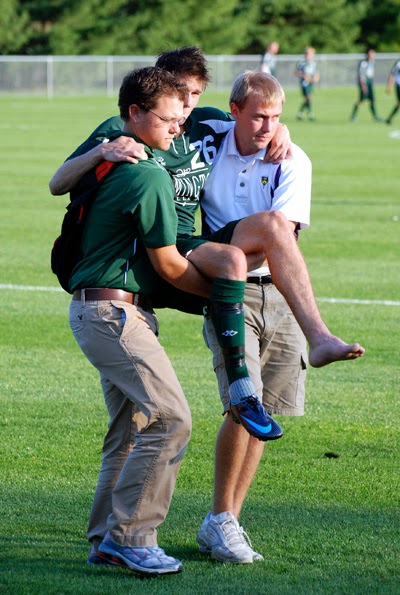
    It is important to remember that when you win, it isn’t just the superstars and the heroes that win the game.  Every member of your team had a part, Every coach, every water boy, every trainer, every teacher you ever had who helped you to earn the grades you needed to play ball, it took the guy on the sidelines who sprained his ankle before the season started, every football booster, every friend who gave you a ride home from practice, every relative, every parent, and every brother or sister that comes to watch you play.  As David said, these are the people who “watch the supplies” for you. 
    When you win, it isn’t just because of the guy who threw the touchdown pass, or who caught the interception, or who made the big tackle.  Your victory didn’t come because of the superstars; it took every single one of you. 
And that includes the people who just watch the supplies.

—————————————————————————————————

To have Crossfusion delivered directly to your email, click here.

Youth Questions: What is Communion? Why do we do it like that?


Note: I asked our youth to write down any questions that they had about faith, the church, or life in general.  This is a part of that series.
 

Question: Why do we do communion the way that we do?

    Before we talk about how we “do” communion, we ought to talk about what it is, and why we do it.  The gospels of Matthew, Mark, and Luke (Luke 22 is a good example) all tell the story of the Last Supper.  This was the Passover meal that everyone in Israel shared together every year to remember God rescuing them from slavery in Egypt.  In some ways, this meal was a lot like some of our families celebrate Thanksgiving.  Often a lot of the same people were together, if you were anywhere close to home you usually met with your family, and every year there were traditions, speeches, and toasts that everyone had memorized.
    This particular meal was the last big meal the disciples had together before Jesus was arrested and crucified and Jesus was the host.  But during the meal and he did some really unusual things that the disciples didn’t understand (until later).
    First, when Jesus broke the bread, instead of saying what everyone usually said, Jesus said this is “my body” broken for you.  Later, during the second toast of the evening, Jesus completely changed the script.  Instead of saying the usual Passover speech, Jesus said, “This cup is the new covenant in my blood, which is poured out for you.” This toast had all sorts of connections to Jewish culture, from being a reference to the first Covenant that God made with Abraham, to having amazing similarities to the toast where a Jewish groom seals a contract (a new covenant) to return and marry his bride.  The disciples were understandably confused by this because it didn’t fit with Passover.  It all made sense to them later though after Jesus ascended into heaven and they began to understand that Jesus was the bridegroom and the church was to be the “bride of Christ” after his return.
    In any case, when Jesus broke the bread and drank from the cup Jesus asked his followers to “do this in remembrance of me.”  And so, just as the Jews celebrated the Passover every year to remember what God had done for them, we celebrate communion as we remember what Christ has done for us and also remember that Christ is coming back.
    But returning to the original question, there are lots of ways to “do” (we usually prefer to say “share”) communion.  We can have communion by intinction, in which we tear a piece of bread off of a loaf and dip it in a common cup.  In some cases, people all drink out of a common cup, but because of concerns about unintentionally sharing germs, that method is not often used today.  We also share with little pieces of bread and tiny cups, or with unleavened bread (which might be flat breads like pita bread or something like saltine crackers).  For very large groups there are plastic cups that include a small wafer of “bread” under a foil seal and a cup of juice under a second foil seal.  In that way, the ushers only have to pass out one basket that includes both of the communion elements.  At one large youth gathering I heard about, they wanted to share communion but didn’t have enough bread and juice so they used potato chips and cola (there are some theological problems with this, but their hearts were in the right place).


Did you enjoy reading this?


Other questions and answers in this series can be found here: Ask the Pastor

Click here to subscribe to this blog.

Click here if you would like to subscribe to Pastor John’s weekly messages.

Click here to visit Pastor John’s YouTube channel.


One Small Act Can Change the World


    Every day we make thousands of choices.  We go to the grocery store. We choose to stop at a traffic light.  Some decisions are so small that we don’t give them a second thought, but even the smallest of choices can make a world of difference.
    Captain Edward Smith chose to ignore warnings about ice in the path of the Titanic.  That one decision changed everything.
    In 1955, a seamstress at a local department store was riding the bus to work.  As the bus filled, she refused to give up her seat to another customer.  It seems like such a small thing, but with that one small choice, Rosa Parks changed the course of civil rights and American history.
    In 1989 a column of tanks descended on Tiananmen Square to crush the ongoing student.  As they did, one man stepped in front of the lead tank.  By doing so, he compelled the driver of the tank to choose.  Because of one man, the entire column of tanks came to a halt. Photographs of that moment appeared on the front pages of newspapers around the world.  With one act of defiance, one man captures the imagination of the world.
    Last week (April 9, 2014), a student armed with knives entered the high school in Murrysville, Pennsylvania and attacked other students and a security guard.  Amid the mayhem, Nate Scimio, a student and one of the wounded, reached out and pulled the nearest fire alarm.  His quick thinking is saved lives and helped to evacuate the school.
    Even the most simple and mundane choices have the power to make a gigantic difference.  This is exactly what we find in the story of Jesus’ triumphal entry into Jerusalem.  Two of Jesus’ friends are asked to do something so remarkably simple that we are stunned to discover how important their contribution becomes. 
Jesus tells his friends to go into town, find a donkey that he knows is there, untie it, and bring it back. 
How much easier could that be?
    What Jesus did was like asking someone to pick up a prescription.  We’ve already phoned ahead, we already know that it’s ready, all they have to do is show up, get it, and bring it back. 
And yet, as simple as it is, the task that these followers perform is significant.
    As simple as it was, the disciples did as they were asked.  As simple as it was, this act makes it possible for Jesus to arrive the way that the Kings of Israel had arrived.  One small choice transforms an ordinary arrival into an historic event. 
I want you to imagine what that might look like in your life.
Because God is the architect of our lives, he already has the big things all planned out. 
    God doesn’t ask us to build a multi-national pharmaceutical conglomerate, but simply to pick up a prescription.    Go, get it, and come back.
    A story, originally told by Loren Eiseley, tells of a man walking along a beach the night after an enormous storm.  The beach was littered with starfish which had been washed ashore and as he walked, the man came across a child who was picking up starfish, one at a time, and throwing them back into the sea.  After watching the child for some time the man said, “Why are you doing this? Look at this beach! You can’t save all these starfish. There are thousands of them.  You can’t begin to make a difference!”
    But after thinking about it for a moment, the child continued to throw starfish back into the ocean.  Each time saying, “I made a difference to thatone… I made a difference to that one…”
    Before God asks you to do something big, I can guarantee that God will ask you to do something small.  Be ready.  Do not hesitate because the thing that God asks is small. 
In the hands of God, one small act can change the world.
    Volunteer an hour of your time to visit someone who is lonely.  Buy an extra can of food for someone that is hungry.   
Smile.  A kind word or a friendly face can change the course of an entire day.   
Donate blood.  
Cry with a friend, or offer a shoulder to cry on.   
Share Jesus with a neighbor.   
Take a casserole to a neighbor who has health problems.   
    Offer to watch the children of a young family that can’t afford a baby sitter.  This may sound small, but others did this for us when our children were small and trust me, this was a generous and amazing gift.   
    Invite a single friend to dinner.  Did you know that for singles away from home, as well as for widows and widowers, family holidays like Christmas and Easter are the hardest to get through?  What’s one more chair at the table?   
    Buy a box of diapers or a can of formula for a single parent.  Do you know how expensive that stuff can be?  
Offer to wash an elderly neighbor’s car or shovel their walk in the winter.
You can make a difference but you have to do something.
One.
Small.
Thing.
It doesn’t have to be a big thing to make a big difference.
But in the hands of God, one small act can change the world.

A Great Cloud of Witnesses


What does it mean to be surrounded by a “cloud” of witnesses? 
    Not long ago I was preaching on Jesus’ answer to the Sadducees in regard to the existence of life after death.  In Luke 20:27-38, Jesus reminds them that Moses called God, “the God of Abraham, and the God of Isaac, and the God of Jacob.”  Jesus implies that it would be foolish to say such a thing in the present tense if they were not, presently, alive.  Jesus said, “He is not the God of the dead, but of the living, for to him all are alive.”
The Apostle Paul described life as a sporting event in which we are called to give our best, saying,
Therefore, since we are surrounded by such a great cloud of witnesses, let us throw off everything that hinders and the sin that so easily entangles. And let us run with perseverance the race marked out for us…” (Hebrews 12:1)
    Paul expands on the idea of resurrection and the afterlife to remind the church that those who are alive in the next world are watching those of us who remain in this one.  Paul specifically refers to the prophets, saints, and martyrs but it isn’t difficult to imagine that this also includes all of those who have always loved us and cared for us, but who no longer remain among the living of this world.  I know that my grandmother prayed for me nearly every single day of her life and I have no reason to imagine that she has stopped doing so today.
Let me share a mental picture that I have found meaningful.  Have you ever held a newborn baby, yours, or your grandchild, niece or nephew for the very first time?  Do you remember how that made you feel?  It is a magnificent feeling.   Hold on to that feeling.  Now, imagine the moment when you first arrive in the next world, right after you have “crossed over” and passed through Saint Peter’s pearly gates, right after you’ve met Jesus face to face, or however you might image your arrival.  Now, you see, standing before you, a group of people.  Some you know, but many you do not.  In the front are your parents, lost children, and dear friends, but there are many more, perhaps hundreds, even thousands of faces that you do not know.  As you embrace your family and your friends, your father, or perhaps your grandfather, takes you by the hand and says, “There is someone here, that I have wanted you to meet for a very long time.” And he turns to a an unfamiliar face and says, “This is myfather” or “This is my grandfather.”  And then, for hours on end, they in turn introduce you to their fathers, and their wives, and their children, allof whom have known you since you were born, and have been watching you grow, and have been praying for you that Jesus would watch over you and guard your steps. 
    And the feeling that you have is the feeling of holding that newborn child in your arms, multiplied by ten thousand, or more.
    Every moment of your life that you were in trouble, every moment when you faced difficult choices, every moment when you needed prayer, all of these hundreds and thousands of friends and family who love you, were watching and praying for you.
   Think of this, when we walk outside in a heavy fog, that moment when the clouds lay upon the surface of the earth, we are not near the cloud, or next to the cloud, we are completely engulfed and surrounded by the cloud.
    This is the picture that Paul draws for us.  With every choice that we make, with every success or failure, with every crisis or ordinary day, we can imagine that this cloud of people who love us, family and friends, surround us, watch over us, and pray for us.
    Because our God is the god of the living and not the dead, we are constantly watched over by those who love us, care for us, and who are, even now, praying for us.  Paul says that because we are surrounded by this “great cloud of witnesses” we should cast aside everything that is holding us back and have the confidence to forge ahead into the unknown toward whatever God has placed in our path.  

May we all have the courage to “run with perseverance the race marked out for us…”

Are You Good?


    My family and I spent a week in July attending a pastor’s seminar in the Upper Peninsula of Michigan.  The speaker for the week was Tom Blackaby who is the author of several well-known Christian books.  During that week there were many times when I gave serious though about the things that Mr. Blackaby brought to us but also about things in my own mind that his thoughts stirred within me.  During that time together Tom Blackaby stated the obvious by saying:
“Those who aren’t following Jesus aren’t his followers.  Followers follow.”
    Simple, yet thought provoking.  Of course, as I have shred here before, this idea immediately got me thinking about churches and church folk whose actions look and smell nothing like the actions of Jesus.  All too often, we discover people who say that they are followers of Jesus, but act nothing like him.  The more we follow Jesus, the more our actions will look (and smell) like his and the more we will begin to look like him.
That line of thinking brought me to this:
Good people, do good.
Perhaps not as obvious as “Followers follow” but just as true.
    While even good people have lapses in judgment and do things that they should not, failing to do good begins our removal from the category of “good.”  If we know what we should do and fail to do it, are we, indeed good?  In the epic novel “War and Peace,” Leo Tolstoy said:
“All that is necessary for evil to triumph is for good men to do nothing”
If we see evil and do nothing, how can we call ourselves good?
    Jesus said, “But love your enemies, do good to them, and lend to them without expecting to get anything back. (Luke 6:35)
    If we are expected to do good to our enemies, how much more so should we do good for those who are not?
    The first instruction that John Wesley gave to all of his pastors, and one that is still given to pastors today is this: “Be diligent. Never be unemployed. Never be triflingly employed. Never while away time, nor spend more time at any place than is strictly necessary.”  In Wesley’s mind, doing good once in a while doesn’t reach high enough.
As followers of Jesus, we are called to do good.  Sitting back and watching the world go by doesn’t count.
   
Doing good once in a while isn’t enough.
Good people, do good.
Are youdoing good?

Trayvon, George, and the Church

    I wrote Sunday’s message, “The Test”, long before the verdict in the Zimmerman trial was announced and yet, the parallels between these events and scripture reading were worth noting.

    In the parable of the Good Samaritan (Luke 10:25-37) a religious lawyer seeks to use Jesus to assure himself that he is good enough to go gain eternal life.  The lawyer and Jesus agree that the two fundamental criteria are 1) to love God and 2) to love your neighbor, but that isn’t good enough and so he asks Jesus “Who is my neighbor?”  In the time of Jesus, rabbis had differing opinion over who qualified to be a “neighbor” and these opinions ranged from friends and family, up to including anyone who was Jewish.  This man was hoping, even expecting, that Jesus’ opinion would be similar so that he could declare himself “good enough.” But Jesus goes an entirely different direction.  Jesus tells this story of a man who was brutally robbed, beaten and left for dead in the wilderness only to be rescued by a Samaritan.  
For many of us, this may also require some explanation.
    Long before the birth of Jesus, the Jews and the Samaritans hated one another with a deep and abiding hate.  Regardless of whose version of history you believe, hostilities between the Samaritans and the Jews dated back to the Old Testament, perhaps a thousand years or more.  Over the centuries, each side had attacked the other and had desecrated or burned the others’ temple.   A great many had been killed on both sides.  The only reason that the two groups were not fighting one another in the time of Jesus was that the Roman army was there to make sure that they didn’t. 
    In this environment of hatred, Jesus tells a story in which the Samaritan enemy was the hero and tells the man that even his enemy is his neighbor.  Jesus’ command is to “Go and do likewise.”  As followers of Jesus the  command to “Go and do likewise”  instructs us to show mercy to people we’ve never met, to share what we have with people who can’t do anything in return, to help people who aren’t like us, people who don’t like us, and even to people whom we consider to be our enemies.  It was a tough pill for that lawyer to swallow and it isn’t any easier for us today.  The parable of the Good Samaritan has always been, and will always be, difficult to put into practice.
    If we measure the events surrounding the death of Trayvon Martin by this standard we find that everyone failed.  Both George Zimmerman and Trayvon Martin failed when they chose to be suspicious and hostile and to engage in a brutal brawl on the ground rather than try to explain, discuss or walk away.  Both men assumed the other was his enemy.  The news media when they looked first for sensational headlines before reporting the facts.  Others failed because they were looking for an enemy and assumed that this violence was somehow different, that this murder was somehow more notable than the other thousands of young people who have been victims of violence since Trayvon Martin died. 
    Finally, the church failed.  We have known the story of the Good Samaritan since we were children.  We know that Jesus taught us to love our enemies and to do good to those who persecute us.  And yet, even now, in the midst of this tragedy, the followers of Jesus Christ, both black and white, look to place blame and to see an enemy in others, rather than demonstrate mercy, compassion, and forgiveness.  For the church, this case cannot be about who is right or who is wrong.  A wedge has been driven between two groups who already saw the other as the enemy.  Instead of arguing over who was in the right, we must find ways to avoid this sort of violence that kills young men and women every day in Sanford, Florida, New York, Washington D.C., and all across our nation.  We must find ways to teach the things that Jesus commanded us to teach.  We must show mercy to people we’ve never met, share what we have with people who can’t do anything in return, help people who aren’t like us, people who don’t like us, and even people that we consider to be our enemies.  We are called to be agents of healing instead of division.  We must love our enemies, do good to those who persecute us, and yes, we must love our neighbors.
Each one of us can make the world a better place if only we would, “Go and do likewise.”

We *Are* Making a Difference


    I have friends who like to say that the world would be better off without the church.  Today, 2,400,000 Africans would disagree with them.  If it had not been for the United Methodist Church (and her partners) many of those 2.4 million people, most of them children…

…would be dead.
    In 2010, children in sub-Saharan Africa were dying from malaria at a rate of one every 30 seconds.  Today that rate has dropped to one every 60 seconds.  The difference?  Our church’s campaign to eliminate malaria.  In 2008, we had “Nothing but Nets” which partnered with the NBA as well as the Bill and Melinda Gates Foundation.  Then in 2010 this effort became “Imagine No Malaria.”  Imagine No Malaria still has the support of the Gates Foundation but also the World Health Organization, The Global Fund to fight AIDS, Tuberculosis and Malaria, and the United Nations Foundation.  Since 2008, The United Methodist Church has raised $40 million dollars toward our goal of $75 million.  Together, we have distributed 1.2 million insecticide treated bed nets and trained 5400 community health workers to distribute bed nets, train families in their use, and track usage rates.  The results are obvious.  In the last three years we have reduced the childhood death rate (from malaria) by half.
    Why us?  Why is the church important if the NBA, Bill Gates, the UN, and these other big names are already involved?  Is it just because eleven million United Methodists can raise money?  That is undeniably a part of it, but helping the poor has been a part of our United Methodist DNA from the very beginning.  For 200 years we have built and maintained hospitals and schools all across the continent of Africa.  When this project was conceived, everyone knew that while Americans can often be generous, and some are great at publicity, someone had to be the “boots on the ground.”  United Methodists were already there, all across the continent of Africa.  Over two centuries we have built relationships with governments, leaders and decision makers in many of those nations and we established a reputation as being genuinely interested in the welfare of their people, as well as trustworthy.
    Of course, we can’t rest yet.  The job isn’t done.  We haven’t reached our goals and one child every sixty seconds is still way too many.  The goal of Imagine No Malaria is the total elimination and eradication of malaria from the face of the earth.  That’s a long way off, but we’re headed in the right direction.
    I don’t pretend that United Methodists have a monopoly on compassion.  Clearly our story is just one of many.  Imagine No Malaria is just one way, that one church, is making a difference.  And so, to all those who think we would be better off without the church, I say this:
The people of Africa would like to disagree with you…
…because today their children are not dead.

A Letter to Sugar Grove Church


   This week I mailed a letter to the church where I attended while I was away at college more than twenty years ago.  Although I attended Ohio Northern University for six years, I attended Sugar Grove United Methodist Church for only two or three.  I tried other churches and I tried not going to church at all for a while.  Nothing felt right.  Some churches were just cold and no one talked to me.  The big Methodist church downtown was friendly enough but the pastor was a pacifist and I was in the military so it was often awkward.  Finally, I found Sugar Grove.  My welcome there was a little unexpected.  Sugar Grove was several miles outside of town in the middle of miles and miles of wheat and corn.  No students attended Sugar Grove nor did any professors or university staff… just farmers and local folks.  Nevertheless, that is where I was made to feel right at home and a part of the family.  Even though I haven’t had any contact with the good folks from Sugar Grove for a very long time, I wanted to let them know that I will be ordained in June and that they had a part in God’s unfolding plan.  Below are some excerpts from my letter.
Sugar Grove United Methodist Church                                                                                  

Ada, Ohio 45810

Greetings to you in the name of our Lord and Savior Jesus Christ, from John Partridge, a student you might remember from long ago.

Many years ago, sometime around 1986, I first visited your church at Sugar Grove.  I had been a student since 1982 and, although I had attended many of the churches in town, I had never felt particularly at home in any of them.  I don’t remember whether I came just to give it a try or at the invitation of Don Spar, but the latter is more likely.  In any case, I remember Don telling me that if I wasn’t going home for Easter that year, his mother insisted that I come to church with them, and then follow them home for Easter dinner.  I also clearly remember, after church, seeing an older man, make eye contact from me from the other side of the sanctuary and make his way to me, weaving his way through the maze of pews, just so he could shake my hand and welcome me to Sugar Grove.  I knew that I was, finally, at home.

Whenever I share my call to ministry story, or tell others of what the church has meant to me in my journey, I often share stories about Sugar Grove.  Sugar Grove has always been a part of my story and a part of my call to ministry.  I thought I would write to let you know about my upcoming ordination, because chances are, none of you knew.

I am not sure that there is anyone at Sugar Grove that remembers me, and that’s okay, but I know who you are and what you have meant to me.  Your faithfulness to the message of Jesus Christ is, and always will be, a part of my story.  May God richly bless each one of you and your ministry.  I hope that you will remember that no matter your size, every day you are a part of a thousand stories that you might never hear on this side of eternity.  Never forget that every day you are making a difference in the lives of others just like you made a difference to me.

I hope that Sugar Grove United Methodist Church will always continue to love like Jesus.
….
 
Sugar Grove isn’t unique.  I have known other small country churches that were more loving and more welcoming than other, larger, urban and suburban churches. There’s a lesson in that for all of us.

No matter who you are… 

Love like Jesus.


Called to a Different Path


“Do not go where the path may lead, go instead where there is no path and leave a trail.” – Ralph Waldo Emerson 

    I am a Cleveland Indians fan.  I follow the Indians, not because they their winning record (obviously), but by accident of geography. I grew up in Northeast Ohio, went to high school in Akron, and my first job after college sent me to Cleveland for ten years.  As a Cleveland fan, Boston is considered to be an evil empire second only to the New York Yankees.  This week’s attack on the Boston Marathon (a very different thing than baseball) stirs in me the sort of protective feelings that siblings have for one another.  Feelings such as, “Nobody messes with my brother but me.” We don’t yet know who committed this horror, but the reaction of most Americans is, like mine, anger.  This is, I think, a natural and instinctive reaction, but a dangerous one as well.  As Christians, we need to carefully gauge our reactions so that our emotions do not draw us away from the path we have been called to follow.
    Anger is not evil.  Nor is it wrong or sinful to feel angry, but how we allow anger to motivate us, in what direction we allow anger to push us, may well be.  Anger over the attack on Pearl Harbor drew the United States into a war with Japan.  Anger over the attacks of September 11th provided support for wars against Iraq and Afghanistan.  These may, or may not, be proper if we judge them as a means of seeking justice or resisting aggression, but we cross a line when we allow hatred and revenge to become our motivation.
    As a follower of Jesus Christ, I do not believe, as some of my friends do, that we have been called to a path of non-violence or pacifism.  I do believe, however, that we have been called to a different path, a direction different than our instincts alone would lead us.
    In Leviticus, a book often noted for its violence, we find a warning that revenge will lead us astray.
“Do not seek revenge or bear a grudge against anyone among your people, but love your neighbor as yourself. I am the Lord.”  Leviticus 19:18
 
    But what if the perpetrator of this horror is not “among our people” but someone else?  Well, Jesus had something to say about that…
27 “But to you who are listening I say: Love your enemies, do good to those who hate you, 28 bless those who curse you, pray for those who mistreat you. 29 If someone slaps you on one cheek, turn to them the other also. If someone takes your coat, do not withhold your shirt from them. 30 Give to everyone who asks you, and if anyone takes what belongs to you, do not demand it back. 31 Do to others as you would have them do to you.
    This is hard.  Jesus wants us to do good to people who insist upon doing us harm.  Why?  Every fiber of my being wants to hit back when I am hit, to hurt the guy that hurts my family and to put the smack-down whoever did this thing to the people of Boston.  But that isn’t what Jesus had in mind.  Our calling is to a different path.  If you read the rest of the passage I just interrupted we get a few more details…
 “If you love those who love you, what credit is that to you? Even sinners love those who love them. 33 And if you do good to those who are good to you, what credit is that to you? Even sinners do that. 34 And if you lend to those from whom you expect repayment, what credit is that to you? Even sinners lend to sinners, expecting to be repaid in full. 35 But love your enemies, do good to them, and lend to them without expecting to get anything back. Then your reward will be great, and you will be children of the Most High, because he is kind to the ungrateful and wicked. 36 Be merciful, just as your Father is merciful. – Luke 6:27-28
    This is hard.  Why should we do good to those who seek to harm us?  Why should we be merciful?  Because we are called to follow a different path, a radical path, a path that calls us to love not only those who love us back, but everyone, whether they love us or not.  We are called to love the way that Jesus loved.
    Paul echoes these same feelings in his letter to the church in Rome and summarizes it by saying, “Do not be overcome by evil, but overcome evil with good.” (Romans 12:21)
    I don’t think that any of this means that we cannot protect ourselves or seek justice, only that we must guard ourselves from seeking revenge and retribution instead of justice, and being driven by hatred and vengeance instead of mercy and compassion.  
This isn’t the place our instincts would lead us.
We are called to follow a different path.