
Deuteronomy 5:12-15 Mark 2:23 – 3:6 2 Corinthians 4:5-12
How many of you have had to turn your computer, or your phone, or your printer, or some other electronic, or even mechanical, device, off and then back on again, to make it work the way that it’s supposed to work? All of us. Anne Lamott once said, “Almost anything will work again if you unplug it for a few minutes, including you.”
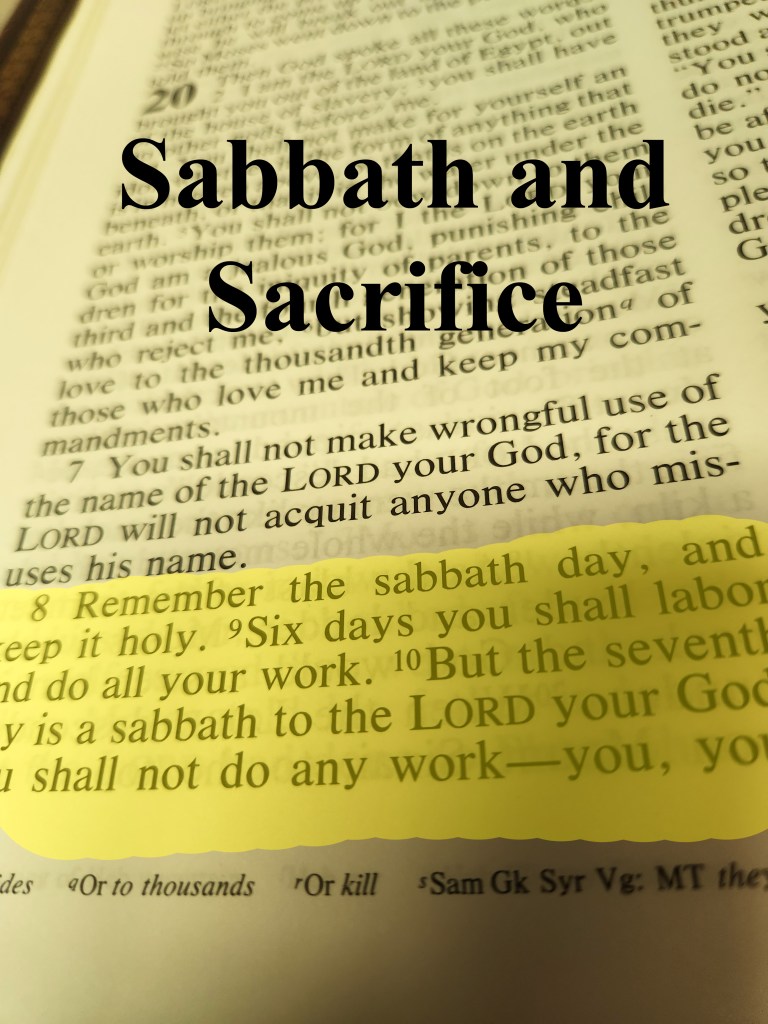
It’s a thoughtful sentiment, but Anne Lamott was hardly the first person to think about the value of turning us humans off and back on again. In fact, unplugging human beings, and then plugging them in again is the whole principle behind sabbath rest. Sabbath rest, of course, is an ancient idea, and, to understand that we need to go back to the beginning, to Deuteronomy 5:12-15, where we hear this command from God to his people:
12 “Observe the Sabbath day by keeping it holy, as the Lord your God has commanded you. 13 Six days you shall labor and do all your work, 14 but the seventh day is a sabbath to the Lord your God. On it you shall not do any work, neither you, nor your son or daughter, nor your male or female servant, nor your ox, your donkey or any of your animals, nor any foreigner residing in your towns, so that your male and female servants may rest, as you do. 15 Remember that you were slaves in Egypt and that the Lord your God brought you out of there with a mighty hand and an outstretched arm. Therefore, the Lord your God has commanded you to observe the Sabbath day.
When we read this, we realize that there are two purposes behind God’s requirement of the sabbath day. The first of these is simply to rest, to unplug, and reset our bodies and minds so that we can start fresh again in a new week. And the second reason is to remember what God has done for us, to remember God’s mighty acts of rescue, redemption, and rescue, and to spend time honoring and worshiping our God. But, over time, the reason and rationale behind honoring the sabbath got confused. Because everyone recognized that the sabbath was important, the priests and other religious leaders made rules to help the people of Israel get it right. But along the way, the rules that they made, and the traditions that they established, became so important, that they were held to be of the same importance as God’s original commands. And that’s why Jesus gets into an argument with the Pharisees in Mark 2:23 – 3:6 where we hear this:
23 One Sabbath Jesus was going through the grain fields, and as his disciples walked along, they began to pick some heads of grain. 24 The Pharisees said to him, “Look, why are they doing what is unlawful on the Sabbath?”
25 He answered, “Have you never read what David did when he and his companions were hungry and in need? 26 In the days of Abiathar the high priest, he entered the house of God and ate the consecrated bread, which is lawful only for priests to eat. And he also gave some to his companions.”
27 Then he said to them, “The Sabbath was made for man, not man for the Sabbath. 28 So the Son of Man is Lord even of the Sabbath.”
3:1 Another time Jesus went into the synagogue, and a man with a shriveled hand was there. 2 Some of them were looking for a reason to accuse Jesus, so they watched him closely to see if he would heal him on the Sabbath. 3 Jesus said to the man with the shriveled hand, “Stand up in front of everyone.”
4 Then Jesus asked them, “Which is lawful on the Sabbath: to do good or to do evil, to save life or to kill?” But they remained silent.
5 He looked around at them in anger and, deeply distressed at their stubborn hearts, said to the man, “Stretch out your hand.” He stretched it out, and his hand was completely restored. 6 Then the Pharisees went out and began to plot with the Herodians how they might kill Jesus.
Since the commandment to rest on the sabbath day required observant followers of God to refrain from work, it was natural that, over time, people wanted to know what exactly qualified as work. Moreover, after Israel had been sent into captivity in Babylon because of their unfaithfulness, the priests and other religious leaders wanted to write rules that would figuratively put fences around the commandments of God so that, if you were to follow their man-made rules, you would always be found to be in obedience to God’s commandments. Staying inside the fence, as it were, prevented you from even accidentally breaking a commandment.
The problem with this system was that, after a while, the rules that were intended to help obey the commandments became elevated to the same level of importance as the commandments themselves. And so, in this story, we find the disciples snapping off, and chewing on some uncooked heads of grain as they walked through the fields. But even though they exerted no energy other than lifting their hands to their mouths, according to the rules, what they had done was defined as harvesting, and harvesting was work. God’s commandment to observe the sabbath never said that you couldn’t eat, but the rules that had been written by generations of priests said that what they had done was sin (hint: it wasn’t).
And so, Jesus gives an example from scripture about how the great King David had done the same thing, and worse, and explained that God intended the sabbath to improve the lives of human beings and not to be an additional burden to them. Jesus had the same argument over healing a man who had suffered from what may well have been a birth defect. While healing was somehow defined as work, Jesus asked how doing good and undoing evil could possibly be wrong.
And that’s all well and good, but as we often ask… so what?
So, what if we know that God created a sabbath rest and a time of worship for the benefit of humanity?
So, what if we understand we shouldn’t define our sabbath rest too narrowly, and that doing good things on our day of rest is okay?
How does that make a difference to us as we live our lives?
Well, for that, let’s turn to Paul’s second letter to the church in Corinth for some clarity. But, as we read, this may not immediately sound like it is at all related to our understanding of sabbath. But it is, so bear with me until we finish, and I can unpack it a little. In 2 Corinthians 4:5-12, Paul says…
5 For what we preach is not ourselves, but Jesus Christ as Lord, and ourselves as your servants for Jesus’ sake. 6 For God, who said, “Let light shine out of darkness,” made his light shine in our hearts to give us the light of the knowledge of God’s glory displayed in the face of Christ.
7 But we have this treasure in jars of clay to show that this all-surpassing power is from God and not from us. 8 We are hard pressed on every side, but not crushed; perplexed, but not in despair; 9 persecuted, but not abandoned; struck down, but not destroyed. 10 We always carry around in our body the death of Jesus, so that the life of Jesus may also be revealed in our body. 11 For we who are alive are always being given over to death for Jesus’ sake, so that his life may also be revealed in our mortal body. 12 So then, death is at work in us, but life is at work in you.
And again, I understand that this message of servanthood and persecution doesn’t immediately sound like it connects to our understanding of sabbath, but let’s look a little closer. Paul reminds us that what we tell the world is not a message about us, it is a message about Jesus Christ, about how he came to bring light into a dark world, to display God’s glory, and to change hearts. Because of that, Paul says that we have the treasure of Jesus Christ in jars of clay.
Wait.
What does that mean?
Our explanation comes from what immediately follows, and that is a list of all the horrible things that have happened to them as messengers of the gospel. They were hard pressed, persecuted, and struck down, but while these things happened, and while they did experience abuse, pain, and suffering, they were not completely crushed, they did not despair, they did not feel as if they had been abandoned, and they were not destroyed. They themselves were carrying the message of Jesus Christ, but they knew that they were finite, fragile, and temporary vessels. More to the point, we, all of us, are like jars of clay. We are fragile vessels that contain the treasure of Jesus Christ.
We are fragile. Like clay we leak, we chip, we scratch, and we break. If God intended for us to contain his treasure, he would have stored it in something more durable like a stout treasure chest or a stone fortress. But he didn’t. The only way for us to preserve the treasure that we contain… is to share it with others.
Paul says that “we who are alive are always being given over to death for Jesus’s sake.” That means that we must be at work giving of ourselves, offering ourselves as a sacrifice to God, and sharing the good news of Jesus Christ. Death is at work in us because our time on earth is limited, and because the sacrifice of Jesus Christ is a part of who we are. But life is also at work in us through Jesus’ resurrection and his gift of eternal life to those who believe.
And so, if we look at it with Paul’s words in mind, sabbath is a time of rest and renewal when we remember who we are as we come together to worship our God, refill our leaky clay vessels, share our courage and strength with one another, share the Spirit of God that dwells within us, build one another up, equip one another, teach, learn, and grow, so that we can go back out into the world as a living sacrifice to Jesus Christ and to the kingdom of God.
Anne Lamott said, “Almost anything will work again if you unplug it for a few minutes, including you.”
And the truth of scripture tells us that she’s not wrong. Human beings were not designed or built to go non-stop, twenty-four hours a day, seven day a week, three hundred and sixty-five (or 366) days a year. The God of creation built us with a need for rest. Once every seven days he offers us a sabbath, a time to reset, restore, rest, and renew both physically and spiritually so that we can face the world, and all the evil in it, for another week.
Without rest, without sabbath, we are easily crushed, suffer despair, and feel abandoned and destroyed. Without sabbath, our fragile clay leaks and our faith weakens. Without sabbath, we are not prepared to live lives of sacrifice to God.
Simply put, without sabbath, and without rest, we cannot be the people that God wants, and needs, us to be.
Please LIKE and SHARE!
Click here to subscribe to Pastor John’s blog.
Click here if you would like to subscribe to Pastor John’s weekly messages.
Click here to visit Pastor John’s YouTube channel.
*You have been reading a message presented at Christ United Methodist Church on the date noted at the top of the first page. Rev. John Partridge is the pastor at Christ UMC in Alliance, Ohio. Duplication of this message is a part of our Media ministry, if you have received a blessing in this way, we would love to hear from you. Letters and donations in support of the Media ministry or any of our other projects may be sent to Christ United Methodist Church, 470 East Broadway Street, Alliance, Ohio 44601. These messages are available to any interested persons regardless of membership. You may subscribe to these messages, in print or electronic formats, by writing to the address noted, or by contacting us at secretary@CUMCAlliance.org. These messages can also be found online at https://pastorpartridge.com . All Scripture quotations, unless otherwise indicated, are taken from the Holy Bible, New International Version®, NIV®. Copyright ©1973, 1978, 1984, 2011 by Biblica, Inc.™ Used by permission of Zondervan. All rights reserved worldwide. www.zondervan.comThe “NIV” and “New International Version” are trademarks registered in the United States Patent and Trademark Office by Biblica, Inc.™

 Pastor Partridge