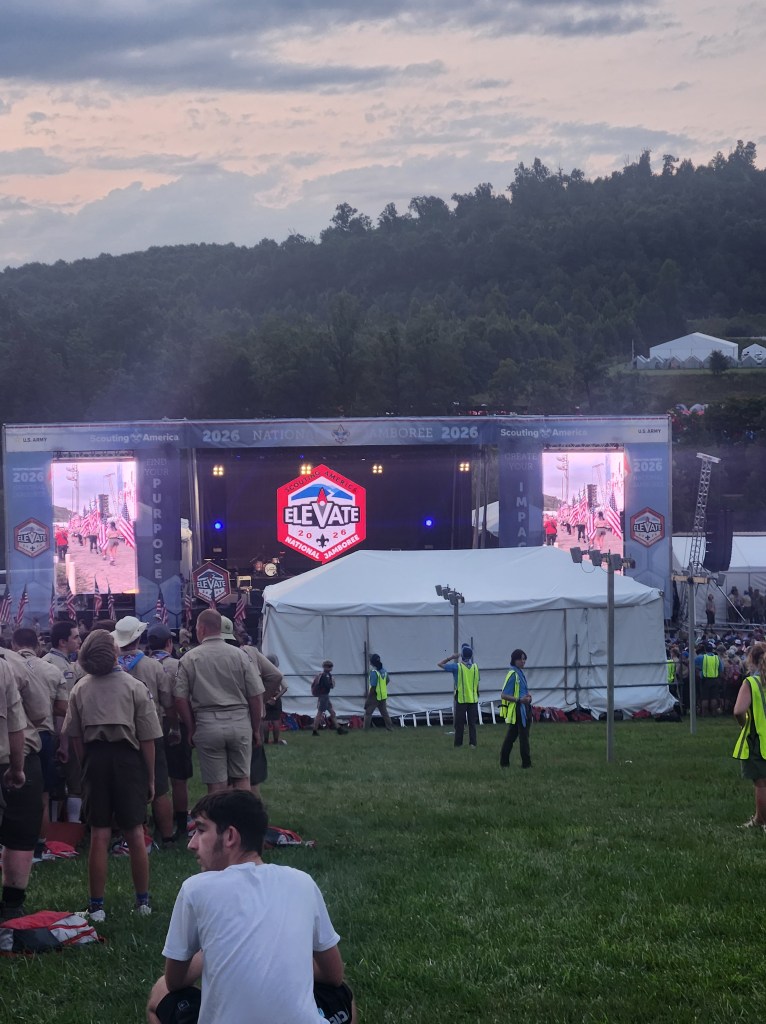
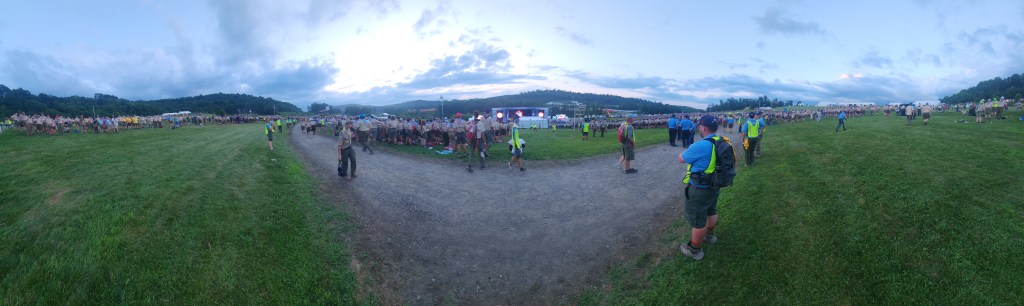
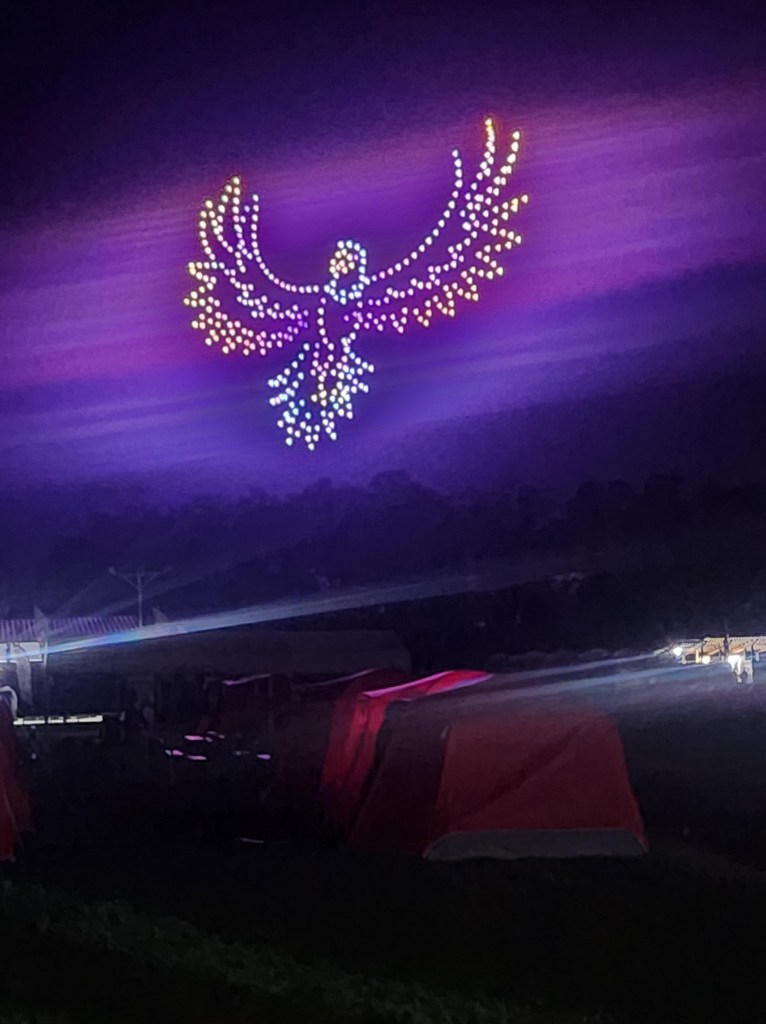
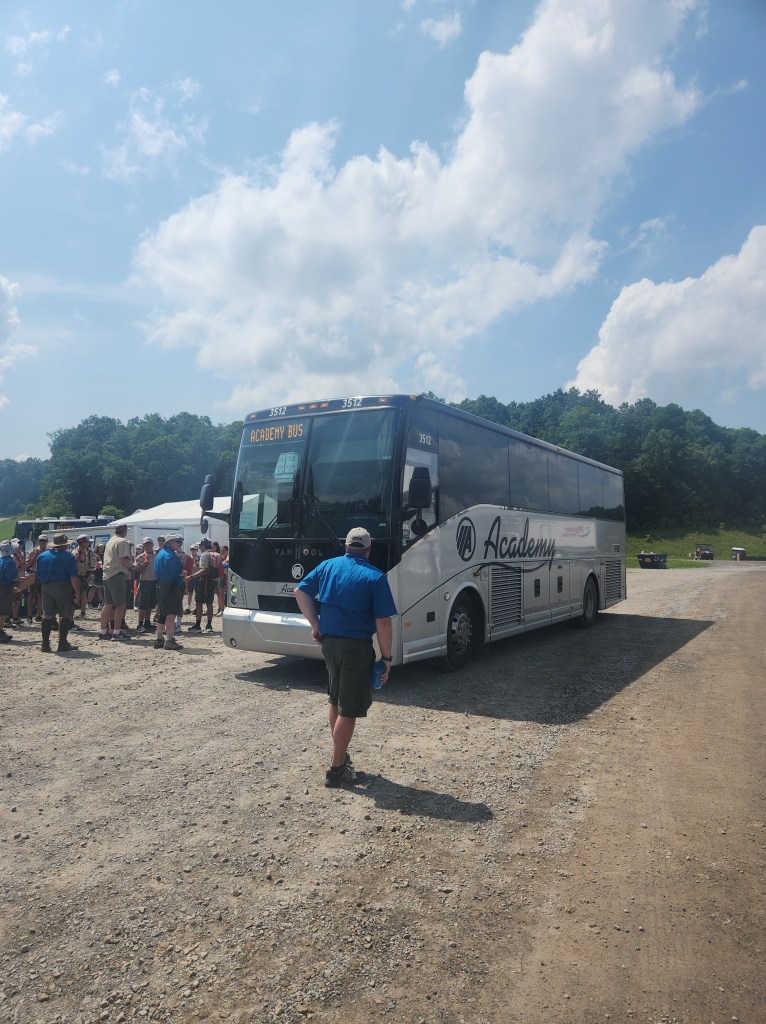
I have decided to make an attempt at posting daily, or as close as possible, updates to what I actually do as a chaplain at the National Scout Jamboree. Clearly, as a play on the Star Trek phrase “Captain’s Log” I am shamelessly naming this series, “Chaplain’s Blog.” In any case, today is my first official day at the Bechtel Summit in Glen Jean, West Virginia serving on the chaplain’s staff. Even so, my preparations started months ago in certifying or re-certifying a number of required trainings such as inclement weather, child protection, mental health, and a few others. For the last few days, I was retrieving camping supplies, cameras, flashlight, and other things that get put away around the house and at work when I am not at scout camp. Yesterday, I even spent an hour or two in the driveway replacing the electric drive on a rear window of my pickup truck and then cleaning out all the stuff that normally resides in the back seat but which I won’t need here.
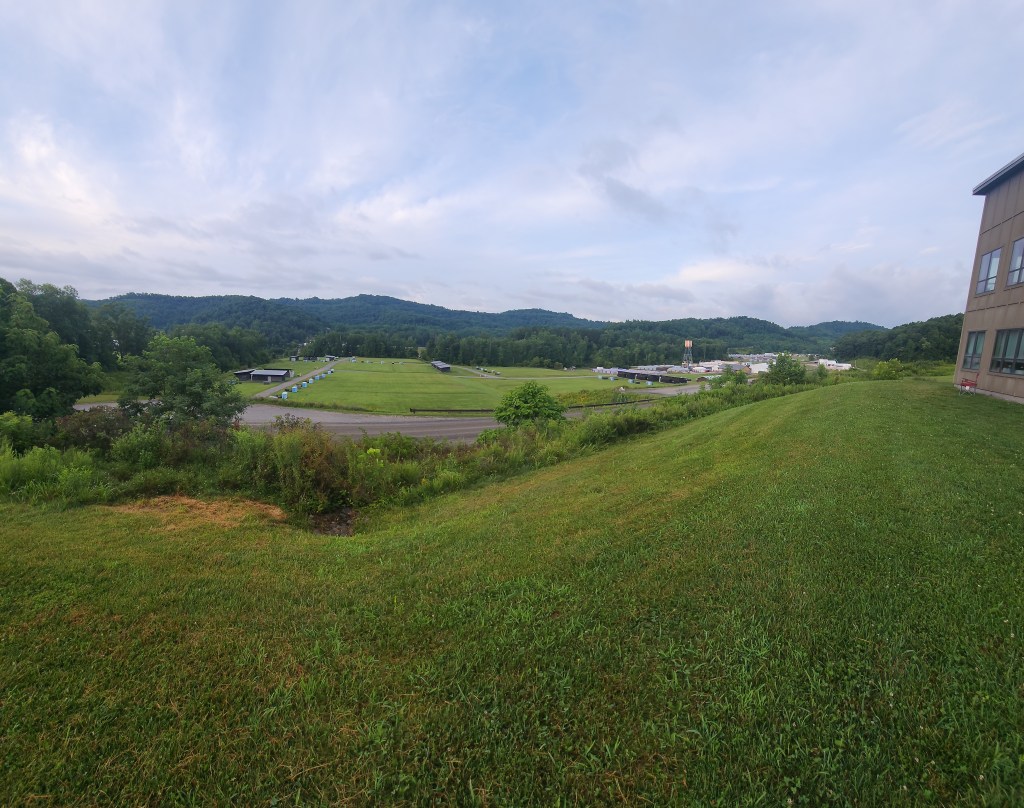
So, this morning, although I had set my alarm for six, I was awake and moving by five-thirty. I did the usual Sunday things, shower, shave, etc., but then finished my final packing of my shaving kit and all of the chargers for my electronic devices (like phones and my cochlear implant). I had breakfast, picked up a soda, and loaded the truck by 8:30, and was joined by Josh (age 21) from our church’s Troop 50 who will serve as a Chaplain’s Assistant. We departed and headed for the Jamboree some time after 9:00, stopped at Subway for lunch south of Charleston, WV, and arrived here shortly before 2:00 pm. Then we waited in line for an hour or so at the Welcome Center to get our jamboree credentials and a few other things. The drive from registration to our subcamp (Delta Two) took us through the New River Gorge National Park but we were here in 20 minutes or so (it’s a *really* big camp).
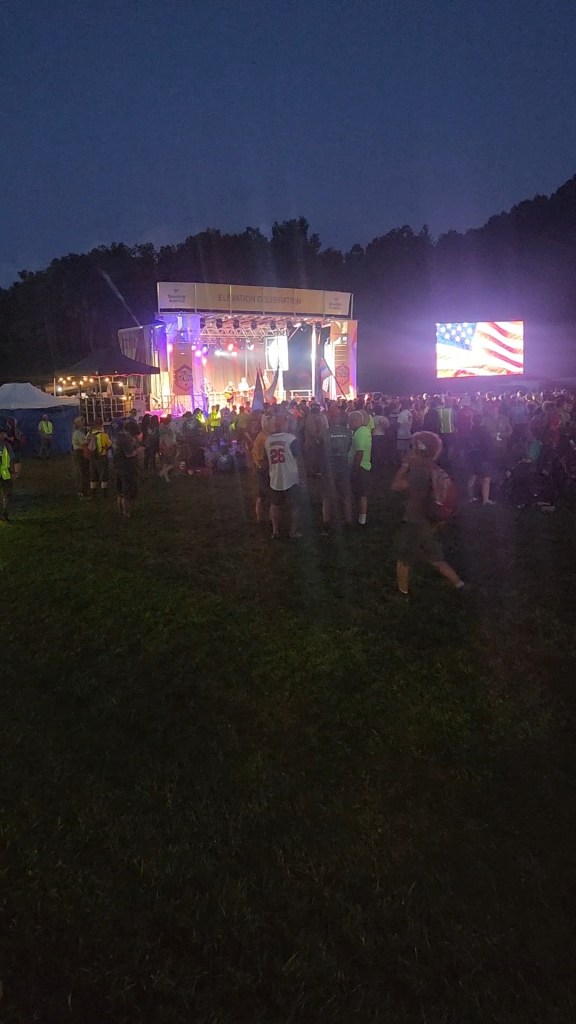
We got our tent assignments, unloaded the truck, and then I drove to the far side of the camp to my assigned parking lot. Since I was one of the first to arrive at the distant overflow lot, it took a bit to figure out where we were supposed to be, but we got that sorted and then I hiked two or three miles back to my tent. But, just as I arrived (now it’s around 6:00 pm), the rest of the staff was leaving for dinner, so I hiked up the hill (another half mile or so) to the dining hall. By the time we were done eating, it was time to head over to the next subcamp over (Charlie Two) for the first of two offered Protestant worship services (there were also two offered Catholic services). Once that was over, we walked back to our tents and finally just sat, hydrated, and caught up on messages and social media.
So, now it’s after 10:00 pm and Day One is over.
I realize that this series isn’t likely be terribly exciting (but you never know), but I’m hoping that this will offer some insight as to what I do, and by extension what chaplains generally might do when we volunteer and sleep in tents for two weeks serving at the the National Jamboree. Hopefully, we will meet back here tomorrow.
Blessings,
Pastor John
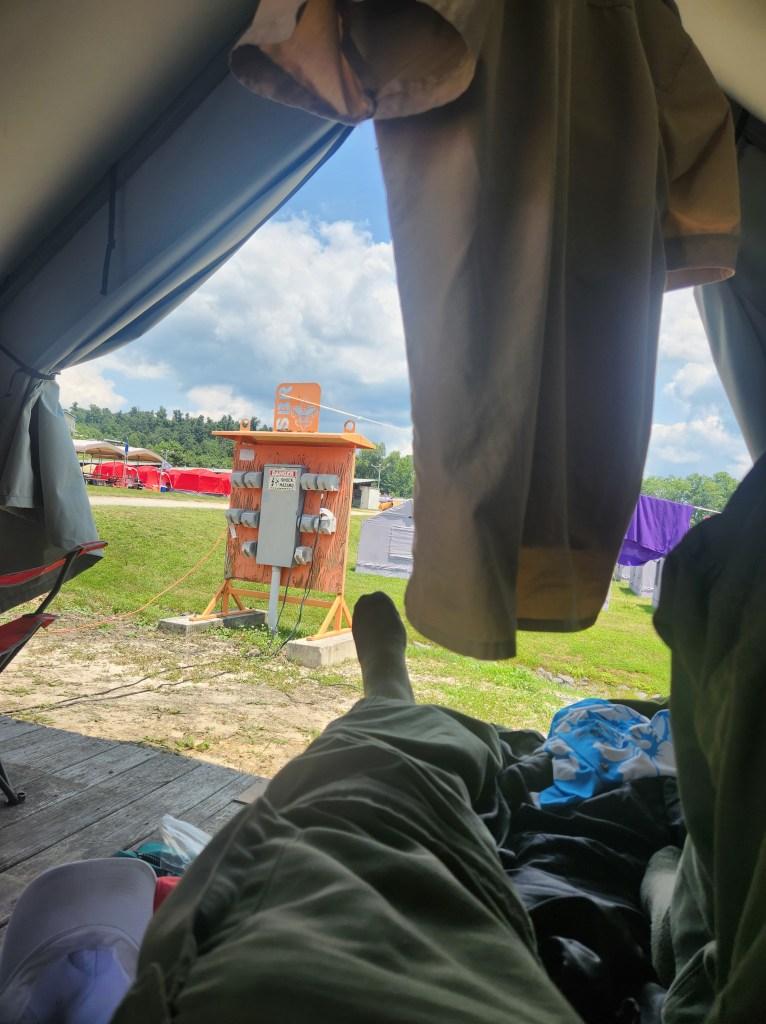
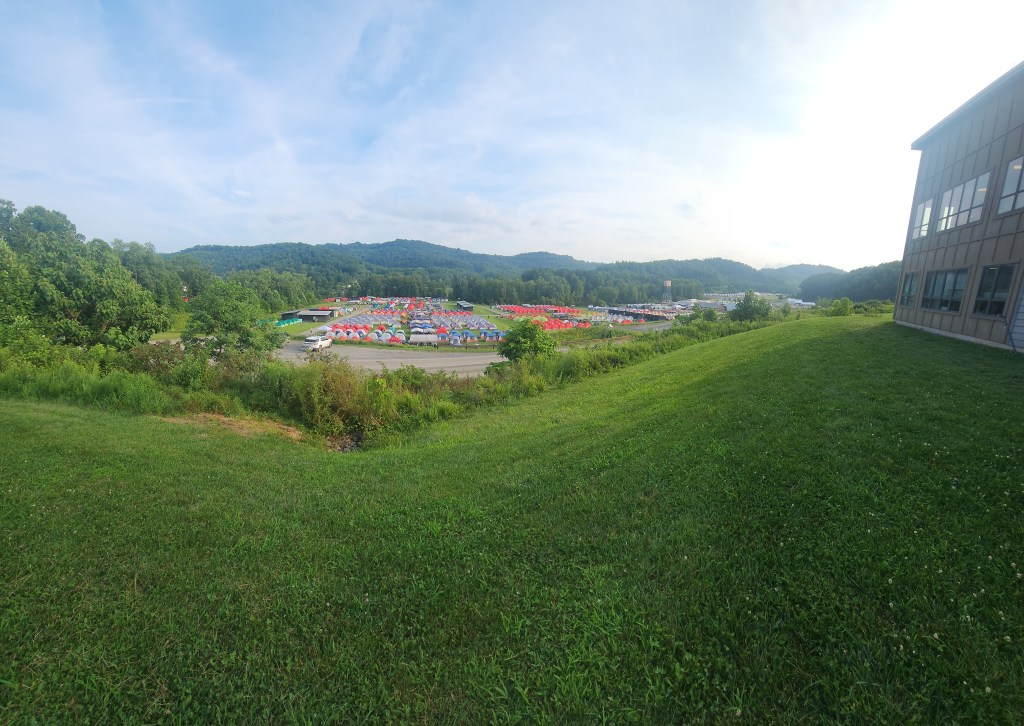
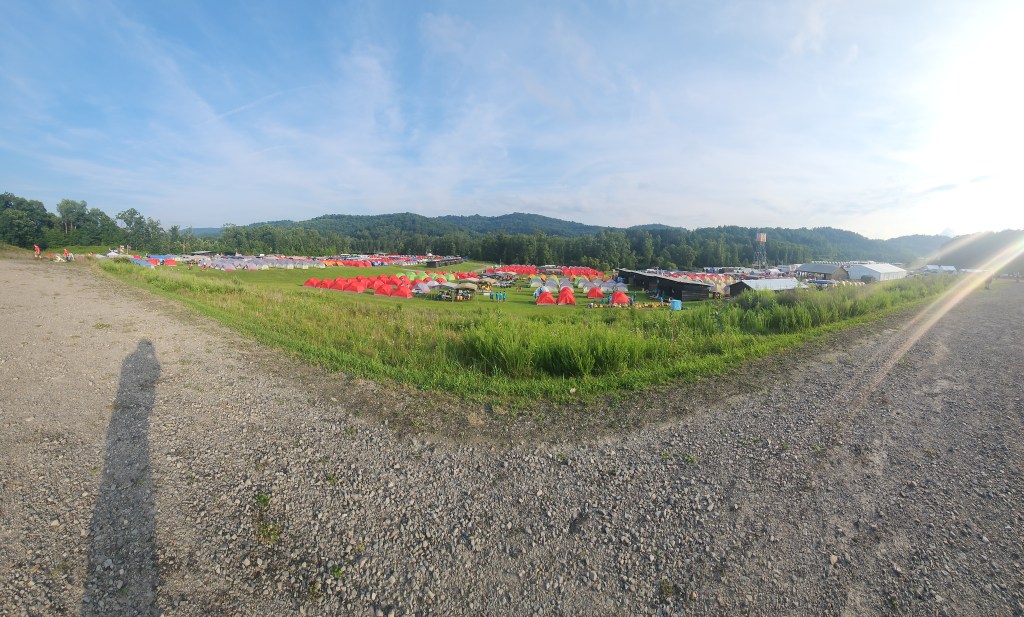
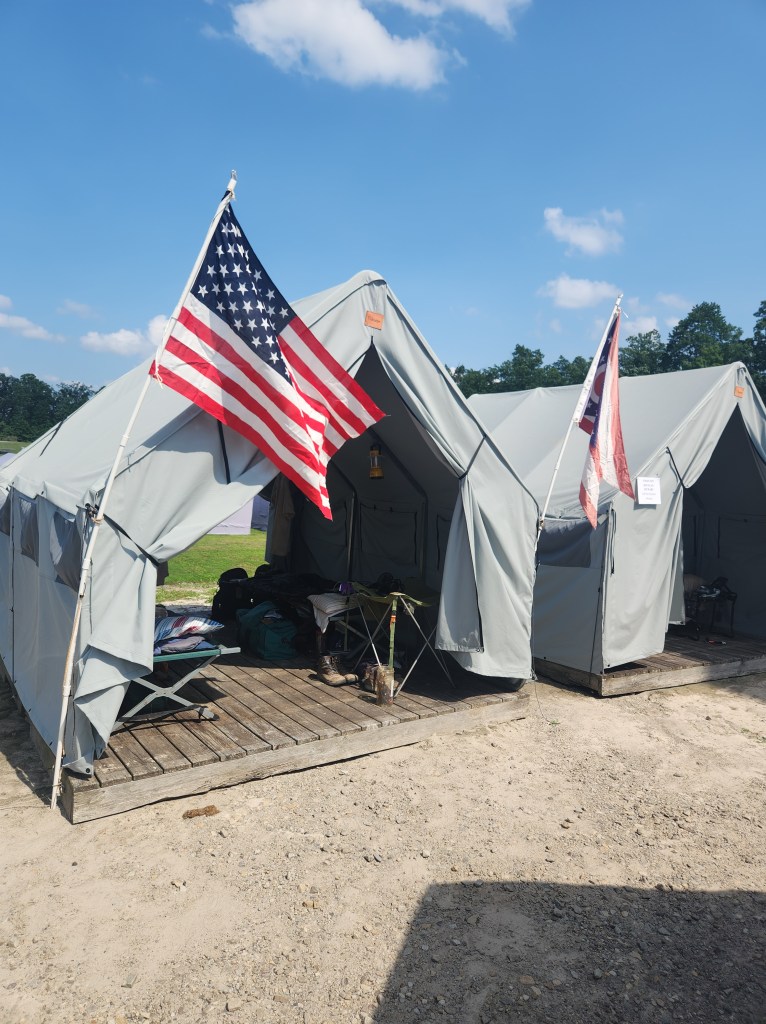
PS. The photo above is my place of residence for the next two weeks.
Most of you know that I am involved in Scouting. I was a scout in my youth but did not pursue it the way that my two Eagle Scout brothers did but that doesn’t mean that I didn’t like it. I came back to scouting when our sons were old enough to join Cub Scouts, and I have remained active in scouting since then. And, once we came to Christ Church and the incredible leaders (and scouts) of Troop and Pack 50, I am once again, attending weekly and even joined them at scout camp last year.
Cold Showers and Tent Camping
But even so, some of you may not understand why I occasionally serve on the staff of the National Scout Jamboree or what it is that I do when I am there. At a fundamental level, from my earliest days of scouting as a youth, things like the Philmont Scout Ranch, other high adventure camps, the National Scout Jamboree, and the World Jamboree were unattainable, unaffordable, dreams. I left scouting too soon as a youth, but our family could not afford such a thing in any case. But, in 2015 or 2016, the United Methodist Men, who function as our denomination’s liaison with scouting, issued a plea for pastors to serve on the chaplain’s staff for the 2017 National Jamboree and I jumped at the chance to fulfill a truly “bucket list” item.
Was it primitive? Of course. It’s called scout “camp” and not scout “hotel” for a reason. But I camped with scouts in my youth, camped with my family on vacation both as a child and as a parent, camped in the military, camped at Annual Conference, and even camped on vacation. Camping doesn’t bother me. I *like* camping, even if the ice-cold showers are not my favorite thing. But what happened at the 2017 Jamboree, and every subsequent event of that kind, was so deeply worthwhile that I keep spending my own money to go back.
And yes, the staff pay to go to the Jamboree. Many of the scouts, and even leaders, assume that what they pay to attend covers the cost of the staff as well as the cost of the Jamboree itself. But no, the staff pays as much, or more, than the participants themselves. And, although there are repeated promises that the staff will get designated “days off” to attend some of the available activities, everyone knows that, while the intentions are good, there are rarely more than a few hours that we can sneak off to see some of the sights.
But What Do You Do?
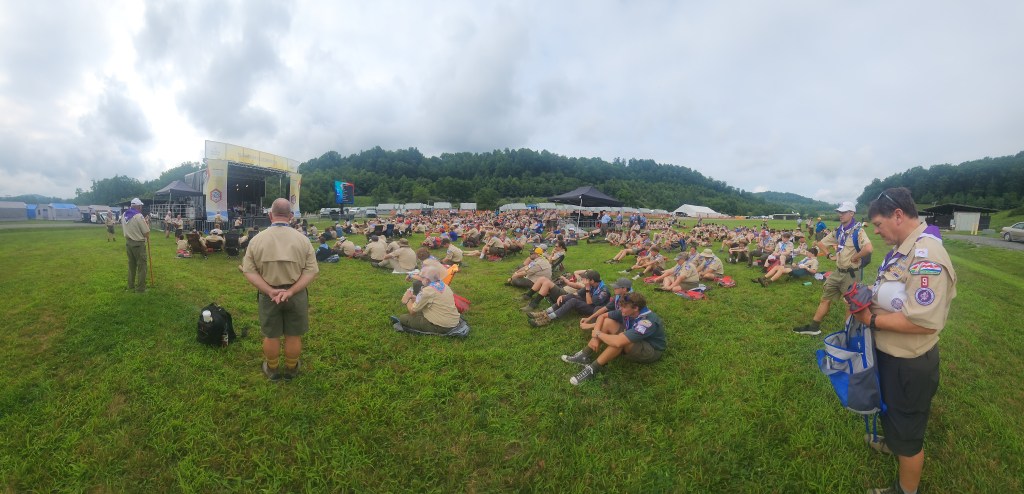
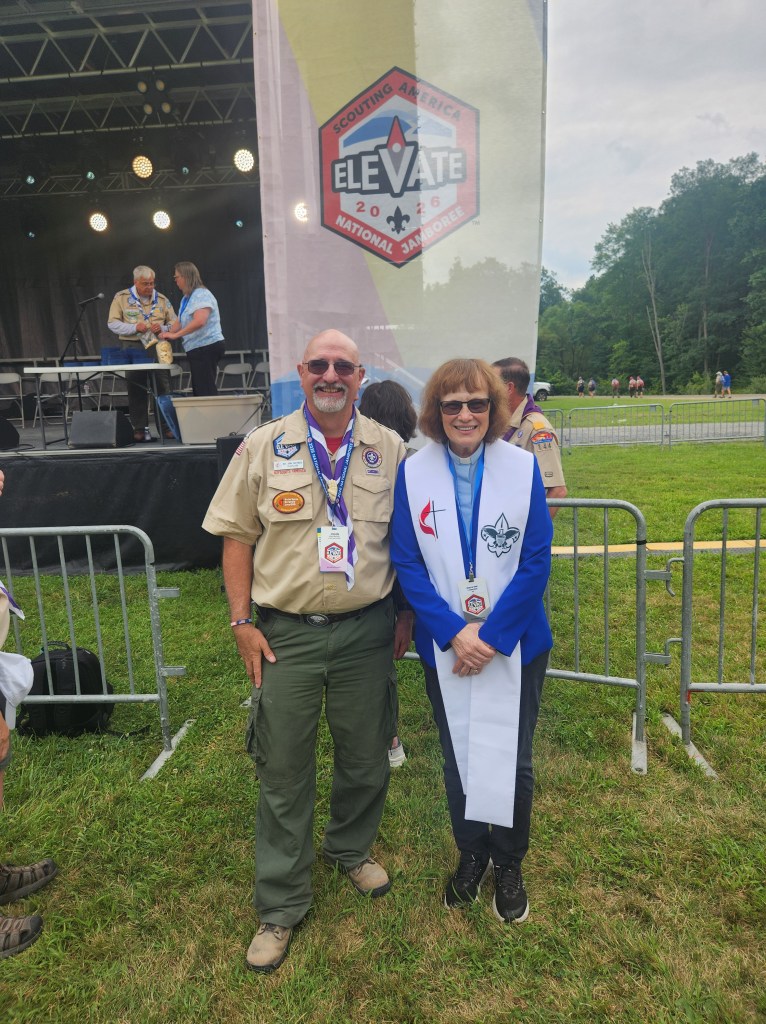
Much like scout camp, the chaplains at the Jamboree fill several roles. Our primary responsibility, of course, is to being a spiritual leader. But at scout camp that doesn’t always look like what we do at church. We do, as a group, organize and officiate worship services for the staff as they arrive on Sunday evening, and then for the entire camp the following week, but with several dozen chaplains, many of them Protestant, I am unlikely to preach, although the Bishop serving West Virginia might be asked to say a few words at the Methodist worship service. At these services I have passed out music, offered prayer, assisted with the serving of communion, or shared a brief meditation.
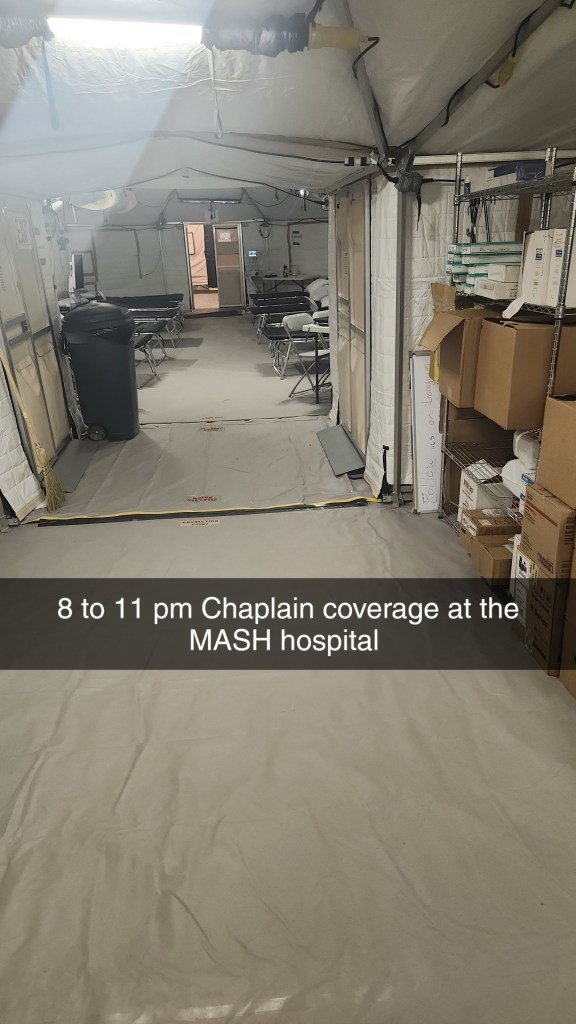
During the week, chaplains take shifts so that someone is always on hand at the field hospitals to minister to both patients and doctors, as well as to work with mental health professionals if needed. Chaplains also help medical staff to watch for scouts who might be at risk for heat injury while sitting outdoors for hours at large events. Early in the week we will introduce ourselves to all the troop leadership in our subcamp (this year there will be 40 troops with approximately 2,000 scouts) so that they can call on us to talk with campers for everything from homesickness to a crisis at home such as divorce or the loss of a parent. We also have occasionally functioned as mediators between adults who can get a little frayed at the edges after a week or two of cold showers, lack of sleep, and herding cats.
But when we’re not doing chaplain things, our second (third?) role is to do whatever needs doing for the regular subcamp staff. We help to greet and guide troops on arrival day, when hundreds of Greyhound buses disgorge thousands of scouts in a handful of hours, and the reverse on departure day. In between, the logistics of overseeing two thousand scouts and 80 or 90 adult leaders can be formidable. This scout needs an escort to the medical tent, someone else needs the key to get their daily allotment of propane, another lost his identification, or needs directions, or other staff have done these things and they just need someone to staff the office (tent) while they are gone, or a thousand other things.
On the few hours during the week that I break away, or pass by traveling from one place to another, there are many interesting things to see and do in the merit badge tents, informational displays put on by environmental and conservation groups, military units, national parks, coal mining companies (it *is* in West Virginia after all), automobile manufacturers, the Rotary Club, and many others. I have, in different years, gone rock climbing, ziplining, mountain biking, watched Scottish Highland games, talked to someone in Colorado via Ham radio, and met wonderful people from every corner of our nation, Canada, and around the world.
Yes, I do have a little fun, but I also learn something every day, work from breakfast to bedtime, and am effectively the pastor of a small-town of two thousand people comprised mostly of young adults. I am thankful that Christ Church recognizes that this is not a vacation but simply ministry in a different location. By the end of these two weeks, I will be exhausted, sunburned, and a little dehydrated, but although every single day, and every jamboree is different, I will also be helping youth and adults to have an amazing experience. Without question, the work is hard, but it is also remarkably fulfilling and rewarding.
And that is why I spend two weeks outdoors, sleep in a tent, and take cold showers.
Thank you all for allowing me the opportunity to do this.
If you haven’t already, some of you will certainly be wondering what’s going on by the end of May. I didn’t preach for two Sundays in April and missed (or will miss) three more in May.
I’m fine… Really.
In April, I was in church for United Women in Faith Sunday, as well as the following week when I asked Pastor Christ to preach so that I could finish my research paper and other work that was due at the end of spring semester. Then, in May, I participated in the Great Day of Music Sunday (but didn’t preach) followed by two more Sundays in which Pastor Chris preached again. On the first of these, I was on a summer semester study trip as our entire class was in Israel to see all the places that we’ve been studying and writing about for the last 30 plus weeks. I returned on a Friday (if I was on schedule) but, again, Pastor Chris was kind enough to preach so that I didn’t have to worry about writing a sermon while I was traveling.
Of course, I’m writing this before I leave for Israel so that Dolores can put it in the newsletter, but by the time you read this, I should be back. I plan to be here through June, but I’ll miss a week or two in July when I will once again be serving as chaplain for the 2023 National Scout Jamboree. After that, I think I will be around for a while. There is a chance that I’ll be out again later in the year to perform a church wedding for our son Jonah and his wife Kylie after their private back yard service this past January.
Other than that, I don’t have any definite plans, but at some point, Patti and I might like to go somewhere… together.
I want to say thank you to all of you for allowing me the flexibility to go to school and serve in ministry in other capacities such as scouting and missions. I also want to say thank you to Pastor Chris and Susan Haddox who almost always say ‘yes” when I need to be somewhere else. And of course, I want to say thank you to my wife, Patti, for putting up with all my travel (and other shenanigans).
I just spent two weeks living in a tent, sleeping on a cot, walking farther than I have in
Our home away from home.
decades, taking really cold showers, and I probably had one of the best times of my life doing it. For two weeks in July, I served as a chaplain, along with about 76 other pastors (including just about every denomination and faith you can name), at the National Boy Scout Jamboree which is held every four years at the Summit Bechtel Reserve in Glen Jean, West Virginia. While many people have heard about the Jamboree, many have questions about what a chaplain does and why the Boy Scouts would need so many of them for a single event. Honestly, I
The chaplains of the 2017 National Scout Jamboree (photo by Father Senic Cirera, San Mateo, California)
asked myself the same questions before I went, and while some of the answers are simple, others take a little more explaining.
The easiest question to answer is why the Jamboree would need almost eighty chaplains. Simply put, scouting has always regarded the spiritual life of its members to be an important value regardless of faith and with something over 28,000 scouts and 6,000 staff converging on the Summit for two weeks, this small city needed trained pastors to provide spiritual care. As a member of a sub-camp staff, my tent-mate Michael Lavoi (a Mormon chaplain) and I were responsible for a “congregation” of more than 20 sub-camp staff as well as 2,000 scouts and their adult leaders. As staff members, we helped out in registration during the busy arrival day, helping to carry mail, or wherever an extra hand was needed. And, although the first few days were easy from a pastoral perspective, after everyone started getting tired we were called upon to help scouts, and adult scout leaders, mediate personal conflicts. There were young people who were homesick, some that were in fights, leaders who knew about a death in the family of one of their scouts but whose family asked that they not be told, there were threats of suicide, thefts (yes, it happens even in the Boy Scouts), and everything else that happens when people live together.
But that isn’t all we did. Chaplains took turns working shifts in the basecamp medical center so that one of us was either present or on call so that we could encourage the doctors and nurses but also to be on hand to provide comfort to scouts who were sick or injured. We took turns offering worship opportunities, not only on Sunday, but every morning or afternoon. Each scout had the opportunity to earn a special “Duty to God and Country” patch during the jamboree, and one of the requirements to earn it was to meet with their chaplain and talk about what their “duty to God” might look like in every day life. That meant that many of our daily “office hours” as well as our evenings were spent meeting with individual scouts, or entire troops, to discuss subjects of religious significance. Often, as we met with these young people, and shared meals with them, they asked other substantive questions about God, religion, faith, and other things.
Of course there was worship. The first Sunday we were there, before the scouts
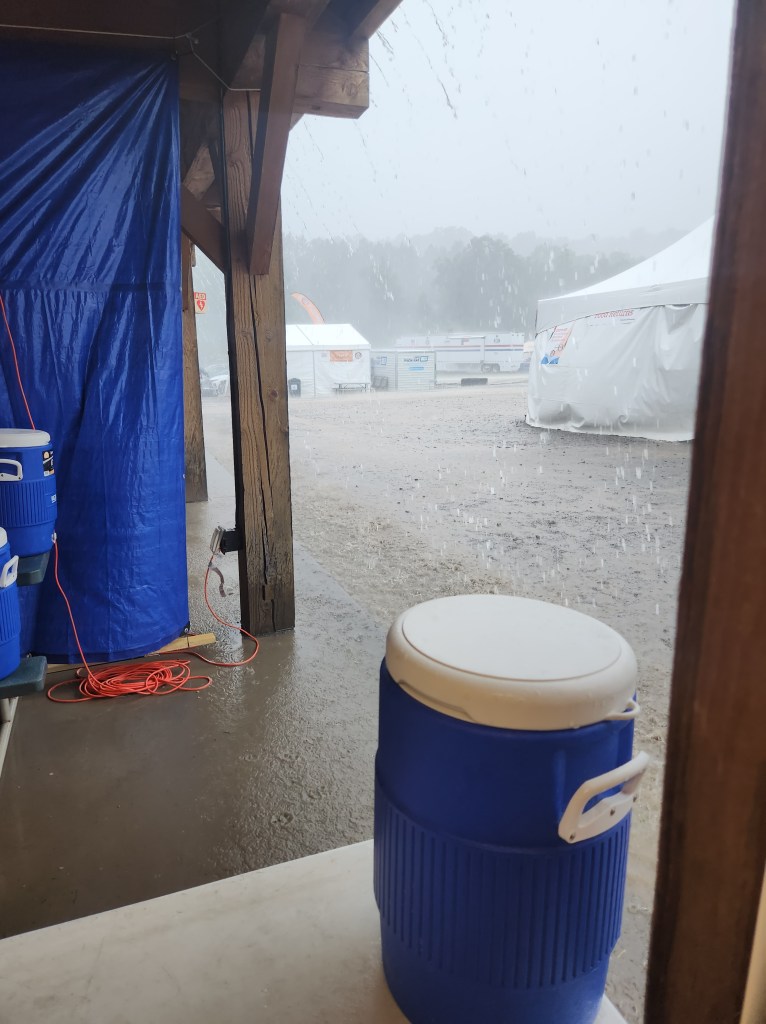
arrived, we held a Protestant service in the back of the dining hall and had somewhere between 300 and 600 staff in attendance. A week later, the Protestant service was held in the stadium and, while we met in the pouring rain, there were still
Left to Right, Bishop Sandra Steiner Ball (West Virginia Annual Conference), Rev. John Partridge (East Ohio Annual Conference), Scout Mark Dyer Jr. (Peninsula-Delaware Annual Conference) Photo by Deborah Coble, West Virginia Annual Conference
probably two or three thousand in attendance. Afterward, the United Methodist chaplains hosted a communion service (open to everyone) on Brownsea Island near
the stadium. That service, officiated by West Virginia Area Bishop Sandra Steiner Ball, was attended by 200 or more and the communion elements were served by the 15
United Methodist chaplains alongside United Methodist scouts who had volunteered to help. As I returned to my tent from our communion service, I noticed that the rain had finally stopped, and that may have contributed to the increased attendance (probably 5000 or more) at the Catholic worship service which followed ours at the stadium.
It’s worth noting that the Summit is enormous and covers 14,000 acres and adjoins 70,000 acres of National Park Service land in the New River Gorge National Park. That means that nothing is close to anything else. A walk to the bathroom is a quarter mile round trip. A visit to the medical tent is a mile. A trip to the stadium or to the chaplains’ headquarters can be two miles one way, and if you hike up to the top of Garden Ground Mountain to visit the Scottish games or the pioneer village, its at least three miles, all up hill, one way. Over the course of two weeks, I walked about 75 miles and my partner, Michael, had hiked well over 100 miles.
But being a chaplain isn’t all work. In two weeks you have the opportunity to live with, and share your life with, your fellow staff members. Some of these scouters return every four years and request the same arrangements so that they can work together again. There’s a chance to encourage young people and to build relationships with people of other faiths, and people from other states and other countries. Not only was the jamboree attended by participants and staff from all 50 states, but also from 58 other nations. Our leadership tried hard to make sure that staff members could get some time off and see some of the activities in and around the Summit, and although there isn’t enough time to see everything, as you visit you find yourself among young people from around the world. While I didn’t get a chance to ride the half mile long zip line (the “Big Zip”), I did get a chance to climb a rock wall, navigate the treetop high ROPES course, and ride through all of the mountain bike courses.
Remember that while the Boy Scouts in the United States is mostly for boys, ours is one of the only countries where that is true. All of the international troops are coed, as are the older youth from the Venturing, Explorers, and Sea Scout programs in the United States. And so, while I was invited to participate by the United Methodist Men, whose office includes our official United Methodist scouting representative, there is a desperate need for female chaplains as well. Out of all the chaplains present, only one was female and, since our denomination is one of the few who ordain female clergy, the United Methodist Church has the opportunity to fill this need. Chaplains and other staffers at the Jamboree ranged in age from their 20’s up to well into their 80’s.
My two weeks at the Jamboree were probably some of the hardest and yet some of the most rewarding, and fun, that I have ever had. They are indeed, memories that will last a lifetime. But the next Jamboree is in four years and the United States will host the World Jamboree at the Summit in two years. Whether you are clergy or laity, male or female, young or old, you have gifts and skills that can be used to encourage and bless the next generation of young people from around the world.