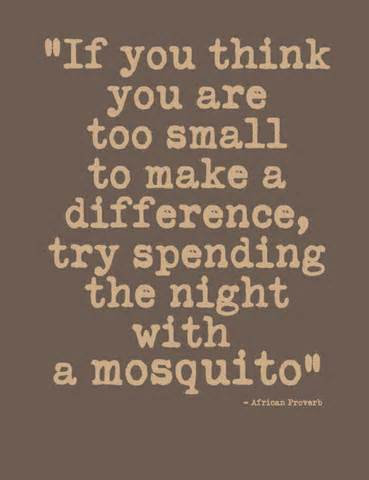
We *Are* Making a Difference


    I have friends who like to say that the world would be better off without the church.  Today, 2,400,000 Africans would disagree with them.  If it had not been for the United Methodist Church (and her partners) many of those 2.4 million people, most of them children…

…would be dead.
    In 2010, children in sub-Saharan Africa were dying from malaria at a rate of one every 30 seconds.  Today that rate has dropped to one every 60 seconds.  The difference?  Our church’s campaign to eliminate malaria.  In 2008, we had “Nothing but Nets” which partnered with the NBA as well as the Bill and Melinda Gates Foundation.  Then in 2010 this effort became “Imagine No Malaria.”  Imagine No Malaria still has the support of the Gates Foundation but also the World Health Organization, The Global Fund to fight AIDS, Tuberculosis and Malaria, and the United Nations Foundation.  Since 2008, The United Methodist Church has raised $40 million dollars toward our goal of $75 million.  Together, we have distributed 1.2 million insecticide treated bed nets and trained 5400 community health workers to distribute bed nets, train families in their use, and track usage rates.  The results are obvious.  In the last three years we have reduced the childhood death rate (from malaria) by half.
    Why us?  Why is the church important if the NBA, Bill Gates, the UN, and these other big names are already involved?  Is it just because eleven million United Methodists can raise money?  That is undeniably a part of it, but helping the poor has been a part of our United Methodist DNA from the very beginning.  For 200 years we have built and maintained hospitals and schools all across the continent of Africa.  When this project was conceived, everyone knew that while Americans can often be generous, and some are great at publicity, someone had to be the “boots on the ground.”  United Methodists were already there, all across the continent of Africa.  Over two centuries we have built relationships with governments, leaders and decision makers in many of those nations and we established a reputation as being genuinely interested in the welfare of their people, as well as trustworthy.
    Of course, we can’t rest yet.  The job isn’t done.  We haven’t reached our goals and one child every sixty seconds is still way too many.  The goal of Imagine No Malaria is the total elimination and eradication of malaria from the face of the earth.  That’s a long way off, but we’re headed in the right direction.
    I don’t pretend that United Methodists have a monopoly on compassion.  Clearly our story is just one of many.  Imagine No Malaria is just one way, that one church, is making a difference.  And so, to all those who think we would be better off without the church, I say this:
The people of Africa would like to disagree with you…
…because today their children are not dead.

Called to a Different Path


“Do not go where the path may lead, go instead where there is no path and leave a trail.” – Ralph Waldo Emerson 

    I am a Cleveland Indians fan.  I follow the Indians, not because they their winning record (obviously), but by accident of geography. I grew up in Northeast Ohio, went to high school in Akron, and my first job after college sent me to Cleveland for ten years.  As a Cleveland fan, Boston is considered to be an evil empire second only to the New York Yankees.  This week’s attack on the Boston Marathon (a very different thing than baseball) stirs in me the sort of protective feelings that siblings have for one another.  Feelings such as, “Nobody messes with my brother but me.” We don’t yet know who committed this horror, but the reaction of most Americans is, like mine, anger.  This is, I think, a natural and instinctive reaction, but a dangerous one as well.  As Christians, we need to carefully gauge our reactions so that our emotions do not draw us away from the path we have been called to follow.
    Anger is not evil.  Nor is it wrong or sinful to feel angry, but how we allow anger to motivate us, in what direction we allow anger to push us, may well be.  Anger over the attack on Pearl Harbor drew the United States into a war with Japan.  Anger over the attacks of September 11th provided support for wars against Iraq and Afghanistan.  These may, or may not, be proper if we judge them as a means of seeking justice or resisting aggression, but we cross a line when we allow hatred and revenge to become our motivation.
    As a follower of Jesus Christ, I do not believe, as some of my friends do, that we have been called to a path of non-violence or pacifism.  I do believe, however, that we have been called to a different path, a direction different than our instincts alone would lead us.
    In Leviticus, a book often noted for its violence, we find a warning that revenge will lead us astray.
“Do not seek revenge or bear a grudge against anyone among your people, but love your neighbor as yourself. I am the Lord.”  Leviticus 19:18
 
    But what if the perpetrator of this horror is not “among our people” but someone else?  Well, Jesus had something to say about that…
27 “But to you who are listening I say: Love your enemies, do good to those who hate you, 28 bless those who curse you, pray for those who mistreat you. 29 If someone slaps you on one cheek, turn to them the other also. If someone takes your coat, do not withhold your shirt from them. 30 Give to everyone who asks you, and if anyone takes what belongs to you, do not demand it back. 31 Do to others as you would have them do to you.
    This is hard.  Jesus wants us to do good to people who insist upon doing us harm.  Why?  Every fiber of my being wants to hit back when I am hit, to hurt the guy that hurts my family and to put the smack-down whoever did this thing to the people of Boston.  But that isn’t what Jesus had in mind.  Our calling is to a different path.  If you read the rest of the passage I just interrupted we get a few more details…
 “If you love those who love you, what credit is that to you? Even sinners love those who love them. 33 And if you do good to those who are good to you, what credit is that to you? Even sinners do that. 34 And if you lend to those from whom you expect repayment, what credit is that to you? Even sinners lend to sinners, expecting to be repaid in full. 35 But love your enemies, do good to them, and lend to them without expecting to get anything back. Then your reward will be great, and you will be children of the Most High, because he is kind to the ungrateful and wicked. 36 Be merciful, just as your Father is merciful. – Luke 6:27-28
    This is hard.  Why should we do good to those who seek to harm us?  Why should we be merciful?  Because we are called to follow a different path, a radical path, a path that calls us to love not only those who love us back, but everyone, whether they love us or not.  We are called to love the way that Jesus loved.
    Paul echoes these same feelings in his letter to the church in Rome and summarizes it by saying, “Do not be overcome by evil, but overcome evil with good.” (Romans 12:21)
    I don’t think that any of this means that we cannot protect ourselves or seek justice, only that we must guard ourselves from seeking revenge and retribution instead of justice, and being driven by hatred and vengeance instead of mercy and compassion.  
This isn’t the place our instincts would lead us.
We are called to follow a different path.

Top Ten 2011 Blog Posts


    I know I’m a year late, but as I began to assemble the top ten blog posts of 2012, I realized that there were a few from 2011 that still had value and might well be worth a second look.  Here they are, more or less in order of popularity.
1) God Will Destroy the Fat Cats – November 29, 2011 – A Blog about God’s desire to destroy the rich, well, not really… but sort of.
2) Laws of Man and God – Are guns evil? Part 1 – February 9, 2011 – Part 1 of 4 – The first in a series that I wrote after the shooting of Gabriel Giffords.  Not really pro-gun or anti gun, just asking a lot of questions and thinking out loud.    The first two installments made the year’s top ten, but while part 3 was moderately popular, almost no one made it to part 4.  My lesson?  Even broken into pieces, this was just too long.
3) Happy Birthday Mr. Shea! – February 2, 2011 – A tribute to George Beverly Shea           on his 102nd birthday.  
4) Laws of Man and God – Are guns evil? Part 2– February 10, 2011 – Part 2 of 4
5) Living Together, No Harm No Foul? – April 27, 2011 – Is living together normal, healthy, moral and responsible?  I’m sure you can find lots of people who think it’s a good idea, but, well, no. 
6) Seeing God in the World Around You – March 25, 2011 – A man I never met, weeps during my talk, wondering how I knew so much about his life.  I didn’t.  But God did.
7) 20/20 Blindness – March 31, 2011 – A blind man is thrown out of a restaurant because of his guide dog.  Apparently, humans are just as blind today as the Pharisees that Jesus knew.            
8) Christmas in January – January 4, 2011- I explain why our family still leaves our Christmas decorations us until the first week in January.  Not everyone celebrates Christmas on December 25th you know.
9) Too Busy for God? – May 25, 2011 – Do you plans for the summer, or for the New Year, include church.  If church is important to you, don’t allow it to happen by accident.

    In reality, there was a three or four way tie for tenth place.  Instead of picking one of those, or using all of them, I jump to the blog that comes after the tie because, even though it was read less often, it had more comments than any other blog of the year.  That’s worth something mentioning, I think.

10) A New Digital Divide – Who wins, who loses? – January 19, 2011 – As we become an increasingly technological society, we cannot allow ourselves to forget the people who are being left behind.
Honorable Mention) The Nightmare of Democracy? – February 14, 2011 – I include this, a blog that was written at the very beginning of what we now call the Arab Spring.  In it, I worried that the revolution in Egypt might not be such a great thing.  In the two years since, attacks on Coptic Christians and on the Coptic Church have increased and the government has shown little interest in preventing it.  Events are still unfolding in the Middle East and as they do, out brothers and sisters in Christ will continue to be in need of our prayers.

A Dream So Big


    My wife, Patti, and another member of our church first met Steve Peifer during a trip to visit Keith and Jamie Weaver, missionaries sent by our church to the people of Kenya.  There, Patti met Steve and worked with this beautiful wife Nancy in the library at Rift Valley Academy.  I first met Steve at my home church when we invited him to come and tell us about his efforts to feed hungry school children that he describes in A Dream So Big.  Since then Patti and I have answered a call to pastoral ministry and have not only followed Steve’s adventures through his regular emails, but have, on several occasions, invited him to speak in the churches where we were serving.  I don’t think that his story has ever failed to astound his listeners. 

     
    Steve is an average, middle class guy whose life was turned upside down and who, through no particular plan of his own, ended up in Kenya, Africa seeing things that most of us cannot imagine, and doing things that we would be afraid to do.  Throughout this story, Steve insists that he is not an amazing man, just a man through whom, God is doing amazing things. 
 
    In A Dream So Big, we meet Steve, Nancy, and their family before the adventure began, at home, in Texas.  We walk with them through one of the most difficult times that a parent can imagine, the loss of their child, Steven, and then follow them as they head to Africa.  At first, their African adventure is intended to be just a year away to sort things out and to process the pain and the trauma of losing a child, a time for their family to be together and to heal.  But, as Steve often points out, Africa changes a person.  After a year in Kenya, the Peifers feel called, if not compelled, to return on a more permanent basis, and it is then that the real adventure begins.  
    Not content to see children lying in the dirt at school because they are weak from hunger, Steve sets out to change the world, or at least his little corner of it.  Steve asks, and with the help of his friends and supporters in the United States, begins to provide lunches for two schools nearby.  Two schools become four, and then ten, and by the end of the book become a truly extraordinary number.  Providing food not only allows the children to be free from hunger, but gives them the strength to get an education and an incentive to stay in school.  Even with these successes, Steve is not content.  Building on the feeding program, Steve and his friends begin to build solar powered computer centers.
    Just because I said the word computer, do not be tempted to think that this is just another story about wealthy, white Americans swooping in to “rescue” Africa.  Those stories are old and they often are the picture of “Ugly Americans” with all the cultural insensitivity that you might expect.  That is not Steve’s story.  Steve builds a program in which the villages take ownership of their schools and their computer centers.  The parents know that when these children finish school and head into the city to find work, as most of them do, that they will find good paying, skilled jobs instead of living in the slums fighting with untold thousands of others for a handful of unskilled jobs.  The school children, their parents, and many others have seen Steve’s vision, and it is a vision that can break the back of poverty in Africa.  It is a vision that can change the world.
    I highly recommend A Dream So Big.  As you follow Steve, Nancy and their family on this amazing adventure, you will laugh out loud at the ridiculous situations in which Steve finds himself.  But you will also weep at the poverty and hopelessness that he sees all around him.  A Dream So Big invites you, not only to follow along, but to be a part of this incredible adventure.  I have no doubt that Steve Peifer is changing the world, one child at a time.  When you read this book, you will discover that you can too.
Steve’s book, A Dream So Big will be released next week and can be found on Amazon here: A Dream So Big.

Sometimes Right is Wrong


    Not long ago my wife, Patti, and I attended a seminar with Dr. Terry Wardle at Ashland Seminary.  During one session Dr. Wardle noted that sometimes the question is not whether something is right or wrong, but whether it is loving or unloving.  This idea struck me and I immediately wrote it in my notebook.  While this may not always be the case, this is a wonderful lens by which we can examine our choices as we live out our faith.  Checking to see if our actions are loving or unloving is a great way to get closer to deciding, “What would Jesus do?” 
   
    Some will object that Jesus was the perfect man and lived his life without sin, and so, he could not have done wrong.  And yet, he did.  During his ministry, Jesus seemed often to be at odds with the Pharisees, men who devoted their lived to following “the rules” and, in fact, devised rules stricter than those contained in the Law so that, by following these ‘new and improved’ rules, they would never, even accidently, violate the Law.  Simply put, the Pharisees made it their business never to break a rule.  They were devoted to living that was always right and never wrong but if this is so, why were they so often at odds with Jesus?
    The Pharisees began to hate Jesus and plot for his humiliation and, ultimately, his destruction when Jesus repeatedly revealed their hypocrisy and the failure of their rules-based morality.  Jesus pointed out that what they had achieved was like white washing a tomb; it looked pretty on the outside bur remained full of corruption on the inside.  The Pharisees were known to tithe from everything they earned, every increase that God granted to them, even to the point of giving ten percent of the growth from their herb gardens and yet some of them had elderly parents whom they allowed to starve.  They justified their actions by saying that all their money was “Corban” or, dedicated to God.  They had followed one rule so vigorously, that they missed the bigger ideas of “love your neighbor” and “honor your father and mother.”  They had done what was “right” but had failed to be loving.  As Jesus saw it, they had missed the point.
    At the same time, the Pharisees attacks against Jesus revolved around what they perceived as his wrongdoing.  Jesus and his followers were rule breakers.  Jesus sat down with sinners, tax collectors, prostitutes, outcasts, and ate with them.  No self respecting, rule-following, religious person would be seen socializing, let alone sharing food, with “those people,” and yet, Jesus did.  As Jesus and his followers were walking through a field on the Sabbath, they were hungry and the disciples began to pick heads of grain, rub them between their hands to remove the chaff, and eat them.  The Pharisees asked Jesus why he allowed them to do wrong. Clearly they were harvesting on the Sabbath, and everyone knew that harvesting was work and work was not permitted on the Sabbath.  They made the same accusation against Jesus when he healed a man on the Sabbath.  Since healing was “work,” obviously Jesus had done wrong.  Again, as Jesus saw it, they had missed the point.
    In each case, the Pharisees wanted to follow the rules, to do what was right, but Jesus wasn’t as concerned with right and wrong as he was with being loving.  Jesus believed that the Pharisees had missed the point when following “the rules” caused them to be unloving.
    If we see ourselves in the mirror held up by the Pharisees, we should.  The Pharisees weren’t bad people; they were the church leaders and teachers of their day.  Like the Pharisees, I think sometimes we get so focused on “the rules” that we miss the point.  When people of faith debate issues like homosexuality, abortion, capital punishment and other “religious” issues in the public square we often carve out positions that we believe are “right” and yet, at the same time, fail miserably at being loving.  That doesn’t mean that we have to accept sin, Jesus didn’t, but Jesus found a way to be loving even if it broke a few rules.
    As we enter the public square we must ask ourselves if our arguments are right, but also if they are loving.  Because…
Sometimes, right is wrong.

The Christmas Manger – Born to Die?


    During our Advent Bible Study, a few people were surprised when we saw an image that looked a lot like this one.  It is a feeding trough, a manger, from the part of the world where Jesus lived.  For many of us who grew up in northern woodlands, this is not at all what we have been taught or expect.  For most of our lives we have grown up with the idea that the manger in which Mary and Joseph placed the baby Jesus was a wooden thing made with boards nailed into an ‘X’ on each end and this doesn’t quite seem right.  For us, a people who are accustomed to being surrounded by trees, building things from stone seems unnecessarily difficult.  Where we live, trees grow wild and we have to mow, trim, cut and work to keep them from growing where we don’t want them.  Israel (and all of the Near East) is a different place.  Take a look at the pictures and videos that are available, look at the pictures you can find in books about Israel.  You will likely notice that in much of the country, trees are not common and often, where they are more common, they are tended and cultivated as food producing crops, not as building materials.  In that part of the world, stone is a much more common building material… for many things.  Stone is used not because it is easier or cheaper (it isn’t) but because it’s what they have.
    I saw this image a year or two ago and I have had conversations about Near Eastern building materials before so this didn’t really surprise me.  What struck me however came later when I opened this month’s issue of Biblical Archaeology Review and read an article on the Tomb of Pharaoh’s Daughter in Jerusalem.  There, included in the article, were photographs of stone sarcophaguses (sarcophagi?) found in and near Jerusalem.  I could not get copies of these pictures but they are similar to this one.

    Before the front wall of this was broken out, it would have looked strikingly like a stone manger.
An argument could be made that tombs that contain this sort of sarcophagus were built only for the rich and powerful of Israel’s elite.  Jesus would never have been buried in such a tomb… and yet… far more common in that time, even for middle class and poorer folks were burials in stone ossuaries, bone boxes, in which the remains of a buried person were re-buried. 

Jesus came to earth to sacrifice his life and die on the cross for our sins.   
Was his death and burial foreshadowed by the manger in which he slept on the day of his birth, or was it an accident? 
 Either way, it makes you think.

Christians are Wrong; Atheists are Right

    This week, in the span of twenty four hours, I received two invitations; one from an Atheist friend, and a second from a good Christian friend.  The atheist invitation was for International Blasphemy Rights Day (held on September 30th of each year) which “is a day to promote the rights to freedom of belief and expression and stand up in a show of solidarity for the liberty to challenge reigning religious beliefs without fear of murder, litigation, or reprisal.”  The Christian invitation was to sign a petition to force Youtube to stop a video that was blasphemous to the name of Jesus Christ. 

Wow.  

    It isn’t often that this sort of thing drops into my lap.  What’s more rare, is a situation in which I agree so strongly  with the atheists and so clearly disagree with the (well-intentioned) Christians.  To me, the atheists ‘get it’ and these particular Christians just don’t (however well-intentioned) particularly in light of recent events in Egypt, Libya and elsewhere in the Middle East.

   
    The United States is an amazing place.  Our Constitution guarantees freedom of religion and freedom of speech like nowhere else in the world and that gives us, as Christians, an unprecedented opportunity to compete in the arena of ideas.  I believe, as the Apostle Paul did, that Christianity is absolutely able to stand on its own in any such competition if it is given the ability to speak clearly.  Our freedom allows us to do exactly that.  My atheist friends may disagree with me on matters of faith but they understand that this same freedom allows them to disbelieve without fear of punishment or reprisal, whether from Christians, or Muslims, or anyone else.  My Christian friends want someone to protect Jesus from being defamed when, I believe, Jesus doesn’t need protecting.  First of all, Jesus is completely able to defend himself if he chooses to do so and second, Jesus chose not to defend himself when his accusers defamed him face to face.
  
    In recent days the entire Middle East has been in an uproar over a video produced by an American and released on YouTube.  In it, the Muslin prophet, Mohammad, is presented in a negative light.  This, the Islamists claim, is blasphemous.  They demand that YouTube remove the video, that the United States government require that the video be removed from the Internet and pass blasphemy laws preventing such things from happening in the future (sound familiar?).  Free speech on the other hand requires that none of this happen.  Free speech allows any of us to say things, to present a range of ideas, even offensive ones, without fear of punishment or reprisals.  If the government were to prohibit us from blaspheming Jesus, then why not do the same for Mohammad? 

    Already our friends in Canada have passed hate speech laws that make it illegal for Christian pastors to preach what the Bible says about homosexuality (even if preached compassionately and not being deliberately inflammatory)  but that same speech, unpopular or not, is still legal in the United States.  If free speech is constrained to protect Christians today, it may very well be used to harm us tomorrow.  I don’t like it when people burn flags, but I believe that it is a protected form of free speech that I am willing to protect.  I don’t like it when the KKK or other hateful groups march and spout their venom from the public square, but it too is an important example of free speech.  Just because I don’t like it isn’t a good reason to make it stop.  After all, I have things to say that other people don’t like very much and I wouldn’t want someone to decide that my speech was no longer legal.

 In this case, I think the Christians are wrong and the atheists are right.
 
Jesus is not threatened by the people who oppose him.  Christianity doesn’t need the law to protect us from blasphemy.  Jesus is more than able to compete in the arena of ideas.
The atheists are right. 
Free speech is far more valuable…
                                                           …for all of us.

The Politics of Falsehood


    I try to guard my personal opinions from the members of my church because their knowledge of my opinion may interfere with my ability to communicate a far more important message.  I hope that no one in the congregation of our church ever feels that they cannot objectively hear what I am teaching about the Bible because of some perceived political disagreement.  Even so, I have grave misgivings about our upcoming election and it isn’t just about the candidates.  My problem is that, perhaps now more than ever, the truth is taking a beating.
    In the television series “House,” Dr. Gregory House is fond of reminding his staff that “Everybody lies.”  Never has this been truer than during this election.  Each candidate has been caught stretching the truth, or worse.  It seems that after every speech or public appearance the fact-checkers are out in full force pointing out what was incorrect or misrepresented.  Even the media have been caught being “inventive.”  Sadly in the decades since the Watergate scandal, we’ve grown accustomed to “media bias” and understand that each news outlet allows their particular worldview to color their reporting, but now we’re seeing media outlets create their own news or creatively editing audio and video without revealing what they’ve done.  Heck, even the fact-checkers can’t be trusted.  After a recent speech by Paul Ryan, one set of fact checkers went wild pointing out his apparent “lies,” followed by another that pointed out the flaws in the “facts” presented by the first set of fact-checkers, and so on… for nearly a week.  
(Sigh)
    The television show, The X-Files” told us that we should “trust no one.”  This election certainly seems to make us think that this is true, but if we take a look at scripture we might regain a better perspective.  Our problem is that we expect our leaders to tell the truth, and our anger and disillusionment grow out of their failure to live up to our expectations.  We often think of the Bible as being full of love and grace, but in this regard scripture cautions us to be far more cautious, perhaps even downright cynical.  Psalm 20:7 reminds us that while “Some trust in chariots and some in horses… we trust in the name of the LORD our God.”  Whenever we think that the government or the military or any human authority is our salvation, we are in deep trouble.  Isaiah goes farther saying, “Stop trusting in mere humans, who have but a breath in their nostrils. Why hold them in esteem? (Isaiah 2:22)  Particularly when we expect government to be trustworthy, our trust in is misplaced.  Psalm 118:8 teaches that “It is better to take refuge in the LORD than to trust in humans.”
    The clear theme here is that whenever we put our trust in human beings, we are sure to be disappointed but there is one upon whom we can safely place our trust.  Psalm 119:138 declares that “The statutes you have laid down are righteous; they are fully trustworthy.”And Proverbs 3:5 says that we should “Trust in the LORD with all your heart and lean not on your own understanding.”
    So does that mean that we as Christians should give our elected representatives and our media pass?  Should we simply overlook their self-serving dance with the truth?  Clearly, no.  Proverbs 12:22 says that “The LORD detests lying lips, but he delights in people who are trustworthy.” What’s more, Paul declares that “…it is required that those who have been given a trust must prove faithful.” (Romans 12:21)  We should not overlook what our elected officials and the candidates for office are doing to the truth, but we should do all that we can to hold them accountable.
    As we move ever closer to our next presidential election, the followers of Jesus Christ need to hold fast to the truth that we have been given.  We cannot be content to choose the “lesser of two evils” but instead remember our calling to be agents of truth and good in the world around us.  The apostle Paul put it this way, “Love must be sincere. Hate what is evil; cling to what is good.  (Romans 12:9)
    Instead of giving anyone a pass for playing fast and loose with the truth, or making excuses because “everybody does it,” let us instead recommit ourselves to love, hope, and goodness.
Do not be overcome by evil, but overcome evil with good.  (1 Corinthians 4:2) 

What’s the Big Deal About Sex?


    Early this month a group of Secret Service Agents as well as military personnel (presumably male), were in Columbia as a part of President Barack Obama’s trip there for a multinational conference.  As most of us have seen in the news, these individuals had a grand time partying with prostitutes after hours prior to the President’s arrival.  Once they returned home, this exploded into a scandal of epic proportions.  But so what?  From the perspective of faith and the church, I could easily make a list of why this was not a good thing for these men to do, but I really wonder if Congress’ shock at the behavior of the Secret Service is only for show during an election year.  After all, what’s the big deal about sex?  Here are a few questions that are being raised:
    Whose money did they spend?  Congressman Peter King wants to know if the money these men spent was taxpayer per diem.  So what if it was?  Per Diem (literally, per day) is money paid to persons who are on special duty or special assignment.  It is, simply, a paycheck.  If these men were paid per diem, it is because they were working on a job where they earned it.  If Congressman King believes that we the people have a right to control how someone spends a government paycheck then he is going to have an awful lot his fellow representatives looking over their collective shoulders.
    They work for the government.  So what?  They were not ‘at work,’ it was after hours, they were on their own time.  How often have we heard that what we do on our personal time is nobody’s business?
    It’s illegal.  No it isn’t.  Prostitution might be illegal in most places here in the United States, but it isn’t in Columbia.  Besides the financial transaction, this was simply an arrangement between consenting adults.
    It’s immoral.  What?  We in the church have been told loudly and often that we shouldn’t force our moral values on others.  In our modern culture, we are told, it is perfectly acceptable and normal for adults to determine their own morality.  In that environment, who should judge whether the behavior of these men is immoral or not?  Besides, in recent decades Congress seems to have made a hobby of turning a blind eye to the moral and sexual indiscretions of their peers.  Judge not, lest ye be judged, right?
    What these men did certainly violates many of the teaching of Christianity but with increasing regularity we are reminded that the United States is increasingly multi-cultural, multi-religious and increasingly non-religious.  Even the President said “Whatever we once were, we are no longer just a Christian nation; we are also a Jewish nation, a Muslim nation, a Buddhist nation, a Hindu nation, and a nation of nonbelievers.” (Barack Obama, June 28, 2006)  And so again I ask, so what?
    Certainly I realize that there are national security concerns that come with allowing our Secret Service personnel to cavort with prostitutes but historically, one major concern was that such behavior would result in blackmail.  In this era of new morality, why is that a concern either?  If these men are free to dictate their own morality and what they were doing was perfectly legal, then what leverage remains for blackmail?
    I don’t doubt that there were rules in place both by the Secret Service and by the military and I don’t doubt that rules were broken.  But if we, as an enlightened and liberated society, have refused to legislate morality and if we have cast off the bonds of propriety, allowing morals to be defined by every individual, then all that we have left to guide us are rules, and frankly, rules aren’t much to count on as the underpinning of an entire society.
    I want to be clear, I don’t agree with what these men did.  What they did was both wrong and stupid, but I say these things to make a point.  It may indeed be true that we are no longer a Christian nation, but once we have cast off the lines that tie our culture to a fixed and immovable standard of decency and morality, the coastline can get pretty fuzzy.

Jesus to the World

    As we begin the month of April, end the season of Lent, celebrate Easter, and begin the season of resurrection, I hope that we will take the time to remember.  During Lent we were often asked to remember.  We were asked to remember our sin, to remember Jesus trial, conviction, brutal beatings, crucifixion and ultimate humiliation and death on the cross.  But this is different.  As we celebrate spring and begin the season of resurrection, our focus changes.  Now, instead of recalling the darkness, we change our focus to the light.  All these things are good news.  We remember that Jesus said he would be “lifted up” just as Moses lifted up the bronze serpent in the desert.  We remember that Jesus’ death on the cross was the act that saved us, it was his sacrifice, his acceptance of a punishment that rightly belonged to us.  But as amazing has his sacrifice was (and is), the story would be horribly tragic if it had ended there and that is why our focus now shifts.  
    Now, we shift our attention to the end of the story, or more correctly, to the beginning of the new story.  As we celebrate the coming of spring we remember that the trees that once looked dead burst forth in new growth.  We remember that the spring flowers that died last summer rise again from the earth and display their beauty to the world.  In the same way, we remember that Easter is a story of a new beginning.  Jesus took our punishment for sin when he died on the cross, but in three days what was once dead burst from the earth, rose again, and returned to life.  It was through the resurrection that we know that God approved of Christ’s sacrifice.  It was through the resurrection that we know that Jesus is the Son of God, the second person of the Trinity, and it is through the resurrection that we know that a new age has begun.  At the moment of resurrection we discover the end of the Passion story and the end of the Gospels but we also find the beginning of God’s new covenant with his people.  It is at the moment of resurrection that we begin to anticipate the future work of the body of Christ and the creation of the church as we know it.
    Lent and Easter, the Passion and the Resurrection, are two sides of one whole.  During Lent we remember what Christ has done for us.  At Easter we celebrate his victory over death and our invitation to eternal life but there is more to it than that.  Easter is the end of the Gospel story and near the end of Jesus’ time on earth but it is just the beginning of ourstory, the story of the church and ourmission.  Easter begins a turning point of history when Christ prepares his followers to take up his cross, to assume his mission on earth as their mission and to truly become the hands and feet of Jesus.  The celebration of Easter is not only a call to remember and not only a call to follow Jesus Christ, but it is a call to be Jesus to the world.
On Easter Sunday we will shout, “He is risen!” but as we do so we will hear the risen Christ calling to us to take up his cross and to carry on with the work that he began.
Will we answer his call?
Will we beJesus to the world around us?
.