God’s Choice

God’s Choice

July 14, 2024*

By Pastor John Partridge

2 Samuel 6:1-5, 12b-19                     Mark 6:14-29                         Ephesians 1:3-14

What choices have you made so far today? It seems obvious to say that everyone here chose to wake up, get out of bed, get dressed, and come to church. Most of us also chose to take a shower, brush our teeth, and otherwise make ourselves presentable. But those are the easy choices.  We like to eat and have the money to pay for things, so we choose to go to work. But occasionally, at work, at home, and elsewhere, we must make harder choices. Do we go along with the crowd, do we follow our friends, even when what they are doing is not honoring to God? Do we stand up against our own political party, or our own church denomination, or our alumni association, or the club to which we’ve belonged for many years, when those groups choose a path that runs against the instructions of scripture? Or do we sometimes elevate our need to belong, or our allegiance to some organization, above our obedience to God and, in doing so, make it into an idol?

Our scriptures for today are dramatically different from one another and have little in common except that, in each one, the people in the story had to make choices, and the choices that they made defined them and revealed who they were at heart. We begin by returning once again to the story of David contained in 2 Samuel 6:1-5, 12b-19 in which, with Israel now unified and at peace, David and his army retrieve the Ark of the Covenant and bring it to Jerusalem.

6:1 David again brought together all the able young men of Israel—thirty thousand. He and all his men went to Baalahin Judah to bring up from there the ark of God, which is called by the Name, the name of the Lord Almighty, who is enthroned between the cherubim on the ark. They set the ark of God on a new cart and brought it from the house of Abinadab, which was on the hill. Uzzah and Ahio, sons of Abinadab, were guiding the new cart with the ark of God on it, and Ahio was walking in front of it. David and all Israel were celebrating with all their might before the Lord, with castanets, harps, lyres, timbrels, sistrums [an Egyptian shaker/rattle instrument] and cymbals.

So, David went to bring up the ark of God from the house of Obed-Edom to the City of David with rejoicing. 13 When those who were carrying the ark of the Lord had taken six steps, he sacrificed a bull and a fattened calf. 14 Wearing a linen ephod, David was dancing before the Lord with all his might, 15 while he and all Israel were bringing up the ark of the Lord with shouts and the sound of trumpets.

16 As the ark of the Lord was entering the City of David, Michal, the daughter of Saul, watched from a window. And when she saw King David leaping and dancing before the Lord, she despised him in her heart.

17 They brought the ark of the Lord and set it in its place inside the tent that David had pitched for it, and David sacrificed burnt offerings and fellowship offerings before the Lord. 18 After he had finished sacrificing the burnt offerings and fellowship offerings, he blessed the people in the name of the Lord Almighty. 19 Then he gave a loaf of bread, a cake of dates and a cake of raisins to each person in the whole crowd of Israelites, both men and women. And all the people went to their homes.

David had been anointed as king and had unified all twelve tribes of Israel. Together they had conquered the Jebusites and declared Jerusalem as the capitol of their unified nation. David had choices. He could do anything that he wanted to do, but among the first things that he does is to take his entire army, travel to Baalah in Judah, take possession of the Ark of the Covenant, and bring it, with much celebration, to their new home. But watching from a window was David’s wife, Michal, who was the daughter of King Saul. As she watched David singing, and dancing before God in celebration, she did not approve. To her, it was undignified for the king to sing and dance and act with joyful abandon in public. But David had made a choice. David could have built a palace, or set out to conquer his neighbors, or undertake projects that would make Israel, and him, richer. But David wanted to honor God first and chose obedience and faithfulness instead of wealth, power, prestige, or even dignity. David chose joy and thankfulness over appearances, respectability, and decorum. And it was those choices, among many others, that defined who David was, and revealed his heart to God and to the world.

In an entirely different story, of an entirely different sort of king, we read the story of king Herod Antipas and the death of John the Baptist in Mark 6:14-29. And in this story, like David, Herod makes some choices that defined him, and revealed his heart.

14 King Herod [Antipas who ruled over Galilee and Perea, the areas east of the Jordan River] heard about this, for Jesus’ name had become well known. Some were saying, “John the Baptist has been raised from the dead, and that is why miraculous powers are at work in him.”

15 Others said, “He is Elijah.”

And still others claimed, “He is a prophet, like one of the prophets of long ago.”

16 But when Herod heard this, he said, “John, whom I beheaded, has been raised from the dead!”

17 For Herod himself had given orders to have John arrested, and he had him bound and put in prison. He did this because of Herodias, his brother Philip’s wife, whom he had married. 18 For John had been saying to Herod, “It is not lawful for you to have your brother’s wife.” [Herod Philip who ruled over Ceasarea Phillip and the area north and west of Galilee] 19 So Herodias nursed a grudge against John and wanted to kill him. But she was not able to, 20 because Herod feared John and protected him, knowing him to be a righteous and holy man. When Herod heard John, he was greatly puzzled; yet he liked to listen to him.

21 Finally the opportune time came. On his birthday Herod gave a banquet for his high officials and military commanders and the leading men of Galilee. 22 When the daughter ofHerodias came in and danced, she pleased Herod and his dinner guests.

The king said to the girl, “Ask me for anything you want, and I’ll give it to you.” 23 And he promised her with an oath, “Whatever you ask I will give you, up to half my kingdom.”

24 She went out and said to her mother, “What shall I ask for?”

“The head of John the Baptist,” she answered.

25 At once the girl hurried in to the king with the request: “I want you to give me right now the head of John the Baptist on a platter.”

26 The king was greatly distressed, but because of his oaths and his dinner guests, he did not want to refuse her. 27 So he immediately sent an executioner with orders to bring John’s head. The man went, beheaded John in the prison, 28 and brought back his head on a platter. He presented it to the girl, and she gave it to her mother. 29 On hearing of this, John’s disciples came and took his body and laid it in a tomb.

Although Herod was distressed by the choice that he was forced to make because of the unwise oath that he had taken in front of his guests, rather than choosing what was right, he chose violence. Rather than choosing repentance and righteousness, Herod chose his reputation. For Herod, it was more important to look good than to be good.

And now we come to Paul’s letter to the church in Ephesus and the words of Ephesians 1:3-14, where Paul reminds us of what God chose. God’s choices were, and are, limitless. God is the creator of at least one universe and all that we know. God could do anything, but Paul reminds us that the choice God makes is utterly astounding and, as it did in the case of David and Herod, God’s choice reveals his heart. Paul says:

Praise be to the God and Father of our Lord Jesus Christ, who has blessed us in the heavenly realms with every spiritual blessing in Christ. For he chose us in him before the creation of the world to be holy and blameless in his sight. In love hepredestined us for adoption to sonshipthrough Jesus Christ, in accordance with his pleasure and will— to the praise of his glorious grace, which he has freely given us in the One he loves. In him we have redemption through his blood, the forgiveness of sins, in accordance with the riches of God’s grace that he lavished on us. With all wisdom and understanding, hemade known to us the mystery of his will according to his good pleasure, which he purposed in Christ, 10 to be put into effect when the times reach their fulfillment—to bring unity to all things in heaven and on earth under Christ.

11 In him we were also chosen, having been predestined according to the plan of him who works out everything in conformity with the purpose of his will, 12 in order that we, who were the first to put our hope in Christ, might be for the praise of his glory. 13 And you also were included in Christ when you heard the message of truth, the gospel of your salvation. When you believed, you were marked in him with a seal, the promised Holy Spirit, 14 who is a deposit guaranteeing our inheritance until the redemption of those who are God’s possession—to the praise of his glory.

As I said a moment ago, God’s choices were, and are, limitless, and Paul’s point is that with infinite power at his fingertips, God chose… us. Paul says that before the creation of the world, God intended for us to be holy and blameless and planned to adopt us into sonship. And it is worth a moment of explanation that the phrase that Paul uses, “adoption to sonship” isn’t just flowery or emotional language, it is a Greek legal term that describes a legal and binding adoption. God, through Jesus Christ, legally adopts us as his children, with all the rights of inheritance that implies, forgives our sins, and pours out his grace on us. Paul says that we were chosen to be a part of God’s plan to bring about the will of God. And, when we chose to believe, we were marked with the Holy Spirit as a deposit and downpayment of our future inheritance as God’s children.

When David became king, his choices revealed his heart and his character and, instead of choosing to pursue wealth, power, notoriety, or ego stroking building projects, David chose to make his first act an act of faithfulness, obedience, and joy.

In contrast, when asked for the head of John the Baptist, Herod Antipas chose violence and reputation over repentance and righteousness.

But God, the king of the universe, with infinite power to do whatever comes to his mind…

… chooses us. And not only does God choose us, but he also plans, in advance, even before creation, to make us holy and blameless through the sacrifice of his son Jesus Christ, and to legally adopt us as his heirs, as sons and daughters of the king. And just to be sure that that we know that he loves us, and see his intentions for us, God marks us with a seal, and leaves us with a deposit guaranteeing our inheritance, by sending the Holy Spirit to live with us, and in us.

David chose obedience.

Herod chose his reputation.

God… (pause) …chose us.

Like David, and like Herod, God’s choice reveals his heart and his character and leaves us with a choice.

Will we choose God, and follow him?

________________________________________________

Please LIKE and SHARE!

Click here to subscribe to Pastor John’s blog.

Click here if you would like to subscribe to Pastor John’s weekly messages.

Click here to visit Pastor John’s YouTube channel.


*You have been reading a message presented at Christ United Methodist Church on the date noted at the top of the first page.  Rev. John Partridge is the pastor at Christ UMC in Alliance, Ohio.  Duplication of this message is a part of our Media ministry, if you have received a blessing in this way, we would love to hear from you.  Letters and donations in support of the Media ministry or any of our other projects may be sent to Christ United Methodist Church, 470 East Broadway Street, Alliance, Ohio 44601.  These messages are available to any interested persons regardless of membership.  You may subscribe to these messages, in print or electronic formats, by writing to the address noted, or by contacting us at secretary@CUMCAlliance.org.  These messages can also be found online at https://pastorpartridge.com .  All Scripture quotations, unless otherwise indicated, are taken from the Holy Bible, New International Version®, NIV®. Copyright ©1973, 1978, 1984, 2011 by Biblica, Inc.™ Used by permission of Zondervan. All rights reserved worldwide. www.zondervan.comThe “NIV” and “New International Version” are trademarks registered in the United States Patent and Trademark Office by Biblica, Inc.™

Photo by Comstock on Freeimages.com

The Unlikely, Improbable, and Impossible

The Unlikely, Improbable, and Impossible

July 07, 2024*

By Pastor John Partridge

2 Samuel 5:1-5, 9-10              Mark 6:1-13               2 Corinthians 12:2-10

If you look at today’s sermon title, you will see three words of interest: Unlikely, Improbable, and Impossible. So, what, you might ask, is the difference? And to describe the difference, at least for us to have a starting point, let me give you some examples.

First, although I can, technically, choose to retire, or outright quit, any time that I want to do so, it is unlikely that I will do so anytime in the next couple of years. Although I can, I am not likely to do so unless something significant were to change. Second, since I have been here at Christ Church for six years, and have been in ministry for twenty, and the bishop of the East Ohio Conference has never once set foot in my church on a Sunday morning, it is improbable that our bishop would unexpectedly arrive to worship with us this morning. It is, of course, possible, since our bishop can choose to attend church anywhere that she wants to, but given our experience, it is improbable that it would happen today. And finally, since she lacks the ability to speak in a human language, it is impossible for our German Shepherd, Natasha, to arrive at church and preach today’s sermon. It isn’t just that it is unlikely for Patti to drive, or even walk, Natasha to church on a Sunday morning, or that it is improbable that Natasha would have any interest in preaching, but since she cannot speak English, let alone with any significant vocabulary, we understand that such a thing would be impossible.

Looking at these words from another perspective, Arthur Conan Doyle through his character, Dr. Watson, once asked Sherlock Holmes how he could have reached his conclusion and solved the mystery from the few facts that were in evidence. In answer, Sherlock famously said, “Once you eliminate the impossible, whatever remains, no matter how improbable, must be the truth.”

And so, with the impossible in mind, let us return once again to the story of Israel’s great King David. You will remember that in our scripture lesson last week, we read of the death of King Saul, and the subsequent mourning of David and the entire nation of Israel. But this week, we see something new as both the tribes of Israel, and the tribe of Judah, come together to anoint David as their king. This didn’t happen right away. After the death of Saul and Jonathan, the southern tribe of Judah anointed David as their king, but the northern tribes of Israel followed Saul’s surviving son, Ishbaal. What followed was something like a civil war with tensions and violence between the two, but finally Ishbaal was assassinated by two of his own officers, who were later put to death by David for Ishbaal’s murder. But after the death of Ishbaal, we come to 2 Samuel 5:1-10 and hear this:

5:1 All the tribes of Israel came to David at Hebron and said, “We are your own flesh and blood. In the past, while Saul was king over us, you were the one who led Israel on their military campaigns. And the Lord said to you, ‘You will shepherd my people Israel, and you will become their ruler.’”

When all the elders of Israel had come to King David at Hebron, the king made a covenant with them at Hebron before the Lord, and they anointed David king over Israel.

David was thirty years old when he became king, and he reigned forty years. In Hebron he reigned over Judah seven years and six months, and in Jerusalem he reigned over all Israel and Judah thirty-three years.

The king and his men marched to Jerusalem to attack the Jebusites, who lived there. The Jebusites said to David, “You will not get in here; even the blind and the lame can ward you off.” They thought, “David cannot get in here.” Nevertheless, David captured the fortress of Zion—which is the City of David.

On that day David had said, “Anyone who conquers the Jebusites will have to use the water shaft to reach those ‘lame and blind’ who are David’s enemies.” That is why they say, “The ‘blind and lame’ will not enter the palace.”

David then took up residence in the fortress and called it the City of David. He built up the area around it, from the terracesinward. 10 And he became more and more powerful, because the Lord God Almighty was with him.

And thus, in this short reading, we see David being anointed for the third time, the first when he was a young man about 15 years of age by the prophet Samuel, again by the tribe of Judah after the death of Saul, and now by the other 11 tribes as Israel returns to what is referred to as the United Monarchy when all 12 tribes joined together. That journey, from shepherd boy to king, was seen, even by David’s family, as impossible. And yet, because God was in it, the impossible became reality. Next, was the story of how the united nation of Israel, captured the city of Jerusalem, which was so well constructed, and so well defended, that it was thought to be impossible to capture. And yet, Israel does so.

Still more impossibilities become reality in the account of Jesus and the disciples found in Mark 6:1-13 where we hear this:

6:1 Jesus left there and went to his hometown, accompanied by his disciples. When the Sabbath came, he began to teach in the synagogue, and many who heard him were amazed.

“Where did this man get these things?” they asked. “What’s this wisdom that has been given him? What are these remarkable miracles he is performing? Isn’t this the carpenter? Isn’t this Mary’s son and the brother of James, Joseph, Judas, and Simon? Aren’t his sisters here with us?” And they took offense at him.

Jesus said to them, “A prophet is not without honor except in his own town, among his relatives and in his own home.” He could not do any miracles there, except lay his hands on a few sick people and heal them. He was amazed at their lack of faith.

Then Jesus went around teaching from village to village. Calling the Twelve to him, he began to send them out two by two and gave them authority over impure spirits.

These were his instructions: “Take nothing for the journey except a staff—no bread, no bag, no money in your belts. Wear sandals but not an extra shirt. 10 Whenever you enter a house, stay there until you leave that town. 11 And if any place will not welcome you or listen to you, leave that place, and shake the dust off your feet as a testimony against them.”

12 They went out and preached that people should repent. 13 They drove out many demons, and anointed many sick people with oil, and healed them.

First, as Jesus preaches in his hometown, the people are offended that Jesus preaches with wisdom and authority because they cannot imagine that someone that they know could possess such amazing gifts from God. They knew, or at least they believed, that such a thing was impossible. Such things just didn’t happen. But it did.

Second, as Jesus sends his disciples out to preach, teach, and cast out demons in the surrounding villages, he takes particular care that none of them are equipped with anything that could support them in their work. They took a walking stick, but no money, no food, no change of clothing, and not even an empty sack that they might use to save leftovers. The result was that they did what was humanly impossible. They preached without education, they drove out demons, and they healed the sick. In other words, they did things that only God could do and by doing so, demonstrated that God was with them.

And that is exactly the point that Paul makes about his own ministry, as well as ours in 2 Corinthians 12:2-10. Rather than protest, as many of us do, that we can’t do this thing, or that thing because we aren’t properly educated, or haven’t had time to prepare, or that we don’t have enough money, or some other excuse, Paul says that our weaknesses are exactly the point. He says…

I know a man in Christ who fourteen years ago was caught up to the third heaven. Whether it was in the body or out of the body I do not know—God knows. And I know that this man—whether in the body or apart from the body I do not know, but God knows— was caught up to paradise and heard inexpressible things, things that no one is permitted to tell. I will boast about a man like that, but I will not boast about myself, except about my weaknesses. Even if I should choose to boast, I would not be a fool, because I would be speaking the truth. But I refrain, so no one will think more of me than is warranted by what I do or say, or because of these surpassingly great revelations. Therefore, in order to keep me from becoming conceited, I was given a thorn in my flesh, a messenger of Satan, to torment me. Three times I pleaded with the Lord to take it away from me. But he said to me, “My grace is sufficient for you, for my power is made perfect in weakness.” Therefore, I will boast all the more gladly about my weaknesses, so that Christ’s power may rest on me. 10 That is why, for Christ’s sake, I delight in weaknesses, in insults, in hardships, in persecutions, in difficulties. For when I am weak, then I am strong.

Paul says that all sorts of unlikely, improbable, and impossible things happened to him and the only explanation that he can offer is, much like Sherlock Holmes, having eliminated the impossible, the only reasonable conclusion that is left is the truth that God must have done it.

For the youngest son, of an unimportant man, from an unimportant tribe, to become the king, was impossible but David did it.

For anyone to capture Jerusalem, was physically, militarily, tactically, geographically, and topographically impossible but Israel did it.

For the son of a carpenter, without the benefit of higher education, to preach, teach, heal, and cast out demons was impossible, but Jesus did it.

For uneducated fishermen and the other followers of Jesus to go into the countryside without food, or clothing, or any assistance at all, and to preach, teach, cast out demons, and heal the sick was impossible, but the disciples did it.

For Paul to accomplish what he did, in the face of insults, hardships, persecutions, arrests, beatings, and imprisonment was impossible, but he did it.

Too often we focus on what we think we need to do the job, but our God delights in our weakness because it is in our shortcomings where the world sees God pulling the strings behind the curtain. We don’t need faith when we see the Cleveland Clinic heal people, armed with thousands of doctors, and tens of millions of dollars in laboratories, technicians, tools, machines, and other medical whiz-bangery. But watch an ordinary lay person, lay hands on a sick person, pray, and bring about their healing, and we stand amazed because we know that we have witnessed the hand of God.

We are all called by God to do his work and, regardless of who we are, or how unprepared we might feel, we must act and do what God is calling us to do. Because, at the end of the day, we see God most clearly when, with his help, we accomplish the unlikely, the improbable, and the impossible.

________________________________________________

Please LIKE and SHARE!

Click here to subscribe to Pastor John’s blog.

Click here if you would like to subscribe to Pastor John’s weekly messages.

Click here to visit Pastor John’s YouTube channel.


*You have been reading a message presented at Christ United Methodist Church on the date noted at the top of the first page.  Rev. John Partridge is the pastor at Christ UMC in Alliance, Ohio.  Duplication of this message is a part of our Media ministry, if you have received a blessing in this way, we would love to hear from you.  Letters and donations in support of the Media ministry or any of our other projects may be sent to Christ United Methodist Church, 470 East Broadway Street, Alliance, Ohio 44601.  These messages are available to any interested persons regardless of membership.  You may subscribe to these messages, in print or electronic formats, by writing to the address noted, or by contacting us at secretary@CUMCAlliance.org.  These messages can also be found online at https://pastorpartridge.com .  All Scripture quotations, unless otherwise indicated, are taken from the Holy Bible, New International Version®, NIV®. Copyright ©1973, 1978, 1984, 2011 by Biblica, Inc.™ Used by permission of Zondervan. All rights reserved worldwide. www.zondervan.comThe “NIV” and “New International Version” are trademarks registered in the United States Patent and Trademark Office by Biblica, Inc.™

Photo by mwookie on Freeimages.com

Hellen Who?

Hellen Who?

 (or Why History Matters)

by John Partridge

For the last few weeks, I have been reading several accounts of Israel’s history. None of this is contained in the Bible because the particular histories that I have been reading describe the “Hellenization” of Israel that occurred between Malachi, the last book of the Old Testament, and Matthew, the first book of the New Testament. But what is Hellenization?  And, why does it matter if it isn’t in the Bible?

First, let me explain a little about Hellenism. Quite simply, “Hellenic” is just a synonym for “Greek.” Greek people can be known as Hellenes, and one of the first democracies was known as the Hellenic Republic. Greek government and culture was widely known in the ancient world and, when Alexander the Great (who was technically Macedonian) conquered much of the ancient world, including Israel, both the culture and the style of government of Greece spread with the empire. This influence is seen in the way that governments were organized, the language that people spoke, the types of art that became popular, the architecture that was used, and a host of other things as well.

But you still might ask why that matters if the empire that we find in the New Testament is Roman and not Greek. It matters because the Greek empire, in one form or another, was around for a long time and when the Romans finally became the dominant force, old political divisions of the Greek empire were still felt in the Roman empire. Even so, the Romans so admired Greek culture that they kept much of it. In the Roman empire, Greek was the language of business (and even in some military units), much of Roman government was modeled after the system used by the Greeks, and so was much of their art, philosophy, educational system, sporting events, and architecture. These two cultures were so tied together, and the Romans so influenced by Greek culture, that we often see them referred to not as Greek culture, or Roman culture separately, but as Greco-Roman culture collectively.

Because of their faith, their relationship with God, and their own unique history, Israel resisted some of these changes, but adopted others. Some crept in little by little, some were fought by religious leaders, but others, at least among the wealthy and political leaders, were adopted wholeheartedly. Learning about this cultural shift helps us to better grasp what happened between Malachi and Matthew and better understand the world that we enter as we read the New Testament. Even if these things aren’t described in the pages of scripture, their influence is felt everywhere on those pages. Learning about this inter-testamental history helps us to better understand the tensions between the rich and the poor, between the political leaders and the religious leaders, and between the various religious sects like the Pharisees, Sadducees, Essenes, and the new teachings of Jesus.

But history tells us more than that, and understanding history makes the stories of the New Testament richer, deeper, and more three-dimensional. Learning about the history of the intertestamental period (the time between Malachi and Matthew) helps us to see that King Herod was more three-dimensional than the tyrant that we see in a handful of verses in the gospels. This history tells us where Herod came from, who his family was, how he came to power, why he was so loyal to the Roman government, why his loyalties sometimes shifted, how Herod was politically astute in the extreme, and why he appears to be so incredibly paranoid when we meet him in the New Testament. And understanding Herod just scratches the surface because he and his family only really appear a few decades before Jesus. Before Herod and his father Antipater, there was an entire line of Jews that governed Israel known as the Hasmonean empire. And understanding that history explains more about Herod’s family and both why, and how, the Romans came to occupy, and then rule over Israel as well as how Herod conspired to murder the last of the Hasmoneans. This last thing also explains some of the ill will, and even outright hatred, that some Jews had for Herod.

As we read scripture, we become familiar with the Temple in Jerusalem, and many of us know that this was a magnificent engineering achievement of King Herod and possibly his crowning achievement. But what we don’t find in scripture is that the Temple in Jerusalem isn’t the only temple that Herod built. In fact, it isn’t the only temple that Herod built in Israel. Herod also built temples to Augustus, to Roma, and to Saturn in places like Caesarea, Sebaste in Samaria, Paneaus north of Galilee, and other Greek cities in Israel, as well as temples and municipal building projects in other countries of the Roman Empire. As a result, people across the Roman world knew of, and were grateful to Israel’s King Herod and, by extension, knew of, and were grateful to, the nation of Israel herself.

Understanding the history of the ancient world also helps us to understand the stories of the New Testament beyond the gospel stories. As we read Paul’s letters, and the stories of his travels, imprisonments, beatings, and trials, a knowledge of extra-biblical history helps us to understand why people sometimes listened to his preaching but at other times the crowds tried to kill him or the local authorities arrested and imprisoned him. We know from scripture that Paul was a Roman citizen, but history offers several possibilities surrounding how Paul, and his family, might have acquired Roman citizenship.  Likewise, connecting to my original point, while we know that Paul was well educated, what scholars still debate is just how much Greek (or Hellenizing) influence there was in Paul’s education. There are hints in Paul’s writings that might suggest an understanding, or at least the influence, of Greek philosophy and the structure used in public Greek and Roman debate. So, if even Paul, who described himself as a Jew among Jews, and a Pharisee among Pharisees felt the influence of Hellenism, then yes, it’s worth stretching ourselves to learn more about history outside of what we find in the pages of scripture.

Because… history matters.


Please LIKE and SHARE!

Click here to subscribe to Pastor John’s blog.

Click here if you would like to subscribe to Pastor John’s weekly messages.

Click here to visit Pastor John’s YouTube channel.


Finding Purpose (and Snakes)

Finding Purpose (and Snakes)

March 10, 2024*

By Pastor John Partridge

Numbers 21:4-9        John 3:14-21              Ephesians 2:1-10

Have you seen Raiders of the Lost Ark?

That was the original movie in which, Indiana Jones, an intrepid archaeologist, searches the world for ancient clues to the location of Israel’s lost Ark of the Covenant. In this movie, there is a climactic scene as Indy and his friend and guide Sallah, enter the Well of Souls where the Ark had been hidden several millennia ago. As Indy and Sallah look down into the room containing the ark, Sallah says, “Indy, why does the floor move?” And after Sallah gives Indiana Jones his torch, Indy says, “Snakes. Why’d it have to be snakes?” Although he has had a lifelong fear of snakes, Indy’s salvation, as it were, comes from the torches that they hold. With their flames, and little gasoline, they hold back the snakes until they can retrieve the Ark. Well, at least until the bad guys trap Indy in the pit and the torches burn out.

In any case, although Indiana Jones does not appear in today’s scripture, snakes, and the rescue of God’s people from those snakes, do. We begin this morning with the people of Israel on their journey from slavery in Egypt to freedom in the Promised Land. But along the way, they take a detour around the nation and the people of Edom who refuse to allow Israel to pass through. We join Moses and the people in Numbers 21:4-9, and hear these words:

They traveled from Mount Hor along the route to the Red Sea, to go around Edom. But the people grew impatient on the way; they spoke against God and against Moses, and said, “Why have you brought us up out of Egypt to die in the wilderness? There is no bread! There is no water! And we detest this miserable food!”

Then the Lord sent venomous snakes among them; they bit the people and many Israelites died. The people came to Moses and said, “We sinned when we spoke against the Lord and against you. Pray that the Lord will take the snakes away from us.” So, Moses prayed for the people.

The Lord said to Moses, “Make a snake and put it up on a pole; anyone who is bitten can look at it and live.” So Moses made a bronze snake and put it up on a pole. Then when anyone was bitten by a snake and looked at the bronze snake, they lived.

First, some of you are bound to ask, “Did God really send snakes to kill people?” And the answer to that is… maybe. To be clear, I’m not hedging my bets, it just that it isn’t necessarily all that clear cut. The people were whining and complaining and speaking out against God and against Moses, so yes, it’s definitely a possibility that God could have chosen to punish them and doing so really isn’t outside of our understanding of the nature of God. On the other hand, when we remember that the people of the Old Testament subscribed to a theology that assumed that anything that happened to you, whether that was good or bad, had been sent to you by God, then other possibilities also present themselves. If the same thing happened to us, or to Indiana Jones, today, we would say that we were traveling across the wilderness and encountered many snakes. And so, while it’s possible that God sent the snakes, it is also possible that they simply passed through a place that had many poisonous snakes. In either case, Israel’s understanding of God would have caused them to tell the story the way that we just read it, that God sent venomous snakes among them.

The important bit, however, is what happens next. The people come to Moses, repent of their sin against him and against God, and ask that Moses would pray for their deliverance so that God would take the snakes away from them. Moses does, but God does not take the snakes away. Instead, God offers a way for people who have been bitten to be rescued from death. All they had to do is to have faith in God and look toward the bronze snake that Moses had mounted on a pole in their camp. The salvation and rescue of God’s people was found in their faith in God, and their trust in the symbol that had been lifted up.

And that leads us directly to the teaching of Jesus that we find in John 3:14-21 when he says:

14 Just as Moses lifted up the snake in the wilderness, so the Son of Man must be lifted up, 15 that everyone who believes may have eternal life in him.”

16 For God so loved the world that he gave his one and only Son, that whoever believes in him shall not perish but have eternal life. 17 For God did not send his Son into the world to condemn the world, but to save the world through him. 18 Whoever believes in him is not condemned, but whoever does not believe stands condemned already because they have not believed in the name of God’s one and only Son. 19 This is the verdict: Light has come into the world, but people loved darkness instead of light because their deeds were evil. 20 Everyone who does evil hates the light, and will not come into the light for fear that their deeds will be exposed. 21 But whoever lives by the truth comes into the light, so that it may be seen plainly that what they have done has been done in the sight of God.

Jesus says that, like Moses “lifted up” the symbol of the snake in the wilderness, so must he, the Son of Man, be “lifted up.” It is likely that this is an intentional double meaning as “lifted up” means “exalted” as well as reflective of the bronze snake being lifted on a pole. Since Jesus often foretells his trial, crucifixion, and death, this may also be a foreshadowing of both the exaltation of Jesus and his physical lifting as his cross is put in place. But Jesus adds to the connection of the snakes in the wilderness, and says that just as the people were cured of their poison-induced illness when they had faith in the curative powers of the bronze snake, so too will those who put their faith in Jesus be cured of the poison of sin and death, and have eternal life. Whoever believes in Jesus will not be condemned before God, but those who do not believe have already been condemned.

And that lead us directly to Ephesians 2:1-10 where Paul uses that exact sort of imagery when he says that before we came to Jesus Christ, we were already dead:

2:1 As for you, you were dead in your transgressions and sins, in which you used to live when you followed the ways of this world and of the ruler of the kingdom of the air, the spirit who is now at work in those who are disobedient. All of us also lived among them at one time, gratifying the cravings of our flesh and following its desires and thoughts. Like the rest, we were by nature deserving of wrath. But because of his great love for us, God, who is rich in mercy, made us alive with Christ even when we were dead in transgressions—it is by grace you have been saved. And God raised us up with Christ and seated us with him in the heavenly realms in Christ Jesus, in order that in the coming ages he might show the incomparable riches of his grace, expressed in his kindness to us in Christ Jesus. For it is by grace you have been saved, through faith—and this is not from yourselves, it is the gift of God— not by works, so that no one can boast. 10 For we are God’s handiwork, created in Christ Jesus to do good works, which God prepared in advance for us to do.

Because, as Jesus taught, “whoever does not believe stands condemned already because they have not believed in the name of God’s one and only Son,” then Paul explains that before we came to faith in Christ we were, figuratively and spiritually, dead. Our selfish goals were centered on gratifying the cravings, desires, and thoughts of our human flesh. Those desires populate common phrases from our culture like “do whatever feels good,” “do whatever the heart wants,” “whoever has the most toys wins,” “the one with the most gold makes the rules,” “power corrupts,” “feeling are more important than facts,” and other similar sentiments. Selfishness is the basis of our human nature and that is why Paul says, “we were, by nature, deserving of wrath.”

We were, by our very nature, deserving of wrath, punishment, and death. But God, who is rich in mercy, made us alive with Christ and saved us through grace. Just like the bronze snake, Jesus was lifted up on the cross so that we could be raised up with him to the kingdom of God and his heavenly home.

But we’re not dead yet. Heaven may be our treasure and our future home, but as long as we are here, God still has a purpose for our lives. God didn’t save the people of Israel from snakes so that they could be idle, God saved them so that they could inhabit the Promised Land, be his people, establish a beachhead for God’s kingdom, and be a lighthouse of hope for the world. Likewise, God did not save us from sin and death so that we could sit back, drink margaritas, and look forward to our home in the sky, by and by.

As Paul said, we represent the craftsmanship and handiwork of God who created us to do good works. It isn’t good works that save us, but having put our faith in Jesus Christ, God has now, in advance, prepared work for us to do. Our mission, therefore, is twofold. First, dig into the bible, spend time in prayer and meditation, and figure out what it is that God is calling us to do, and what work God has prepared for us to do.

And second, once we figure out what that is…

                        …get busy and do it.


Please LIKE and SHARE!

Click here to subscribe to Pastor John’s blog.

Click here if you would like to subscribe to Pastor John’s weekly messages.

Click here to visit Pastor John’s YouTube channel.


*You have been reading a message presented at Christ United Methodist Church on the date noted at the top of the first page.  Rev. John Partridge is the pastor at Christ UMC in Alliance, Ohio.  Duplication of this message is a part of our Media ministry, if you have received a blessing in this way, we would love to hear from you.  Letters and donations in support of the Media ministry or any of our other projects may be sent to Christ United Methodist Church, 470 East Broadway Street, Alliance, Ohio 44601.  These messages are available to any interested persons regardless of membership.  You may subscribe to these messages, in print or electronic formats, by writing to the address noted, or by contacting us at secretary@CUMCAlliance.org.  These messages can also be found online at https://pastorpartridge.com .  All Scripture quotations, unless otherwise indicated, are taken from the Holy Bible, New International Version®, NIV®. Copyright ©1973, 1978, 1984, 2011 by Biblica, Inc.™ Used by permission of Zondervan. All rights reserved worldwide. www.zondervan.comThe “NIV” and “New International Version” are trademarks registered in the United States Patent and Trademark Office by Biblica, Inc.™

Sabbath and Sacrifice

Sabbath and Sacrifice

March 03, 2024U

By Pastor John Partridge

Deuteronomy 5:12-15           Mark 2:23 – 3:6                     2 Corinthians 4:5-12

How many of you have had to turn your computer, or your phone, or your printer, or some other electronic, or even mechanical, device, off and then back on again, to make it work the way that it’s supposed to work? All of us. Anne Lamott once said, “Almost anything will work again if you unplug it for a few minutes, including you.”

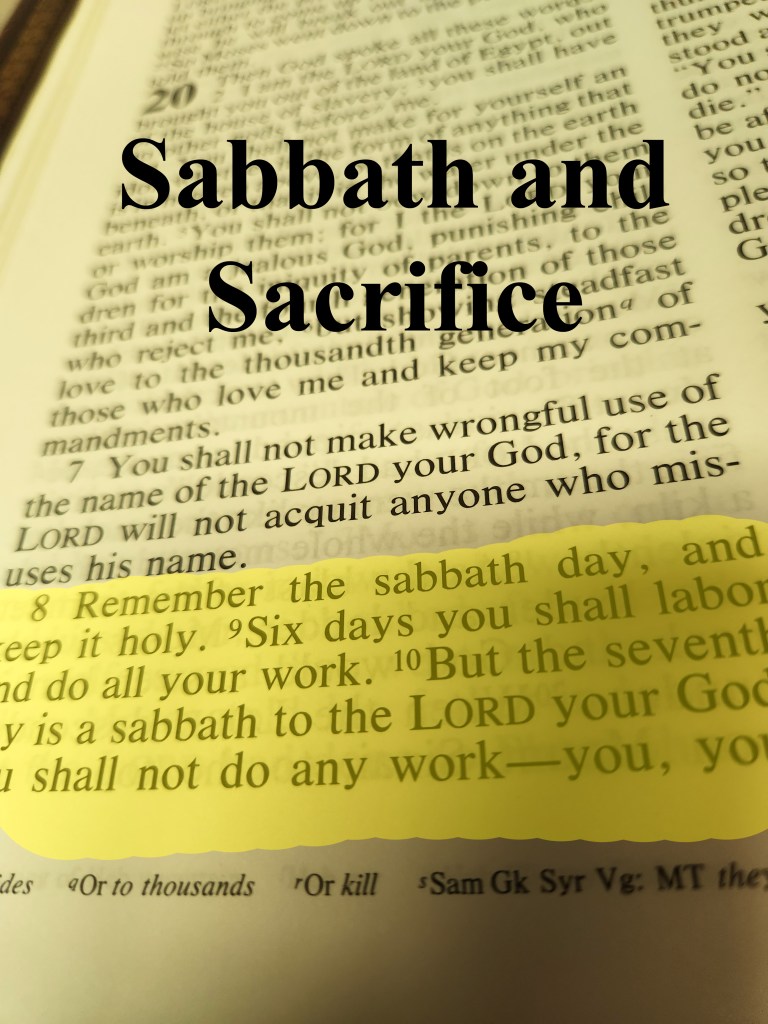
It’s a thoughtful sentiment, but Anne Lamott was hardly the first person to think about the value of turning us humans off and back on again. In fact, unplugging human beings, and then plugging them in again is the whole principle behind sabbath rest. Sabbath rest, of course, is an ancient idea, and, to understand that we need to go back to the beginning, to Deuteronomy 5:12-15, where we hear this command from God to his people:

12 “Observe the Sabbath day by keeping it holy, as the Lord your God has commanded you. 13 Six days you shall labor and do all your work, 14 but the seventh day is a sabbath to the Lord your God. On it you shall not do any work, neither you, nor your son or daughter, nor your male or female servant, nor your ox, your donkey or any of your animals, nor any foreigner residing in your towns, so that your male and female servants may rest, as you do. 15 Remember that you were slaves in Egypt and that the Lord your God brought you out of there with a mighty hand and an outstretched arm. Therefore, the Lord your God has commanded you to observe the Sabbath day.

When we read this, we realize that there are two purposes behind God’s requirement of the sabbath day. The first of these is simply to rest, to unplug, and reset our bodies and minds so that we can start fresh again in a new week. And the second reason is to remember what God has done for us, to remember God’s mighty acts of rescue, redemption, and rescue, and to spend time honoring and worshiping our God. But, over time, the reason and rationale behind honoring the sabbath got confused. Because everyone recognized that the sabbath was important, the priests and other religious leaders made rules to help the people of Israel get it right. But along the way, the rules that they made, and the traditions that they established, became so important, that they were held to be of the same importance as God’s original commands. And that’s why Jesus gets into an argument with the Pharisees in Mark 2:23 – 3:6 where we hear this:

23 One Sabbath Jesus was going through the grain fields, and as his disciples walked along, they began to pick some heads of grain. 24 The Pharisees said to him, “Look, why are they doing what is unlawful on the Sabbath?”

25 He answered, “Have you never read what David did when he and his companions were hungry and in need? 26 In the days of Abiathar the high priest, he entered the house of God and ate the consecrated bread, which is lawful only for priests to eat. And he also gave some to his companions.”

27 Then he said to them, “The Sabbath was made for man, not man for the Sabbath. 28 So the Son of Man is Lord even of the Sabbath.”

3:1 Another time Jesus went into the synagogue, and a man with a shriveled hand was there. Some of them were looking for a reason to accuse Jesus, so they watched him closely to see if he would heal him on the Sabbath. Jesus said to the man with the shriveled hand, “Stand up in front of everyone.”

Then Jesus asked them, “Which is lawful on the Sabbath: to do good or to do evil, to save life or to kill?” But they remained silent.

He looked around at them in anger and, deeply distressed at their stubborn hearts, said to the man, “Stretch out your hand.” He stretched it out, and his hand was completely restored. Then the Pharisees went out and began to plot with the Herodians how they might kill Jesus.

Since the commandment to rest on the sabbath day required observant followers of God to refrain from work, it was natural that, over time, people wanted to know what exactly qualified as work. Moreover, after Israel had been sent into captivity in Babylon because of their unfaithfulness, the priests and other religious leaders wanted to write rules that would figuratively put fences around the commandments of God so that, if you were to follow their man-made rules, you would always be found to be in obedience to God’s commandments. Staying inside the fence, as it were, prevented you from even accidentally breaking a commandment.

The problem with this system was that, after a while, the rules that were intended to help obey the commandments became elevated to the same level of importance as the commandments themselves. And so, in this story, we find the disciples snapping off, and chewing on some uncooked heads of grain as they walked through the fields. But even though they exerted no energy other than lifting their hands to their mouths, according to the rules, what they had done was defined as harvesting, and harvesting was work. God’s commandment to observe the sabbath never said that you couldn’t eat, but the rules that had been written by generations of priests said that what they had done was sin (hint: it wasn’t).

And so, Jesus gives an example from scripture about how the great King David had done the same thing, and worse, and explained that God intended the sabbath to improve the lives of human beings and not to be an additional burden to them. Jesus had the same argument over healing a man who had suffered from what may well have been a birth defect. While healing was somehow defined as work, Jesus asked how doing good and undoing evil could possibly be wrong.

And that’s all well and good, but as we often ask… so what?

So, what if we know that God created a sabbath rest and a time of worship for the benefit of humanity?

So, what if we understand we shouldn’t define our sabbath rest too narrowly, and that doing good things on our day of rest is okay?

How does that make a difference to us as we live our lives?

Well, for that, let’s turn to Paul’s second letter to the church in Corinth for some clarity. But, as we read, this may not immediately sound like it is at all related to our understanding of sabbath. But it is, so bear with me until we finish, and I can unpack it a little. In 2 Corinthians 4:5-12, Paul says…

For what we preach is not ourselves, but Jesus Christ as Lord, and ourselves as your servants for Jesus’ sake. For God, who said, “Let light shine out of darkness,” made his light shine in our hearts to give us the light of the knowledge of God’s glory displayed in the face of Christ.

But we have this treasure in jars of clay to show that this all-surpassing power is from God and not from us. We are hard pressed on every side, but not crushed; perplexed, but not in despair; persecuted, but not abandoned; struck down, but not destroyed. 10 We always carry around in our body the death of Jesus, so that the life of Jesus may also be revealed in our body. 11 For we who are alive are always being given over to death for Jesus’ sake, so that his life may also be revealed in our mortal body. 12 So then, death is at work in us, but life is at work in you.

And again, I understand that this message of servanthood and persecution doesn’t immediately sound like it connects to our understanding of sabbath, but let’s look a little closer.  Paul reminds us that what we tell the world is not a message about us, it is a message about Jesus Christ, about how he came to bring light into a dark world, to display God’s glory, and to change hearts. Because of that, Paul says that we have the treasure of Jesus Christ in jars of clay.

Wait.

What does that mean?

Our explanation comes from what immediately follows, and that is a list of all the horrible things that have happened to them as messengers of the gospel. They were hard pressed, persecuted, and struck down, but while these things happened, and while they did experience abuse, pain, and suffering, they were not completely crushed, they did not despair, they did not feel as if they had been abandoned, and they were not destroyed. They themselves were carrying the message of Jesus Christ, but they knew that they were finite, fragile, and temporary vessels. More to the point, we, all of us, are like jars of clay. We are fragile vessels that contain the treasure of Jesus Christ.

We are fragile. Like clay we leak, we chip, we scratch, and we break. If God intended for us to contain his treasure, he would have stored it in something more durable like a stout treasure chest or a stone fortress. But he didn’t. The only way for us to preserve the treasure that we contain… is to share it with others.

Paul says that “we who are alive are always being given over to death for Jesus’s sake.” That means that we must be at work giving of ourselves, offering ourselves as a sacrifice to God, and sharing the good news of Jesus Christ. Death is at work in us because our time on earth is limited, and because the sacrifice of Jesus Christ is a part of who we are. But life is also at work in us through Jesus’ resurrection and his gift of eternal life to those who believe.

And so, if we look at it with Paul’s words in mind, sabbath is a time of rest and renewal when we remember who we are as we come together to worship our God, refill our leaky clay vessels, share our courage and strength with one another, share the Spirit of God that dwells within us, build one another up, equip one another, teach, learn, and grow, so that we can go back out into the world as a living sacrifice to Jesus Christ and to the kingdom of God.

Anne Lamott said, “Almost anything will work again if you unplug it for a few minutes, including you.”

And the truth of scripture tells us that she’s not wrong. Human beings were not designed or built to go non-stop, twenty-four hours a day, seven day a week, three hundred and sixty-five (or 366) days a year. The God of creation built us with a need for rest. Once every seven days he offers us a sabbath, a time to reset, restore, rest, and renew both physically and spiritually so that we can face the world, and all the evil in it, for another week.

Without rest, without sabbath, we are easily crushed, suffer despair, and feel abandoned and destroyed. Without sabbath, our fragile clay leaks and our faith weakens. Without sabbath, we are not prepared to live lives of sacrifice to God.

Simply put, without sabbath, and without rest, we cannot be the people that God wants, and needs, us to be.


Please LIKE and SHARE!

Click here to subscribe to Pastor John’s blog.

Click here if you would like to subscribe to Pastor John’s weekly messages.

Click here to visit Pastor John’s YouTube channel.


*You have been reading a message presented at Christ United Methodist Church on the date noted at the top of the first page.  Rev. John Partridge is the pastor at Christ UMC in Alliance, Ohio.  Duplication of this message is a part of our Media ministry, if you have received a blessing in this way, we would love to hear from you.  Letters and donations in support of the Media ministry or any of our other projects may be sent to Christ United Methodist Church, 470 East Broadway Street, Alliance, Ohio 44601.  These messages are available to any interested persons regardless of membership.  You may subscribe to these messages, in print or electronic formats, by writing to the address noted, or by contacting us at secretary@CUMCAlliance.org.  These messages can also be found online at https://pastorpartridge.com .  All Scripture quotations, unless otherwise indicated, are taken from the Holy Bible, New International Version®, NIV®. Copyright ©1973, 1978, 1984, 2011 by Biblica, Inc.™ Used by permission of Zondervan. All rights reserved worldwide. www.zondervan.comThe “NIV” and “New International Version” are trademarks registered in the United States Patent and Trademark Office by Biblica, Inc.™

Religion that Misses the Point

Religion that Misses the Point

(Ash Wednesday)

February 14, 2024*

By Pastor John Partridge

Isaiah 58:1-12            Matthew 6:1-6, 16-21            2 Corinthians 5:20b-6:10

Scripture Readings

Isaiah 58:1-12

58:1 “Shout it aloud, do not hold back.
    Raise your voice like a trumpet.
Declare to my people their rebellion
    and to the descendants of Jacob their sins.
For day after day they seek me out;
    they seem eager to know my ways,
as if they were a nation that does what is right
    and has not forsaken the commands of its God.
They ask me for just decisions
    and seem eager for God to come near them.
‘Why have we fasted,’ they say,
    ‘and you have not seen it?
Why have we humbled ourselves,
    and you have not noticed?’

“Yet on the day of your fasting, you do as you please
    and exploit all your workers.
Your fasting ends in quarreling and strife,
    and in striking each other with wicked fists.
You cannot fast as you do today
    and expect your voice to be heard on high.
Is this the kind of fast I have chosen,
    only a day for people to humble themselves?
Is it only for bowing one’s head like a reed
    and for lying in sackcloth and ashes?
Is that what you call a fast,
    a day acceptable to the Lord?

“Is not this the kind of fasting I have chosen:
to loose the chains of injustice
    and untie the cords of the yoke,
to set the oppressed free
    and break every yoke?
Is it not to share your food with the hungry
    and to provide the poor wanderer with shelter—
when you see the naked, to clothe them,
    and not to turn away from your own flesh and blood?
Then your light will break forth like the dawn,
    and your healing will quickly appear;
then your righteousness will go before you,
    and the glory of the Lord will be your rear guard.
Then you will call, and the Lord will answer;
    you will cry for help, and he will say: Here am I.

“If you do away with the yoke of oppression,
    with the pointing finger and malicious talk,
10 and if you spend yourselves in behalf of the hungry
    and satisfy the needs of the oppressed,
then your light will rise in the darkness,
    and your night will become like the noonday.
11 The Lord will guide you always;
    he will satisfy your needs in a sun-scorched land
    and will strengthen your frame.
You will be like a well-watered garden,
    like a spring whose waters never fail.
12 Your people will rebuild the ancient ruins
    and will raise up the age-old foundations;
you will be called Repairer of Broken Walls,
    Restorer of Streets with Dwellings.

Matthew 6:1-6, 16-21

6:1 “Be careful not to practice your righteousness in front of others to be seen by them. If you do, you will have no reward from your Father in heaven.

“So when you give to the needy, do not announce it with trumpets, as the hypocrites do in the synagogues and on the streets, to be honored by others. Truly I tell you, they have received their reward in full. But when you give to the needy, do not let your left hand know what your right hand is doing, so that your giving may be in secret. Then your Father, who sees what is done in secret, will reward you.

“And when you pray, do not be like the hypocrites, for they love to pray standing in the synagogues and on the street corners to be seen by others. Truly I tell you, they have received their reward in full. But when you pray, go into your room, close the door, and pray to your Father, who is unseen. Then your Father, who sees what is done in secret, will reward you.

16 “When you fast, do not look somber as the hypocrites do, for they disfigure their faces to show others they are fasting. Truly I tell you, they have received their reward in full. 17 But when you fast, put oil on your head and wash your face, 18 so that it will not be obvious to others that you are fasting, but only to your Father, who is unseen; and your Father, who sees what is done in secret, will reward you.

19 “Do not store up for yourselves treasures on earth, where moths and vermin destroy, and where thieves break in and steal. 20 But store up for yourselves treasures in heaven, where moths and vermin do not destroy, and where thieves do not break in and steal. 21 For where your treasure is, there your heart will be also.

Religion: Missing the Point

In the scriptures that we heard a few moments ago, we heard God, through the prophet Isaiah, declare that his people were in rebellion against him because, while they came to church and seemed eager to know about God, they didn’t do the things that God had called them, and taught them, to do. The asked God for wisdom, fasted, and prayed, but refused his instructions by exploiting their workers, and fighting among themselves.

God declares that his people are in rebellion against him because their religion completely misses the point. Instead of fasting and giving up food, or other comforts, God wants his people to free the oppressed and overturn injustice. Rather than just giving up food and going hungry for a day, God wants his people to feed the hungry, provide shelter for the homeless, and clothe the naked. Instead of oppressing others, blaming others for your problems, and running people down with your words, spend your time feeding the hungry and helping to ease the burden of oppression. When God’s people do these things, then we begin to understand the point of our religion, only then will people begin to see the light of God in us, and it is then that God will begin to bless his people and grow his church.

We find a good example of how things should be done in the words of the Apostle Paul to the church in Corinth in 2 Corinthians 5:20b-6:10, when he says:

We implore you on Christ’s behalf: Be reconciled to God. 21 God made him who had no sin to be sinfor us, so that in him we might become the righteousness of God.

6:1 As God’s co-workers we urge you not to receive God’s grace in vain. For he says,

“In the time of my favor I heard you,
    and in the day of salvation I helped you.”

I tell you, now is the time of God’s favor, now is the day of salvation.

We put no stumbling block in anyone’s path, so that our ministry will not be discredited. Rather, as servants of God we commend ourselves in every way: in great endurance; in troubles, hardships and distresses; in beatings, imprisonments and riots; in hard work, sleepless nights and hunger; in purity, understanding, patience and kindness; in the Holy Spirit and in sincere love; in truthful speech and in the power of God; with weapons of righteousness in the right hand and in the left; through glory and dishonor, bad report and good report; genuine, yet regarded as impostors; known, yet regarded as unknown; dying, and yet we live on; beaten, and yet not killed; 10 sorrowful, yet always rejoicing; poor, yet making many rich; having nothing, and yet possessing everything.

Paul declares that he, his missionary team, and those supporting them in ministry in Corinth, did everything that they could to bring people to faith without stumbling over any hypocrisy in the way that they lived their lives. They endured trouble, hardship and distress, beatings, imprisonment, riots, hard work, lack of sleep, and hunger, while living a life of purity and having an attitude that expressed understanding, patience, kindness, and love toward the people around them. Even when they were falsely accused, when they suffered for their beliefs and for their ministry, they rejoiced in sharing the good news of Jesus Christ with others.

In short, they lived, and they loved, as if the teachings of scripture, and the words of Jesus Christ mattered. Unlike the people that Isaiah was rebuking, they did not just show up on Sunday morning and abuse their employees on Sunday afternoon. They didn’t tell people how great their church was, and then argue and fight with one another.

Although today is the day that we wear ashes on our forehead, and enter the season when people choose to fast from one thing or another, remember that these things are only a reminder. They are a reminder that we should never practice a religion that misses the point. They are a reminder that what God really wants, isn’t ashes and fasting from food, what God really wants for his people to feed the hungry, provide shelter for the homeless, clothe the naked, and fight against oppression and injustice.

What God really wants is obedience…. and love.


Please LIKE and SHARE!

Click here to subscribe to Pastor John’s blog.

Click here if you would like to subscribe to Pastor John’s weekly messages.

Click here to visit Pastor John’s YouTube channel.


*You have been reading a message presented at Christ United Methodist Church on the date noted at the top of the first page.  Rev. John Partridge is the pastor at Christ UMC in Alliance, Ohio.  Duplication of this message is a part of our Media ministry, if you have received a blessing in this way, we would love to hear from you.  Letters and donations in support of the Media ministry or any of our other projects may be sent to Christ United Methodist Church, 470 East Broadway Street, Alliance, Ohio 44601.  These messages are available to any interested persons regardless of membership.  You may subscribe to these messages, in print or electronic formats, by writing to the address noted, or by contacting us at secretary@CUMCAlliance.org.  These messages can also be found online at https://pastorpartridge.com .  All Scripture quotations, unless otherwise indicated, are taken from the Holy Bible, New International Version®, NIV®. Copyright ©1973, 1978, 1984, 2011 by Biblica, Inc.™ Used by permission of Zondervan. All rights reserved worldwide. www.zondervan.comThe “NIV” and “New International Version” are trademarks registered in the United States Patent and Trademark Office by Biblica, Inc.™

Goals of Lepers and Christians

Goals of Lepers and Christians

(Scout Sunday)

February 11, 2024*

By Pastor John Partridge

2 Kings 5:1-14            Mark 1: 1:40-45                    1 Corinthians 9: 24-27

What are your goals?

Maybe you aren’t sure about your goals because sometimes it takes a while for all our wants and wishes to get sorted and distilled into something that looks more like a plan than just wishful thinking. If you aren’t sure, goals are the thing that gets you out of bed in the morning even if your goal is just to get to work on time and pay your bills. But we often have bigger goals. When we’re in our teens our goal might be to finish school and buy a car. In our twenties and thirties, we might dream of a career, success, advancement, a family, and a home of our own. Later, we might have a goal of owning our own business, or climbing the corporate ladder, travel, hobbies, or writing a book. And at some point, many of us begin to add retirement to our life’s goals (and the earlier we begin planning for retirement the better off we are, though that’s a whole subject of its own).

But did you know that the lepers that we read about in scripture had goals? And, what do the goals of ancient lepers have to do with the goals that we have a Christians, and as a church, hundreds, even thousands, of years later?

Let’s begin with the story of Naaman, the commander of the armies of Aram, found in 2 Kings 5:1-14. Aram, at that time, was one of the most powerful nations in the world and so, as the commander of its armies, Naaman was important, powerful, wealthy, and perhaps second only in influence to the king of Aram himself, and with whom Naaman had a close relationship. But Naaman had a problem that money and power and influence couldn’t solve, and we join the story at that point.

5:1 Now Naaman was commander of the army of the king of Aram. He was a great man in the sight of his master and highly regarded, because through him the Lord had given victory to Aram. He was a valiant soldier, but he had leprosy.

Now bands of raiders from Aram had gone out and had taken captive a young girl from Israel, and she served Naaman’s wife. She said to her mistress, “If only my master would see the prophet who is in Samaria! He would cure him of his leprosy.”

Naaman went to his master and told him what the girl from Israel had said. “By all means, go,” the king of Aram replied. “I will send a letter to the king of Israel.” So Naaman left, taking with him ten talentsof silver, six thousand shekelsof gold and ten sets of clothing. The letter that he took to the king of Israel read: “With this letter I am sending my servant Naaman to you so that you may cure him of his leprosy.”

As soon as the king of Israel read the letter, he tore his robes and said, “Am I God? Can I kill and bring back to life? Why does this fellow send someone to me to be cured of his leprosy? See how he is trying to pick a quarrel with me!”

When Elisha the man of God heard that the king of Israel had torn his robes, he sent him this message: “Why have you torn your robes? Have the man come to me and he will know that there is a prophet in Israel.” So Naaman went with his horses and chariots and stopped at the door of Elisha’s house. 10 Elisha sent a messenger to say to him, “Go, wash yourself seven times in the Jordan, and your flesh will be restored, and you will be cleansed.”

11 But Naaman went away angry and said, “I thought that he would surely come out to me and stand and call on the name of the Lord his God, wave his hand over the spot and cure me of my leprosy. 12 Are not Abana and Pharpar, the rivers of Damascus, better than all the waters of Israel? Couldn’t I wash in them and be cleansed?” So, he turned and went off in a rage.

13 Naaman’s servants went to him and said, “My father, if the prophet had told you to do some great thing, would you not have done it? How much more, then, when he tells you, ‘Wash and be cleansed’!” 14 So he went down and dipped himself in the Jordan seven times, as the man of God had told him, and his flesh was restored and became clean like that of a young boy.

First, I am certain that I am not the only person that just needs to know how much money that we are talking about when they start throwing around words like “talents of silver” and “shekels of gold.” And so, before we go any further, I will do the math for you. One Babylonian talent is a bit over sixty-six pounds, with translates to 800.2 troy ounces per talent. Multiply 800.2 troy ounces times ten talents, and times Monday’s silver spot price of $22.34 per ounce and you end up with a 665.6-pound pile of silver worth $179,165 in today’s market. That’s a fair amount of money and a lot of weight to carry, but then we have six thousand shekels of gold. Six thousand shekels would weigh 262.5 pounds, or 3150 troy ounces, time Monday’s spot price of $2056.37 per ounce and we end up with a current value of $6,477,565.50 which is a serious amount of running around money.

But, when the Naaman shows up in front of Israel’s king, the king tears his robes as a sign of distress and mourning because he thinks that he is being set up and that somehow Aram wants to find a reason to be offended and declare war against them. Naaman knows, the king of Aram knows, and the king of Israel knows that he can’t heal leprosy because no one can cure leprosy so it must be a trap… right? Leprosy was the great equalizer. It didn’t matter if you had money and power or if you were poor. There was no cure, at all, ever, for leprosy and it would, eventually, after much suffering, kill you. But Elisha hears about the king’s problem and asks that Naaman be sent to him.

You see, Naaman’s goal was not to declare war on Israel because he really had leprosy. So far, he had been able to keep it a secret among a small group of people, but sooner or later the truth would come out and he would be cast out of polite society as unclean and when that happened, he would lose everything and become a beggar on the streets of Aram. Naaman’s only goal was to be healed and become whole again. He stumbles over his pride and his nationalism at first because why would Israel’s river be any better than any of Aram’s rivers, but he humbles himself, does what Elisha asked of him, and is healed.

And then almost a thousand years later, in Mark 1:40-45, we meet another person with leprosy. This man has the same problem, but he is already poor, and already an outcast. But he hears about Jesus, goes to him, gets down on his knees in humility, and begs Jesus to heal him.

40 A man with leprosy came to him and begged him on his knees, “If you are willing, you can make me clean.”

41 Jesus was indignant [some translations “he was filled with compassion]. He reached out his hand and touched the man. “I am willing,” he said. “Be clean!” 42 Immediately the leprosy left him, and he was cleansed.

43 Jesus sent him away at once with a strong warning: 44 “See that you don’t tell this to anyone. But go, show yourself to the priest and offer the sacrifices that Moses commanded for your cleansing, as a testimony to them.” 45 Instead he went out and began to talk freely, spreading the news. As a result, Jesus could no longer enter a town openly but stayed outside in lonely places. Yet the people still came to him from everywhere.

Even though he was poor, this man’s goal was the same as Naaman’s, to be healed and become whole again. Both men with leprosy had a goal and they did whatever they could to attain it. One offered money and traveled to a distant country only to discover that what was needed wasn’t money, but humility. The second didn’t travel with an entourage but fell at Jesus feet in humility and faith. In the end, though they could hardly be more different, both men did all that they could to reach their goal.

But where does that leave us, and what does any of that have to do with us, or with the church, in the twenty-first century? If we’re honest, it has everything to do with us. In 1 Corinthians 9:24-27, Paul writes to the church in Corinth about what they should be doing, and what we should be doing, to achieve our goals. He said…

24 Do you not know that in a race all the runners run, but only one gets the prize? Run in such a way as to get the prize. 25 Everyone who competes in the games goes into strict training. They do it to get a crown that will not last, but we do it to get a crown that will last forever. 26 Therefore I do not run like someone running aimlessly; I do not fight like a boxer beating the air. 27 No, I strike a blow to my body and make it my slave so that after I have preached to others, I myself will not be disqualified for the prize.

If your goal is to run in the Olympics, then you cannot train for one hour every other Saturday. If you want to accomplish your goals, your everyday actions must reflect those goals. The two men with leprosy wanted to be whole again and they did whatever they could to find someone that could help them to get there, and with humility, did whatever was asked of them. If we as individuals, and as a church, or as a pack, or as a troop, have goals, then we must, every day, do whatever must be done in order to achieve those goals.

If we intend to gain rank and one day earn our Eagle Scout award, then we must be busy doing the work of scouting to earn rank and community service hours. If we want to grow closer to God, or grow our church, then we must be busy doing that work as well, not just for one hour every other Saturday, but we must daily, diligently, do the work of reading and studying scripture, inviting our friends and neighbors to church, being busy in prayer, sharing the message of the gospel and the Good News of Jesus Christ, and just like we would of we were training for the Olympics, having the humility to patiently, and persistently, do the work, day in, and day out.

All runners run, but only one will win the prize. We must pursue our goals, and run our race, in such a way that we will not be disqualified for the prize.


Please LIKE and SHARE!

Click here to subscribe to Pastor John’s blog.

Click here if you would like to subscribe to Pastor John’s weekly messages.

Click here to visit Pastor John’s YouTube channel.


*You have been reading a message presented at Christ United Methodist Church on the date noted at the top of the first page.  Rev. John Partridge is the pastor at Christ UMC in Alliance, Ohio.  Duplication of this message is a part of our Media ministry, if you have received a blessing in this way, we would love to hear from you.  Letters and donations in support of the Media ministry or any of our other projects may be sent to Christ United Methodist Church, 470 East Broadway Street, Alliance, Ohio 44601.  These messages are available to any interested persons regardless of membership.  You may subscribe to these messages, in print or electronic formats, by writing to the address noted, or by contacting us at secretary@CUMCAlliance.org.  These messages can also be found online at https://pastorpartridge.com .  All Scripture quotations, unless otherwise indicated, are taken from the Holy Bible, New International Version®, NIV®. Copyright ©1973, 1978, 1984, 2011 by Biblica, Inc.™ Used by permission of Zondervan. All rights reserved worldwide. www.zondervan.comThe “NIV” and “New International Version” are trademarks registered in the United States Patent and Trademark Office by Biblica, Inc.™

Photo by tutu55 on Freeimages.com

Freedom’s Surrender

Freedom’s Surrender

February 04, 2024*

By Pastor John Partridge

Isaiah 40:21-31          Mark 1:29-39             1 Corinthians 9:16-23

We’re going to start this morning with a quiz.

Most of you did not expect a quiz on Sunday morning, and some of you may struggle with the question, but here it is:

What idols do we worship in the United States in the twenty-first century?

Anyone who has been in church for any length of time at all, or anyone who has started reading the bible knows that there are many cautions and sermons against committing sin by worshipping idols.

Many of us would argue that our contemporary society doesn’t have any idols simply because you won’t find any temples where people worship Baal, or Jupiter, or Roma, or any of the ancient gods and goddesses. But is that enough of a defense?

It could easily be argued that idol worship is anything that we make so important in our lives that we are willing to sacrifice to it, and put ahead of God in priority, importance, or love. In scripture, God repeatedly makes the point that he simply will not accept second place. When we choose to worship God and his son Jesus Christ, God’s expectation, and God’s demand, is that we make him first in our lives. And if we use that definition, then it isn’t hard at all to see that Americans worship idols all the time. Even those of us who regularly go to church sometimes put God in second place because we are worshiping comfort, or sports, or money, or entertainment, or even the entertainment or indulgence of our children. As we discussed last week, as Americans, we often elevate rights above the importance that God gives to them and there are few other things that American culture elevates, and which may be regarded as idols, if we aren’t careful.

But first, let’s begin this morning by remembering who God is and why it is that we come here each Sunday to worship him. Let’s begin by listening to the words of the prophet Isaiah as he reminds God’s people of what God has done, why they belong to God, and why they really ought to stop complaining. We hear these words in Isaiah 40:21-31:

21 Do you not know?
    Have you not heard?
Has it not been told you from the beginning?
    Have you not understood since the earth was founded?
22 He sits enthroned above the circle of the earth,
    and its people are like grasshoppers.
He stretches out the heavens like a canopy,
    and spreads them out like a tent to live in.
23 He brings princes to naught
    and reduces the rulers of this world to nothing.
24 No sooner are they planted,
    no sooner are they sown,
    no sooner do they take root in the ground,
than he blows on them and they wither,
    and a whirlwind sweeps them away like chaff.

25 “To whom will you compare me?
    Or who is my equal?” says the Holy One.
26 Lift up your eyes and look to the heavens:
    Who created all these?
He who brings out the starry host one by one
    and calls forth each of them by name.
Because of his great power and mighty strength,
    not one of them is missing.

27 Why do you complain, Jacob?
    Why do you say, Israel,
“My way is hidden from the Lord;
    my cause is disregarded by my God”?
28 Do you not know?
    Have you not heard?
The Lord is the everlasting God,
    the Creator of the ends of the earth.
He will not grow tired or weary,
    and his understanding no one can fathom.
29 He gives strength to the weary
    and increases the power of the weak.
30 Even youths grow tired and weary,
    and young men stumble and fall;
31 but those who hope in the Lord
    will renew their strength.
They will soar on wings like eagles;
    they will run and not grow weary,
    they will walk and not be faint.

Isaiah begins by asking why you do not seem to understand the most obvious thing in the world, that God is not just big, but bigger than big. God is not just powerful, but so powerful that humans do not, and cannot, compare to him, nor can our imagination comprehend God’s power. Isaiah then continues by asking why people complain that God is hidden, or that God is ignoring them, or that God has forgotten them. Instead, Isaiah says, God knows exactly what you are doing, God is aware of your problems and cares about their resolution, but because God is all-powerful and all-knowing, God understands your situation better than you ever could. As such, God is not impatient, as we often are, and God waits for the right time to do what needs to be done. Once we understand and accept that this is true, then we also understand that our role is to trust God and as hard as it is to get past our own impatience, our role is to be patient and wait for God.

But then we read Mark 1:29-39. And here we find Jesus, God in human form, powerful beyond all understanding, and yet, what he does with that power staggers our imagination and our understanding. Mark says…

29 As soon as they left the synagogue, they went with James and John to the home of Simon and Andrew. 30 Simon’s mother-in-law was in bed with a fever, and they immediately told Jesus about her. 31 So he went to her, took her hand, and helped her up. The fever left her, and she began to wait on them.

32 That evening after sunset the people brought to Jesus all the sick and demon possessed. 33 The whole town gathered at the door, 34 and Jesus healed many who had various diseases. He also drove out many demons, but he would not let the demons speak because they knew who he was.

35 Very early in the morning, while it was still dark, Jesus got up, left the house, and went off to a solitary place, where he prayed. 36 Simon and his companions went to look for him, 37 and when they found him, they exclaimed: “Everyone is looking for you!”

38 Jesus replied, “Let us go somewhere else—to the nearby villages—so I can preach there also. That is why I have come.” 39 So he traveled throughout Galilee, preaching in their synagogues, and driving out demons.

In this short passage, we see Jesus heal Peter’s mother-in-law of an unspecified virus, heal the sick, and drive out demons. Jesus is, at this point, wildly popular and people flock to see him wherever he goes. He is incredibly powerful. He could, at this point, do anything that he wanted to do. He could make a fortune just by performing healings. Can you imagine what Herod or other powerful people would have paid to be healed of their gout, diabetes, heart failure, lead poisoning,meningitis, encephalitis, syphilis, and other unknown and misunderstood diseases from which they suffered? Can you imagine what it would have been worth to Ceasar to know who was trying to kill him? Jesus could have done whatever he wanted. He could have been rich, he could have travelled, he could have had earthly power, but instead he tells his disciples that they will walk to nearby villages so that he can preach, teach, heal, and drive out demons because, he says, “that is why I have come.”

Jesus had the power and the freedom to do whatever he wanted to do, but he chose to do what God had sent him to do. And that feeds into what Paul says in his letter to the church in Corinth. Paul wasn’t powerful like Jesus, but he clearly had other options of what he could do with his life. Paul explains his choices this way in 1 Corinthians 9:16-23:

16 For when I preach the gospel, I cannot boast, since I am compelled to preach. Woe to me if I do not preach the gospel! 17 If I preach voluntarily, I have a reward; if not voluntarily, I am simply discharging the trust committed to me. 18 What then is my reward? Just this: that in preaching the gospel I may offer it free of charge, and so not make full use of my rights as a preacher of the gospel.

19 Though I am free and belong to no one, I have made myself a slave to everyone, to win as many as possible. 20 To the Jews I became like a Jew, to win the Jews. To those under the law I became like one under the law (though I myself am not under the law), so as to win those under the law. 21 To those not having the law I became like one not having the law (though I am not free from God’s law but am under Christ’s law), so as to win those not having the law. 22 To the weak I became weak, to win the weak. I have become all things to all people so that by all possible means I might save some. 23 I do all this for the sake of the gospel, that I may share in its blessings.

Paul says that he doesn’t travel from town to town and preach the gospel because of some inflated sense of self-importance but because that is why God has called him, and what God compels him daily to go out and do. Like Jesus, and like generations of pastors, teachers, and evangelists that have followed him, Paul doesn’t preach so that he can gain wealth, or fame, or some other earthly reward, but simply because he is being obedient to God.

Paul says that he is free to do whatever he wants to do. As a Roman citizen, and as a person from a family that had some measure of wealth, Paul is free to go wherever he wants to go, and do whatever he wants to do. Until he chose to follow Jesus, Paul was recognized as a leader within the Pharisees and among the rulers and leaders of Israel and, if it were power and notoriety that he wanted, it is likely that he could have gone back to that life. Paul had the freedom to do whatever he wanted to do, but instead, he gave up his freedom to be obedient to God. He gave up his comfort to suffer alongside the slaves and the poor. He gave up the familiarity of his Jewishness so that he could minister to, and with, the Gentiles. Although Paul had freedom, he gave up that freedom whenever, and wherever necessary so that he could accomplish the mission given to him by Jesus Christ.

Just as we spoke last week about rights, we must be careful as the followers of Jesus Christ and as citizens of the United States in the twenty-first century, to not make an idol of our freedoms. As important, and as wonderful, as freedom is, if we are to answer the call that God has upon our lives, we must sometimes set our freedoms aside in order to accomplish the mission that God has assigned to us.

Our rights and freedoms are not idols to be worshiped, they are tools to be used, set aside, or even surrendered, in pursuit of rescuing the lost as we share the story and the gospel of Jesus.


Please LIKE and SHARE!

Click here to subscribe to Pastor John’s blog.

Click here if you would like to subscribe to Pastor John’s weekly messages.

Click here to visit Pastor John’s YouTube channel.


*You have been reading a message presented at Christ United Methodist Church on the date noted at the top of the first page.  Rev. John Partridge is the pastor at Christ UMC in Alliance, Ohio.  Duplication of this message is a part of our Media ministry, if you have received a blessing in this way, we would love to hear from you.  Letters and donations in support of the Media ministry or any of our other projects may be sent to Christ United Methodist Church, 470 East Broadway Street, Alliance, Ohio 44601.  These messages are available to any interested persons regardless of membership.  You may subscribe to these messages, in print or electronic formats, by writing to the address noted, or by contacting us at secretary@CUMCAlliance.org.  These messages can also be found online at https://pastorpartridge.com .  All Scripture quotations, unless otherwise indicated, are taken from the Holy Bible, New International Version®, NIV®. Copyright ©1973, 1978, 1984, 2011 by Biblica, Inc.™ Used by permission of Zondervan. All rights reserved worldwide. www.zondervan.comThe “NIV” and “New International Version” are trademarks registered in the United States Patent and Trademark Office by Biblica, Inc.™

Rights, Truth, or Distraction?

Rights, Truth, or Distraction?

January 28, 2024*

By Pastor John Partridge

Deuteronomy 18:15-20         Mark 1:21-28             1 Corinthians 8:1-13

I hear voices.

Seriously, every day I hear voices.

But so do you.

Every day we hear voices and opinions on the news, on social media, and in real life. We hear talking heads that give us opinions labeled as entertainment, we have news reporters that inject their opinions into the news, we have political parties of the left, right, and center that would argue that the sky isn’t blue if they thought it would win them votes, we watch wars from a distance and hear voices from factions from around the world spewing widely different points of view, and just about every major news story has a conspiracy theory to go with it. These voices offer us a cacophony of noise that makes us wonder where we might find the truth and might even make us doubt our own sanity.

But, although the stories behind the voices might be different, our struggle is not much different than that faced by the people of the Old and New Testaments. They too heard the voices of different opinions, different religions, different factions within their own religion, and similar arguments between their politicians, rulers, and foreign powers. The world is, and has been, filled with voices and opinions and the challenge that we face is choosing those voices to which we will listen, and discerning the truth from among the noise. Of course, we could spend months of sermons, and volumes of reading and study to even begin to dig through it all, but since this is both a new and an ancient problem, we find that scripture gives us guidelines that can help us.  We begin in another time of confusion. As Israel prepared to enter the Promised Land, they worried what would happen to them, and who would lead them, if Moses did not go with them, and for that matter, if Moses, who was already old, were to die. And in Deuteronomy 18:15-20, we hear an answer from Moses that answered some of their questions but also some of ours when he says:

15 The Lord your God will raise up for you a prophet like me from among you, from your fellow Israelites. You must listen to him. 16 For this is what you asked of the Lord your God at Horeb on the day of the assembly when you said, “Let us not hear the voice of the Lord our God nor see this great fire anymore, or we will die.”

17 The Lord said to me: “What they say is good. 18 I will raise up for them a prophet like you from among their fellow Israelites, and I will put my words in his mouth. He will tell them everything I command him. 19 I myself will call to account anyone who does not listen to my words that the prophet speaks in my name. 20 But a prophet who presumes to speak in my name anything I have not commanded, or a prophet who speaks in the name of other gods, is to be put to death.”

Moses’ answer is both good news and bad news. God promises that his people will continue to hear his voice through leaders and prophets that he would send and that he will continue to lead them. That’s the good news. The bad news is that there would also be other voices, from other people, that God did not send. Even worse is that some of those other voices would claim to be prophets sent from God and would claim to speak for God. For obvious reasons, that’s not good. False prophets could have any number of motivations, but as we’ve seen often enough in the twentieth and twenty-first centuries, cult leaders and televangelists enriching themselves at the expense of faithful, though gullible believers is a very real possibility. But from the realms of everyday living to politics, listening to the voices of false prophets could be disastrous. This is so important, that the punishment for these charlatans isn’t just that they should be ignored, imprisoned, cast out, exiled, or excommunicated from the community, the punishment for pretending to speak for God … was death. God wasn’t playing around because the lives of his people, and the hope of his nation were at stake.

In contrast, as we read the story of the gospel in Mark 1:21-28, we see how the people reacted to Jesus in comparison to the preachers and politicians with whom everyone was familiar.

21 They went to Capernaum, and when the Sabbath came, Jesus went into the synagogue and began to teach. 22 The people were amazed at his teaching, because he taught them as one who had authority, not as the teachers of the law. 23 Just then a man in their synagogue who was possessed by an impure spirit cried out, 24 “What do you want with us, Jesus of Nazareth? Have you come to destroy us? I know who you are—the Holy One of God!”

25 “Be quiet!” said Jesus sternly. “Come out of him!” 26 The impure spirit shook the man violently and came out of him with a shriek.

27 The people were all so amazed that they asked each other, “What is this? A new teaching—and with authority! He even gives orders to impure spirits and they obey him.” 28 News about him spread quickly over the whole region of Galilee.

It was evident by the tone and tenor of Jesus’ teaching that he was different. He did not equivocate. He did not hedge. He did not express opinions or discuss possibilities or probabilities. Unlike the other preachers and teachers that everyone had heard, Jesus taught as if he knew what he was talking about and as if he had the authority to back up his words. And not only did Jesus preach and act as if he knew what God wanted, he demonstrated God’s power by healing the sick and the lame, raising the dead, and casting out demons. Jesus was the real deal and the people who saw him knew it because he spoke like it, lived like it, acted like it, and demonstrated it.

But how does that translate to us? What advice does scripture have that can help us to discern the truth and find guidance as we listen to the conflicting voices that we hear every day?

For that, let us once again turn to the writings of the Apostle Paul in his first letter to the church in Corinth. Reading from 1 Corinthians 8:1-13 we hear this instruction and advice:

8:1 Now about food sacrificed to idols: We know that “We all possess knowledge.” But knowledge puffs up while love builds up. Those who think they know something do not yet know as they ought to know. But whoever loves God is known by God.

So then, about eating food sacrificed to idols: We know that “An idol is nothing at all in the world” and that “There is no God but one.” For even if there are so-called gods, whether in heaven or on earth (as indeed there are many “gods” and many “lords”), yet for us there is but one God, the Father, from whom all things came and for whom we live; and there is but one Lord, Jesus Christ, through whom all things came and through whom we live.

But not everyone possesses this knowledge. Some people are still so accustomed to idols that when they eat sacrificial food, they think of it as having been sacrificed to a god, and since their conscience is weak, it is defiled. But food does not bring us near to God; we are no worse if we do not eat, and no better if we do.

Be careful, however, that the exercise of your rights does not become a stumbling block to the weak. 10 For if someone with a weak conscience sees you, with all your knowledge, eating in an idol’s temple, won’t that person be emboldened to eat what is sacrificed to idols? 11 So this weak brother or sister, for whom Christ died, is destroyed by your knowledge. 12 When you sin against them in this way and wound their weak conscience, you sin against Christ. 13 Therefore, if what I eat causes my brother or sister to fall into sin, I will never eat meat again, so that I will not cause them to fall.

10 The fear of the Lord is the beginning of wisdom;
    all who follow his precepts have good understanding.
    To him belongs eternal praise.

The first two verses contain an easily overlooked, but important tidbit. If we word it with a slightly more common phrasing, what we hear is, “Some people think that they know something, but until they understand how to love, they don’t know as much as they think that they do.” Let me say that again, “Some people think that that they are pretty smart, but until they understand how to love, they aren’t as smart as they should be.” And that is what is at the core of the rest of the passage.

In Corinth there was a disagreement among believers about whether it was okay to eat meat that had been sacrificed to idols. In Greece, much like it was in Israel, particularly without refrigeration, most people simply did not eat meat that often. Even if you wanted to eat meat, it was rare that you would want to butcher an entire animal. But there were meat markets in a city as large as Corinth. The problem was that much of the meat that was available for sale, came to the butcher after it had been sacrificed on some pagan altar.

Some believers felt that it was sinful to eat meat that had been sacrificed to a pagan god, but others believed that since pagan gods weren’t real, that it didn’t matter, that it wasn’t sinful, and it was fine for them to eat such meat. But Paul, strict as he was in his Jewish practice, says that even though he agrees that it isn’t sinful, and that believers have every right to eat it, it still might be wrong to exercise that right if doing so weakens, or damages, the faith of another believer. Paul says that when you exercise your rights in such a way that you hurt people and tempt them to do what they believe to be sin, then you destroy them, and you commit sin against Jesus. Paul’s conclusion is that he would rather give up meat forever than to cause a brother or sister in Christ to lose their faith.

So let us consider what we have heard from scripture today. First, that we can expect to hear voices that speak falsely, that claim to be something that they are not, that claim to speak for God when they do not, and who will attempt to enrich themselves at your expense. But those who are trustworthy will speak the truth, live in a way that models their faith, act as if they have faith, and demonstrate their faith in all that they do. Those that do not do these things are not worth following.

Second, while our rights are important, they are not always the most important. Knowing something, without understanding how to love, means that you don’t really know what you think that you know. If we exercise our rights in such a way that we hurt other people, tempt them to sin, or damage their faith, then we sin against God and against Christ in doing so. For Paul, the issue at hand was whether the followers of Jesus Christ had the right to eat meat that had been sacrificed to idols but imagine how we might apply that to our modern discussions about rights. Although rights are certainly important, especially in our 21st century American culture, the measurement isn’t whether we have a right to free speech, or to bear arms, or to not incriminate ourselves, or to eat meat and drink alcohol, or to protest, or to have an abortion, or smoke marijuana, or to a host of other rights that we hold dear, the real measurement is whether in exercising those rights, we hurt other people, tempt them to sin, or damage their faith.

When we do that, even if we have a right to do whatever we did, then we sin.

Remember we said that some people think that that they are smart, but until they understand how to love, they aren’t as smart as they should be.

The measurement isn’t about rights, it’s about having love and compassion for the people around us.

We must never let the voices of the world around us distract us from living and acting in ways that are truthful, compassionate, faithful, and loving.


Please LIKE and SHARE!

Click here to subscribe to Pastor John’s blog.

Click here if you would like to subscribe to Pastor John’s weekly messages.

Click here to visit Pastor John’s YouTube channel.


*You have been reading a message presented at Christ United Methodist Church on the date noted at the top of the first page.  Rev. John Partridge is the pastor at Christ UMC in Alliance, Ohio.  Duplication of this message is a part of our Media ministry, if you have received a blessing in this way, we would love to hear from you.  Letters and donations in support of the Media ministry or any of our other projects may be sent to Christ United Methodist Church, 470 East Broadway Street, Alliance, Ohio 44601.  These messages are available to any interested persons regardless of membership.  You may subscribe to these messages, in print or electronic formats, by writing to the address noted, or by contacting us at secretary@CUMCAlliance.org.  These messages can also be found online at https://pastorpartridge.com .  All Scripture quotations, unless otherwise indicated, are taken from the Holy Bible, New International Version®, NIV®. Copyright ©1973, 1978, 1984, 2011 by Biblica, Inc.™ Used by permission of Zondervan. All rights reserved worldwide. www.zondervan.comThe “NIV” and “New International Version” are trademarks registered in the United States Patent and Trademark Office by Biblica, Inc.™

The End is (Really!) Near

The End is (Really!) Near

January 21, 2024*

By Pastor John Partridge

Jonah 3:1-5, 10          Mark 1:14-20             1 Corinthians 7:29-31

Do you watch cartoons? Or do you read the comics on the funny pages of the newspaper, or online?

I’m not sure exactly what to call it, but there is a cartoon component, image, idea, motif, or stylistic element that has been used, copied, reused so many times that it is impossible to figure out when it first appeared. The image that I am thinking of is that of a person carrying a sandwich board or a sign on a pole that says, “The End is Near.” Often the person carrying the sign is portrayed as a sixties-era hippy, but other times it can be a businessman in a suit, or whatever else fits the point that the cartoonist is trying to convey.

But outside of cartoons and attempts at humor, we have often seen similar doom and gloom, end of the world stories in the real world. These stories once came from a raft of scientists that were predicting the dawn of a new ice age, or those that now predict rising sea levels due to global warming, or to asteroids that will destroy civilization, or a catastrophic x-class solar flare that may one day wipe out all the computers and electricity generation across out entire planet. Not to be outdone, there seem to be regular announcements by various religious groups that the world will end, or that Christ will return, because of their interpretation of scripture, or because of the Mayan calendar, or because of something else. Overall, we have heard that “The End is Near” so often that we no longer bother to pay any attention to such announcements at all.

But maybe we should.

What if the place that we heard “The End is Near” is in the bible? And what if we didn’t hear it just once, but over and over again, generation after generation, from the mouths of prophets, disciples, and from Jesus himself? Would we assume that if the message had been repeated so often, just as we assume today when we listen to the news, that it must not be true, and we are free to ignore it? Or would we notice that sometimes it was true, and things did not go well for the people who didn’t listen?

Let’s take a look at three samples from scripture, and then we will think about what it all means, and just what we might, and might not, want to ignore, and what we should be doing about it in our lives, and in our church, today. We begin with the end of the story in the book of Jonah. First God sent Jonah to preach a message of repentance to the people of Nineveh, but Jonah didn’t want to do that. Jonah knew that the people of Nineveh were awful, evil, terrible people who hated God, hated the people of Israel, and treated their enemies, criminals, and anyone they took a dislike to, with contempt, abuse, violence, and death. Nineveh was the city that hung the heads, and often the bodies, of their enemies on the gates and the walls of their city to warn everyone what happened to those who dared to oppose them. They were not nice people. In any case, God prevails, and Jonah, after his encounter with a big fish, obeys God. This is the story that we hear in Jonah 3:1-5, 10.

3:1 Then the word of the Lord came to Jonah a second time: “Go to the great city of Nineveh and proclaim to it the message I give you.”

Jonah obeyed the word of the Lord and went to Nineveh. Now Nineveh was a very large city; it took three days to go through it. Jonah began by going a day’s journey into the city, proclaiming, “Forty more days and Nineveh will be overthrown.” The Ninevites believed God. A fast was proclaimed, and all of them, from the greatest to the least, put on sackcloth.

10 When God saw what they did and how they turned from their evil ways, he relented and did not bring on them the destruction he had threatened.

The message that Jonah carried into Nineveh, however reluctantly, was a message that God intended to utterly destroy them as a people and as a city. As far as they were concerned, Jonah was predicting the end of the world. But they listened to Jonah, heard his message, they repented of their evil actions, habits, and culture, and God relented and did not bring upon them the destruction that he had planned.

It is worth noting however, that some years later, Nineveh returns to their old ways, continue to do evil, and God declares through the prophet Nahum, that their time is ended. The Babylonians invade and Nineveh is erased from history, disappears from the maps of the world, and its ruins only rediscovered by archaeologists in 1847.

We hear a similar story, though far less violent, in Mark 1:14-20 in which Jesus is the one sharing the message from God:

14 After John was put in prison, Jesus went into Galilee, proclaiming the good news of God. 15 “The time has come,” he said. “The kingdom of God has come near. Repent and believe the good news!”

16 As Jesus walked beside the Sea of Galilee, he saw Simon and his brother Andrew casting a net into the lake, for they were fishermen. 17 “Come, follow me,” Jesus said, “and I will send you out to fish for people.” 18 At once they left their nets and followed him.

19 When he had gone a little farther, he saw James, son of Zebedee and his brother John in a boat, preparing their nets. 20 Without delay he called them, and they left their father Zebedee in the boat with the hired men and followed him.

The message of Jesus was that the kingdom of God had arrived and that everyone should repent and believe the good news. But why is repentance so important, so vital, to the news that the kingdom of God had arrived? It is important because, in the calendar of God, now that the kingdom had arrived, the followers of God now knew that judgement was at hand and could come at any moment. The news that the messiah had come was inescapably tied to an understanding that the end was near, and judgement was coming.

And if you aren’t convinced that these events are so closely tied together, then listen to Paul explain it to the church in Corinth as recorded in 1 Corinthians 7:29-31:

29 What I mean, brothers and sisters, is that the time is short. From now on those who have wives should live as if they do not; 30 those who mourn, as if they did not; those who are happy, as if they were not; those who buy something, as if it were not theirs to keep; 31 those who use the things of the world, as if not engrossed in them. For this world in its present form is passing away.

Paul says that the time is short, that the end is indeed near, and because it is, the followers of Jesus Christ must live as if time is important. We should not live as if we have all the time in the world, but as if Jesus could return tomorrow, or this afternoon, or before we draw our next breath. Paul’s words describe a need for urgency in our behavior and in our actions. We must act as if the world might end tomorrow. We must live as if our mission is important and assume that we might not get a second chance to share the good news with the people around us. We should share what we have and not get addicted to the accumulation of possessions. And finally, we should behave as if we aren’t addicted to the things of popular culture and the popularity of fads and famous folk.

Jesus said that no one knows the day or the hour of his return and the day of judgement, but scripture says that the end is near.

And we really ought to act like it.

We must live lives that reflect some urgency.


Please LIKE and SHARE!

Click here to subscribe to Pastor John’s blog.

Click here if you would like to subscribe to Pastor John’s weekly messages.

Click here to visit Pastor John’s YouTube channel.


*You have been reading a message presented at Christ United Methodist Church on the date noted at the top of the first page.  Rev. John Partridge is the pastor at Christ UMC in Alliance, Ohio.  Duplication of this message is a part of our Media ministry, if you have received a blessing in this way, we would love to hear from you.  Letters and donations in support of the Media ministry or any of our other projects may be sent to Christ United Methodist Church, 470 East Broadway Street, Alliance, Ohio 44601.  These messages are available to any interested persons regardless of membership.  You may subscribe to these messages, in print or electronic formats, by writing to the address noted, or by contacting us at secretary@CUMCAlliance.org.  These messages can also be found online at https://pastorpartridge.com .  All Scripture quotations, unless otherwise indicated, are taken from the Holy Bible, New International Version®, NIV®. Copyright ©1973, 1978, 1984, 2011 by Biblica, Inc.™ Used by permission of Zondervan. All rights reserved worldwide. www.zondervan.comThe “NIV” and “New International Version” are trademarks registered in the United States Patent and Trademark Office by Biblica, Inc.™