
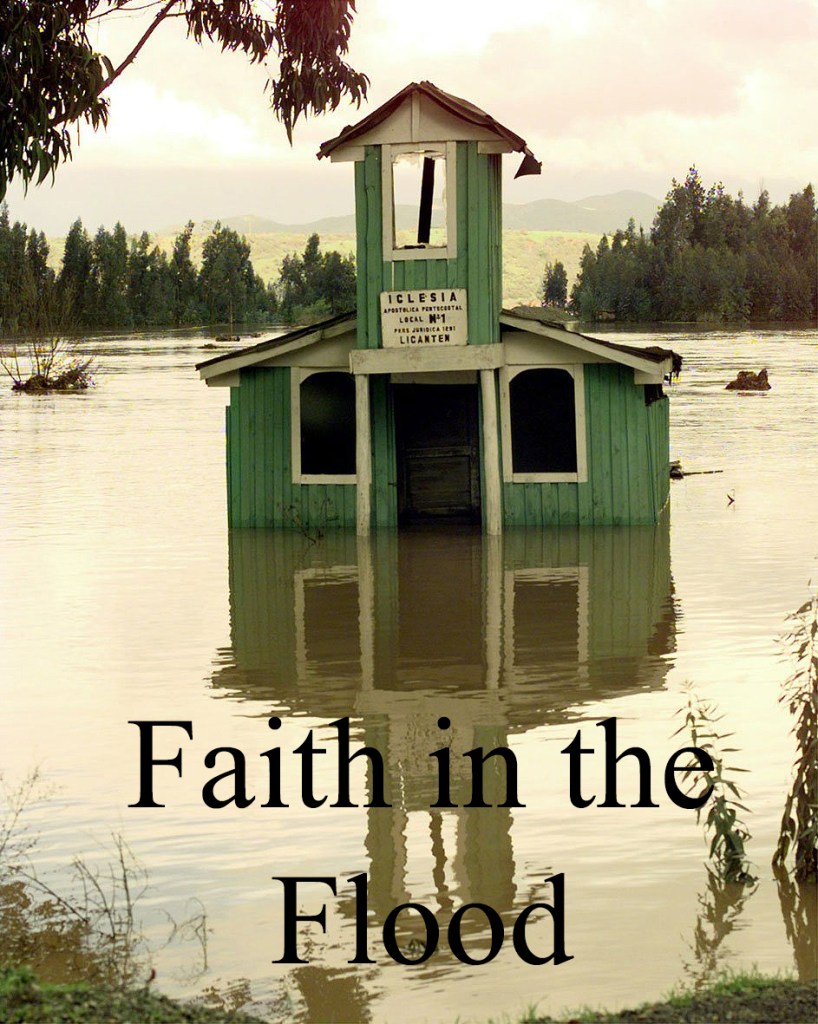
Faith in the Flood

Faith in the Flood

November 05, 2023*

By Pastor John Partridge

Joshua 3:7-17             Matthew 23:1-12                               1 Thessalonians 2:9-13

There is an old joke about a flood and a faithful saint of the church. The weather forecast was for torrential rains and flooding and people were advised to evacuate. But when two sheriff’s deputies came to the door of this faithful saint asking them to leave, they simply replied that “God will provide.” And so, the rains came, and the flood waters rose. Soon the first floor of their house was under water, and they moved all their valuables up to the second floor. About that time, a Boy Scout came by in a canoe and offered to carry them to safety, but they refused and simply said, “God will provide.” It continued to rain and to flood waters continued to rise, and soon, this faithful saint of the church was sitting on their roof. And, as they were sitting on their roof, the National Guard arrived in a helicopter and offered to lift them out of their distress, but they again declined saying, “God will provide.” Not long after that, the flood waters carried that saint away and, when they were welcomed at the pearly gates of heaven they cried out, “God, why didn’t you save me?” And God replied, “Well, I sent two sheriff’s deputies, a Boy Scout, and the National Guard. What more did you want?”

I have always liked that joke because it’s funny and because it points us toward one of the church’s common failures. Well-known Croatian theologian Miroslav Volf said, “There is something deeply hypocritical about praying for a problem you are unwilling to resolve.” The question isn’t whether our lives will have storms and floods, the question is what we will do when we face them. That is what we see in Joshua 3:7-17, because as the people of Israel prepare to cross the Jordan River into the Promised Land, Joshua commands the priests to take a step of faith… right into the middle of the flood.

And the Lord said to Joshua, “Today I will begin to exalt you in the eyes of all Israel, so they may know that I am with you as I was with Moses. Tell the priests who carry the ark of the covenant: ‘When you reach the edge of the Jordan’s waters, go and stand in the river.’”

Joshua said to the Israelites, “Come here and listen to the words of the Lord your God. 10 This is how you will know that the living God is among you and that he will certainly drive out before you the Canaanites, Hittites, Hivites, Perizzites, Girgashites, Amorites and Jebusites. 11 See, the ark of the covenant of the Lord of all the earth will go into the Jordan ahead of you. 12 Now then, choose twelve men from the tribes of Israel, one from each tribe. 13 And as soon as the priests who carry the ark of the Lord—the Lord of all the earth—set foot in the Jordan, its waters flowing downstream will be cut off and stand up in a heap.”

14 So when the people broke camp to cross the Jordan, the priests carrying the ark of the covenant went ahead of them. 15 Now the Jordan is at flood stage all during harvest. Yet as soon as the priests who carried the ark reached the Jordan and their feet touched the water’s edge, 16 the water from upstream stopped flowing. It piled up in a heap a great distance away, at a town called Adam in the vicinity of Zarethan, while the water flowing down to the Sea of the Arabah (that is, the Dead Sea) was completely cut off. So, the people crossed over opposite Jericho. 17 The priests who carried the ark of the covenant of the Lord stopped in the middle of the Jordan and stood on dry ground, while all Israel passed by until the whole nation had completed the crossing on dry ground.

The Jordan River is at flood stage and is a raging torrent. So violently does it flow that Jericho isn’t even watching this border as closely as they might because Baal is the god of rivers and storms, and this was the season that they could see his power and knew that he was protecting them. After the adventure with the spies, Israel almost certainly knew that as well. Further, as one of the two spies who had lived through the 40 years in the wilderness, Joshua was personally aware of this. Nonetheless, God commands Joshua to tell the priests who carry the arc of the covenant, to “go and stand in the river.” Just go and stand in the middle of the raging torrent of the harvest flood. Worse, the banks of the Jordan are often not gentle slopes but rapid drop-offs that would be invisible in the muddy floodwaters. I’m sure that those priests had some concerns, but they also had faith in God and faith in Joshua. With the weight of the ark on their shoulders, and almost no chance of catching themselves if they stumbled, the priests do as they were asked and boldly step into the rushing water.

And the water stopped.

As soon as their feet touched the water, the water stopped flowing and piled up in a heap upstream of them and, as the priests stood in the middle of the riverbed, the entire nation of Israel crossed the river on dry ground. The people of God, and especially those priests weighted down with the ark of covenant on their shoulders, didn’t just pray for God’s deliverance and their entry into the Promised Land, they acted on their faith, and they stepped out into the flood.

But the priests and the leaders of the church aren’t always that faithful and aren’t always the best example for people to follow. That was the case in Matthew 23:1-12 when Jesus tells the people to live their lives differently than Israel’s leaders.

23:1 Then Jesus said to the crowds and to his disciples: “The teachers of the law and the Pharisees sit in Moses’ seat. So you must be careful to do everything they tell you. But do not do what they do, for they do not practice what they preach. They tie up heavy, cumbersome loads and put them on other people’s shoulders, but they themselves are not willing to lift a finger to move them.

“Everything they do is done for people to see: They make their phylacterieswide and the tassels on their garments long; they love the place of honor at banquets and the most important seats in the synagogues; they love to be greeted with respect in the marketplaces and to be called ‘Rabbi’ by others.

“But you are not to be called ‘Rabbi,’ for you have one Teacher, and you are all brothers. And do not call anyone on earth ‘father,’ for you have one Father, and he is in heaven. 10 Nor are you to be called instructors, for you have one Instructor, the Messiah. 11 The greatest among you will be your servant. 12 For those who exalt themselves will be humbled, and those who humble themselves will be exalted.

Jesus says that although the teachers of the law and the Pharisees hold important leadership positions, and although the people must be careful to follow their instructions and do as the leaders teach, they should not live by the example that those leaders provide. Those leaders lived a life that was all about the show. They wore flashy religious vestments and large phylacteries, which were prayers or scriptures that were etched in silver, copper, or even on baked clay tablets. While rabbis routinely wore tassels on their robes, these leaders had to had bigger, and longer tassels then everyone else. And, whenever there was a banquet, or when they went to church, they had to have the most visible, and most important seats in the house so that everyone could see how important they were. But while they put on a good show, they didn’t live lives that demonstrated the things that they taught. Jesus said that the people who would be the greatest among them, would first be a servant to others. Following Jesus, honoring God, and living a life of faith wasn’t about looking good, it was all about having the humility to live a life that acted on faith and did the work of the kingdom of God.

That’s exactly the message that we hear Paul telling the people of the church in Thessalonica in his letter that we read in 1 Thessalonians 2:9-13 when he says…

Surely you remember, brothers and sisters, our toil and hardship; we worked night and day in order not to be a burden to anyone while we preached the gospel of God to you. 10 You are witnesses, and so is God, of how holy, righteous, and blameless we were among you who believed. 11 For you know that we dealt with each of you as a father deals with his own children, 12 encouraging, comforting, and urging you to live lives worthy of God, who calls you into his kingdom and glory.

13 And we also thank God continually because, when you received the word of God, which you heard from us, you accepted it not as a human word, but as it actually is, the word of God, which is indeed at work in you who believe.

Paul asks the people of the church to remember the example that he and his fellow missionaries provided for them as they lived among them. They worked, and they worked hard, day and night, so that they would not be a burden to the church, but they also lived lives that were holy, righteous, and blameless. They did not rule over them as some leaders do, but encouraged and comforted them, and treated them as if they were their own children so that they could urge them to live lives that were worthy of the God who called them into his kingdom. Paul says that he and his associates continually thank God because the people of the church not only received the word of God but allowed God to work through them. They didn’t just accept Jesus and have faith in Jesus, they lived out their faith through their actions.

The people of Israel had faith in God and believed that he would lead them into the Promised Land, but the evidence of that faith was visibly seen when the priests carrying the ark of the covenant boldly stepped forward into the raging flood waters of the Jordan River.

While Jesus acknowledged that the people should be obedient to their leaders, he also told them that in order to honor God, they had to do better. Rather putting on a good show, a true life of faith is a life that serves others and demonstrates God’s love through the actions of the believer.

And Paul says much the same thing. The proof of the message that they taught was found in the way that they lived, and the proof that the church had believed was seen, not in the words that they spoke or in the worship of their people, but in the work that they did among those who did not believe.

We may laugh at the imaginary saint of the church that prayed to God but ignored two sheriff’s deputies, a Boy Scout, and the National Guard, but the truth is that faith demands that we do more than pray.

Real faith is found in the actions of the church.

Real faith is when we roll up our sleeves and get to work.


Please LIKE and SHARE!

Click here to subscribe to Pastor John’s blog.

Click here if you would like to subscribe to Pastor John’s weekly messages.

Click here to visit Pastor John’s YouTube channel.


*You have been reading a message presented at Christ United Methodist Church on the date noted at the top of the first page.  Rev. John Partridge is the pastor at Christ UMC in Alliance, Ohio.  Duplication of this message is a part of our Media ministry, if you have received a blessing in this way, we would love to hear from you.  Letters and donations in support of the Media ministry or any of our other projects may be sent to Christ United Methodist Church, 470 East Broadway Street, Alliance, Ohio 44601.  These messages are available to any interested persons regardless of membership.  You may subscribe to these messages, in print or electronic formats, by writing to the address noted, or by contacting us at secretary@CUMCAlliance.org.  These messages can also be found online at https://pastorpartridge.com .  All Scripture quotations, unless otherwise indicated, are taken from the Holy Bible, New International Version®, NIV®. Copyright ©1973, 1978, 1984, 2011 by Biblica, Inc.™ Used by permission of Zondervan. All rights reserved worldwide. www.zondervan.comThe “NIV” and “New International Version” are trademarks registered in the United States Patent and Trademark Office by Biblica, Inc.™


Finding Nebo

Finding Nebo

October 29, 2023*

By Pastor John Partridge

Deuteronomy 34:1-12        Matthew 22:34-46         

1 Thessalonians 2:1-8

Many of us are, by now, familiar with the 2003 Pixar animated movie “Finding Nemo” in which Marlin, an overprotective, single, clown fish father, pursues his son, Nemo, across the dangers of the vast Pacific Ocean in hopes of rescuing him from the scuba divers that captured him. It’s a good story. But despite the similarity of the name in the title, Nemo is not what we are looking for. Our story for today begins with an ending. At the end of Moses’ life, knowing that he will never set foot in the Promised Land that he has pursued for most of his adult life, he finds himself, not in the Pacific Ocean with a small clownfish named Nemo, but at the top of a mountain named Nebo. And, in an odd sort of way, we discover that, as the followers of Jesus Christ, we too are spending ourselves in pursuit of finding Nebo. As I said before, we begin this morning with an ending in Deuteronomy 34:1-12 where it says:

34:1 Then Moses climbed Mount Nebo from the plains of Moab to the top of Pisgah, across from Jericho. There the Lord showed him the whole land—from Gilead to Dan, all of Naphtali, the territory of Ephraim and Manasseh, all the land of Judah as far as the Mediterranean Sea, the Negev and the whole region from the Valley of Jericho, the City of Palms, as far as Zoar. Then the Lord said to him, “This is the land I promised on oath to Abraham, Isaac, and Jacob when I said, ‘I will give it to your descendants.’ I have let you see it with your eyes, but you will not cross over into it.”

And Moses the servant of the Lord died there in Moab, as the Lord had said. He buried himin Moab, in the valley opposite Beth Peor, but to this day no one knows where his grave is. Moses was a hundred and twenty years old when he died, yet his eyes were not weak, nor his strength gone. The Israelites grieved for Moses in the plains of Moab thirty days, until the time of weeping and mourning was over.

Now Joshua, son of Nun, was filled with the spiritof wisdom because Moses had laid his hands on him. So, the Israelites listened to him and did what the Lord had commanded Moses.

10 Since then, no prophet has risen in Israel like Moses, whom the Lord knew face to face, 11 who did all those signs and wonders the Lord sent him to do in Egypt—to Pharaoh and to all his officials and to his whole land. 12 For no one has ever shown the mighty power or performed the awesome deeds that Moses did in the sight of all Israel.

When you make the journey to visit Israel, once the present violence ends and peace returns, you will find that Israel is surprisingly small. For us in the United States we can compare it in our minds knowing that Israel is smaller than Massachusetts and slightly smaller than New Jersey. If you could make a non-stop road trip along its main highway, you could travel its entire length in less than six hours. And so, while there is, perhaps, some exaggeration in the account that we read in Deuteronomy, probably not much. From the top of Mount Nebo, with good visibility, Moses would have seen a great deal of the Promised Land that Israel was about to inherit. But Moses wasn’t going. He had come this far, but his time on earth was finished and, although God allowed him to see the land of Israel, he would never cross the Jordan River and set his feet upon it. Instead, Moses would be buried somewhere in Moab on the slopes of Mount Nebo and make a different crossing into his heavenly inheritance with God. Moses never crossed over into the Promised Land, but Moses’ legacy was that he listened to the call of God, obeyed the instructions of God, and led his family, his tribe, his community, and his people into God’s promise.

But God’s promise to his people was about more than land. As Israel had struggled during their captivity in Egypt, they cried out to God for a rescuer that would carry them out of Egypt to freedom. And God heard the prayers of his people, and sent Moses to lead them out of Egypt, across the desert, through the years of wandering in the wilderness, and right the edge of the Promised Land. But throughout many years of suffering, in the land of Israel, under the yoke of other oppressive nations such as Babylon, Greece, Egypt, and Rome, the people of Israel again prayed to God and looked for a rescuer, a messiah, that would, once again, bring them freedom and prosperity. The seeds of that hope for a messiah were contained in the writings of the prophets, but it was not always understood how it would happen, or who the messiah would be. And that’s how Jesus can ask a question that stumped the biblical scholars of his day when they come to him to present a question with which they hope to test him in Matthew 22:34-46 where we read this:

34 Hearing that Jesus had silenced the Sadducees, the Pharisees got together. 35 One of them, an expert in the law, tested him with this question: 36 “Teacher, which is the greatest commandment in the Law?”

37 Jesus replied: “‘Love the Lord your God with all your heart and with all your soul and with all your mind.’ 38 This is the first and greatest commandment. 39 And the second is like it: ‘Love your neighbor as yourself.’ 40 All the Law and the Prophets hang on these two commandments.”

41 While the Pharisees were gathered together, Jesus asked them, 42 “What do you think about the Messiah? Whose son is he?”

“The son of David,” they replied.

43 He said to them, “How is it then that David, speaking by the Spirit, calls him ‘Lord’? For he says,

44 “‘The Lord said to my Lord:
    “Sit at my right hand
until I put your enemies
    under your feet.”’

45 If then David calls him ‘Lord,’ how can he be his son?” 46 No one could say a word in reply, and from that day on no one dared to ask him any more questions.

The puzzle that Jesus puts to the Pharisees is the kind of a problem that often causes us to get stuck in the twenty-first century. While Jesus’ question seems simple to us it was a serious problem to these biblical scholars because it required that they get past their own cultural biases to answer it. In a culturally patriarchal system of honor, it was understood that fathers were always greater in prestige and honor than their sons. If a grandfather or great-grandfather could have, somehow, come back from the dead, that elderly person would automatically become the head of an entire clan of his descendants and all his sons, grandsons, and everyone else would be expected to defer to them and honor them. But although the scholars know that the Messiah would be a living descendant of David, referred to as “the son of David,” their cultural bias prevents them from understanding how, in Psalm 110, David refers to his descendant as his Lord, and thereby gives his descendant honor and defers to him as someone greater than the greatest king that Israel ever had. The Pharisees could simply not understand how a son of David could be greater than David and so, they misunderstood what, and who, the messiah would be. For us, although we have our own cultural blind spots, we understand that Jesus was, and is, God’s promised Messiah, he is the son of David, and he is David’s lord because he is the son of God.

But, twenty-one centuries later, what does that mean for us? If we follow God as Moses did, and we accept Jesus as our lord, and follow him, then what why does all that matter? It matters because, like Moses, we are trying to find our mountain top, our Nebo, but like the Pharisees, we can’t quite figure out what that means. But Paul did, and he explains it to the church in Thessalonica in 1 Thessalonians 2:1-8, saying…

2:1 You know, brothers and sisters, that our visit to you was not without results. We had previously suffered and been treated outrageously in Philippi, as you know, but with the help of our God we dared to tell you his gospel in the face of strong opposition. For the appeal we make does not spring from error or impure motives, nor are we trying to trick you. On the contrary, we speak as those approved by God to be entrusted with the gospel. We are not trying to please people but God, who tests our hearts. You know we never used flattery, nor did we put on a mask to cover up greed—God is our witness. We were not looking for praise from people, not from you or anyone else, even though as apostles of Christ we could have asserted our authority. Instead, we were like young children among you.

Just as a nursing mother cares for her children, 8so we cared for you. Because we loved you so much, we were delighted to share with you not only the gospel of God but our lives as well.

Paul’s message is that life wasn’t perfect. Everyone knew that sometimes the lives of Paul and his associates had faced some significant suffering. They had been arrested, beaten, and thrown into prison on many occasions. But despite their suffering, with the help of God, they dared to continue telling others the story of the gospel regardless of the opposition that they faced. Their motivation wasn’t to trick anyone, to get rich, or for any other impure motive, but simply to share the message with which they had been entrusted by God. Their goal was to share the gospel, and their lives, with the people to whom God had led them.

Moses, Paul, Silas, Timothy, and many others were seeking to find their Nebo, to lead their family, their tribe, their community, and their people into God’s promise, which they now understood as the promise of Jesus Christ. And that’s the mission that has been passed down to us. Because we are the people who, like Paul, have been entrusted with the gospel, the people who have met Jesus, and who have believed in him and have put our trust in him, we too are seeking our Nebo. As we have been reminded on this All-Saints Day, our time on earth is short and won’t last forever and one day we too will cross over into God’s promise as Moses did, and as these saints of the church have done.

Our mission, our hope, and our calling is to lead our people to God’s promise through the message and the gospel of Jesus Christ…

…before it’s our turn to cross over.


Please LIKE and SHARE!

Click here to subscribe to Pastor John’s blog.

Click here if you would like to subscribe to Pastor John’s weekly messages.

Click here to visit Pastor John’s YouTube channel.


*You have been reading a message presented at Christ United Methodist Church on the date noted at the top of the first page.  Rev. John Partridge is the pastor at Christ UMC in Alliance, Ohio.  Duplication of this message is a part of our Media ministry, if you have received a blessing in this way, we would love to hear from you.  Letters and donations in support of the Media ministry or any of our other projects may be sent to Christ United Methodist Church, 470 East Broadway Street, Alliance, Ohio 44601.  These messages are available to any interested persons regardless of membership.  You may subscribe to these messages, in print or electronic formats, by writing to the address noted, or by contacting us at secretary@CUMCAlliance.org.  These messages can also be found online at https://pastorpartridge.com .  All Scripture quotations, unless otherwise indicated, are taken from the Holy Bible, New International Version®, NIV®. Copyright ©1973, 1978, 1984, 2011 by Biblica, Inc.™ Used by permission of Zondervan. All rights reserved worldwide. www.zondervan.comThe “NIV” and “New International Version” are trademarks registered in the United States Patent and Trademark Office by Biblica, Inc.™

The Tax Trap

The Tax Trap

October 22, 2023*

By Pastor John Partridge

Exodus 33:12-23                    Matthew 22:15-22                             1 Thessalonians 1:1-10

Leadership is intimidating.

That is to say, leadership can be intimidating if you have the humility to pause and think about the impact of what you are doing.

The first time that I recall having any real leadership was in the early 1990’s when I had returned to my Army Reserve unit from my advanced training in my MOS (Military Occupational Specialty) and was expected to lead one of the monthly classes that were held to keep everyone fresh on our required skills. Since I had so recently returned from training, I was therefore the most qualified to teach one or two of the classes. I was still a Private First Class, and I had sergeants, staff sergeants, and just about everyone else in “my” classroom for fifteen minutes. As I continued to do this over the years, my rank, and my skills, advanced and I became more comfortable doing it.

But then on July 4th, 2004, I stood in front of the gathered people of the Johnsville United Methodist Church for the first time as their pastor. This was, once again, entirely new and, at that time, despite being over 40 years old, I had very little training as a pastor. But, once again, with time, experience, and more training, leading God’s people became a little easier.

But regardless of whether it was in the early 1990’s or in 2004, I always knew that I wasn’t alone. There were senior noncommissioned officers who could help me if I stumbled while I was teaching classes in my reserve unit, and in every church that I have served, there have always been patient, competent, congregations, volunteers, and staff to help me do what I do. Leadership is always intimidating, but the idea of leading… alone… would be terrifying.

But that is exactly what is foremost in Moses’ mind as he has a conversation with God in Exodus 33:12-23.

12 Moses said to the Lord, “You have been telling me, ‘Lead these people,’ but you have not let me know whom you will send with me. You have said, ‘I know you by name and you have found favor with me.’ 13 If you are pleased with me, teach me your ways so I may know you and continue to find favor with you. Remember that this nation is your people.”

14 The Lord replied, “My Presence will go with you, and I will give you rest.”

15 Then Moses said to him, “If your Presence does not go with us, do not send us up from here. 16 How will anyone know that you are pleased with me and with your people unless you go with us? What else will distinguish me and your people from all the other people on the face of the earth?”

17 And the Lord said to Moses, “I will do the very thing you have asked, because I am pleased with you, and I know you by name.”

18 Then Moses said, “Now show me your glory.”

19 And the Lord said, “I will cause all my goodness to pass in front of you, and I will proclaim my name, the Lord, in your presence. I will have mercy on whom I will have mercy, and I will have compassion on whom I will have compassion. 20 But,” he said, “you cannot see my face, for no one may see me and live.”

21 Then the Lord said, “There is a place near me where you may stand on a rock. 22 When my glory passes by, I will put you in a cleft in the rock and cover you with my hand until I have passed by. 23 Then I will remove my hand and you will see my back; but my face must not be seen.”

The first thing out of Moses’ mouth is, “I can’t do this alone.” Those aren’t his exact words, but that is clearly the idea when he says, “whom will you send with me?” And God’s response is, I will go with you, and I will give you rest. God promises that his presence will be so tangibly real, that Moses will never feel as if he is alone and he will be comforted, and be able to sleep at night, because he knows that he is not alone.

Why does that matter?

Well, if you are in any kind of leadership position, you can find comfort in that. But there are other reasons that we’ll get to in a few minutes.

Next, we come to yet another story of the Pharisees trying to trick Jesus into saying something stupid that would either be a criminal offense or would be offensive and reduce his popularity with the people. There’s some back story to this that helps us make sense of that, but we’ll cross that bridge when we come to it. For now, let’s look at this story from Matthew 22:15-22:

15 Then the Pharisees went out and laid plans to trap him in his words. 16 They sent their disciples to him along with the Herodians. “Teacher,” they said, “we know that you are a man of integrity and that you teach the way of God in accordance with the truth. You aren’t swayed by others because you pay no attention to who they are. 17 Tell us then, what is your opinion? Is it right to pay the imperial taxto Caesar or not?”

18 But Jesus, knowing their evil intent, said, “You hypocrites, why are you trying to trap me? 19 Show me the coin used for paying the tax.” They brought him a denarius, 20 and he asked them, “Whose image is this? And whose inscription?”

21 “Caesar’s,” they replied.

Then he said to them, “So give back to Caesar what is Caesar’s, and to God what is God’s.”

22 When they heard this, they were amazed. So, they left him and went away.

This was the tax trap. First, you will note that the Pharisees don’t come to see Jesus in person. Instead, they send their lackeys that are less well-known so that Jesus might not recognize this as a trap, and second, they send along with them the Herodians. Which may cause us to ask, who the heck were the Herodians? And that’s a good question that the bible doesn’t answer very well, but which history does. We know that the ruler of Israel at the time of Jesus’ birth had been Herod the Great, and the current ruler was one of his sons, Herod Antipas. And so, the Herodians were Jews, who had sold out to the Romans, to the culture of the Romans, and to the plan that Herod had for their nation. To make a connection to the United States of the twenty-first century, these were the people who were more interested in conforming to the culture of Hollywood, and to their political party than they were in conforming to the laws of Moses and the prophets. They were born Jews but were culturally Roman. The plan clearly was that if Jesus said that good Jews shouldn’t pay Roman taxes, which was a prominent idea in some Jewish circles, then the Herodians would charge Jesus with a crime. The argument in some Jewish circles was that because Rome was immoral and acted counter to the beliefs of Israel, that paying taxes to Rome was therefore immoral. Further, because Rome circulated coinage that bore graven images that were prohibited by scripture, that using such coinage was sinful and a corrupting influence.

But Jesus’ interpretation was different.

Jesus said that if Ceasar’s face was on the coin, then pay Ceasar what was due to Ceasar, but pay to God what belonged to God. In Jesus’ interpretation, the scriptures demanded that faithful people should follow God with all their heart, with all their soul, with all their mind, and with all their strength. That is what was owed to God. It is your choices and your morality that are important.

Hold on to that idea because we’re going to come back to that in a minute, but this connects us to Paul’s message to the church in Thessalonica that we hear in 1 Thessalonians 1:1-10:

1:1 Paul, Silas,and Timothy,

To the church of the Thessalonians in God the Father and the Lord Jesus Christ:

Grace and peace to you.

We always thank God for all of you and continually mention you in our prayers. We remember before our God and Father your work produced by faith, your labor prompted by love, and your endurance inspired by hope in our Lord Jesus Christ.

For we know, brothers and sistersloved by God, that he has chosen you, because our gospel came to you not simply with words but also with power, with the Holy Spirit and deep conviction. You know how we lived among you for your sake. You became imitators of us and of the Lord, for you welcomed the message in the midst of severe suffering with the joy given by the Holy Spirit. And so you became a model to all the believers in Macedonia and Achaia. The Lord’s message rang out from you not only in Macedonia and Achaia—your faith in God has become known everywhere. Therefore, we do not need to say anything about it, for they themselves report what kind of reception you gave us. They tell how you turned to God from idols to serve the living and true God, 10 and to wait for his Son from heaven, whom he raised from the dead—Jesus, who rescues us from the coming wrath.

What Paul says is important, but I also think that how Paul said it is important.  You will note that Paul does not simply say that we remember you because of your work, your labor, and your endurance. What Paul says is that we remember you to God because of the work that we have seen in you that was produced by faith, because of the labor that you have done that was prompted by love, and by the endurance that you have shown that was inspired by hope. This is the work that God is doing because his people love him with all their heart, with all their soul, with all their mind and with all their strength. They are doing the work of the kingdom because of their faith, because of their love, and because of their hope and not because it was what was culturally expected, or because of some other sense of ethical, moral, or cultural obligation. When we remember James’ teaching that faith is revealed by works, this is that. Faith came first, but because the people had faith, it inspired them to work, labor, and hope.

So, how do we tie this all together and make sense of it?

Jesus’ challenge to the tax trap points us toward self-reflection in several directions. Two thousand years ago the fear was that taxes, especially using money with graven images on it, was a corrupting influence that faithful Jews should avoid. But Jesus says that it isn’t. Paying taxes isn’t inherently sinful, nor are we automatically guilty of the sinful or immoral acts of the government. Of course, this is held in tension with several other scriptures that say that we will, as a people, be held responsible for the sins of our nation. There’s no way we have the time to even try to sort that out so I’m not even going to try.

But our point of personal self-reflection and struggle is to remember that a sinful government doesn’t necessarily corrupt us personally. But the reverse is also true, such that the righteous acts of government do not make us personally righteous. It is a good thing for the government to feed the poor, but the Roman government did that. It is a good thing for the government to care for the elderly and a host of other things, but none of the things that the government does, relieves us of doing the things that God has commanded us to do. Whether our government is good or evil, we are still obligated to feed the hungry, clothe the naked, care for the widows and orphans, speak for the immigrants and the voiceless, and to do the work of the kingdom of God. On the day that we stand in judgement before God, we will be judged by what we have done, and what we have left undone and that includes how we voted, and when we chose not to vote.

But the second point of connection here is that, like Moses, and like the pastor of a church, God knows that we cannot do all these things alone. We are a part of a community of faith. We can do great things, sometimes impossible things, because we work together… and because God promises to go with us.

We are not alone.


Please LIKE and SHARE!

Click here to subscribe to Pastor John’s blog.

Click here if you would like to subscribe to Pastor John’s weekly messages.

Click here to visit Pastor John’s YouTube channel.


*You have been reading a message presented at Christ United Methodist Church on the date noted at the top of the first page.  Rev. John Partridge is the pastor at Christ UMC in Alliance, Ohio.  Duplication of this message is a part of our Media ministry, if you have received a blessing in this way, we would love to hear from you.  Letters and donations in support of the Media ministry or any of our other projects may be sent to Christ United Methodist Church, 470 East Broadway Street, Alliance, Ohio 44601.  These messages are available to any interested persons regardless of membership.  You may subscribe to these messages, in print or electronic formats, by writing to the address noted, or by contacting us at secretary@CUMCAlliance.org.  These messages can also be found online at https://pastorpartridge.com .  All Scripture quotations, unless otherwise indicated, are taken from the Holy Bible, New International Version®, NIV®. Copyright ©1973, 1978, 1984, 2011 by Biblica, Inc.™ Used by permission of Zondervan. All rights reserved worldwide. www.zondervan.comThe “NIV” and “New International Version” are trademarks registered in the United States Patent and Trademark Office by Biblica, Inc.™

Addicted to… Rules?

Addicted to Rules

October 08, 2023*

By Pastor John Partridge

Exodus 20:1-4, 7-9, 12-20                 Matthew 21:33-46                             Philippians 3:4b-14

In 1985 radio stations everywhere were playing the debut of Robert Palmer’s new hit song, Addicted to Love. That song will be familiar to those of us in a particular age group, but it begins like this:

The lights are on, but you’re not home
Your mind is not your own
Your heart sweats, your body shakes
Another kiss is what it takes
You can’t sleep, you can’t eat
There’s no doubt, you’re in deep
Your throat is tight, you can’t breathe
Another kiss is all you need.

Whoa, you like to think that you’re immune to the stuff, oh yeah
It’s closer to the truth to say you can’t get enough
You know you’re gonna have to face it, you’re addicted to love.

Robert Palmer may have taken a certain amount of artistic license, but just this week I had a conversation with a friend about how some people simply can’t stand to live alone, and that can lead them to making bad choices and being in a relationship with someone who isn’t good for them, and sometimes one bad relationship after another.

Addiction, of any kind, even an addition to something that is normally good, can be a bad thing. Addiction, even to something good, takes things too far and winds up being harmful. And that’s one of the things that we will find as we read and think about today’s scriptures. We begin with what God intended for good, the ten commandments. Most of these commandments are regarded as good things, even by people who do not share our faith, and even by people who have no faith at all. Prohibitions against theft, murder, adultery, and false witness, just to name a few, are almost inarguably good things. But can such prohibitions go too far? Before we get into that, let’s begin at the beginning and just read the words of Exodus 20:1-4, 7-9, 12-20.

20:1 And God spoke all these words:

“I am the Lord your God, who brought you out of Egypt, out of the land of slavery.

“You shall have no other gods before me.

“You shall not make for yourself an image in the form of anything in heaven above or on the earth beneath or in the waters below.

“You shall not misuse the name of the Lord your God, for the Lord will not hold anyone guiltless who misuses his name.

“Remember the Sabbath day by keeping it holy. Six days you shall labor and do all your work,

12 “Honor your father and your mother, so that you may live long in the land the Lord your God is giving you.

13 “You shall not murder.

14 “You shall not commit adultery.

15 “You shall not steal.

16 “You shall not give false testimony against your neighbor.

17 “You shall not covet your neighbor’s house. You shall not covet your neighbor’s wife, or his male or female servant, his ox or donkey, or anything that belongs to your neighbor.”

18 When the people saw the thunder and lightning and heard the trumpet and saw the mountain in smoke, they trembled with fear. They stayed at a distance 19 and said to Moses, “Speak to us yourself and we will listen. But do not have God speak to us or we will die.”

20 Moses said to the people, “Do not be afraid. God has come to test you, so that the fear of God will be with you to keep you from sinning.”

Saying things like, “don’t take things that don’t belong to you,” “don’t murder or hurt other people, or that it’s not good to even wish you had the nice things that your neighbor has,” are not that controversial. Even honoring your parents, when they deserve it, is something that most of us can generally agree on. But we can understand why people who do not share our faith, or who don’t believe in God, would take issue with rules about gods, idols, taking God’s name in vain, or keeping the sabbath. Other than those rules that are specific to our worship of our God, I think most people would agree that these are reasonable rules and, in fact, most of these rules end up being codified in the laws of cities, states, and nations around the world.

But that’s where the trouble starts. Or, perhaps, if we think of it another way, perhaps that’s where the addiction starts. In an attempt to ensure that the people of Israel would always follow these ten rules, the leaders of Israel wrote more rules that regulated life, or put fences around the rules, so that people wouldn’t, even accidentally, break these ten commandments. (pause) But even that wasn’t enough for some people. After Israel had been carried into captivity in Babylon for seventy years, returned to Israel, and rebuilt their nation, the leaders began to understand that their exile had been caused by Israel’s disobedience to God. And so, at some point, the people that we know as the Pharisees in the time of the New Testament accumulated an even longer list of rules that built fences around the fences that had been built around the rules. And while some of the Pharisees were legitimately trying to keep Israel on the straight and narrow and stay close to God, others began to become more devoted to the rules than they were to the God they were supposed to worship.  And it was exactly that sort of thing that had the Pharisees up in arms about the popularity that Jesus had with the common people and the background to exchanges such as the one we find in Matthew 21:33-46, (which immediately follows our passage from last week in which Jesus said that Prostitutes and tax collectors were getting into heaven before the Pharisees)where we hear Jesus say:

33 “Listen to another parable: There was a landowner who planted a vineyard. He put a wall around it, dug a winepress in it and built a watchtower. Then he rented the vineyard to some farmers and moved to another place. 34 When the harvest time approached, he sent his servants to the tenants to collect his fruit.

35 “The tenants seized his servants; they beat one, killed another, and stoned a third. 36 Then he sent other servants to them, more than the first time, and the tenants treated them the same way. 37 Last of all, he sent his son to them. ‘They will respect my son,’ he said.

38 “But when the tenants saw the son, they said to each other, ‘This is the heir. Come, let’s kill him and take his inheritance.’ 39 So they took him and threw him out of the vineyard and killed him.

40 “Therefore, when the owner of the vineyard comes, what will he do to those tenants?”

41 “He will bring those wretches to a wretched end,” they replied, “and he will rent the vineyard to other tenants, who will give him his share of the crop at harvest time.”

42 Jesus said to them, “Have you never read in the Scriptures:

“‘The stone the builders rejected
    has become the cornerstone;
the Lord has done this,
    and it is marvelous in our eyes’?

43 “Therefore I tell you that the kingdom of God will be taken away from you and given to a people who will produce its fruit. 44 Anyone who falls on this stone will be broken to pieces; anyone on whom it falls will be crushed.”

45 When the chief priests and the Pharisees heard Jesus’ parables, they knew he was talking about them. 46 They looked for a way to arrest him, but they were afraid of the crowd because the people held that he was a prophet.

One of the first things that we should probably notice is that Jesus may very well be foretelling his own death in this parable since it isn’t hard to understand that as the son of God, he is the son of the landowner of Israel. The second thing to notice is that, even though the priests and the Pharisees may not have understood Jesus’ allusion to being the son of the landowner, they clearly understood that he was talking about them and that they were the ungrateful tenants in the story. Everyone understood that Jesus was accusing Israel’s leadership of not giving to God what was expected and due. The accusation is clear that the leaders had violated several of the commandments, that they had put themselves ahead of God, that they had made money, power, and influence into an idol, and that they were, generally, unfaithful.

The contrast to the priests and the Pharisees is found in the life of Paul, after his encounter with Jesus on the road to Damascus. After Paul’s conversion, he sees the rules, and his former addiction to the rules, in an entirely different light. In Philippians 3:4b-14 he says…

If someone else thinks they have reasons to put confidence in the flesh, I have more: circumcised on the eighth day, of the people of Israel, of the tribe of Benjamin, a Hebrew of Hebrews; in regard to the law, a Pharisee; as for zeal, persecuting the church; as for righteousness based on the law, faultless.

But whatever were gains to me I now consider loss for the sake of Christ. What is more, I consider everything a loss because of the surpassing worth of knowing Christ Jesus my Lord, for whose sake I have lost all things. I consider them garbage, that I may gain Christ and be found in him, not having a righteousness of my own that comes from the law, but that which is through faith inChrist—the righteousness that comes from God on the basis of faith. 10 I want to know Christ—yes, to know the power of his resurrection and participation in his sufferings, becoming like him in his death, 11 and so, somehow, attaining to the resurrection from the dead.

12 Not that I have already obtained all this, or have already arrived at my goal, but I press on to take hold of that for which Christ Jesus took hold of me. 13 Brothers and sisters, I do not consider myself yet to have taken hold of it. But one thing I do: Forgetting what is behind and straining toward what is ahead, 14 I press on toward the goal to win the prize for which God has called me heavenward in Christ Jesus.

Paul was a Pharisee. He followed the rules, he was born into the right kind of family, went to the right kind of schools with the right kind of teachers, he, and his family, followed all the prescribed rituals, he dedicated his life to enforcing the rules, he hunted down Jews who had chosen to follow Jesus and prosecuted, and imprisoned them for their failure to follow the rules. He was there watching the coats of the men who stoned Stepehen in Jerusalem and, I think we can safely say, that he was addicted to the rules. But, after he met Jesus, his addiction was broken, and he saw the rules in an entirely different light. I don’t want you to misunderstand, Paul still followed most of those rules. He still thought that they were an important part of his faith, but the rules were no longer an addiction, and they were no longer something that was more important than faith. His addiction, and the value that he once put on the rules, money, power, and influence, he now valued no more than garbage. In fact, the word that we translate as “garbage” is the name of the valley below Jerusalem where the sewers emptied, where dead animals were thrown, and where the remains of sacrifices were burned. It was a place of disgusting filth and that was the value that Paul now placed on his former addiction.

Addiction, of any kind, even an addition to something that is normally good, takes things too far and winds up being harmful, and that’s true whether you’re addicted to love, rules, tradition, sex, money, power, politics, authority, fame, fortune, comfort, prestige, sports, hobbies, family, or anything else that you might put ahead of God.

God said ““I am the Lord your God… You shall have no other gods beforeme.”

Even if those gods seem like good things, we cannot put them ahead of God.

It’s important that we get it right.


Please LIKE and SHARE!

Click here to subscribe to Pastor John’s blog.

Click here if you would like to subscribe to Pastor John’s weekly messages.

Click here to visit Pastor John’s YouTube channel.


*You have been reading a message presented at Christ United Methodist Church on the date noted at the top of the first page.  Rev. John Partridge is the pastor at Christ UMC in Alliance, Ohio.  Duplication of this message is a part of our Media ministry, if you have received a blessing in this way, we would love to hear from you.  Letters and donations in support of the Media ministry or any of our other projects may be sent to Christ United Methodist Church, 470 East Broadway Street, Alliance, Ohio 44601.  These messages are available to any interested persons regardless of membership.  You may subscribe to these messages, in print or electronic formats, by writing to the address noted, or by contacting us at secretary@CUMCAlliance.org.  These messages can also be found online at https://pastorpartridge.com .  All Scripture quotations, unless otherwise indicated, are taken from the Holy Bible, New International Version®, NIV®. Copyright ©1973, 1978, 1984, 2011 by Biblica, Inc.™ Used by permission of Zondervan. All rights reserved worldwide. www.zondervan.comThe “NIV” and “New International Version” are trademarks registered in the United States Patent and Trademark Office by Biblica, Inc.™

This IS That Day

This IS that Day

September 10, 2023*

By Pastor John Partridge

Exodus 12:1-14                      Matthew 18:15-20                             Romans 13:8-14

Near the end of the Lord of the Rings movie trilogy, the few forces that remain from the nations of Rohan and Gondor march to the gates of Mordor, the center and capitol of Sauron the undead who is spreading a plague of evil across Middle Earth. The forces of good have been fighting in pitched battles for weeks and are hopelessly outnumbered, but here they will take what may just be their final stand against evil. But before the battle begins, Aragorn, the future king of Gondor, gives this speech:

Hold your ground! Hold your ground. Sons of Gondor! Of Rohan! My brothers! I see in your eyes the same fear that would take the heart of me. A day may come when the courage of Men fails, when we forsake our friends, and break all bonds of fellowship, but it is not this day. An hour of wolves and shattered shields when the Age of Men comes crashing down, but it is not this day! This day we fight! By all that you hold dear on this good earth, I bid you stand, Men of the West!

It is a rousing speech, even though it doesn’t appear anywhere in the original books by J.R.R. Tolkien. But Aragorn’s emphasis is that a day may come when everyone’s fears are realized and evil overcomes the world.

But this is not that day.

I begin with Aragorn’s speech this morning because, although the emphasis is different, it bears a striking similarity to God’s message in today’s scripture passage in Exodus 12:1-14. For eight hundred years Israel had lived in the nation of Egypt and, for many hundreds of those years, Israel had been enslaved by their Egyptian masters and subjected to backbreaking labor. For hundreds of years the people of Israel had prayed that God would rescue them and although God had heard their prayers, finally, as we read last week, God sent Moses to deliver them from Egypt and lead them to God’s promised land. And this is God’s speech:

12:1 The Lord said to Moses and Aaron in Egypt, 2“This month is to be for you the first month, the first month of your year. Tell the whole community of Israel that on the tenth day of this month each man is to take a lamb for his family, one for each household. If any household is too small for a whole lamb, they must share one with their nearest neighbor, having taken into account the number of people there are. You are to determine the amount of lamb needed in accordance with what each person will eat. The animals you choose must be year-old males without defect, and you may take them from the sheep or the goats. Take care of them until the fourteenth day of the month, when all the members of the community of Israel must slaughter them at twilight. Then they are to take some of the blood and put it on the sides and tops of the door frames of the houses where they eat the lambs. That same night they are to eat the meat roasted over the fire, along with bitter herbs, and bread made without yeast. Do not eat the meat raw or boiled in water, but roast it over a fire—with the head, legs, and internal organs. 10 Do not leave any of it till morning; if some is left till morning, you must burn it. 11 This is how you are to eat it: with your cloak tucked into your belt, your sandals on your feet and your staff in your hand. Eat it in haste; it is the Lord’s Passover.

12 “On that same night I will pass through Egypt and strike down every firstborn of both people and animals, and I will bring judgment on all the gods of Egypt. I am the Lord. 13 The blood will be a sign for you on the houses where you are, and when I see the blood, I will pass over you. No destructive plague will touch you when I strike Egypt.

14 “This is a day you are to commemorate; for the generations to come you shall celebrate it as a festival to the Lord—a lasting ordinance.

God’s speech to Moses and Aaron was to be passed on to all the people in much the way that Aragorn gave his speech to the troops under him. God said that this is the day. After hundreds of years of slavery, prayers without number, cries to God for mercy, and an unending and undefeatable hope in God’s rescue, now is the time. This is so important that it will reset the clock and the calendar, and this singular event will now mark Israel’s new year. God’s people are called to be ready, eat as if their departure might be at any moment, to have their bags packed, their shoes on, and be ready to walk out the door into their new lives in an instant. And in this moment, as a part of their preparation, they are to paint the blood of their sacrificial lambs on the doorframes and lintels of their homes as a sign of their faith and trust in the God who was rescuing them from slavery and death. Israel had prayed for a day of rescue and redemption, and this was that day.

But before they could cross over from the old and into the new, before they could cross over from slavery to freedom, they had to show God a sign of their faith. They had to physically perform an action that revealed their faith in God before being welcomed into the new order of things. And that’s a part of what Jesus is describing to the disciples in Matthew 18:15-20. It isn’t anything as big and as impressive as the speech that God gave to Moses and Aaron, but it represents an action that the followers of Jesus Christ needed to perform as a demonstration of their faith. Jesus said:

15 “If your brother or sister sins, go and point out their fault, just between the two of you. If they listen to you, you have won them over. 16 But if they will not listen, take one or two others along, so that ‘every matter may be established by the testimony of two or three witnesses.’ 17 If they still refuse to listen, tell it to the church; and if they refuse to listen even to the church, treat them as you would a pagan or a tax collector.

18 “Truly I tell you, whatever you bind on earth will be bound in heaven, and whatever you loose on earth will be loosed in heaven.

19 “Again, truly I tell you that if two of you on earth agree about anything they ask for, it will be done for them by my Father in heaven. 20 For where two or three gather in my name, there am I with them.”

Jesus said that as his followers, and as his church, he knew that we were not always going to get along and weren’t always going to get things right. And so, when we hurt one another, or whenever we crossed lines of sin or behavior that we shouldn’t, Jesus commands us to call each other out, to help one another to correct our mistakes, and get back on the right path. This passage is all about church discipline. Jesus says that we are to make every effort to correct the behavior of our fellow believers, but whomever we throw out of the church would be out of his church. In other words, our actions here, especially in church discipline, have eternal impact.

But how we behave isn’t about following rules, it’s about the way that we live our lives in much the same way as God commanded the people of Israel in the days before the exodus. In Romans 13:8-14, Paul explains that how we live our lives, and the actions that we take, are an outward sign of our faith just as it was when the people of Israel painted the blood of their lambs on the doorposts of their homes. Paul says:

Let no debt remain outstanding, except the continuing debt to love one another, for whoever loves others has fulfilled the law. The commandments, “You shall not commit adultery,” “You shall not murder,” “You shall not steal,” “You shall not covet,” and whatever other command there may be, are summed up in this one command: “Love your neighbor as yourself.” 10 Love does no harm to a neighbor. Therefore, love is the fulfillment of the law.

11 And do this, understanding the present time: The hour has already come for you to wake up from your slumber, because our salvation is nearer now than when we first believed. 12 The night is nearly over; the day is almost here. So let us put aside the deeds of darkness and put on the armor of light. 13 Let us behave decently, as in the daytime, not in carousing and drunkenness, not in sexual immorality and debauchery, not in dissension and jealousy. 14 Rather, clothe yourselves with the Lord Jesus Christ, and do not think about how to gratify the desires of the flesh.

We are to live as if the commandments of God matter. Rather than painting blood over our doorposts, the mark of our belonging should be seen by the people around us in the way that we live. Get out of debt, stay out of debt, don’t loan money to one another, pay your debts off, or forgive the debts that you hold against others, but do what you need to do to zero it out. Paul says that because the law is intended to prevent harm, then love is the fulfillment of the law. We are to obey the commandments, not by making ourselves crazy following hundreds of rules, but by simply loving others as much as we love ourselves. I don’t like to be hungry, so I understand that I should take action when the people around me are hungry. I don’t like injustice when it happens to me, and so I fight against injustice everywhere. This applies to everything that we do, from injustice, to unfairness, to discrimination, and flowing through every area of our lives. If we haven’t liked it when it happened to us, or if we wouldn’t like it if it were done to us, then it is our duty and our mission to make sure that it doesn’t happen to anyone.

Simply because that’s what love looks like.

The last part of this passage is a wake-up call much like we use on children as we get nearer to Christmas. In February, none of us give a lot of thought to Christmas. We aren’t Christmas shopping, and our children aren’t thinking that it’s necessary to behave because Santa “sees you when you’re sleeping” and “knows when you’re awake.” As far as Christmas is concerned, in February we’re just going through life on autopilot. And it’s that kind of awake, but unconscious, living from which Paul is trying to shake us awake. We cannot allow ourselves to function on autopilot and go through life in a fog because we’ve convinced ourselves that the day of judgement will be months, years, or decades in the future. As the calendar pages flip, we are ever closer to judgement and salvation than we have ever been. For that reason, we must prepare ourselves by living lives that we wouldn’t be afraid to see projected on the jumbotron at a stadium or broadcast live on the television evening news.

Because even though we’ve been waiting for a long time, one day, sooner than we think, we’re going to wake up and hear God say…

this is that day.


Please LIKE and SHARE!

Click here to subscribe to Pastor John’s blog.

Click here if you would like to subscribe to Pastor John’s weekly messages.

Click here to visit Pastor John’s YouTube channel.


*You have been reading a message presented at Christ United Methodist Church on the date noted at the top of the first page.  Rev. John Partridge is the pastor at Christ UMC in Alliance, Ohio.  Duplication of this message is a part of our Media ministry, if you have received a blessing in this way, we would love to hear from you.  Letters and donations in support of the Media ministry or any of our other projects may be sent to Christ United Methodist Church, 470 East Broadway Street, Alliance, Ohio 44601.  These messages are available to any interested persons regardless of membership.  You may subscribe to these messages, in print or electronic formats, by writing to the address noted, or by contacting us at secretary@CUMCAlliance.org.  These messages can also be found online at https://pastorpartridge.com .  All Scripture quotations, unless otherwise indicated, are taken from the Holy Bible, New International Version®, NIV®. Copyright ©1973, 1978, 1984, 2011 by Biblica, Inc.™ Used by permission of Zondervan. All rights reserved worldwide. www.zondervan.comThe “NIV” and “New International Version” are trademarks registered in the United States Patent and Trademark Office by Biblica, Inc.™

I’m Not Worthy

I’m Not Worthy!

September 03, 2023*

By Pastor John Partridge

Exodus 3:1-15                        Matthew 16:21-28                             Romans 12:9-21

I’m almost certain that you are familiar with the phrase, “I’m not worthy.” It’s been used in the Marvel superhero movies, Raiders of the Lost Ark movies, cartoons like The Simpsons, quite famously in the Wayne’s World sketches on Saturday Night Live, and in the movie of the same name. But of course, though re-popularized in our culture in movies and television, this phrase, or words like it, is hardly new. It appears in ancient literature from a host of time periods. Medieval monks were known to say that they weren’t worthy, and we even hear words a lot like it in scripture.

“I’m not worthy” is a phrase that could easily come with a warning label because while it can be used as an honest expression of humility, it can also be used, and frequently is used, as an excuse to avoid doing work that we don’t want to do. And so, as we read today’s scriptures, I want you to listen for the phrases that sound as if someone is saying “I’m not worthy,” though not in exactly those words, and then we will consider whether they are genuinely not worthy of the thing that has been asked of them, if they’re just trying to get out of doing something they don’t want to do, or if the answer is somewhere in between. We begin by returning to the story of Exodus, this time skipping from the infant Moses that we saw last week, all the way to the story of Moses and the burning bush eighty years later in Exodus 3:1-15.

3:1 Now Moses was tending the flock of Jethro his father-in-law, the priest of Midian, and he led the flock to the far side of the wilderness and came to Horeb, the mountain of God. There the angel of the Lord appeared to him in flames of fire from within a bush. Moses saw that though the bush was on fire it did not burn up. So Moses thought, “I will go over and see this strange sight—why the bush does not burn up.”

When the Lord saw that he had gone over to look, God called to him from within the bush, “Moses! Moses!”

And Moses said, “Here I am.”

“Do not come any closer,” God said. “Take off your sandals, for the place where you are standing is holy ground.” Then he said, “I am the God of your father, the God of Abraham, the God of Isaac and the God of Jacob.” At this, Moses hid his face, because he was afraid to look at God.

The Lord said, “I have indeed seen the misery of my people in Egypt. I have heard them crying out because of their slave drivers, and I am concerned about their suffering. So I have come down to rescue them from the hand of the Egyptians and to bring them up out of that land into a good and spacious land, a land flowing with milk and honey—the home of the Canaanites, Hittites, Amorites, Perizzites, Hivites and Jebusites. And now the cry of the Israelites has reached me, and I have seen the way the Egyptians are oppressing them. 10 So now, go. I am sending you to Pharaoh to bring my people the Israelites out of Egypt.”

11 But Moses said to God, “Who am I that I should go to Pharaoh and bring the Israelites out of Egypt?”

12 And God said, “I will be with you. And this will be the sign to you that it is I who have sent you: When you have brought the people out of Egypt, youwill worship God on this mountain.”

13 Moses said to God, “Suppose I go to the Israelites and say to them, ‘The God of your fathers has sent me to you,’ and they ask me, ‘What is his name?’ Then what shall I tell them?”

14 God said to Moses, “I am who I am.” This is what you are to say to the Israelites: ‘I am has sent me to you.’”

15 God also said to Moses, “Say to the Israelites, ‘The Lord, the God of your fathers—the God of Abraham, the God of Isaac and the God of Jacob—has sent me to you.’

“This is my name forever,
    the name you shall call me
    from generation to generation.

When God calls Moses to return to Egypt after forty years in Midian, Moses’ answer is, “Who am I, that I should go to Pharaoh?” Who am I, that I should go, which, in other words, means I’m not worthy to go, I’m not important enough to go, nobody knows me there any longer, I’m wanted there for killing a man, or just more plainly, I don’t want to go or, I’m afraid to go.

Whether Moses’ actual words were, I don’t want to go, I’m afraid to go, who am I that I should go, or I’m not worthy… what Moses is doing is just making excuses to avoid doing what God was calling him to do. But God knew that. And so, God calms Moses’ fears and sets aside his excuses, and simply says “I will be with you.” Of course, Moses isn’t done making excuses, but God patiently responds, teaches Moses what he must do, and what he must say, so that he is prepared and equipped to do God’s work.

And when we read the story about Peter’s rebuke of Jesus in Matthew 16:21-28, and put it in context, instead of just reading a few verses at a time as we often do on Sunday morning, we discover that the motivation of Peter’s famous rebuke of Jesus could easily have had roots in his feelings of unworthiness. We remember that this story immediately follows the passage we read last week when Jesus changed Simon’s name to Peter and declared that “on this rock I will build my church.” And with that in mind, let us continue reading with where it says…

21 From that time on Jesus began to explain to his disciples that he must go to Jerusalem and suffer many things at the hands of the elders, the chief priests, and the teachers of the law, and that he must be killed and on the third day be raised to life.

22 Peter took him aside and began to rebuke him. “Never, Lord!” he said. “This shall never happen to you!”

23 Jesus turned and said to Peter, “Get behind me, Satan! You are a stumbling block to me; you do not have in mind the concerns of God, but merely human concerns.”

24 Then Jesus said to his disciples, “Whoever wants to be my disciple must deny themselves and take up their cross and follow me. 25 For whoever wants to save their life will lose it, but whoever loses their life for me will find it. 26 What good will it be for someone to gain the whole world, yet forfeit their soul? Or what can anyone give in exchange for their soul? 27 For the Son of Man is going to come in his Father’s glory with his angels, and then he will reward each person according to what they have done.

28 “Truly I tell you, some who are standing here will not taste death before they see the Son of Man coming in his kingdom.”

Knowing that Peter’s actions immediately follow the events we discussed last week in which Jesus told Peter that “on this rock I will build my church,” it isn’t hard to imagine that at least a part of his knee-jerk response to Jesus teaching that he must die, is a reaction to his understanding that without Jesus, Peter would be the one responsible to take charge of the other disciples and of Jesus’ ministry in general. It’s one thing to consider what might happen in the future, but our reaction, even to those events for which we planned, can be quite different when faced with the reality of them happening. It was one thing for Jesus to tell Peter that one day he would be in charge, and quite another to announce that he was on his way to Jerusalem to make that happen. In the latter case, Peter reacts by saying, “This shall never happen!” Peter says, ‘No way Jesus! I want you to always be in charge.’

Peter, like Moses, despite planning for the day when Jesus would no longer be with them, doesn’t want the responsibility of carrying out those plans and rebukes Jesus for saying that it was about to happen. No way Jesus, I don’t want to be in charge yet. But Jesus’ reaction to Peter is much sterner than God’s was to Moses. While God patiently told Moses that he would be with him, and answered many of his questions, Jesus calls Peter’s resistance an attack of Satan and calls Peter himself a stumbling block to Jesus and his ministry. Whether we say that Peter’s resistance was hesitancy, or reluctance, or making excuses, Jesus condemns his actions as being focused only on human concerns and not being sufficiently mindful of the concerns of God.

But once again, we ask ourselves, why does this matter? What do Moses’ excuses, or Peter’s reluctance, or any of this have to do with us? And that is what Paul is getting at in his letter to the church in Rome as we hear these words in Romans 12:9-21:

Love must be sincere. Hate what is evil; cling to what is good. 10 Be devoted to one another in love. Honor one another above yourselves. 11 Never be lacking in zeal, but keep your spiritual fervor, serving the Lord. 12 Be joyful in hope, patient in affliction, faithful in prayer. 13 Share with the Lord’s people who are in need. Practice hospitality.

14 Bless those who persecute you; bless and do not curse. 15 Rejoice with those who rejoice; mourn with those who mourn. 16 Live in harmony with one another. Do not be proud, but be willing to associate with people of low position. Do not be conceited.

17 Do not repay anyone evil for evil. Be careful to do what is right in the eyes of everyone. 18 If it is possible, as far as it depends on you, live at peace with everyone. 19 Do not take revenge, my dear friends, but leave room for God’s wrath, for it is written: “It is mine to avenge; I will repay,” says the Lord. 20 On the contrary:

“If your enemy is hungry, feed him;
    if he is thirsty, give him something to drink.
In doing this, you will heap burning coals on his head.”

21 Do not be overcome by evil, but overcome evil with good.

Paul emphasizes that love simply isn’t love unless it is sincere. Love that is faked might be beneficial, but it isn’t love and the recipients of that fake love will know the difference. Real love, honors others above ourselves. We cannot just be motivated; we must be zealous for our cause so that we can maintain our spiritual fervor. 

Do you hear the words that Paul is using here? They aren’t average, common, boring, monotonous, or plain vanilla. Paul uses words like love, sincerity, hate, cling, devotion, zeal, and fervor. These are words that express strength, power, energy, and excitement. Our faith was never meant to be boring, and it shouldn’t be, if we’re doing it right. Paul encourages us to bless the people around us, even if they aren’t nice to us in return, to share life with others, to live in harmony and not to be proud or conceited, but to be willing to associate with “people of low position” who are often looked down upon by our culture.

But don’t be misled by Paul’s encouragement to honor others above ourselves, to not be proud, and to associate with people of low position. We should not misunderstand these instructions to mean that we are not worthy. Jesus often set aside his own needs so that he could care for the needs of others. He wasn’t proud, and he wasn’t afraid to associate with all sorts of outcasts.

Rather, it is because we are worthy, because God has chosen us, because we have been adopted into God’s family, that we should engage the people around us regardless of their social class. Like Moses and Peter, God will not allow us to use “worthiness” as an excuse to get out of the work he as placed in front of us.

It is because we are worthy that we must never be lacking in zeal and be continually motivated to serve others so that we can overcome evil with good and call all the worlds’ people to repentance.


Please LIKE and SHARE!

Click here to subscribe to Pastor John’s blog.

Click here if you would like to subscribe to Pastor John’s weekly messages.

Click here to visit Pastor John’s YouTube channel.


*You have been reading a message presented at Christ United Methodist Church on the date noted at the top of the first page.  Rev. John Partridge is the pastor at Christ UMC in Alliance, Ohio.  Duplication of this message is a part of our Media ministry, if you have received a blessing in this way, we would love to hear from you.  Letters and donations in support of the Media ministry or any of our other projects may be sent to Christ United Methodist Church, 470 East Broadway Street, Alliance, Ohio 44601.  These messages are available to any interested persons regardless of membership.  You may subscribe to these messages, in print or electronic formats, by writing to the address noted, or by contacting us at secretary@CUMCAlliance.org.  These messages can also be found online at https://pastorpartridge.com .  All Scripture quotations, unless otherwise indicated, are taken from the Holy Bible, New International Version®, NIV®. Copyright ©1973, 1978, 1984, 2011 by Biblica, Inc.™ Used by permission of Zondervan. All rights reserved worldwide. www.zondervan.comThe “NIV” and “New International Version” are trademarks registered in the United States Patent and Trademark Office by Biblica, Inc.™

Risk

Risk

August 27, 2023*

By Pastor John Partridge

Exodus 1:8 – 2:10                  

Matthew 16:13-20                            

Romans 12:1-8

If I said the word “Risk,” what do you think of?

Perhaps you think of gambling, or maybe the board game of “Risk.” Or maybe you think about a list of things that, in your head, you have classified as “risky.” But risk isn’t always about Las Vegas, and it isn’t always a bad thing. We take risks every day, from using a gas pump handle that hasn’t been cleaned for the last week, to eating gas station hot dogs, or just driving to church, our lives are full of risks. Every day we make a thousand decisions while, consciously or unconsciously, evaluating the level of risk that we’re willing to take. Some of us will throw away the food in the refrigerator as soon as it’s even close to its expiration date, and others of us will open the lid and give it a sniff regardless of the date on the package.

The question isn’t whether we are willing to take risks because we all do. The question we ask ourselves is, “How willing am I to take this particular risk?” And that’s what I want to think about as we read today’s scriptures. Each character in these stories is taking a risk, and each of them is weighing the cost of those risks and what those risks, and their potential cost, might mean to their future. We begin with the origin story of Moses in Exodus 1:8 – 2:10, where we hear these words:

Then a new king, to whom Joseph meant nothing, came to power in Egypt. “Look,” he said to his people, “the Israelites have become far too numerous for us. 10 Come, we must deal shrewdly with them, or they will become even more numerous and, if war breaks out, will join our enemies, fight against us, and leave the country.”

11 So they put slave masters over them to oppress them with forced labor, and they built Pithom and Rameses as store cities for Pharaoh. 12 But the more they were oppressed, the more they multiplied and spread; so, the Egyptians came to dread the Israelites 13 and worked them ruthlessly. 14 They made their lives bitter with harsh labor in brick and mortar and with all kinds of work in the fields; in all their harsh labor the Egyptians worked them ruthlessly.

15 The king of Egypt said to the Hebrew midwives, whose names were Shiphrah and Puah, 16 “When you are helping the Hebrew women during childbirth on the delivery stool, if you see that the baby is a boy, kill him; but if it is a girl, let her live.” 17 The midwives, however, feared God and did not do what the king of Egypt had told them to do; they let the boys live. 18 Then the king of Egypt summoned the midwives and asked them, “Why have you done this? Why have you let the boys live?”

19 The midwives answered Pharaoh, “Hebrew women are not like Egyptian women; they are vigorous and give birth before the midwives arrive.”

20 So God was kind to the midwives and the people increased and became even more numerous. 21 And because the midwives feared God, he gave them families of their own.

22 Then Pharaoh gave this order to all his people: “Every Hebrew boy that is born you must throw into the Nile but let every girl live.”

2:1 Now a man of the tribe of Levi married a Levite woman, and she became pregnant and gave birth to a son. When she saw that he was a fine child, she hid him for three months. But when she could hide him no longer, she got a papyrus basketfor him and coated it with tar and pitch. Then she placed the child in it and put it among the reeds along the bank of the Nile. His sister stood at a distance to see what would happen to him.

Then Pharaoh’s daughter went down to the Nile to bathe, and her attendants were walking along the riverbank. She saw the basket among the reeds and sent her female slave to get it. She opened it and saw the baby. He was crying, and she felt sorry for him. “This is one of the Hebrew babies,” she said.

Then his sister asked Pharaoh’s daughter, “Shall I go and get one of the Hebrew women to nurse the baby for you?”

“Yes, go,” she answered. So, the girl went and got the baby’s mother. Pharaoh’s daughter said to her, “Take this baby and nurse him for me, and I will pay you.” So, the woman took the baby and nursed him. 10 When the child grew older, she took him to Pharaoh’s daughter, and he became her son. She named him Moses, saying, “I drew him out of the water.”

Although we see Pharaoh as the bad guy in this story (and we should), we also understand that he was weighing his risks. The Egyptians were worried that the Israelites would soon outnumber them, if they didn’t already, and decide to ally themselves with Egypt’s enemies. And so, Pharaoh had to decide of it was better to risk a revolt, or to commit genocide.

The soldiers had to decide whether they should obey their orders and become murderers, or if it was more dangerous to disobey orders from the Pharoah. Unlike the soldiers, however, the midwives in this story chose to risk open defiance and disobedience of Pharoah’s orders and refused to murder the male children.

Moses’ mother and father took an incredible risk. In hiding him for three months they could easily have been discovered and suffered imprisonment or death for their disobedience. But despite the care that they took to waterproof the little basket and turn it into a tiny boat, the odds of success were incredibly slim. So slim, I think, that playing Russian roulette would be far safer in comparison. If the boat leaks, Moses drowns. If it doesn’t leak, he could get eaten by a crocodile, and if his boat goes safely down the river, he dies from dehydration, starvation, or exposure. This was the longest of longshots. There was almost no chance of success but, when they evaluated the risks, Moses’ parents decided that the risk of putting their baby in a boat were better than trying to hide him from the Egyptian soldiers.

Moses’ sister took a risk in following the basket down the river. Was she risking an encounter with crocodiles? Was it a risk to ask the princess about finding a wet nurse for the baby? And what risk did Pharaoh’s daughter take in accepting a Jewish baby into her home and adopting him as her own son?

Everyone in the story, in their own way, evaluated their options and took risks that led them to make the choices that they did. But Moses’ family put their trust in God. They took risks because they trusted that God was a part of their story and had a compassionate and loving interest in outcome.

In Matthew 16:13-20 where we read the story of Peter’s recognition of Jesus as the Messiah, and we can see the risk that he took to do so:

13 When Jesus came to the region of Caesarea Philippi, he asked his disciples, “Who do people say the Son of Man is?”

14 They replied, “Some say John the Baptist; others say Elijah; and still others, Jeremiah or one of the prophets.”

15 “But what about you?” he asked. “Who do you say I am?”

16 Simon Peter answered, “You are the Messiah, the Son of the living God.”

17 Jesus replied, “Blessed are you, Simon, son of Jonah, for this was not revealed to you by flesh and blood, but by my Father in heaven. 18 And I tell you that you are Peter, and on this rock, I will build my church, and the gates of Hadeswill not overcome it. 19 I will give you the keys of the kingdom of heaven; whatever you bind on earth will bebound in heaven, and whatever you loose on earth will beloosed in heaven.” 20 Then he ordered his disciples not to tell anyone that he was the Messiah.

Other disciples may have come to the same conclusion but, just as he did when he stepped out of the boat to walk on water, Peter took a risk and spoke up first. And, in accepting the appointment of being the head of Jesus’ church, Peter understood he might be painting a target on his back, and that was even more clear after Jesus’ crucifixion.

But what about us? What risks do we take? Or rather, what risks should we take? In Romans 12:1-8, Paul reminds us of a few things we should consider.

12:1 Therefore, I urge you, brothers and sisters, in view of God’s mercy, to offer your bodies as a living sacrifice, holy and pleasing to God—this is your true and proper worship. Do not conform to the pattern of this world, but be transformed by the renewing of your mind. Then you will be able to test and approve what God’s will is—his good, pleasing, and perfect will.

For by the grace given me I say to every one of you: Do not think of yourself more highly than you ought, but rather think of yourself with sober judgment, in accordance with the faith God has distributed to each of you. For just as each of us has one body with many members, and these members do not all have the same function, so in Christ we, though many, form one body, and each member belongs to all the others. We have different gifts, according to the grace given to each of us. If your gift is prophesying, then prophesy in accordance with yourfaith; if it is serving, then serve; if it is teaching, then teach; if it is to encourage, then give encouragement; if it is giving, then give generously; if it is to lead, do it diligently; if it is to show mercy, do it cheerfully.

Paul doesn’t use the word “risk,” but he does use the word “sacrifice.” He knew that our bodies, our actions, and the way that we spend our time and our energy, are all offerings and sacrifices that we give to God. Our everyday actions, the choices that we make, and the risks, large or small, that we take, are all offerings to God as our true and proper worship of what he has given to us and what he has done for us. But Paul’s caution in this is that we must not allow ourselves to be tempted or persuaded by what is perceived as “normal’ in the culture that surrounds us. Rather than committing ourselves to keeping up with the Joneses and trying to be like our neighbors, or keeping up with the Kardashians, instead we must remain intent upon the transformation and renewing of our minds so that instead of becoming more like the people of our culture, we increasingly reflect the character and the mind of God and of Jesus Christ.

Moses’ parents risked their lives because of their trust in God.

Peter risked humiliation to be the first to proclaim Jesus was the Messiah and risked death to be the leader of Christ’s church.

Paul says that every choice that we make, our every act, every demonstration of faith, every risk that we take on behalf of Jesus Christ, is an act of worship that transforms us, day by day, moment by moment, into the likeness of Christ.

What will you risk for him today?


Please LIKE and SHARE!

Click here to subscribe to Pastor John’s blog.

Click here if you would like to subscribe to Pastor John’s weekly messages.

Click here to visit Pastor John’s YouTube channel.


*You have been reading a message presented at Christ United Methodist Church on the date noted at the top of the first page.  Rev. John Partridge is the pastor at Christ UMC in Alliance, Ohio.  Duplication of this message is a part of our Media ministry, if you have received a blessing in this way, we would love to hear from you.  Letters and donations in support of the Media ministry or any of our other projects may be sent to Christ United Methodist Church, 470 East Broadway Street, Alliance, Ohio 44601.  These messages are available to any interested persons regardless of membership.  You may subscribe to these messages, in print or electronic formats, by writing to the address noted, or by contacting us at secretary@CUMCAlliance.org.  These messages can also be found online at https://pastorpartridge.com .  All Scripture quotations, unless otherwise indicated, are taken from the Holy Bible, New International Version®, NIV®. Copyright ©1973, 1978, 1984, 2011 by Biblica, Inc.™ Used by permission of Zondervan. All rights reserved worldwide. www.zondervan.comThe “NIV” and “New International Version” are trademarks registered in the United States Patent and Trademark Office by Biblica, Inc.™

Get Out of the Boat!

Get Out of the Boat!

August 13, 2023*

By Pastor John Partridge

Genesis 37:1-4, 12-28                        Matthew 14:22-33                 Romans 10:5-15

During my last several years at Ohio Northern University in Ada, Ohio, I tended bar at night at the Station House Inn downtown. Since I worked there for several years, I naturally got to know, and became friends with, many of our regular customers. And it was through some of these regular customers that I got invited to join what was jokingly referred to as the “Dunkirk Ski Team.” My friend Don Spar owned a small ski boat and, along with Gary, and several others, he would take his boat out to the abandoned Dunkirk quarry (that had filled with water when quarrying had accidentally struck a natural spring) and went water skiing around the quarry. At the time, I did not know how to water ski, but this did not deter my friends and they were determined to teach me. And they did. As they told me, it isn’t hard, all you have to do is stand up once the boat starts moving, and if you fall, you just fall into the water.

I fell a few times, but I did learn to ski.  Perhaps not well, but I could do it, and we had a good time. But the very first thing to know about learning to water ski is that you can’t do it from shore, and you can’t do it from inside the boat. If you’re going to ski, you have to get out of the boat. 

That seems obvious, and even a little silly. But that is an important lesson that we find several times in today’s scriptures. We begin with the story of Joseph and his brothers in Genesis 37:1-4, 12-28, but while we often focus on Joseph when we read this story, today I want you to listen, and pay attention to the actions of Joseph’s oldest brother Reuben.

37:1 Jacob lived in the land where his father had stayed, the land of Canaan.

This is the account of Jacob’s family line.

Joseph, a young man of seventeen, was tending the flocks with his brothers, the sons of Bilhah and the sons of Zilpah, his father’s wives, and he brought their father a bad report about them.

Now Israel loved Joseph more than any of his other sons, because he had been born to him in his old age; and he made an ornaterobe for him. When his brothers saw that their father loved him more than any of them, they hated him and could not speak a kind word to him.

12 Now his brothers had gone to graze their father’s flocks near Shechem, 13 and Israel said to Joseph, “As you know, your brothers are grazing the flocks near Shechem. Come, I am going to send you to them.”

“Very well,” he replied.

14 So he said to him, “Go and see if all is well with your brothers and with the flocks, and bring word back to me.” Then he sent him off from the Valley of Hebron.

When Joseph arrived at Shechem, 15 a man found him wandering around in the fields and asked him, “What are you looking for?”

16 He replied, “I’m looking for my brothers. Can you tell me where they are grazing their flocks?”

17 “They have moved on from here,” the man answered. “I heard them say, ‘Let’s go to Dothan.’”

So, Joseph went after his brothers and found them near Dothan. 18 But they saw him in the distance, and before he reached them, they plotted to kill him.

19 “Here comes that dreamer!” they said to each other. 20 “Come now, let’s kill him and throw him into one of these cisterns and say that a ferocious animal devoured him. Then we’ll see what comes of his dreams.”

21 When Reuben heard this, he tried to rescue him from their hands. “Let’s not take his life,” he said. 22 “Don’t shed any blood. Throw him into this cistern here in the wilderness, but don’t lay a hand on him.” Reuben said this to rescue him from them and take him back to his father.

23 So when Joseph came to his brothers, they stripped him of his robe—the ornate robe he was wearing— 24 and they took him and threw him into the cistern. The cistern was empty; there was no water in it.

25 As they sat down to eat their meal, they looked up and saw a caravan of Ishmaelites coming from Gilead. Their camels were loaded with spices, balm, and myrrh, and they were on their way to take them down to Egypt.

26 Judah said to his brothers, “What will we gain if we kill our brother and cover up his blood? 27 Come, let’s sell him to the Ishmaelites and not lay our hands on him; after all, he is our brother, our own flesh and blood.” His brothers agreed.

28 So when the Midianite merchants came by, his brothers pulled Joseph up out of the cistern and sold him for twenty shekelsof silver [eight ounces @ $23.19/ oz = $185.52] to the Ishmaelites, who took him to Egypt.

Most of you are familiar with Joseph’s story, and you can be sure that we’ll be hearing more about him in the coming weeks. But to cut right to the heart of today’s lesson, what did you hear Reuben do? Out of all of Joseph’s brothers, only Reuben thought that killing Joseph was wrong. Or, if he wasn’t the only one who thought it was wrong, then he is the only one who had the courage to act on his beliefs. Reuben convinced his brothers not to kill Joseph and hoped to return and set him free. Joseph still got sold into slavery, but he owed his life to Reuben.

More than one brother might have felt that murdering their brother was wrong…

…but Reuben was the one who got out of the boat.

An even more obvious example is Peter in the story of when Jesus walked on water in Matthew 14:22-33 where we hear this:

22 Immediately Jesus made the disciples get into the boat and go on ahead of him to the other side, while he dismissed the crowd. 23 After he had dismissed them, he went up on a mountainside by himself to pray. Later that night, he was there alone, 24 and the boat was already a considerable distance from land, buffeted by the waves because the wind was against it.

25 Shortly before dawn Jesus went out to them, walking on the lake. 26 When the disciples saw him walking on the lake, they were terrified. “It’s a ghost,” they said, and cried out in fear.

27 But Jesus immediately said to them: “Take courage! It is I. Don’t be afraid.”

28 “Lord, if it’s you,” Peter replied, “tell me to come to you on the water.”

29 “Come,” he said.

Then Peter got down out of the boat, walked on the water, and came toward Jesus. 30 But when he saw the wind, he was afraid and, beginning to sink, cried out, “Lord, save me!”

31 Immediately Jesus reached out his hand and caught him. “You of little faith,” he said, “why did you doubt?”

32 And when they climbed into the boat, the wind died down. 33 Then those who were in the boat worshiped him, saying, “Truly you are the Son of God.”

I cannot count the number times that I have heard this story read and at some point, someone tries to discredit Peter for his lack of faith. Pastors preach that Peter didn’t have enough faith, or that Peter took his eyes off of Jesus, or that Peter allowed himself to be distracted by the things of the world, or some other commentary that makes Peter somehow look like the bad guy. But folks, I’m here to tell you that I am completely impressed by Peter’s faith because, outside of folks in Minnesota in January, Peter is the only person in the history of our planet, other than Jesus, to walk on water. At the end of the day, fear or not, sinking or not, crying for help or not, Peter walked on water.

And the reason that Peter walked on water is that…

…Peter got out of the boat.

There were at least eleven other people on that boat, and more than one of them might have been wishing that they could do what Jesus was doing. More than one of them may have been wondering if they could walk on water. But Peter was the one who acted. Peter was the one who got out of the boat.

And hopefully, now that this idea of getting out of the boat is firmly implanted in your mind, I want to move on to Paul’s letter to the church in Rome as he teaches them something about the need to share their faith in Romans 10:5-15:

Moses writes this about the righteousness that is by the law: “The person who does these things will live by them.” But the righteousness that is by faith says: “Do not say in your heart, ‘Who will ascend into heaven?’” (that is, to bring Christ down) “or ‘Who will descend into the deep?’” (that is, to bring Christ up from the dead). But what does it say? “The word is near you; it is in your mouth and in your heart,” that is, the message concerning faith that we proclaim: If you declare with your mouth, “Jesus is Lord,” and believe in your heart that God raised him from the dead, you will be saved. 10 For it is with your heart that you believe and are justified, and it is with your mouth that you profess your faith and are saved. 11 As Scripture says, “Anyone who believes in him will never be put to shame.” 12 For there is no difference between Jew and Gentile—the same Lord is Lord of all and richly blesses all who call on him, 13 for, “Everyone who calls on the name of the Lord will be saved.”

14 How, then, can they call on the one they have not believed in? And how can they believe in the one, of whom they have not heard? And how can they hear without someone preaching to them? 15 And how can anyone preach unless they are sent? As it is written: “How beautiful are the feet of those who bring good news!”

Paul enumerates the story of our faith and how we were rescued by Jesus and reconciled to God, but then he insists that the only way that the people around us will ever know the joy of rescue and reconciliation that we have already found, is if we get out of the boat. How can they call on a God that they don’t know? How can they believe if no one tells them? How can they hear if no one preaches?

In the time of the New Testament, feet were ugly. Walking outside meant that by the end of the day, or any time that you came indoors, your feet were covered in dust, animal droppings, trash, and whatever filth had been laying or decaying in the streets. Many houses had special basins of water by the door for foot washing as soon as you came in from the street. But even then, Paul says “how beautiful are the feet of those who bring good news!” The news of Jesus Christ is so good, that the people who hear it will love you… and your ugly feet.

Just as we hear in the message of the Christmas story, the Good News of Jesus Christ isgood news of great joy that is for all the people.

But all the good news in the world won’t make any difference if we don’t get out of the boat.

If we’re going to change the world, if we’re going to make a difference, if we’re going to grow our church, if we’re going to save the souls of the lost…

…We have to get out of the boat.


Please LIKE and SHARE!

Click here to subscribe to Pastor John’s blog.

Click here if you would like to subscribe to Pastor John’s weekly messages.

Click here to visit Pastor John’s YouTube channel.


*You have been reading a message presented at Christ United Methodist Church on the date noted at the top of the first page.  Rev. John Partridge is the pastor at Christ UMC in Alliance, Ohio.  Duplication of this message is a part of our Media ministry, if you have received a blessing in this way, we would love to hear from you.  Letters and donations in support of the Media ministry or any of our other projects may be sent to Christ United Methodist Church, 470 East Broadway Street, Alliance, Ohio 44601.  These messages are available to any interested persons regardless of membership.  You may subscribe to these messages, in print or electronic formats, by writing to the address noted, or by contacting us at secretary@CUMCAlliance.org.  These messages can also be found online at https://pastorpartridge.com .  All Scripture quotations, unless otherwise indicated, are taken from the Holy Bible, New International Version®, NIV®. Copyright ©1973, 1978, 1984, 2011 by Biblica, Inc.™ Used by permission of Zondervan. All rights reserved worldwide. www.zondervan.comThe “NIV” and “New International Version” are trademarks registered in the United States Patent and Trademark Office by Biblica, Inc.™

Choosing to be Alone

Choosing to be Alone

August 06, 2023*

By Pastor John Partridge

Genesis 32:22-31                   Matthew 14:13-21                 Romans 9:1-5

A great many books have been written and many movies have been made about being stranded on a desert island. Stories like Robinson Crusoe, The Lord of the Flies, Brooke Shields in Blue Lagoon, Harrison Ford’s “Six Days, Seven Nights,” Tom Hanks’ “Cast Away,” and even Sigourney Weaver in “Alien” only scratch the surface of stories in which the characters are stranded and alone.

All those stories are about characters who were stranded accidentally or in some way against their will, but sometimes people seek out isolation and solitude deliberately. In the study of Christianity, or history, we encounter those who are referred to as “the desert fathers.” These were early Christian hermits whose practice of self-denial in the Egyptian desert, beginning in the third century, formed the basis of what would become Christian monasticism. Some of their writings have survived into the modern era and continue to inform our study and our faith. As we toured the fortress of Masada in the Judean desert, we saw the remains of many of small huts, caves, or shelters that had been made, and lived in, by some of these early Christian hermits. Their hope was that by choosing to be alone, their voluntary isolation would allow their study, meditation, and prayer to draw them closer to God and to see his truth more clearly.

Such monasticism isn’t for most of us, but there are times when we just want to be alone. There are times when being alone helps us to think, to pray, to study, to collect our thoughts, to make sense of our feelings, and, just as the desert fathers hoped, to draw closer to God. But the desert fathers were far from the first people to seek solitude to find God. We often see the prophets of the Old Testament wander off to the desert or to other lonely places for the same reason, and this is exactly what we see in Genesis 32:22-31. In this story, Jacob contemplates his reunion with Esau after decades of separation.  He has already sent gifts ahead of him, as well as all his flocks, herds, and servants. And, as we rejoin that story, Jacob even sends his family ahead of him so that he can remain in that place… alone.

22 That night Jacob got up and took his two wives, his two female servants and his eleven sons and crossed the ford of the Jabbok. 23 After he had sent them across the stream, he sent over all his possessions. 24 So Jacob was left alone, and a man wrestled with him till daybreak. 25 When the man saw that he could not overpower him, he touched the socket of Jacob’s hip so that his hip was wrenched as he wrestled with the man. 26 Then the man said, “Let me go, for it is daybreak.”

But Jacob replied, “I will not let you go unless you bless me.”

27 The man asked him, “What is your name?”

“Jacob,” he answered.

28 Then the man said, “Your name will no longer be Jacob, but Israel, because you have struggled with God and with humans and have overcome.” [Israel means he struggles with God.]

29 Jacob said, “Please tell me your name.”

But he replied, “Why do you ask my name?” Then he blessed him there.

30 So Jacob called the place Peniel, [Peniel means face of God.] saying, “It is because I saw God face to face, and yet my life was spared.”

31 The sun rose above him as he passed Peniel, and he was limping because of his hip. 32 Therefore to this day the Israelites do not eat the tendon attached to the socket of the hip, because the socket of Jacob’s hip was touched near the tendon.

Jacob’s intent may have been just to enjoy the solitude and to collect his thoughts about what he might do, or say, when he finally encountered his brother, whom Jacob had swindled out of his inheritance. But, since we also know that Jacob is one of the patriarchs and founders of the faith of Israel, we should also consider that his intent was to stay behind, meditate, pray, and meet with God. And, as it happens, that’s exactly what happens, though in a much more real sense than Jacob anticipated. Jacob wrestles all night with a man who Jacob believes is more than just a man and at daybreak, demands a blessing before releasing him.

Jacob is wealthy. He has herds of camels, sheep, and goats, he has servants and a family. Jacob has all that he needs, but he knows that the blessing of God was more important than having more material things. And so, he demands a blessing from God, and he gets one, along with a limp that he will have for the rest of his life as a constant reminder of his encounter with God.

I want to pause here for a moment and illuminate this point. Jacob clearly wrestles with a flesh and blood man, but Jacob also knows that this is more than just a man and afterwards names the places Penial because “I met God face to face.” When we put these two things together, we concluded that Jacob met God in human flesh. Meeting God is, theologically speaking, a theophany. But, as Christians, we already have a name for God in human flesh and that is… Jesus. And so, this passage brings us a curious question. Does God have more than one human manifestation? Is there more than one way that God can choose to appear in human flesh? Or was this a theological “Christophany”? Was the man with whom Jacob wrestled, Jesus, two thousand years before Jesus’ earthly, physical birth? Honestly, I have no idea, and neither does anyone else, but it is an interesting thing to think about.

Fast forward those two thousand years, and in Matthew 14:13-21, we find Jesus trying to find that same solitude that Jacob was seeking.

13 When Jesus heard what had happened, he withdrew by boat privately to a solitary place. Hearing of this, the crowds followed him on foot from the towns. 14 When Jesus landed and saw a large crowd, he had compassion on them and healed their sick.

15 As evening approached, the disciples came to him and said, “This is a remote place, and it’s already getting late. Send the crowds away, so they can go to the villages and buy themselves some food.”

16 Jesus replied, “They do not need to go away. You give them something to eat.”

17 “We have here only five loaves of bread and two fish,” they answered.

18 “Bring them here to me,” he said. 19 And he directed the people to sit down on the grass. Taking the five loaves and the two fish and looking up to heaven, he gave thanks and broke the loaves. Then he gave them to the disciples, and the disciples gave them to the people. 20 They all ate and were satisfied, and the disciples picked up twelve basketfuls of broken pieces that were left over. 21 The number of those who ate was about five thousand men, besides women and children.

Jesus was teaching and preaching, and news finally reaches him that his cousin John the Baptist had been beheaded, and Jesus is just done. He leaves the place where he has been preaching, gets in a boat, and heads for a quiet place where he can grieve the loss of his family member, come to grips with his emotions, and get his head together. Jesus knows that he needs some time alone, and he knows that he needs some solitude to spend in meditation, prayer, and meeting with God just as Jacob did.

But the people follow him. His work follows him. The needs of the people follow him. And despite his disappointment at his failure to find some solitude, Jesus responds not in frustration, but from a spirit of compassion. As tired as he was, as grief stricken as he was, as frustrated as he was, Jesus responds by attempting to meet the needs of the people and he heals the sick. For hours on end, Jesus heals the sick, until they start running out of daylight and everyone is getting hungry for something to eat. But because the day had started by deliberately traveling to a solitary place, there wasn’t anything nearby.

But, after inventorying every scrap of food that they can find, they produce five loaves of bread and two fish. Life is like that, and so is our life of faith. As much as we’d like to start out our adult life like we do in the game of Monopoly, with a few million dollars, some property, a house, and a car, most of us do not. We can only begin where we are with what we have. And that’s what Jesus does. He begins where they are, with what they have. He begins in the middle of nowhere, with five loaves of bread and two fish. He begins there… but he doesn’t end there. Jesus gives thanks to God for what they have and starts passing it out… to five thousand men, plus the women and children, so in my estimation, at the very least, there are ten or fifteen thousand people gathered in this remote place. And everyone eats, not just until everyone has had a nibble of something, but until every person has eaten and was satisfied. When they were finished, they had twelve basketsful of food leftover.  And, in case you forgot, not only did fifteen thousand people eat, but there was still more food leftover than the five loaves and two fish with which they had started.

But in Romans 9:1-5, Paul considers an entirely different kind of solitude. Here, Paul mourns for the descendants of Abraham, Isaac, and Jacob saying…

9:1 I speak the truth in Christ. I am not lying; my conscience confirms it through the Holy Spirit— I have great sorrow and unceasing anguish in my heart. For I could wish that I myself were cursed and cut off from Christ for the sake of my people, those of my own race, the people of Israel. Theirs is the adoption to sonship; theirs the divine glory, the covenants, the receiving of the law, the temple worship, and the promises. Theirs are the patriarchs, and from them is traced the human ancestry of the Messiah, who is God over all, forever praised! Amen.

What Paul is mourning is that the people of Israel have followed God for so many years, through all sorts of battles, disasters and triumphs, destruction and rebuilding, through good kings and terrible kings, through a host of different occupying nations and armies, and through all these things continued to follow God. But now, because their focus was on the status quo, remaining in power, and maintaining their relationships with Rome, they refused to see the fulfillment of scripture and accept the arrival of the promised messiah in the person of Jesus Christ. Despite their history, their adoption by God, their covenants with God, the laws of Moses, the temple, the patriarchs, despite all of the promises that God had given to them, and despite the Messiah tracing his family tree through them, they now were lost because they refused to follow Jesus.

Jacob chose to be alone with God and he was blessed.

Jesus set out for solitary place so that he could be with God, and he performed miracles that began only with what he had.

But the leaders of Israel were lost because despite all that they had, they chose to be alone, without God.

And God let them go.

The choices that you make can change everything. You can begin with what little you already have.

God drew Jacob closer, and he let Esau walk away.

God will give you what you want.

You can choose to be alone with God, or alone without God.

Choose wisely.


Please LIKE and SHARE!

Click here to subscribe to Pastor John’s blog.

Click here if you would like to subscribe to Pastor John’s weekly messages.

Click here to visit Pastor John’s YouTube channel.


*You have been reading a message presented at Christ United Methodist Church on the date noted at the top of the first page.  Rev. John Partridge is the pastor at Christ UMC in Alliance, Ohio.  Duplication of this message is a part of our Media ministry, if you have received a blessing in this way, we would love to hear from you.  Letters and donations in support of the Media ministry or any of our other projects may be sent to Christ United Methodist Church, 470 East Broadway Street, Alliance, Ohio 44601.  These messages are available to any interested persons regardless of membership.  You may subscribe to these messages, in print or electronic formats, by writing to the address noted, or by contacting us at secretary@CUMCAlliance.org.  These messages can also be found online at https://pastorpartridge.com .  All Scripture quotations, unless otherwise indicated, are taken from the Holy Bible, New International Version®, NIV®. Copyright ©1973, 1978, 1984, 2011 by Biblica, Inc.™ Used by permission of Zondervan. All rights reserved worldwide. www.zondervan.comThe “NIV” and “New International Version” are trademarks registered in the United States Patent and Trademark Office by Biblica, Inc.™

Reproduction or Condemnation?

Reproduction or Condemnation?

July 16, 2023*

By Pastor John Partridge

Genesis 25:19-34       Matthew 13:1-9, 18-23          Romans 8:1-11

It is said that the problem of growth, or more accurately the lack of growth, currently being experienced by the modern church can be attributed, at least in part, to the widespread, successful procreation of those whom we often refer to as the Greatest Generation. Simply put, during the nineteen forties, fifties, and sixties, that generation was so wildly successful, and even prolific, at physical reproduction, that they, and the church, became utterly preoccupied with child rearing and many churches simply forgot how to reproduce spiritually.

Churches everywhere were bursting at the seams with children, churches were expanded, education wings were added, and just managing the growth and education of their existing church membership demanded such full-time attention, that almost no one discussed the need for sharing their faith, nor did they pass along the practical skills of faith-sharing and spiritual reproduction to their members or children. The consequences of these actions, or inaction, were that several generations watched their churches begin to shrink while, at the same time, having no idea what to do about it, and feeling no desire or compulsion to do the things that needed to be done simply because they had never seen it modeled in the lives of their parents or grandparents.

And, unexpectedly, as we continue working our way through the story of Abraham and his family in the book of Genesis, our story turns to focus on this difference between physical and spiritual reproduction. We begin this morning by skipping ahead a little from last week and rejoin Isaac and Rebekah as they have children of their own, and as those children grow up and grapple with both life and faith. We begin reading with Genesis 25:19-34…

19 This is the account of the family line of Abraham’s son Isaac.

Abraham became the father of Isaac, 20 and Isaac was forty years old when he married Rebekah, daughter of Bethuel the Aramean from Paddan Aramand sister of Laban the Aramean.

21 Isaac prayed to the Lord on behalf of his wife, because she was childless. The Lord answered his prayer, and his wife Rebekah became pregnant. 22 The babies jostled each other within her, and she said, “Why is this happening to me?” So, she went to inquire of the Lord.

23 The Lord said to her,

“Two nations are in your womb,
    and two peoples from within you will be separated;
one people will be stronger than the other,
    and the older will serve the younger.”

24 When the time came for her to give birth, there were twin boys in her womb. 25 The first to come out was red, and his whole body was like a hairy garment; so, they named him Esau. 26 After this, his brother came out, with his hand grasping Esau’s heel; so, he was named Jacob. Isaac was sixty years old when Rebekah gave birth to them.

27 The boys grew up, and Esau became a skillful hunter, a man of the open country, while Jacob was content to stay at home among the tents. 28 Isaac, who had a taste for wild game, loved Esau, but Rebekah loved Jacob.

29 Once when Jacob was cooking some stew, Esau came in from the open country, famished. 30 He said to Jacob, “Quick, let me have some of that red stew! I’m famished!” (That is why he was also called Edom.)

31 Jacob replied, “First sell me your birthright.”

32 “Look, I am about to die,” Esau said. “What good is the birthright to me?”

33 But Jacob said, “Swear to me first.” So, he swore an oath to him, selling his birthright to Jacob.

34 Then Jacob gave Esau some bread and some lentil stew. He ate and drank, and then got up and left.

So, Esau despised his birthright.

In a twist on Abraham’s story, in which he had two sons and had to decide which would remain in his family and which he would love, we find in this story that Isaac and Rebekah have two sons, and each one loves one child more than the other. But just as the story of Israel is not told from the perspective and lineage of Ishmael, neither is it reckoned from the lineage of Esau. God declares that the descendants of both men will become great nations, but only one will become God’s favorite.

This is not only an unusual focus on parental favoritism, but casts the hero of the story, Jacob, in an odd light in a patriarchal society. In that culture, recorded on clay tablets in the archives of their neighbors, a common insult of male warriors was to say that they were “like women” or that they should have stayed home with the women. And so, in that culture, when scripture records that Esau was an outdoorsman and a skillful hunter, and Jacob was “content to stay at home among the tents,” is casting Esau as the manly hero and the favorite of the reader and painting Jacob as insultingly effeminate. Thus, as I remember what little I know about literature, both men are cast “against type” where the hero would be seen by the reader as the villain and the villain would be seen having the characteristics of a typical hero.

But at the end of our reading, we arrive at the sentence “So, Esau despised his birthright.”  That puzzled me and I wondered what it meant. From our perspective, it’s not hard to understand that since Esau was an outdoorsman and avid hunter, that the administration of his family’s lands, crops, livestock, hired hands, servants, and extended family members just wasn’t something that he cared to do. In our understanding, we can accept that maybe he would have simply preferred that Jacob, who was “content to stay home among the tents” and who was perhaps temperamentally better suited to administration, would take over for their father as the head of the household and let Esau inherit a smaller portion without inheriting all of the responsibilities that came with inheriting the larger portion that came with his birthright.

But that wasn’t the understanding of the rabbis and the teachers of Israel. Because of Esau’s choice, the writer of Hebrews 12:16 goes as far as to describe Esau as “godless.” For these ancient interpreters, Esau’s rejection of his birthright was more than a rejection of his responsibilities to the administration of his family fortune, it was an outright rejection of Abraham’s covenant with God. And so, the biblical condemnation of Esau isn’t because of his place in his family’s lineage of physical reproduction, it was because of he rejected his place in his family’s lineage of spiritual reproduction.

Jesus doesn’t mention Esau by name, but when he preaches using the parable of the sower in Matthew 13:1-9, 18-23, we gain insight into this way of thinking about spiritual reproduction.

13:1 That same day Jesus went out of the house and sat by the lake. Such large crowds gathered around him that he got into a boat and sat in it, while all the people stood on the shore. Then he told them many things in parables, saying: “A farmer went out to sow his seed. As he was scattering the seed, some fell along the path, and the birds came and ate it up. Some fell on rocky places, where it did not have much soil. It sprang up quickly because the soil was shallow. But when the sun came up, the plants were scorched, and they withered because they had no root. Other seed fell among thorns, which grew up and choked the plants. Still other seed fell on good soil, where it produced a crop—a hundred, sixty or thirty times what was sown. Whoever has ears, let them hear.”

18 “Listen then to what the parable of the sower means: 19 When anyone hears the message about the kingdom and does not understand it, the evil one comes and snatches away what was sown in their heart. This is the seed sown along the path. 20 The seed falling on rocky ground refers to someone who hears the word and at once receives it with joy. 21 But since they have no root, they last only a short time. When trouble or persecution comes because of the word, they quickly fall away. 22 The seed falling among the thorns refers to someone who hears the word, but the worries of this life and the deceitfulness of wealth choke the word, making it unfruitful. 23 But the seed falling on good soil refers to someone who hears the word and understands it. This is the one who produces a crop, yielding a hundred, sixty or thirty times what was sown.”

Jesus is just sitting, as many of us have done, enjoying the calm of the seashore and the sound of the wind and the waves, when he gets mobbed by people wanting to hear him teach. And so, he told them many things, but among them was this parable about planting. Jesus explains its meaning, but in the end, it is about spiritual reproduction. The followers of Jesus are expected to plant spiritual seeds and be doing the work of spiritual reproduction and the reason that we are expected to reproduce is explained in the words of Romans 8:1-11 where Paul says:

8:1 Therefore, there is now no condemnation for those who are in Christ Jesus, because through Christ Jesus the law of the Spirit who gives life has set youfree from the law of sin and death. For what the law was powerless to do because it was weakened by the flesh, God did by sending his own Son in the likeness of sinful flesh to be a sin offering. And so, he condemned sin in the flesh, in order that the righteous requirement of the law might be fully met in us, who do not live according to the flesh but according to the Spirit.

Those who live according to the flesh have their minds set on what the flesh desires; but those who live in accordance with the Spirit have their minds set on what the Spirit desires. The mind governed by the flesh is death, but the mind governed by the Spirit is life and peace. The mind governed by the flesh is hostile to God; it does not submit to God’s law, nor can it do so. Those who are in the realm of the flesh cannot please God.

You, however, are not in the realm of the flesh but are in the realm of the Spirit, if indeed the Spirit of God lives in you. And if anyone does not have the Spirit of Christ, they do not belong to Christ. 10 But if Christ is in you, then even though your body is subject to death because of sin, the Spirit gives lifebecause of righteousness. 11 And if the Spirit of him who raised Jesus from the dead is living in you, he who raised Christ from the dead will also give life to your mortal bodies because ofhis Spirit who lives in you.

The important phrases that I want to pull out of this are these: First, “Therefore, there is now no condemnation for those who are in Christ Jesus…” and second, “Those who are in the realm of the flesh cannot please God.”

That means that God does not, and will not, condemn those who are committed to following Christ and in whom Christ dwells. But it also means that no amount of good works will ever be enough to please God if the Spirit of God does not live within you.

So, let’s summarize.

Esau was the grandson of Abraham but is completely left out of the genealogy of Israel, and is considered by Israel’s teaches to be godless, because he rejected his spiritual inheritance. Esau was, in the minds of Israel’s teachers and interpreters, “bad seed.” Jesus teaches that everyone who follows him is called to plant seeds so that they can reproduce spiritually. And Paul explains that while God will not condemn those who follow Jesus, anyone who does not surely will be condemned.

If the Spirit of God does not live inside of a person, there is nothing that they can do, in heaven or on earth, to save themselves. And that means that we stand at this dividing line between life and death. The seeds that we plant, the seeds that bring about spiritual reproduction, are all that stands between eternity and the condemnation of God.

Each of us, through our lives and through our words, may well be, literally, the difference between life and death for our friends and neighbors.

And that is why spiritual reproduction is still vitally important.


Please LIKE and SHARE!

Click here to subscribe to Pastor John’s blog.

Click here if you would like to subscribe to Pastor John’s weekly messages.

Click here to visit Pastor John’s YouTube channel.


*You have been reading a message presented at Christ United Methodist Church on the date noted at the top of the first page.  Rev. John Partridge is the pastor at Christ UMC in Alliance, Ohio.  Duplication of this message is a part of our Media ministry, if you have received a blessing in this way, we would love to hear from you.  Letters and donations in support of the Media ministry or any of our other projects may be sent to Christ United Methodist Church, 470 East Broadway Street, Alliance, Ohio 44601.  These messages are available to any interested persons regardless of membership.  You may subscribe to these messages, in print or electronic formats, by writing to the address noted, or by contacting us at secretary@CUMCAlliance.org.  These messages can also be found online at https://pastorpartridge.com .  All Scripture quotations, unless otherwise indicated, are taken from the Holy Bible, New International Version®, NIV®. Copyright ©1973, 1978, 1984, 2011 by Biblica, Inc.™ Used by permission of Zondervan. All rights reserved worldwide. www.zondervan.comThe “NIV” and “New International Version” are trademarks registered in the United States Patent and Trademark Office by Biblica, Inc.™