

Through the Impossible

Through the Impossible

July 05, 2026*

By Pastor John Partridge

Genesis 24:34-38, 42-49, 58-67          

Matthew 11:16-19, 25-30                 

Romans 7:15-25a

In September 1814, during the War of 1812, American lawyer and amateur poet Francis Scott Key traveled to Baltimore on a truce ship. His mission, authorized by President James Madison, was to negotiate the release of Dr. William Beanes, an American civilian who had been captured by the British. While Key successfully negotiated Beanes’ release, he and his companions had overheard the British planning their upcoming attack on Baltimore, so they were detained for their own security.

On September 13, 1814, the British Royal Navy launched a massive assault on Fort McHenry, the military stronghold guarding Baltimore Harbor. For 25 hours, Key watched in captivity as rockets and bombs rained down on the fort. Because of the heavy smoke and the darkness of the night, Key could not tell if the fort had fallen or if the Americans had surrendered. The only proof that the fort was still holding was the occasional flash of the “rocket’s red glare,” briefly illuminating the skies.

At the break of dawn on September 14, the smoke began to clear. Through his spyglass, Key looked toward Fort McHenry and saw a giant American garrison flag waving triumphantly over the ramparts.

Elated and moved by the fierce American resistance, Key pulled a letter from his pocket and began crafting a poem that would later be set to music and become our national anthem.

O say, can you see
By the dawn’s early light
What so proudly we hailed
At the twilight’s last gleaming?

Whose broad stripes and bright stars
Through the perilous fight
O’er the ramparts we watched
Were so gallantly streaming?

And the rockets’ red glare
The bombs bursting in air
Gave proof through the night
That our flag was still there.

O say, does that star-spangled banner yet wave
O’er the land of the free and the home of the brave?  

– Francis Scott Key

During the dark night of September 13th, 1814, while watching the continuous violence of the British naval bombardment of Fort McHenry, it must have seemed impossible for the American defenders to survive. Only brief flashes from the exploding shells gave occasional hints that the American flag still flew over the fort until, finally, the dawn revealed that twenty-five hours of sustained British bombardment had been unsuccessful in dislodging the defenders.

That, I think, sets the tone for the theme of today’s message. When have you witnessed the impossible unfold before your eyes? In my career as a pastor, and even before we went into ministry, Patti and I have witnessed quite a few impossible events that I cannot help but describe as miracles. And while we might not describe all the stories contained in today’s scriptures as miracles, certainly they all describe God working to bring his people through impossible situations… including you and me. We begin this morning by returning to the story of Abraham as he seeks to find a bride for his son Isaac. Not wanting his son to be misguided and led astray by a Canaanite woman from their new home, Abraham sends a trusted servant to his father’s family in search of a bride in Genesis 24:34-38, 42-49, 58-67, he finds one, and this is how he explains his search to her family:

34 So he said, “I am Abraham’s servant. 35 The Lord has blessed my master abundantly, and he has become wealthy. He has given him sheep and cattle, silver and gold, male and female servants, and camels and donkeys. 36 My master’s wife Sarah has borne him a son in her old age, and he has given him everything he owns. 37 And my master made me swear an oath, and said, ‘You must not get a wife for my son from the daughters of the Canaanites, in whose land I live, 38 but go to my father’s family and to my own clan, and get a wife for my son.’

42 “When I came to the spring today, I said, ‘Lord, God of my master Abraham, if you will, please grant success to the journey on which I have come. 43 See, I am standing beside this spring. If a young woman comes out to draw water and I say to her, “Please let me drink a little water from your jar,” 44 and if she says to me, “Drink, and I’ll draw water for your camels too,” let her be the one the Lord has chosen for my master’s son.’

45 “Before I finished praying in my heart, Rebekah came out, with her jar on her shoulder. She went down to the spring and drew water, and I said to her, ‘Please give me a drink.’

46 “She quickly lowered her jar from her shoulder and said, ‘Drink, and I’ll water your camels too.’ So, I drank, and she watered the camels also.

47 “I asked her, ‘Whose daughter are you?’

“She said, ‘The daughter of Bethuel son of Nahor, whom Milkah bore to him.’

“Then I put the ring in her nose and the bracelets on her arms, 48 and I bowed down and worshiped the Lord. I praised the Lord, the God of my master Abraham, who had led me on the right road to get the granddaughter of my master’s brother for his son. 49 Now if you will show kindness and faithfulness to my master, tell me; and if not, tell me, so I may know which way to turn.”

58 So they called Rebekah and asked her, “Will you go with this man?”

“I will go,” she said.

59 So they sent their sister Rebekah on her way, along with her nurse and Abraham’s servant and his men. 60 And they blessed Rebekah and said to her,

“Our sister, may you increase
    to thousands upon thousands;
may your offspring possess
    the cities of their enemies.”

61 Then Rebekah and her attendants got ready and mounted the camels and went back with the man. So, the servant took Rebekah and left.

62 Now Isaac had come from Beer Lahai Roi, for he was living in the Negev. 63 He went out to the field one evening to meditate, and as he looked up, he saw camels approaching. 64 Rebekah also looked up and saw Isaac. She got down from her camel 65 and asked the servant, “Who is that man in the field coming to meet us?”

“He is my master,” the servant answered. So, she took her veil and covered herself.

66 Then the servant told Isaac all he had done. 67 Isaac brought her into the tent of his mother Sarah, and he married Rebekah. So, she became his wife, and he loved her; and Isaac was comforted after his mother’s death.

Think about what happened. Abraham’s trusted servant, a man who does not share Abraham’s faith, is sent to place he has never been, to find a woman among a people that he has never met and, out of respect for his employer, prays to Abraham’s God that he would be led to the right woman, and specifies the conditions so that he might know that God had chosen that particular woman. And everything unfolds, exactly as he prayed that it would. What Abraham asked was difficult. What the servant prayed for was impossible. And yet, God moved through the impossible and the servant meets Rebekah in exactly the way in which he had prayed.

In an entirely different way, Jesus addresses a crowd of people who are likewise faced with impossible and insurmountable problems and many of these problems are still faced by the people around us today: Poverty, hunger, unemployment, sickness, violence, uncertainty, difficult employers, and more. On top of these daily worries, religious leaders piled on mountains of rules that made life even more difficult and more expensive. And Jesus speaks these words of comfort in Matthew 11:16-19, 25-30:

16 “To what can I compare this generation? They are like children sitting in the marketplaces and calling out to others:

17 “‘We played the pipe for you,
    and you did not dance;
we sang a dirge,
    and you did not mourn.’

18 For John came neither eating nor drinking, and they say, ‘He has a demon.’ 19 The Son of Man came eating and drinking, and they say, ‘Here is a glutton and a drunkard, a friend of tax collectors and sinners.’ But wisdom is proved right by her deeds.”

25 At that time Jesus said, “I praise you, Father, Lord of heaven and earth, because you have hidden these things from the wise and learned, and revealed them to little children. 26 Yes, Father, for this is what you were pleased to do.

27 “All things have been committed to me by my Father. No one knows the Son except the Father, and no one knows the Father except the Son and those to whom the Son chooses to reveal him.

28 “Come to me, all you who are weary and burdened, and I will give you rest. 29 Take my yoke upon you and learn from me, for I am gentle and humble in heart, and you will find rest for your souls. 30 For my yoke is easy and my burden is light.”

Jesus said that this generation was just like the children who played games in the marketplace and made rules that found fault no matter what choices you made. Life was already difficult, but Israel’s leaders, instead of making things easier, chose instead to make things harder in people who were already struggling. And Jesus calls to these hurting people and declares that he will help them to move through the impossible, saying, “28 “Come to me, all you who are weary and burdened, and I will give you rest. 29 Take my yoke upon you and learn from me, for I am gentle and humble in heart, and you will find rest for your souls. 30 For my yoke is easy and my burden is light.”

And finally, in his letter to the church in Rome, Paul describes a struggle that every Christian has faced throughout history. No matter how strong our intentions are to do better, we always seem to fall short of our aspirations, and often our failures are even more dramatic. In Romans 7:15-25 Paul writes:

15 I do not understand what I do. For what I want to do I do not do, but what I hate I do. 16 And if I do what I do not want to do, I agree that the law is good. 17 As it is, it is no longer I myself who do it, but it is sin living in me. 18 For I know that good itself does not dwell in me, that is, in my sinful nature. For I have the desire to do what is good, but I cannot carry it out. 19 For I do not do the good I want to do, but the evil I do not want to do—this I keep on doing. 20 Now if I do what I do not want to do, it is no longer I who do it, but it is sin living in me that does it.

21 So I find this law at work: Although I want to do good, evil is right there with me. 22 For in my inner being I delight in God’s law; 23but I see another law at work in me, waging war against the law of my mind and making me a prisoner of the law of sin at work within me. 24 What a wretched man I am! Who will rescue me from this body that is subject to death? 25 Thanks be to God, who delivers me through Jesus Christ our Lord!

So then, I myself in my mind am a slave to God’s law, but in my sinful nature, a slave to the law of sin.

Paul admits that he simply cannot help himself. As much as he intends to do what is right and good, as much as he intends, and desperately wants, to do the things that he knows that he should do, he cannot. Worse, the things that he knows, and wants not to do, despite his best efforts, he does those things anyway. “I desire to go good, but I cannot carry it out.” And in this, Paul describes not only his inner being that delight’s in God and in doing God’s will, but also his inner human sinful nature such that good and evil live side-by-side inside of him. His point is that we fall too easily into temptation, and even when we try to do good, we often fail. But as discouraging as that may sound, Paul’s conclusion is to give thanks to God who delivers us through Jesus Christ regardless of our sin and failure.

This is the miracle that we see every day as the followers of Jesus Christ. Just as God made a way through the impossible so that Abraham’s servant could find the bride that God had chosen for Isaac, God continues to make a way through impossible circumstances for us today. No matter how hard life can get, no matter what difficult circumstances we may find ourselves in, no matter the struggles that we face, Jesus calls to hurting people and declares that he will help them to move through the impossible, saying, “28 “Come to me, all you who are weary and burdened, and I will give you rest. Likewise, when we are tempted to criticize and beat ourselves up because of our failures, Paul reminds us that our failure only reminds us that we are human. The good news is, as it has always been, that this is why we follow Jesus and why Jesus gave his life to save us, because despite our failures, despite the drama, despite our overwhelming shortcomings, God delivers us through Jesus Christ our Lord.

No matter what we face, no matter how impossible, God always makes a way.


Please LIKE and SHARE!

Click here to subscribe to Pastor John’s blog.

Click here if you would like to subscribe to Pastor John’s weekly messages.

Click here to visit Pastor John’s YouTube channel.


*You have been reading a message presented at Christ United Methodist Church on the date noted at the top of the first page.  Rev.  John Partridge is the pastor at Christ UMC in Alliance, Ohio.  Duplication of this message is a part of our Media ministry, if you have received a blessing in this way, we would love to hear from you.  Letters and donations in support of the Media ministry or any of our other projects may be sent to Christ United Methodist Church, 470 East Broadway Street, Alliance, Ohio 44601.  These messages are available to any interested persons regardless of membership.  You may subscribe to these messages, in print or electronic formats, by writing to the address noted, or by contacting us at secretary@CUMCAlliance.org.  These messages can also be found online at https://pastorpartridge.com .  All Scripture quotations, unless otherwise indicated, are taken from the Holy Bible, New International Version®, NIV®. Copyright ©1973, 1978, 1984, 2011 by Biblica, Inc.™ Used by permission of Zondervan. All rights reserved worldwide. www.zondervan.comThe “NIV” and “New International Version” are trademarks registered in the United States Patent and Trademark Office by Biblica, Inc.™
Choosing Slavery

Choosing Slavery

June 28, 2026*

By Pastor John Partridge

Genesis 22:1-14                     Matthew 10:40-42                             Romans 6:12-23

This morning, I want to begin with two questions which are, in the end, really only one question.

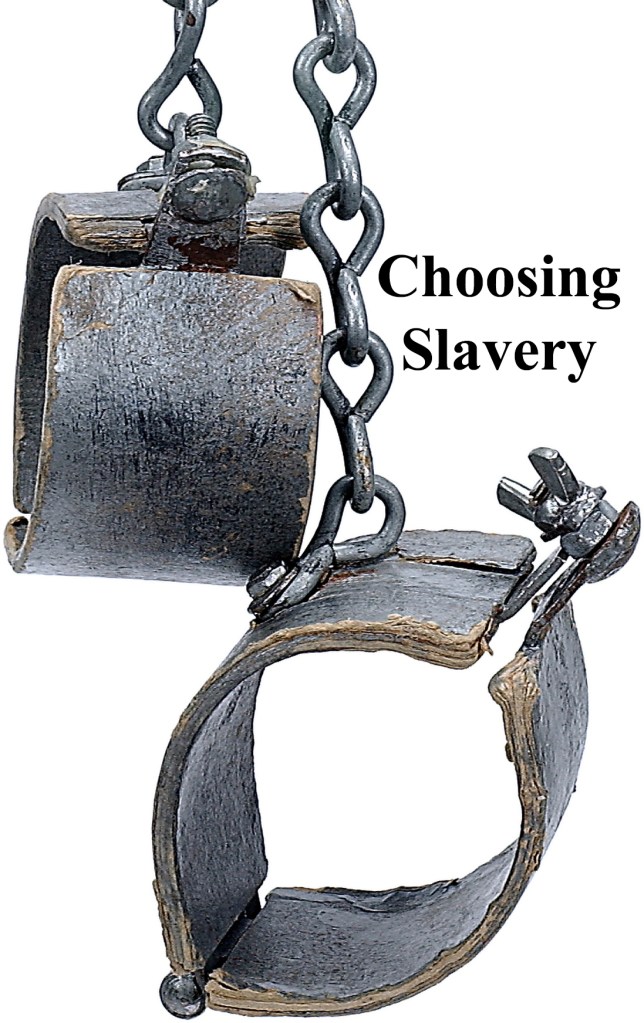
First, what does it mean to surrender? Not the kind of tepid negotiated peace that we often see in modern political conflict, but the absolutely dominating peace that follows what is known as unconditional surrender. What sort of treatment would one expect, and what would it mean to surrender… unconditionally?

Second, under what conditions would you choose to become a slave? And again, I don’t mean the lighthearted sort of slavery that we see in high school fundraisers where you must do the bidding of an upperclassman for a day. I mean absolutely surrender your life, liberty, choice, and freedom for the rest of your natural life. As Americans, our national and cultural core clings to things like life, liberty, and the pursuit of happiness. But under what conditions would you give that all up?

This was not an uncommon choice in the ancient world. Remember that I have said that in places like Israel, as well as many others in the first century Roman world, approximately 90 percent of the population lived at a subsistence level of poverty. Subsistence level means that, while they may have owned land, or even possessed valuable skilled trades, they earned just enough to feed themselves and their families, and no more. They were, perpetually, one bad harvest or one bad debt from starvation. Worse, those persons to whom you owed money were entitled to recover what was owed from whatever personally belonged to you… including your life and your liberty, as well as that of your family.

And so, some people, faced with an insurmountable debt, might occasionally sell their freedom, possibly to someone that they knew would be a humane master, so that their debts would be paid and their family would not be sold along with them. At other times, there were historically recorded instances, when people would work to pay off a debt, more as indentured servants, and would then ask to become slaves to their employer so that they would not have the constant worry and fear of daily earning enough money to remain free. There were still other similar cases that involved romantic relationships between a free person and a slave in which the free person chose slavery so that they could stay together.

And so, as we read our scriptures for today, we find Abraham who, while not a slave, has a relationship with God that checks all the same boxes, we have a teaching from the Apostle Paul that insists that everyone is a slave, and there is a brief word from Jesus who explains how his followers should treat one another. While these may not seem to have a lot in common, bear with me and, hopefully, you will see how this all fits together. As I noted, we begin with the story of Abraham in Genesis 22:1-14, when God asks him to do something that, given the path that Abraham and Sarah traveled to parenthood, is absolutely inconceivable.

22:1 Some time later God tested Abraham. He said to him, “Abraham!”

“Here I am,” he replied.

Then God said, “Take your son, your only son, whom you love—Isaac—and go to the region of Moriah. Sacrifice him there as a burnt offering on a mountain I will show you.”

Early the next morning Abraham got up and loaded his donkey. He took with him two of his servants and his son Isaac. When he had cut enough wood for the burnt offering, he set out for the place God had told him about. On the third day Abraham looked up and saw the place in the distance. He said to his servants, “Stay here with the donkey while I and the boy go over there. We will worship and then we will come back to you.”

Abraham took the wood for the burnt offering and placed it on his son Isaac, and he himself carried the fire and the knife. As the two of them went on together, Isaac spoke up and said to his father Abraham, “Father?”

“Yes, my son?” Abraham replied.

“The fire and wood are here,” Isaac said, “but where is the lamb for the burnt offering?”

Abraham answered, “God himself will provide the lamb for the burnt offering, my son.” And the two of them went on together.

When they reached the place God had told him about, Abraham built an altar there and arranged the wood on it. He bound his son Isaac and laid him on the altar, on top of the wood. 10 Then he reached out his hand and took the knife to slay his son. 11 But the angel of the Lord called out to him from heaven, “Abraham! Abraham!”

“Here I am,” he replied.

12 “Do not lay a hand on the boy,” he said. “Do not do anything to him. Now I know that you fear God, because you have not withheld from me your son, your only son.”

13 Abraham looked up and there in a thicket he saw a ram caught by its horns. He went over and took the ram and sacrificed it as a burnt offering instead of his son. 14 So Abraham called that place The Lord Will Provide. And to this day it is said, “On the mountain of the Lord it will be provided.”

God commands Abraham to take Isaac, his only son, who is, you will remember from last week, Abraham’s only son because Abraham was forced into an impossible position and compelled to divorce his wife Hagar and send both Hagar and his other son, Ishmael, away. And now, having done that, God commands Abraham to offer Isaac to God as a sacrifice on an altar on top of a mountain. And Abraham collects Isaac, and he goes. We don’t know what Abraham was thinking. I suspect that he didn’t tell Sarah where he was going, because this was Abraham’s test, and because I don’t think she would have let him go. But Abraham does tell his servants that We will worship and then we will come back to you.” Abraham was fully committed to sacrificing Isaac but, at the same time, believed that, somehow, Isaac would be restored to him at the end of the day.

But, in the end, after being brought to the razor’s edge, where the knife was already aimed for his son, and Abraham completely ready and willing to take his life, God stops him and then says, “Now I know that you fear God.” This is God acknowledging that Abraham was completely sold out, completely surrendered to God. Abraham was, by all definitions, a slave to God who was willing to do absolutely anything that God commanded him to do.

Next, we come to the words of Jesus regarding welcome and hospitality in Matthew 10:40-42, that, at first, seem ridiculously out of place in a discussion about slavery, but if you bear with me, I think it will all fit together in the end. Jesus said:

40 “Anyone who welcomes you welcomes me, and anyone who welcomes me welcomes the one who sent me. 41 Whoever welcomes a prophet as a prophet will receive a prophet’s reward, and whoever welcomes a righteous person as a righteous person will receive a righteous person’s reward. 42 And if anyone gives even a cup of cold water to one of these little ones who is my disciple, truly I tell you, that person will certainly not lose their reward.”

And, once again, you are thinking that this is all about hospitality and cannot possibly have anything to do with slavery. I can understand that, because that’s what I was thinking the first several times that I read through these scriptures. But hold on to that, and I think you will understand how it fits in few minutes after we read Paul’s explanation of our own relationship to slavery in Romans 6:12-23 when he says:

12 Therefore do not let sin reign in your mortal body so that you obey its evil desires. 13 Do not offer any part of yourself to sin as an instrument of wickedness, but rather offer yourselves to God as those who have been brought from death to life; and offer every part of yourself to him as an instrument of righteousness. 14 For sin shall no longer be your master, because you are not under the law, but under grace.

15 What then? Shall we sin because we are not under the law but under grace? By no means! 16 Don’t you know that when you offer yourselves to someone as obedient slaves, you are slaves of the one you obey—whether you are slaves to sin, which leads to death, or to obedience, which leads to righteousness? 17 But thanks be to God that, though you used to be slaves to sin, you have come to obey from your heart the pattern of teaching that has now claimed your allegiance. 18 You have been set free from sin and have become slaves to righteousness.

19 I am using an example from everyday life because of your human limitations. Just as you used to offer yourselves as slaves to impurity and to ever-increasing wickedness, so now offer yourselves as slaves to righteousness leading to holiness. 20 When you were slaves to sin, you were free from the control of righteousness. 21 What benefit did you reap at that time from the things you are now ashamed of? Those things result in death! 22 But now that you have been set free from sin and have become slaves of God, the benefit you reap leads to holiness, and the result is eternal life. 23 For the wages of sin is death, but the gift of God is eternal life in Christ Jesus our Lord.

Paul explains that because we are now under the grace of Jesus Christ, we are no longer slaves to sin, and thus sin is no longer our master. But that means that we are now slaves to Jesus Christ because we have given ourselves to God and he has purchased us with the life of his son, Jesus. Moreover, Paul says that everyone that you know, whether they follow Jesus or not, is a slave to something because “you are slaves of the one you obey.” If we were not slaves to Jesus, we would be slaves to sin, wickedness, impurity, or pleasure, or money, or power, or influence, or charisma, or politics, or knowledge, or… something else. But because we have offered ourselves to Jesus, and because we have been rescued from sin and death, we are now slaves to God and slaves to Jesus Christ. As such we should be just as sold out, just as committed, and just as completely surrendered to the will of God as Abraham was.

And once we understand that then this also explains how we connect to Jesus’ words about hospitality that we read from the Gospel of Matthew. If we recognize that we are all slaves to Jesus Christ, then how can we not act hospitably and welcoming to others that also belong to him. Can you imagine that a slave owner would be pleased with one of his slaves mistreating another? It would follow that it would please a master for his slaves to care for one another and do everything in their power to encourage and equip them to do the work that the master had given them to do and not to discourage or impede them from doing it.

Just as Abraham was, we are called to be fully committed, sold out, and completely surrendered to the will of God just as if we were slaves to Jesus. And having accepted Jesus as our master, then we must not only do everything we can, with all that we are, to accomplish the work that he has given us to do, but we must also welcome others who follow him, and do whatever we can to aid them in doing his work as well.


*You have been reading a message presented at Christ United Methodist Church on the date noted at the top of the first page.  Rev.  John Partridge is the pastor at Christ UMC in Alliance, Ohio.  Duplication of this message is a part of our Media ministry, if you have received a blessing in this way, we would love to hear from you.  Letters and donations in support of the Media ministry or any of our other projects may be sent to Christ United Methodist Church, 470 East Broadway Street, Alliance, Ohio 44601.  These messages are available to any interested persons regardless of membership.  You may subscribe to these messages, in print or electronic formats, by writing to the address noted, or by contacting us at secretary@CUMCAlliance.org.  These messages can also be found online at https://pastorpartridge.com .  All Scripture quotations, unless otherwise indicated, are taken from the Holy Bible, New International Version®, NIV®. Copyright ©1973, 1978, 1984, 2011 by Biblica, Inc.™ Used by permission of Zondervan. All rights reserved worldwide. www.zondervan.comThe “NIV” and “New International Version” are trademarks registered in the United States Patent and Trademark Office by Biblica, Inc.™
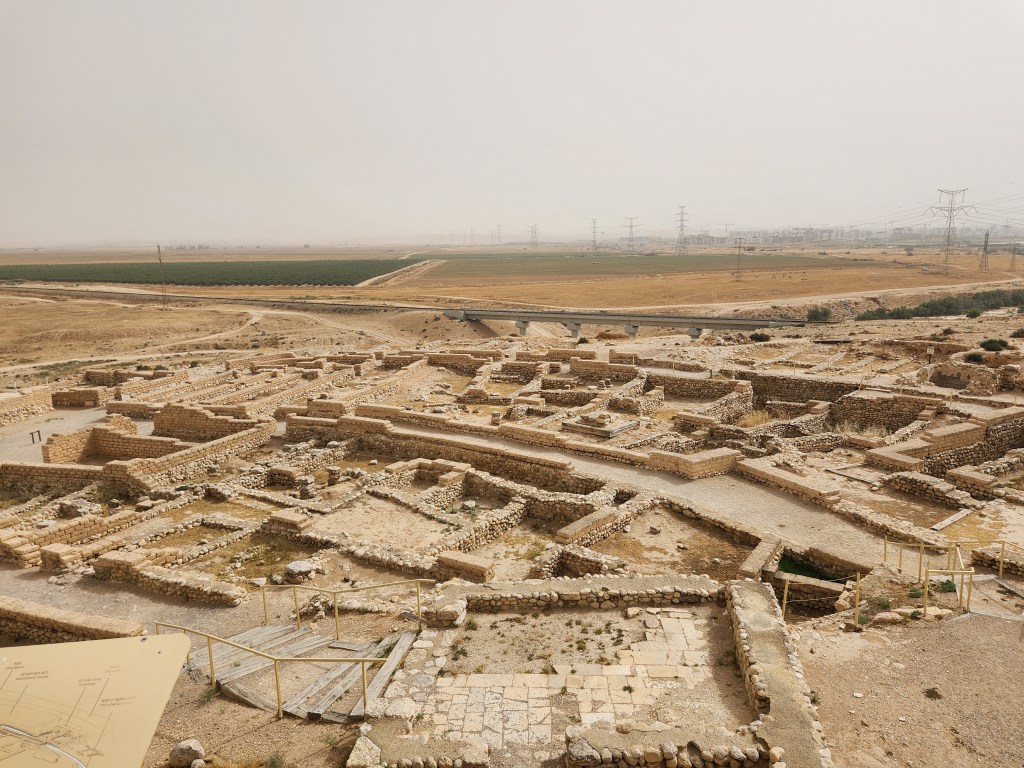
Photo by Zedcor Wholly Owned on FreeImages

Reproduction or Condemnation?

Reproduction or Condemnation?

July 16, 2023*

By Pastor John Partridge

Genesis 25:19-34       Matthew 13:1-9, 18-23          Romans 8:1-11

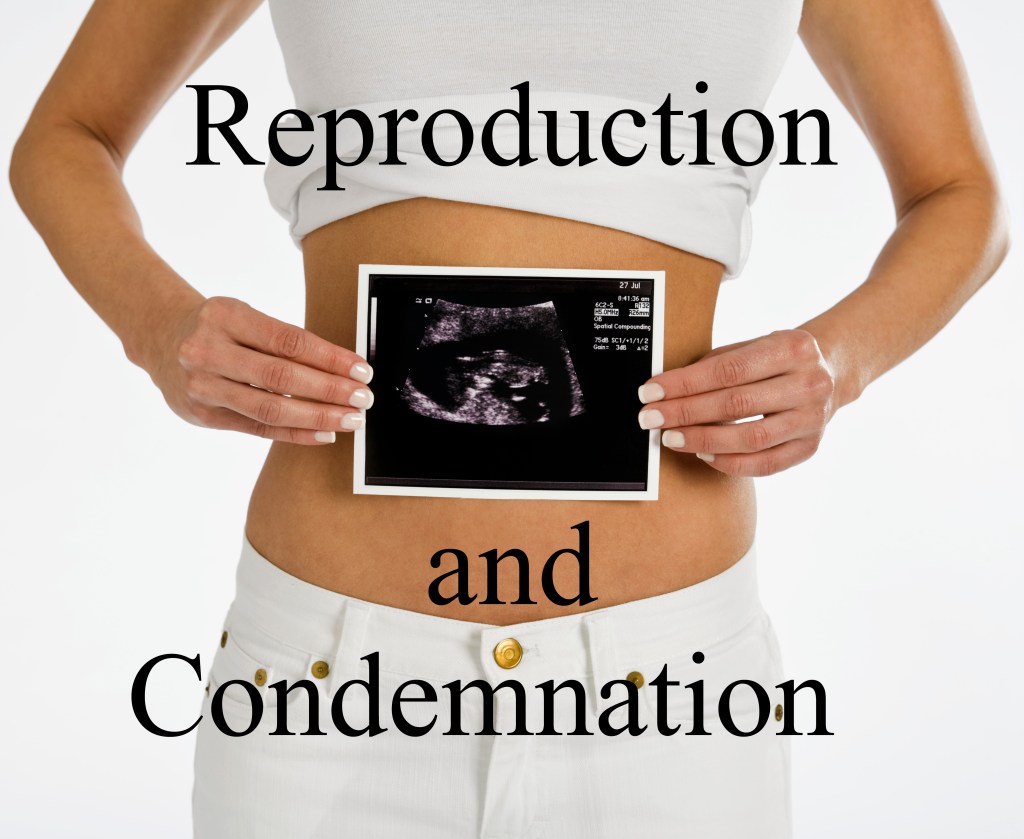
It is said that the problem of growth, or more accurately the lack of growth, currently being experienced by the modern church can be attributed, at least in part, to the widespread, successful procreation of those whom we often refer to as the Greatest Generation. Simply put, during the nineteen forties, fifties, and sixties, that generation was so wildly successful, and even prolific, at physical reproduction, that they, and the church, became utterly preoccupied with child rearing and many churches simply forgot how to reproduce spiritually.

Churches everywhere were bursting at the seams with children, churches were expanded, education wings were added, and just managing the growth and education of their existing church membership demanded such full-time attention, that almost no one discussed the need for sharing their faith, nor did they pass along the practical skills of faith-sharing and spiritual reproduction to their members or children. The consequences of these actions, or inaction, were that several generations watched their churches begin to shrink while, at the same time, having no idea what to do about it, and feeling no desire or compulsion to do the things that needed to be done simply because they had never seen it modeled in the lives of their parents or grandparents.

And, unexpectedly, as we continue working our way through the story of Abraham and his family in the book of Genesis, our story turns to focus on this difference between physical and spiritual reproduction. We begin this morning by skipping ahead a little from last week and rejoin Isaac and Rebekah as they have children of their own, and as those children grow up and grapple with both life and faith. We begin reading with Genesis 25:19-34…

19 This is the account of the family line of Abraham’s son Isaac.

Abraham became the father of Isaac, 20 and Isaac was forty years old when he married Rebekah, daughter of Bethuel the Aramean from Paddan Aramand sister of Laban the Aramean.

21 Isaac prayed to the Lord on behalf of his wife, because she was childless. The Lord answered his prayer, and his wife Rebekah became pregnant. 22 The babies jostled each other within her, and she said, “Why is this happening to me?” So, she went to inquire of the Lord.

23 The Lord said to her,

“Two nations are in your womb,
    and two peoples from within you will be separated;
one people will be stronger than the other,
    and the older will serve the younger.”

24 When the time came for her to give birth, there were twin boys in her womb. 25 The first to come out was red, and his whole body was like a hairy garment; so, they named him Esau. 26 After this, his brother came out, with his hand grasping Esau’s heel; so, he was named Jacob. Isaac was sixty years old when Rebekah gave birth to them.

27 The boys grew up, and Esau became a skillful hunter, a man of the open country, while Jacob was content to stay at home among the tents. 28 Isaac, who had a taste for wild game, loved Esau, but Rebekah loved Jacob.

29 Once when Jacob was cooking some stew, Esau came in from the open country, famished. 30 He said to Jacob, “Quick, let me have some of that red stew! I’m famished!” (That is why he was also called Edom.)

31 Jacob replied, “First sell me your birthright.”

32 “Look, I am about to die,” Esau said. “What good is the birthright to me?”

33 But Jacob said, “Swear to me first.” So, he swore an oath to him, selling his birthright to Jacob.

34 Then Jacob gave Esau some bread and some lentil stew. He ate and drank, and then got up and left.

So, Esau despised his birthright.

In a twist on Abraham’s story, in which he had two sons and had to decide which would remain in his family and which he would love, we find in this story that Isaac and Rebekah have two sons, and each one loves one child more than the other. But just as the story of Israel is not told from the perspective and lineage of Ishmael, neither is it reckoned from the lineage of Esau. God declares that the descendants of both men will become great nations, but only one will become God’s favorite.

This is not only an unusual focus on parental favoritism, but casts the hero of the story, Jacob, in an odd light in a patriarchal society. In that culture, recorded on clay tablets in the archives of their neighbors, a common insult of male warriors was to say that they were “like women” or that they should have stayed home with the women. And so, in that culture, when scripture records that Esau was an outdoorsman and a skillful hunter, and Jacob was “content to stay at home among the tents,” is casting Esau as the manly hero and the favorite of the reader and painting Jacob as insultingly effeminate. Thus, as I remember what little I know about literature, both men are cast “against type” where the hero would be seen by the reader as the villain and the villain would be seen having the characteristics of a typical hero.

But at the end of our reading, we arrive at the sentence “So, Esau despised his birthright.”  That puzzled me and I wondered what it meant. From our perspective, it’s not hard to understand that since Esau was an outdoorsman and avid hunter, that the administration of his family’s lands, crops, livestock, hired hands, servants, and extended family members just wasn’t something that he cared to do. In our understanding, we can accept that maybe he would have simply preferred that Jacob, who was “content to stay home among the tents” and who was perhaps temperamentally better suited to administration, would take over for their father as the head of the household and let Esau inherit a smaller portion without inheriting all of the responsibilities that came with inheriting the larger portion that came with his birthright.

But that wasn’t the understanding of the rabbis and the teachers of Israel. Because of Esau’s choice, the writer of Hebrews 12:16 goes as far as to describe Esau as “godless.” For these ancient interpreters, Esau’s rejection of his birthright was more than a rejection of his responsibilities to the administration of his family fortune, it was an outright rejection of Abraham’s covenant with God. And so, the biblical condemnation of Esau isn’t because of his place in his family’s lineage of physical reproduction, it was because of he rejected his place in his family’s lineage of spiritual reproduction.

Jesus doesn’t mention Esau by name, but when he preaches using the parable of the sower in Matthew 13:1-9, 18-23, we gain insight into this way of thinking about spiritual reproduction.

13:1 That same day Jesus went out of the house and sat by the lake. Such large crowds gathered around him that he got into a boat and sat in it, while all the people stood on the shore. Then he told them many things in parables, saying: “A farmer went out to sow his seed. As he was scattering the seed, some fell along the path, and the birds came and ate it up. Some fell on rocky places, where it did not have much soil. It sprang up quickly because the soil was shallow. But when the sun came up, the plants were scorched, and they withered because they had no root. Other seed fell among thorns, which grew up and choked the plants. Still other seed fell on good soil, where it produced a crop—a hundred, sixty or thirty times what was sown. Whoever has ears, let them hear.”

18 “Listen then to what the parable of the sower means: 19 When anyone hears the message about the kingdom and does not understand it, the evil one comes and snatches away what was sown in their heart. This is the seed sown along the path. 20 The seed falling on rocky ground refers to someone who hears the word and at once receives it with joy. 21 But since they have no root, they last only a short time. When trouble or persecution comes because of the word, they quickly fall away. 22 The seed falling among the thorns refers to someone who hears the word, but the worries of this life and the deceitfulness of wealth choke the word, making it unfruitful. 23 But the seed falling on good soil refers to someone who hears the word and understands it. This is the one who produces a crop, yielding a hundred, sixty or thirty times what was sown.”

Jesus is just sitting, as many of us have done, enjoying the calm of the seashore and the sound of the wind and the waves, when he gets mobbed by people wanting to hear him teach. And so, he told them many things, but among them was this parable about planting. Jesus explains its meaning, but in the end, it is about spiritual reproduction. The followers of Jesus are expected to plant spiritual seeds and be doing the work of spiritual reproduction and the reason that we are expected to reproduce is explained in the words of Romans 8:1-11 where Paul says:

8:1 Therefore, there is now no condemnation for those who are in Christ Jesus, because through Christ Jesus the law of the Spirit who gives life has set youfree from the law of sin and death. For what the law was powerless to do because it was weakened by the flesh, God did by sending his own Son in the likeness of sinful flesh to be a sin offering. And so, he condemned sin in the flesh, in order that the righteous requirement of the law might be fully met in us, who do not live according to the flesh but according to the Spirit.

Those who live according to the flesh have their minds set on what the flesh desires; but those who live in accordance with the Spirit have their minds set on what the Spirit desires. The mind governed by the flesh is death, but the mind governed by the Spirit is life and peace. The mind governed by the flesh is hostile to God; it does not submit to God’s law, nor can it do so. Those who are in the realm of the flesh cannot please God.

You, however, are not in the realm of the flesh but are in the realm of the Spirit, if indeed the Spirit of God lives in you. And if anyone does not have the Spirit of Christ, they do not belong to Christ. 10 But if Christ is in you, then even though your body is subject to death because of sin, the Spirit gives lifebecause of righteousness. 11 And if the Spirit of him who raised Jesus from the dead is living in you, he who raised Christ from the dead will also give life to your mortal bodies because ofhis Spirit who lives in you.

The important phrases that I want to pull out of this are these: First, “Therefore, there is now no condemnation for those who are in Christ Jesus…” and second, “Those who are in the realm of the flesh cannot please God.”

That means that God does not, and will not, condemn those who are committed to following Christ and in whom Christ dwells. But it also means that no amount of good works will ever be enough to please God if the Spirit of God does not live within you.

So, let’s summarize.

Esau was the grandson of Abraham but is completely left out of the genealogy of Israel, and is considered by Israel’s teaches to be godless, because he rejected his spiritual inheritance. Esau was, in the minds of Israel’s teachers and interpreters, “bad seed.” Jesus teaches that everyone who follows him is called to plant seeds so that they can reproduce spiritually. And Paul explains that while God will not condemn those who follow Jesus, anyone who does not surely will be condemned.

If the Spirit of God does not live inside of a person, there is nothing that they can do, in heaven or on earth, to save themselves. And that means that we stand at this dividing line between life and death. The seeds that we plant, the seeds that bring about spiritual reproduction, are all that stands between eternity and the condemnation of God.

Each of us, through our lives and through our words, may well be, literally, the difference between life and death for our friends and neighbors.

And that is why spiritual reproduction is still vitally important.


Please LIKE and SHARE!

Click here to subscribe to Pastor John’s blog.

Click here if you would like to subscribe to Pastor John’s weekly messages.

Click here to visit Pastor John’s YouTube channel.


*You have been reading a message presented at Christ United Methodist Church on the date noted at the top of the first page.  Rev. John Partridge is the pastor at Christ UMC in Alliance, Ohio.  Duplication of this message is a part of our Media ministry, if you have received a blessing in this way, we would love to hear from you.  Letters and donations in support of the Media ministry or any of our other projects may be sent to Christ United Methodist Church, 470 East Broadway Street, Alliance, Ohio 44601.  These messages are available to any interested persons regardless of membership.  You may subscribe to these messages, in print or electronic formats, by writing to the address noted, or by contacting us at secretary@CUMCAlliance.org.  These messages can also be found online at https://pastorpartridge.com .  All Scripture quotations, unless otherwise indicated, are taken from the Holy Bible, New International Version®, NIV®. Copyright ©1973, 1978, 1984, 2011 by Biblica, Inc.™ Used by permission of Zondervan. All rights reserved worldwide. www.zondervan.comThe “NIV” and “New International Version” are trademarks registered in the United States Patent and Trademark Office by Biblica, Inc.™
Beersheba Unexpected

An overview of most of the remains of ancient Beersheba

Beersheba Unexpected

Each day, as we rode on our tour bus toward a new destination, our class took turns preparing a short biblical history lesson of what had happened in that place. Sometimes these were recorded in the Old or New Testaments but sometimes the events of interest to us were to be found in the writings of Josephus, or in rediscovered texts from Egypt, Mesopotamia, or other archeological explorations. And so, on our way to Be’er Sheva (biblical Beersheba) we were reminded of the many biblical references, which are entirely in the Old Testament for reasons that I will explain shortly.

The first reference to Beersheba comes as early Genesis 21 when Abraham sends Hagar and Ishmael away and they “wandered in the Desert of Beersheba.” Just a few verses later, Abraham makes an oath (which amounts to a modern treaty) with Abimelech and exchange seven lambs as a part of the agreement. The name “Beersheba” therefore is said to stem from that event either because the word Beersheba is similar to the Hebrew root of “made an oath,” or because it is similar to the root word of “seven” (or possibly both).

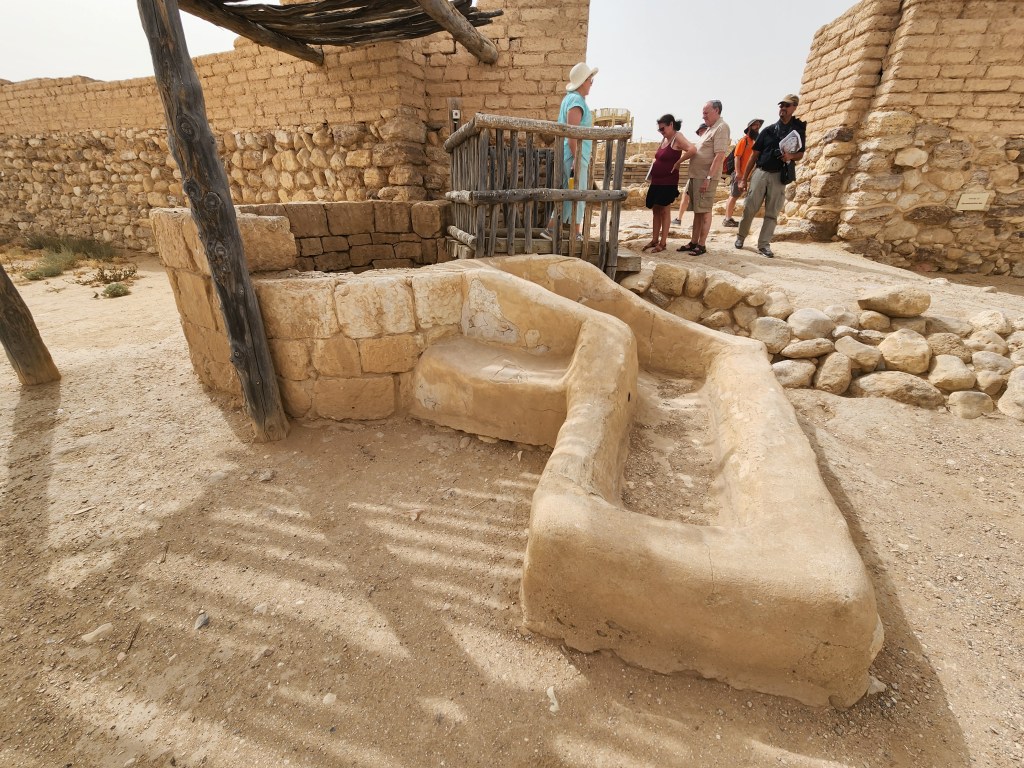
The well at Beersheba

Later, in Genesis 46, Jacob stops in Beersheba to offer sacrifices to God on his way to Egypt, Elijah stops there while running for his life in 1 Kings 19, and almost all of the other occurrences simply use Beersheba as an expression to say all of Israel from north to south as we see in Judges 20:1 when it says, “Then all Israel from Dan to Beersheba and from the land of Gilead came together as one and assembled before the Lord in Mizpah.” This expression is used simply because Dan was, for the most part, the farthest north that Israel grew, and Beersheba was its farthest southern extent.  To the north of Dan was the nation of Aram (which is modern day Syria) and to the south was… well, sand.  Beersheba was, and is, at the northern edge of the Negev desert, which scripture often describes as “wilderness” and the Sinai Peninsula. Continuing south brings you to the borders of Egypt. When the Jews returned to Israel after the Babylonian captivity, Nehemiah records that some returned to Beersheba, but, perhaps because there were so few, and because that territory is no longer controlled by Israel, there is no other mention of that place in scripture.

Looking down into the (deep) well

And so, while Beersheba is well attested in the Bible, compared to many of the other places that we visited, not a lot happened there. And yet, I was struck by the presence of the place in a way that I wasn’t in many of the others. Beersheba may not have had a central role in the stories of scripture, but it was present. The reason that Beersheba was important to Abraham and Isaac was because of the well that was there. Here, at the northern edge of the desert, there isn’t much water other that what flows down the wadi (dry riverbed) during the infrequent rains. And so, this well is very likely the same well that Abraham knew. Moreover, even though it may not often be mentioned by name, anyone who traveled through this region was almost certain to have stopped here.

A model of the Horned Altar found at Beersheba

It is also believed that Beersheba was one of the places of worship that had been built so that people wouldn’t have to travel the many miles north to Jerusalem. If so, this is one of the temples that King Hezekiah ordered torn down in 1 Kings 18. During archaeological digs here, a four-horned altar, often described in scripture, and typically used for sacrifice, was discovered here in secondary use. “Secondary use” means that after the temple here had been torn down, someone reused the stones as a part of wall. The stones from that wall have been moved to the Israel Museum in Jerusalem and reassembled into an altar.

Finally, during those times that Israel controlled Beersheba, it was a military outpost. This was the border between Israel and the wilderness, and between Israel and any enemies, such as Egypt, that might come from the south. Duty here was probably far from home, and certainly hot, unforgiving, and generally miserable.

A city street

Still, what is it about Be’er Sheva that unexpectedly struck me? Why does it have a presence that I could feel? For me, it’s because, like just a few other places, this is where it happened. In other places, over the last two thousand years, the places described in scripture have moved, walls have been torn down and rebuilt, whole cities have been destroyed, rebuilt, destroyed again, over and over until the places that we read about are tens of meters below the surface. But wells don’t move. While the stones surrounding this well at the surface may have been replaced many times, this is the place where Abraham, Isaac, Jacob, Elijah, invading Pharaohs, Mesopotamian generals, Roman armies, Israelite kings, and so many others have stood, draw water, and had a moment of rest.

It was unexpected.  I was surprised.

Beersheba city gate

But here, on a smallish hill on the edge of the desert, I felt as if I was in the presence of history.

And, having done so, it is so much easier to imagine what those people were feeling. The panic of Hagar as she is cast out to almost certain death in the desert, the relief of Israeli merchants returning home from Egypt, the apprehension of outpost soldiers knowing that Egypt’s army was on its way towards them, the anticipation of Pharoah as he moved north towards larger, more well-defended outposts and cities, and the courage of those settlers who dared to make this remote place their home.

It is that insight, out ability to imagine what it must have been like, that allows us to better understand, explain, teach, and preach the stories of scripture. Because understanding those people, and their feelings transforms dry words into real people.


Please LIKE and SHARE!

Click here to subscribe to Pastor John’s blog.

Click here if you would like to subscribe to Pastor John’s weekly messages.

Click here to visit Pastor John’s YouTube channel.