Life and Death Choices

Life and Death Choices

June 21, 2026*

By Pastor John Partridge

Genesis 21:8-21                     Matthew 10:24-39                             Romans 6:1-11

Have you ever been in a position where you were compelled to make a choice, but none of the choices were good ones? One of the most famous of these is that of Socrates who, in 399 BCE was convicted of impiety and corrupting the youth of Athens with his philosophy and was given the choice of exile or death by poison. Neither was a good choice, but Socrates felt that exile was a fate worse than death and thus chose poison. In the modern era, being confronted by bad choices remains common. In combat, soldiers and sailors are often faced with choices that have terrible results regardless of what they choose. Likewise, the homeless, those in poverty, and many others are faced with choosing between multiple bad choices with no good options. What do you choose when faced with a fine for $300 or three days in jail, when you don’t have $300 and will lose your job if you miss three days of work?

I don’t have the answer because, obviously, there are no good answers. But this is what Abraham faces as we read from Genesis 21:8-21. Isaac, the son of Abraham and Sarah, had grown enough to be weaned from his mother, possible at the age of three, or perhaps a bit older, but when that happens, Sarah forces Abraham to make a choice that he doesn’t want to make, and in which someone will be hurt no matter what he chooses.

The child grew and was weaned, and on the day Isaac was weaned Abraham held a great feast. But Sarah saw that the son whom Hagar the Egyptian had borne to Abraham was mocking, 10 and she said to Abraham, “Get rid of that slave woman and her son, for that woman’s son will never share in the inheritance with my son Isaac.”

11 The matter distressed Abraham greatly because it concerned his son. 12 But God said to him, “Do not be so distressed about the boy and your slave woman. Listen to whatever Sarah tells you, because it is through Isaac that your offspring will be reckoned. 13 I will make the son of the slave into a nation also, because he is your offspring.”

14 Early the next morning Abraham took some food and a skin of water and gave them to Hagar. He set them on her shoulders and then sent her off with the boy. She went on her way and wandered in the Desert of Beersheba.

15 When the water in the skin was gone, she put the boy under one of the bushes. 16 Then she went off and sat down about a bowshot away, for she thought, “I cannot watch the boy die.” And as she sat there, she began to sob.

17 God heard the boy crying, and the angel of God called to Hagar from heaven and said to her, “What is the matter, Hagar? Do not be afraid; God has heard the boy crying as he lies there. 18 Lift the boy up and take him by the hand, for I will make him into a great nation.”

19 Then God opened her eyes and she saw a well of water. So, she went and filled the skin with water and gave the boy a drink.

20 God was with the boy as he grew up. He lived in the desert and became an archer. 21 While he was living in the Desert of Paran, his mother got a wife for him from Egypt.

There are several things that might be helpful as we try to understand this. First, as revered of an ancestor as he may be, Abraham was just as flawed and just as human as the rest of us. He made mistakes, and we cannot argue that this interaction, as painful as it is, was anything close to perfect. Second, culturally, despite Hagar being owned by Abraham, once she bore him a child, she legally became his wife. Therefore, although Isaac was the child of Sarah, and the child that God had promised to them since this entire adventure began, it can be argued that Ishmael was, legally, the firstborn male child and would therefor inherit the lion’s share of Abraham’s estate. Third, because Hagar was legally his wife, Abraham could not sell her, or give her away, or set her free, or simply throw her out as it appears that he did. Instead, legally, what we are witnessing is a legal divorce proceeding. Although the details are not included in the writing of Genesis, in order for Abraham to send Hagar away, there had to be some formal stuff that legally satisfied the requirements of divorce.

With all that in mind, Sarah forces Abraham to make a choice that has been coming ever since he chose to make a baby with Hagar. The choice to do nothing results in Ishmael being declared as the firstborn son, and displacing Isaac as the child of God’s promise. The second choice is to divorce Hagar, send her away, but raise Ishmael for himself, again resulting in Ishmael being understood as the firstborn son, The third option was to divorce Hagar, and send both her, and Ishmael, away leaving Isaac as the only son. Abraham didn’t want to do any of those things. Not surprisingly, as his son, he had feelings for Ishmael, and likely for Hagar as well. But Abraham also had feelings for Sarah and for Isaac, didn’t want to hurt them, and also wanted to honor God’s gift by allowing Issac to receive the inheritance that had been promised to him. No matter what Abraham chooses, something gets broken and someone gets hurt. Could Abraham have done better by Hagar and Ishmael? Should he have done better? Yeah, probably. But as we all know, it’s easy to sit in judgement when you don’t have all the facts.

In any case, Abraham is forced into a life-or-death choice, with nothing to ease the pain and loss except for God’s promise to care for Ishmael. But, like it or not, all of us face life-or-death choices. Hopefully, the choices that we face have some good mixed with the bad and, like Abraham and many others, we will not be forced to choose between several bad options. But, in Matthew 10:24-39, Jesus describes one of those choices we will have to make, when he says:

24 “The student is not above the teacher, nor a servant above his master. 25 It is enough for students to be like their teachers, and servants like their masters. If the head of the house has been called Beelzebul, how much more the members of his household!

26 “So, do not be afraid of them, for there is nothing concealed that will not be disclosed, or hidden that will not be made known. 27 What I tell you in the dark, speak in the daylight; what is whispered in your ear, proclaim from the roofs. 28 Do not be afraid of those who kill the body but cannot kill the soul. Rather, be afraid of the One who can destroy both soul and body in hell. 29 Are not two sparrows sold for a penny? Yet not one of them will fall to the ground outside your Father’s care. 30 And even the very hairs of your head are all numbered. 31 So don’t be afraid; you are worth more than many sparrows.

32 “Whoever acknowledges me before others, I will also acknowledge before my Father in heaven. 33 But whoever disowns me before others, I will disown before my Father in heaven.

34 “Do not suppose that I have come to bring peace to the earth. I did not come to bring peace, but a sword. 35 For I have come to turn…

“‘a man against his father,
    a daughter against her mother,
a daughter-in-law against her mother-in-law—
36     a man’s enemies will be the members of his own household.’

37 “Anyone who loves their father or mother more than me is not worthy of me; anyone who loves their son or daughter more than me is not worthy of me. 38 Whoever does not take up their cross and follow me is not worthy of me. 39 Whoever finds their life will lose it, and whoever loses their life for my sake will find it.

Jesus says that it is enough for us to be like our teachers and like our master, Jesus. We should not be afraid of those who criticize or condemn Jesus, and to an even greater degree, us. In the end, Jesus says, the truth will be made known. Everything that has been hidden will be revealed, everything that has been deliberately concealed will be made public. Nothing will linger in the shadows, all conspiracies and secrets will be brought into the light, all lies will be exposed. And so, Jesus urges us to put away our fear of those who can only kill us, but who cannot take away our life with an eternal God. Rather, we should choose carefully whom we would rather have as our enemy. Should we ally ourselves with those who might attack our credibility, tell lies about us, conspire against us, or even kill us, but whose schemes will be revealed on the day of judgement? Or should we ally ourselves with the creator of the universe, the champion of truth, the bearer of all wisdom, and the keeper of our souls for all eternity? It is a life-or-death choice.

When Jesus says, “Whoever acknowledges me before others, I will also acknowledge before my Father in heaven. 33 But whoever disowns me before others, I will disown before my Father in heaven” He isn’t talking about silly internet memes that demand that you repost if you really love Jesus. He is saying that we must choose a side. We must put Jesus first, above our parents, above our families, and above our own well-being. But by choosing Jesus, and placing him first, we will find life.

Paul reinforces this teaching as he writes to the church in Rome in Romans 6:1b-11, saying:

6:1 What shall we say, then? Shall we go on sinning so that grace may increase? By no means! We are those who have died to sin; how can we live in it any longer? Or don’t you know that all of us who were baptized into Christ Jesus were baptized into his death? We were therefore buried with him through baptism into death in order that, just as Christ was raised from the dead through the glory of the Father, we too may live a new life.

For if we have been united with him in a death like his, we will certainly also be united with him in a resurrection like his. For we know that our old self was crucified with him so that the body ruled by sin might be done away with, that we should no longer be slaves to sin— because anyone who has died has been set free from sin.

Now if we died with Christ, we believe that we will also live with him. For we know that since Christ was raised from the dead, he cannot die again; death no longer has mastery over him. 10 The death he died, he died to sin once for all; but the life he lives, he lives to God.

11 In the same way, count yourselves dead to sin but alive to God in Christ Jesus.

Paul says, “Shall we go on sinning?” and point out that we have choices to make. We chose to follow Jesus. We chose to be baptized and make a public statement that we were following Jesus. And, Paul asks, if we have been baptized, and we have died to sin and raised to a new life in Christ, then shouldn’t we live as if we are following the example, and the teachings, of Jesus?

The story of Abraham tells us that although we have many choices to make, sometimes we will be faced with choices that have no good options. Sometimes our choices will hurt people. Sometimes our choices may be the pivot between life and death for ourselves or for others. But Jesus reminds us that our choices also decide with whom we will ally ourselves. Will we choose to be God’s ally, or God’s enemy? Will we choose to put Jesus first, even ahead of our family, our jobs, our wealth, and our well-being?

Will we choose to life as if following Jesus means something?

As Joshual once said, “choose for yourself this day whom you will serve.” (Joshua 24:15)

And having done that, we must live as if that choice means something.

But… choose wisely, because these really are… life and death choices.


Please LIKE and SHARE!

Click here to subscribe to Pastor John’s blog.

Click here if you would like to subscribe to Pastor John’s weekly messages.

Click here to visit Pastor John’s YouTube channel.


*You have been reading a message presented at Christ United Methodist Church on the date noted at the top of the first page.  Rev.  John Partridge is the pastor at Christ UMC in Alliance, Ohio.  Duplication of this message is a part of our Media ministry, if you have received a blessing in this way, we would love to hear from you.  Letters and donations in support of the Media ministry or any of our other projects may be sent to Christ United Methodist Church, 470 East Broadway Street, Alliance, Ohio 44601.  These messages are available to any interested persons regardless of membership.  You may subscribe to these messages, in print or electronic formats, by writing to the address noted, or by contacting us at secretary@CUMCAlliance.org.  These messages can also be found online at https://pastorpartridge.com .  All Scripture quotations, unless otherwise indicated, are taken from the Holy Bible, New International Version®, NIV®. Copyright ©1973, 1978, 1984, 2011 by Biblica, Inc.™ Used by permission of Zondervan. All rights reserved worldwide. www.zondervan.comThe “NIV” and “New International Version” are trademarks registered in the United States Patent and Trademark Office by Biblica, Inc.™


Photo by Vexels.com on FreeImages

Directions and Credits “For Us”

Directions and Credits “For Us”

June 07, 2026*

By Pastor John Partridge

Genesis 12:1-9                       Matthew 9:9-13, 18-26                      Romans 4:13-25

How do you explain Christianity to the people around you?

I think that you know what I mean. Your friends certainly know that you are a Christian, or that you regularly, or… occasionally, attend church. And, if they are comfortable in their relationship with you, they may eventually ask a question like, “How does that work… exactly?” How does one become a Christian, and what do you have to do because you are a Christian? Some of that we know, and if we’re honest, we spend years of our lives working out some of the other parts of it. But we also know that many people who claim the name of Jesus Christ, and who call themselves Christian, get a lot that wrong. But, as confusing as that is, I think, or at least I hope, that our study of today’s scriptures should help clear away some of our confusion.

But before we jump into our scriptures, I want to read two quotes that will frame our discussion.

First, Margaret Mead, a well-known American anthropologist who spent her life studying human behavior, once said, “What people say, what people do, and what they say they do are entirely different things.” This explains an awful lot about politics but reveals the truth that we see in our everyday lives. “What people say, what people do, and what they say they do are entirely different things.” The second quote, from Sir Winston Churchill, is similar, but the focus is different, and will lead us very well into today’s scripture, and that is, “I no longer listen to what people say, I just watch what they do. Behavior never lies.”

“I no longer listen to what people say, I just watch what they do. Behavior never lies.”

That really is powerful.

And so, I want you to keep these ideas in mind as we read and think about today’s scripture lesson. We begin this morning reading from the story of Abraham in Genesis 12:1-9 which says:

12:1 The Lord had said to Abram, “Go from your country, your people and your father’s household to the land I will show you.

“I will make you into a great nation,
    and I will bless you;
I will make your name great,
    and you will be a blessing.
I will bless those who bless you,
    and whoever curses you I will curse;
and all peoples on earth
    will be blessed through you.”

So Abram went, as the Lord had told him; and Lot went with him. Abram was seventy-five years old when he set out from Harran. He took his wife Sarai, his nephew Lot, all the possessions they had accumulated and the people they had acquired in Harran, and they set out for the land of Canaan, and they arrived there.

Abram traveled through the land as far as the site of the great tree of Moreh at Shechem. At that time the Canaanites were in the land. The Lord appeared to Abram and said, “To your offspringI will give this land.” So, he built an altar there to the Lord, who had appeared to him.

From there he went on toward the hills east of Bethel and pitched his tent, with Bethel on the west and Ai on the east. There he built an altar to the Lord and called on the name of the Lord.

Then Abram set out and continued toward the Negev.

I pause here to do something that Engineers rarely do. I pause here to teach a little English. You are all familiar with the past, present, and future tenses, but English also has an imperative, which we use in instructions and commands. This is important, because while every sentence typically requires both a noun and a verb to make sense, in the imperative, a noun is only implied and not required. This is why commands like “Jump” or “Get out” make perfect sense even though they don’t have a noun in them. The noun, typically “you” is implied. And this is what we see when God commands Abram. If we include the implied noun in the first verse, God says “You go” or “I command you to go” from the places, people, and things that you know, and to the place that I will show you. But, then in the second verse, God explains that Abram’s obedience is not pointless, but that God is offering a transaction. Verse one says “You go” but in verse two, God says that if Abram goes, then “I will” do these things. And this becomes God’s promise to Abram.

But as we noted earlier, regardless of what Abram might have said, which is not recorded, it is important for us to watch what Abram does. And as we read the story, we see that Abram does several things. First, Abram goes. He is seventy-five years old, well-established, and reasonably wealthy, and he leaves it all behind, family, friends, and everything familiar, and heads off into the unknown. But on the way to the place that God is leading him, he stops, twice, both in Shechem, and in Bethel, and builds an altar to worship God and to give thanks, while he is still on the way to the blessing that he has not yet received. And, after giving thanks to God, Abram packs up and continues the way toward wherever it is that God is leading him.

And we see something similar in the gospel of Matthew as Jesus calls the disciple Matthew to follow him. But we also see something quite different, even the opposite, in the same story. In Matthew 9:9-13, 18-26, we read this:

As Jesus went on from there, he saw a man named Matthew sitting at the tax collector’s booth. “Follow me,” he told him, and Matthew got up and followed him.

10 While Jesus was having dinner at Matthew’s house, many tax collectors and sinners came and ate with him and his disciples. 11 When the Pharisees saw this, they asked his disciples, “Why does your teacher eat with tax collectors and sinners?”

12 On hearing this, Jesus said, “It is not the healthy who need a doctor, but the sick. 13 But go and learn what this means: ‘I desire mercy, not sacrifice.’For I have not come to call the righteous, but sinners.”

18 While he was saying this, a synagogue leader came and knelt before him and said, “My daughter has just died. But come and put your hand on her, and she will live.” 19 Jesus got up and went with him, and so did his disciples.

20 Just then a woman who had been subject to bleeding for twelve years came up behind him and touched the edge of his cloak. 21 She said to herself, “If I only touch his cloak, I will be healed.”

22 Jesus turned and saw her. “Take heart, daughter,” he said, “your faith has healed you.” And the woman was healed at that moment.

23 When Jesus entered the synagogue leader’s house and saw the noisy crowd and people playing pipes, 24he said, “Go away. The girl is not dead but asleep.” But they laughed at him. 25 After the crowd had been put outside, he went in and took the girl by the hand, and she got up. 26 News of this spread through all that region.

So, where we saw God and Abram in the previous story, here we have Jesus and Matthew having a similar conversation. Jesus says, “Follow me” and Matthew gets up and follows. But as soon as Jesus arrives at Matthew’s house, the Pharisees complain that Jesus is socializing with the wrong kind of people. Jesus says, “It is not the healthy that need a doctor but the sick. But go and learn what this means: ‘I desire mercy, not sacrifice.” But where Matthew did what Jesus told him to do, the implication of the story is that the Pharisees surely did not. Jesus said, “go and learn” and the Pharisees ignored his instructions.

But to add contrast to the contrast between those two stories, the gospel writer immediately follows that story with two more in which people act in ways that demonstrate their faith through their actions. First, by a woman who gave herself directions to touch Jesus’ cloak, and second by a synagogue leader who asked Jesus for help, and then did whatever Jesus asked him to do even when the crowd of people, in his own house, laugh at Jesus, and by extension, the synagogue leader himself, for even imagining that the girl could be alive.

And that’s where we get to us. In Paul’s letter to the church in Rome, he explains what following Jesus means, how we become followers, or what we now name as being Christians, and also covers how many Jews of his day, and Christians today, get the whole thing wrong. Reading from Romans 4:13-25, we hear this:

13 It was not through the law that Abraham and his offspring received the promise that he would be heir of the world, but through the righteousness that comes by faith. 14 For if those who depend on the law are heirs, faith means nothing and the promise is worthless, 15because the law brings wrath. And where there is no law there is no transgression.

16 Therefore, the promise comes by faith, so that it may be by grace and may be guaranteed to all Abraham’s offspring—not only to those who are of the law but also to those who have the faith of Abraham. He is the father of us all. 17 As it is written: “I have made you a father of many nations.” He is our father in the sight of God, in whom he believed—the God who gives life to the dead and calls into being things that were not.

18 Against all hope, Abraham in hope believed and so became the father of many nations, just as it had been said to him, “So shall your offspring be.” 19 Without weakening in his faith, he faced the fact that his body was as good as dead—since he was about a hundred years old—and that Sarah’s womb was also dead. 20 Yet he did not waver through unbelief regarding the promise of God, but was strengthened in his faith and gave glory to God, 21 being fully persuaded that God had power to do what he had promised. 22 This is why “it was credited to him as righteousness.” 23 The words “it was credited to him” were written not for him alone, 24but also for us, to whom God will credit righteousness—for us who believe in him who raised Jesus our Lord from the dead. 25 He was delivered over to death for our sins and was raised to life for our justification.

Paul reminds the Jews of the first century that while Abraham was the father of their tribe and of their religion, he did not possess the writings of the Law or the prophets in which the Pharisees, teachers of the law, and so many others placed so much importance. Paul says that it wasn’t the ten commandments that made Jews righteous, nor was it the Law, or the prophets, nor the adherence to the hundreds of rules that regulated the behavior of obedient Jews. Instead, Paul explains that the thing that made Abraham righteous, and the thing that lay at the core of what made people righteous for all time, was that they had placed their faith in God. Paul says that now, for us, this is what we have as believers in Jesus Christ. It isn’t because we adhere to the ten commandments, or because we follow a bunch of rules about alcohol, tobacco, snake handling, how we say our prayers, how we dress, how we speak, how we worship, or dozens of other rules that people say Christians are supposed to follow, but that God credits us with righteousness, God sees us as righteous, simply because we believe in Jesus Christ.

Just as the Pharisees thought that Jesus’ faith was wrong because he ate with tax collectors and sinners, lots of people, church people, and non-church people alike, often get this backwards. We aren’t Christian because we follow a bunch of rules. We are Christian because we have put our trust in Jesus.

But then why do we follow some of the rules and behave in certain ways? The example that springs to mind is the reason that I do not ride motorcycles. I like them. I once thought that I would surely own one. But the idea of me riding a motorcycle would worry my wife to no end. I stay away from motorcycles, not because Patti has made some kind of rule, or because she has forbidden me from doing so, but because I love her, a choose to behave in ways that give her comfort and not worry. And the same can be said for why Christians do many of the things we do. We do not follow rules because following rules makes us Christian. Putting our faith in Jesus is what makes us Christian. We follow certain rules, and adopt certain behaviors, not because we must, but because we choose to do so because we love Jesus and want to honor him.


*You have been reading a message presented at Christ United Methodist Church on the date noted at the top of the first page.  Rev.  John Partridge is the pastor at Christ UMC in Alliance, Ohio.  Duplication of this message is a part of our Media ministry, if you have received a blessing in this way, we would love to hear from you.  Letters and donations in support of the Media ministry or any of our other projects may be sent to Christ United Methodist Church, 470 East Broadway Street, Alliance, Ohio 44601.  These messages are available to any interested persons regardless of membership.  You may subscribe to these messages, in print or electronic formats, by writing to the address noted, or by contacting us at secretary@CUMCAlliance.org.  These messages can also be found online at https://pastorpartridge.com .  All Scripture quotations, unless otherwise indicated, are taken from the Holy Bible, New International Version®, NIV®. Copyright ©1973, 1978, 1984, 2011 by Biblica, Inc.™ Used by permission of Zondervan. All rights reserved worldwide. www.zondervan.comThe “NIV” and “New International Version” are trademarks registered in the United States Patent and Trademark Office by Biblica, Inc.™

Photo by Comstock on FreeImages

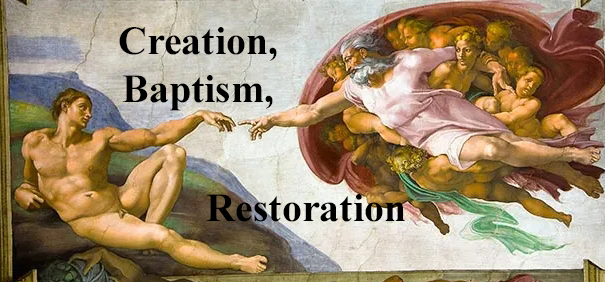
Creation, Baptism, Restoration

Creation, Baptism, Restoration

May 31, 2026*

(Trinity Sunday)

By Pastor John Partridge

Genesis 1:1 – 2:4                    Matthew 28:16-20                 2 Corinthians 13:11-13

Last week I said that it is our stories that tell us where we came from and who we are. Do you remember that? Our stories are an important part of us for these, and many reasons, but there are a few stories that anchor us. For some of us, the story of how we came to faith in Jesus Christ is an anchor. Other anchors can be built on our family stories, sometimes our military experiences, key events in high school or college, unfortunately, sometimes unintentionally, we establish an anchor in some trauma that we once experienced but other times we are anchored in times that we experienced wonder, or miracles in our lives. The moment, in an ordinary hotel room in China, that our daughter was placed in my arms, is an anchor that is indelibly burned into my memory. It was a moment of wonder, the moment that Patti and I became parents, and the moment that I became a father.

And so, it is unsurprising that the beginning of things, weddings, births, boot camps, elections, and other “firsts” are memorable enough to become our anchors. And, as believers in God, and in Jesus Christ, and as a church, one of our common anchors lies in the creation of the world. Even if you do not believe in a literal creation and subscribe to something more akin to eons of evolution, as a follower of God, the creation story of Genesis still holds a special place and value. But why is it a topic today, as we celebrate Trinity Sunday? What is the connection to the trinity that is so strong, and so special, that we are invited to read, and remember, the entire first chapter of Genesis? I honestly wondered about the same thing, and did a little study before I decided how much of it I was really going to use. But in the end, I decided that it was important, and I’ll explain why afterward. Reading from Genesis 1:1 – 2:4a, we hear this:

1:1 In the beginning God created the heavens and the earth. Now the earth was formless and empty, darkness was over the surface of the deep, and the Spirit of God was hovering over the waters.

And God said, “Let there be light,” and there was light. God saw that the light was good, and he separated the light from the darkness. God called the light “day,” and the darkness he called “night.” And there was evening, and there was morning—the first day.

And God said, “Let there be a vault between the waters to separate water from water.” So God made the vault and separated the water under the vault from the water above it. And it was so. God called the vault “sky.” And there was evening, and there was morning—the second day.

And God said, “Let the water under the sky be gathered to one place, and let dry ground appear.” And it was so. 10 God called the dry ground “land,” and the gathered waters he called “seas.” And God saw that it was good.

11 Then God said, “Let the land produce vegetation: seed-bearing plants and trees on the land that bear fruit with seed in it, according to their various kinds.” And it was so. 12 The land produced vegetation: plants bearing seed according to their kinds and trees bearing fruit with seed in it according to their kinds. And God saw that it was good. 13 And there was evening, and there was morning—the third day.

14 And God said, “Let there be lights in the vault of the sky to separate the day from the night, and let them serve as signs to mark sacred times, and days and years, 15 and let them be lights in the vault of the sky to give light on the earth.” And it was so. 16 God made two great lights—the greater light to govern the day and the lesser light to govern the night. He also made the stars. 17 God set them in the vault of the sky to give light on the earth, 18 to govern the day and the night, and to separate light from darkness. And God saw that it was good. 19 And there was evening, and there was morning—the fourth day.

20 And God said, “Let the water teem with living creatures, and let birds fly above the earth across the vault of the sky.” 21 So God created the great creatures of the sea and every living thing with which the water teems and that moves about in it, according to their kinds, and every winged bird according to its kind. And God saw that it was good. 22 God blessed them and said, “Be fruitful and increase in number and fill the water in the seas, and let the birds increase on the earth.” 23 And there was evening, and there was morning—the fifth day.

24 And God said, “Let the land produce living creatures according to their kinds: the livestock, the creatures that move along the ground, and the wild animals, each according to its kind.” And it was so. 25 God made the wild animals according to their kinds, the livestock according to their kinds, and all the creatures that move along the ground according to their kinds. And God saw that it was good.

26 Then God said, “Let us make mankind in our image, in our likeness, so that they may rule over the fish in the sea and the birds in the sky, over the livestock and all the wild animals, and over all the creatures that move along the ground.”

27 So God created mankind in his own image,
    in the image of God he created them;
    male and female he created them.

28 God blessed them and said to them, “Be fruitful and increase in number; fill the earth and subdue it. Rule over the fish in the sea and the birds in the sky and over every living creature that moves on the ground.”

29 Then God said, “I give you every seed-bearing plant on the face of the whole earth and every tree that has fruit with seed in it. They will be yours for food. 30 And to all the beasts of the earth and all the birds in the sky and all the creatures that move along the ground—everything that has the breath of life in it—I give every green plant for food.” And it was so.

31 God saw all that he had made, and it was very good. And there was evening, and there was morning—the sixth day.

2:1 Thus the heavens and the earth were completed in all their vast array.

By the seventh day God had finished the work he had been doing; so, on the seventh day he rested from all his work. Then God blessed the seventh day and made it holy, because on it he rested from all the work of creating that he had done.

This is the account of the heavens and the earth when they were created, when the Lord God made the earth and the heavens.

As I mentioned, the first reason for remembering the creation story is simply because it is one of our most memorable and important anchors. But as we celebrate Trinity Sunday, and as we examine the story in light of our theological trinitarian beliefs, our understanding of Father, Son, and Holy Spirit, we can see them in the story as well. First, we see that the Spirit of God hovered over the waters of creation, and next we hear God the Father speak the universe into existence saying, “Let there be light.” But we also see Jesus. In this case, since this is a Jewish history, Jesus is not named, but to our understanding of the trinity, when we see a shift in verse six from God speaking “Let there he a vault between the waters…” and then God acting in verse seven “So, God made the vault and separated the water…” our understanding, as trinitarians, and from other passages in the New Testament, is that while God the Father speaks (in verse six), it is Jesus the son who acts as the agent of creation (in verse seven). As such, while several passages in the New Testament say that Jesus was present at the time of creation, this is how we understand his presence.

And even though the word “trinity” appears nowhere in scripture, it is this understanding of the trinity that then leads to Jesus’ instructions to the disciples in Matthew 28:16-20 that includes all three persons of God.

16 Then the eleven disciples went to Galilee, to the mountain where Jesus had told them to go. 17 When they saw him, they worshiped him; but some doubted. 18 Then Jesus came to them and said, “All authority in heaven and on earth has been given to me. 19 Therefore go and make disciples of all nations, baptizing them in the name of the Father and of the Son and of the Holy Spirit, 20 and teaching them to obey everything I have commanded you. And surely, I am with you always, to the very end of the age.”

As I mentioned, the word “trinity” does not appear in scripture, but since there are passages like this one, in which Jesus himself uses the phrase ‘Father, Son, and Holy Spirit,’ it didn’t take long for someone to start using a single word to describe it. But since nearly all of us here already believe in the trinity, and I doubt that I have persuaded anyone that did not, what’s the point? What is our goal? And for today we simply end with the Paul’s concluding words from his second letter to the church in Corinth in 2 Corinthians 13:11-13 as he wrote:

11 Finally, brothers and sisters, rejoice! Strive for full restoration, encourage one another, be of one mind, live in peace. And the God of love and peace will be with you.

12 Greet one another with a holy kiss. 13 All God’s people here send their greetings.

Paul was in Macedonia, and was writing to the church in Corinth, Greece, and his conclusion sends greetings to them from a people in another nation who would have otherwise been strangers, but who now, because of their faith, have become brothers and sisters who care about one another. But Paul also reminds the church that the goal, for all of them, is to move, even to struggle toward restoration. We can easily understand that Paul means that we should work to restore the relationship of ourselves, and the people around us, with God the Father, God the Son, and God the Holy Spirit. But because his conclusion also includes the greetings of the people in the church in Macedonia, it isn’t difficult for us to also understand that we should strive for reconciliation between one another, the people around us, and with the people of other nations. We are, in the end, all members of God’s creation. We should seek to encourage one another, be of one mind, and live in peace with all of humanity, but especially with all those who are members of God’s family and followers of Jesus Christ, regardless of their race or nation of birth.

Whenever we remember the unity of the trinity, Father, Son, and Holy Spirit, we should remember that we are also called to unity, to tell the world about the triune God, the message of the Gospel, and to live in peace with the people around us, with all those who share our faith, and with the people of the world.


Please LIKE and SHARE!

Click here to subscribe to Pastor John’s blog.

Click here if you would like to subscribe to Pastor John’s weekly messages.

Click here to visit Pastor John’s YouTube channel.


*You have been reading a message presented at Christ United Methodist Church on the date noted at the top of the first page.  Rev.  John Partridge is the pastor at Christ UMC in Alliance, Ohio.  Duplication of this message is a part of our Media ministry, if you have received a blessing in this way, we would love to hear from you.  Letters and donations in support of the Media ministry or any of our other projects may be sent to Christ United Methodist Church, 470 East Broadway Street, Alliance, Ohio 44601.  These messages are available to any interested persons regardless of membership.  You may subscribe to these messages, in print or electronic formats, by writing to the address noted, or by contacting us at secretary@CUMCAlliance.org.  These messages can also be found online at https://pastorpartridge.com .  All Scripture quotations, unless otherwise indicated, are taken from the Holy Bible, New International Version®, NIV®. Copyright ©1973, 1978, 1984, 2011 by Biblica, Inc.™ Used by permission of Zondervan. All rights reserved worldwide. www.zondervan.comThe “NIV” and “New International Version” are trademarks registered in the United States Patent and Trademark Office by Biblica, Inc.™

From Chaos to Confidence

From Chaos to Confidence

April 05, 2026*

(Easter Sunday)

By Pastor John Partridge

John 20:1-18              Acts 10:34-43             Colossians 3:1-4

Easter can still be surprising if we look at it from a different angle than we usually do. And one way to do that is to consider Easter as an act of God’s creation. That may seem unusual but bear with me and this message will become clear before we’re done. In the first words of Genesis, we hear these words:

1:1 In the beginning God created the heavens and the earth. Now the earth was formless and empty, darkness was over the surface of the deep, and the Spirit of God was hovering over the waters. (Genesis 1:1-2)

And, as easily as this passage comes to our memory, consider that the Hebrew that we translate as “formless and empty” is tohu va-bohu which implies an environment understood by the ancient world as one of terrifying disorder, such that in some modern translations, this phrase is being rendered simply as chaos. The world in the beginning was a place of terrifying chaos, and from it, God created order. And again, while the parallels might not be immediately apparent, bear with me as we begin this morning by remembering the first Easter morning that we read in John 20:1-18:

20:1 Early on the first day of the week, while it was still dark, Mary Magdalene went to the tomb and saw that the stone had been removed from the entrance. So she came running to Simon Peter and the other disciple, the one Jesus loved, and said, “They have taken the Lord out of the tomb, and we don’t know where they have put him!”

So Peter and the other disciple started for the tomb. Both were running, but the other disciple outran Peter and reached the tomb first. He bent over and looked in at the strips of linen lying there but did not go in. Then Simon Peter came along behind him and went straight into the tomb. He saw the strips of linen lying there, as well as the cloth that had been wrapped around Jesus’ head. The cloth was still lying in its place, separate from the linen. Finally the other disciple, who had reached the tomb first, also went inside. He saw and believed. (They still did not understand from Scripture that Jesus had to rise from the dead.) 10 Then the disciples went back to where they were staying.

11 Now Mary stood outside the tomb crying. As she wept, she bent over to look into the tomb 12 and saw two angels in white, seated where Jesus’ body had been, one at the head and the other at the foot.

13 They asked her, “Woman, why are you crying?”

“They have taken my Lord away,” she said, “and I don’t know where they have put him.” 14 At this, she turned around and saw Jesus standing there, but she did not realize that it was Jesus.

15 He asked her, “Woman, why are you crying? Who is it you are looking for?”

Thinking he was the gardener, she said, “Sir, if you have carried him away, tell me where you have put him, and I will get him.”

16 Jesus said to her, “Mary.”

She turned toward him and cried out in Aramaic, “Rabboni!” (which means “Teacher”).

17 Jesus said, “Do not hold on to me, for I have not yet ascended to the Father. Go instead to my brothers and tell them, ‘I am ascending to my Father and your Father, to my God and your God.’”

18 Mary Magdalene went to the disciples with the news: “I have seen the Lord!” And she told them that he had said these things to her.

The actions of the players in this story may not seem all that strange to us in the twenty-first century, but in the context of the first century, everything understood to be culturally normal is turned on its head. Women were believed and understood to be unreliable such that, under Roman law, the testimony of a woman in court was only considered to be dependable if produced under torture. But here, while the women are understandably emotional, they are the ones doing the work that must be done while the men have remained at home paralyzed with grief. Similarly, we are told that the disciples, who had walked with Jesus for three years, still did not understand that Jesus had to rise from the dead. These men were baffled, confused, and emotionally incapacitated to the point that they follow the leadership of Mary and the other women. Moreover, Jesus’ first appearance isn’t to any of his trusted friends and disciples, but to the women whose testimonies would automatically be doubted. From the perspective of the disciples and the people in story, everything here is upside-down and utterly chaotic. If the disciples had chosen to invent a story about the resurrection, this is exactly the kind of story that they would have avoided at all costs because it would have been completely unbelievable. To the original audience, this story is utter chaos.

But just a few weeks later, when Peter confronts a crowd of people in the temple courts in Acts 10:34-43, he says this:

34 Then Peter began to speak: “I now realize how true it is that God does not show favoritism 35 but accepts from every nation the one who fears him and does what is right. 36 You know the message God sent to the people of Israel, announcing the good news of peace through Jesus Christ, who is Lord of all. 37 You know what has happened throughout the province of Judea, beginning in Galilee after the baptism that John preached— 38 how God anointed Jesus of Nazareth with the Holy Spirit and power, and how he went around doing good and healing all who were under the power of the devil, because God was with him.

39 “We are witnesses of everything he did in the country of the Jews and in Jerusalem. They killed him by hanging him on a cross, 40 but God raised him from the dead on the third day and caused him to be seen. 41 He was not seen by all the people, but by witnesses whom God had already chosen—by us who ate and drank with him after he rose from the dead. 42 He commanded us to preach to the people and to testify that he is the one whom God appointed as judge of the living and the dead. 43 All the prophets testify about him that everyone who believes in him receives forgiveness of sins through his name.”

Peter admits that it all seems crazy. He knew that the women saw Jesus first, that the men were the ones who were overly emotional and paralyzed by grief, and he finally sees the truth, he now understands that God’s plan doesn’t automatically follow the prejudices and favoritisms of human culture. Despite the chaos, despite turning the preconceived assumptions of culture on their heads, Peter admits that they stood as witnesses to the truth of the story that they shared and the message that they preached. The story that Peter and the disciples were preaching was chaotic, crazy, culturally disconnected, and felt uncomfortable and wrong to many who heard it, but nonetheless, they stood up and swore that this was the truth that they had witnessed.

But where does that leave us? Why does it matter? And what does it mean for us?

And as we read Paul’s letter to the church in Colossae, he connects the dots for us. Reading from Colossians 3:1-4, we hear this:

3:1 Since, then, you have been raised with Christ, set your hearts on things above, where Christ is, seated at the right hand of God. Set your minds on things above, not on earthly things. For you died, and your life is now hidden with Christ in God. When Christ, who is yourlife, appears, then you also will appear with him in glory.

Paul summarizes the story that the disciples told. Because Jesus died and rose to life again, and because we have chosen to follow him and to put our trust in him, we too have been raised from the dead. But, because have, and because we have this hope for the future, God calls us to live our lives differently from the people around us. We are called to focus on God’s kingdom and not on the things that our earthly cultures label as important. More importantly, we have confidence that when Christ returns, we will live with him in the glory of his kingdom.

Just as God’s presence in the story of creation transformed chaos into order, the resurrection of Jesus on that Easter morning two millennia ago has transformed the confusion and chaos of our culture into a calm assurance for our future and for eternity.

What began as chaos has been transformed, through faith, into confidence.

Our mission is to remember, and to live out, the words of Peter that we heard in Acts 10. 42 He commanded us to preach to the people and to testify that he is the one whom God appointed as judge of the living and the dead. We are called to preach, and to tell the world, not because we seek power, or influence, or because we want to manipulate people for our own selfish purposes, but because we choose to share the peace, confidence, assurance, and love that we have found, and because we want to help others to escape the chaos of our culture.

Happy Easter everyone!


Please LIKE and SHARE!

Click here to subscribe to Pastor John’s blog.

Click here if you would like to subscribe to Pastor John’s weekly messages.

Click here to visit Pastor John’s YouTube channel.


*You have been reading a message presented at Christ United Methodist Church on the date noted at the top of the first page.  Rev.  John Partridge is the pastor at Christ UMC in Alliance, Ohio.  Duplication of this message is a part of our Media ministry, if you have received a blessing in this way, we would love to hear from you.  Letters and donations in support of the Media ministry or any of our other projects may be sent to Christ United Methodist Church, 470 East Broadway Street, Alliance, Ohio 44601.  These messages are available to any interested persons regardless of membership.  You may subscribe to these messages, in print or electronic formats, by writing to the address noted, or by contacting us at secretary@CUMCAlliance.org.  These messages can also be found online at https://pastorpartridge.com .  All Scripture quotations, unless otherwise indicated, are taken from the Holy Bible, New International Version®, NIV®. Copyright ©1973, 1978, 1984, 2011 by Biblica, Inc.™ Used by permission of Zondervan. All rights reserved worldwide. www.zondervan.comThe “NIV” and “New International Version” are trademarks registered in the United States Patent and Trademark Office by Biblica, Inc.™
Outside the Rules

Outside the Rules

March 01, 2026*

(Second Sunday of Lent)

By Pastor John Partridge

Genesis 12:1-4a                     John 3:1-17                Romans 4:1-5, 13-17

One of the accusations that people make against Christianity, or even against religion in general, is that it’s just a list of rules to follow. Sometimes the accusations are specifically that the rules were written by male clergy to perpetuate the existing patriarchal power structures and to enrich the church and the clergy. But while there might have been some truth to some of that at one time, and while there are certainly a few megachurches and televangelists to whom this still applies, there are very few clergy who get rich from serving the local church, and few churches that we would likely label as wealthy. Christ Church has an endowment, but while it may look like a lot, it’s less than many people have saved for retirement and generates just enough income to help offset, but not completely pay for, the maintenance costs of our building. More to the point of today’s message is that much of Christianity exists because Jesus, Jesus’ ministry, and the church that grew up to follow him, broke the accepted rules. But, before we dive too deeply into that, let’s go back to one of the origin stories of our faith, to the calling of Abram, who would become Abraham, the father of the Jews and the people whose descendants would eventually include Jesus and bring about Christianity.

Reading from Genesis 12:1-4a, we hear this:

12:1 The Lord had said to Abram, “Go from your country, your people and your father’s household to the land I will show you.

“I will make you into a great nation, and I will bless you;
I will make your name great, and you will be a blessing.
I will bless those who bless you, and whoever curses you I will curse;
and all peoples on earth will be blessed through you.”

So Abram went, as the Lord had told him; and Lot went with him. Abram was seventy-five years old when he set out from Harran.

The story itself is simple. God called Abram to trust him, to go into the unknown, to travel to an unknown place, for an undefined and undescribed future, that would, eventually, bring blessings to him and to his family. And, despite the unbelievable, and almost unimaginable, level of trust that this required, at the age of seventy-five, Abram walked away from his entire life, completely redefined who he was, and Abram went.

Many things happen between the time of Abraham and the time of Jesus, but it is a story with which you are familiar. After the time of Abraham, the people of Israel lived as slaves in the land of Egypt and were rescued from their slavery by the power of God working through the leadership of Moses. After leaving Egypt and escaping across the Red Sea from the pursuing Egyptian army, God gave Israel the Law and the Commandments as guides to their worship and to knowing what their God expected of them. But, by the time of Jesus, the worship of God had become so academically over-studied and so extensively over-interpreted, that it became increasingly rigid and less of what God intended for it to be. And it is in that environment that Jesus has a discussion with Nicodemus, a man who had dedicated his life to following the rules and doing the things that they believed that God wanted. We hear that story in John 3:1-17, which says:

3:1 Now there was a Pharisee, a man named Nicodemus who was a member of the Jewish ruling council. (Note: This is the Sanhedrin, seventy-one members who ruled over Israel) He came to Jesus at night and said, “Rabbi, we know that you are a teacher who has come from God. For no one could perform the signs you are doing if God were not with him.”

Jesus replied, “Very truly I tell you, no one can see the kingdom of God unless they are born again.”

“How can someone be born when they are old?” Nicodemus asked. “Surely they cannot enter a second time into their mother’s womb to be born!”

Jesus answered, “Very truly I tell you, no one can enter the kingdom of God unless they are born of water and the Spirit. Flesh gives birth to flesh, but the Spiritgives birth to spirit. You should not be surprised at my saying, ‘Youmust be born again.’ The wind blows wherever it pleases. You hear its sound, but you cannot tell where it comes from or where it is going. So, it is with everyone born of the Spirit.”

“How can this be?” Nicodemus asked.

10 “You are Israel’s teacher,” said Jesus, “and do you not understand these things? 11 Very truly I tell you, we speak of what we know, and we testify to what we have seen, but still, you people do not accept our testimony. 12 I have spoken to you of earthly things, and you do not believe; how then will you believe if I speak of heavenly things? 13 No one has ever gone into heaven except the one who came from heaven—the Son of Man. 14 Just as Moses lifted up the snake in the wilderness, so the Son of Man must be lifted up, 15 that everyone who believes may have eternal life in him.”

16 For God so loved the world that he gave his one and only Son, that whoever believes in him shall not perish but have eternal life. 17 For God did not send his Son into the world to condemn the world, but to save the world through him.

Nicodemus, unlike some other Pharisees and leaders in Israel, openly accepts that Jesus is a teacher that has been sent by God. This seems obvious because of the miracles and other signs that Jesus performed. But he did not understand when Jesus said that no one could enter the kingdom of God without being born of the spirit. And, while Jesus criticizes church leadership for their failure to understand, he patiently explains to Nicodemus that anyone who wants to go to heaven must follow someone who knows how to get there and, since Jesus is the only person that has already been there, it would be wise to follow him. Anyone who believes in Jesus will have eternal life and live with him in God’s house. But Jesus also makes and important proclamation that is often ignored but is important for us to remember. Jesus says that “God did not send his Son into the world to condemn the world, but to save the world through him.” And, if we make the logical conclusion that we should follow his example, we must therefore understand that our job is not to condemn sinners for sinning, but instead to point them toward Jesus so that they can find the rescue that we have already found.

But why is this conversation, and what it represents, so disruptive to the concept of following the rules? And why does Jesus, and the people that follow him, deviate so strongly from the rules that everyone thought that they knew about following God? Paul answers this question in his letter to the church in Rome, and in Romans 4:1-5, 13-17 we hear this explanation:

4:1 What then shall we say that Abraham, our forefather according to the flesh, discovered in this matter? If, in fact, Abraham was justified by works, he had something to boast about—but not before God. What does Scripture say? “Abraham believed God, and it was credited to him as righteousness.”

Now to the one who works, wages are not credited as a gift but as an obligation. However, to the one who does not work but trusts God who justifies the ungodly, their faith is credited as righteousness.

13 It was not through the law that Abraham and his offspring received the promise that he would be heir of the world, but through the righteousness that comes by faith. 14 For if those who depend on the law are heirs, faith means nothing and the promise is worthless, 15 because the law brings wrath. And where there is no law there is no transgression.

16 Therefore, the promise comes by faith, so that it may be by grace and may be guaranteed to all Abraham’s offspring—not only to those who are of the law but also to those who have the faith of Abraham. He is the father of us all. 17 As it is written: “I have made you a father of many nations.” He is our father in the sight of God, in whom he believed—the God who gives life to the dead and calls into being things that were not.

Paul explains that Abraham was a faithful follower of God long before the rules were written, long before Moses was born, or generations of priests, scholars, and theologians studied and interpreted the Law, Commandments, and the words of the prophets. No one could ever say that Abraham wasn’t suitably Jewish, or that he couldn’t rest with God, but Abraham didn’t follow the rules that the Pharisees and the leaders of Israel thought were so important. Instead, Paul says, following God isn’t an act of labor in which we work to earn points with God or to, in some other way, earn our way to righteousness by following the rules.

Instead, like Abraham, it is our faith in God, and in Jesus, for which righteousness is credited to us. Yes, Paul says, the Law is important because it tells us about the character of God and the ways in which God wants us to behave, but it is not the law that saves us. In fact, Paul points out, the reason that Abraham would become the father of many nations as God promised, and not just the father of Israel, is that other, non-Jewish, nations can follow the faith of Abraham even if they aren’t descended from anyone in his family. We worship the God of creation and the God that has brought the dead back to life, and anyone can choose to follow God, and his son Jesus Christ. Anyone can put their faith in Jesus, just as Abraham put his faith in God, be credited with the righteousness of God, be accepted into God’s family, and find a place in God’s heavenly home.

Despite begin accused of being agenda driven rule followers, the rules never have been, and never will be, a path that allows us to work our way into the good graces of God. The only path to God is to follow in the footsteps of Abraham, trust God, and put our faith in Jesus.

The rules have their place, but they will never save a single person.

The only thing that can save us from ourselves… is faith in Jesus.

And that’s a lot easier to explain to our friends than a list of rules.


*You have been reading a message presented at Christ United Methodist Church on the date noted at the top of the first page.  Rev. John Partridge is the pastor at Christ UMC in Alliance, Ohio.  Duplication of this message is a part of our Media ministry, if you have received a blessing in this way, we would love to hear from you.  Letters and donations in support of the Media ministry or any of our other projects may be sent to Christ United Methodist Church, 470 East Broadway Street, Alliance, Ohio 44601.  These messages are available to any interested persons regardless of membership.  You may subscribe to these messages, in print or electronic formats, by writing to the address noted, or by contacting us at secretary@CUMCAlliance.org.  These messages can also be found online at https://pastorpartridge.com .  All Scripture quotations, unless otherwise indicated, are taken from the Holy Bible, New International Version®, NIV®. Copyright ©1973, 1978, 1984, 2011 by Biblica, Inc.™ Used by permission of Zondervan. All rights reserved worldwide. www.zondervan.comThe “NIV” and “New International Version” are trademarks registered in the United States Patent and Trademark Office by Biblica, Inc.™

Photo by PhotoObjects.net on Freeimages.com

Christian Extra-Terrestrials?

Click here to listen to the Podcast

Click here to watch the livestream of this service: https://youtu.be/SA72AxXPOR0

Christian Extra-Terrestrials?

February 20, 2022*

By Pastor John Partridge

Genesis 45:3-11, 15

Luke 6:27-38

1 Corinthians 15:35-38, 42-50

Many of you are old enough to have watched the Steven Spielberg movie, E.T. the Extraterrestrial and, even if you haven’t watched it, you probably at least know something about it.  There’s also a good chance that E.T. is what you thought of when you saw today’s sermon title, “Christian Extraterrestrials.”  But despite Elon Musk’s goal of establishing a colony on Mars, interplanetary Christians is not what I have in mind… at least for today.  What I have in mind, however, is just a little bit different linguistically.  I thought about using Superhuman, or Supernatural, but those words bring up mental images of Superman from the planet Krypton, or a couple of brothers on television who fight ghosts, demons, and other non-human creatures, so neither of those words really work either.  But the definition of the prefix “extra” means “beyond” and so while “extra-terrestrial” can mean a person, or a creature, that is from beyond our planet, it might also mean someone from this planet whose abilities lie beyond the those of normal, or expected, people. 

And besides, it made you curious.

In any case, “beyond terrestrial” is a legitimate translation of the language that is used in our scriptures today.  But, before we get to that, let’s begin with the story of Joseph.  Nearing the end of Joseph’s epic in Genesis, we join his story at the point where, having once been sold into slavery by his brothers, Joseph is now, after Pharaoh, the second most powerful man in all of Egypt if not the second most powerful man on the planet.  But at this moment, Joseph reveals his true identity to his brothers, the same men who years earlier had beaten him, thrown him in an empty cistern, and sold him into slavery.  And, understandably, when his brothers realize who he is, they are terrified.  We rejoin that story in Genesis 45:3-11,15:

Joseph said to his brothers, “I am Joseph! Is my father still living?” But his brothers were not able to answer him, because they were terrified at his presence.

Then Joseph said to his brothers, “Come close to me.” When they had done so, he said, “I am your brother Joseph, the one you sold into Egypt! And now, do not be distressed and do not be angry with yourselves for selling me here, because it was to save lives that God sent me ahead of you. For two years now there has been famine in the land, and for the next five years there will be no plowing and reaping. But God sent me ahead of you to preserve for you a remnant on earth and to save your lives by a great deliverance.

“So then, it was not you who sent me here, but God. He made me father to Pharaoh, lord of his entire household and ruler of all Egypt. Now hurry back to my father and say to him, ‘This is what your son Joseph says: God has made me lord of all Egypt. Come down to me; don’t delay. 10 You shall live in the region of Goshen and be near me—you, your children and grandchildren, your flocks, and herds, and all you have. 11 I will provide for you there, because five years of famine are still to come. Otherwise, you and your household and all who belong to you will become destitute.’

15 And he kissed all his brothers and wept over them. Afterward his brothers talked with him.

Joseph’s brothers were terrified that, because he was now the most powerful man in Egypt, and not the pesky younger brother, they expected that he would take his revenge on them for what they had done.  And, honestly, no one would be surprised if that had happened.  Joseph had every right to be angry and it would have been fair for him to sell his brothers into slavery as they had done to him.  But Joseph’s relationship with God gave him a different perspective.  Rather than seeing this as an opportunity for revenge, Joseph sees that God has been intervening in human affairs, influencing events, and moving him into position so that he could rescue the entire nation of Egypt, and his family, the people that would one day become the nation of Israel.  Joseph behaves in a way that is unexpected because his relationship with God has given him a vision of the world that is beyond human.

And we can see that same vision as Jesus teaches his disciples in Luke 6:27-38, as he says:

27 “But to you who are listening I say: Love your enemies, do good to those who hate you, 28 bless those who curse you, pray for those who mistreat you. 29 If someone slaps you on one cheek, turn to them the other also. If someone takes your coat, do not withhold your shirt from them. 30 Give to everyone who asks you, and if anyone takes what belongs to you, do not demand it back. 31 Do to others as you would have them do to you.

32 “If you love those who love you, what credit is that to you? Even sinners love those who love them. 33 And if you do good to those who are good to you, what credit is that to you? Even sinners do that. 34 And if you lend to those from whom you expect repayment, what credit is that to you? Even sinners lend to sinners, expecting to be repaid in full. 35 But love your enemies, do good to them, and lend to them without expecting to get anything back. Then your reward will be great, and you will be children of the Most High, because he is kind to the ungrateful and wicked. 36 Be merciful, just as your Father is merciful.

37 “Do not judge, and you will not be judged. Do not condemn, and you will not be condemned. Forgive, and you will be forgiven. 38 Give, and it will be given to you. A good measure, pressed down, shaken together, and running over, will be poured into your lap. For with the measure you use, it will be measured to you.”

Jesus says that being ‘just as good’ as the evil people around you isn’t good enough.  And being just as good as average and ordinary people isn’t good enough either.  The standard for his followers is to do good even when no other reasonable person would do good, to be unreasonably good, or… beyond humanly good.  Jesus wants his followers to love the people around them more than other reasonable people would love, to love in a way that is beyond humanly loving or, beyond earthly love. 

And the examples that Jesus gives are so far beyond our understanding of normal, that they are understandably difficult.  Jesus says that we should loan money, not just to people that we trust, and not just people that we believe can pay us back, but to loan money to people we don’t even like, people we regard as our enemies, and that includes people that we might be confident have no means, and possibly no intention, of ever paying us back.  Jesus says that we should loan them the money with no expectation that we should get it back.  In other words, just give money away to people that you hate, and who probably hate you back.  Loving in ways that are beyond human, or beyond terrestrial, is exactly the point that Jesus is making.  Our calling isn’t to love the people around us like ordinary, average, or even exceptional people love, our calling is to love the people around us the way that God loves.  God is loving, kind, and merciful to the ungrateful and the wicked who neither like him nor even know him.

It’s worth noting here that “Do not judge” is currently one of the most commonly misquoted and misinterpreted verses of scripture.  It most certainly does not mean that we should… never… judge.  Matthew includes this same quote from Jesus, but records Jesus’ statement as saying, “Do not judge, or you too will be judged. For in the same way you judge others, you will be judged, and with the measure you use, it will be measured to you.” (Matthew 7:1) To make this clear, some translations record this as “Do not judge unfairly” rather than simply do not judge.  There are many times when Jesus asks, even commands us to judge between good and evil, honor and dishonor, to be discerning in all that we do, and other things.  What Jesus clearly means is that we will be judged in the same way that we judge others.  Don’t rush to judgement.  Don’t judge without evidence. Or, as the translators have said, don’t judge unfairly.  Likewise, we can expect to receive the generosity of God with the same, or better, generosity that we show others.  Give and it will be given to you in an even more abundant and generous measure.

But why?  Why is the standard for love, mercy, and compassion so much higher for Christians than it is for everyone else?  Why does God demand that our behavior be beyond human, whether we call that super-human or extra-terrestrial?  We find the answer to “why” in Paul’s letter to the church in Corinth where he says (1 Corinthians 15:35-38, 42-50)

35 But someone will ask, “How are the dead raised? With what kind of body will they come?” 36 How foolish! What you sow does not come to life unless it dies. 37 When you sow, you do not plant the body that will be, but just a seed, perhaps of wheat or of something else. 38 But God gives it a body as he has determined, and to each kind of seed he gives its own body.

42 So will it be with the resurrection of the dead. The body that is sown is perishable, it is raised imperishable; 43 it is sown in dishonor, it is raised in glory; it is sown in weakness, it is raised in power; 44 it is sown a natural body, it is raised a spiritual body.

If there is a natural body, there is also a spiritual body. 45 So it is written: “The first man Adam became a living being”; the last Adam [aka Jesus], a life-giving spirit. 46 The spiritual did not come first, but the natural, and after that the spiritual. 47 The first man was of the dust of the earth; the second man is of heaven. 48 As was the earthly man [Adam], so are those who are of the earth; and as is the heavenly man [Jesus], so also are those who are of heaven. 49 And just as we have borne the image of the earthly man, so shall webear the image of the heavenly man.

And although Paul takes a while to get to his point, the answer really is simple.  The reason that the followers of Jesus Christ are commanded, and empowered, to behave in ways that are beyond human, and the reason that it isn’t okay to just be the same as other people, is because earth and heaven are not the same.  Adam and Jesus are not the same.  When we choose to follow Jesus Christ, we become image bearers of God.  Our calling is no longer to look like everyone else and reflect the image of the world in which we live, but rather to reflect the image of a merciful, just, compassionate, and loving God and to reflect an entirely different reality.

As the image bearers of God, we must love more than humanly possible, be impossibly forgiving, extraordinarily generous, inhumanly merciful, and in every other way that we can, be an accurate reflection the goodness and holiness of God.

God has called us, commanded us, and empowered us to behave in ways that are super-human, and beyond earthly.

In other words, we are called to be nothing less than Extra-Terrestrial Christians.


Did you enjoy reading this?

Please LIKE and SHARE!

Click here to subscribe to Pastor John’s blog.

Click here if you would like to subscribe to Pastor John’s weekly messages.

Click here to visit Pastor John’s YouTube channel.


*You have been reading a message presented at Christ United Methodist Church on the date noted at the top of the first page.  Rev. John Partridge is the pastor at Christ UMC in Alliance, Ohio.  Duplication of this message is a part of our Media ministry, if you have received a blessing in this way, we would love to hear from you.  Letters and donations in support of the Media ministry or any of our other projects may be sent to Christ United Methodist Church, 470 East Broadway Street, Alliance, Ohio 44601.  These messages are available to any interested persons regardless of membership.  You may subscribe to these messages, in print or electronic formats, by writing to the address noted, or by contacting us at secretary@CUMCAlliance.org.  If you have questions, you can ask them in our discussion forum on Facebook (search for Pastor John Online).  These messages can also be found online at https://pastorpartridge.com.  All Scripture references are from the New International Version unless otherwise noted.