Genesis 1:1 – 2:4 Matthew 28:16-20 2 Corinthians 13:11-13
Last week I said that it is our stories that tell us where we came from and who we are. Do you remember that? Our stories are an important part of us for these, and many reasons, but there are a few stories that anchor us. For some of us, the story of how we came to faith in Jesus Christ is an anchor. Other anchors can be built on our family stories, sometimes our military experiences, key events in high school or college, unfortunately, sometimes unintentionally, we establish an anchor in some trauma that we once experienced but other times we are anchored in times that we experienced wonder, or miracles in our lives. The moment, in an ordinary hotel room in China, that our daughter was placed in my arms, is an anchor that is indelibly burned into my memory. It was a moment of wonder, the moment that Patti and I became parents, and the moment that I became a father.
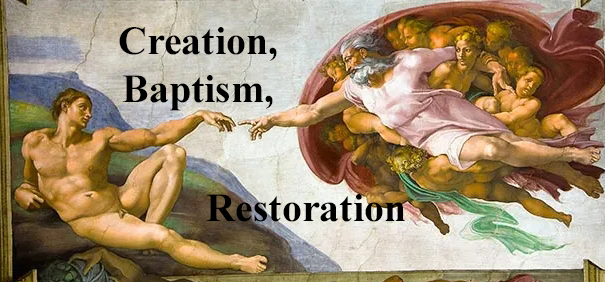
And so, it is unsurprising that the beginning of things, weddings, births, boot camps, elections, and other “firsts” are memorable enough to become our anchors. And, as believers in God, and in Jesus Christ, and as a church, one of our common anchors lies in the creation of the world. Even if you do not believe in a literal creation and subscribe to something more akin to eons of evolution, as a follower of God, the creation story of Genesis still holds a special place and value. But why is it a topic today, as we celebrate Trinity Sunday? What is the connection to the trinity that is so strong, and so special, that we are invited to read, and remember, the entire first chapter of Genesis? I honestly wondered about the same thing, and did a little study before I decided how much of it I was really going to use. But in the end, I decided that it was important, and I’ll explain why afterward. Reading from Genesis 1:1 – 2:4a, we hear this:
1:1 In the beginning God created the heavens and the earth. 2 Now the earth was formless and empty, darkness was over the surface of the deep, and the Spirit of God was hovering over the waters.
3 And God said, “Let there be light,” and there was light. 4 God saw that the light was good, and he separated the light from the darkness. 5 God called the light “day,” and the darkness he called “night.” And there was evening, and there was morning—the first day.
6 And God said, “Let there be a vault between the waters to separate water from water.” 7 So God made the vault and separated the water under the vault from the water above it. And it was so. 8 God called the vault “sky.” And there was evening, and there was morning—the second day.
9 And God said, “Let the water under the sky be gathered to one place, and let dry ground appear.” And it was so. 10 God called the dry ground “land,” and the gathered waters he called “seas.” And God saw that it was good.
11 Then God said, “Let the land produce vegetation: seed-bearing plants and trees on the land that bear fruit with seed in it, according to their various kinds.” And it was so. 12 The land produced vegetation: plants bearing seed according to their kinds and trees bearing fruit with seed in it according to their kinds. And God saw that it was good. 13 And there was evening, and there was morning—the third day.
14 And God said, “Let there be lights in the vault of the sky to separate the day from the night, and let them serve as signs to mark sacred times, and days and years, 15 and let them be lights in the vault of the sky to give light on the earth.” And it was so. 16 God made two great lights—the greater light to govern the day and the lesser light to govern the night. He also made the stars. 17 God set them in the vault of the sky to give light on the earth, 18 to govern the day and the night, and to separate light from darkness. And God saw that it was good. 19 And there was evening, and there was morning—the fourth day.
20 And God said, “Let the water teem with living creatures, and let birds fly above the earth across the vault of the sky.” 21 So God created the great creatures of the sea and every living thing with which the water teems and that moves about in it, according to their kinds, and every winged bird according to its kind. And God saw that it was good. 22 God blessed them and said, “Be fruitful and increase in number and fill the water in the seas, and let the birds increase on the earth.” 23 And there was evening, and there was morning—the fifth day.
24 And God said, “Let the land produce living creatures according to their kinds: the livestock, the creatures that move along the ground, and the wild animals, each according to its kind.” And it was so. 25 God made the wild animals according to their kinds, the livestock according to their kinds, and all the creatures that move along the ground according to their kinds. And God saw that it was good.
26 Then God said, “Let us make mankind in our image, in our likeness, so that they may rule over the fish in the sea and the birds in the sky, over the livestock and all the wild animals, and over all the creatures that move along the ground.”
27 So God created mankind in his own image,
in the image of God he created them;
male and female he created them.
28 God blessed them and said to them, “Be fruitful and increase in number; fill the earth and subdue it. Rule over the fish in the sea and the birds in the sky and over every living creature that moves on the ground.”
29 Then God said, “I give you every seed-bearing plant on the face of the whole earth and every tree that has fruit with seed in it. They will be yours for food. 30 And to all the beasts of the earth and all the birds in the sky and all the creatures that move along the ground—everything that has the breath of life in it—I give every green plant for food.” And it was so.
31 God saw all that he had made, and it was very good. And there was evening, and there was morning—the sixth day.
2:1 Thus the heavens and the earth were completed in all their vast array.
2 By the seventh day God had finished the work he had been doing; so, on the seventh day he rested from all his work. 3 Then God blessed the seventh day and made it holy, because on it he rested from all the work of creating that he had done.
4 This is the account of the heavens and the earth when they were created, when the Lord God made the earth and the heavens.
As I mentioned, the first reason for remembering the creation story is simply because it is one of our most memorable and important anchors. But as we celebrate Trinity Sunday, and as we examine the story in light of our theological trinitarian beliefs, our understanding of Father, Son, and Holy Spirit, we can see them in the story as well. First, we see that the Spirit of God hovered over the waters of creation, and next we hear God the Father speak the universe into existence saying, “Let there be light.” But we also see Jesus. In this case, since this is a Jewish history, Jesus is not named, but to our understanding of the trinity, when we see a shift in verse six from God speaking “Let there he a vault between the waters…” and then God acting in verse seven “So, God made the vault and separated the water…” our understanding, as trinitarians, and from other passages in the New Testament, is that while God the Father speaks (in verse six), it is Jesus the son who acts as the agent of creation (in verse seven). As such, while several passages in the New Testament say that Jesus was present at the time of creation, this is how we understand his presence.
And even though the word “trinity” appears nowhere in scripture, it is this understanding of the trinity that then leads to Jesus’ instructions to the disciples in Matthew 28:16-20 that includes all three persons of God.
16 Then the eleven disciples went to Galilee, to the mountain where Jesus had told them to go. 17 When they saw him, they worshiped him; but some doubted. 18 Then Jesus came to them and said, “All authority in heaven and on earth has been given to me. 19 Therefore go and make disciples of all nations, baptizing them in the name of the Father and of the Son and of the Holy Spirit, 20 and teaching them to obey everything I have commanded you. And surely, I am with you always, to the very end of the age.”
As I mentioned, the word “trinity” does not appear in scripture, but since there are passages like this one, in which Jesus himself uses the phrase ‘Father, Son, and Holy Spirit,’ it didn’t take long for someone to start using a single word to describe it. But since nearly all of us here already believe in the trinity, and I doubt that I have persuaded anyone that did not, what’s the point? What is our goal? And for today we simply end with the Paul’s concluding words from his second letter to the church in Corinth in 2 Corinthians 13:11-13 as he wrote:
11 Finally, brothers and sisters, rejoice! Strive for full restoration, encourage one another, be of one mind, live in peace. And the God of love and peace will be with you.
12 Greet one another with a holy kiss. 13 All God’s people here send their greetings.
Paul was in Macedonia, and was writing to the church in Corinth, Greece, and his conclusion sends greetings to them from a people in another nation who would have otherwise been strangers, but who now, because of their faith, have become brothers and sisters who care about one another. But Paul also reminds the church that the goal, for all of them, is to move, even to struggle toward restoration. We can easily understand that Paul means that we should work to restore the relationship of ourselves, and the people around us, with God the Father, God the Son, and God the Holy Spirit. But because his conclusion also includes the greetings of the people in the church in Macedonia, it isn’t difficult for us to also understand that we should strive for reconciliation between one another, the people around us, and with the people of other nations. We are, in the end, all members of God’s creation. We should seek to encourage one another, be of one mind, and live in peace with all of humanity, but especially with all those who are members of God’s family and followers of Jesus Christ, regardless of their race or nation of birth.
Whenever we remember the unity of the trinity, Father, Son, and Holy Spirit, we should remember that we are also called to unity, to tell the world about the triune God, the message of the Gospel, and to live in peace with the people around us, with all those who share our faith, and with the people of the world.
Please LIKE and SHARE!
Click here to subscribe to Pastor John’s blog.
Click here if you would like to subscribe to Pastor John’s weekly messages.
Click here to visit Pastor John’s YouTube channel.
*You have been reading a message presented at Christ United Methodist Church on the date noted at the top of the first page. Rev. John Partridge is the pastor at Christ UMC in Alliance, Ohio. Duplication of this message is a part of our Media ministry, if you have received a blessing in this way, we would love to hear from you. Letters and donations in support of the Media ministry or any of our other projects may be sent to Christ United Methodist Church, 470 East Broadway Street, Alliance, Ohio 44601. These messages are available to any interested persons regardless of membership. You may subscribe to these messages, in print or electronic formats, by writing to the address noted, or by contacting us at secretary@CUMCAlliance.org. These messages can also be found online at https://pastorpartridge.com . All Scripture quotations, unless otherwise indicated, are taken from the Holy Bible, New International Version®, NIV®. Copyright ©1973, 1978, 1984, 2011 by Biblica, Inc.™ Used by permission of Zondervan. All rights reserved worldwide. www.zondervan.comThe “NIV” and “New International Version” are trademarks registered in the United States Patent and Trademark Office by Biblica, Inc.™