
Genesis 22:1-14 Matthew 10:40-42 Romans 6:12-23
This morning, I want to begin with two questions which are, in the end, really only one question.
First, what does it mean to surrender? Not the kind of tepid negotiated peace that we often see in modern political conflict, but the absolutely dominating peace that follows what is known as unconditional surrender. What sort of treatment would one expect, and what would it mean to surrender… unconditionally?
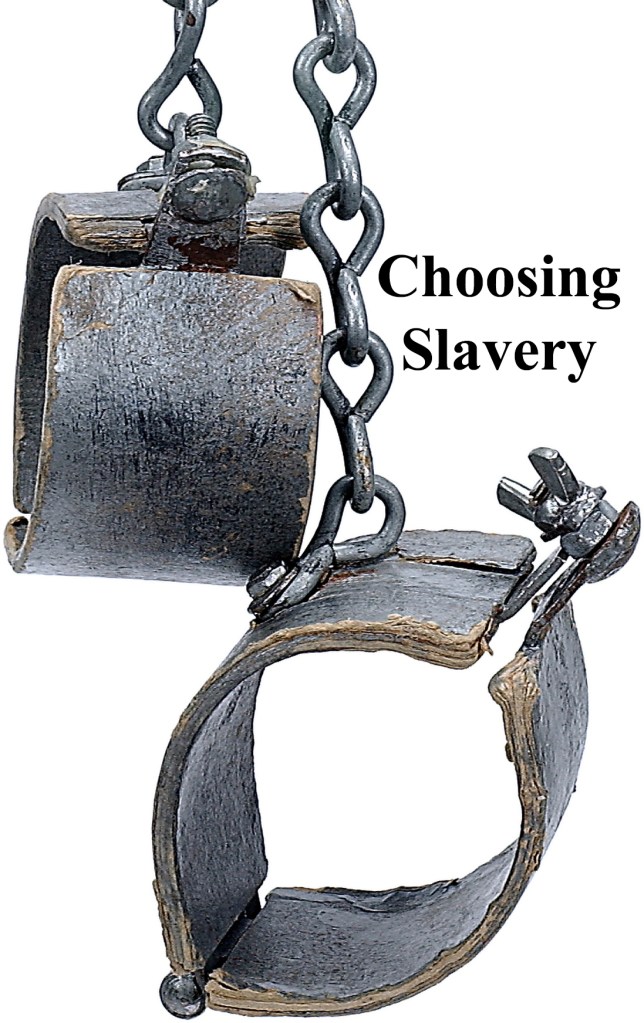
Second, under what conditions would you choose to become a slave? And again, I don’t mean the lighthearted sort of slavery that we see in high school fundraisers where you must do the bidding of an upperclassman for a day. I mean absolutely surrender your life, liberty, choice, and freedom for the rest of your natural life. As Americans, our national and cultural core clings to things like life, liberty, and the pursuit of happiness. But under what conditions would you give that all up?
This was not an uncommon choice in the ancient world. Remember that I have said that in places like Israel, as well as many others in the first century Roman world, approximately 90 percent of the population lived at a subsistence level of poverty. Subsistence level means that, while they may have owned land, or even possessed valuable skilled trades, they earned just enough to feed themselves and their families, and no more. They were, perpetually, one bad harvest or one bad debt from starvation. Worse, those persons to whom you owed money were entitled to recover what was owed from whatever personally belonged to you… including your life and your liberty, as well as that of your family.
And so, some people, faced with an insurmountable debt, might occasionally sell their freedom, possibly to someone that they knew would be a humane master, so that their debts would be paid and their family would not be sold along with them. At other times, there were historically recorded instances, when people would work to pay off a debt, more as indentured servants, and would then ask to become slaves to their employer so that they would not have the constant worry and fear of daily earning enough money to remain free. There were still other similar cases that involved romantic relationships between a free person and a slave in which the free person chose slavery so that they could stay together.
And so, as we read our scriptures for today, we find Abraham who, while not a slave, has a relationship with God that checks all the same boxes, we have a teaching from the Apostle Paul that insists that everyone is a slave, and there is a brief word from Jesus who explains how his followers should treat one another. While these may not seem to have a lot in common, bear with me and, hopefully, you will see how this all fits together. As I noted, we begin with the story of Abraham in Genesis 22:1-14, when God asks him to do something that, given the path that Abraham and Sarah traveled to parenthood, is absolutely inconceivable.
22:1 Some time later God tested Abraham. He said to him, “Abraham!”
“Here I am,” he replied.
2 Then God said, “Take your son, your only son, whom you love—Isaac—and go to the region of Moriah. Sacrifice him there as a burnt offering on a mountain I will show you.”
3 Early the next morning Abraham got up and loaded his donkey. He took with him two of his servants and his son Isaac. When he had cut enough wood for the burnt offering, he set out for the place God had told him about. 4 On the third day Abraham looked up and saw the place in the distance. 5 He said to his servants, “Stay here with the donkey while I and the boy go over there. We will worship and then we will come back to you.”
6 Abraham took the wood for the burnt offering and placed it on his son Isaac, and he himself carried the fire and the knife. As the two of them went on together, 7 Isaac spoke up and said to his father Abraham, “Father?”
“Yes, my son?” Abraham replied.
“The fire and wood are here,” Isaac said, “but where is the lamb for the burnt offering?”
8 Abraham answered, “God himself will provide the lamb for the burnt offering, my son.” And the two of them went on together.
9 When they reached the place God had told him about, Abraham built an altar there and arranged the wood on it. He bound his son Isaac and laid him on the altar, on top of the wood. 10 Then he reached out his hand and took the knife to slay his son. 11 But the angel of the Lord called out to him from heaven, “Abraham! Abraham!”
“Here I am,” he replied.
12 “Do not lay a hand on the boy,” he said. “Do not do anything to him. Now I know that you fear God, because you have not withheld from me your son, your only son.”
13 Abraham looked up and there in a thicket he saw a ram caught by its horns. He went over and took the ram and sacrificed it as a burnt offering instead of his son. 14 So Abraham called that place The Lord Will Provide. And to this day it is said, “On the mountain of the Lord it will be provided.”
God commands Abraham to take Isaac, his only son, who is, you will remember from last week, Abraham’s only son because Abraham was forced into an impossible position and compelled to divorce his wife Hagar and send both Hagar and his other son, Ishmael, away. And now, having done that, God commands Abraham to offer Isaac to God as a sacrifice on an altar on top of a mountain. And Abraham collects Isaac, and he goes. We don’t know what Abraham was thinking. I suspect that he didn’t tell Sarah where he was going, because this was Abraham’s test, and because I don’t think she would have let him go. But Abraham does tell his servants that “We will worship and then we will come back to you.” Abraham was fully committed to sacrificing Isaac but, at the same time, believed that, somehow, Isaac would be restored to him at the end of the day.
But, in the end, after being brought to the razor’s edge, where the knife was already aimed for his son, and Abraham completely ready and willing to take his life, God stops him and then says, “Now I know that you fear God.” This is God acknowledging that Abraham was completely sold out, completely surrendered to God. Abraham was, by all definitions, a slave to God who was willing to do absolutely anything that God commanded him to do.
Next, we come to the words of Jesus regarding welcome and hospitality in Matthew 10:40-42, that, at first, seem ridiculously out of place in a discussion about slavery, but if you bear with me, I think it will all fit together in the end. Jesus said:
40 “Anyone who welcomes you welcomes me, and anyone who welcomes me welcomes the one who sent me. 41 Whoever welcomes a prophet as a prophet will receive a prophet’s reward, and whoever welcomes a righteous person as a righteous person will receive a righteous person’s reward. 42 And if anyone gives even a cup of cold water to one of these little ones who is my disciple, truly I tell you, that person will certainly not lose their reward.”
And, once again, you are thinking that this is all about hospitality and cannot possibly have anything to do with slavery. I can understand that, because that’s what I was thinking the first several times that I read through these scriptures. But hold on to that, and I think you will understand how it fits in few minutes after we read Paul’s explanation of our own relationship to slavery in Romans 6:12-23 when he says:
12 Therefore do not let sin reign in your mortal body so that you obey its evil desires. 13 Do not offer any part of yourself to sin as an instrument of wickedness, but rather offer yourselves to God as those who have been brought from death to life; and offer every part of yourself to him as an instrument of righteousness. 14 For sin shall no longer be your master, because you are not under the law, but under grace.
15 What then? Shall we sin because we are not under the law but under grace? By no means! 16 Don’t you know that when you offer yourselves to someone as obedient slaves, you are slaves of the one you obey—whether you are slaves to sin, which leads to death, or to obedience, which leads to righteousness? 17 But thanks be to God that, though you used to be slaves to sin, you have come to obey from your heart the pattern of teaching that has now claimed your allegiance. 18 You have been set free from sin and have become slaves to righteousness.
19 I am using an example from everyday life because of your human limitations. Just as you used to offer yourselves as slaves to impurity and to ever-increasing wickedness, so now offer yourselves as slaves to righteousness leading to holiness. 20 When you were slaves to sin, you were free from the control of righteousness. 21 What benefit did you reap at that time from the things you are now ashamed of? Those things result in death! 22 But now that you have been set free from sin and have become slaves of God, the benefit you reap leads to holiness, and the result is eternal life. 23 For the wages of sin is death, but the gift of God is eternal life in Christ Jesus our Lord.
Paul explains that because we are now under the grace of Jesus Christ, we are no longer slaves to sin, and thus sin is no longer our master. But that means that we are now slaves to Jesus Christ because we have given ourselves to God and he has purchased us with the life of his son, Jesus. Moreover, Paul says that everyone that you know, whether they follow Jesus or not, is a slave to something because “you are slaves of the one you obey.” If we were not slaves to Jesus, we would be slaves to sin, wickedness, impurity, or pleasure, or money, or power, or influence, or charisma, or politics, or knowledge, or… something else. But because we have offered ourselves to Jesus, and because we have been rescued from sin and death, we are now slaves to God and slaves to Jesus Christ. As such we should be just as sold out, just as committed, and just as completely surrendered to the will of God as Abraham was.
And once we understand that then this also explains how we connect to Jesus’ words about hospitality that we read from the Gospel of Matthew. If we recognize that we are all slaves to Jesus Christ, then how can we not act hospitably and welcoming to others that also belong to him. Can you imagine that a slave owner would be pleased with one of his slaves mistreating another? It would follow that it would please a master for his slaves to care for one another and do everything in their power to encourage and equip them to do the work that the master had given them to do and not to discourage or impede them from doing it.
Just as Abraham was, we are called to be fully committed, sold out, and completely surrendered to the will of God just as if we were slaves to Jesus. And having accepted Jesus as our master, then we must not only do everything we can, with all that we are, to accomplish the work that he has given us to do, but we must also welcome others who follow him, and do whatever we can to aid them in doing his work as well.
*You have been reading a message presented at Christ United Methodist Church on the date noted at the top of the first page. Rev. John Partridge is the pastor at Christ UMC in Alliance, Ohio. Duplication of this message is a part of our Media ministry, if you have received a blessing in this way, we would love to hear from you. Letters and donations in support of the Media ministry or any of our other projects may be sent to Christ United Methodist Church, 470 East Broadway Street, Alliance, Ohio 44601. These messages are available to any interested persons regardless of membership. You may subscribe to these messages, in print or electronic formats, by writing to the address noted, or by contacting us at secretary@CUMCAlliance.org. These messages can also be found online at https://pastorpartridge.com . All Scripture quotations, unless otherwise indicated, are taken from the Holy Bible, New International Version®, NIV®. Copyright ©1973, 1978, 1984, 2011 by Biblica, Inc.™ Used by permission of Zondervan. All rights reserved worldwide. www.zondervan.comThe “NIV” and “New International Version” are trademarks registered in the United States Patent and Trademark Office by Biblica, Inc.™

