Exodus 20:1-4, 7-9, 12-20 Matthew 21:33-46 Philippians 3:4b-14
Long before I ever heard a call to ministry, I was persuaded to co-teach a new Sunday school class at our church for a bunch of us who felt like we just did not “fit” into either of the two existing adult classes. Brian Baer and I shared the responsibility for teaching because he was occasionally required to travel for work, and although I travelled regularly, I was usually, but not always, home on weekends. And so, we had an arrangement that if Brian was teaching and got called away, he would leave our study guide on the table with a bookmark where we had left off, and I would pick it up in Sunday morning and continue. And if I was traveling, the reverse was true. In any case, during that period, one of the lessons that Brian taught struck a chord with me and has stayed with me ever since.
The title of the reading for the week in question was, “Just a thimble-full of God, please.” What the study described was a fire hose sized faucet or Niagara Falls from which believers would receive blessings from God. Such a faucet could pour out the Spirit of God and God’s blessings in unimaginable abundance. And yet, too many believers came to that spigot carrying only thimble and asking God only for a tiny blessing instead because they were afraid that to ask God for more would mean that God’s abundant blessing might cause them change something about the way that they lived. Too many of us would rather live on a starvation ration of God’s blessing, receiving a thimbleful at a time, rather than being immersed in God’s abundance and risk whatever a deeper relationship might require of us.
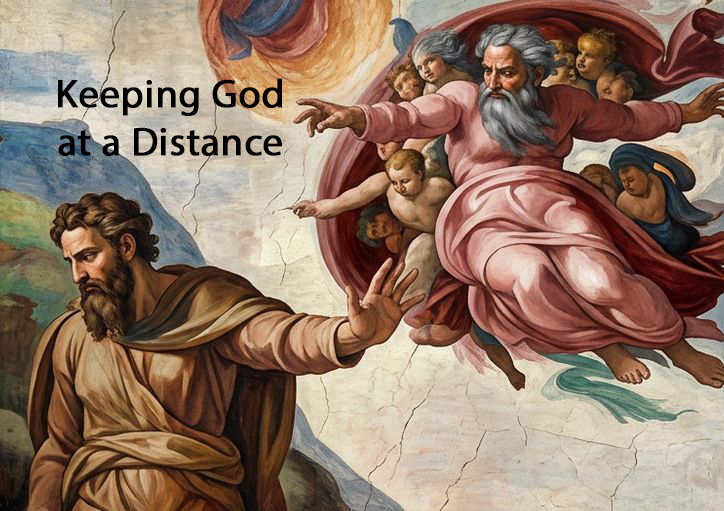
Too often we think of God’s arrival on earth through Jesus Christ as a sort of kindly visitation, like having an old friend over for tea and scones. But that is not the picture that scripture paints for us. Rather than sharing a table for tea, the arrival of Jesus on earth is described as something more akin to a beachhead at Normandy at the invasion of France. Jesus’ arrival on earth is the beginning of God’s invasion to take back the world from the control of Satan, and the business of his church is to capture as much territory and save as many people as we possibly can. None of that fits into the idea that we have of sharing a quiet cup of tea. But the calmer image, much like the image of a “thimbleful of God” allows us to keep God at arm’s length and not get so close that something might be required of us. This isn’t new. We see this same image early in scripture and we find it as we continue reading the story of Exodus in Exodus 20:1-4, 7-9, 12-20 where it says:
20:1 And God spoke all these words:
2 “I am the Lord your God, who brought you out of Egypt, out of the land of slavery.
3 “You shall have no other gods before me.
4 “You shall not make for yourself an image in the form of anything in heaven above or on the earth beneath or in the waters below.
7 “You shall not misuse the name of the Lord your God, for the Lord will not hold anyone guiltless who misuses his name.
8 “Remember the Sabbath day by keeping it holy. 9 Six days you shall labor and do all your work,
12 “Honor your father and your mother, so that you may live long in the land the Lord your God is giving you.
13 “You shall not murder.
14 “You shall not commit adultery.
15 “You shall not steal.
16 “You shall not give false testimony against your neighbor.
17 “You shall not covet your neighbor’s house. You shall not covet your neighbor’s wife, or his male or female servant, his ox or donkey, or anything that belongs to your neighbor.”
18 When the people saw the thunder and lightning and heard the trumpet and saw the mountain in smoke, they trembled with fear. They stayed at a distance 19 and said to Moses, “Speak to us yourself and we will listen. But do not have God speak to us or we will die.”
20 Moses said to the people, “Do not be afraid. God has come to test you, so that the fear of God will be with you to keep you from sinning.”
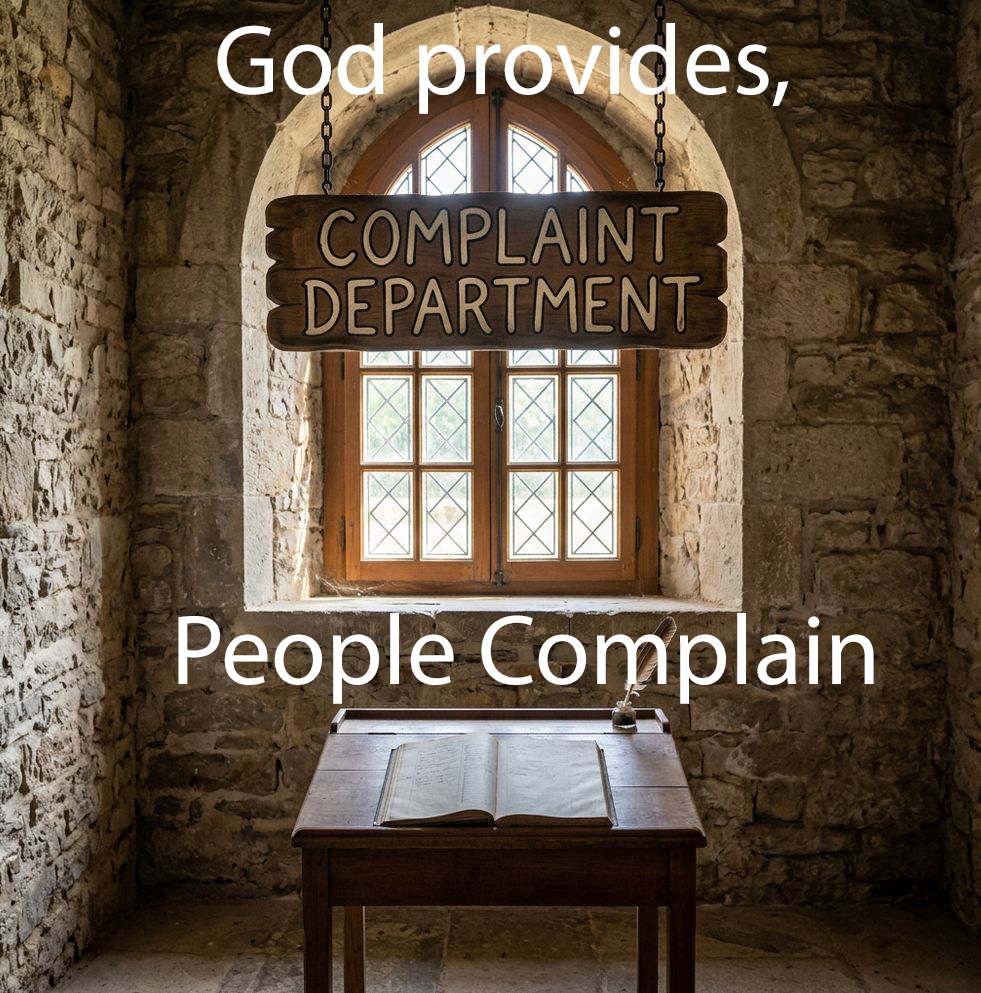
We are all familiar with the ten commandments, but what I find interesting considering today’s discussion is that no one had any issue with God laying down some rules. No one complained about God restricting their freedom or anything else. The thing with which people took issue was in meeting God personally. They told Moses that the rules were okay, but they wanted to use Moses to meet God so they didn’t have to it themselves, so they could keep God at arm’s length, and insulate them from God’s presence. But Moses sees through their maneuvering, understands that the root of their negotiations was fear, and says, “Do not be afraid.” God’s purpose was to equip the people to live in such a way that sin would not be so easy and automatic.
But there is danger is keeping God at a distance. As we read the story of the landowner and his vineyard in Matthew 21:33-46, we see how doing so can affect our attitudes toward God. Jesus said:
33 “Listen to another parable: There was a landowner who planted a vineyard. He put a wall around it, dug a winepress in it, and built a watchtower. Then he rented the vineyard to some farmers and moved to another place. 34 When the harvest time approached, he sent his servants to the tenants to collect his fruit.
35 “The tenants seized his servants; they beat one, killed another, and stoned a third. 36 Then he sent other servants to them, more than the first time, and the tenants treated them the same way. 37 Last of all, he sent his son to them. ‘They will respect my son,’ he said.
38 “But when the tenants saw the son, they said to each other, ‘This is the heir. Come, let’s kill him and take his inheritance.’ 39 So they took him and threw him out of the vineyard and killed him.
40 “Therefore, when the owner of the vineyard comes, what will he do to those tenants?”
41 “He will bring those wretches to a wretched end,” they replied, “and he will rent the vineyard to other tenants, who will give him his share of the crop at harvest time.”
42 Jesus said to them, “Have you never read in the Scriptures:
“‘The stone the builders rejected
has become the cornerstone;
the Lord has done this,
and it is marvelous in our eyes’?
43 “Therefore, I tell you that the kingdom of God will be taken away from you and given to a people who will produce its fruit. 44 Anyone who falls on this stone will be broken to pieces; anyone on whom it falls will be crushed.”
45 When the chief priests and the Pharisees heard Jesus’ parables, they knew he was talking about them. 46 They looked for a way to arrest him, but they were afraid of the crowd because the people held that he was a prophet.
We know that the landowner in the story is God. He plants a vineyard, builds a winepress, a wall, and a watchtower, and then rents the whole thing out so that someone else can reap the harvest and return a little back to the builder. But the tenants hadn’t seen him for a long time. It may have been for a season, but it may have been several years if it took a while for the vines to mature enough to produce fruit. In any case, the rent was due. And rather than collecting a monthly or yearly rent at a flat rate, even while the vines were not producing grapes, the rent was due as a percentage of the crop.
But when servants of the landowner arrive to collect the rent, the renters act as if they own the land. The landowner had been distant for so long, they felt justified in treating the landowner’s servants as if they were trespassers, or worse. And then, when the landowner’s son comes, they threw him out and killed him. The story is obviously outrageous. But one might imagine that, at this point, the renters assumed that the landowner had been gone for so long that he was never coming back and that they could do whatever they wanted. Because the landowner had been distant from the renters for so long, they made assumptions that were totally wrong.
And speaking as someone who had dedicated their life to being a Pharisee, Paul understood exactly what those wrong assumptions looked like from the inside. But Paul’s assumptions got scrambled, thrown out, and rewritten when he met Jesus on the road to persecute Christians in Damascus and he explains what the realignment of his values looked like in Philippians 3:4b-14 as he writes to the church in Philippi, Greece saying:
If someone else thinks they have reasons to put confidence in the flesh, I have more: 5 circumcised on the eighth day, of the people of Israel, of the tribe of Benjamin, a Hebrew of Hebrews; in regard to the law, a Pharisee; 6 as for zeal, persecuting the church; as for righteousness based on the law, faultless.
7 But whatever were gains to me I now consider loss for the sake of Christ. 8 What is more, I consider everything a loss because of the surpassing worth of knowing Christ Jesus my Lord, for whose sake I have lost all things. I consider them garbage, that I may gain Christ 9 and be found in him, not having a righteousness of my own that comes from the law, but that which is through faith in Christ—the righteousness that comes from God on the basis of faith. 10 I want to know Christ—yes, to know the power of his resurrection and participation in his sufferings, becoming like him in his death, 11 and so, somehow, attaining to the resurrection from the dead.
12 Not that I have already obtained all this, or have already arrived at my goal, but I press on to take hold of that for which Christ Jesus took hold of me. 13 Brothers and sisters, I do not consider myself yet to have taken hold of it. But one thing I do: Forgetting what is behind and straining toward what is ahead, 14 I press on toward the goal to win the prize for which God has called me heavenward in Christ Jesus.
Paul says that he threw out his entire value system and everything that he once built his life upon he now considers worth less than garbage. Instead, he has found that following Jesus is so incredibly valuable, that nothing he had before can even come close. Any goodness that we have in the eyes of God comes only from our faith in Jesus Christ and not because of anything that we have done, and not because of how well we were able to follow the rules. But, Paul says, “I press on to take hold of that for which Christ Jesus took hold of me.” God has called us to follow him for a reason. God has a purpose and a mission for each one of us. The birth of Jesus Christ was the beachhead upon which God was invading the world and our mission is to take back control from God’s enemies, capture as much territory as possible, and save as many people as we possibly can.
God never intended for us to keep him distant at arm’s length so that we could forget who he was. Jesus’ arrival on earth was a reminder to us that God is present in the here and now and his spirit has taken up residence within each one of us. We can’t subcontract our faith. God would not allow the people of Isreal to make Moses a spiritual intermediary, and neither can we use pastors to insulate us from getting close to God. With the coming of Jesus, and his sending of the Spirit of God at Pentecost, our relationship with God is as personal as it could possibly be.
God cannot be kept at a distance or at arm’s length.
Each one of us has a calling and a mission to advance the kingdom of God.
We must do whatever is possible to change the world, capture territory from the enemy, and save as many people as we possibly can.
And neither Moses, nor your pastor, can do the work that God has called you to do.
*You have been reading a message presented at Christ United Methodist Church on the date noted at the top of the first page. Rev. John Partridge is the pastor at Christ UMC in Alliance, Ohio. Duplication of this message is a part of our Media ministry, if you have received a blessing in this way, we would love to hear from you. Letters and donations in support of the Media ministry or any of our other projects may be sent to Christ United Methodist Church, 470 East Broadway Street, Alliance, Ohio 44601. These messages are available to any interested persons regardless of membership. You may subscribe to these messages, in print or electronic formats, by writing to the address noted, or by contacting us at secretary@CUMCAlliance.org. These messages can also be found online at https://pastorpartridge.com . All Scripture quotations, unless otherwise indicated, are taken from the Holy Bible, New International Version®, NIV®. Copyright ©1973, 1978, 1984, 2011 by Biblica, Inc.™ Used by permission of Zondervan. All rights reserved worldwide. www.zondervan.comThe “NIV” and “New International Version” are trademarks registered in the United States Patent and Trademark Office by Biblica, Inc.™