
Exodus 16:2-15 Matthew 20:1-16 Philippians 1:21-30
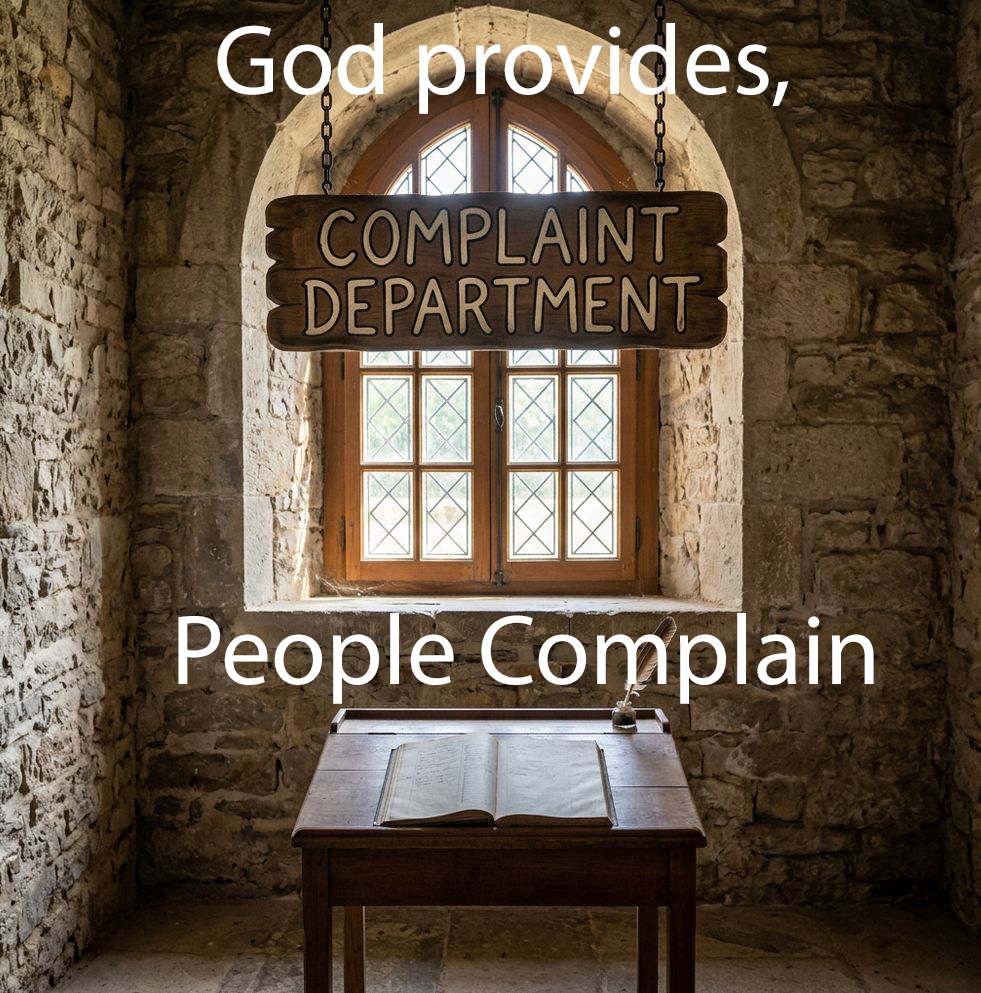
It is said that the only things in life that are certain are death and taxes. But, in my own experience, I suggest that there is a third certainty in any situation that involves humans, and that is… complaining. At every employer for which I have worked, including churches, regardless of how bad or how well, things were going there at the time, if you listened, pretty much everyone had something that they could, and often would, complain about. There is both humor and tragedy in that, and we can, with certainty, know that this is not simply a recent, or even a cultural development, but something that is common to all of humanity throughout time. As proof, we return to the story of the people of Israel 45 days after God freed them from their captivity in Egypt, and probably not long after God parted the waters of the Red Sea and destroyed the Army of Egypt that sought to recapture them. As we return to the story in Exodus 16:2-15, we hear this:
16:1 The whole Israelite community set out from Elim and came to the Desert of Sin, which is between Elim and Sinai, on the fifteenth day of the second month after they had come out of Egypt. 2 In the desert the whole community grumbled against Moses and Aaron. 3 The Israelites said to them, “If only we had died by the Lord’s hand in Egypt! There we sat around pots of meat and ate all the food we wanted, but you have brought us out into this desert to starve this entire assembly to death.”
4 Then the Lord said to Moses, “I will rain down bread from heaven for you. The people are to go out each day and gather enough for that day. In this way I will test them and see whether they will follow my instructions. 5 On the sixth day they are to prepare what they bring in, and that is to be twice as much as they gather on the other days.”
6 So Moses and Aaron said to all the Israelites, “In the evening you will know that it was the Lord who brought you out of Egypt, 7 and in the morning, you will see the glory of the Lord, because he has heard your grumbling against him. Who are we, that you should grumble against us?” 8 Moses also said, “You will know that it was the Lord when he gives you meat to eat in the evening and all the bread you want in the morning, because he has heard your grumbling against him. Who are we? You are not grumbling against us, but against the Lord.”
9 Then Moses told Aaron, “Say to the entire Israelite community, ‘Come before the Lord, for he has heard your grumbling.’”
10 While Aaron was speaking to the whole Israelite community, they looked toward the desert, and there was the glory of the Lord appearing in the cloud.
11 The Lord said to Moses, 12 “I have heard the grumbling of the Israelites. Tell them, ‘At twilight you will eat meat, and in the morning, you will be filled with bread. Then you will know that I am the Lord your God.’”
13 That evening quail came and covered the camp, and in the morning, there was a layer of dew around the camp. 14 When the dew was gone, thin flakes like frost on the ground appeared on the desert floor. 15 When the Israelites saw it, they said to each other, “What is it?” For they did not know what it was.
Moses said to them, “It is the bread the Lord has given you to eat. 16 This is what the Lord has commanded: ‘Everyone is to gather as much as they need. Take an omer [about three pounds] for each person you have in your tent.’”
17 The Israelites did as they were told; some gathered much, some little. 18 And when they measured it by the omer, the one who gathered much did not have too much, and the one who gathered little did not have too little. Everyone had gathered just as much as they needed.
No sooner had God rescued them, and they stopped running for their lives, God’s people started complaining. As many of us have done, they minimized the negative and exaggerated the positive. In this case, they immediately minimized the suffering that they had endured at the hands of the Egyptians and exaggerated the abundance that they had, complaining that, as slaves, they had pots full of meant and all the food they could eat. And so, God decided to test the people of Israel by providing them with food to eat in the form of quail in the evening, and thin flakes of bread that they called manna, which literally means “What is it?”
Our next example is a story that Jesus told as an example of what God’s kingdom is like in Matthew 20:1-16. Jesus said:
20:1 “For the kingdom of heaven is like a landowner who went out early in the morning to hire workers for his vineyard. 2 He agreed to pay them a denarius for the day and sent them into his vineyard.
3 “About nine in the morning he went out and saw others standing in the marketplace doing nothing. 4 He told them, ‘You also go and work in my vineyard, and I will pay you whatever is right.’ 5 So they went.
“He went out again about noon and about three in the afternoon and did the same thing. 6 About five in the afternoon he went out and found still others standing around. He asked them, ‘Why have you been standing here all day long doing nothing?’
7 “‘Because no one has hired us,’ they answered.
“He said to them, ‘You also go and work in my vineyard.’
8 “When evening came, the owner of the vineyard said to his foreman, ‘Call the workers and pay them their wages, beginning with the last ones hired and going on to the first.’
9 “The workers who were hired about five in the afternoon came and each received a denarius. 10 So, when those came who were hired first, they expected to receive more. But each one of them also received a denarius. 11 When they received it, they began to grumble against the landowner. 12 ‘These who were hired last worked only one hour,’ they said, and you have made them equal to us who have borne the burden of the work and the heat of the day.’
13 “But he answered one of them, ‘I am not being unfair to you, friend. Didn’t you agree to work for a denarius? 14 Take your pay and go. I want to give the one who was hired last, the same as I gave you. 15 Don’t I have the right to do what I want with my own money? Or are you envious because I am generous?’
16 “So, the last will be first, and the first will be last.”
Since this is a story that describes the kingdom of heaven, we can understand that the landowner in the story is God himself. And as Jesus tells the story, he is well aware that the nature of human beings is to complain, even when God is honoring his promises, doing good things, and benefiting everyone involved. In the story, each worker is given exactly what they were promised, and yet they complain that the workers who were hired early in the day were paid unfairly.
In both the example from Exodus and from Jesus’ own story explaining what God’s kingdom is like, what we find is that even when God provides for his people, they will still find a way to complain about it. But in both cases, the example is given not to tell us that complaining is acceptable and normal, but that even though it is common, it is inappropriate, rude, and ungrateful. But if that is the case, then what is the right way to respond to God’s generosity and how we live our lives? And that is exactly what Paul explains to the church on Philippi as we read from Philippians 1:21-30.
21 For to me, to live is Christ and to die is gain. 22 If I am to go on living in the body, this will mean fruitful labor for me. Yet what shall I choose? I do not know! 23 I am torn between the two: I desire to depart and be with Christ, which is better by far; 24 but it is more necessary for you that I remain in the body. 25 Convinced of this, I know that I will remain, and I will continue with all of you for your progress and joy in the faith, 26 so that through my being with you again your boasting in Christ Jesus will abound on account of me.
27 Whatever happens, conduct yourselves in a manner worthy of the gospel of Christ. Then, whether I come and see you or only hear about you in my absence, I will know that you stand firm in the one Spirit, striving together as one for the faith of the gospel 28 without being frightened in any way by those who oppose you. This is a sign to them that they will be destroyed, but that you will be saved – and that by God. 29 For it has been granted to you on behalf of Christ not only to believe in him, but also to suffer for him, 30 since you are going through the same struggle you saw I had, and now hear that I still have.
Paul says that although he lives in Christ and is able to do fruitful labor for God as he does so, he would gain from death because he would go to live with Jesus in the kingdom of God. That said, he knew that his life was a benefit to church so that the people could grow in Christ because of his words and actions. But Paul notes that the people of the church should conduct themselves in a manner that was worthy of the gospel of Jesus Christ no matter what circumstance, good or bad, that they found themselves in. Paul desired that the people of the church would stand firm in their faith, work together in unity, and not be frightened by anyone who might oppose or stand against them. Paul said that even though we have been called to believe in Jesus Christ, we have also been called to suffer and struggle for him.
Life isn’t always going to be perfect, and it isn’t always going to be neat and tidy. Sometimes it is going to be uncomfortable, sometimes, we will suffer, and sometimes life will be messy. But in each case, complaining about God’s choices and God’s provision is not the best choice. Although we all know that complaining is a deep-seated part of our humanity, it does not contribute to our growth. Worse, complaining about God’s provision is, rude, ungrateful, and inappropriate.
No matter what we face in life, regardless of whether we are showered with blessings, or whether we struggle and suffer, our calling is to stand together in unity, do the work that God has set before us, stand firm in our faith, and live lives that are worthy of Jesus and the gift of life that he has given to us.
Please LIKE and SHARE!
Click here to subscribe to Pastor John’s blog.
Click here if you would like to subscribe to Pastor John’s weekly messages.
Click here to visit Pastor John’s YouTube channel.
*You have been reading a message presented at Christ United Methodist Church on the date noted at the top of the first page. Rev. John Partridge is the pastor at Christ UMC in Alliance, Ohio. Duplication of this message is a part of our Media ministry, if you have received a blessing in this way, we would love to hear from you. Letters and donations in support of the Media ministry or any of our other projects may be sent to Christ United Methodist Church, 470 East Broadway Street, Alliance, Ohio 44601. These messages are available to any interested persons regardless of membership. You may subscribe to these messages, in print or electronic formats, by writing to the address noted, or by contacting us at secretary@CUMCAlliance.org. These messages can also be found online at https://pastorpartridge.com . All Scripture quotations, unless otherwise indicated, are taken from the Holy Bible, New International Version®, NIV®. Copyright ©1973, 1978, 1984, 2011 by Biblica, Inc.™ Used by permission of Zondervan. All rights reserved worldwide. www.zondervan.comThe “NIV” and “New International Version” are trademarks registered in the United States Patent and Trademark Office by Biblica, Inc.™

