
Exodus 14:19-31 Matthew 18:21-35 Romans 14:1-12
Throughout history, there are times that are referred to as inflection points, times in which culture, society, attitudes, values, or other things suddenly make a change from the line, or arc, that they had previously been following in a predictable way. It isn’t always obvious, but years later, these can be moments toward which everyone points and recognizes at the time when everything changed. The time in which we live today might well be one of those times. As we watch the evening news or scroll through our internet news feeds, we seem to see dramatic changes in the way that our nation values the lives of immigrants, people of faith, members of opposing political parties, or even anyone who disagrees with us. Moreover, changes in the way that we value the people around us are often triggered by how our political, religious, and other leaders speak about those groups of people, and how we then choose to judge their politics, morality, or faith. But as the followers of God, and as followers of Jesus Christ, we must be careful as we navigate the challenging waters of changing times because scripture has much to say about how we judge others and how God will, ultimately, judge us.
We begin this morning by examining a moment of judgement that we might have missed in a story that we have read dozens of times. We rejoin our story of Moses and the Exodus of God’s people from their captivity in Egypt. God parts the waters of the Red Sea, the people of Israel cross on dry land, and then there is a moment, an inflection point, when everything might have been different. We rejoin this story reading from Exodus 14:19-31 where it says:
19 Then the angel of God, who had been traveling in front of Israel’s army, withdrew and went behind them. The pillar of cloud also moved from in front and stood behind them, 20 coming between the armies of Egypt and Israel. Throughout the night the cloud brought darkness to the one side and light to the other side; so, neither went near the other all night long.
21 Then Moses stretched out his hand over the sea, and all that night the Lord drove the sea back with a strong east wind and turned it into dry land. The waters were divided, 22 and the Israelites went through the sea on dry ground, with a wall of water on their right and on their left.
23 The Egyptians pursued them, and all Pharaoh’s horses and chariots and horsemen followed them into the sea. 24 During the last watch of the night the Lord looked down from the pillar of fire and cloud at the Egyptian army and threw it into confusion. 25 He jammed the wheels of their chariots so that they had difficulty driving. And the Egyptians said, “Let’s get away from the Israelites! The Lord is fighting for them against Egypt.”
26 Then the Lord said to Moses, “Stretch out your hand over the sea so that the waters may flow back over the Egyptians and their chariots and horsemen.” 27 Moses stretched out his hand over the sea, and at daybreak the sea went back to its place. The Egyptians were fleeing toward it, and the Lord swept them into the sea. 28 The water flowed back and covered the chariots and horsemen—the entire army of Pharaoh that had followed the Israelites into the sea. Not one of them survived.
29 But the Israelites went through the sea on dry ground, with a wall of water on their right and on their left. 30 That day the Lord saved Israel from the hands of the Egyptians, and Israel saw the Egyptians lying dead on the shore. 31 And when the Israelites saw the mighty hand of the Lord displayed against the Egyptians, the people feared the Lord and put their trust in him and in Moses his servant.
Up until now, a pillar of clouds and fire and gone ahead of the people as they advanced through the wilderness. But when the army of Egypt traps them against the sea, the angel of God moves from offense to defense, withdraws from the front, and stands between the people of Israel and the army of Egypt. It is then that Moses stretches out his hand over the sea and God drives a path of dry land through the water on which Israel could cross. But this is also the moment when the soldiers of Egypt are given a choice, and it is a moment in which everything might have been different. It is at this moment that each soldier must know, as they face a tower of cloud that blocks their path, and when that tower of cloud becomes a tower of fire after the sun sets, and then again as they witness Israel’s God part the waters of the sea and watch the nation of Israel cross the sea on dry land. It is at this moment that they must know that Israel’s God is real, and powerful, and acting both to protect the people of Israel and to stand in defiance against the entire pantheon of the gods of Egypt. And so, knowing this, each soldier had a choice to make, each man had the chance to recognize the power of Israel’s God and could choose whether they would continue to their pursuit.
And the soldiers chose. To a man, they chose to continue their pursuit. Perhaps they feared what would happen to them if they disobeyed, or what Pharoah would do if they returned empty handed, but each soldier made a choice. And God judged them saying “to Moses, “Stretch out your hand over the sea so that the waters may flow back over the Egyptians and their chariots and horsemen.” But the people of Israel “feared the Lord and put their trust in him and in Moses his servant.”
But God has something to say about how we judge the people around us as well. This can be difficult for all of us, and it was an issue for the disciples of Jesus. Peter is uncertain about the whole concept of forgiveness and asks Jesus about it in Matthew 18:21-35 where we hear these words:
21 Then Peter came to Jesus and asked, “Lord, how many times shall I forgive my brother or sister who sins against me? Up to seven times?”
22 Jesus answered, “I tell you, not seven times, but seventy-seven times.
23 “Therefore, the kingdom of heaven is like a king who wanted to settle accounts with his servants. 24 As he began the settlement, a man who owed him ten thousand bags of gold was brought to him. 25 Since he was not able to pay, the master ordered that he and his wife and his children and all that he had be sold to repay the debt.
26 “At this the servant fell on his knees before him. ‘Be patient with me,’ he begged, ‘and I will pay back everything.’ 27 The servant’s master took pity on him, canceled the debt and let him go.
28 “But when that servant went out, he found one of his fellow servants who owed him a hundred silver coins. He grabbed him and began to choke him. ‘Pay back what you owe me!’ he demanded.
29 “His fellow servant fell to his knees and begged him, ‘Be patient with me, and I will pay it back.’
30 “But he refused. Instead, he went off and had the man thrown into prison until he could pay the debt. 31 When the other servants saw what had happened, they were outraged and went and told their master everything that had happened.
32 “Then the master called the servant in. ‘You wicked servant,’ he said, ‘I canceled all that debt of yours because you begged me to. 33 Shouldn’t you have had mercy on your fellow servant just as I had on you?’ 34 In anger his master handed him over to the jailers to be tortured, until he should pay back all he owed.
35 “This is how my heavenly Father will treat each of you unless you forgive your brother or sister from your heart.”
When Peter asks how many times Jesus requires us to forgive others, Jesus essentially says, “forever.” The comparison that Jesus draws, is to a man who has been forgiven a debt of ten thousand talents of gold. One talent was worth about twenty years wages. So, ten thousand talents, is about what the average laborer would earn if they worked for two hundred thousand years. It is an impossible number, and it is meant to be so. But that man, who has been forgiven an impossible debt, abuses and jails a fellow servant who owes him one hundred denarii, or a little more than three months wages. Not a small amount, but not anything approaching what the first man had already been forgiven.
It is this disparity that Jesus uses to illustrate the debt that we owe to God. The debt that we owe is impossible and unfathomable. And so, because God has forgiven us of so much, he commands us to be forgiving, forever, of whatever offenses we think have been committed by people around us. And the terrifying conclusion comes when Jesus says that our failure to forgive others will result in God withdrawing his forgiveness from us.
Paul has a similar conversation about judgment with the people of the church in Rome as we read from Romans 14:1-12 he says:
14:1 Accept the one whose faith is weak, without quarreling over disputable matters. 2 One person’s faith allows them to eat anything, but another, whose faith is weak, eats only vegetables. 3 The one who eats everything must not treat with contempt the one who does not, and the one who does not eat everything must not judge the one who does, for God has accepted them. 4 Who are you to judge someone else’s servant? To their own master, servants stand or fall. And they will stand, for the Lord is able to make them stand.
5 One person considers one day more sacred than another; another considers every day alike. Each of them should be fully convinced in their own mind. 6 Whoever regards one day as special does so to the Lord. Whoever eats meat does so to the Lord, for they give thanks to God; and whoever abstains does so to the Lord and gives thanks to God. 7 For none of us lives for ourselves alone, and none of us dies for ourselves alone. 8 If we live, we live for the Lord; and if we die, we die for the Lord. So, whether we live or die, we belong to the Lord. 9 For this very reason, Christ died and returned to life so that he might be the Lord of both the dead and the living.
10 You, then, why do you judge your brother or sister? Or why do you treat them with contempt? For we will all stand before God’s judgment seat. 11 It is written:
“‘As surely as I live,’ says the Lord,
‘every knee will bow before me;
every tongue will acknowledge God.’”
12 So then, each of us will give an account of ourselves to God.
Paul says that faith is different for each person. What offends you may not offend someone else, and something that you feel fits perfectly within your faith, might be offensive to someone else. But we cannot treat others with contempt, or stand in judgement of them just because their faith is different than ours, or because they are at a different place, and a different maturity, in their faith than we are. It doesn’t matter if they want to worship on Saturday, or on Sunday, or whether they rotate days, or whether they worship at all in a way that you think is appropriate. Whether we live or die, we belong to Jesus. Paul’s rhetorical question then becomes, ‘Why do you judge others and treat them with contempt when each of us will stand before God and answer for ourselves?’
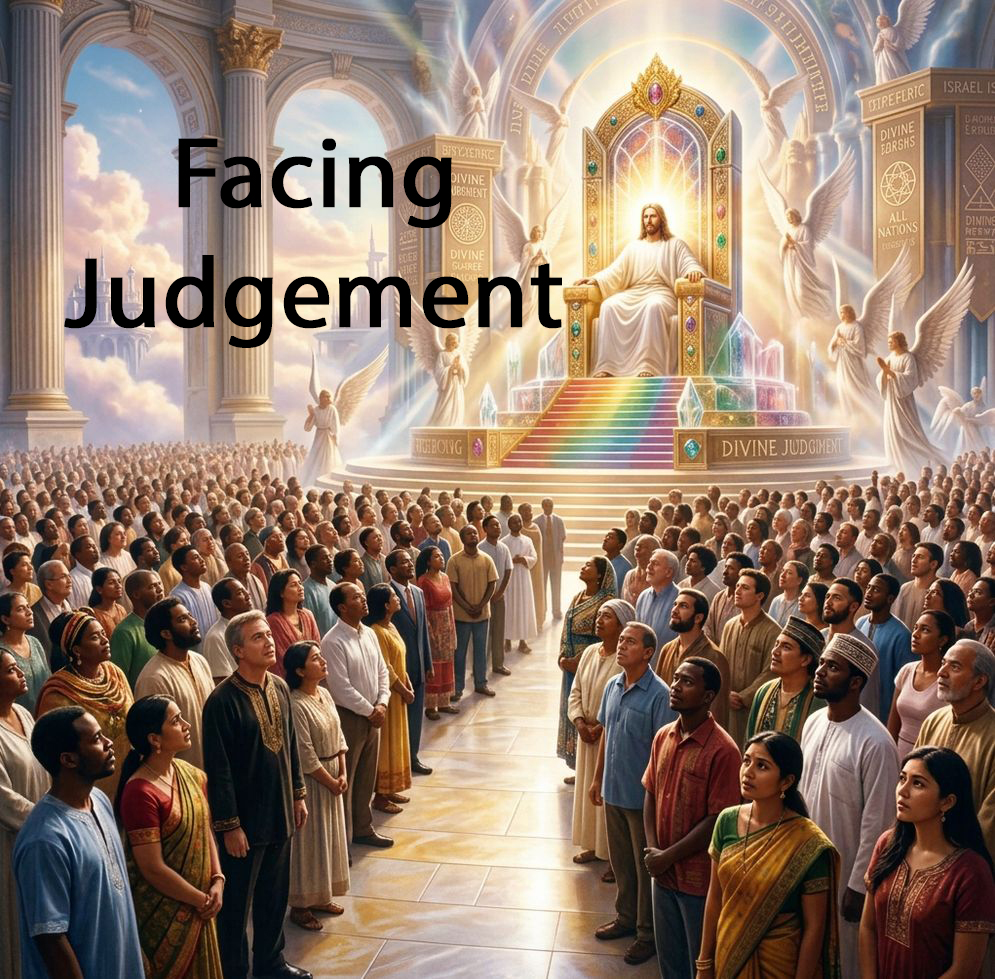
The conclusion reminds us of the story of Exodus and of Jesus’ words to the disciples. Whenever there is an inflection point, whenever we are faced with changes in our society, culture, morals, and values, we are reminded that each of us have the chance to make a choice for ourselves. We will not be judged for the sins of others, God will not ask us what sins were committed by our neighbors or the people around us, but we will answer for ourselves, and we will be judged for the sins that belong to us alone.
And that is more than enough to keep you awake at night.
There’s no need for any of us to stand in judgement of others because their faith is different than ours, or because they sin differently than we do. Instead, our calling is to forgive the people around us, forever, seventy times seven, and live a life a grace that looks so much like Jesus that others will be drawn to his light.
That’s more than enough, that’s difficult enough.
There’s no need to pile anything else on top of it.
Please LIKE and SHARE!
Click here to subscribe to Pastor John’s blog.
Click here if you would like to subscribe to Pastor John’s weekly messages.
Click here to visit Pastor John’s YouTube channel.
*You have been reading a message presented at Christ United Methodist Church on the date noted at the top of the first page. Rev. John Partridge is the pastor at Christ UMC in Alliance, Ohio. Duplication of this message is a part of our Media ministry, if you have received a blessing in this way, we would love to hear from you. Letters and donations in support of the Media ministry or any of our other projects may be sent to Christ United Methodist Church, 470 East Broadway Street, Alliance, Ohio 44601. These messages are available to any interested persons regardless of membership. You may subscribe to these messages, in print or electronic formats, by writing to the address noted, or by contacting us at secretary@CUMCAlliance.org. These messages can also be found online at https://pastorpartridge.com . All Scripture quotations, unless otherwise indicated, are taken from the Holy Bible, New International Version®, NIV®. Copyright ©1973, 1978, 1984, 2011 by Biblica, Inc.™ Used by permission of Zondervan. All rights reserved worldwide. www.zondervan.comThe “NIV” and “New International Version” are trademarks registered in the United States Patent and Trademark Office by Biblica, Inc.™

