
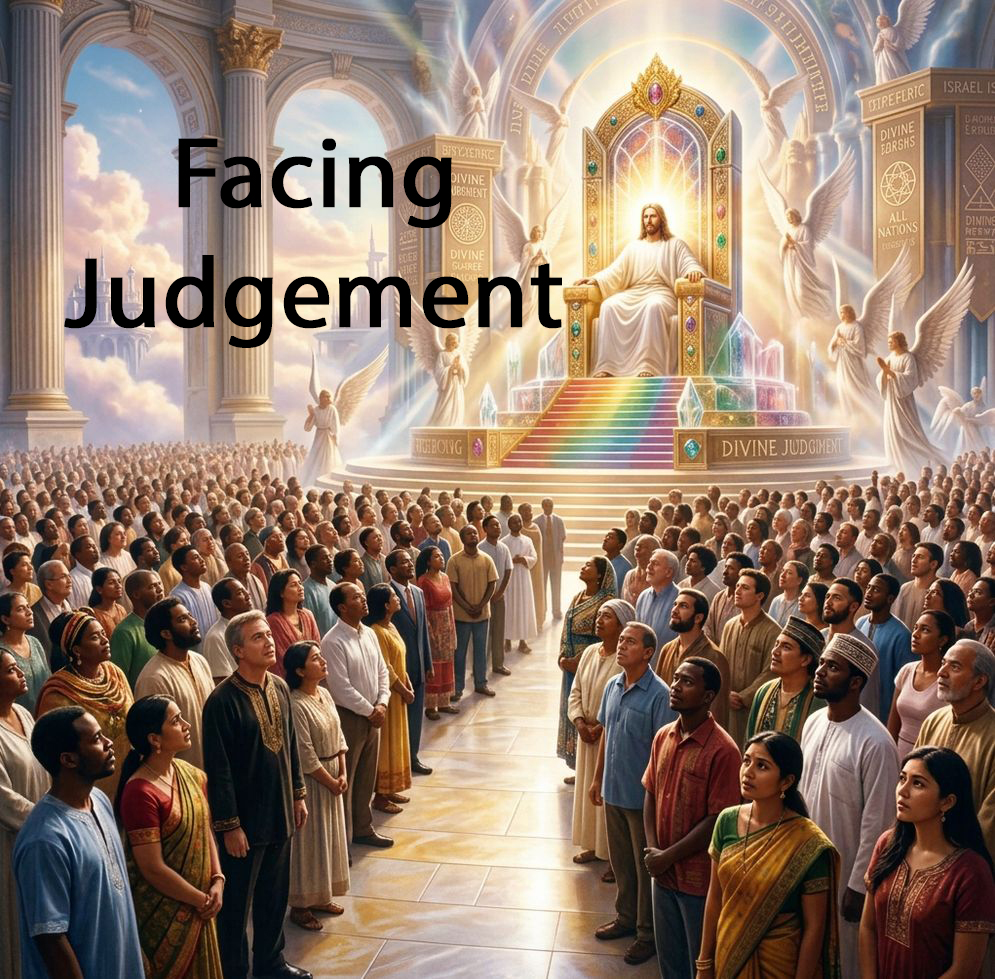
Facing Judgement

Facing Judgement

September 13, 2026*

By Pastor John Partridge

Exodus 14:19-31        Matthew 18:21-35                 Romans 14:1-12

Throughout history, there are times that are referred to as inflection points, times in which culture, society, attitudes, values, or other things suddenly make a change from the line, or arc, that they had previously been following in a predictable way. It isn’t always obvious, but years later, these can be moments toward which everyone points and recognizes at the time when everything changed. The time in which we live today might well be one of those times. As we watch the evening news or scroll through our internet news feeds, we seem to see dramatic changes in the way that our nation values the lives of immigrants, people of faith, members of opposing political parties, or even anyone who disagrees with us. Moreover, changes in the way that we value the people around us are often triggered by how our political, religious, and other leaders speak about those groups of people, and how we then choose to judge their politics, morality, or faith. But as the followers of God, and as followers of Jesus Christ, we must be careful as we navigate the challenging waters of changing times because scripture has much to say about how we judge others and how God will, ultimately, judge us.

We begin this morning by examining a moment of judgement that we might have missed in a story that we have read dozens of times. We rejoin our story of Moses and the Exodus of God’s people from their captivity in Egypt. God parts the waters of the Red Sea, the people of Israel cross on dry land, and then there is a moment, an inflection point, when everything might have been different. We rejoin this story reading from Exodus 14:19-31 where it says:

19 Then the angel of God, who had been traveling in front of Israel’s army, withdrew and went behind them. The pillar of cloud also moved from in front and stood behind them, 20 coming between the armies of Egypt and Israel. Throughout the night the cloud brought darkness to the one side and light to the other side; so, neither went near the other all night long.

21 Then Moses stretched out his hand over the sea, and all that night the Lord drove the sea back with a strong east wind and turned it into dry land. The waters were divided, 22 and the Israelites went through the sea on dry ground, with a wall of water on their right and on their left.

23 The Egyptians pursued them, and all Pharaoh’s horses and chariots and horsemen followed them into the sea. 24 During the last watch of the night the Lord looked down from the pillar of fire and cloud at the Egyptian army and threw it into confusion. 25 He jammed the wheels of their chariots so that they had difficulty driving. And the Egyptians said, “Let’s get away from the Israelites! The Lord is fighting for them against Egypt.”

26 Then the Lord said to Moses, “Stretch out your hand over the sea so that the waters may flow back over the Egyptians and their chariots and horsemen.” 27 Moses stretched out his hand over the sea, and at daybreak the sea went back to its place. The Egyptians were fleeing toward it, and the Lord swept them into the sea. 28 The water flowed back and covered the chariots and horsemen—the entire army of Pharaoh that had followed the Israelites into the sea. Not one of them survived.

29 But the Israelites went through the sea on dry ground, with a wall of water on their right and on their left. 30 That day the Lord saved Israel from the hands of the Egyptians, and Israel saw the Egyptians lying dead on the shore. 31 And when the Israelites saw the mighty hand of the Lord displayed against the Egyptians, the people feared the Lord and put their trust in him and in Moses his servant.

Up until now, a pillar of clouds and fire and gone ahead of the people as they advanced through the wilderness. But when the army of Egypt traps them against the sea, the angel of God moves from offense to defense, withdraws from the front, and stands between the people of Israel and the army of Egypt. It is then that Moses stretches out his hand over the sea and God drives a path of dry land through the water on which Israel could cross. But this is also the moment when the soldiers of Egypt are given a choice, and it is a moment in which everything might have been different. It is at this moment that each soldier must know, as they face a tower of cloud that blocks their path, and when that tower of cloud becomes a tower of fire after the sun sets, and then again as they witness Israel’s God part the waters of the sea and watch the nation of Israel cross the sea on dry land. It is at this moment that they must know that Israel’s God is real, and powerful, and acting both to protect the people of Israel and to stand in defiance against the entire pantheon of the gods of Egypt. And so, knowing this, each soldier had a choice to make, each man had the chance to recognize the power of Israel’s God and could choose whether they would continue to their pursuit.

And the soldiers chose. To a man, they chose to continue their pursuit. Perhaps they feared what would happen to them if they disobeyed, or what Pharoah would do if they returned empty handed, but each soldier made a choice. And God judged them saying “to Moses, “Stretch out your hand over the sea so that the waters may flow back over the Egyptians and their chariots and horsemen.” But the people of Israel “feared the Lord and put their trust in him and in Moses his servant.”

But God has something to say about how we judge the people around us as well. This can be difficult for all of us, and it was an issue for the disciples of Jesus. Peter is uncertain about the whole concept of forgiveness and asks Jesus about it in Matthew 18:21-35 where we hear these words:

21 Then Peter came to Jesus and asked, “Lord, how many times shall I forgive my brother or sister who sins against me? Up to seven times?”

22 Jesus answered, “I tell you, not seven times, but seventy-seven times.

23 “Therefore, the kingdom of heaven is like a king who wanted to settle accounts with his servants. 24 As he began the settlement, a man who owed him ten thousand bags of gold was brought to him. 25 Since he was not able to pay, the master ordered that he and his wife and his children and all that he had be sold to repay the debt.

26 “At this the servant fell on his knees before him. ‘Be patient with me,’ he begged, ‘and I will pay back everything.’ 27 The servant’s master took pity on him, canceled the debt and let him go.

28 “But when that servant went out, he found one of his fellow servants who owed him a hundred silver coins. He grabbed him and began to choke him. ‘Pay back what you owe me!’ he demanded.

29 “His fellow servant fell to his knees and begged him, ‘Be patient with me, and I will pay it back.’

30 “But he refused. Instead, he went off and had the man thrown into prison until he could pay the debt. 31 When the other servants saw what had happened, they were outraged and went and told their master everything that had happened.

32 “Then the master called the servant in. ‘You wicked servant,’ he said, ‘I canceled all that debt of yours because you begged me to. 33 Shouldn’t you have had mercy on your fellow servant just as I had on you?’ 34 In anger his master handed him over to the jailers to be tortured, until he should pay back all he owed.

35 “This is how my heavenly Father will treat each of you unless you forgive your brother or sister from your heart.”

When Peter asks how many times Jesus requires us to forgive others, Jesus essentially says, “forever.” The comparison that Jesus draws, is to a man who has been forgiven a debt of ten thousand talents of gold. One talent was worth about twenty years wages. So, ten thousand talents, is about what the average laborer would earn if they worked for two hundred thousand years. It is an impossible number, and it is meant to be so. But that man, who has been forgiven an impossible debt, abuses and jails a fellow servant who owes him one hundred denarii, or a little more than three months wages. Not a small amount, but not anything approaching what the first man had already been forgiven.

It is this disparity that Jesus uses to illustrate the debt that we owe to God. The debt that we owe is impossible and unfathomable. And so, because God has forgiven us of so much, he commands us to be forgiving, forever, of whatever offenses we think have been committed by people around us. And the terrifying conclusion comes when Jesus says that our failure to forgive others will result in God withdrawing his forgiveness from us.

Paul has a similar conversation about judgment with the people of the church in Rome as we read from Romans 14:1-12 he says:

14:1 Accept the one whose faith is weak, without quarreling over disputable matters. One person’s faith allows them to eat anything, but another, whose faith is weak, eats only vegetables. The one who eats everything must not treat with contempt the one who does not, and the one who does not eat everything must not judge the one who does, for God has accepted them. Who are you to judge someone else’s servant? To their own master, servants stand or fall. And they will stand, for the Lord is able to make them stand.

One person considers one day more sacred than another; another considers every day alike. Each of them should be fully convinced in their own mind. Whoever regards one day as special does so to the Lord. Whoever eats meat does so to the Lord, for they give thanks to God; and whoever abstains does so to the Lord and gives thanks to God. For none of us lives for ourselves alone, and none of us dies for ourselves alone. If we live, we live for the Lord; and if we die, we die for the Lord. So, whether we live or die, we belong to the Lord. For this very reason, Christ died and returned to life so that he might be the Lord of both the dead and the living.

10 You, then, why do you judge your brother or sister? Or why do you treat them with contempt? For we will all stand before God’s judgment seat. 11 It is written:

“‘As surely as I live,’ says the Lord,
‘every knee will bow before me;
    every tongue will acknowledge God.’”

12 So then, each of us will give an account of ourselves to God.

Paul says that faith is different for each person. What offends you may not offend someone else, and something that you feel fits perfectly within your faith, might be offensive to someone else. But we cannot treat others with contempt, or stand in judgement of them just because their faith is different than ours, or because they are at a different place, and a different maturity, in their faith than we are. It doesn’t matter if they want to worship on Saturday, or on Sunday, or whether they rotate days, or whether they worship at all in a way that you think is appropriate. Whether we live or die, we belong to Jesus. Paul’s rhetorical question then becomes, ‘Why do you judge others and treat them with contempt when each of us will stand before God and answer for ourselves?’

The conclusion reminds us of the story of Exodus and of Jesus’ words to the disciples. Whenever there is an inflection point, whenever we are faced with changes in our society, culture, morals, and values, we are reminded that each of us have the chance to make a choice for ourselves. We will not be judged for the sins of others, God will not ask us what sins were committed by our neighbors or the people around us, but we will answer for ourselves, and we will be judged for the sins that belong to us alone.

And that is more than enough to keep you awake at night.

There’s no need for any of us to stand in judgement of others because their faith is different than ours, or because they sin differently than we do. Instead, our calling is to forgive the people around us, forever, seventy times seven, and live a life a grace that looks so much like Jesus that others will be drawn to his light.

That’s more than enough, that’s difficult enough.

There’s no need to pile anything else on top of it.


Please LIKE and SHARE!

Click here to subscribe to Pastor John’s blog.

Click here if you would like to subscribe to Pastor John’s weekly messages.

Click here to visit Pastor John’s YouTube channel.


*You have been reading a message presented at Christ United Methodist Church on the date noted at the top of the first page.  Rev.  John Partridge is the pastor at Christ UMC in Alliance, Ohio.  Duplication of this message is a part of our Media ministry, if you have received a blessing in this way, we would love to hear from you.  Letters and donations in support of the Media ministry or any of our other projects may be sent to Christ United Methodist Church, 470 East Broadway Street, Alliance, Ohio 44601.  These messages are available to any interested persons regardless of membership.  You may subscribe to these messages, in print or electronic formats, by writing to the address noted, or by contacting us at secretary@CUMCAlliance.org.  These messages can also be found online at https://pastorpartridge.com .  All Scripture quotations, unless otherwise indicated, are taken from the Holy Bible, New International Version®, NIV®. Copyright ©1973, 1978, 1984, 2011 by Biblica, Inc.™ Used by permission of Zondervan. All rights reserved worldwide. www.zondervan.comThe “NIV” and “New International Version” are trademarks registered in the United States Patent and Trademark Office by Biblica, Inc.™

Truth, Conspiracy, and Living Worthy (Part 2)

Truth, Conspiracy, and Living Worthy
(Part 2: What is a Worthy Life?)

Click here to listen to the podcast

Click here to watch the livestream of this worship service: https://youtu.be/Y5HMv4fbSRI

Click here to watch the closing benediction: https://youtu.be/znZWSsxIBlg


July 17, 2022*

By Pastor John Partridge

Amos 8:1-12               Colossians 1:1-14

We live in a nation, a world, and denomination that is filled with division.

That seems obvious to even the casual observer and even more obvious to anyone who reads, or watches, the news.  Last week we talked about how the followers of Jesus Christ are called to live and to love in a divided world, we heard God’s calling to Amos, how God’s patience has limits, how God intended to measure the people with a plumb line to see who was straight and who was crooked, and we heard Jesus’ example of the Good Samaritan that shows us how our love and mercy can, and should flow across the lines of division that surround us.  (All this can be found in last week’s message here: https://pastorpartridge.com/2022/07/10/truth-conspiracy-and-living-worthy-part-1/)

But how else are we called to live?  What is it that God wants to measure in us?  What is it that tries God’s patience?  And what would it look like if we lived our lives in a way that was worthy of the God that we claim to follow?

Those questions cover a lot of ground so let’s get started by hearing God’s explanation to Amos and the charges that God was bringing against his church and his people that we find in Amos 8:1-12.

8:1 This is what the Sovereign Lord showed me: a basket of ripe fruit. “What do you see, Amos?” he asked.

“A basket of ripe fruit,” I answered.

Then the Lord said to me, “The time is ripe for my people Israel; I will spare them no longer.

“In that day,” declares the Sovereign Lord, “the songs in the temple will turn to wailing. Many, many bodies—flung everywhere! Silence!”

Hear this, you who trample the needy
    and do away with the poor of the land,

saying,

“When will the New Moon be over that we may sell grain,
and the Sabbath be ended that we may market wheat?”—
skimping on the measure, boosting the price and cheating with dishonest scales,
buying the poor with silver and the needy for a pair of sandals,
    selling even the sweepings with the wheat.

The Lord has sworn by himself, the Pride of Jacob: “I will never forget anything they have done.

“Will not the land tremble for this, and all who live in it mourn?
The whole land will rise like the Nile; it will be stirred up and then sink like the river of Egypt.

“In that day,” declares the Sovereign Lord,

“I will make the sun go down at noon and darken the earth in broad daylight.
10 I will turn your religious festivals into mourning and all your singing into weeping.
I will make all of you wear sackcloth and shave your heads.
I will make that time like mourning for an only son and the end of it like a bitter day.

11 “The days are coming,” declares the Sovereign Lord, “when I will send a famine through the land— not a famine of food or a thirst for water, but a famine of hearing the words of the Lord.
12 People will stagger from sea to sea and wander from north to east, searching for the word of the Lord, but they will not find it.

God says that his people go to the temple, sing songs of praise to God, leave the church, and then trample the needy and abuse the poor.  They worship God but are impatient and can’t wait for the religious holiday to be over, they can’t wait for the sabbath to be over so they can get back to work and make more money.  And when they go back to work, they lie, cheat, and steal because, to them, money is a greater god than the God of Israel.  They cheat their customers, they cheat the poor, they ignore God’s command to share and to help the poor among them even to the point of sweeping up and selling what’s spilled on the floor rather than allowing the poor to glean it.  So much do they ignore God’s commands about the poor, that they are unforgiving and deliberately drive the poor into bankruptcy so that they can buy the needy as slaves by purchasing debts as small as the cost of a pair of shoes. 

Can you imagine being sold into slavery for a debt as inconsequential as a hundred-dollar pair of shoes?  That was the world in which Amos lived.  And God’s judgement is that he will never forget anything that they have done.  As he always has, God will stand up for the poor and the needy and God will bring punishment to those who have abused them.  God says that he is removing his blessings from them and sending all manner of punishment and declares that there is a day coming when no faithful priests will remain to teach the truth.

God’s patience with his two-faced, hypocritical people is at an end and the poor will be avenged.  When they have lost the money that they desired more than God, through their suffering, perhaps they will learn the meaning of mercy, compassion, and love.

That brings us some clarity and understanding about what tries God’s patience, and how God measures us, but we still need to better understand how that translates into living justly in the twenty-first century.  What would it look like for us to live a life that is worthy of the God we claim to follow?  And for that, let’s turn to Paul’s letter to the church in Colossae found in Colossians 1:1-14, where we hear these words:

1:1 Paul, an apostle of Christ Jesus by the will of God, and Timothy our brother,

To God’s holy people in Colossae, the faithful brothers and sistersin Christ:

Grace and peace to you from God our Father.

We always thank God, the Father of our Lord Jesus Christ, when we pray for you, because we have heard of your faith in Christ Jesus and of the love you have for all God’s people— the faith and love that spring from the hope stored up for you in heaven and about which you have already heard in the true message of the gospel that has come to you. In the same way, the gospel is bearing fruit and growing throughout the whole world—just as it has been doing among you since the day you heard it and truly understood God’s grace. You learned it from Epaphras, our dear fellow servant, who is a faithful minister of Christ on ourbehalf, and who also told us of your love in the Spirit.

For this reason, since the day we heard about you, we have not stopped praying for you. We continually ask God to fill you with the knowledge of his will through all the wisdom and understanding that the Spirit gives, 10 so that you may live a life worthy of the Lord and please him in every way: bearing fruit in every good work, growing in the knowledge of God, 11 being strengthened with all power according to his glorious might so that you may have great endurance and patience, 12 and giving joyful thanks to the Father, who has qualified youto share in the inheritance of his holy people in the kingdom of light. 13 For he has rescued us from the dominion of darkness and brought us into the kingdom of the Son he loves, 14 in whom we have redemption, the forgiveness of sins.

This is an example of a good church, and it is one with which Paul is pleased, publicly praises, prays for, and for which Paul gives thanks to God.  And it is a church that people are talking about.  While Paul is in prison, or at least house arrest, in Rome, he hears stories about the things that they are doing.  Some of these stories came from Epaphras, a Gentile convert who was mentored by Paul, and who now is a preacher, teacher, evangelist, and church planter in Greece, but Paul’s words make it sound as if this was not the first time that he’d heard good things about what was happening there.  People were telling stories about the church in Colossae, and they were stories about their faith and their love for their neighbors and for one another.  And people weren’t just telling stories about them, the church was bearing fruit, it was evangelizing, sharing the stories of Jesus and the gospels, and people were coming to faith because of the love and the grace that they saw in the people of the church.

That doesn’t mean that they were left on their own.  Paul, Timothy, and their ministry team, continue to pray for them, support them, mentor them, answer questions, guide them, offer advice, and whatever else they can to help them learn and grow.  Paul wants this entire church to become worthy of the Lord, Jesus Christ.  And Paul explains what he means by “worthy” so that everyone will know what that looks like.  Living a life that is “worthy” means living a life that pleases God, that bears fruit by exhibiting the fruits of the Spirit and by reproducing their faith and bringing new people to faith in Jesus.  Living worthy means doing good works, regularly and continually growing in knowledge, building up to great endurance, learning great patience, and giving joyful thanks to God who qualified you to share in his inheritance.

God cares about what his people are doing and how we live our lives.  His patience has limits, and he will measure us with his plumb line to make sure we stay on the straight and narrow and not get warped and crooked.  God calls us to overcome the divisions that surround us by loving the people with whom we disagree, and even loving our enemies, as much as we love ourselves.  But living a worthy life isn’t just a one-time rescue mission or something that we do occasionally.  Living a life worthy of Jesus Christ is a lifetime commitment to pleasing God, bearing fruit, doing good, growing in knowledge, and growing in endurance, patience, and thanksgiving to God.

You see, a few verses later, in Colossians 1:28-29, Paul explains that the goal isn’t just for us to become better people, and it isn’t just to love our neighbors.  Paul says:

28 He is the one we proclaim, admonishing and teaching everyone with all wisdom, so that we may present everyone fully mature in Christ. 29 To this end I strenuously contend with all the energy Christ so powerfully works in me.

The end goal of living a life worthy of Jesus Christ isn’t just focused on me and isn’t just focused on the local church.  The end goal isn’t even to bring people to faith in Jesus Christ, although that’s certainly part of it.  The goal of living a worthy life is to present… everyone to God, not just as converts and believers, but to present… everyone… to God as… fully mature disciples.  Paul says that it is that goal toward which he is strenuously working, and toward which the church is called, with all the energy of Jesus Christ that works within us and through us.

The goal isn’t just to be lifeguards that pull drowning people out of the water.  The goal is to pull everyone out of the water, and then train them, educate them, and mentor them, until everyone is a lifeguard.  It is, I admit, and enormous task.  It’s too big for any one of us to accomplish alone.  That’s why we can’t be Lone Ranger Christians.  We must all work together, as the church, through the power of Jesus Christ, and the Spirit of God that lives within us, to make and mature disciples for Jesus Christ for the transformation of the world.

That is how we overcome division.

And that is how we live lives that are worthy of Jesus Christ.


Did you enjoy this?

Please LIKE and SHARE!

Click here to subscribe to Pastor John’s blog.

Click here if you would like to subscribe to Pastor John’s weekly messages.

Click here to visit Pastor John’s YouTube channel.


*You have been reading a message presented at Christ United Methodist Church on the date noted at the top of the first page.  Rev. John Partridge is the pastor at Christ UMC in Alliance, Ohio.  Duplication of this message is a part of our Media ministry, if you have received a blessing in this way, we would love to hear from you.  Letters and donations in support of the Media ministry or any of our other projects may be sent to Christ United Methodist Church, 470 East Broadway Street, Alliance, Ohio 44601.  These messages are available to any interested persons regardless of membership.  You may subscribe to these messages, in print or electronic formats, by writing to the address noted, or by contacting us at secretary@CUMCAlliance.org.  These messages can also be found online at https://pastorpartridge.com .  All Scripture references are from the New International Version unless otherwise noted.

Truth, Conspiracy, and Living Worthy (Part 1)

Click here to listen to the podcast

Click here to watch the Children’s message: https://youtu.be/QPw59iVqX5I

Click here to watch the entire worship service: https://youtu.be/O2jub7Nl198


Truth, Conspiracy, and Living Worthy

(Part 1: Neighborly Division?)

July 10, 2022*

By Pastor John Partridge

Amos 7:7-17                           Luke 10:25-37                        Colossians 1:1-14

There’s a word that we have been using more in the last few years than we have in the last few decades.  That word is…

…Division.

There are divisions between races, between political parties, divisions over guns, abortion, supreme court justices, election results, inflation, corporate greed, government corruption, as well as the ongoing division within our denomination.  And within those divisions, everyone thinks that they are right, that they have exclusive access to the truth and that any information that disagrees with their viewpoint is part of a conspiracy of some kind.  I’ve seen internet memes about Supreme Court conspiracies, presidential election conspiracies (from at least two entirely different points of view), gun control conspiracies, tax conspiracies, gasoline conspiracies, pandemic conspiracies of all sorts, and there were even a few flat earth and faked moon-landing conspiracies throw in. 

I’m not going to even try to wade into that mess except to say that psychologically speaking, it’s easier to say that something is a conspiracy, than it is to admit that we simply don’t understand how something could, or did, happen.  Instead, this morning I want to look at where the followers of Jesus Christ should be, what position we should take, when everyone around us is drawing lines in the sand and taking sides.  We begin this morning by reading the words of the prophet Amos.  I think the words of Amos sound particularly relevant and familiar to the twenty-first century world that we see in the news every day.  You see, Amos was a sheep herder and a tree trimmer who was called by God to speak the truth to a nation, a church, a government, and a king that didn’t want to hear the truth.  And in Amos 7:7-17 we hear these words:

This is what he showed me: The Lord was standing by a wall that had been built true to plumb, with a plumb line in his hand. And the Lord asked me, “What do you see, Amos?”

“A plumb line,” I replied.

Then the Lord said, “Look, I am setting a plumb line among my people Israel; I will spare them no longer.

“The high places of Isaac will be destroyed
    and the sanctuaries of Israel will be ruined;
    with my sword I will rise against the house of Jeroboam.”

10 Then Amaziah the priest of Bethel sent a message to Jeroboam king of Israel: “Amos is raising a conspiracy against you in the very heart of Israel. The land cannot bear all his words. 11 For this is what Amos is saying:

“‘Jeroboam will die by the sword, and Israel will surely go into exile, away from their native land.’”

12 Then Amaziah said to Amos, “Get out, you seer! Go back to the land of Judah. Earn your bread there and do your prophesying there. 13 Don’t prophesy anymore at Bethel, because this is the king’s sanctuary and the temple of the kingdom.”

14 Amos answered Amaziah, “I was neither a prophet nor the son of a prophet, but I was a shepherd, and I also took care of sycamore-fig trees. 15 But the Lord took me from tending the flock and said to me, ‘Go, prophesy to my people Israel.’ 16 Now then, hear the word of the Lord. You say,

“‘Do not prophesy against Israel and stop preaching against the descendants of Isaac.’

17 “Therefore this is what the Lord says:

“‘Your wife will become a prostitute in the city, and your sons and daughters will fall by the sword.  Your land will be measured and divided up, and you yourself will die in a pagancountry.
And Israel will surely go into exile, away from their native land.’”

The first thing we hear is God showing Amos a plumb line.  Not everyone may be familiar with this simple device, but masons, carpenters, and builders of all kinds use these things to make sure that what they are building is straight and not curved, bent, angled, or warped.  God’s patience has limits and God has had enough of the corruption of his church, his priests, his people, and even Israel’s king and says that he is going to measure them all and see who is built the right way.

Once Amos begins to deliver this message from God, Amaziah the priest, who is supposed to be a representative of God, tells the king that Amos is spreading fake news and is raising a conspiracy against the king.  Amaziah continues by telling Amos to go home and make money prophesying somewhere else.  Amos, of course, isn’t paid to preach.  Contrary to Amaziah’s assumptions, Amos isn’t on the government payroll, he isn’t on the take, and he doesn’t prophecy for profit.  But Amaziah, although he is a priest, obviously works for the king and for the government, but not for the truth and not for God.  And, because he wears the robes and vestments of the priesthood, but shills for the government and tells God’s prophet to shut up and go away, God levies a particularly nasty judgement and curse against him.

And again, as we live in a world where preachers are accused of being “in it for the money,” where every politician claims that God is on their side, where everyone lays claim to their own individual brand of truth, and where every voice of opposition is labeled as a conspiracy, the words of Amos sound eerily familiar.  But what should we do about it?  What truth should we believe?

A part of our answer for today comes from Jesus’ encounter with a church theologian who specialized in interpreting the Law of Moses.  As we will see, he didn’t come to Jesus because he didn’t know the answer, he came because he wanted Jesus to agree with him and validate his opinion.  We hear these words in Luke 10:25-37:

25 On one occasion an expert in the law stood up to test Jesus. “Teacher,” he asked, “what must I do to inherit eternal life?”

26 “What is written in the Law?” he replied. “How do you read it?”

27 He answered, “‘Love the Lord your God with all your heart and with all your soul and with all your strength and with all your mind’; and ‘Love your neighbor as yourself.’”

28 “You have answered correctly,” Jesus replied. “Do this and you will live.”

29 But he wanted to justify himself, so he asked Jesus, “And who is my neighbor?”

30 In reply Jesus said: “A man was going down from Jerusalem to Jericho, when he was attacked by robbers. They stripped him of his clothes, beat him and went away, leaving him half dead. 31 A priest happened to be going down the same road, and when he saw the man, he passed by on the other side. 32 So too, a Levite, when he came to the place and saw him, passed by on the other side. 33 But a Samaritan, as he traveled, came where the man was; and when he saw him, he took pity on him. 34 He went to him and bandaged his wounds, pouring on oil and wine. Then he put the man on his own donkey, brought him to an inn and took care of him. 35 The next day he took out two denarii and gave them to the innkeeper. ‘Look after him,’ he said, ‘and when I return, I will reimburse you for any extra expense you may have.’

36 “Which of these three do you think was a neighbor to the man who fell into the hands of robbers?”

37 The expert in the law replied, “The one who had mercy on him.”

Jesus told him, “Go and do likewise.”

This man is a theological lawyer.  His expertise and experience are likely in interpreting and applying the Law of Moses to modern society and court cases though he is not described as a magistrate or a judge.  And so, as I said, we might best understand his work as both a theologian and a lawyer.  In any case, he didn’t just want an answer, because he understood the scriptures well enough to find the answer for himself, what he really wanted was for Jesus to tell him that he was right.  Our scripture says that “he wanted to justify himself.”  He wanted Jesus to tell him that he was right, his interpretation was right, that his life was right, and that he didn’t need to change anything to gain eternal life.  That’s what he wanted. 

And doesn’t that sound familiar in our twenty-first century world?  How often do we do that as individuals, or see it done by politicians, members of Congress, or even in the church?  How often do we only listen to the echo chambers of social media, or biased news, so that we can hear opinions that agree with our own and confirm that we’re “just fine” the way we are?  It happens constantly.  But Jesus’ answer doesn’t do what the lawyer wanted.  Jesus is not an echo chamber.  Rather than validate the man’s opinion, Jesus exposes his bias and challenges him to examine an entirely disturbing way of looking at things. 

In the traditional scriptural interpretation, your neighbor was any other descendant of Abraham, Israelite, or Jew.  Gentiles, backsliders, sinners and the unclean were not neighbors.  But Jesus creates a story in which an enemy of Israel was the hero of the story who sacrificed his time, his money, and his convenience to show compassion to a Jew and likely to save his life.  In Jesus’ opinion, your neighbor isn’t the person who looks like you, or who goes to church with you, who believes like you, or who even comes from the same country as you.  Jesus turns the rules and the law on its head by saying that our neighbors aren’t even people who like us, but instead are all the people of the world up to, and including, our fiercest enemies.  And folks, if you haven’t already figured it out, the reason that this turns the culture of Jesus’ day on its head, and why it still turns our twenty-first century culture on its head, is that this is not the expected answer and not the way that any of us usually think about the world and our place in it. 

This conversation with Jesus started with a statement of law, “‘Love the Lord your God with all your heart and with all your soul and with all your strength and with all your mind;’ and ‘Love your neighbor as yourself.’”  But if my sworn enemy is my neighbor, if my boss that hates me is my neighbor, if the guy that lets his dog poop in my yard is my neighbor, if abortionists and pro-lifers, black lives matter and the Ku Klux Klan, Iranian, Iraqis, Russians, Ukrainians, Muslims, atheists, Catholics, Presbyterians, United Methodists, Global Methodists and everything in between are all my neighbors, then my life just got a lot more complicated because Jesus wants me to treat them, and love them, the way that I love myself. 

That’s about as far as we’re going to go today, but we will resume, continue, and hopefully conclude, this topic next week.  But for today, let me leave you with these thoughts:

All our divisions, whether they are between political parties, divisions over guns, abortion, supreme court justices, election results, inflation, corporate greed, government corruption or the ongoing division within our denomination, all look a lot different if, and when, we remember that all the people on the “other side” are our neighbors.  And because Jesus says that they are our neighbors, and because we are commanded to love our neighbors as much as we love ourselves, it completely re-frames how we treat them and refocuses everything that we do, and how we live our lives.

We live in a nation, and a world, which is filled with division, but we are commanded to love as if it isn’t.


Read the rest of this two-part message, “Truth, Conspiracy, and Living Worthy: What *is* a Worthy Life?” here: https://pastorpartridge.com/2022/07/17/truth-conspiracy-and-living-worthy-part-2/


Did you enjoy this?

Please LIKE and SHARE!

Click here to subscribe to Pastor John’s blog.

Click here if you would like to subscribe to Pastor John’s weekly messages.

Click here to visit Pastor John’s YouTube channel.


*You have been reading a message presented at Christ United Methodist Church on the date noted at the top of the first page.  Rev. John Partridge is the pastor at Christ UMC in Alliance, Ohio.  Duplication of this message is a part of our Media ministry, if you have received a blessing in this way, we would love to hear from you.  Letters and donations in support of the Media ministry or any of our other projects may be sent to Christ United Methodist Church, 470 East Broadway Street, Alliance, Ohio 44601.  These messages are available to any interested persons regardless of membership.  You may subscribe to these messages, in print or electronic formats, by writing to the address noted, or by contacting us at secretary@CUMCAlliance.org.  These messages can also be found online at https://pastorpartridge.com .  All Scripture references are from the New International Version unless otherwise noted.