

Keeping the Goal in Mind

Keeping the Goal in Mind

July 28, 2024*

By Pastor John Partridge

2 Samuel 11:1-15                   John 6:1-21                Ephesians 3:14-21

Although last week we talked about how God sometimes distracts or redirects us so that he can take us to someplace better, this morning we remember that sometimes it is also important for us to keep the goal in mind, put our heads down, and grind it out. Although I am not in that kind of physical condition now, a few years ago, I got into a regular routine of running and eventually ran a half-marathon. During such a long race, there are plenty of times when you are out of breath, or your feet hurt, or you start to get cramps, or some other part of your body tries to convince you that quitting would be a good idea, or even that just walking for a while would be helpful. Much of that is why you train, after a while, after putting lots of miles behind you, you are familiar with most of those feelings, and you learn how to deal with them or simply to overcome them. And so, during the race, the important thing is to keep the goal in mind, even if you redraw the boundaries so that your new goal is just making it to the next telephone pole, and then the one after that, and the one after that.

Likewise, there are times when we are raising children, that we are ready to give them back, or to give them away to strangers. My own mother told of times when church people would say that I was just so cute, and they could take me home with them. Mom’s reply was that they could, and they would laugh at her joke, but Mom confessed that there were times when she was absolutely not joking. But as hard as it can be, in those moments of desperation, to think a decade or two into the future, those are the times when we need to keep the goal in mind. The goal of childrearing isn’t just to survive the day, although sometimes that is all that we can manage, the goal is to raise decent, kind, caring, and thoughtful human beings who have a solid relationship with Jesus.

And, as we read the scriptures for today, we discover that, in each case, keeping the goal in mind makes a difference in the choices that are made, as well as the direction of the story, and of the lives of those in it. We begin this morning once again with the story of King David, this time when David did not keep the goal in mind, and one bad decision leads to another, and then another, and so on, and so on down a road that he should never had travelled at all, as we read from 2 Samuel 11:1-15.

11:1 In the spring, at the time when kings go off to war, David sent Joab out with the king’s men and the whole Israelite army. They destroyed the Ammonites and besieged Rabbah. But David remained in Jerusalem.

One evening David got up from his bed and walked around on the roof of the palace. From the roof he saw a woman bathing. The woman was very beautiful, and David sent someone to find out about her. The man said, “She is Bathsheba, the daughter of Eliam and the wife of Uriah the Hittite.” Then David sent messengers to get her. She came to him, and he slept with her. (Now she was purifying herself from her monthly uncleanness.) Then she went back home. The woman conceived and sent word to David, saying, “I am pregnant.”

So David sent this word to Joab: “Send me Uriah the Hittite.” And Joab sent him to David. When Uriah came to him, David asked him how Joab was, how the soldiers were and how the war was going. Then David said to Uriah, “Go down to your house and wash your feet.” So, Uriah left the palace, and a gift from the king was sent after him. But Uriah slept at the entrance to the palace with all his master’s servants and did not go down to his house.

10 David was told, “Uriah did not go home.” So, he asked Uriah, “Haven’t you just come from a military campaign? Why didn’t you go home?”

11 Uriah said to David, “The ark and Israel and Judah are staying in tents, and my commander Joab and my lord’s men are camped in the open country. How could I go to my house to eat and drink and make love to my wife? As surely as you live, I will not do such a thing!”

12 Then David said to him, “Stay here one more day, and tomorrow I will send you back.” So, Uriah remained in Jerusalem that day and the next. 13 At David’s invitation, he ate and drank with him, and David made him drunk. But in the evening Uriah went out to sleep on his mat among his master’s servants; he did not go home.

14 In the morning David wrote a letter to Joab and sent it with Uriah. 15 In it he wrote, “Put Uriah out in front where the fighting is fiercest. Then withdraw from him so he will be struck down and die.”

David’s first mistake was the one that led to all the rest, and we find it in the first sentence. “In the spring… when kings go off to war…” Joab and all of Israel’s armies, conscripts, and mercenaries, go off to war with the Ammonites. They defeat the armies of Ammon in the fields and now besiege the walled city of Rabbah, which is, today, known as Amman Jordan. But in the days when kings go off to war, David, the king, does not go off to war, but instead loses sight of the goal, does the thing that is contrary to every other story that we have read about David since he fought against Goliath as a teen, stays home and lets others fight his battles for him. Having done that, David is now in a place where he should never have been in the first place, and his mistakes, and his sins, begin to pile up upon one another. David looks when he should have looked away, asked when he should have remained silent, sent messengers when he should have been conducting business, slept with another man’s wife when he already had more women than anyone needs, and then conspires to cover it all up and make it go away. In each case, David lost sight of the goal and it led him to seek the destruction of one of the most honorable men that we meet in all of scripture.

And then in John 6:1-21, we read two stories, each of which tells a story about goals.

6:1 Some time after this, Jesus crossed to the far shore of the Sea of Galilee (that is, the Sea of Tiberias), and a great crowd of people followed him because they saw the signs he had performed by healing the sick. Then Jesus went up on a mountainside and sat down with his disciples. The Jewish Passover Festival was near.

When Jesus looked up and saw a great crowd coming toward him, he said to Philip, “Where shall we buy bread for these people to eat?” He asked this only to test him, for he already had in mind what he was going to do.

Philip answered him, “It would take more than half a year’s wages to buy enough bread for each one to have a bite!”

Another of his disciples, Andrew, Simon Peter’s brother, spoke up, “Here is a boy with five small barley loaves and two small fish, but how far will they go among so many?”

10 Jesus said, “Have the people sit down.” There was plenty of grass in that place, and they sat down (about five thousand men were there). 11 Jesus then took the loaves, gave thanks, and distributed to those who were seated as much as they wanted. He did the same with the fish.

12 When they had all had enough to eat, he said to his disciples, “Gather the pieces that are left over. Let nothing be wasted.” 13 So they gathered them and filled twelve baskets with the pieces of the five barley loaves left over by those who had eaten.

14 After the people saw the sign Jesus performed, they began to say, “Surely this is the Prophet who is to come into the world.” 15 Jesus, knowing that they intended to come and make him king by force, withdrew again to a mountain by himself.

16 When evening came, his disciples went down to the lake, 17where they got into a boat and set off across the lake for Capernaum. By now it was dark, and Jesus had not yet joined them. 18 A strong wind was blowing, and the waters grew rough. 19 When they had rowed about three or four miles, they saw Jesus approaching the boat, walking on the water; and they were frightened. 20 But he said to them, “It is I; don’t be afraid.” 21 Then they were willing to take him into the boat, and immediately the boat reached the shore where they were heading.

First, we find the disciples trying to work out how to feed the crowds of people who had come to hear Jesus. Philip is gobsmacked by the impossibility of feeding them all. In Matthew’s version of this story the disciples suggest sending everyone home before it gets too late so that the people in the crowd can eat at home or find someone to sell them something to eat.  But Andrew, even though he doesn’t fully understand, keeps the goal in mind. Andrew knows that the goal is to minister to the crowd and to care for their needs and so, even though he isn’t sure how it can help, he is hopeful, insightful, and faithful, and offers Jesus the sack lunch that the mother of one small boy had sent along with him. And because of Andrew’s insight, Jesus feeds more than five thousand people. It is worth noting here that although I have heard folks try to explain this away, that this wasn’t really all that miraculous, and that what really happened was that the boy’s generosity inspired others in the crowd to share the food that they had brought, that is not what the story says. John clearly says that in the end, they gathered twelve baskets that were filled “with the pieces of the five barley loaves” that were left over.

Next, after Jesus withdraws to a mountain, by himself, to rest, the disciples lose sight of the goal. We would expect that the goal, in this case, is for Jesus to minister to the people and for the disciples to minister to, or to at least follow, Jesus. But at some point, the disciples seem to decide that home and a comfortable bed are not that far away, they leave Jesus, and head back to Capernaum without him. On the way, they encounter a strong wind blowing against them, and so they cannot sail, and they are forced to row against what John says was not just a breeze, but a strong wind. Rowing three or four miles against a strong wind had to be an ordeal. But then they see Jesus walking on the water, take him into the boat once they stop being terrified that he might be a ghost, the wind stops, and they miraculously reach the shores of home.

And finally, in his letter to the church in Ephesus, Paul reminds us of the goal we should all keep in mind. Reading from Ephesians 3:14-21, we hear this:

14 For this reason I kneel before the Father, 15 from whom every familyin heaven and on earth derives its name. 16 I pray that out of his glorious riches he may strengthen you with power through his Spirit in your inner being, 17 so that Christ may dwell in your hearts through faith. And I pray that you, being rooted and established in love, 18 may have power, together with all the Lord’s holy people, to grasp how wide and long and high and deep is the love of Christ, 19 and to know this love that surpasses knowledge—that you may be filled to the measure of all the fullness of God.

20 Now to him who is able to do immeasurably more than all we ask or imagine, according to his power that is at work within us, 21 to him be glory in the church and in Christ Jesus throughout all generations, for ever and ever! Amen.

Paul says that he prays so that Christ would live in the hearts of the people through faith. He prays so that they would be rooted and established with love and so that we would have the power to understand how amazing the love of Jesus is, and Paul’s hope is that the people of the church would be filled with the same measure of love.

David and the disciples of Jesus are reminders of what can go wrong when we fail to keep our goals in mind. The real goal of following Jesus is to be filled with the love of Jesus and to love others the way that Jesus did.

All the rest, as important as it might be, are details.

The real goal of following Jesus is to be filled with the love of Jesus and to love others the way that Jesus did.

Let us pray that might keep that goal in mind.


Please LIKE and SHARE!

Click here to subscribe to Pastor John’s blog.

Click here if you would like to subscribe to Pastor John’s weekly messages.

Click here to visit Pastor John’s YouTube channel.


*You have been reading a message presented at Christ United Methodist Church on the date noted at the top of the first page.  Rev. John Partridge is the pastor at Christ UMC in Alliance, Ohio.  Duplication of this message is a part of our Media ministry, if you have received a blessing in this way, we would love to hear from you.  Letters and donations in support of the Media ministry or any of our other projects may be sent to Christ United Methodist Church, 470 East Broadway Street, Alliance, Ohio 44601.  These messages are available to any interested persons regardless of membership.  You may subscribe to these messages, in print or electronic formats, by writing to the address noted, or by contacting us at secretary@CUMCAlliance.org.  These messages can also be found online at https://pastorpartridge.com .  All Scripture quotations, unless otherwise indicated, are taken from the Holy Bible, New International Version®, NIV®. Copyright ©1973, 1978, 1984, 2011 by Biblica, Inc.™ Used by permission of Zondervan. All rights reserved worldwide. www.zondervan.comThe “NIV” and “New International Version” are trademarks registered in the United States Patent and Trademark Office by Biblica, Inc.™

Photo by Kaliyoda on Freeimages.com

Death and Excuses

Death and Excuses

March 03, 2024*

(Community Evening Lenten Service)

By Pastor John Partridge

Luke 14:12-23

Have you filed your income tax forms yet?

I know that some of my friends have done so, and I know that my tax guy, and the accountants in our church are all well into their busy season, but while I always have good intentions, I usually procrastinate until April.

In any case, it is likely that all of us have heard at least a part of a letter from Benjamin Franklin to French scientist Jean-Baptiste Le Roy in November 1789, in which Franklin wrote, “Our new Constitution is now established, everything seems to promise it will be durable; but, in this world, nothing is certain except death and taxes.”

And this evening, just for the sake of argument, and as an excuse to borrow from Mr. Franklin, I suggest that we might also include excuses among those things that are certain and inevitable.  As such, let’s begin by reading Luke 14:12-23. But, as we do, I want you to notice that the excuses given appear to be in order of increasing acceptability. The first is as blatant as saying that you can’t go out because you planned to wash your hair (particularly bald as I am) but each successive excuse gets better. Luke writes:

12 Then Jesus said to his host, “When you give a luncheon or dinner, do not invite your friends, your brothers or sisters, your relatives, or your rich neighbors; if you do, they may invite you back and so you will be repaid. 13 But when you give a banquet, invite the poor, the crippled, the lame, the blind, 14 and you will be blessed. Although they cannot repay you, you will be repaid at the resurrection of the righteous.”

15 When one of those at the table with him heard this, he said to Jesus, “Blessed is the one who will eat at the feast in the kingdom of God.”

16 Jesus replied: “A certain man was preparing a great banquet and invited many guests. 17 At the time of the banquet he sent his servant to tell those who had been invited, ‘Come, for everything is now ready.’

18 “But they all alike began to make excuses. The first said, ‘I have just bought a field, and I must go and see it. Please excuse me.’

19 “Another said, ‘I have just bought five yoke of oxen, and I’m on my way to try them out. Please excuse me.’

20 “Still another said, ‘I just got married, so I can’t come.’

21 “The servant came back and reported this to his master. Then the owner of the house became angry and ordered his servant, ‘Go out quickly into the streets and alleys of the town and bring in the poor, the crippled, the blind and the lame.’

22 “‘Sir,’ the servant said, ‘what you ordered has been done, but there is still room.’

23 “Then the master told his servant, ‘Go out to the roads and country lanes and compel them to come in, so that my house will be full. 24 I tell you, not one of those who were invited will get a taste of my banquet.’”

The first excuse is just plain bad. It would be bad today, and it would have been just as bad in the first century. No one would buy a field without seeing it first. Such an excuse is only used to avoid the honesty of saying, “I don’t want to come.” The second excuse is only slightly better, though it is at least plausible. I can easily imagine that, while you might be able to look over the five oxen that you wanted to buy, you may not, before the sale was completed, have had the opportunity to yoke them as a team, take them out into your field, and see how they worked together, especially if they had not previously been worked together as a team. But still, this isn’t something that you couldn’t put off for a few days if you had any real desire to attend a banquet to which you had been invited.

The third excuse is rather good. Being a newlywed in Israel in the first century was an excuse for everything. Traditionally, in Israel’s history, for a year after being newly married you could not even be conscripted into the military at the king’s decree. Building your house, establishing your household, building a relationship with your new wife and her family, and bringing honor to your family by fathering a child was important and indispensable work.

But none of those excuses were found to be acceptable and the master who had invited them became angry and instead of people who had been thought of as friends and family, or as important and influential, he invited the poor, the crippled, the blind, the lame and anyone else that was typically forgotten, ignored, and left out in the cold. When even that did not fill his banquet hall, he sent his servants out to collect any farm family, indigent wanderer, homeless person, migrant worker, foreign born alien, and anyone else that they could find and bring them in to feast at his table.

The frightening part of this story is that it is about much more than excuses or taxes. It is a story about how ordinary people procrastinate or ignore the invitation of the creator of the universe. If we start at the end of the story and work backward to the beginning, we are reminded that Jesus started talking about a great banquet when someone mentioned feasting in the kingdom of God. And, before that, Jesus had been teaching that the people who can afford to invite others to dinner should be inviting the poor, the crippled, the blind, and the lame instead of other folks who are wealthy enough to reciprocate.

Taken together, we understand that the master of the banquet is the God of creation, and the original invitation was to the people we would think of as “the usual suspects.” They were the political leaders, the wealthy, the influential, the church and all the “respectable people” that one would expect to encounter at a banquet held by a king. But every one of them finds an excuse, and while the excuses range from incredibly lame to respectably good, none of them are found to be acceptable. And so, instead of filling the banquet hall with respectable people, God fills it with outcasts, sinners, drunks, cheaters, prostitutes, farmers, shepherds, indigent wanderers, homeless people, migrant workers, foreigners, and anyone else that would accept his invitation.

And, while that might be a little uncomfortable, many of us will accept that this is the message of Jesus Christ. The frightening part of that message is the part that is left unwritten and unsaid, and that is, what happens to the people who made excuses? You see, because we’ve remembered that the master of the banquet is God, and that God can, and does, invite anyone that he pleases, we must also remember that God’s banquet, in this story, stands in for God’s kingdom, and our eternity in it. The people who procrastinated and made excuses end up being too busy to accept God’s invitation to eternity and therefore spend their eternity somewhere else.

And so, we are left with two important lessons. First, do not procrastinate or make excuses. If you have not already decided to follow Jesus Christ and become a part of God’s kingdom, do not, under any circumstances, decide that you can hold off making that decision until tomorrow. You do not want God to find you busy doing something else, no matter how good, or how important that other thing might be. And second, for those of us who have already made that choice, and who already follow Jesus, then Jesus still teaches that our wealth, at whatever level that term applies, is to be used helping the people around us. If we can afford to invite our family and friends to dinner, we can just as easily afford to feed others. We are expected to treat the outcasts, sinners, drunks, cheaters, prostitutes, farmers, shepherds, indigent wanderers, homeless people, migrant workers, foreigners, and everyone else as if they were the people we care for and love.

God’s command to the followers of Jesus Christ, is to live as if our very lives were a sacrifice to God. We are commanded to love the lord our God with all our heart, with all our mind, with all our strength, and with all our soul. Our money, our health, our time, and everything that we have belongs to God, and we must use what God has given us to care for, and to witness to, the people around us. God’s command applies to everyone, and not just to the people who can repay us.

We must live our lives, and love the people around us, as if our faith really mattered.

No excuses.  


Please LIKE and SHARE!

Click here to subscribe to Pastor John’s blog.

Click here if you would like to subscribe to Pastor John’s weekly messages.

Click here to visit Pastor John’s YouTube channel.


*You have been reading a message presented at Christ United Methodist Church on the date noted at the top of the first page.  Rev. John Partridge is the pastor at Christ UMC in Alliance, Ohio.  Duplication of this message is a part of our Media ministry, if you have received a blessing in this way, we would love to hear from you.  Letters and donations in support of the Media ministry or any of our other projects may be sent to Christ United Methodist Church, 470 East Broadway Street, Alliance, Ohio 44601.  These messages are available to any interested persons regardless of membership.  You may subscribe to these messages, in print or electronic formats, by writing to the address noted, or by contacting us at secretary@CUMCAlliance.org.  These messages can also be found online at https://pastorpartridge.com .  All Scripture quotations, unless otherwise indicated, are taken from the Holy Bible, New International Version®, NIV®. Copyright ©1973, 1978, 1984, 2011 by Biblica, Inc.™ Used by permission of Zondervan. All rights reserved worldwide. www.zondervan.comThe “NIV” and “New International Version” are trademarks registered in the United States Patent and Trademark Office by Biblica, Inc.™
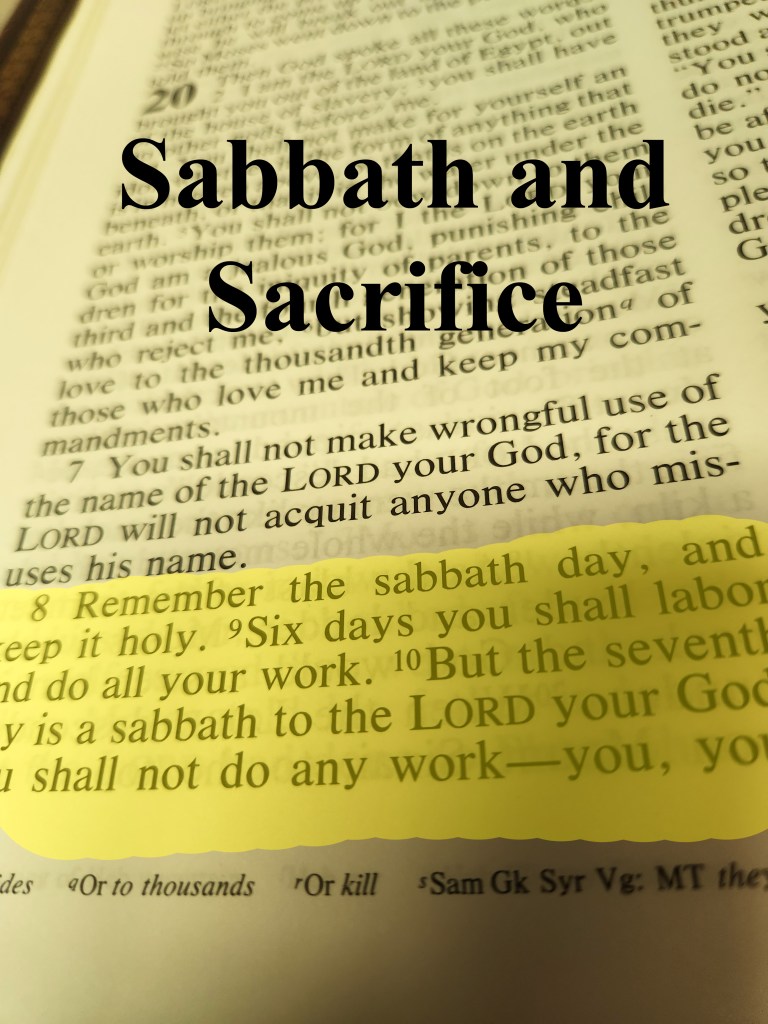
Sabbath and Sacrifice

Sabbath and Sacrifice

March 03, 2024U

By Pastor John Partridge

Deuteronomy 5:12-15           Mark 2:23 – 3:6                     2 Corinthians 4:5-12

How many of you have had to turn your computer, or your phone, or your printer, or some other electronic, or even mechanical, device, off and then back on again, to make it work the way that it’s supposed to work? All of us. Anne Lamott once said, “Almost anything will work again if you unplug it for a few minutes, including you.”

It’s a thoughtful sentiment, but Anne Lamott was hardly the first person to think about the value of turning us humans off and back on again. In fact, unplugging human beings, and then plugging them in again is the whole principle behind sabbath rest. Sabbath rest, of course, is an ancient idea, and, to understand that we need to go back to the beginning, to Deuteronomy 5:12-15, where we hear this command from God to his people:

12 “Observe the Sabbath day by keeping it holy, as the Lord your God has commanded you. 13 Six days you shall labor and do all your work, 14 but the seventh day is a sabbath to the Lord your God. On it you shall not do any work, neither you, nor your son or daughter, nor your male or female servant, nor your ox, your donkey or any of your animals, nor any foreigner residing in your towns, so that your male and female servants may rest, as you do. 15 Remember that you were slaves in Egypt and that the Lord your God brought you out of there with a mighty hand and an outstretched arm. Therefore, the Lord your God has commanded you to observe the Sabbath day.

When we read this, we realize that there are two purposes behind God’s requirement of the sabbath day. The first of these is simply to rest, to unplug, and reset our bodies and minds so that we can start fresh again in a new week. And the second reason is to remember what God has done for us, to remember God’s mighty acts of rescue, redemption, and rescue, and to spend time honoring and worshiping our God. But, over time, the reason and rationale behind honoring the sabbath got confused. Because everyone recognized that the sabbath was important, the priests and other religious leaders made rules to help the people of Israel get it right. But along the way, the rules that they made, and the traditions that they established, became so important, that they were held to be of the same importance as God’s original commands. And that’s why Jesus gets into an argument with the Pharisees in Mark 2:23 – 3:6 where we hear this:

23 One Sabbath Jesus was going through the grain fields, and as his disciples walked along, they began to pick some heads of grain. 24 The Pharisees said to him, “Look, why are they doing what is unlawful on the Sabbath?”

25 He answered, “Have you never read what David did when he and his companions were hungry and in need? 26 In the days of Abiathar the high priest, he entered the house of God and ate the consecrated bread, which is lawful only for priests to eat. And he also gave some to his companions.”

27 Then he said to them, “The Sabbath was made for man, not man for the Sabbath. 28 So the Son of Man is Lord even of the Sabbath.”

3:1 Another time Jesus went into the synagogue, and a man with a shriveled hand was there. Some of them were looking for a reason to accuse Jesus, so they watched him closely to see if he would heal him on the Sabbath. Jesus said to the man with the shriveled hand, “Stand up in front of everyone.”

Then Jesus asked them, “Which is lawful on the Sabbath: to do good or to do evil, to save life or to kill?” But they remained silent.

He looked around at them in anger and, deeply distressed at their stubborn hearts, said to the man, “Stretch out your hand.” He stretched it out, and his hand was completely restored. Then the Pharisees went out and began to plot with the Herodians how they might kill Jesus.

Since the commandment to rest on the sabbath day required observant followers of God to refrain from work, it was natural that, over time, people wanted to know what exactly qualified as work. Moreover, after Israel had been sent into captivity in Babylon because of their unfaithfulness, the priests and other religious leaders wanted to write rules that would figuratively put fences around the commandments of God so that, if you were to follow their man-made rules, you would always be found to be in obedience to God’s commandments. Staying inside the fence, as it were, prevented you from even accidentally breaking a commandment.

The problem with this system was that, after a while, the rules that were intended to help obey the commandments became elevated to the same level of importance as the commandments themselves. And so, in this story, we find the disciples snapping off, and chewing on some uncooked heads of grain as they walked through the fields. But even though they exerted no energy other than lifting their hands to their mouths, according to the rules, what they had done was defined as harvesting, and harvesting was work. God’s commandment to observe the sabbath never said that you couldn’t eat, but the rules that had been written by generations of priests said that what they had done was sin (hint: it wasn’t).

And so, Jesus gives an example from scripture about how the great King David had done the same thing, and worse, and explained that God intended the sabbath to improve the lives of human beings and not to be an additional burden to them. Jesus had the same argument over healing a man who had suffered from what may well have been a birth defect. While healing was somehow defined as work, Jesus asked how doing good and undoing evil could possibly be wrong.

And that’s all well and good, but as we often ask… so what?

So, what if we know that God created a sabbath rest and a time of worship for the benefit of humanity?

So, what if we understand we shouldn’t define our sabbath rest too narrowly, and that doing good things on our day of rest is okay?

How does that make a difference to us as we live our lives?

Well, for that, let’s turn to Paul’s second letter to the church in Corinth for some clarity. But, as we read, this may not immediately sound like it is at all related to our understanding of sabbath. But it is, so bear with me until we finish, and I can unpack it a little. In 2 Corinthians 4:5-12, Paul says…

For what we preach is not ourselves, but Jesus Christ as Lord, and ourselves as your servants for Jesus’ sake. For God, who said, “Let light shine out of darkness,” made his light shine in our hearts to give us the light of the knowledge of God’s glory displayed in the face of Christ.

But we have this treasure in jars of clay to show that this all-surpassing power is from God and not from us. We are hard pressed on every side, but not crushed; perplexed, but not in despair; persecuted, but not abandoned; struck down, but not destroyed. 10 We always carry around in our body the death of Jesus, so that the life of Jesus may also be revealed in our body. 11 For we who are alive are always being given over to death for Jesus’ sake, so that his life may also be revealed in our mortal body. 12 So then, death is at work in us, but life is at work in you.

And again, I understand that this message of servanthood and persecution doesn’t immediately sound like it connects to our understanding of sabbath, but let’s look a little closer.  Paul reminds us that what we tell the world is not a message about us, it is a message about Jesus Christ, about how he came to bring light into a dark world, to display God’s glory, and to change hearts. Because of that, Paul says that we have the treasure of Jesus Christ in jars of clay.

Wait.

What does that mean?

Our explanation comes from what immediately follows, and that is a list of all the horrible things that have happened to them as messengers of the gospel. They were hard pressed, persecuted, and struck down, but while these things happened, and while they did experience abuse, pain, and suffering, they were not completely crushed, they did not despair, they did not feel as if they had been abandoned, and they were not destroyed. They themselves were carrying the message of Jesus Christ, but they knew that they were finite, fragile, and temporary vessels. More to the point, we, all of us, are like jars of clay. We are fragile vessels that contain the treasure of Jesus Christ.

We are fragile. Like clay we leak, we chip, we scratch, and we break. If God intended for us to contain his treasure, he would have stored it in something more durable like a stout treasure chest or a stone fortress. But he didn’t. The only way for us to preserve the treasure that we contain… is to share it with others.

Paul says that “we who are alive are always being given over to death for Jesus’s sake.” That means that we must be at work giving of ourselves, offering ourselves as a sacrifice to God, and sharing the good news of Jesus Christ. Death is at work in us because our time on earth is limited, and because the sacrifice of Jesus Christ is a part of who we are. But life is also at work in us through Jesus’ resurrection and his gift of eternal life to those who believe.

And so, if we look at it with Paul’s words in mind, sabbath is a time of rest and renewal when we remember who we are as we come together to worship our God, refill our leaky clay vessels, share our courage and strength with one another, share the Spirit of God that dwells within us, build one another up, equip one another, teach, learn, and grow, so that we can go back out into the world as a living sacrifice to Jesus Christ and to the kingdom of God.

Anne Lamott said, “Almost anything will work again if you unplug it for a few minutes, including you.”

And the truth of scripture tells us that she’s not wrong. Human beings were not designed or built to go non-stop, twenty-four hours a day, seven day a week, three hundred and sixty-five (or 366) days a year. The God of creation built us with a need for rest. Once every seven days he offers us a sabbath, a time to reset, restore, rest, and renew both physically and spiritually so that we can face the world, and all the evil in it, for another week.

Without rest, without sabbath, we are easily crushed, suffer despair, and feel abandoned and destroyed. Without sabbath, our fragile clay leaks and our faith weakens. Without sabbath, we are not prepared to live lives of sacrifice to God.

Simply put, without sabbath, and without rest, we cannot be the people that God wants, and needs, us to be.


Please LIKE and SHARE!

Click here to subscribe to Pastor John’s blog.

Click here if you would like to subscribe to Pastor John’s weekly messages.

Click here to visit Pastor John’s YouTube channel.


*You have been reading a message presented at Christ United Methodist Church on the date noted at the top of the first page.  Rev. John Partridge is the pastor at Christ UMC in Alliance, Ohio.  Duplication of this message is a part of our Media ministry, if you have received a blessing in this way, we would love to hear from you.  Letters and donations in support of the Media ministry or any of our other projects may be sent to Christ United Methodist Church, 470 East Broadway Street, Alliance, Ohio 44601.  These messages are available to any interested persons regardless of membership.  You may subscribe to these messages, in print or electronic formats, by writing to the address noted, or by contacting us at secretary@CUMCAlliance.org.  These messages can also be found online at https://pastorpartridge.com .  All Scripture quotations, unless otherwise indicated, are taken from the Holy Bible, New International Version®, NIV®. Copyright ©1973, 1978, 1984, 2011 by Biblica, Inc.™ Used by permission of Zondervan. All rights reserved worldwide. www.zondervan.comThe “NIV” and “New International Version” are trademarks registered in the United States Patent and Trademark Office by Biblica, Inc.™

The Tax Trap

The Tax Trap

October 22, 2023*

By Pastor John Partridge

Exodus 33:12-23                    Matthew 22:15-22                             1 Thessalonians 1:1-10

Leadership is intimidating.

That is to say, leadership can be intimidating if you have the humility to pause and think about the impact of what you are doing.

The first time that I recall having any real leadership was in the early 1990’s when I had returned to my Army Reserve unit from my advanced training in my MOS (Military Occupational Specialty) and was expected to lead one of the monthly classes that were held to keep everyone fresh on our required skills. Since I had so recently returned from training, I was therefore the most qualified to teach one or two of the classes. I was still a Private First Class, and I had sergeants, staff sergeants, and just about everyone else in “my” classroom for fifteen minutes. As I continued to do this over the years, my rank, and my skills, advanced and I became more comfortable doing it.

But then on July 4th, 2004, I stood in front of the gathered people of the Johnsville United Methodist Church for the first time as their pastor. This was, once again, entirely new and, at that time, despite being over 40 years old, I had very little training as a pastor. But, once again, with time, experience, and more training, leading God’s people became a little easier.

But regardless of whether it was in the early 1990’s or in 2004, I always knew that I wasn’t alone. There were senior noncommissioned officers who could help me if I stumbled while I was teaching classes in my reserve unit, and in every church that I have served, there have always been patient, competent, congregations, volunteers, and staff to help me do what I do. Leadership is always intimidating, but the idea of leading… alone… would be terrifying.

But that is exactly what is foremost in Moses’ mind as he has a conversation with God in Exodus 33:12-23.

12 Moses said to the Lord, “You have been telling me, ‘Lead these people,’ but you have not let me know whom you will send with me. You have said, ‘I know you by name and you have found favor with me.’ 13 If you are pleased with me, teach me your ways so I may know you and continue to find favor with you. Remember that this nation is your people.”

14 The Lord replied, “My Presence will go with you, and I will give you rest.”

15 Then Moses said to him, “If your Presence does not go with us, do not send us up from here. 16 How will anyone know that you are pleased with me and with your people unless you go with us? What else will distinguish me and your people from all the other people on the face of the earth?”

17 And the Lord said to Moses, “I will do the very thing you have asked, because I am pleased with you, and I know you by name.”

18 Then Moses said, “Now show me your glory.”

19 And the Lord said, “I will cause all my goodness to pass in front of you, and I will proclaim my name, the Lord, in your presence. I will have mercy on whom I will have mercy, and I will have compassion on whom I will have compassion. 20 But,” he said, “you cannot see my face, for no one may see me and live.”

21 Then the Lord said, “There is a place near me where you may stand on a rock. 22 When my glory passes by, I will put you in a cleft in the rock and cover you with my hand until I have passed by. 23 Then I will remove my hand and you will see my back; but my face must not be seen.”

The first thing out of Moses’ mouth is, “I can’t do this alone.” Those aren’t his exact words, but that is clearly the idea when he says, “whom will you send with me?” And God’s response is, I will go with you, and I will give you rest. God promises that his presence will be so tangibly real, that Moses will never feel as if he is alone and he will be comforted, and be able to sleep at night, because he knows that he is not alone.

Why does that matter?

Well, if you are in any kind of leadership position, you can find comfort in that. But there are other reasons that we’ll get to in a few minutes.

Next, we come to yet another story of the Pharisees trying to trick Jesus into saying something stupid that would either be a criminal offense or would be offensive and reduce his popularity with the people. There’s some back story to this that helps us make sense of that, but we’ll cross that bridge when we come to it. For now, let’s look at this story from Matthew 22:15-22:

15 Then the Pharisees went out and laid plans to trap him in his words. 16 They sent their disciples to him along with the Herodians. “Teacher,” they said, “we know that you are a man of integrity and that you teach the way of God in accordance with the truth. You aren’t swayed by others because you pay no attention to who they are. 17 Tell us then, what is your opinion? Is it right to pay the imperial taxto Caesar or not?”

18 But Jesus, knowing their evil intent, said, “You hypocrites, why are you trying to trap me? 19 Show me the coin used for paying the tax.” They brought him a denarius, 20 and he asked them, “Whose image is this? And whose inscription?”

21 “Caesar’s,” they replied.

Then he said to them, “So give back to Caesar what is Caesar’s, and to God what is God’s.”

22 When they heard this, they were amazed. So, they left him and went away.

This was the tax trap. First, you will note that the Pharisees don’t come to see Jesus in person. Instead, they send their lackeys that are less well-known so that Jesus might not recognize this as a trap, and second, they send along with them the Herodians. Which may cause us to ask, who the heck were the Herodians? And that’s a good question that the bible doesn’t answer very well, but which history does. We know that the ruler of Israel at the time of Jesus’ birth had been Herod the Great, and the current ruler was one of his sons, Herod Antipas. And so, the Herodians were Jews, who had sold out to the Romans, to the culture of the Romans, and to the plan that Herod had for their nation. To make a connection to the United States of the twenty-first century, these were the people who were more interested in conforming to the culture of Hollywood, and to their political party than they were in conforming to the laws of Moses and the prophets. They were born Jews but were culturally Roman. The plan clearly was that if Jesus said that good Jews shouldn’t pay Roman taxes, which was a prominent idea in some Jewish circles, then the Herodians would charge Jesus with a crime. The argument in some Jewish circles was that because Rome was immoral and acted counter to the beliefs of Israel, that paying taxes to Rome was therefore immoral. Further, because Rome circulated coinage that bore graven images that were prohibited by scripture, that using such coinage was sinful and a corrupting influence.

But Jesus’ interpretation was different.

Jesus said that if Ceasar’s face was on the coin, then pay Ceasar what was due to Ceasar, but pay to God what belonged to God. In Jesus’ interpretation, the scriptures demanded that faithful people should follow God with all their heart, with all their soul, with all their mind, and with all their strength. That is what was owed to God. It is your choices and your morality that are important.

Hold on to that idea because we’re going to come back to that in a minute, but this connects us to Paul’s message to the church in Thessalonica that we hear in 1 Thessalonians 1:1-10:

1:1 Paul, Silas,and Timothy,

To the church of the Thessalonians in God the Father and the Lord Jesus Christ:

Grace and peace to you.

We always thank God for all of you and continually mention you in our prayers. We remember before our God and Father your work produced by faith, your labor prompted by love, and your endurance inspired by hope in our Lord Jesus Christ.

For we know, brothers and sistersloved by God, that he has chosen you, because our gospel came to you not simply with words but also with power, with the Holy Spirit and deep conviction. You know how we lived among you for your sake. You became imitators of us and of the Lord, for you welcomed the message in the midst of severe suffering with the joy given by the Holy Spirit. And so you became a model to all the believers in Macedonia and Achaia. The Lord’s message rang out from you not only in Macedonia and Achaia—your faith in God has become known everywhere. Therefore, we do not need to say anything about it, for they themselves report what kind of reception you gave us. They tell how you turned to God from idols to serve the living and true God, 10 and to wait for his Son from heaven, whom he raised from the dead—Jesus, who rescues us from the coming wrath.

What Paul says is important, but I also think that how Paul said it is important.  You will note that Paul does not simply say that we remember you because of your work, your labor, and your endurance. What Paul says is that we remember you to God because of the work that we have seen in you that was produced by faith, because of the labor that you have done that was prompted by love, and by the endurance that you have shown that was inspired by hope. This is the work that God is doing because his people love him with all their heart, with all their soul, with all their mind and with all their strength. They are doing the work of the kingdom because of their faith, because of their love, and because of their hope and not because it was what was culturally expected, or because of some other sense of ethical, moral, or cultural obligation. When we remember James’ teaching that faith is revealed by works, this is that. Faith came first, but because the people had faith, it inspired them to work, labor, and hope.

So, how do we tie this all together and make sense of it?

Jesus’ challenge to the tax trap points us toward self-reflection in several directions. Two thousand years ago the fear was that taxes, especially using money with graven images on it, was a corrupting influence that faithful Jews should avoid. But Jesus says that it isn’t. Paying taxes isn’t inherently sinful, nor are we automatically guilty of the sinful or immoral acts of the government. Of course, this is held in tension with several other scriptures that say that we will, as a people, be held responsible for the sins of our nation. There’s no way we have the time to even try to sort that out so I’m not even going to try.

But our point of personal self-reflection and struggle is to remember that a sinful government doesn’t necessarily corrupt us personally. But the reverse is also true, such that the righteous acts of government do not make us personally righteous. It is a good thing for the government to feed the poor, but the Roman government did that. It is a good thing for the government to care for the elderly and a host of other things, but none of the things that the government does, relieves us of doing the things that God has commanded us to do. Whether our government is good or evil, we are still obligated to feed the hungry, clothe the naked, care for the widows and orphans, speak for the immigrants and the voiceless, and to do the work of the kingdom of God. On the day that we stand in judgement before God, we will be judged by what we have done, and what we have left undone and that includes how we voted, and when we chose not to vote.

But the second point of connection here is that, like Moses, and like the pastor of a church, God knows that we cannot do all these things alone. We are a part of a community of faith. We can do great things, sometimes impossible things, because we work together… and because God promises to go with us.

We are not alone.


Please LIKE and SHARE!

Click here to subscribe to Pastor John’s blog.

Click here if you would like to subscribe to Pastor John’s weekly messages.

Click here to visit Pastor John’s YouTube channel.


*You have been reading a message presented at Christ United Methodist Church on the date noted at the top of the first page.  Rev. John Partridge is the pastor at Christ UMC in Alliance, Ohio.  Duplication of this message is a part of our Media ministry, if you have received a blessing in this way, we would love to hear from you.  Letters and donations in support of the Media ministry or any of our other projects may be sent to Christ United Methodist Church, 470 East Broadway Street, Alliance, Ohio 44601.  These messages are available to any interested persons regardless of membership.  You may subscribe to these messages, in print or electronic formats, by writing to the address noted, or by contacting us at secretary@CUMCAlliance.org.  These messages can also be found online at https://pastorpartridge.com .  All Scripture quotations, unless otherwise indicated, are taken from the Holy Bible, New International Version®, NIV®. Copyright ©1973, 1978, 1984, 2011 by Biblica, Inc.™ Used by permission of Zondervan. All rights reserved worldwide. www.zondervan.comThe “NIV” and “New International Version” are trademarks registered in the United States Patent and Trademark Office by Biblica, Inc.™

I Will Go… Or Will I?

I Will Go… Or Will I?

July 09, 2023*

By Pastor John Partridge

Genesis 24:34-38, 42-49, 58-67         Matthew 11:16-19, 25-30      Romans 7:15-25a

Throughout our lives we must decide in whom we will put our trust. When we are children, we trust our parents.  In school, we often trusted our teachers. In college we trusted that the curriculum and all the agony that it put us through, would be useful and valuable to us upon completion. When we accepted employment, we put a lot of trust in the company that hired us, as well as the supervisors and managers that trained us and oversaw our work. And any of us who served in the military entrusted our lives to those persons who made our duty assignments and sent us to places down the street and around the world.

In recent weeks we have studied how Abraham was repeated tested by God. First God called Abraham to “go to a place that I will show you,” and then we read about Abraham’s conflicted emotions, and his trust in God, as he sent Hagar and Ishmael out into the wilderness, and then again when God tested his willingness to sacrifice his son Isaac. And those are just a few of the many examples from Abraham’s life. But, as we continue reading the story of Genesis, the family of Abraham continues to be tested by God. As Isaac matures to a marriageable age, his father worries that Isaac’s faith might suffer if he were to marry a Canaanite woman. And so, Abraham sends one of his trusted servants to go back to his home country, to find the descendants of the family that he left behind, and among them find a wife for Isaac.

It is almost certain that Abraham’s servant has never been to the place that he has been sent but he trusts that his master would not send him into great danger. At the same time, Abraham and Isaac trusted that this servant would be a good judge of character as his mission was, literally, to select the person with whom Isaac would spend the rest of his life. And so, in Genesis 24:34-38, 42-49, 58-67, the servant finds Abraham’s extended family, meets a girl, and this happens…

34 So he said, “I am Abraham’s servant. 35 The Lord has blessed my master abundantly, and he has become wealthy. He has given him sheep and cattle, silver and gold, male and female servants, and camels and donkeys. 36 My master’s wife Sarah has borne him a son in her old age, and he has given him everything he owns. 37 And my master made me swear an oath, and said, ‘You must not get a wife for my son from the daughters of the Canaanites, in whose land I live, 38 but go to my father’s family and to my own clan, and get a wife for my son.’

42 “When I came to the spring today, I said, ‘Lord, God of my master Abraham, if you will, please grant success to the journey on which I have come. 43 See, I am standing beside this spring. If a young woman comes out to draw water and I say to her, “Please let me drink a little water from your jar,” 44 and if she says to me, “Drink, and I’ll draw water for your camels too,” let her be the one the Lord has chosen for my master’s son.’

45 “Before I finished praying in my heart, Rebekah came out, with her jar on her shoulder. She went down to the spring and drew water, and I said to her, ‘Please give me a drink.’

46 “She quickly lowered her jar from her shoulder and said, ‘Drink, and I’ll water your camels too.’ So, I drank, and she watered the camels also.

47 “I asked her, ‘Whose daughter are you?’

“She said, ‘The daughter of Bethuel son of Nahor, whom Milkah bore to him.’

“Then I put the ring in her nose and the bracelets on her arms, 48 and I bowed down and worshiped the Lord. I praised the Lord, the God of my master Abraham, who had led me on the right road to get the granddaughter of my master’s brother for his son. 49 Now if you will show kindness and faithfulness to my master, tell me; and if not, tell me, so I may know which way to turn.”

58 So they called Rebekah and asked her, “Will you go with this man?”

“I will go,” she said.

59 So they sent their sister Rebekah on her way, along with her nurse and Abraham’s servant and his men. 60 And they blessed Rebekah and said to her,

“Our sister, may you increase
    to thousands upon thousands;
may your offspring possess
    the cities of their enemies.”

61 Then Rebekah and her attendants got ready and mounted the camels and went back with the man. So, the servant took Rebekah and left.

62 Now Isaac had come from Beer Lahai Roi, for he was living in the Negev. 63 He went out to the field one evening to meditate, and as he looked up, he saw camels approaching. 64 Rebekah also looked up and saw Isaac. She got down from her camel 65 and asked the servant, “Who is that man in the field coming to meet us?”

“He is my master,” the servant answered. So, she took her veil and covered herself.

66 Then the servant told Isaac all he had done. 67 Isaac brought her into the tent of his mother Sarah, and he married Rebekah. So, she became his wife, and he loved her; and Isaac was comforted after his mother’s death.

And so, not only did Abraham’s servant trust his master, and not only did Abraham and Isaac trust the servant, but Rebekah was asked to trust a man that she had just met, to leave her home, journey to meet a total stranger, whose family she had never met, so that she could get married and spend the rest of her life with them and almost certainly never see her parents, family, or friends, ever again.

That’s a lot of trust.

But trusting is hard.

And sometimes the people in whom you are asked to place your trust are not trustworthy. And that was, in large part, the situation that Jesus finds in the story of Matthew 11:16-19, 25-30. Although Jesus and the disciples were faithful Jews who attended services in the synagogues and observed the prescribed feasts and festivals at the temple in Jerusalem, Jesus also knew that following God was hard and not everyone had the faith of Abraham. And worse, Jesus knew that many times, the people who ran the Temple, and who led God’s people, were not the most trustworthy people.  And in that story, Jesus speaks into the situation this way…

16 “To what can I compare this generation? They are like children sitting in the marketplaces and calling out to others:

17 “‘We played the pipe for you,
    and you did not dance;
we sang a dirge,
    and you did not mourn.’

18 For John came neither eating nor drinking, and they say, ‘He has a demon.’ 19 The Son of Man came eating and drinking, and they say, ‘Here is a glutton and a drunkard, a friend of tax collectors and sinners.’ But wisdom is proved right by her deeds.”

25 At that time Jesus said, “I praise you, Father, Lord of heaven and earth, because you have hidden these things from the wise and learned, and revealed them to little children. 26 Yes, Father, for this is what you were pleased to do.

27 “All things have been committed to me by my Father. No one knows the Son except the Father, and no one knows the Father except the Son and those to whom the Son chooses to reveal him.

28 “Come to me, all you who are weary and burdened, and I will give you rest. 29 Take my yoke upon you and learn from me, for I am gentle and humble in heart, and you will find rest for your souls. 30 For my yoke is easy and my burden is light.”

Jesus says that many of the people in that generation were like the children that demand that strangers play a game with them. Only they know the rules, they won’t explain the rules, and then they are angry that you didn’t play their game according to their rules. Jesus continues by explaining that the religious leaders of Israel have behaved exactly that way. They saw John refraining from food and drink, and they criticized him for doing so, but then Jesus came and did not refrain from eating and drinking, and they criticized him for that. Just like children in the marketplaces, the religious leaders of Israel were angry because John and Jesus had refused to play their games.

But Jesus also knew that many people really wanted to follow God and to have a good relationship with God, but the leaders of Israel had made the rules so confusing that it kept people up at night. The leaders had created a system of worship that was overly burdensome, time consuming, and still left people unsure of their standing before God. And into this confusion, Jesus says, ““Come to me, all you who are weary and burdened, and I will give you rest. 29 Take my yoke upon you and learn from me, for I am gentle and humble in heart, and you will find rest for your souls. 30 For my yoke is easy and my burden is light.”

Jesus says, “Following God, and having a good relationship with God is not as hard as you’ve been told. All that you need to do, is… trust me.”  Trust me, and I will take away the burdensome rules and the sleepless nights. Trust me… and find… rest.

But Paul finds that even following Jesus can still be difficult. As we read just last week, Paul knows that even though we have grace and forgiveness because of Jesus’ sacrifice, we are not free to sin, but must still strive live a life of righteousness. But doing what is right can be hard. In Romans 7:15-25a Paul says…

15 I do not understand what I do. For what I want to do I do not do, but what I hate I do. 16 And if I do what I do not want to do, I agree that the law is good. 17 As it is, it is no longer I myself who do it, but it is sin living in me. 18 For I know that good itself does not dwell in me, that is, in my sinful nature. For I have the desire to do what is good, but I cannot carry it out. 19 For I do not do the good I want to do, but the evil I do not want to do—this I keep on doing. 20 Now if I do what I do not want to do, it is no longer I who do it, but it is sin living in me that does it.

21 So I find this law at work: Although I want to do good, evil is right there with me. 22 For in my inner being I delight in God’s law; 23 but I see another law at work in me, waging war against the law of my mind and making me a prisoner of the law of sin at work within me. 24 What a wretched man I am! Who will rescue me from this body that is subject to death? 25 Thanks be to God, who delivers me through Jesus Christ our Lord!

When we read these words quickly, we find that these might almost be unintelligible gibberish. But, if we slow way down, read slowly, think about what we’re reading, and consider the meaning, we can dig down into it and get a better sense of what Paul was trying to communicate. And, if we’re honest, this is how Paul intended it to be. This isn’t a comic book, or even a newspaper, that has all the imagery and ideas distilled down into their simplest form that we can skim over, past, and through with little effort and no intellectual engagement. These are transformational ideas that require the focus of our minds and spirits.

And, when we do that, we discover that Paul is saying several things that create a logical progression of thought. First, Paul says that he keeps doing the things that he doesn’t want to do, and so he agrees that the law is good because the law helps to keep him righteous.  For example, we know, intellectually, that driving too fast is dangerous, but without speed limits, we will almost certainly do so. We might not always obey the speed limits, but that boundary helps us to be conscious of our speed and keep everyone on the road safer. In the same way, the boundaries given to us in the law help us to be righteous.

Second, after a lot of confusing language about what he wants to do in comparison to what he actually does, Paul concludes that because of the sin that lives inside of him, he is incapable of consistently doing good.

Simply put, we just can’t do it by ourselves.

But Jesus stands ready to walk with us, and to help us to do better and to overcome the natural evil that lives within us.

Like we saw with Moses, his servant, Isaac, and Rebekah, scripture repeatedly tells us stories about trust. Our relationship is built on our ability to trust in God.

Paul admits that trusting is hard, and that the sin and evil that is inside of us makes it impossible to be consistently good. We, like Paul, must admit that we simply cannot do it alone. We must surrender control, offer our lives as a living sacrifice to God, and trust Jesus to transform us into something better.

It is Jesus who says, trust me, and I will take away the burdensome rules and the sleepless nights.

Trust me… and find… rest.


Please LIKE and SHARE!

Click here to subscribe to Pastor John’s blog.

Click here if you would like to subscribe to Pastor John’s weekly messages.

Click here to visit Pastor John’s YouTube channel.


*You have been reading a message presented at Christ United Methodist Church on the date noted at the top of the first page.  Rev. John Partridge is the pastor at Christ UMC in Alliance, Ohio.  Duplication of this message is a part of our Media ministry, if you have received a blessing in this way, we would love to hear from you.  Letters and donations in support of the Media ministry or any of our other projects may be sent to Christ United Methodist Church, 470 East Broadway Street, Alliance, Ohio 44601.  These messages are available to any interested persons regardless of membership.  You may subscribe to these messages, in print or electronic formats, by writing to the address noted, or by contacting us at secretary@CUMCAlliance.org.  These messages can also be found online at https://pastorpartridge.com .  All Scripture quotations, unless otherwise indicated, are taken from the Holy Bible, New International Version®, NIV®. Copyright ©1973, 1978, 1984, 2011 by Biblica, Inc.™ Used by permission of Zondervan. All rights reserved worldwide. www.zondervan.comThe “NIV” and “New International Version” are trademarks registered in the United States Patent and Trademark Office by Biblica, Inc.™

Unreasonable Demands

Click here to listen to the podcast

Click here to watch the video.


Unreasonable Demands

July 02, 2023*

By Pastor John Partridge

Genesis 22:1-14                     Matthew 10:40-42                 Romans 6:12-23

Have you ever had a bad boss?

At my last secular job, the company president, and one or two others, were known to publicly chastise, criticize, and even berate employees, and even supervisors and shop foremen, for mistakes they believed those employees had made. The first time I saw such a thing, I remembered that one of the very first, foundational, and fundamental rules that we had been taught in Non-commissioned officer school, was to always praise your subordinates in public, but criticize and correct them in private. The results were what you would expect, such encounters lowered morale for entire departments and even for the entire shop floor. Worse, some of those employees, especially shop foremen, soon found other employment for fewer hours and more money. Would they have started looking for a job if they had been criticized in private? Maybe, but I’m sure that such encounters helped them to make up their minds to leave.

But stories about bad bosses can be found all over the internet. The Reddit website has entire forums dedicated to the stories of employees, and their bad bosses. Of course, many of those stories end with the employees quitting and telling those bosses to “get stuffed.” But those stories resonate with us, especially if we had a bad boss, and especially if we felt that we had to put up with it because of the economic or other conditions in which we found ourselves.

But what if God is the one who is being unreasonable?

That’s what we appear to be seeing in the story of Genesis 22:1-14. This is the story about God’s command that Abraham sacrifice Isaac as a burnt offering. But the story is all kinds of wrong, in all kinds of ways.  We’ll get to that, but first, let’s read the story…

22:1 Some time later God tested Abraham. He said to him, “Abraham!”

“Here I am,” he replied.

Then God said, “Take your son, your only son, whom you love—Isaac—and go to the region of Moriah. Sacrifice him there as a burnt offering on a mountain I will show you.”

Early the next morning Abraham got up and loaded his donkey. He took with him two of his servants and his son Isaac. When he had cut enough wood for the burnt offering, he set out for the place God had told him about. On the third day Abraham looked up and saw the place in the distance. He said to his servants, “Stay here with the donkey while I and the boy go over there. We will worship and then we will come back to you.”

Abraham took the wood for the burnt offering and placed it on his son Isaac, and he himself carried the fire and the knife. As the two of them went on together, Isaac spoke up and said to his father Abraham, “Father?”

“Yes, my son?” Abraham replied.

“The fire and wood are here,” Isaac said, “but where is the lamb for the burnt offering?”

Abraham answered, “God himself will provide the lamb for the burnt offering, my son.” And the two of them went on together.

When they reached the place God had told him about, Abraham built an altar there and arranged the wood on it. He bound his son Isaac and laid him on the altar, on top of the wood. 10 Then he reached out his hand and took the knife to slay his son. 11 But the angel of the Lord called out to him from heaven, “Abraham! Abraham!”

“Here I am,” he replied.

12 “Do not lay a hand on the boy,” he said. “Do not do anything to him. Now I know that you fear God, because you have not withheld from me your son, your only son.”

13 Abraham looked up and there in a thicket he saw a ramcaught by its horns. He went over and took the ram and sacrificed it as a burnt offering instead of his son. 14 So Abraham called that place The Lord Will Provide. And to this day it is said, “On the mountain of the Lord it will be provided.”

Those of us who are familiar with this story, through regular repetition, have likely made our peace with it, but there’s still something about it that bothers us. In this case, it is our familiarity with the story that blinds us to some of the problems that present themselves in it and, as such, it’s likely that anyone who is unfamiliar with this story will take issue with several things while they read it. First among these is that God asks Abraham to sacrifice Isaac, but this is the same God that throughout the Old Testament, strongly, and repeatedly prohibits any kind of human sacrifice. Second, God promised Abraham children, and now asks that Abraham sacrifice the only child that he has left. Third, as we heard last week, God promised that Abraham would have heirs through Isaac and that Isaac’s descendants would become a great nation. Fourth, again as we heard last week, Abraham had already sent Ishmael away, so Isaac is all that he has left. And fifth, at this point, Isaac must be nearly in his teens, so Sarah, who was already over one hundred years old when Isaac was conceived, must now be somewhere between 110 to 120 years old. Although all things are possible with God, if it was unlikely for a 100-year-old woman to have a baby, having a second one at 120 would seem to be even more unlikely.

For all these reasons, it seems like God’s command to sacrifice Isaac is not only unreasonable but violates God’s agreement with Abraham in a several different ways.

And yet…

Abraham does not complain. Abraham knows all about all these issues and I am certain that all of them had to be swirling through his mind. But Abraham does not object or rebel against God. Abraham knows that the death of Isaac would break God’s promise, destroy his marriage, cancel his future, and erase his legacy.

But Abraham obeys and is faithful. Even though obeying God violates everything that Abraham knows to be true, destroys everything that he holds dear, and erases everything that he has spent his entire life building, Abraham obeys anyway. Even though Abraham can’t see a way that God can possibly make this insanity work, Abraham trusts that God is faithful, will honor his promises, and will find a way through.

But if we look at Matthew 10:40-42, we find something that is the same, sort of a test. Jesus says…

40 “Anyone who welcomes you welcomes me, and anyone who welcomes me welcomes the one who sent me. 41 Whoever welcomes a prophet as a prophet will receive a prophet’s reward, and whoever welcomes a righteous person as a righteous person will receive a righteous person’s reward. 42 And if anyone gives even a cup of cold water to one of these little ones who is my disciple, truly I tell you, that person will certainly not lose their reward.”

Jesus says that if you offer hospitality to those who are doing the work of God, potentially in your home, but also in small acts of kindness like sharing your food and water, that you will share in the rewards that God will give them for their faithfulness.  Welcoming the servants of God, is a gift to God and hospitality given in the name of God is rewarded by God. But doing so comes at a risk, and at a cost to you. The people to whom you offer hospitality may well be strangers, and you might not understand their mission. But your understanding and your comfort are not prerequisites to your obedience.

And finally, we return to Paul’s letter to the church in Rome exactly where we left off last week in Romans 6:12-23, as Paul connects our behavior and our actions to our faithfulness, and to our indebtedness, to God. Paul says…

11 In the same way, count yourselves dead to sin but alive to God in Christ Jesus. 12 Therefore do not let sin reign in your mortal body so that you obey its evil desires. 13 Do not offer any part of yourself to sin as an instrument of wickedness, but rather offer yourselves to God as those who have been brought from death to life; and offer every part of yourself to him as an instrument of righteousness. 14 For sin shall no longer be your master, because you are not under the law, but under grace.

15 What then? Shall we sin because we are not under the law but under grace? By no means! 16 Don’t you know that when you offer yourselves to someone as obedient slaves, you are slaves of the one you obey—whether you are slaves to sin, which leads to death, or to obedience, which leads to righteousness? 17 But thanks be to God that, though you used to be slaves to sin, you have come to obey from your heart the pattern of teaching that has now claimed your allegiance. 18 You have been set free from sin and have become slaves to righteousness.

19 I am using an example from everyday life because of your human limitations. Just as you used to offer yourselves as slaves to impurity and to ever-increasing wickedness, so now offer yourselves as slaves to righteousness leading to holiness. 20 When you were slaves to sin, you were free from the control of righteousness. 21 What benefit did you reap at that time from the things you are now ashamed of? Those things result in death! 22 But now that you have been set free from sin and have become slaves of God, the benefit you reap leads to holiness, and the result is eternal life. 23 For the wages of sin is death, but the gift of God is eternal life inChrist Jesus our Lord.

Paul’s point is that we are called to offer our lives as a sacrifice to God. How we live, how we act, and how we behave are all sacrifices and gifts that we give to God as acts of faithfulness and obedience. Further, Paul emphasizes that while we were once slaves to sin, we are now slaves to righteousness. This isn’t just a useful turn of phrase for the purposes of illustration. In the Roman world, Paul, and everyone else, lived in a culture of honor and patronage. In that culture, when a patron, or other wealthy person, aided you in a business transaction that you could never have put together for yourself, or paid a debt on your behalf that you could never have paid without their help, you became, as a matter of honor, indebted to them.

While, legally and technically, your debt had been paid, you now owed your life and your honor to your new patron. While you could ignore their requests, doing so would be dishonorable and would mark you as an ungracious scoundrel. This is the language that Paul uses in several of his books because it was language that is seen in many Greek and Roman texts and so we know that it was common language that everyone in the ancient world would have readily understood and accepted.

I could explain at some length, but the summary is that because Jesus paid a debt for us, because he substituted his life in place of ours, we now owe him a debt of honor. We owe God our gratitude, our faith, and our obedience. And so, we are expected to behave like Abraham, to obey even when doing so seems impossible and to have the faith that God can, and often does, accomplish the impossible.

Set aside sin.

Obey God.

Trust that God is faithful, will honor his promises, and will find a way through.

And offer your entire life as a living sacrifice to the glory of Jesus Christ and to the building of his kingdom.


Please LIKE and SHARE!

Click here to subscribe to Pastor John’s blog.

Click here if you would like to subscribe to Pastor John’s weekly messages.

Click here to visit Pastor John’s YouTube channel.


*You have been reading a message presented at Christ United Methodist Church on the date noted at the top of the first page.  Rev. John Partridge is the pastor at Christ UMC in Alliance, Ohio.  Duplication of this message is a part of our Media ministry, if you have received a blessing in this way, we would love to hear from you.  Letters and donations in support of the Media ministry or any of our other projects may be sent to Christ United Methodist Church, 470 East Broadway Street, Alliance, Ohio 44601.  These messages are available to any interested persons regardless of membership.  You may subscribe to these messages, in print or electronic formats, by writing to the address noted, or by contacting us at secretary@CUMCAlliance.org.  These messages can also be found online at https://pastorpartridge.com .  All Scripture quotations, unless otherwise indicated, are taken from the Holy Bible, New International Version®, NIV®. Copyright ©1973, 1978, 1984, 2011 by Biblica, Inc.™ Used by permission of Zondervan. All rights reserved worldwide. www.zondervan.comThe “NIV” and “New International Version” are trademarks registered in the United States Patent and Trademark Office by Biblica, Inc.™

Blind Opinion

Click here to listen to the Podcast

Click here to watch the livestream of the entire worship service: https://youtube.com/live/8FaRugRy5sQ?feature=share

Click here to watch the sermon: https://youtu.be/LxneUCy9RYE


Blind Opinion

March 19, 2023*

(4th Sunday of Lent)

By Pastor John Partridge

John 9:1-41

There is a way of misinterpreting scripture that may have grown out of the primitive worship of gods and idols that existed long before God revealed himself to Abraham.  For primitive people, if you prayed for rain, and it rained, then it was clear that the gods loved you.  But if there was a drought, then it must be because the gods were angry with you.  Despite testimony to the contrary that we find in the story of Job, that frame of mind shows up with some regularity in the Old Testament, where we find people claiming that they were wealthy because God loved them but that if you were poor, it much be because you sinned or did something wrong.  If we pay attention, we will notice that there are plenty of times in scripture where bad things happen to faithful, and good, even beloved, followers of God. 

This attitude toward the poor, the unfortunate, the victims of accidents, the sick, the infirm, the crippled, those with birth defects, and many others, continues into the time of the New Testament and, if we’re honest, still rears its ugly head in the words we hear from some televangelists and others who are selling some variation of what is now referred to as the prosperity gospel.  Jesus specifically preached against this attitude and understanding on multiple occasions, but one of the clearest of these is found in the story of his healing of the man who was born blind. (John 9:1-41)

9:1 As he went along, he saw a man blind from birth. His disciples asked him, “Rabbi, who sinned, this man or his parents, that he was born blind?”

So common was this method of interpretation, that Jesus’ own disciples assumed that this man’s blindness simply must have been the result of someone’s sin.  For the disciples asking this question, that part of the equation wasn’t even in doubt.  The puzzle for them wasn’t if someone sinned, but who it was who had sinned.  Sin and punishment was assumed to be a part of this man’s infirmity and so the question that the disciples ask Jesus is “who sinned?”  They likely wonder how the blind man might have sinned even before he was born, or if God was somehow punishing the sin of his parents by making him to be born blind, which certainly seems unfair.  But Jesus replies that both options are wrong.

“Neither this man nor his parents sinned,” said Jesus, “but this happened so that the works of God might be displayed in him. As long as it is day, we must do the works of him who sent me. Night is coming, when no one can work. While I am in the world, I am the light of the world.”

Jesus explains that sin isn’t the only reason that bad things happen.  But it’s also important to note that neither does Jesus say that God intentionally caused the man to be blind.  He doesn’t say that God made the man blind. But he does say that God intends to use the man’s blindness for a higher purpose.  In this particular instance, God has chosen to use this man’s blindness to reveal a little bit of Jesus’ light to the world.

After saying this, he spit on the ground, made some mud with the saliva, and put it on the man’s eyes. “Go,” he told him, “wash in the Pool of Siloam” (this word means “Sent”). So the man went and washed, and came home seeing.

His neighbors and those who had formerly seen him begging asked, “Isn’t this the same man who used to sit and beg?” Some claimed that he was.

Others said, “No, he only looks like him.”

It’s worth stopping again here to point out that some of the man’s neighbors didn’t even consider the possibility of blindness being cured.  Even though they saw this guy every single day, they assumed that if the man in front of them wasn’t blind, then it simply had to be someone else.

But he himself insisted, “I am the man.”

The man insistently tells his neighbors “No, REALLY, it MEEEE!

10 “How then were your eyes opened?” they asked.

11 He replied, “The man they call Jesus made some mud and put it on my eyes. He told me to go to Siloam and wash. So, I went and washed, and then I could see.”

12 “Where is this man?” they asked him.

“I don’t know,” he said.

And here we gain some additional insight into the minds of the blind man’s neighbors, and maybe into the entire culture of that time.  As soon as they determine that their neighbor is no longer blind, their first reaction isn’t to throw a party, or to congratulate him, or to celebrate with him, their first response is to drag him into court.  To be fair, maybe this is because whenever a leper was cured of leprosy (which could have been any one of a dozen or more different skin diseases such as psoriasis), the cured person had to be brought into the temple, inspected by a priest, and “legally” or “officially” declared to be clean.  In that case, what we see here is that his neighbors bring the man into the courts of the temple so that he can be declared to be cleansed from the “sin” that had presented itself as blindness and therefore welcomed back into worship.

13 They brought to the Pharisees the man who had been blind. 14 Now the day on which Jesus had made the mud and opened the man’s eyes was a Sabbath. 15 Therefore the Pharisees also asked him how he had received his sight. “He put mud on my eyes,” the man replied, “and I washed, and now I see.”

16 Some of the Pharisees said, “This man is not from God, for he does not keep the Sabbath.”

It is obvious that the man is no longer blind.  And so, now the argument shifts from his blindness to Jesus.  They don’t like Jesus and they don’t want to admit that Jesus could have been the agent who performed the healing of the blind man.  But the only way to deny that Jesus healed the blind man, is to discredit him and insist that because Jesus is a sinner, that the blind man was somehow healed some other way.  And, as we will see, this turns into an almost laughably funny circular argument.

But others asked, “How can a sinner perform such signs?” So, they were divided.

17 Then they turned again to the blind man, “What have you to say about him? It was your eyes he opened.”

The man replied, “He is a prophet.”

18 They still did not believe that he had been blind and had received his sight until they sent for the man’s parents. 19 “Is this your son?” they asked. “Is this the one you say was born blind? How is it that now he can see?”

20 “We know he is our son,” the parents answered, “and we know he was born blind. 21 But how he can see now, or who opened his eyes, we don’t know. Ask him. He is of age; he will speak for himself.” 22 His parents said this because they were afraid of the Jewish leaders, who already had decided that anyone who acknowledged that Jesus was the Messiah would be put out of the synagogue. 23 That was why his parents said, “He is of age; ask him.”

The blind man’s parents are dragged in front of these powerful leaders and even before they are summoned, they already know that these powerful men do not like Jesus and have threatened to excommunicate anyone who claims that Jesus is the Messiah.  And so, being good and faithful Jews, but also parents who love their son, they do the best that they can to stay out of whatever trouble he is in, and not get caught between Jesus and these angry and powerful leaders.  They want to support their son, but they don’t want to get thrown out of the temple or their local synagogue.  And so, their answers don’t go any farther than they must.  They tell the truth but refuse to speculate beyond their own knowledge.  They swear that their son was, indeed, born blind but they have no firsthand knowledge of how he was healed, or who healed him and they refuse to speculate or comment further.

Their son, on the other hand, has spent his entire life outside the temple.  His blindness, much like leprosy, though not communicable, was seen as uncleanness, or more specifically un-wholeness, and thus prohibited him entering into a holy space.  Not only does he want to support the man that healed him, he literally has nothing to lose because they are threatening to take away something that he has never had.  And so…

24 A second time they summoned the man who had been blind. “Give glory to God by telling the truth, “They said. “We know this man is a sinner.”

25 He replied, “Whether he is a sinner or not, I don’t know. One thing I do know. I was blind but now I see!”

26 Then they asked him, “What did he do to you? How did he open your eyes?”

27 He answered, “I have told you already and you did not listen. Why do you want to hear it again? Do you want to become his disciples too?”

28 Then they hurled insults at him and said, “You are this fellow’s disciple! We are disciples of Moses! 29 We know that God spoke to Moses, but as for this fellow, we don’t even know where he comes from.”

30 The man answered, “Now that is remarkable! You don’t know where he comes from, yet he opened my eyes. 31 We know that God does not listen to sinners. He listens to the godly person who does his will. 32 Nobody has ever heard of opening the eyes of a man born blind. 33 If this man were not from God, he could do nothing.”

34 To this they replied, “You were steeped in sin at birth; how dare you lecture us!” And they threw him out.

And right there we see that these church leaders believe the same misinterpretation of scripture that the disciples had.  They dismiss the (formerly) blind man and dismiss the value of his opinion and the value of his eyewitness testimony, because they believe that his blindness must have been caused by either his parents’ sinfulness or his own, and this continued blindness must, therefore, have been an outward sign of his sin and of God’s displeasure.  But…

35 Jesus heard that they had thrown him out, and when he found him, he said, “Do you believe in the Son of Man?”

36 “Who is he, sir?” the man asked. “Tell me so that I may believe in him.”

37 Jesus said, “You have now seen him; in fact, he is the one speaking with you.”

38 Then the man said, “Lord, I believe,” and he worshiped him.

39 Jesus said, “For judgment I have come into this world, so that the blind will see and those who see will become blind.”

40 Some Pharisees who were with him heard him say this and asked, “What? Are we blind too?”

41 Jesus said, “If you were blind, you would not be guilty of sin; but now that you claim you can see, your guilt remains.

The Pharisees that were listening to Jesus teach were not stupid men.  They had dedicated their lives to studying scripture, and a strict obedience to keeping the oral and written law and they were surprised and offended that Jesus would call them blind.  But Jesus says that their blindness came because of their insistence that only their interpretation of scripture could be correct.

The truth was that bad things happen to good people.  The truth is that being poor doesn’t mean that God hates you, or is angry with you, or that God is punishing you for being sinful.  The truth is that being rich, or living in a rich nation, doesn’t mean that God loves you any more than poor people or people who live in other nations, or that your wealth is a sign of your righteousness.  The truth is that good people can be rich or poor, American, Asian, European, or African.  The truth is that sometimes bad things happen.  But when we have faith, God can use those bad things to accomplish good.

The other truth is that what God wants isn’t always obvious.  And, even when we spend our lives trying to get it right, we need to have the humility to recognize that sometimes we can get it wrong. 


Please LIKE and SHARE!

Click here to subscribe to Pastor John’s blog.

Click here if you would like to subscribe to Pastor John’s weekly messages.

Click here to visit Pastor John’s YouTube channel.


*You have been reading a message presented at Christ United Methodist Church on the date noted at the top of the first page.  Rev. John Partridge is the pastor at Christ UMC in Alliance, Ohio.  Duplication of this message is a part of our Media ministry, if you have received a blessing in this way, we would love to hear from you.  Letters and donations in support of the Media ministry or any of our other projects may be sent to Christ United Methodist Church, 470 East Broadway Street, Alliance, Ohio 44601.  These messages are available to any interested persons regardless of membership.  You may subscribe to these messages, in print or electronic formats, by writing to the address noted, or by contacting us at secretary@CUMCAlliance.org.  These messages can also be found online at https://pastorpartridge.com .  All Scripture quotations, unless otherwise indicated, are taken from the Holy Bible, New International Version®, NIV®. Copyright ©1973, 1978, 1984, 2011 by Biblica, Inc.™ Used by permission of Zondervan. All rights reserved worldwide. www.zondervan.comThe “NIV” and “New International Version” are trademarks registered in the United States Patent and Trademark Office by Biblica, Inc.™

Half-Truths and Lies

Half-Truths and Lies

February 26, 2023*

(1st Sunday of Lent)

By Pastor John Partridge

Genesis 2:15-17; 3:1-7                      Matthew 4:1-11                     Romans 5:12-19

In Star Wars – Return of the Jedi, Luke encounters his mentor, Obi Wan Kenobi, and asks him why he lied and told him that Darth Vader had killed his father.  Obi Wan answers by saying “So, what I told you was true… from a certain point of view.” When Luke presses the issue, Obi Wan continues by saying, “Luke, you’re going to find that many of the truths we cling to depend greatly on our own point of view.”  We all find that history is often told by the victors, and that the same events, when recounted by participants and authors from opposite sides, are often described very differently.

But what makes matters worse, is that in an effort to make themselves look good, many writers and public speakers not only tell stories from differing points of view, they resort to telling those stories and filling them with half-truths, lies, and outright fabrications.  As sad as this situation may be, it isn’t new.  We see that very thing in the story of creation and the fall of Adam and Eve in Genesis 2:15-17; 3:1-7 when the serpent twists the truth to his own purposes.  In that story we hear this:

15 The Lord God took the man and put him in the Garden of Eden to work it and take care of it. 16 And the Lord God commanded the man, “You are free to eat from any tree in the garden; 17 but you must not eat from the tree of the knowledge of good and evil, for when you eat from it you will certainly die.”

3 Now the serpent was more crafty than any of the wild animals the Lord God had made. He said to the woman, “Did God really say, ‘You must not eat from any tree in the garden’?”

The woman said to the serpent, “We may eat fruit from the trees in the garden, but God did say, ‘You must not eat fruit from the tree that is in the middle of the garden, and you must not touch it, or you will die.’”

“You will not certainly die,” the serpent said to the woman. “For God knows that when you eat from it your eyes will be opened, and you will be like God, knowing good and evil.”

When the woman saw that the fruit of the tree was good for food and pleasing to the eye, and also desirable for gaining wisdom, she took some and ate it. She also gave some to her husband, who was with her, and he ate it. Then the eyes of both of them were opened, and they realized they were naked; so they sewed fig leaves together and made coverings for themselves.

The story is sadly familiar to us, and we have seen the process repeated every day in our news media.  God made a simple statement explaining the rules of living in the garden, “you are free to eat… but you must not eat from the tree of the knowledge of good and evil.”  But when the serpent quotes God’s instructions, he twists the words to say that God had forbidden them from eating the fruit of all the trees.  Eve argues, but having heard the serpent’s exaggeration, she also exaggerates, misunderstands, or misinterprets God’s instructions and claims that they cannot even touch the tree or God will strike them dead.  The serpent then escalates to outright lies and more half-truths, saying that surely, they would not die, but that by eating the fruit from the tree of the knowledge of good and evil, they would become like God.

Having believed the lie, sadly, after eating the fruit, Adam and Eve discovered that they were not like God.  Their eyes were opened, they gained understanding, but they had lost their innocence, their home, and their relationship with God.  And that was Satan’s intent all along.  His goal was, and is, to destroy the relationship between God and his people and true to form, we see him attempting to do exactly the same thing, using exactly the same methods, in the story of Jesus’ wilderness temptation in Matthew 4:1-11 where it says…

4:1 Then Jesus was led by the Spirit into the wilderness to be temptedby the devil. After fasting forty days and forty nights, he was hungry. The tempter came to him and said, “If you are the Son of God, tell these stones to become bread.”

Jesus answered, “It is written: ‘Man shall not live on bread alone, but on every word that comes from the mouth of God.’”

Then the devil took him to the holy city and had him stand on the highest point of the temple. “If you are the Son of God,” he said, “throw yourself down. For it is written:

“‘He will command his angels concerning you,
    and they will lift you up in their hands,
    so that you will not strike your foot against a stone.’”

Jesus answered him, “It is also written: ‘Do not put the Lord your God to the test.’”

Again, the devil took him to a very high mountain and showed him all the kingdoms of the world and their splendor. “All this I will give you,” he said, “if you will bow down and worship me.”

10 Jesus said to him, “Away from me, Satan! For it is written: ‘Worship the Lord your God, and serve him only.’”

11 Then the devil left him, and angels came and attended him.

Knowing that Jesus is too smart to believe his lies, but willing to try anyway, Satan begins by twisting the truth, and attempting to play on Jesus’ pride.  He challenges Jesus to prove who he is by saying “If you are the Son of God…” then prove it.  If you are who you say that you are, if you are who you believe yourself to be, then do this thing to prove it.  But Jesus doesn’t have anything to prove, and has the humility to realize that pride is a trap.  Instead of walking into that trap, Jesus replies that the scriptures that describe the Messiah and the Son of God, also say that he is obedient.  The Son of God doesn’t need to live on bread but genuinely needs to live on the word of God.  The Son of God may be protected by the angels of heaven, but he is wise enough to know that it would be sinful to test God by deliberately putting himself in danger.

Once again, Satan appeals to pride and to impatience, by offering Jesus the kingdoms of the world that are, by God’s grace, at his disposal.  But Jesus knows that all these will be his eventually, and in any case, regardless of Satan’s temporary control of the principalities of earth, God is the true king who creates, controls, and rules over the universe and everything in it, including Satan and his minions.  Jesus knew that the words of Satan were half-truths and lies, and so his enemy leaves him in hopes that he might try again at another time.

Time after time, the enemy of God has demonstrated a regular pattern of behavior that he uses to deceive the followers of God in an attempt to destroy their relationship with God and with one another.  The enemy of God is the original master of spin, who twists the truth, speaks half-truths, slander, and distributes lies and total fabrications wherever they might be believed.  The good news is that the enemy of God isn’t the only one with a pattern of behavior, and that’s exactly what Paul describes in his letter to the church in Rome that we find in Romans 5:12-19, where he says:

12 Therefore, just as sin entered the world through one man, and death through sin, and in this way death came to all people, because all sinned—

13 To be sure, sin was in the world before the law was given, but sin is not charged against anyone’s account where there is no law. 14 Nevertheless, death reigned from the time of Adam to the time of Moses, even over those who did not sin by breaking a command, as did Adam, who is a pattern of the one to come.

15 But the gift is not like the trespass. For if the many died by the trespass of the one man, how much more did God’s grace and the gift that came by the grace of the one man, Jesus Christ, overflow to the many! 16 Nor can the gift of God be compared with the result of one man’s sin: The judgment followed one sin and brought condemnation, but the gift followed many trespasses and brought justification. 17 For if, by the trespass of the one man, death reigned through that one man, how much more will those who receive God’s abundant provision of grace and of the gift of righteousness reign in life through the one man, Jesus Christ!

18 Consequently, just as one trespass resulted in condemnation for all people, so also one righteous act resulted in justification and life for all people. 19 For just as through the disobedience of the one man the many were made sinners, so also through the obedience of the one man the many will be made righteous.

Paul begins this conversation about sin with Adam and reminds us that it was with Adam and Eve that sin entered the world and into humanity.  But he also points out that before they ate the fruit of the tree of the knowledge of good and evil, their actions were not sinful because of their innocence.  Because they didn’t know the difference between good and evil, they were not guilty of sin.  But afterward, after they ate the fruit, they knew… and that knowledge was passed down from generation to generation into all of humanity.  Adam and Eve became the pattern for all of humanity.

And that is why Paul says that, ordinarily, human beings could not have been convicted of breaking the laws of God prior to God giving the law to Moses.  You simply cannot be convicted of breaking a law that hasn’t been passed, but we still can be found guilty of our conscience because, in our hearts, we know the difference between good and evil.  It is for this reason that all of humanity, from the time of Adam and Eve, is guilty of sin, and this is why, as Paul puts it, death reigned.

But… God sent a gift.  Through his grace, God sent his son to break the pattern that had been set by Adam and Eve.  Because of the gift and the sacrifice of one man, Jesus, a pathway to forgiveness and righteousness was opened to all of humanity.  The lies and half-truths of the enemy no longer need to entangle us, destroy our relationship with God, and drag us down into death.  God’s grace is now freely available at all times, to everyone, everywhere.

We must, of course, continue to be aware, and be wary.  The enemy of God still roams throughout the earth searching for those whom he may destroy.  He is still the grandmaster of spin.  He still speaks finely crafted half-truths, lies, and fabrications that are designed to appeal to our egos, our vanity, our impatience, our pride, and all our other shortcomings and vulnerabilities.  We will still drift off course.  We will still fall into his traps.  We will still make mistakes.  We will still fall short of God’s commands, teachings, and expectations.  But we are no longer doomed to repeat those mistakes and allow them to become the pattern of our lives. 

Grace awaits.

At any moment, in any place, we may go to God and ask for forgiveness and know that because of the obedience of Jesus, and his act of righteousness on the cross, our forgiveness is guaranteed.

The pattern of sin and death has been broken.

This is the Good News that we are called to share with the world.


Did you enjoy this?

Please LIKE and SHARE!

Click here to subscribe to Pastor John’s blog.

Click here if you would like to subscribe to Pastor John’s weekly messages.

Click here to visit Pastor John’s YouTube channel.


*You have been reading a message presented at Christ United Methodist Church on the date noted at the top of the first page.  Rev. John Partridge is the pastor at Christ UMC in Alliance, Ohio.  Duplication of this message is a part of our Media ministry, if you have received a blessing in this way, we would love to hear from you.  Letters and donations in support of the Media ministry or any of our other projects may be sent to Christ United Methodist Church, 470 East Broadway Street, Alliance, Ohio 44601.  These messages are available to any interested persons regardless of membership.  You may subscribe to these messages, in print or electronic formats, by writing to the address noted, or by contacting us at secretary@CUMCAlliance.org.  These messages can also be found online at https://pastorpartridge.com .  All Scripture quotations, unless otherwise indicated, are taken from the Holy Bible, New International Version®, NIV®. Copyright ©1973, 1978, 1984, 2011 by Biblica, Inc.™ Used by permission of Zondervan. All rights reserved worldwide. www.zondervan.comThe “NIV” and “New International Version” are trademarks registered in the United States Patent and Trademark Office by Biblica, Inc.™

Half-Baked Sin

Half-Baked Sin

February 22, 2023*

(Ash Wednesday)

By Pastor John Partridge

Joel 2:1-2, 12-17                    Matthew 6:1-6, 16-21                        2 Corinthians 5:20b – 6:10

Old Testament Reading

Joel 2:1-2, 12-17 

2:1 Blow the trumpet in Zion;sound the alarm on my holy hill.

Let all who live in the land tremble,for the day of the Lord is coming.
It is close at hand—
    a day of darkness and gloom, a day of clouds and blackness.
Like dawn spreading across the mountains a large and mighty army comes,
such as never was in ancient times nor ever will be in ages to come.

12 “Even now,” declares the Lord,“return to me with all your heart,
    with fasting and weeping and mourning.”

13 Rend your heartand not your garments.
Return to the Lord your God, for he is gracious and compassionate,
slow to anger and abounding in love, and he relents from sending calamity.
14 Who knows? He may turn and relent
 and leave behind a blessing—
grain offerings and drink offerings for the Lord your God.

15 Blow the trumpet in Zion,declare a holy fast,call a sacred assembly.
16 Gather the people,
 consecrate the assembly; bring together the elders,
    gather the children, those nursing at the breast.
Let the bridegroom leave his room and the bride her chamber.
17 Let the priests, who minister before the Lord, weep between the portico and the altar.
Let them say, “Spare your people, Lord. Do not make your inheritance an object of scorn,
    a byword among the nations.
Why should they say among the peoples,
    ‘Where is their God?’”

New Testament Reading

Matthew 6:1-6, 16-21

6:1 “Be careful not to practice your righteousness in front of others to be seen by them. If you do, you will have no reward from your Father in heaven.

“So when you give to the needy, do not announce it with trumpets, as the hypocrites do in the synagogues and on the streets, to be honored by others. Truly I tell you, they have received their reward in full. But when you give to the needy, do not let your left hand know what your right hand is doing, so that your giving may be in secret. Then your Father, who sees what is done in secret, will reward you.

“And when you pray, do not be like the hypocrites, for they love to pray standing in the synagogues and on the street corners to be seen by others. Truly I tell you, they have received their reward in full. But when you pray, go into your room, close the door, and pray to your Father, who is unseen. Then your Father, who sees what is done in secret, will reward you.

16 “When you fast, do not look somber as the hypocrites do, for they disfigure their faces to show others they are fasting. Truly I tell you, they have received their reward in full. 17 But when you fast, put oil on your head and wash your face, 18 so that it will not be obvious to others that you are fasting, but only to your Father, who is unseen; and your Father, who sees what is done in secret, will reward you.

19 “Do not store up for yourselves treasures on earth, where moths and vermin destroy, and where thieves break in and steal. 20 But store up for yourselves treasures in heaven, where moths and vermin do not destroy, and where thieves do not break in and steal. 21 For where your treasure is, there your heart will be also.

Half-Baked Sin

February 22, 2023*

(Ash Wednesday)

By Pastor John Partridge

Ash Wednesday is a day to remember and to repent of our sin.  It is a day to remember because we so often drift from God’s path slowly, like a ship sailing across the sea with a compass that’s just a fraction of a degree out of calibration.  It isn’t much, it’s barely noticeable but, over time, slowly but surely, we drift off course.  Other times we convince ourselves that little sins don’t count, or a certain kind of sin isn’t really sin.  We’re good at ignoring our own faults and believing that what we have done is okay. 

But that isn’t God’s message at all.  In Joel we heard God’s proclamation to blow the trumpets to announce a day of judgement but before that happens, God calls his people to return to him with all their hearts.  God’s advice is not to rend their garments in a common cultural sign of outward mourning and repentance, but instead to rend their hearts, to be personally, and emotionally broken so that real forgiveness, and real healing, can happen.

The reverse is also true.  In our reading from Matthew, Jesus teaches us not to do good as an outward display of our righteousness but instead, just to consistently, quietly, and privately, do good.  Certainly, you can hire a brass band, parade through town to the local food pantry and, in front of the television cameras and the local news media, present them with one of those giant six-foot checks that everyone can read from a block away. 

But Jesus says that doing good in that way is an action that benefits you, and that your motivation for doing it was to boost your reputation rather than obedience to God, or any real sort of goodness or righteousness.  In other words, in God’s eyes, it doesn’t count.  Instead do good… for the sake of doing good.  Do good because it’s the right thing to do.  Do good, because you want to be obedient to God’s commands to feed the hungry, clothe the naked, and care for the poor, but to do that, you don’t need everyone to know that you’re doing it.  Your goal is to build up your investments in your heavenly bank accounts, and not your earthly ones.  The ledgers that God keeps are the only ones that matter.

In his second letter to the church in Corinth, Paul writes these words of instruction (2 Corinthians 5:20b – 6:10).

20 We implore you on Christ’s behalf: Be reconciled to God. 21 God made him who had no sin to be sinfor us, so that in him we might become the righteousness of God.

6:1 As God’s co-workers we urge you not to receive God’s grace in vain. For he says,

“In the time of my favor I heard you,
    and in the day of salvation I helped you.”

I tell you, now is the time of God’s favor, now is the day of salvation.

We put no stumbling block in anyone’s path, so that our ministry will not be discredited. Rather, as servants of God we commend ourselves in every way: in great endurance; in troubles, hardships and distresses; in beatings, imprisonments and riots; in hard work, sleepless nights and hunger; in purity, understanding, patience and kindness; in the Holy Spirit and in sincere love; in truthful speech and in the power of God; with weapons of righteousness in the right hand and in the left; through glory and dishonor, bad report and good report; genuine, yet regarded as impostors; known, yet regarded as unknown; dying, and yet we live on; beaten, and yet not killed; 10 sorrowful, yet always rejoicing; poor, yet making many rich; having nothing, and yet possessing everything.

Paul says that while he and his ministry team were in Corinth, they did everything they could to insure that people saw their work, that they heard the message of Jesus, and saw Jesus in them and didn’t just see a group of people who were trying to draw attention to themselves or enrich themselves.  And when I say that they did everything they could to point to Jesus, that included being beaten, thrown in prison, run out of town by rioters, working from dawn to dusk in their tent shop so they didn’t take a penny of the church’s money, going without sleep, going hungry at times, but despite their hardships they still remained pure, understanding, patient, and kind to the people around them, and that included the people who were beating, imprisoning, and ridiculing them.  We all understand how we can get irritable when we’re hungry and we joke at the description of being “hangry,” but Paul said that they didn’t do that.  They kept their cool and showed kindness even in situations where we could easily forgive them for being grumpy.

We can’t do follow God half-heartedly, halfway, or in half measures.  We can’t convince ourselves that “white lies” aren’t lies, or that shoplifting from the grocery story by “tasting” the grapes or taking a “sample” from the barrel of peanuts is okay.  Our culture likes to say that if it feels good, then it must be okay.  But that isn’t at all what God says.  We can’t deceive ourselves into thinking that gossiping about others isn’t a sin, or that gambling doesn’t hurt people, or selfishness isn’t that bad.  We must instead grapple with scripture and struggle to live lives that are holy and righteous.  We must wrestle with our understanding that what God calls sin, is sin, and that there’s no such thing as an acceptable amount of sin. 

When you’re sailing across the vastness of the ocean, having a compass that’s just a fraction of a degree out of calibration could mean drifting hundreds, or thousands of miles off course and could mean the difference between life and death.  Ash Wednesday, and the season of Lent, is a chance for us to check our calibration.  To check our moral and spiritual compass.  To set aside any false ideas that we had about God overlooking some of our little sins, or convincing ourselves that God didn’t really mean it when he said that thing that we like to do is sinful. 

Let us take the time to tell God that we got it wrong, that we have made mistakes, that we have fallen short, and have drifted off course.  Let us take the time say we’re sorry, to confess our sins, to repent, and to ask for God’s forgiveness.


 Did you enjoy this?

Please LIKE and SHARE!

Click here to subscribe to Pastor John’s blog.

Click here if you would like to subscribe to Pastor John’s weekly messages.

Click here to visit Pastor John’s YouTube channel.

*You have been reading a message presented at Christ United Methodist Church on the date noted at the top of the first page.  Rev. John Partridge is the pastor at Christ UMC in Alliance, Ohio.  Duplication of this message is a part of our Media ministry, if you have received a blessing in this way, we would love to hear from you.  Letters and donations in support of the Media ministry or any of our other projects may be sent to Christ United Methodist Church, 470 East Broadway Street, Alliance, Ohio 44601.  These messages are available to any interested persons regardless of membership.  You may subscribe to these messages, in print or electronic formats, by writing to the address noted, or by contacting us at secretary@CUMCAlliance.org.  These messages can also be found online at https://pastorpartridge.com .  All Scripture quotations, unless otherwise indicated, are taken from the Holy Bible, New International Version®, NIV®. Copyright ©1973, 1978, 1984, 2011 by Biblica, Inc.™ Used by permission of Zondervan. All rights reserved worldwide. www.zondervan.comThe “NIV” and “New International Version” are trademarks registered in the United States Patent and Trademark Office by Biblica, Inc.™

Broken Trust

Click here to listen to the podcast

Click here to watch the livestream: https://youtu.be/4_i23MALhl4


Broken Trust

September 18, 2022*

By Pastor John Partridge

Jeremiah 8:18 – 9:1               Luke 16:1-13              1 Timothy 2:1-7

When our children were just beginning elementary school, our school district had a problem.  They had too many elementary school-age children and not enough space to fit them all.  That is not a unique problem.  The problem was that they had an additional elementary school building that was in good repair, that they couldn’t use.  Immediately behind the district administration building was an empty elementary school whose steam plant was active and supplied heat to the administration building. The problem, and the reason that the school was empty, was asbestos. 

Before the school could be safely filled with children and teachers, the district would need to spend a half a million dollars to remediate the asbestos.  At the same time, they couldn’t tear it down because it provided heat to the administration building and because… it would cost a half million dollars to remediate the asbestos.  The obvious solution would have been to ask the taxpayers for a one-time, emergency, tax levy to raise the half million dollars that would be needed to remove the asbestos and return that school to its useful purpose.  But, because taxpayers have been lied to by politicians for so long, it was impossible to pass a temporary tax levy because no one trusts a politician when they say that a new tax would be temporary.

The trust between taxpayers and their government has been broken so repeatedly, that we now simply assume politicians are lying most of the time.  Frank Sonnenberg said that “Trust is like blood pressure. It’s silent, vital to good health, and if abused it can be deadly.” And Dr. Jane Greer had this to say about trust, “Broken trust forces us, first, to acknowledge a painful reality we may have chosen to ignore, then, to make some difficult decisions.” That’s exactly what the taxpayers of our school district did.  They made some difficult decisions, which caused more problems and more difficult decisions later.  It is this cycle of broken trust that has complicated the administration of our government, the operation and conduct of our churches, our schools, and it creeps into every facet of our lives.

And, as we read the words of Jeremiah 8:18 – 9:1, what we hear underneath the words of a nation mourning from its captivity in Babylon, is the pain of the trust that was broken between the people of Israel and their God.

18 You who are my Comforterin sorrow,
    my heart is faint within me.
19 Listen to the cry of my people
    from a land far away:
“Is the Lord not in Zion?
    Is her King no longer there?”

“Why have they aroused my anger with their images,
    with their worthless foreign idols?”

20 “The harvest is past,
    the summer has ended,
    and we are not saved.”

21 Since my people are crushed, I am crushed;
    I mourn, and horror grips me.
22 Is there no balm in Gilead?
    Is there no physician there?
Why then is there no healing
    for the wound of my people?

9:1 Oh, that my head were a spring of water
    and my eyes a fountain of tears!
I would weep day and night
    for the slain of my people.

Jeremiah speaks for his people and says that they faint with sorrow over the loss of their nation and their God but, at the same time, he is angry that his people broke their trust with God and aroused his anger by abandoning him and worshiping the idols of another nation.  The people are saying that “the harvest is past, and the summer is ended, and we are not saved.”  The realization of reality is finally hitting them that God isn’t going to bail them out easily and quickly this time and that they are not going home any time soon.  Jeremiah says that with this realization, horror grips him and there is no comfort, no physician, and no healing to be found as they mourn what they have lost, come to grips with their new reality, and weep for all those who died because of their rebellion and broken trust.

And then in Luke 16:1-13, Jesus tells a story about an entirely different kind of broken trust but compliments the man who does wrong because of the lesson that the church should learn from him about how we can operate within a system that often struggles with trust issues.

16:1 Jesus told his disciples: “There was a rich man whose manager was accused of wasting his possessions. So he called him in and asked him, ‘What is this I hear about you? Give an account of your management, because you cannot be manager any longer.’

“The manager said to himself, ‘What shall I do now? My master is taking away my job. I’m not strong enough to dig, and I’m ashamed to beg— I know what I’ll do so that, when I lose my job here, people will welcome me into their houses.’

“So he called in each one of his master’s debtors. He asked the first, ‘How much do you owe my master?’

“‘Nine hundred gallons of olive oil,’ he replied.

“The manager told him, ‘Take your bill, sit down quickly, and make it four hundred and fifty.’

“Then he asked the second, ‘And how much do you owe?’

“‘A thousand bushels[about thirty tons] of wheat,’ he replied.

“He told him, ‘Take your bill and make it eight hundred.’

“The master commended the dishonest manager because he had acted shrewdly. For the people of this world are more shrewd in dealing with their own kind than are the people of the light. I tell you, use worldly wealth to gain friends for yourselves, so that when it is gone, you will be welcomed into eternal dwellings.

10 “Whoever can be trusted with very little can also be trusted with much, and whoever is dishonest with very little will also be dishonest with much. 11 So if you have not been trustworthy in handling worldly wealth, who will trust you with true riches? 12 And if you have not been trustworthy with someone else’s property, who will give you property of your own?

13 “No one can serve two masters. Either you will hate the one and love the other, or you will be devoted to the one and despise the other. You cannot serve both God and money.”

Jesus praises the dishonest man for his shrewdness in using the tools that he had available to him.  Despite being fired, he had time left, and tools at his disposal, to prepare for, and to secure resources for his future.  Clearly his actions amount to fraud and theft, and certainly Jesus expects that we will not do those things.  But, although we are held to a higher standard, and expected to be trustworthy and live up to our promises to our employers and the people around us, we are encouraged to use the tools that we have been given by our employers, by our community, our leaders, our governments, and by our Constitution, to further the cause of the kingdom of God.  We are to prove ourselves trustworthy with what we have been given here, so that we can demonstrate to God that he can trust us with real wealth and true riches in heaven.

But how do we connect that story with the heartbreak experienced by Jeremiah and the people of Israel during their captivity in Babylon?  We begin with the idea that the phrase “we cannot serve two masters,” can be about money, it can also be about other things that take the place of God.  In a letter to his young friend and protégé Timothy, Paul briefly describes the relationship that we should be cultivating with the powers that surround us. (1 Timothy 2:1-7)

2:1 I urge, then, first of all, that petitions, prayers, intercession, and thanksgiving be made for all people— for kings and all those in authority, that we may live peaceful and quiet lives in all godliness and holiness. This is good, and pleases God our Savior, who wants all people to be saved and to come to a knowledge of the truth. For there is one God and one mediator between God and mankind, the man Christ Jesus, who gave himself as a ransom for all people. This has now been witnessed to at the proper time. And for this purpose I was appointed a herald and an apostle—I am telling the truth; I am not lying—and a true and faithful teacher of the Gentiles.

Paul urges Timothy and the church to pray for kings and the people in authority in their governments even though, like now, those leaders had often broken trust with the people over whom they ruled.  Some had not only broken trust but had actively persecuted their citizens.  And yet, Paul’s encouragement isn’t to rebel, or to resist, but to pray for them, and to do whatever they could do to live peaceful and quiet lives of integrity and honesty that were both godly and holy.

Our goal is to peacefully coexist with our government, not to put our trust in the government and not to break our trust with God by putting our faith in money, power, or government officials.  Neither should we abdicate our responsibilities to God or entrust our government with do the work that God has commanded us to do.  Our calling is to shrewdly use the freedoms and the tools that we have been given, but to remain faithful to our God, to our integrity, honesty, and to the promises that we have made. 

The missionary journeys of Paul and the other disciples were made possible by the infrastructure and the safety and freedom to travel brought about by the Roman empire and its military.  In his letters, we sometimes see Paul use his Roman citizenship as a tool to accomplish his mission for Jesus Christ, but Paul never concedes that Caesar is lord, and he never puts his faith and trust in the Roman government.  For Paul, citizenship was a useful tool, but his loyalty was always firmly in Jesus Christ, and his faith and trust always belonged, without question, to the kingdom of God first.  We are similarly challenged.  Finding the balance that Paul had will be as challenging to us as it was for him.  But our calling is to remain faithful to Jesus Christ, to put our whole trust only in God, and to shrewdly use the rights, freedom, citizenship, money, and other tools at our disposal to further the interests of God’s kingdom wherever we can.  At the same time, we must live lives that are trustworthy, honest, filled with integrity, and remain faithful to the promises that we have made so that we may live peaceful and quiet lives in all godliness and holiness.

If he were here, I am certain that Paul would confess that finding that balance, while living in a powerful military empire, was challenging, and doing so is likely to be similarly challenging for us in twenty-first century United States.  But one thing we can learn from Jeremiah is that getting that balance wrong can have devastating, and sometimes eternal, consequences.


Did you enjoy this?

Please LIKE and SHARE!

Click here to subscribe to Pastor John’s blog.

Click here if you would like to subscribe to Pastor John’s weekly messages.

Click here to visit Pastor John’s YouTube channel.


*You have been reading a message presented at Christ United Methodist Church on the date noted at the top of the first page.  Rev. John Partridge is the pastor at Christ UMC in Alliance, Ohio.  Duplication of this message is a part of our Media ministry, if you have received a blessing in this way, we would love to hear from you.  Letters and donations in support of the Media ministry or any of our other projects may be sent to Christ United Methodist Church, 470 East Broadway Street, Alliance, Ohio 44601.  These messages are available to any interested persons regardless of membership.  You may subscribe to these messages, in print or electronic formats, by writing to the address noted, or by contacting us at secretary@CUMCAlliance.org.  These messages can also be found online at https://pastorpartridge.com .  All Scripture references are from the New International Version unless otherwise noted.