

From Chaos to Confidence

From Chaos to Confidence

April 05, 2026*

(Easter Sunday)

By Pastor John Partridge

John 20:1-18              Acts 10:34-43             Colossians 3:1-4

Easter can still be surprising if we look at it from a different angle than we usually do. And one way to do that is to consider Easter as an act of God’s creation. That may seem unusual but bear with me and this message will become clear before we’re done. In the first words of Genesis, we hear these words:

1:1 In the beginning God created the heavens and the earth. Now the earth was formless and empty, darkness was over the surface of the deep, and the Spirit of God was hovering over the waters. (Genesis 1:1-2)

And, as easily as this passage comes to our memory, consider that the Hebrew that we translate as “formless and empty” is tohu va-bohu which implies an environment understood by the ancient world as one of terrifying disorder, such that in some modern translations, this phrase is being rendered simply as chaos. The world in the beginning was a place of terrifying chaos, and from it, God created order. And again, while the parallels might not be immediately apparent, bear with me as we begin this morning by remembering the first Easter morning that we read in John 20:1-18:

20:1 Early on the first day of the week, while it was still dark, Mary Magdalene went to the tomb and saw that the stone had been removed from the entrance. So she came running to Simon Peter and the other disciple, the one Jesus loved, and said, “They have taken the Lord out of the tomb, and we don’t know where they have put him!”

So Peter and the other disciple started for the tomb. Both were running, but the other disciple outran Peter and reached the tomb first. He bent over and looked in at the strips of linen lying there but did not go in. Then Simon Peter came along behind him and went straight into the tomb. He saw the strips of linen lying there, as well as the cloth that had been wrapped around Jesus’ head. The cloth was still lying in its place, separate from the linen. Finally the other disciple, who had reached the tomb first, also went inside. He saw and believed. (They still did not understand from Scripture that Jesus had to rise from the dead.) 10 Then the disciples went back to where they were staying.

11 Now Mary stood outside the tomb crying. As she wept, she bent over to look into the tomb 12 and saw two angels in white, seated where Jesus’ body had been, one at the head and the other at the foot.

13 They asked her, “Woman, why are you crying?”

“They have taken my Lord away,” she said, “and I don’t know where they have put him.” 14 At this, she turned around and saw Jesus standing there, but she did not realize that it was Jesus.

15 He asked her, “Woman, why are you crying? Who is it you are looking for?”

Thinking he was the gardener, she said, “Sir, if you have carried him away, tell me where you have put him, and I will get him.”

16 Jesus said to her, “Mary.”

She turned toward him and cried out in Aramaic, “Rabboni!” (which means “Teacher”).

17 Jesus said, “Do not hold on to me, for I have not yet ascended to the Father. Go instead to my brothers and tell them, ‘I am ascending to my Father and your Father, to my God and your God.’”

18 Mary Magdalene went to the disciples with the news: “I have seen the Lord!” And she told them that he had said these things to her.

The actions of the players in this story may not seem all that strange to us in the twenty-first century, but in the context of the first century, everything understood to be culturally normal is turned on its head. Women were believed and understood to be unreliable such that, under Roman law, the testimony of a woman in court was only considered to be dependable if produced under torture. But here, while the women are understandably emotional, they are the ones doing the work that must be done while the men have remained at home paralyzed with grief. Similarly, we are told that the disciples, who had walked with Jesus for three years, still did not understand that Jesus had to rise from the dead. These men were baffled, confused, and emotionally incapacitated to the point that they follow the leadership of Mary and the other women. Moreover, Jesus’ first appearance isn’t to any of his trusted friends and disciples, but to the women whose testimonies would automatically be doubted. From the perspective of the disciples and the people in story, everything here is upside-down and utterly chaotic. If the disciples had chosen to invent a story about the resurrection, this is exactly the kind of story that they would have avoided at all costs because it would have been completely unbelievable. To the original audience, this story is utter chaos.

But just a few weeks later, when Peter confronts a crowd of people in the temple courts in Acts 10:34-43, he says this:

34 Then Peter began to speak: “I now realize how true it is that God does not show favoritism 35 but accepts from every nation the one who fears him and does what is right. 36 You know the message God sent to the people of Israel, announcing the good news of peace through Jesus Christ, who is Lord of all. 37 You know what has happened throughout the province of Judea, beginning in Galilee after the baptism that John preached— 38 how God anointed Jesus of Nazareth with the Holy Spirit and power, and how he went around doing good and healing all who were under the power of the devil, because God was with him.

39 “We are witnesses of everything he did in the country of the Jews and in Jerusalem. They killed him by hanging him on a cross, 40 but God raised him from the dead on the third day and caused him to be seen. 41 He was not seen by all the people, but by witnesses whom God had already chosen—by us who ate and drank with him after he rose from the dead. 42 He commanded us to preach to the people and to testify that he is the one whom God appointed as judge of the living and the dead. 43 All the prophets testify about him that everyone who believes in him receives forgiveness of sins through his name.”

Peter admits that it all seems crazy. He knew that the women saw Jesus first, that the men were the ones who were overly emotional and paralyzed by grief, and he finally sees the truth, he now understands that God’s plan doesn’t automatically follow the prejudices and favoritisms of human culture. Despite the chaos, despite turning the preconceived assumptions of culture on their heads, Peter admits that they stood as witnesses to the truth of the story that they shared and the message that they preached. The story that Peter and the disciples were preaching was chaotic, crazy, culturally disconnected, and felt uncomfortable and wrong to many who heard it, but nonetheless, they stood up and swore that this was the truth that they had witnessed.

But where does that leave us? Why does it matter? And what does it mean for us?

And as we read Paul’s letter to the church in Colossae, he connects the dots for us. Reading from Colossians 3:1-4, we hear this:

3:1 Since, then, you have been raised with Christ, set your hearts on things above, where Christ is, seated at the right hand of God. Set your minds on things above, not on earthly things. For you died, and your life is now hidden with Christ in God. When Christ, who is yourlife, appears, then you also will appear with him in glory.

Paul summarizes the story that the disciples told. Because Jesus died and rose to life again, and because we have chosen to follow him and to put our trust in him, we too have been raised from the dead. But, because have, and because we have this hope for the future, God calls us to live our lives differently from the people around us. We are called to focus on God’s kingdom and not on the things that our earthly cultures label as important. More importantly, we have confidence that when Christ returns, we will live with him in the glory of his kingdom.

Just as God’s presence in the story of creation transformed chaos into order, the resurrection of Jesus on that Easter morning two millennia ago has transformed the confusion and chaos of our culture into a calm assurance for our future and for eternity.

What began as chaos has been transformed, through faith, into confidence.

Our mission is to remember, and to live out, the words of Peter that we heard in Acts 10. 42 He commanded us to preach to the people and to testify that he is the one whom God appointed as judge of the living and the dead. We are called to preach, and to tell the world, not because we seek power, or influence, or because we want to manipulate people for our own selfish purposes, but because we choose to share the peace, confidence, assurance, and love that we have found, and because we want to help others to escape the chaos of our culture.

Happy Easter everyone!


Please LIKE and SHARE!

Click here to subscribe to Pastor John’s blog.

Click here if you would like to subscribe to Pastor John’s weekly messages.

Click here to visit Pastor John’s YouTube channel.


*You have been reading a message presented at Christ United Methodist Church on the date noted at the top of the first page.  Rev.  John Partridge is the pastor at Christ UMC in Alliance, Ohio.  Duplication of this message is a part of our Media ministry, if you have received a blessing in this way, we would love to hear from you.  Letters and donations in support of the Media ministry or any of our other projects may be sent to Christ United Methodist Church, 470 East Broadway Street, Alliance, Ohio 44601.  These messages are available to any interested persons regardless of membership.  You may subscribe to these messages, in print or electronic formats, by writing to the address noted, or by contacting us at secretary@CUMCAlliance.org.  These messages can also be found online at https://pastorpartridge.com .  All Scripture quotations, unless otherwise indicated, are taken from the Holy Bible, New International Version®, NIV®. Copyright ©1973, 1978, 1984, 2011 by Biblica, Inc.™ Used by permission of Zondervan. All rights reserved worldwide. www.zondervan.comThe “NIV” and “New International Version” are trademarks registered in the United States Patent and Trademark Office by Biblica, Inc.™

Scriptures for Easter Sunrise

Scriptures for Easter Sunrise

April 05, 2026

by John Partridge

Friends, I am not in the habit of preaching a long sermon at the Easter Sunrise service. I use this time as a musical celebration with our praise team, and for remembering the story of Easter. Since last year’s service used the story from the Gospel of John, this year I have interwoven passages from Matthew, Mark, and Luke. Happy Easter everyone!


Where we left off on Good Friday…

Matthew 27

62 The next day, the one after Preparation Day, the chief priests and the Pharisees went to Pilate. 63 “Sir,” they said, “we remember that while he was still alive that deceiver said, ‘After three days I will rise again.’ 64 So give the order for the tomb to be made secure until the third day. Otherwise, his disciples may come and steal the body and tell the people that he has been raised from the dead. This last deception will be worse than the first.”

65 “Take a guard,” Pilate answered. “Go, make the tomb as secure as you know how.” 66 So they went and made the tomb secure by putting a seal on the stone and posting the guard.

______________________

And how the story resumes on Easter Morning…

Mark 16

16:1 When the Sabbath was over, Mary Magdalene, Mary the mother of James, and Salome bought spices so that they might go to anoint Jesus’ body. Very early on the first day of the week, just after sunrise, they were on their way to the tomb and they asked each other, “Who will roll the stone away from the entrance of the tomb?”

Matthew 28

There was a violent earthquake, for an angel of the Lord came down from heaven and, going to the tomb, rolled back the stone and sat on it. His appearance was like lightning, and his clothes were white as snow. The guards were so afraid of him that they shook and became like dead men.

Mark 16

But when they looked up, they saw that the stone, which was very large, had been rolled away. As they entered the tomb, they saw a young man dressed in a white robe sitting on the right side, and they were alarmed.

“Don’t be alarmed,” he said. “You are looking for Jesus the Nazarene, who was crucified. He has risen! He is not here. See the place where they laid him. But go, tell his disciples and Peter, ‘He is going ahead of you into Galilee. There you will see him, just as he told you.’”

Matthew 28

So the women hurried away from the tomb, afraid yet filled with joy, and ran to tell his disciples. Suddenly Jesus met them. “Greetings,” he said. They came to him, clasped his feet and worshiped him. 10 Then Jesus said to them, “Do not be afraid. Go and tell my brothers to go to Galilee; there they will see me.”

Luke 24

When they came back from the tomb, they told all these things to the Eleven and to all the others. 10 It was Mary Magdalene, Joanna, Mary the mother of James, and the others with them who told this to the apostles. 11 But they did not believe the women, because their words seemed to them like nonsense. 12 Peter, however, got up and ran to the tomb. Bending over, he saw the strips of linen lying by themselves, and he went away, wondering to himself what had happened.

Matthew 28

11 While the women were on their way, some of the guards went into the city and reported to the chief priests everything that had happened. 12 When the chief priests had met with the elders and devised a plan, they gave the soldiers a large sum of money, 13 telling them, “You are to say, ‘His disciples came during the night and stole him away while we were asleep.’ 14 If this report gets to the governor, we will satisfy him and keep you out of trouble.” 15 So the soldiers took the money and did as they were instructed. And this story has been widely circulated among the Jews to this very day.

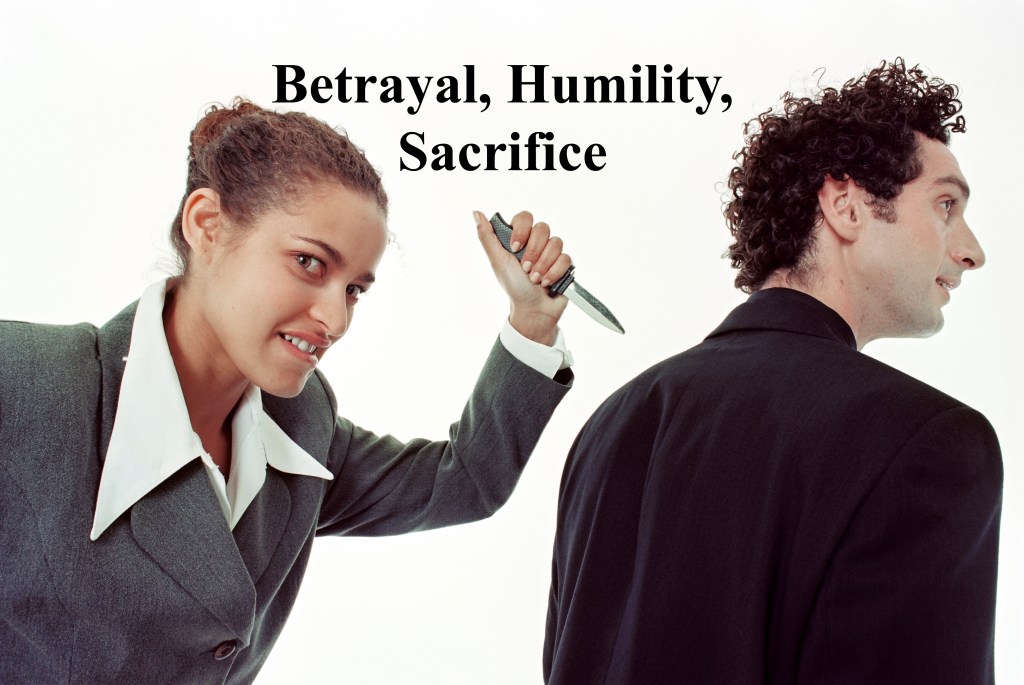
Betrayal, Humility, Sacrifice

Betrayal, Humility, Sacrifice

April 02, 2026*

(Holy Thursday)

By Pastor John Partridge

Exodus 12:1-4, (5-10), 11-14            

John 13:1-17, 31b-35           

1 Corinthians 11:23-26

What is it that makes your family, your church, your civic organization, or your community unique? What is the story that you tell others about how you started, or about your mission, that explains who you are and what you do? As I was growing up, I often heard that while we were encouraged to try new things, Partridges did not quit. If we tried something new, we had to give it a fair trial. Learning to play an instrument is difficult, and so was wrestling when I only weighed seventy-two pounds. But I wasn’t allowed to quit until I had, at least, completed a year or two of band and at least a full season of wrestling. I stayed in band until my second or third year in college and stayed in wrestling for two seasons until I finished junior high school. Patti and I sent the same message to our children when they were growing up. We encourage you to try new things, but once you start, you cannot quit until you’ve given it a fair chance. Every group, and every family, has similar stories that shape the character of the organization as well as the character of its members. And for the people of Israel, and later for the followers of Jesus Christ, one of those formative and defining stories is the story of the first Passover that we find in Exodus 12:1-4, (5-10), 11-14.

12:1 The Lord said to Moses and Aaron in Egypt, “This month is to be for you the first month, the first month of your year. Tell the whole community of Israel that on the tenth day of this month each man is to take a lamb for his family, one for each household. If any household is too small for a whole lamb, they must share one with their nearest neighbor, having taken into account the number of people there are. You are to determine the amount of lamb needed in accordance with what each person will eat. The animals you choose must be year-old males without defect, and you may take them from the sheep or the goats. Take care of them until the fourteenth day of the month, when all the members of the community of Israel must slaughter them at twilight. Then they are to take some of the blood and put it on the sides and tops of the doorframes of the houses where they eat the lambs. That same night they are to eat the meat roasted over the fire, along with bitter herbs, and bread made without yeast. Do not eat the meat raw or boiled in water, but roast it over a fire—with the head, legs, and internal organs. 10 Do not leave any of it till morning; if some is left till morning, you must burn it. 11 This is how you are to eat it: with your cloak tucked into your belt, your sandals on your feet and your staff in your hand. Eat it in haste; it is the Lord’s Passover.

12 “On that same night I will pass through Egypt and strike down every firstborn of both people and animals, and I will bring judgment on all the gods of Egypt. I am the Lord. 13 The blood will be a sign for you on the houses where you are, and when I see the blood, I will pass over you. No destructive plague will touch you when I strike Egypt.

14 “This is a day you are to commemorate; for the generations to come you shall celebrate it as a festival to the Lord—a lasting ordinance.

The Passover story declares to everyone that all of Israel, from the least to the greatest, is a family and that everyone is included. It is also a story of God’s rescue and his love for his people.

And it is with this background in mind that we enter the story of Jesus’ betrayal, arrest, and crucifixion found in John 13:1-17, 31b-35 and hear this:

13:1 It was just before the Passover Festival. Jesus knew that the hour had come for him to leave this world and go to the Father. Having loved his own who were in the world, he loved them to the end.

The evening meal was in progress, and the devil had already prompted Judas, the son of Simon Iscariot, to betray Jesus. Jesus knew that the Father had put all things under his power, and that he had come from God and was returning to God; so he got up from the meal, took off his outer clothing, and wrapped a towel around his waist. After that, he poured water into a basin and began to wash his disciples’ feet, drying them with the towel that was wrapped around him.

He came to Simon Peter, who said to him, “Lord, are you going to wash my feet?”

Jesus replied, “You do not realize now what I am doing, but later you will understand.”

“No,” said Peter, “you shall never wash my feet.”

Jesus answered, “Unless I wash you, you have no part with me.”

“Then, Lord,” Simon Peter replied, “not just my feet but my hands and my head as well!”

10 Jesus answered, “Those who have had a bath need only to wash their feet; their whole body is clean. And you are clean, though not every one of you.” 11 For he knew who was going to betray him, and that was why he said not every one was clean.

12 When he had finished washing their feet, he put on his clothes and returned to his place. “Do you understand what I have done for you?” he asked them. 13 “You call me ‘Teacher’ and ‘Lord,’ and rightly so, for that is what I am. 14 Now that I, your Lord, and Teacher, have washed your feet, you also should wash one another’s feet. 15 I have set you an example that you should do as I have done for you. 16 Very truly I tell you, no servant is greater than his master, nor is a messenger greater than the one who sent him. 17 Now that you know these things, you will be blessed if you do them.

31 When he [Judas] was gone, Jesus said, “Now the Son of Man is glorified, and God is glorified in him. 32 If God is glorified in him. God will glorify the Son in himself, and will glorify him at once.

33 “My children, I will be with you only a little longer. You will look for me, and just as I told the Jews, so I tell you now: Where I am going, you cannot come.

34 “A new command I give you: Love one another. As I have loved you, so you must love one another. 35 By this everyone will know that you are my disciples, if you love one another.”

Jesus knew that these were his last hours on earth and, rather than fleeing to save his own life, Jesus followed the pattern of God, of Israel, and of the Passover, by placing love, family, and rescue ahead of his own wellbeing. Jesus takes on the role of the lowest ranking servant and humbles himself as he washes the feet of those who follow him. Jesus says that just as every person who belongs to the nation of Israel is a part of the family, every person who follows him must be humble enough to wash feet and serve others. The distinguishing character of Jesus’ followers will not only be family but also love and humility. Jesus says, “By this everyone will know that you are my disciples, if you love one another.” This can’t be the ordinary love that we see among families and friends, but it must be so extra-ordinary, so singularly distinctive, that people will see it and know that we belong to Jesus.

But there is another thing that makes our community unique and shapes the character of the organization and its members, and it goes beyond who we are and how we act. In 1 Corinthians 11:23-26, the Apostle Paul explains it this way:

23 For I received from the Lord what I also passed on to you: The Lord Jesus, on the night he was betrayed, took bread, 24 and when he had given thanks, he broke it and said, “This is my body, which is for you; do this in remembrance of me.” 25 In the same way, after supper he took the cup, saying, “This cup is the new covenant in my blood; do this, whenever you drink it, in remembrance of me.” 26 For whenever you eat this bread and drink this cup, you proclaim the Lord’s death until he comes.

Paul says that he was passing what he knew forward to new generations and that this was a key part of his mission. It was important that he passed on to others the knowledge and teaching that he had received from God. He passed on the importance of sharing a meal at the Lord’s table and remembering Jesus’ last supper, but he emphasizes that each time we share that meal together, we proclaim the message of Jesus’ sacrifice, death, and resurrection and teach others about him. Our celebration of the Lord’s table, or the Eucharist, or Communion, is a reminder to us, and a reminder to the world, of the gift that Jesus gave to all of us. And, like Paul, our mission is not to keep that gift to ourselves, but to share it with others and pass it forward to new generations.


*You have been reading a message presented at Christ United Methodist Church on the date noted at the top of the first page.  Rev. John Partridge is the pastor at Christ UMC in Alliance, Ohio.  Duplication of this message is a part of our Media ministry, if you have received a blessing in this way, we would love to hear from you.  Letters and donations in support of the Media ministry or any of our other projects may be sent to Christ United Methodist Church, 470 East Broadway Street, Alliance, Ohio 44601.  These messages are available to any interested persons regardless of membership.  You may subscribe to these messages, in print or electronic formats, by writing to the address noted, or by contacting us at secretary@CUMCAlliance.org.  These messages can also be found online at https://pastorpartridge.com .  All Scripture quotations, unless otherwise indicated, are taken from the Holy Bible, New International Version®, NIV®. Copyright ©1973, 1978, 1984, 2011 by Biblica, Inc.™ Used by permission of Zondervan. All rights reserved worldwide. www.zondervan.com The “NIV” and “New International Version” are trademarks registered in the United States Patent and Trademark Office by Biblica, Inc.™