God’s Choice

God’s Choice

July 14, 2024*

By Pastor John Partridge

2 Samuel 6:1-5, 12b-19                     Mark 6:14-29                         Ephesians 1:3-14

What choices have you made so far today? It seems obvious to say that everyone here chose to wake up, get out of bed, get dressed, and come to church. Most of us also chose to take a shower, brush our teeth, and otherwise make ourselves presentable. But those are the easy choices.  We like to eat and have the money to pay for things, so we choose to go to work. But occasionally, at work, at home, and elsewhere, we must make harder choices. Do we go along with the crowd, do we follow our friends, even when what they are doing is not honoring to God? Do we stand up against our own political party, or our own church denomination, or our alumni association, or the club to which we’ve belonged for many years, when those groups choose a path that runs against the instructions of scripture? Or do we sometimes elevate our need to belong, or our allegiance to some organization, above our obedience to God and, in doing so, make it into an idol?

Our scriptures for today are dramatically different from one another and have little in common except that, in each one, the people in the story had to make choices, and the choices that they made defined them and revealed who they were at heart. We begin by returning once again to the story of David contained in 2 Samuel 6:1-5, 12b-19 in which, with Israel now unified and at peace, David and his army retrieve the Ark of the Covenant and bring it to Jerusalem.

6:1 David again brought together all the able young men of Israel—thirty thousand. He and all his men went to Baalahin Judah to bring up from there the ark of God, which is called by the Name, the name of the Lord Almighty, who is enthroned between the cherubim on the ark. They set the ark of God on a new cart and brought it from the house of Abinadab, which was on the hill. Uzzah and Ahio, sons of Abinadab, were guiding the new cart with the ark of God on it, and Ahio was walking in front of it. David and all Israel were celebrating with all their might before the Lord, with castanets, harps, lyres, timbrels, sistrums [an Egyptian shaker/rattle instrument] and cymbals.

So, David went to bring up the ark of God from the house of Obed-Edom to the City of David with rejoicing. 13 When those who were carrying the ark of the Lord had taken six steps, he sacrificed a bull and a fattened calf. 14 Wearing a linen ephod, David was dancing before the Lord with all his might, 15 while he and all Israel were bringing up the ark of the Lord with shouts and the sound of trumpets.

16 As the ark of the Lord was entering the City of David, Michal, the daughter of Saul, watched from a window. And when she saw King David leaping and dancing before the Lord, she despised him in her heart.

17 They brought the ark of the Lord and set it in its place inside the tent that David had pitched for it, and David sacrificed burnt offerings and fellowship offerings before the Lord. 18 After he had finished sacrificing the burnt offerings and fellowship offerings, he blessed the people in the name of the Lord Almighty. 19 Then he gave a loaf of bread, a cake of dates and a cake of raisins to each person in the whole crowd of Israelites, both men and women. And all the people went to their homes.

David had been anointed as king and had unified all twelve tribes of Israel. Together they had conquered the Jebusites and declared Jerusalem as the capitol of their unified nation. David had choices. He could do anything that he wanted to do, but among the first things that he does is to take his entire army, travel to Baalah in Judah, take possession of the Ark of the Covenant, and bring it, with much celebration, to their new home. But watching from a window was David’s wife, Michal, who was the daughter of King Saul. As she watched David singing, and dancing before God in celebration, she did not approve. To her, it was undignified for the king to sing and dance and act with joyful abandon in public. But David had made a choice. David could have built a palace, or set out to conquer his neighbors, or undertake projects that would make Israel, and him, richer. But David wanted to honor God first and chose obedience and faithfulness instead of wealth, power, prestige, or even dignity. David chose joy and thankfulness over appearances, respectability, and decorum. And it was those choices, among many others, that defined who David was, and revealed his heart to God and to the world.

In an entirely different story, of an entirely different sort of king, we read the story of king Herod Antipas and the death of John the Baptist in Mark 6:14-29. And in this story, like David, Herod makes some choices that defined him, and revealed his heart.

14 King Herod [Antipas who ruled over Galilee and Perea, the areas east of the Jordan River] heard about this, for Jesus’ name had become well known. Some were saying, “John the Baptist has been raised from the dead, and that is why miraculous powers are at work in him.”

15 Others said, “He is Elijah.”

And still others claimed, “He is a prophet, like one of the prophets of long ago.”

16 But when Herod heard this, he said, “John, whom I beheaded, has been raised from the dead!”

17 For Herod himself had given orders to have John arrested, and he had him bound and put in prison. He did this because of Herodias, his brother Philip’s wife, whom he had married. 18 For John had been saying to Herod, “It is not lawful for you to have your brother’s wife.” [Herod Philip who ruled over Ceasarea Phillip and the area north and west of Galilee] 19 So Herodias nursed a grudge against John and wanted to kill him. But she was not able to, 20 because Herod feared John and protected him, knowing him to be a righteous and holy man. When Herod heard John, he was greatly puzzled; yet he liked to listen to him.

21 Finally the opportune time came. On his birthday Herod gave a banquet for his high officials and military commanders and the leading men of Galilee. 22 When the daughter ofHerodias came in and danced, she pleased Herod and his dinner guests.

The king said to the girl, “Ask me for anything you want, and I’ll give it to you.” 23 And he promised her with an oath, “Whatever you ask I will give you, up to half my kingdom.”

24 She went out and said to her mother, “What shall I ask for?”

“The head of John the Baptist,” she answered.

25 At once the girl hurried in to the king with the request: “I want you to give me right now the head of John the Baptist on a platter.”

26 The king was greatly distressed, but because of his oaths and his dinner guests, he did not want to refuse her. 27 So he immediately sent an executioner with orders to bring John’s head. The man went, beheaded John in the prison, 28 and brought back his head on a platter. He presented it to the girl, and she gave it to her mother. 29 On hearing of this, John’s disciples came and took his body and laid it in a tomb.

Although Herod was distressed by the choice that he was forced to make because of the unwise oath that he had taken in front of his guests, rather than choosing what was right, he chose violence. Rather than choosing repentance and righteousness, Herod chose his reputation. For Herod, it was more important to look good than to be good.

And now we come to Paul’s letter to the church in Ephesus and the words of Ephesians 1:3-14, where Paul reminds us of what God chose. God’s choices were, and are, limitless. God is the creator of at least one universe and all that we know. God could do anything, but Paul reminds us that the choice God makes is utterly astounding and, as it did in the case of David and Herod, God’s choice reveals his heart. Paul says:

Praise be to the God and Father of our Lord Jesus Christ, who has blessed us in the heavenly realms with every spiritual blessing in Christ. For he chose us in him before the creation of the world to be holy and blameless in his sight. In love hepredestined us for adoption to sonshipthrough Jesus Christ, in accordance with his pleasure and will— to the praise of his glorious grace, which he has freely given us in the One he loves. In him we have redemption through his blood, the forgiveness of sins, in accordance with the riches of God’s grace that he lavished on us. With all wisdom and understanding, hemade known to us the mystery of his will according to his good pleasure, which he purposed in Christ, 10 to be put into effect when the times reach their fulfillment—to bring unity to all things in heaven and on earth under Christ.

11 In him we were also chosen, having been predestined according to the plan of him who works out everything in conformity with the purpose of his will, 12 in order that we, who were the first to put our hope in Christ, might be for the praise of his glory. 13 And you also were included in Christ when you heard the message of truth, the gospel of your salvation. When you believed, you were marked in him with a seal, the promised Holy Spirit, 14 who is a deposit guaranteeing our inheritance until the redemption of those who are God’s possession—to the praise of his glory.

As I said a moment ago, God’s choices were, and are, limitless, and Paul’s point is that with infinite power at his fingertips, God chose… us. Paul says that before the creation of the world, God intended for us to be holy and blameless and planned to adopt us into sonship. And it is worth a moment of explanation that the phrase that Paul uses, “adoption to sonship” isn’t just flowery or emotional language, it is a Greek legal term that describes a legal and binding adoption. God, through Jesus Christ, legally adopts us as his children, with all the rights of inheritance that implies, forgives our sins, and pours out his grace on us. Paul says that we were chosen to be a part of God’s plan to bring about the will of God. And, when we chose to believe, we were marked with the Holy Spirit as a deposit and downpayment of our future inheritance as God’s children.

When David became king, his choices revealed his heart and his character and, instead of choosing to pursue wealth, power, notoriety, or ego stroking building projects, David chose to make his first act an act of faithfulness, obedience, and joy.

In contrast, when asked for the head of John the Baptist, Herod Antipas chose violence and reputation over repentance and righteousness.

But God, the king of the universe, with infinite power to do whatever comes to his mind…

… chooses us. And not only does God choose us, but he also plans, in advance, even before creation, to make us holy and blameless through the sacrifice of his son Jesus Christ, and to legally adopt us as his heirs, as sons and daughters of the king. And just to be sure that that we know that he loves us, and see his intentions for us, God marks us with a seal, and leaves us with a deposit guaranteeing our inheritance, by sending the Holy Spirit to live with us, and in us.

David chose obedience.

Herod chose his reputation.

God… (pause) …chose us.

Like David, and like Herod, God’s choice reveals his heart and his character and leaves us with a choice.

Will we choose God, and follow him?

________________________________________________

Please LIKE and SHARE!

Click here to subscribe to Pastor John’s blog.

Click here if you would like to subscribe to Pastor John’s weekly messages.

Click here to visit Pastor John’s YouTube channel.


*You have been reading a message presented at Christ United Methodist Church on the date noted at the top of the first page.  Rev. John Partridge is the pastor at Christ UMC in Alliance, Ohio.  Duplication of this message is a part of our Media ministry, if you have received a blessing in this way, we would love to hear from you.  Letters and donations in support of the Media ministry or any of our other projects may be sent to Christ United Methodist Church, 470 East Broadway Street, Alliance, Ohio 44601.  These messages are available to any interested persons regardless of membership.  You may subscribe to these messages, in print or electronic formats, by writing to the address noted, or by contacting us at secretary@CUMCAlliance.org.  These messages can also be found online at https://pastorpartridge.com .  All Scripture quotations, unless otherwise indicated, are taken from the Holy Bible, New International Version®, NIV®. Copyright ©1973, 1978, 1984, 2011 by Biblica, Inc.™ Used by permission of Zondervan. All rights reserved worldwide. www.zondervan.comThe “NIV” and “New International Version” are trademarks registered in the United States Patent and Trademark Office by Biblica, Inc.™


Photo by Comstock on Freeimages.com

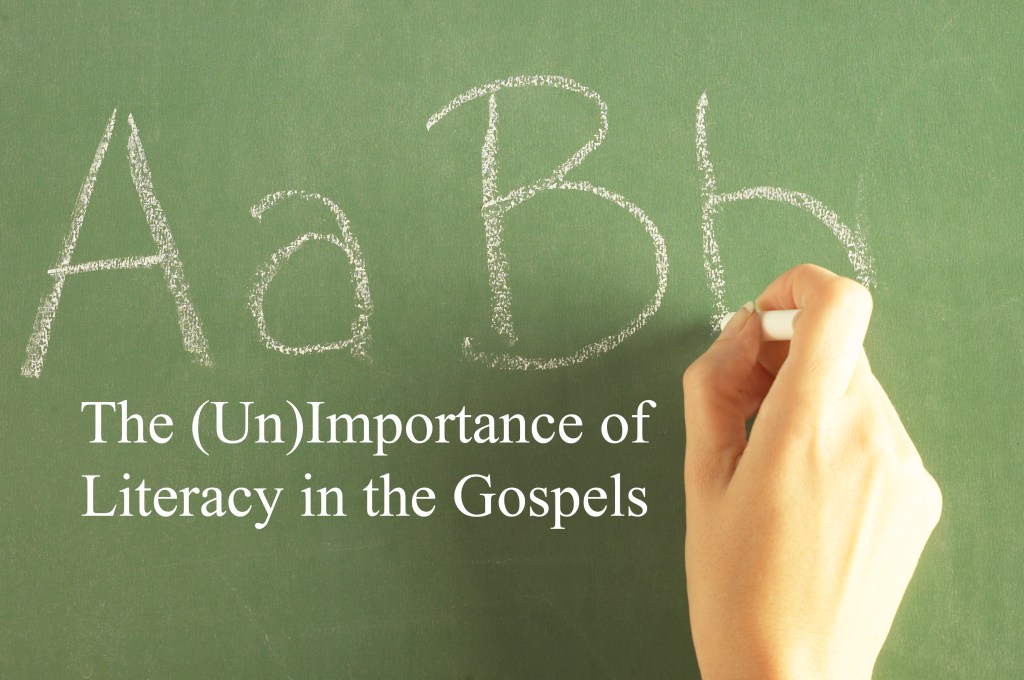
The (Un)Importance of Literacy in the Gospels

The (Un)Importance of Literacy in the Gospels

July 10, 2024

by John Partridge

When we read the Bible, or when we teach, preach, or listen to the Sunday sermon in church we use our imagination to picture, in our mind, the one of the biggest mistakes that we make is to imagine that the people of the New Testament were just like us. Oh, we know that they didn’t have modern conveniences like telephones, electricity, and air conditioning, but in our mind’s eye we see the characters of the bible as having the same values, education, and attitudes that we do… and almost every time we do that, we’re wrong.

Often, our being wrong in this way is not a problem. I have often said on Sunday mornings that as much as times have changed, people are still people and so it’s easy for us to imagine the feelings and emotions that the people in our scripture lessons felt. When we read stories of families who suffered from infertility, in a culture where fertility was seen as God’s approval and blessing, we can feel their frustration and pain. When we read about the death of Jesus’ friend Lazarus, it isn’t hard for us to feel the grief and loss of his sisters Mary and Martha. And it doesn’t matter much if we make a few incorrect assumptions about their values and education.

But sometimes it does.

As I studied the history of first century Israel and Judea this week, I was struck by the literacy rates that historians now attribute to the people of that time and place. But before I get to that, consider that, in the United States, the average rate of literacy is 79 percent. The highest rate of literacy is in the state of New Hampshire at 94.2 percent and the lowest rate is in the state of California which has a literacy rate of 76.9 percent. Without getting into a discussion of politics or education, many nations, even many of those that Americans would look upon as less developed, clock in much higher.

But statistics like these assume that literacy requires both reading and writing because, in our modern culture, reading and writing, for both genders, are both assumed to be necessary. But that hasn’t always been the case, and it certainly wasn’t the case at the turn of the first century. When we read the stories of the New Testament, the people that we meet live in a literary world that is nothing at all like the one in our lived experience and that difference can sometimes change the way that we see and understand them.

One of the first places that we see this difference is found in our expectation of what would be seen as Jesus and his disciples visited synagogues in and around Galilee. Because our life experience tells us that (almost) every church has a pastor or priest, every synagogue has a rabbi, and all of them are literate, we have a natural expectation that this is what happened in the world of the gospels also.

But it isn’t.

First, synagogues, as dedicated buildings, were rare. Instead, in the first century, many synagogues were meetings in private homes or in public buildings that served multiple purposes much like “meeting houses” that were seen in small towns in the American West. Second, while there were such things as rabbis, the rabbis of the first century were scholars and theologians who mostly studied in Jerusalem and rarely, if ever, taught anywhere. Likewise, Pharisees didn’t teach, nor did scribes, which I will say more about later. What happened in synagogues was that the Torah was read or recited from memory. And here we encounter our first big break between our expectations and reality as it relates to literacy.

The typical synagogue rule was that any male in the synagogue gathering could stand and read from the Torah and, from our experience, we would expect that this would be most of the men present. But that wasn’t the case at all. And it is here that I need to draw another distinction that we typically do not make in the twenty-first century, and that is the difference between reading literacy and writing literacy. While we see both as vitally important, that was not the case in the first century. The ability to read simple literary texts, reading literacy, was less than 10 to 15 percent and the majority of those who could do that would be found among the aristocracy in cities and larger towns and not in the small rural areas of Galilee. But to refine that idea a little further, since the literacy rate among girls would have been nearly zero, then the apparent literacy among men would have appeared to be higher. In any case, the result was that in a small rural synagogue, the number of men in the gathering who could read well enough to stand and read from the Torah would have been very small.

In most cases, both in Jewish and in Greco-Roman families, education was private and informal, meaning that the father would teach his children (if the father had any education himself), and then usually only his sons as it was seen to be a waste of time to educate girls. Public schools, as we understand them, simply did not exist in the first century and children did not have the leisure time necessary for education. In a subsistence economy, the labor of children, as soon as they were able to do much of anything, was needed to help their families to grow crops, fish, spin cloth, or whatever was needed for their family to survive. Illiteracy was not seen as a bad thing; it was just an ordinary thing. Only those parents who valued education and had the financial wealth to do it, and had the needed leisure time, would have promoted education, and that leaves us with only a handful of moderately wealthy families.

As I noted earlier, even fewer people could write. Perhaps 10 to 15 percent of people could write slowly, but many not at all. And, as we would measure literacy, being truly literate and able to both read and write, reduces the number to only 2 or 3 percent. According to Richard Horsley, “Writing had little importance except for certain functions of the elite.” People simply did not write letters, or keep journals, or take notes in school. If you needed something written, you hired a scribe, or used a slave that knew how to write. Persons who could write were not seen as socially valuable and may even have been looked down upon. Writing was a skill, much like we see modern tradespersons. If you needed it done, you hired someone who could do it. And that helps explain why scribes didn’t teach. While they had the skill to write, most often they were not otherwise particularly learned or educated.

And when we begin to think about the world of Jesus in this way, it changes how we see the people, the events that we see in the synagogues, about how Jesus was able to read from the Torah scroll (or did he?) and how the Gospels themselves came to be written.

________________________________________________

Please LIKE and SHARE!

Click here to subscribe to Pastor John’s blog.

Click here if you would like to subscribe to Pastor John’s weekly messages.

Click here to visit Pastor John’s YouTube channel.

Photo by Dynamic Graphics Group on Freeimages.com

The Unlikely, Improbable, and Impossible

The Unlikely, Improbable, and Impossible

July 07, 2024*

By Pastor John Partridge

2 Samuel 5:1-5, 9-10              Mark 6:1-13               2 Corinthians 12:2-10

If you look at today’s sermon title, you will see three words of interest: Unlikely, Improbable, and Impossible. So, what, you might ask, is the difference? And to describe the difference, at least for us to have a starting point, let me give you some examples.

First, although I can, technically, choose to retire, or outright quit, any time that I want to do so, it is unlikely that I will do so anytime in the next couple of years. Although I can, I am not likely to do so unless something significant were to change. Second, since I have been here at Christ Church for six years, and have been in ministry for twenty, and the bishop of the East Ohio Conference has never once set foot in my church on a Sunday morning, it is improbable that our bishop would unexpectedly arrive to worship with us this morning. It is, of course, possible, since our bishop can choose to attend church anywhere that she wants to, but given our experience, it is improbable that it would happen today. And finally, since she lacks the ability to speak in a human language, it is impossible for our German Shepherd, Natasha, to arrive at church and preach today’s sermon. It isn’t just that it is unlikely for Patti to drive, or even walk, Natasha to church on a Sunday morning, or that it is improbable that Natasha would have any interest in preaching, but since she cannot speak English, let alone with any significant vocabulary, we understand that such a thing would be impossible.

Looking at these words from another perspective, Arthur Conan Doyle through his character, Dr. Watson, once asked Sherlock Holmes how he could have reached his conclusion and solved the mystery from the few facts that were in evidence. In answer, Sherlock famously said, “Once you eliminate the impossible, whatever remains, no matter how improbable, must be the truth.”

And so, with the impossible in mind, let us return once again to the story of Israel’s great King David. You will remember that in our scripture lesson last week, we read of the death of King Saul, and the subsequent mourning of David and the entire nation of Israel. But this week, we see something new as both the tribes of Israel, and the tribe of Judah, come together to anoint David as their king. This didn’t happen right away. After the death of Saul and Jonathan, the southern tribe of Judah anointed David as their king, but the northern tribes of Israel followed Saul’s surviving son, Ishbaal. What followed was something like a civil war with tensions and violence between the two, but finally Ishbaal was assassinated by two of his own officers, who were later put to death by David for Ishbaal’s murder. But after the death of Ishbaal, we come to 2 Samuel 5:1-10 and hear this:

5:1 All the tribes of Israel came to David at Hebron and said, “We are your own flesh and blood. In the past, while Saul was king over us, you were the one who led Israel on their military campaigns. And the Lord said to you, ‘You will shepherd my people Israel, and you will become their ruler.’”

When all the elders of Israel had come to King David at Hebron, the king made a covenant with them at Hebron before the Lord, and they anointed David king over Israel.

David was thirty years old when he became king, and he reigned forty years. In Hebron he reigned over Judah seven years and six months, and in Jerusalem he reigned over all Israel and Judah thirty-three years.

The king and his men marched to Jerusalem to attack the Jebusites, who lived there. The Jebusites said to David, “You will not get in here; even the blind and the lame can ward you off.” They thought, “David cannot get in here.” Nevertheless, David captured the fortress of Zion—which is the City of David.

On that day David had said, “Anyone who conquers the Jebusites will have to use the water shaft to reach those ‘lame and blind’ who are David’s enemies.” That is why they say, “The ‘blind and lame’ will not enter the palace.”

David then took up residence in the fortress and called it the City of David. He built up the area around it, from the terracesinward. 10 And he became more and more powerful, because the Lord God Almighty was with him.

And thus, in this short reading, we see David being anointed for the third time, the first when he was a young man about 15 years of age by the prophet Samuel, again by the tribe of Judah after the death of Saul, and now by the other 11 tribes as Israel returns to what is referred to as the United Monarchy when all 12 tribes joined together. That journey, from shepherd boy to king, was seen, even by David’s family, as impossible. And yet, because God was in it, the impossible became reality. Next, was the story of how the united nation of Israel, captured the city of Jerusalem, which was so well constructed, and so well defended, that it was thought to be impossible to capture. And yet, Israel does so.

Still more impossibilities become reality in the account of Jesus and the disciples found in Mark 6:1-13 where we hear this:

6:1 Jesus left there and went to his hometown, accompanied by his disciples. When the Sabbath came, he began to teach in the synagogue, and many who heard him were amazed.

“Where did this man get these things?” they asked. “What’s this wisdom that has been given him? What are these remarkable miracles he is performing? Isn’t this the carpenter? Isn’t this Mary’s son and the brother of James, Joseph, Judas, and Simon? Aren’t his sisters here with us?” And they took offense at him.

Jesus said to them, “A prophet is not without honor except in his own town, among his relatives and in his own home.” He could not do any miracles there, except lay his hands on a few sick people and heal them. He was amazed at their lack of faith.

Then Jesus went around teaching from village to village. Calling the Twelve to him, he began to send them out two by two and gave them authority over impure spirits.

These were his instructions: “Take nothing for the journey except a staff—no bread, no bag, no money in your belts. Wear sandals but not an extra shirt. 10 Whenever you enter a house, stay there until you leave that town. 11 And if any place will not welcome you or listen to you, leave that place, and shake the dust off your feet as a testimony against them.”

12 They went out and preached that people should repent. 13 They drove out many demons, and anointed many sick people with oil, and healed them.

First, as Jesus preaches in his hometown, the people are offended that Jesus preaches with wisdom and authority because they cannot imagine that someone that they know could possess such amazing gifts from God. They knew, or at least they believed, that such a thing was impossible. Such things just didn’t happen. But it did.

Second, as Jesus sends his disciples out to preach, teach, and cast out demons in the surrounding villages, he takes particular care that none of them are equipped with anything that could support them in their work. They took a walking stick, but no money, no food, no change of clothing, and not even an empty sack that they might use to save leftovers. The result was that they did what was humanly impossible. They preached without education, they drove out demons, and they healed the sick. In other words, they did things that only God could do and by doing so, demonstrated that God was with them.

And that is exactly the point that Paul makes about his own ministry, as well as ours in 2 Corinthians 12:2-10. Rather than protest, as many of us do, that we can’t do this thing, or that thing because we aren’t properly educated, or haven’t had time to prepare, or that we don’t have enough money, or some other excuse, Paul says that our weaknesses are exactly the point. He says…

I know a man in Christ who fourteen years ago was caught up to the third heaven. Whether it was in the body or out of the body I do not know—God knows. And I know that this man—whether in the body or apart from the body I do not know, but God knows— was caught up to paradise and heard inexpressible things, things that no one is permitted to tell. I will boast about a man like that, but I will not boast about myself, except about my weaknesses. Even if I should choose to boast, I would not be a fool, because I would be speaking the truth. But I refrain, so no one will think more of me than is warranted by what I do or say, or because of these surpassingly great revelations. Therefore, in order to keep me from becoming conceited, I was given a thorn in my flesh, a messenger of Satan, to torment me. Three times I pleaded with the Lord to take it away from me. But he said to me, “My grace is sufficient for you, for my power is made perfect in weakness.” Therefore, I will boast all the more gladly about my weaknesses, so that Christ’s power may rest on me. 10 That is why, for Christ’s sake, I delight in weaknesses, in insults, in hardships, in persecutions, in difficulties. For when I am weak, then I am strong.

Paul says that all sorts of unlikely, improbable, and impossible things happened to him and the only explanation that he can offer is, much like Sherlock Holmes, having eliminated the impossible, the only reasonable conclusion that is left is the truth that God must have done it.

For the youngest son, of an unimportant man, from an unimportant tribe, to become the king, was impossible but David did it.

For anyone to capture Jerusalem, was physically, militarily, tactically, geographically, and topographically impossible but Israel did it.

For the son of a carpenter, without the benefit of higher education, to preach, teach, heal, and cast out demons was impossible, but Jesus did it.

For uneducated fishermen and the other followers of Jesus to go into the countryside without food, or clothing, or any assistance at all, and to preach, teach, cast out demons, and heal the sick was impossible, but the disciples did it.

For Paul to accomplish what he did, in the face of insults, hardships, persecutions, arrests, beatings, and imprisonment was impossible, but he did it.

Too often we focus on what we think we need to do the job, but our God delights in our weakness because it is in our shortcomings where the world sees God pulling the strings behind the curtain. We don’t need faith when we see the Cleveland Clinic heal people, armed with thousands of doctors, and tens of millions of dollars in laboratories, technicians, tools, machines, and other medical whiz-bangery. But watch an ordinary lay person, lay hands on a sick person, pray, and bring about their healing, and we stand amazed because we know that we have witnessed the hand of God.

We are all called by God to do his work and, regardless of who we are, or how unprepared we might feel, we must act and do what God is calling us to do. Because, at the end of the day, we see God most clearly when, with his help, we accomplish the unlikely, the improbable, and the impossible.

________________________________________________

Please LIKE and SHARE!

Click here to subscribe to Pastor John’s blog.

Click here if you would like to subscribe to Pastor John’s weekly messages.

Click here to visit Pastor John’s YouTube channel.


*You have been reading a message presented at Christ United Methodist Church on the date noted at the top of the first page.  Rev. John Partridge is the pastor at Christ UMC in Alliance, Ohio.  Duplication of this message is a part of our Media ministry, if you have received a blessing in this way, we would love to hear from you.  Letters and donations in support of the Media ministry or any of our other projects may be sent to Christ United Methodist Church, 470 East Broadway Street, Alliance, Ohio 44601.  These messages are available to any interested persons regardless of membership.  You may subscribe to these messages, in print or electronic formats, by writing to the address noted, or by contacting us at secretary@CUMCAlliance.org.  These messages can also be found online at https://pastorpartridge.com .  All Scripture quotations, unless otherwise indicated, are taken from the Holy Bible, New International Version®, NIV®. Copyright ©1973, 1978, 1984, 2011 by Biblica, Inc.™ Used by permission of Zondervan. All rights reserved worldwide. www.zondervan.comThe “NIV” and “New International Version” are trademarks registered in the United States Patent and Trademark Office by Biblica, Inc.™

Photo by mwookie on Freeimages.com

Testing Love

Testing Love

June 30, 2024*

By Pastor John Partridge

2 Samuel 1:1, 17-27               Mark 5:21-43             2 Corinthians 8:7-15

We hear the words “I love you” often. We hear them from our loved ones, we hear them on television and in the movies, and we hear the word “love” thrown around by churches, ministry groups, rescue groups, and even government officials in an almost constant stream.

But what if love came with a test?

What would it look like if there was a test to determine if love was real? Is there a way for us to tell if the people who throw around the word “love” really do love, or if they are only using the word to manipulate and to appear to be something more than they really are?

And, although on the surface it may appear that our scriptures for today are not connected, as we dig a little deeper what we find is that they all reveal the truth about the love of the people in them. We begin once again with the story of David. In this passage from 2 Samuel 1:1, 17-27, David learns that King Saul, and his son Jonathan, David’s best, and closest, friend, have died in battle. This is the moment that David knows that Saul will no longer hunt for him, or send his entire army to hunt for him, so that he could be captured and put to death, the moment that David learns that he is no longer a fugitive. This is the moment that David realizes that his anointing as the king of Israel by the prophet Samuel might finally become a reality. But as these realities come into his mind, this is how David reacts:

1:1 After the death of Saul, David returned from striking down the Amalekites and stayed in Ziklag two days.

17 David took up this lament concerning Saul and his son Jonathan, 18 and he ordered that the people of Judah be taught this lament of the bow (it is written in the Book of Jashar):

19 “A gazellelies slain on your heights, Israel.
    How the mighty have fallen!

20 “Tell it not in Gath,
    proclaim it not in the streets of Ashkelon,
lest the daughters of the Philistines be glad,
    lest the daughters of the uncircumcised rejoice.

21 “Mountains of Gilboa,
    may you have neither dew nor rain,
    may no showers fall on your terraced fields.
For there the shield of the mighty was despised,
    the shield of Saul—no longer rubbed with oil.

22 “From the blood of the slain, from the flesh of the mighty,
the bow of Jonathan did not turn back, the sword of Saul did not return unsatisfied.
23 Saul and Jonathan—
    in life they were loved and admired, and in death they were not parted.
They were swifter than eagles, they were stronger than lions.

24 “Daughters of Israel, weep for Saul,
who clothed you in scarlet and finery,
    who adorned your garments with ornaments of gold.

25 “How the mighty have fallen in battle!
    Jonathan lies slain on your heights.
26 I grieve for you, Jonathan my brother;
    you were very dear to me.
Your love for me was wonderful,
    more wonderful than that of women.

27 “How the mighty have fallen!
    The weapons of war have perished!”

Rather than rejoice over the end of being hunted or looking forward to finally having a chance at becoming king, rather than cursing the man who expended so much effort in trying to destroy him… David mourns. David weeps over the loss of his best friend but also over the loss of Israel’s greatest warrior and admired king. Despite Saul’s madness and his persecution of David, David never stopped loving him as his friend and mentor or stopped admiring him and respecting him as Israel’s king.

This is the moment that tests David’s sincerity, and we see that David didn’t just use the word “love” because it was politically expedient or momentarily popular, David’s tears and songs of mourning reveal that his love for both Saul and Jonathan was real.

Curiously, there are two stories, which we have heard and read many times, from the Gospel of Mark, which illustrate this same sort of test for the sincerity of love, trust, and faith and we read these stories this morning from Mark 5:21-43, where it says:

21 When Jesus had again crossed over by boat to the other side of the lake, a large crowd gathered around him while he was by the lake. 22 Then one of the synagogue leaders, named Jairus, came, and when he saw Jesus, he fell at his feet. 23 He pleaded earnestly with him, “My little daughter is dying. Please come and put your hands on her so that she will be healed and live.” 24 So Jesus went with him.

A large crowd followed and pressed around him. 25 And a woman was there who had been subject to bleeding for twelve years. 26 She had suffered a great deal under the care of many doctors and had spent all she had, yet instead of getting better she grew worse. 27 When she heard about Jesus, she came up behind him in the crowd and touched his cloak, 28 because she thought, “If I just touch his clothes, I will be healed.” 29 Immediately her bleeding stopped and she felt in her body that she was freed from her suffering.

30 At once Jesus realized that power had gone out from him. He turned around in the crowd and asked, “Who touched my clothes?”

31 “You see the people crowding against you,” his disciples answered, “and yet you can ask, ‘Who touched me?’”

32 But Jesus kept looking around to see who had done it. 33 Then the woman, knowing what had happened to her, came, and fell at his feet and, trembling with fear, told him the whole truth. 34 He said to her, “Daughter, your faith has healed you. Go in peace and be freed from your suffering.”

35 While Jesus was still speaking, some people came from the house of Jairus, the synagogue leader. “Your daughter is dead,” they said. “Why bother the teacher anymore?”

36 Overhearing what they said, Jesus told him, “Don’t be afraid; just believe.”

37 He did not let anyone follow him except Peter, James, and John the brother of James. 38 When they came to the home of the synagogue leader, Jesus saw a commotion, with people crying and wailing loudly. 39 He went in and said to them, “Why all this commotion and wailing? The child is not dead but asleep.” 40 But they laughed at him.

After he put them all out, he took the child’s father and mother and the disciples who were with him, and went in where the child was. 41 He took her by the hand and said to her, “Talitha koum!” (which means “Little girl, I say to you, get up!”). 42 Immediately the girl stood up and began to walk around (she was twelve years old). At this they were completely astonished. 43 He gave strict orders not to let anyone know about this, and told them to give her something to eat.

First, Jesus meets Jairus, one of the synagogue leaders, or archisynagōgon, who was a powerful and influential man. Far from our thinking that he was the local church lay leader, because there was no such thing as the separation of church, state, or culture, the archisynagogon was the church lay leader, mayor, city administrator, community organizer, and cultural ambassador all rolled up in one person, at least as far as their Roman overlords allowed. But when his daughter was dying, Jairus didn’t go to a rabbi, or to the temple authorities, or to some Roman government official, he came to see Jesus. And when people told him that it was too late, and that his daughter was already dead, Jesus encouraged him to “just believe,” and, despite the laughter of his family and friends who understood that death was permanent and that resurrection was impossible, his love for his daughter allowed him to trust Jesus anyway.

Likewise, after searching for twelve years and seeing every doctor, shaman, healer, and charlatan that she could find, and after spending every penny that she ever had, this poor suffering woman, rather than giving up, thought that she would try one more time. Despite being classified as unclean and being prohibited from coming in contact with “normal” people, she sneaks in from behind everyone, and reaches through the crowd just so that she can touch the fringe on Jesus’ outer garment. When she was tested, there was nothing fake about this poor woman’s suffering nor was there anything fake about her faith.

And I want you to keep those stories in your mind as we read Paul’s words in 2 Corinthians 8:7-15 because Paul understands that sometimes people, and churches, sometimes give lip-service to love. We say that we love Jesus, but we don’t act like it, and we say that we love the people around us, because we know that we’re supposed to, but when push comes to shove, we don’t act very much like we love them. Paul says…

But since you excel in everything—in faith, in speech, in knowledge, in complete earnestness and in the love, we have kindled in you—see that you also excel in this grace of giving.

I am not commanding you, but I want to test the sincerity of your love by comparing it with the earnestness of others. For you know the grace of our Lord Jesus Christ, that though he was rich, yet for your sake he became poor, so that you through his poverty might become rich.

10 And here is my judgment about what is best for you in this matter. Last year you were the first not only to give but also to have the desire to do so. 11 Now finish the work, so that your eager willingness to do it may be matched by your completion of it, according to your means. 12 For if the willingness is there, the gift is acceptable according to what one has, not according to what one does not have.

13 Our desire is not that others might be relieved while you are hard pressed, but that there might be equality. 14 At the present time your plenty will supply what they need, so that in turn their plenty will supply what you need. The goal is equality, 15 as it is written: “The one who gathered much did not have too much, and the one who gathered little did not have too little.”

Paul says that the people in the churches of Corinth are fantastic. They have strong faith, vast knowledge, they are earnest in the things that they do and in the love that they began when they first heard the stories of the gospel.

But Paul wants to test the sincerity of their love.

Paul wants to make sure that they aren’t just giving lip-service to love without really acting like they love. Paul wants to test their love by comparing their earnestness, their passion, against the earnestness and passion of others. He points out that when there was a need, the church in Corinth was the first to step up and give to meet the need, but now Paul asks if their love will compel them to finish what they started. The test, Paul says, isn’t that they should give until they themselves are in need, but that they should give from their abundance until those in need become their equals.

That is quite a test… and it asks a lot of us.

The test of love isn’t just to feed the hungry, but to give from our abundance, not just to feed the poor for a day, but to help the poor, and lift them up, until the poor become our equals. That isn’t a once and done kind of a thing. Like Paul wrote to the Corinthian Christians, you should be loving enough that your eager willingness to do a project may be matched by your completion of it.

Starting a project to help others is a good thing.

But finishing that project is the real test of love.

That’s asking a lot.

But real love isn’t cheap, and we might wonder…

…will our love pass the test?


*You have been reading a message presented at Christ United Methodist Church on the date noted at the top of the first page.  Rev. John Partridge is the pastor at Christ UMC in Alliance, Ohio.  Duplication of this message is a part of our Media ministry, if you have received a blessing in this way, we would love to hear from you.  Letters and donations in support of the Media ministry or any of our other projects may be sent to Christ United Methodist Church, 470 East Broadway Street, Alliance, Ohio 44601.  These messages are available to any interested persons regardless of membership.  You may subscribe to these messages, in print or electronic formats, by writing to the address noted, or by contacting us at secretary@CUMCAlliance.org.  These messages can also be found online at https://pastorpartridge.com .  All Scripture quotations, unless otherwise indicated, are taken from the Holy Bible, New International Version®, NIV®. Copyright ©1973, 1978, 1984, 2011 by Biblica, Inc.™ Used by permission of Zondervan. All rights reserved worldwide. www.zondervan.comThe “NIV” and “New International Version” are trademarks registered in the United States Patent and Trademark Office by Biblica, Inc.™

Photo by Comstock on Freeimages.com

David’s Faith… in David

David’s Faith in… David

June 25, 2024

by Pastor John Partridge

This past week at our church Annual Conference meeting, our Bishop, Tracy Smith Malone, preached a message in which she shared the story of David and Goliath, and framed David’s self-confidence as being a matter of David’s faith in God.

And that’s true.

But it’s more than that.

We can all agree that the story of David and Goliath is clear that while King Saul, and his entire army, were in fear and panic of the size, strength, skill, and power of the Philistine warrior Goliath, David’s faith enabled him to be the only one who had the self-confidence and faith to meet Goliath in single combat, one on one and man-to-man.

But David’s confidence wasn’t entirely faith-based. There was more to it than that and while we usually do a respectable job of preaching the faith part, the other part is just as important. Let me back up and lay some groundwork before I go any farther.

First, it was well-known that a skilled slinger could outrange an archer, strike a moving target at two hundred yards, and were said to be so accurate that they could aim for a specific part of a target’s face. Typical sling stones were 2 to 3 inches in diameter (5-7 cm) and weighed as much as a half-pound (0.25kg). These projectiles would be flung at 100 to 150 miles per hour (160 to 240 kph). Stones of that size, thrown at that speed, could kill by a blow to the head, or by rupturing an organ. Second, we also know that David, spending years in the fields watching his father’s sheep, had ample time, and plenty of rocks, with which to practice his skills with a sling and to become proficient. Third, the stories that we have of David rescuing his sheep by killing a bear and a lion can be offered as evidence of his skill, his fearlessness, and his faith.

And so, you see, David not only had confidence in God, but he also had confidence in… David. He had done the work of preparation. David had practiced during all those lonely years in the wilderness with his father’s sheep. David knew what he could do. He had developed, and honed, his skill with his sling, and he had been battle tested in his encounters with both a lion and a bear.

Yes, David had faith in God. But David had done the work of preparation, and he knew that those two things combined would bring victory against Goliath.

David wasn’t foolish. He didn’t just leap into a fight that he couldn’t hope to win and put all his eggs in the basket of his faith. David did the work of preparation. He developed his skill, and he tested it against deadly opponents. David knew that he had what it took to win, but he also knew that in a fight against a skilled adversary, anything can happen. David did the work of preparation; he did everything that he could to be ready… and the rest he trusted to God.

That was David’s faith… and it’s a model that we would do well to remember.

Faith isn’t jumping off a cliff and hoping that God will save you. Faith is buying a parachute, learning how to use it, and then jumping off a cliff… and trusting that God will use and guide your skill to bring about the desired result.

Faith is important.

But God still expects us to do the work of preparation.

________________________________________________

Please LIKE and SHARE!

Click here to subscribe to Pastor John’s blog.

Click here if you would like to subscribe to Pastor John’s weekly messages.

Click here to visit Pastor John’s YouTube channel.

The Limits of Preparation

The Limits of Preparation

June 23, 2024*

By Pastor John Partridge

1 Samuel 17:1a, 4-11, 19-23, 32-49              Mark 4:35-41           Corinthians 6:1-13

German Field Marshall Helmuth von Moltke was a brilliant military strategist in the 19th Century. He is known today for a quote that has gained popular traction in a shortened form that simply says, “No plan survives contact with the enemy”. This saying applies outside of its obvious military roots because no matter how much we plan or prepare, life is always more complicated and unexpected than our preparations. Olympic athletes train in all sorts of weather, they get hundreds of our nation’s best scientists to develop and oversee their training programs, nutritionists to maximize their diet for the best possible outcome, and still, on the day of the race, they can turn an ankle, trip over an unseen obstacle on the way to the race, or even stumble when a stray cat runs across the track. Life is unpredictable and while preparation must still be an important part of our planning, our preparation and planning won’t always get us across the finish line.

Let’s begin with a story that we have all probably heard before, the story of David and Goliath. I’m going to assume that most of us are familiar with the story, so I’m going skip around a little to save some time. We begin reading this story today from 1 Samuel 17:1a, 4-11, 19-23, 32-49.

Now the Philistines gathered their forces for war and assembled at Sokoh in Judah.

A champion named Goliath, who was from Gath, came out of the Philistine camp. His height was six cubits and a span. [9 ft. 9 inches, for reference, Wilt Chamberlain and Shaquille O’Neill are 7’1” and Andre the Giant was 7’4”] He had a bronze helmet on his head and wore a coat of scale armor of bronze weighing five thousand shekels [125 pounds]; on his legs he wore bronze greaves, and a bronze javelin was slung on his back. His spear shaft was like a weaver’s rod, and its iron point weighed six hundred shekels. [15 pounds] His shield bearer went ahead of him.

Goliath stood and shouted to the ranks of Israel, “Why do you come out and line up for battle? Am I not a Philistine, and are you not the servants of Saul? Choose a man and have him come down to me. If he is able to fight and kill me, we will become your subjects; but if I overcome him and kill him, you will become our subjects and serve us.” 10 Then the Philistine said, “This day I defy the armies of Israel! Give me a man and let us fight each other.” 11 On hearing the Philistine’s words, Saul and all the Israelites were dismayed and terrified.

 24 Whenever the Israelites saw the man, they all fled from him in great fear.

32 David said to Saul, “Let no one lose heart on account of this Philistine; your servant will go and fight him.”

33 Saul replied, “You are not able to go out against this Philistine and fight him; you are only a young man, and he has been a warrior from his youth.”

34 But David said to Saul, “Your servant has been keeping his father’s sheep. When a lion or a bear came and carried off a sheep from the flock, 35 I went after it, struck it, and rescued the sheep from its mouth. When it turned on me, I seized it by its hair, struck it and killed it. 36 Your servant has killed both the lion and the bear; this uncircumcised Philistine will be like one of them, because he has defied the armies of the living God. 37 The Lord who rescued me from the paw of the lion and the paw of the bear will rescue me from the hand of this Philistine.”

Saul said to David, “Go, and the Lord be with you.”

38 Then Saul dressed David in his own tunic. He put a coat of armor on him and a bronze helmet on his head. 39 David fastened on his sword over the tunic and tried walking around, because he was not used to them.

“I cannot go in these,” he said to Saul, “because I am not used to them.” So, he took them off. 40 Then he took his staff in his hand, chose five smooth stones from the stream, put them in the pouch of his shepherd’s bag and, with his sling in his hand, approached the Philistine.

41 Meanwhile, the Philistine, with his shield bearer in front of him, kept coming closer to David. 42 He looked David over and saw that he was little more than a boy, glowing with health and handsome, and he despised him. 43 He said to David, “Am I a dog, that you come at me with sticks?” And the Philistine cursed David by his gods. 44 “Come here,” he said, “and I’ll give your flesh to the birds and the wild animals!”

45 David said to the Philistine, “You come against me with sword and spear and javelin, but I come against you in the name of the Lord Almighty, the God of the armies of Israel, whom you have defied. 46 This day the Lord will deliver you into my hands, and I’ll strike you down and cut off your head. This very day I will give the carcasses of the Philistine army to the birds and the wild animals, and the whole world will know that there is a God in Israel. 47 All those gathered here will know that it is not by sword or spear that the Lord saves; for the battle is the Lord’s, and he will give all of you into our hands.”

48 As the Philistine moved closer to attack him, David ran quickly toward the battle line to meet him. 49 Reaching into his bag and taking out a stone, he slung it and struck the Philistine on the forehead. The stone sank into his forehead, and he fell facedown on the ground.

There’s a lot that can be said about what we find in that reading, but here are the things that I want to highlight: First, Goliath was the champion of the Philistine army. He wasn’t just big; he was the strongest and most skillful soldier of all the Philistines such that none of their other soldiers could beat him. Second, when Goliath offered to end the war by fighting one-on-one with anybody from Israel’s army, Saul the king, as well as his bodyguards, all of the professional soldiers, as well as all of those men, like David’s bothers, that had been conscripted, were terrified because no one, trained or not, could imagine that they could fight Goliath and win. Third, their fear was so great, that whenever they saw Goliath, they ran… but not David. Fourth, Goliath, Saul, and David all spent time in preparation.

Goliath had spent his entire life as a warrior, training with his sword, spear, and javelin. Saul had trained, but he knew that he had been prepared to lead and not to fight. And so, as best as he was able, Saul prepared David to face Goliath the ways that he knew. He gave him his own layers of armor, his helmet, and his sword. But they didn’t fit David, he hadn’t trained to use them, and was unaccustomed to how they felt. And so, instead, David prepared the way that he knew. He took off the armor, set aside the helmet and sword, picked up his shepherd’s staff, and selected five stones (which were probably just a bit smaller than baseballs) that he knew would be suitable for spinning and throwing with his sling.

Of course, David won. But there was more to his accomplishment than preparation because there were others in Saul’s army that knew how to use a sling.

Jesus points to what made David different in Mark 4:35-41, where we hear this:

35 That day when evening came, he said to his disciples, “Let us go over to the other side.” 36 Leaving the crowd behind, they took him along, just as he was, in the boat. There were also other boats with him. 37 A furious squall came up, and the waves broke over the boat, so that it was nearly swamped. 38 Jesus was in the stern, sleeping on a cushion. The disciples woke him and said to him, “Teacher, don’t you care if we drown?”

39 He got up, rebuked the wind, and said to the waves, “Quiet! Be still!” Then the wind died down and it was completely calm.

40 He said to his disciples, “Why are you so afraid? Do you still have no faith?”

41 They were terrified and asked each other, “Who is this? Even the wind and the waves obey him!”

The fishermen were prepared. They had a boat, and they had years of experience, but… there was a squall, a particularly bad, and sudden, appearance of stormy weather. The thing that separated the fishermen from success was… faith.

But, as we consider our present situation and what it takes to share in the work of the Kingdom of God, to share our faith, to grow our church, and to share the good news of Jesus Christ, the Apostle Paul has a few more words of advice that we find in 2 Corinthians 6:1-13. Paul says…

6:1 As God’s co-workers we urge you not to receive God’s grace in vain. For he says,

“In the time of my favor I heard you,
    and in the day of salvation I helped you.”

I tell you, now is the time of God’s favor, now is the day of salvation.

We put no stumbling block in anyone’s path, so that our ministry will not be discredited. Rather, as servants of God we commend ourselves in every way: in great endurance; in troubles, hardships and distresses; in beatings, imprisonments and riots; in hard work, sleepless nights and hunger; in purity, understanding, patience and kindness; in the Holy Spirit and in sincere love; in truthful speech and in the power of God; with weapons of righteousness in the right hand and in the left; through glory and dishonor, bad report and good report; genuine, yet regarded as impostors; known, yet regarded as unknown; dying, and yet we live on; beaten, and yet not killed; 10 sorrowful, yet always rejoicing; poor, yet making many rich; having nothing, and yet possessing everything.

11 We have spoken freely to you, Corinthians, and opened wide our hearts to you. 12 We are not withholding our affection from you, but you are withholding yours from us. 13 As a fair exchange—I speak as to my children—open wide your hearts also.

I have often said that the first rule of sharing the Good News of Jesus Christ is simply… don’t be a jerk. But Paul puts a finer point on it than that. He says that because God wants to save every single person on the planet, and because God is at work trying to rescue them, in all our encounters with the people around us we should “put no stumbling block in anyone’s path.” Which means, don’t do, or say, anything to the people around you that will make it harder for them to hear the message of Jesus Christ from you, of from anyone else today, tomorrow, or ten years from now. If you were trying to save someone from drowning, you would neither put rocks in their pockets, nor do anything to make them afraid of lifeguards or Coast Guard rescue swimmers. Even if you aren’t having any success, even if they favor a brand of politics you don’t like, or participate in a lifestyle with which you disagree, don’t do anything, or say anything, that might prevent them from hearing about Jesus from someone else. Secondly, Paul says, give freely of your affection and “open wide your hearts.” And that means to ask nicely, be kind, be friendly, be loving, and be polite.

It is good for us to read the Bible, study scripture, read books, come to Sunday school and church, learn how to share our faith, and build our confidence in doing so. But the reality is, and always has been, that “No plan survives contact with the enemy.” Life is complicated, and no matter how much we prepare and plan, life doesn’t always happen the way that we had hoped. But beyond our planning and preparation, like David, we have faith that God has our backs to do the things that we can’t do and to plan for the things we cannot know. But we must also listen to Paul so that we are not the reason that someone stumbles and is unable to hear God calling them through the voices of others now, or in the future. Don’t be a jerk. Give love freely, ask nicely, be kind, be friendly, be loving, and be polite.


Please LIKE and SHARE!

Click here to subscribe to Pastor John’s blog.

Click here if you would like to subscribe to Pastor John’s weekly messages.

Click here to visit Pastor John’s YouTube channel.


*You have been reading a message presented at Christ United Methodist Church on the date noted at the top of the first page.  Rev. John Partridge is the pastor at Christ UMC in Alliance, Ohio.  Duplication of this message is a part of our Media ministry, if you have received a blessing in this way, we would love to hear from you.  Letters and donations in support of the Media ministry or any of our other projects may be sent to Christ United Methodist Church, 470 East Broadway Street, Alliance, Ohio 44601.  These messages are available to any interested persons regardless of membership.  You may subscribe to these messages, in print or electronic formats, by writing to the address noted, or by contacting us at secretary@CUMCAlliance.org.  These messages can also be found online at https://pastorpartridge.com .  All Scripture quotations, unless otherwise indicated, are taken from the Holy Bible, New International Version®, NIV®. Copyright ©1973, 1978, 1984, 2011 by Biblica, Inc.™ Used by permission of Zondervan. All rights reserved worldwide. www.zondervan.comThe “NIV” and “New International Version” are trademarks registered in the United States Patent and Trademark Office by Biblica, Inc.™

Who Was Cherea Cassius?

At What Cost?

(What is Worth Your Life?)

June 16, 2024

by John Partridge

Who was Cherea Cassius?

Cherea Cassius was willing to sacrifice his life for something worthwhile. The odds are good that you have never heard of him, but his life, though far from perfect, teaches us something and forces us to look inside and examine ourselves.

The Roman historian Josephus called Cherea Cassius a hero. He was a tribune, a leader of the Pretorian Guard. That group was made up of hand-picked, elite troops of the Roman Army, were the personal bodyguards for the emperor of Rome in both war and peace and, during the rule of Caesar Caius, the Pretorian unit was also responsible for the security of the Senate, and for some law enforcement functions in Rome, and were the only persons who could carry weapons in the sacred parts in the center of Rome.

The Pretorians rubbed shoulders with everyone who was important in Rome and Cherea Cassius met with Caesar every day, knew everything about him, and accompanied him everywhere. But Caesar Caius was not a nice person. His first two years were not that bad, and it seemed as if he was going to be a good leader, but then the power of his office went to his head. While previous emperors had been proclaimed as gods, they knew that they were not, and while Augustus allowed people to say so, he tried to discourage it. But Caius was different. He began to believe that he really was a living god. He demanded the worship of the people around him, and he did things like stealing money from the temples of the gods for his own use, arguing that it was proper because he was a god as well.

Worse than that, he was cruel, and he loved to use his power to watch other people suffer and die. Would take things that he liked, whether they belonged to others or not, even accusing wealthy and powerful people of terrible crimes so that he could kill them and take their lands and estates. Caius was also unpredictable. Someone who was a friend today, and who might have been a friend for years, could find themselves accused of terrible crimes tomorrow.

No one was safe.

I might also mention that Caius was also known as Gaius or, as Caligula (which is a name that some might recognize). Because he thought so highly of himself, Caligula could not stand the idea that the Jews in Judea would not worship him. Most other nations worshiped Rome and its Caesar alongside all their other gods and would offer sacrifices to them together. But the Jews would not. For a long time, Rome had accepted a compromise that every day, in the Temple in Jerusalem, a priest would offer a sacrifice of two lambs and a bull to Israel’s God for the health and prosperity of Caesar, but not to Caesar himself. But that was not good enough for Caligula. He ordered that a statue of himself be constructed and installed inside the holy of holies, the most sacred place in the Temple of Jerusalem. That did not happen, but the Jews never forgot, or forgave the offense against them, and against their God.

In any case, after four years of his rule, and at least two years of living in absolute terror, the leaders in Rome knew that something needed to be done. Many people were so afraid of Caligula, and what he would do to them, and to their family, friends, and anyone else that they cared about, that they just tried to get along, stay out of the way. and not be noticed. But Cherea, and others, knew that anyone who was safe today, could be accused and put to death tomorrow. They knew that no one was safe, and worse, that their nation, and the whole of the Roman empire, was being destroyed because of Caligula.

Cherea also knew that if he were to assassinate the emperor, his life would be forfeited. He understood law enforcement and he knew that murder, even murdering a psychopathic murderer, had to be punished. But he also knew that his family, his friends, fellow soldiers, his nation, and the empire would be safer, and better off, if Caligula was dead.

And so, Cherea organized one of several plots to assassinate Caesar Gaius Caligula and his plan was the first to succeed. In fact, Cherea was first to attack Caligula and draw blood, but his sword thrust was deflected by a bone so that others delivered the fatal blow. Afterward, as you might expect, there was a time of considerable chaos. The Senate wanted to take the opportunity to return Rome to its origins as a democratic republic, but the military feared a republic because they saw the senate as being corrupt, and the people simply mourned because, despite his cruelty, Caligula was popular because he offered them free food and “entertainments” that were often bloody battles in the arena with wild animals, gladiators, prisoners of war, criminals, or the people that Caligula had accused of crimes.

In the end, Claudius was eventually recognized as the new emperor and, as Cherea expected, he, and his conspirators were arrested and put to death. At his execution, Cherea held his head high and acted nobly. He shared a word of encouragement with the soldier, whom he likely knew personally, who had been assigned as the executioner and even asked if he might be killed with the sword with which he had struck Caligula.

It is an ugly story, but Josephus explains that Cherea was remembered, even decades later, as a hero.

So, besides telling a long story, what is my point?

Well, as I read this story, while it is clear that Cherea Cassius was not a perfect human being, and is in no way messianic, he knew that what was happening in his nation was not good. Cherea knew that he was one of the very few people who had the opportunity to do something about the problem. But he also knew that taking action would cost him his life… and he was willing to give up his life to make life better for the people around him.

And that makes me ask this question…

…What are you willing to give to make the world a better place for the people around you?

Are you willing to share what God has given to you to feed the hungry and clothe the naked? Are you willing to speak for the voiceless, care for the broken hearted, bind the wounds of the afflicted, bring hope to the hopeless, and seek justice? Are you willing to share the good news of Jesus Christ with people who are lost, hurting, and trying to find their way in a world that is increasingly hostile and difficult?

Maybe you don’t think that Cherea Cassius was particularly heroic, and that’s okay, but he did what he could, even at the expense of his own life, to make the world a better place.

What are you doing?


Please LIKE and SHARE!

Click here to subscribe to Pastor John’s blog.

Click here if you would like to subscribe to Pastor John’s weekly messages.

Click here to visit Pastor John’s YouTube channel.

Photo by ortonesque on Freeimages.com

Hellen Who?

Hellen Who?

 (or Why History Matters)

by John Partridge

For the last few weeks, I have been reading several accounts of Israel’s history. None of this is contained in the Bible because the particular histories that I have been reading describe the “Hellenization” of Israel that occurred between Malachi, the last book of the Old Testament, and Matthew, the first book of the New Testament. But what is Hellenization?  And, why does it matter if it isn’t in the Bible?

First, let me explain a little about Hellenism. Quite simply, “Hellenic” is just a synonym for “Greek.” Greek people can be known as Hellenes, and one of the first democracies was known as the Hellenic Republic. Greek government and culture was widely known in the ancient world and, when Alexander the Great (who was technically Macedonian) conquered much of the ancient world, including Israel, both the culture and the style of government of Greece spread with the empire. This influence is seen in the way that governments were organized, the language that people spoke, the types of art that became popular, the architecture that was used, and a host of other things as well.

But you still might ask why that matters if the empire that we find in the New Testament is Roman and not Greek. It matters because the Greek empire, in one form or another, was around for a long time and when the Romans finally became the dominant force, old political divisions of the Greek empire were still felt in the Roman empire. Even so, the Romans so admired Greek culture that they kept much of it. In the Roman empire, Greek was the language of business (and even in some military units), much of Roman government was modeled after the system used by the Greeks, and so was much of their art, philosophy, educational system, sporting events, and architecture. These two cultures were so tied together, and the Romans so influenced by Greek culture, that we often see them referred to not as Greek culture, or Roman culture separately, but as Greco-Roman culture collectively.

Because of their faith, their relationship with God, and their own unique history, Israel resisted some of these changes, but adopted others. Some crept in little by little, some were fought by religious leaders, but others, at least among the wealthy and political leaders, were adopted wholeheartedly. Learning about this cultural shift helps us to better grasp what happened between Malachi and Matthew and better understand the world that we enter as we read the New Testament. Even if these things aren’t described in the pages of scripture, their influence is felt everywhere on those pages. Learning about this inter-testamental history helps us to better understand the tensions between the rich and the poor, between the political leaders and the religious leaders, and between the various religious sects like the Pharisees, Sadducees, Essenes, and the new teachings of Jesus.

But history tells us more than that, and understanding history makes the stories of the New Testament richer, deeper, and more three-dimensional. Learning about the history of the intertestamental period (the time between Malachi and Matthew) helps us to see that King Herod was more three-dimensional than the tyrant that we see in a handful of verses in the gospels. This history tells us where Herod came from, who his family was, how he came to power, why he was so loyal to the Roman government, why his loyalties sometimes shifted, how Herod was politically astute in the extreme, and why he appears to be so incredibly paranoid when we meet him in the New Testament. And understanding Herod just scratches the surface because he and his family only really appear a few decades before Jesus. Before Herod and his father Antipater, there was an entire line of Jews that governed Israel known as the Hasmonean empire. And understanding that history explains more about Herod’s family and both why, and how, the Romans came to occupy, and then rule over Israel as well as how Herod conspired to murder the last of the Hasmoneans. This last thing also explains some of the ill will, and even outright hatred, that some Jews had for Herod.

As we read scripture, we become familiar with the Temple in Jerusalem, and many of us know that this was a magnificent engineering achievement of King Herod and possibly his crowning achievement. But what we don’t find in scripture is that the Temple in Jerusalem isn’t the only temple that Herod built. In fact, it isn’t the only temple that Herod built in Israel. Herod also built temples to Augustus, to Roma, and to Saturn in places like Caesarea, Sebaste in Samaria, Paneaus north of Galilee, and other Greek cities in Israel, as well as temples and municipal building projects in other countries of the Roman Empire. As a result, people across the Roman world knew of, and were grateful to Israel’s King Herod and, by extension, knew of, and were grateful to, the nation of Israel herself.

Understanding the history of the ancient world also helps us to understand the stories of the New Testament beyond the gospel stories. As we read Paul’s letters, and the stories of his travels, imprisonments, beatings, and trials, a knowledge of extra-biblical history helps us to understand why people sometimes listened to his preaching but at other times the crowds tried to kill him or the local authorities arrested and imprisoned him. We know from scripture that Paul was a Roman citizen, but history offers several possibilities surrounding how Paul, and his family, might have acquired Roman citizenship.  Likewise, connecting to my original point, while we know that Paul was well educated, what scholars still debate is just how much Greek (or Hellenizing) influence there was in Paul’s education. There are hints in Paul’s writings that might suggest an understanding, or at least the influence, of Greek philosophy and the structure used in public Greek and Roman debate. So, if even Paul, who described himself as a Jew among Jews, and a Pharisee among Pharisees felt the influence of Hellenism, then yes, it’s worth stretching ourselves to learn more about history outside of what we find in the pages of scripture.

Because… history matters.


Please LIKE and SHARE!

Click here to subscribe to Pastor John’s blog.

Click here if you would like to subscribe to Pastor John’s weekly messages.

Click here to visit Pastor John’s YouTube channel.


Pentecost and the Politics of Pain

Pentecost and the Politics of Pain

(Pentecost)

May 19, 2024*

By Pastor John Partridge

John 15:26-16:15                   Acts 2:1-21                 Romans 8:22-27

If you have any empathy at all and have watched the news at any time in the last several years, you just might despair for the state of our planet and its people. The United States is struggling with issues of race more than 150 years after the Civil War. South Africa continues to grapple with their racial issues thirty years after the end of Apartheid.  Russia remains intent upon regaining control of Ukraine and other nations over which it once held sway during the years of the Soviet Union. Israel and Hamas continue to fight one another with far reaching calamity in an enormous city filled with civilians. Genocidal acts continue to be perpetrated against Christians and their churches in Nigeria. China continues to persecute ethnic minorities, Christians, and anyone else that might be perceived as a thread to the communist party. Venezuela’s political conflict has so utterly crashed its economy that people are said to be eating rats, pigeons, and dogs to survive. And, unfortunately, that’s just the beginning. The more we read about what is going on, the more we weep over the state of our planet.

But surely it will get better, right? Or maybe we’re just in a bad place at this present moment and it goes in some kind of cycle. And, while that might seem to be true locally, I don’t know that such a thing has ever been true when we look at the world as a whole unless, of course, we simply go back to a time when there weren’t many people at all, but even then life, and survival, was often simply brutal.

That’s a harsh assessment, but is there any good news?

Of course there is. But before we get to the good news, let’s look at the promise that Jesus made to his disciples after the resurrection but before his ascension into heaven. For that, let’s begin with Jesus’ own words carried to us by the Apostle John in John 15:26-16:15, where Jesus says:

26 “When the Advocate comes, whom I will send to you from the Father—the Spirit of truth who goes out from the Father—he will testify about me. 27 And you also must testify, for you have been with me from the beginning.

16:1 “All this I have told you so that you will not fall away. They will put you out of the synagogue; in fact, the time is coming when anyone who kills you will think they are offering a service to God. They will do such things because they have not known the Father or me. I have told you this, so that when their time comes you will remember that I warned you about them. I did not tell you this from the beginning because I was with you, but now I am going to him who sent me. None of you asks me, ‘Where are you going?’ Rather, you are filled with grief because I have said these things. But very truly I tell you, it is for your good that I am going away. Unless I go away, the Advocate will not come to you; but if I go, I will send him to you. When he comes, he will prove the world to be in the wrong about sin and righteousness and judgment: about sin, because people do not believe in me; 10 about righteousness, because I am going to the Father, where you can see me no longer; 11 and about judgment, because the prince of this world now stands condemned.

12 “I have much more to say to you, more than you can now bear. 13 But when he, the Spirit of truth, comes, he will guide you into all the truth. He will not speak on his own; he will speak only what he hears, and he will tell you what is yet to come. 14 He will glorify me because it is from me that he will receive what he will make known to you. 15 All that belongs to the Father is mine. That is why I said the Spirit will receive from me what he will make known to you.”

Jesus foretells of his return to heaven but promises that when he goes, he will send the Spirit of God, the Advocate, to earth in his place. The Advocate, Jesus says, will prove to the world that they were wrong about sin and righteousness, and wrong about judgement. The Spirit will also guide the followers of Jesus toward the truth. That doesn’t mean that Christians will have any sort of monopoly on truth, but that, over time, as we follow him, we will move away from falsehood and closer to the truth.

These are important promises, not only because our world seems to be broken and we need to have some good news, but because both individually and collectively we find that its far too easy to wander into half-truths, falsehood, fake news, propaganda, and delusion and we need help to stay focused and guided toward the truth. But as important as Jesus’ promise was, perhaps even more important is the fulfillment of that promise on the day of Pentecost that we see in Acts 2:1-21, which says:

2:1 When the day of Pentecost came, they were all together in one place. Suddenly a sound like the blowing of a violent wind came from heaven and filled the whole house where they were sitting. They saw what seemed to be tongues of fire that separated and came to rest on each of them. All of them were filled with the Holy Spirit and began to speak in other tonguesas the Spirit enabled them.

Now there were staying in Jerusalem God-fearing Jews from every nation under heaven. When they heard this sound, a crowd came together in bewilderment, because each one heard their own language being spoken. Utterly amazed, they asked: “Aren’t all these who are speaking Galileans? Then how is it that each of us hears them in our native language? Parthians, Medes and Elamites; residents of Mesopotamia, Judea and Cappadocia, Pontus and Asia, 10 Phrygia and Pamphylia, Egypt and the parts of Libya near Cyrene; visitors from Rome 11 (both Jews and converts to Judaism); Cretans and Arabs—we hear them declaring the wonders of God in our own tongues!” 12 Amazed and perplexed, they asked one another, “What does this mean?”

13 Some, however, made fun of them and said, “They have had too much wine.”

14 Then Peter stood up with the Eleven, raised his voice and addressed the crowd: “Fellow Jews and all of you who live in Jerusalem, let me explain this to you; listen carefully to what I say. 15 These people are not drunk, as you suppose. It’s only nine in the morning! 16 No, this is what was spoken by the prophet Joel:

17 “‘In the last days, God says,
    I will pour out my Spirit on all people.
Your sons and daughters will prophesy, your young men will see visions,
    your old men will dream dreams.
18 Even on my servants, both men and women,
    I will pour out my Spirit in those days, and they will prophesy.
19 I will show wonders in the heavens above and signs on the earth below,
    blood and fire and billows of smoke. 20 The sun will be turned to darkness
    and the moon to blood before the coming of the great and glorious day of the Lord.
21 And everyone who calls on the name of the Lord will be saved.

Jesus returns to his home in heaven and, in fulfillment of his promise, sends the Spirit of God to earth and in a visible and unmistakable way, the Spirit arrives and enters into the disciples and other followers of Jesus Christ that were waiting for its arrival. Jews from all over the known world had gathered in Jerusalem to celebrate a Jewish holy day, and all of them heard the disciples preaching in their own unique languages and dialects.

This begins the fulfillment of the promise that Jesus made, but it is not the complete fulfillment. An undeniable miracle happens in full view of hundreds of unbelievers and the world sees that the power of God lives in the message of Jesus and the disciples. But has this proven the wrong of sin to the entire world? No. And has it guided them to the truth? Not everyone.

And what about the darkness and evil that we see throughout history and in the world in which we now live? It is obvious that pain and suffering and the politics that often perpetuate it haven’t gone away. And so, it’s fair to ask, “What role does the Spirit have in the world?” “What role does the church, and its members have?”, and “What does God expects of us?” We gain insight into these questions from the words of Paul in his letter to the church in Rome found in Romans 8:22-27 where he says:

22 We know that the whole creation has been groaning as in the pains of childbirth right up to the present time. 23 Not only so, but we ourselves, who have the firstfruits of the Spirit, groan inwardly as we wait eagerly for our adoption to sonship, the redemption of our bodies. 24 For in this hope we were saved. But hope that is seen is no hope at all. Who hopes for what they already have? 25 But if we hope for what we do not yet have, we wait for it patiently.

26 In the same way, the Spirit helps us in our weakness. We do not know what we ought to pray for, but the Spirit himself intercedes for us through wordless groans. 27 And he who searches our hearts knows the mind of the Spirit, because the Spirit intercedes for God’s people in accordance with the will of God.

Paul openly admits that all of creation groans as if it were in labor and giving birth because of the pain, suffering, injustice, darkness, and evil that is in the world. In short, the world sucks. But amid that groaning of creation is the inward groaning and anticipation of our adoption, redemption, and a new life in God’s recreated and perfect world that is yet to come. Although we live in a world that is suffering and broken, we have hope in what is yet to come. And as we wait patiently in hope, the Spirit of God helps us in all our weaknesses, all our shortcomings, all our faults, and all the places that we just… aren’t enough. Even when we are so frightened, frustrated, angry, confused, irritated, broken, hurt, suffering, or otherwise unable to find words to pray, the Spirit of God intercedes for us and interprets our groans, and the feelings of our hearts, puts words to them, and carries those prayers to the throne of God.

Despite the constant barrage of unwelcome news and the politics of pain, the good news of Pentecost is that God is with us, that God loves us, cares for us, intercedes for us, and even puts words to our prayers of groaning even when we can’t find words for ourselves. In a world full of suffering and pain, the clear message of scripture is filled with hope because it tells us that…

… we… are not… alone.


Please LIKE and SHARE!

Click here to subscribe to Pastor John’s blog.

Click here if you would like to subscribe to Pastor John’s weekly messages.

Click here to visit Pastor John’s YouTube channel.


*You have been reading a message presented at Christ United Methodist Church on the date noted at the top of the first page.  Rev. John Partridge is the pastor at Christ UMC in Alliance, Ohio.  Duplication of this message is a part of our Media ministry, if you have received a blessing in this way, we would love to hear from you.  Letters and donations in support of the Media ministry or any of our other projects may be sent to Christ United Methodist Church, 470 East Broadway Street, Alliance, Ohio 44601.  These messages are available to any interested persons regardless of membership.  You may subscribe to these messages, in print or electronic formats, by writing to the address noted, or by contacting us at secretary@CUMCAlliance.org.  These messages can also be found online at https://pastorpartridge.com .  All Scripture quotations, unless otherwise indicated, are taken from the Holy Bible, New International Version®, NIV®. Copyright ©1973, 1978, 1984, 2011 by Biblica, Inc.™ Used by permission of Zondervan. All rights reserved worldwide. www.zondervan.comThe “NIV” and “New International Version” are trademarks registered in the United States Patent and Trademark Office by Biblica, Inc.™

A Tithe of Time

A Tithe of Time

May 2024

By Pastor John Partridge


What exactly is a “tithe?” It’s a church word that we sometimes use withing the community of faith, but which rarely gets used anywhere else. Strictly speaking, a tithe means “a tenth.” In the Bible, Israel was called to give God one tenth of what they had earned and that tenth supported the temple, the full-time priesthood, and some additional funds for widows, orphans, and other charitable needs of the community. Tithes were commanded and expected, though this is one of the very few, and perhaps the only, command God gave to Israel that has no punishment for failing to comply. But it is also the only place that God challenges us to test him, saying, “Test me in this and see if I will not throw open the floodgates of heaven and pour out so much blessing that there will not be room enough to store it.” (Malachi 3:10). Incidentally, gifts that went beyond ten percent, are what were called “offerings” to God.

But what money isn’t the only thing that we can tithe because money isn’t the only thing that God gives to us. Of course, money is one of the easiest things to quantify, that is to count, but our net worth, or our gross (not net) annual income is not the only gift that we get from God. Of course, we no longer sacrifice children, and we aren’t expected to give God our firstborn to serve the church, but what about time? God give us time and the time that we have is certainly a gift, so why don’t we think about giving our time back to God? If we dare to think about it that way, a tithe of our time is a lot. A tithe of our time would be giving one day in ten to God. Or even if we thought of it in terms of workdays, that’s one eight-hour day every two weeks. Then again, giving a tenth of our time to God wouldn’t necessarily mean working at the church for eight hours twice a month. It could look like something else.

It might look like sabbath rest. God invites us to rest from our labor once every seven days, to relax and restore us physically, mentally, and spiritually. In that way, we could give a part of our tithe to God just by showing up to church once per week, but also by not filling up the rest of our day with stuff that isn’t restful or that doesn’t honor God. It might be joining a Bible study, a Sunday school class, choir, volunteering for a committee or a work project, or something else in the life of the church.

It might look like an occasional mission trip, or volunteering for Habitat for Humanity, or in Scouting, the homeless shelter, community food pantry, the Alliance of Churches bread ministry, or other places where we can serve God by serving others whether that involves physical labor, or visiting folks in the hospital, writing cards to shut-ins, or answering phones at a suicide hotline.

You are allowed to use your imagination. But if God has given us gifts of time, talents, skills, and abilities, as well as intelligence, education, and money, how will we give back a tenth of what he has given to us?

Blessings,

Pastor John