
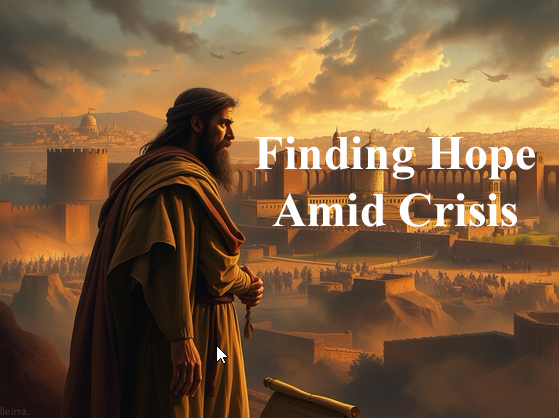
Finding Hope Amid Crisis

Finding Hope Amid Crisis

September 28, 2025*

By Pastor John Partridge

Jeremiah 32:1-3a, 6-15                     Luke 16:19-31                        1 Timothy 6:6-19

There is a curse that dates to the early 19th century that says, “May you live in interesting times.” For most of us, whether we want to admit it or not, boring is good. Boring lives are predictable. Interesting times tend to be filled with tumult, unpredictability, stress, rapid change, crises, and unpleasantness. Despite being interesting, life is not as enjoyable as it might be when we spend our time worrying about war, violence, pestilence, disease, political upheaval, inflation, healthcare, financial ruin, death, and destruction. In comparison, boring predictability is much more likely to allow us to find happiness and contentment. But that wasn’t the world in which the prophet Jeremiah found himself. Jeremiah had been born into a world that was facing one of his nation’s greatest upheavals and was called by God to bring messages of warning and hope to his people. As we read our first scripture, we find the army of Babylon at the gates of Jerusalem and God’s people filled with fear and despair. But into this pit of worry, we hear God bring his people a word of hope for the future (Jeremiah 32:1-3a, 6-15).

32:1 This is the word that came to Jeremiah from the Lord in the tenth year of Zedekiah king of Judah, which was the eighteenth year of Nebuchadnezzar. The army of the king of Babylon was then besieging Jerusalem, and Jeremiah the prophet was confined in the courtyard of the guard in the royal palace of Judah.

Now Zedekiah king of Judah had imprisoned him there, saying, “Why do you prophesy as you do? You say, ‘This is what the Lord says: I am about to give this city into the hands of the king of Babylon, and he will capture it.

Jeremiah said, “The word of the Lord came to me: Hanamel son of Shallum your uncle is going to come to you and say, ‘Buy my field at Anathoth, because as nearest relative it is your right and duty to buy it.’

“Then, just as the Lord had said, my cousin Hanamel came to me in the courtyard of the guard and said, ‘Buy my field at Anathoth in the territory of Benjamin. Since it is your right to redeem it and possess it, buy it for yourself.’

“I knew that this was the word of the Lord; so I bought the field at Anathoth from my cousin Hanamel and weighed out for him seventeen shekelsof silver. 10 I signed and sealed the deed, had it witnessed, and weighed out the silver on the scales. 11 I took the deed of purchase—the sealed copy containing the terms and conditions, as well as the unsealed copy— 12 and I gave this deed to Baruch son of Neriah, the son of Mahseiah, in the presence of my cousin Hanamel and of the witnesses who had signed the deed and of all the Jews sitting in the courtyard of the guard.

13 “In their presence I gave Baruch these instructions: 14 ‘This is what the Lord Almighty, the God of Israel, says: Take these documents, both the sealed and unsealed copies of the deed of purchase, and put them in a clay jar so they will last a long time. 15 For this is what the Lord Almighty, the God of Israel, says: Houses, fields and vineyards will again be bought in this land.’

Although everyone in Jerusalem was worrying and wondering what tomorrow would bring, and whether they might even live to see the sunrise, God brings a message of hope through the simple act of selling a small plot of land. It is likely that in a city under siege, food was becoming scarce and expensive and many things that were normally valuable were becoming useless and cheap. After all, when you are hungry, you can’t eat gold or jewels. And so, in a similar way, Jeremiah’s uncle comes to him in hopes of selling him a field outside the city, that neither of them might ever see again simply because the money that he would get from Jeremiah might buy him enough food for another day or two. In such a situation, you might ordinarily expect that Jeremiah would be completely uninterested and would prefer to keep his money so that he could buy his own food. But God calls Jeremiah in advance and commands him to buy the field from his uncle as a sign to the people of Jerusalem that there is hope for the future. Through the transfer of property, and the sealing away of the documentation, God declares that there will be a time, within the lifetime of Jeremiah, that God’s people will return to Jerusalem and the houses, fields, and vineyards will again be bought and sold. God’s message of hope is that despite the interesting, horrifying, and violent days ahead of them, a stable and boring life of normality will one day return.

But the reality was that many of the people inside the walls of Jerusalem would not live to see a new day. The violence and destruction of Jerusalem’s siege would claim many lives and still more would not live long enough to return from their captivity in Babylon.  But aside from ancient violence, death is an everyday reality for all of us. Life is short in the best of times, and we are all painfully aware of our mortality. And in Luke 16:19-31, Jesus gives us a warning about how we should live so that we can be with him when we reach the end of this life. Jesus said:

19 “There was a rich man who was dressed in purple and fine linen and lived in luxury every day. 20 At his gate was laid a beggar named Lazarus, covered with sores 21 and longing to eat what fell from the rich man’s table. Even the dogs came and licked his sores.

22 “The time came when the beggar died and the angels carried him to Abraham’s side. The rich man also died and was buried. 23 In Hades, where he was in torment, he looked up and saw Abraham far away, with Lazarus by his side. 24 So he called to him, ‘Father Abraham, have pity on me and send Lazarus to dip the tip of his finger in water and cool my tongue, because I am in agony in this fire.’

25 “But Abraham replied, ‘Son, remember that in your lifetime you received your good things, while Lazarus received bad things, but now he is comforted here, and you are in agony. 26 And besides all this, between us and you a great chasm has been set in place, so that those who want to go from here to you cannot, nor can anyone cross over from there to us.’

27 “He answered, ‘Then I beg you, father, send Lazarus to my family, 28 for I have five brothers. Let him warn them, so that they will not also come to this place of torment.’

29 “Abraham replied, ‘They have Moses and the Prophets; let them listen to them.’

30 “‘No, father Abraham,’ he said, ‘but if someone from the dead goes to them, they will repent.’

31 “He said to him, ‘If they do not listen to Moses and the Prophets, they will not be convinced even if someone rises from the dead.’”

First, I want to note that despite this being a parable, Jesus speaks of hell as if it is real. This is important to remember when we hear voices in our culture that say that there is no such thing. If Jesus said that hell is real, then I must believe that it is. Second, the clear message of this parable is that we each have choices to make in this life that cannot be undone in the next and we must live our lives in such a way that we end up on the right side of the chasm that separates comfort from torment. Third, even before his death and resurrection, Jesus was clear that some people will never be convinced of the truth regardless of the evidence presented.

In an odd sort of way, the message of Jesus is like that of Jeremiah. There is hope for our future, but we must seek to make good choices if we want to reach a place of comfort.

But if that is the case, then how do we do that? How do we make good choices? And what kind of choices are good? And as we often do, we find help in the guidance that Paul sent to his friend Timothy in his letter (1 Timothy 6:6-19) where he says:

But godliness with contentment is great gain. For we brought nothing into the world, and we can take nothing out of it. But if we have food and clothing, we will be content with that. Those who want to get rich fall into temptation and a trap and into many foolish and harmful desires that plunge people into ruin and destruction. 10 For the love of money is a root of all kinds of evil. Some people, eager for money, have wandered from the faith and pierced themselves with many griefs.

11 But you, man of God, flee from all this, and pursue righteousness, godliness, faith, love, endurance, and gentleness. 12 Fight the good fight of the faith. Take hold of the eternal life to which you were called when you made your good confession in the presence of many witnesses. 13 In the sight of God, who gives life to everything, and of Christ Jesus, who while testifying before Pontius Pilate made the good confession, I charge you 14 to keep this command without spot or blame until the appearing of our Lord Jesus Christ, 15 which God will bring about in his own time—God, the blessed and only Ruler, the King of kings and Lord of lords, 16 who alone is immortal and who lives in unapproachable light, whom no one has seen or can see. To him be honor and might forever. Amen.

17 Command those who are rich in this present world not to be arrogant nor to put their hope in wealth, which is so uncertain, but to put their hope in God, who richly provides us with everything for our enjoyment. 18 Command them to do good, to be rich in good deeds, and to be generous and willing to share. 19 In this way they will lay up treasure for themselves as a firm foundation for the coming age, so that they may take hold of the life that is truly life.

Paul says that godliness and contentment are good things to which we should aspire but that we should be content with what we have. Whenever we begin to desire more, when we aspire to become rich, we are tempted to do things that are both foolish and harmful and those things have caused the ruin and destruction of many lives. The love of money has led many people to wander from their faith and caused themselves no end of suffering. Instead, Paul says, the followers of God are called to flee from that sort of temptation and to instead pursue righteousness, godliness, faith, love, endurance, and gentleness. Paul charges Timothy, and all of us, to keep the command to fight the good fight of faith.

It is important to note that Paul does not say that the rich are automatically doomed simply because they are rich, especially because we are citizens of one of the richest nations in the history of the world. Instead, Paul instructs the followers of Jesus Christ to command those who are rich to do what is right. Paul says that the rich should not be so arrogant that they put their hope in wealth, which can be lost so easily, but to put their hope in God who richly provides us with all that we need and with everything for our enjoyment. Rich and poor alike should do good, be rich in good deeds, be generous and willing to share. When we do these things, we store treasure for ourselves in our future home and take hold of the things that are truly life giving.

No matter what crisis we face, we are never without hope but some of the choices that we make in this life cannot be undone in the next. Some people will never be convinced of the truth regardless of the evidence presented, but each of us must spend our lives in pursuit of what is good. We must seek godliness, and be content with what we have, resist the temptation to desire wealth at the expense of everything else, and instead pursue righteousness, godliness, faith, love, and gentleness. Be rich in good deeds, do good, be generous with what you have, and be willing to share with those who are in need.

If we do these things, we will increase our enjoyment in this life, draw others to the truth of Jesus Christ, and store up treasure for ourselves in the next.


Please LIKE and SHARE!

Click here to subscribe to Pastor John’s blog.

Click here if you would like to subscribe to Pastor John’s weekly messages.

Click here to visit Pastor John’s YouTube channel.


*You have been reading a message presented at Christ United Methodist Church on the date noted at the top of the first page.  Rev. John Partridge is the pastor at Christ UMC in Alliance, Ohio.  Duplication of this message is a part of our Media ministry, if you have received a blessing in this way, we would love to hear from you.  Letters and donations in support of the Media ministry or any of our other projects may be sent to Christ United Methodist Church, 470 East Broadway Street, Alliance, Ohio 44601.  These messages are available to any interested persons regardless of membership.  You may subscribe to these messages, in print or electronic formats, by writing to the address noted, or by contacting us at secretary@CUMCAlliance.org.  These messages can also be found online at https://pastorpartridge.com .  All Scripture quotations, unless otherwise indicated, are taken from the Holy Bible, New International Version®, NIV®. Copyright ©1973, 1978, 1984, 2011 by Biblica, Inc.™ Used by permission of Zondervan. All rights reserved worldwide. www.zondervan.comThe “NIV” and “New International Version” are trademarks registered in the United States Patent and Trademark Office by Biblica, Inc.™

Which Shepherd Are You?

Click here to listen to the podcast

Click here to watch the livestream of the worship service: https://youtu.be/OiB4VHkLqbA

Click here to watch the sermon video: https://youtu.be/KcTnn9CQjAo


Which Shepherd Are You?

November 20, 2022*

(Christ the King Sunday)

By Pastor John Partridge

Jeremiah 23:1-6                     Luke 23:33-43            Colossians 1:11-20

I saw a cartoon the other day about pyramids.  The joke was simply that instead of thinking that aliens were needed to explain why cultures around the globe chose to build pyramid shaped structures, maybe it was just because everyone figured out that this shape allowed them to make an enormous building that didn’t fall over.  It wasn’t aliens.  It was physics.

In any case, while we don’t build as many pyramids as once did, we do use pyramids to describe a lot of things.  “Pyramid schemes” are bad because, as investment vehicles, only the people at the top ever make any money. But most businesses, non-profits, not-for-profits, military units, charities, churches, scout troops, and almost everyone else, use some kind of pyramid shaped organizational structure.  There is one, or at least a very small number of people at the very top, then more people that report to them, then an even larger number of people that report to them, and so on.  Sometimes those pyramids are quite large and sometimes they are flatter.  The Catholic Church has the Pope at the top, then cardinals, then archbishops, bishops, and then priests (I think), and our church is a little shorter without a pope, we have bishops, district superintendents, and pastors.  But that’s not exactly right, but we’ll come back to it before we’re finished.

Years ago, when I first read The Pilgrim’s Progress, by John Bunyan, I encountered a word that I had never seen used before.  While its component parts were all familiar, the assembly was new to me.  The word that I met, and have grown to appreciate over the years, is… “under-shepherd.”  The idea is familiar to any of us with experience with pyramids and organizational charts.  There’s a shepherd, and then there are subordinate shepherds that work for the shepherd who are therefore under-shepherds.  The concept is simple enough, but it is a useful, and meaningful, way of thinking about our relationship with Jesus.  This is, I think, particularly true as we read God’s words to the prophet Jeremiah in Jeremiah 23:1-6 when he says:

23:1 “Woe to the shepherds who are destroying and scattering the sheep of my pasture!” declares the Lord. Therefore this is what the Lord, the God of Israel, says to the shepherds who tend my people: “Because you have scattered my flock and driven them away and have not bestowed care on them, I will bestow punishment on you for the evil you have done,” declares the Lord. “I myself will gather the remnant of my flock out of all the countries where I have driven them and will bring them back to their pasture, where they will be fruitful and increase in number. I will place shepherds over them who will tend them, and they will no longer be afraid or terrified, nor will any be missing,” declares the Lord.

“The days are coming,” declares the Lord, “when I will raise up for Davida righteous Branch,
a King who will reign wisely and do what is just and right in the land.
In his days Judah will be saved and Israel will live in safety.
This is the name by which he will be called: The Lord Our Righteous Savior.

Obviously, in the time of Jeremiah, Jesus had not yet come, but even so, even as far back as the book of Genesis, God was often referred to as the shepherd of his people.  But more to the point, the rulers of the nation and the leaders of the church were called to be, and were known as, the shepherds of God’s people.  And some of those under-shepherds were not behaving… shepherd-ly.  The leaders of God’s people were scattering and destroying God’s sheep and God was taking it quite personally.  Because of their actions, God declares a curse and a punishment upon them for the evil that they had done.  God says that he himself will regather a remnant of his flock and will find new shepherds who will do what shepherds are called to do.  They will care for the people under their authority, they will have a spine, and will stand up against the enemies and the dangers that face them, and they will protect their flock so that none of them are afraid or go missing.  In fact, it is at this point that God declares that he will raise up the good shepherd, a righteous branch from the root of David’s family tree, who will do what is right, who will reunite the nations of Judah and Israel, and who will be called, The Lord, our righteous Savior.

And although it may not seem like it at first, that is the image that we have of Jesus in his last moments on the cross.  Although he is dying, the good shepherd gives his life for his sheep.  In Luke 23:33-43, we hear these words:

33 When they came to the place called the Skull, they crucified him there, along with the criminals—one on his right, the other on his left. 34 Jesus said, “Father, forgive them, for they do not know what they are doing.” And they divided up his clothes by casting lots.

35 The people stood watching, and the rulers even sneered at him. They said, “He saved others; let him save himself if he is God’s Messiah, the Chosen One.”

36 The soldiers also came up and mocked him. They offered him wine vinegar 37 and said, “If you are the king of the Jews, save yourself.”

38 There was a written notice above him, which read: this is the king of the jews.

39 One of the criminals who hung there, hurled insults at him: “Aren’t you the Messiah? Save yourself and us!”

40 But the other criminal rebuked him. “Don’t you fear God,” he said, “since you are under the same sentence? 41 We are punished justly, for we are getting what our deeds deserve. But this man has done nothing wrong.”

42 Then he said, “Jesus, remember me when you come into your kingdom.”

43 Jesus answered him, “Truly I tell you, today you will be with me in paradise.”

Even in his last moments, with one of the last breaths that he had left in his body, Jesus was rescuing the lost and, with his dying breath, he gave his life so that he could rescue God’s sheep.  Jesus is the good shepherd, the righteous branch of David’s line that God promised to his people.  He is the king of kings, the ruler of the nations, and the rescuer of all humanity.  But, as I often ask, what difference does it make?  How does any of that teach me what I need to know to get through my day today?  How does that offer me guidance on how I live my life?  And we find the answer to some of those questions in Paul’s letter to the church in Colossae in these words from Colossians 1:11-20.

We continually ask God to fill you with the knowledge of his will through all the wisdom and understanding that the Spirit gives,  10 so that you may live a life worthy of the Lord and please him in every way: bearing fruit in every good work, growing in the knowledge of God, 11 being strengthened with all power according to his glorious might so that you may have great endurance and patience, 12 and giving joyful thanks to the Father, who has qualified youto share in the inheritance of his holy people in the kingdom of light. 13 For he has rescued us from the dominion of darkness and brought us into the kingdom of the Son he loves, 14 in whom we have redemption, the forgiveness of sins.

15 The Son is the image of the invisible God, the firstborn over all creation. 16 For in him all things were created: things in heaven and on earth, visible and invisible, whether thrones or powers or rulers or authorities; all things have been created through him and for him. 17 He is before all things, and in him all things hold together. 18 And he is the head of the body, the church; he is the beginning and the firstborn from among the dead, so that in everything he might have the supremacy. 19 For God was pleased to have all his fullness dwell in him, 20 and through him to reconcile to himself all things, whether things on earth or things in heaven, by making peace through his blood, shed on the cross.

Paul’s prayer for the church was that they would be filled with a knowledge and an understanding of God’s will for their lives, mission, and ministry so that they could live lives that were worthy of God and would please God in every way.  Paul prayed that the church would be strengthened with God’s power, have great endurance and patience, and give thanks to God for qualifying the church to share in the inheritance of eternity in heaven.  But Paul also prayed that the church would bear fruit through every good work, and daily grow in their knowledge of God.  I want to repeat that part for emphasis.  Paul prayed that the church would bear fruit through every good work and grow in their knowledge of God. 

And then, Paul repeats the resumé of Jesus and reminds everyone that Jesus is the Messiah, the good shepherd who rose from the dead, and sits on the throne of God as he seeks to rescue all people, reconcile all who are lost with God, and make peace throughout all creation.

All of that, from Jeremiah, to Luke, Jesus, and Paul, serves to remind us that our role, our mission, our place in the pyramid organizational chart, as the followers of Jesus Christ and as the members of his church, is to be under-shepherds.  It is our work, not to scatter and destroy God’s sheep, but to gather them and protect them with our lives, to grow his flock, to rescue the lost sheep, to risk everything that we have to recover the ones that have wandered, to bear fruit, to grow God’s flock, to do good works, to grow in the knowledge of God, to be filled with great endurance and patience, and to give joyful thanks to God.

As the good shepherd has rescued us, let us, as under-shepherds, spend our lives rescuing others, growing, and caring for his flock, so that we might live lives that are worthy of God and please him in every way.


Did you enjoy this?

Please LIKE and SHARE!

Click here to subscribe to Pastor John’s blog.

Click here if you would like to subscribe to Pastor John’s weekly messages.

Click here to visit Pastor John’s YouTube channel.


*You have been reading a message presented at Christ United Methodist Church on the date noted at the top of the first page.  Rev. John Partridge is the pastor at Christ UMC in Alliance, Ohio.  Duplication of this message is a part of our Media ministry, if you have received a blessing in this way, we would love to hear from you.  Letters and donations in support of the Media ministry or any of our other projects may be sent to Christ United Methodist Church, 470 East Broadway Street, Alliance, Ohio 44601.  These messages are available to any interested persons regardless of membership.  You may subscribe to these messages, in print or electronic formats, by writing to the address noted, or by contacting us at secretary@CUMCAlliance.org.  These messages can also be found online at https://pastorpartridge.com .  All Scripture quotations, unless otherwise indicated, are taken from the Holy Bible, New International Version®, NIV®. Copyright ©1973, 1978, 1984, 2011 by Biblica, Inc.™ Used by permission of Zondervan. All rights reserved worldwide. www.zondervan.comThe “NIV” and “New International Version” are trademarks registered in the United States Patent and Trademark Office by Biblica, Inc.™

To Heaven, Through Hell

Click here to listen to the podcast

Click here to watch the livestream of the worship service: https://youtu.be/RYZECRf1RMg

Click here to watch the sermon: https://youtu.be/rfQVmbkBCV0


To Heaven, Through Hell

November 13, 2022*

By Pastor John Partridge

Isaiah 65:17-25                      Luke 21:5-19              2 Thessalonians 3:6-13

Anyone with more than a few laps around the sun is well aware that sometimes life is not a bed of roses, or a bowl of cherries, or however you want to say it, life is not always all that great.  Sometimes it flat-out sucks pond water.  Life is filled with pain, sickness, hurt feelings, tragedy, betrayal, abandonment, loss, suffering, and death.  But it isn’t always bad.  As bad as life can be, and the bad stuff can sometimes last far longer than we’d like, we also know that life can also be filled with joy, healing, excitement, victory, hope, encouragement, friendship, and love.

This understanding is the source of two great quotes that help us to keep our pain in perspective.

Dr. Seuss’s Cat in the Hat said, “Don’t cry because it’s over. Smile because it happened.”

When we struggle with death and loss, and when whenever good things end, it helps to remember that the reason that we are mourning, is because of the good things that happened.  But when we are faced with pain in our future, or when we are enduring it in our present, we should remember that Winston Churchill famously said…

“If you’re going through hell, keep going.”

And it is those perspectives that I would like you to keep in mind this morning as we consider where we are going, what we will pass through on the way there, and how should live our lives in the present so that we can keep moving toward our final destination.  We begin this morning reading from Isaiah 65:17-25, as God paints a picture of what life will be like in the world that is to come.

17 “See, I will create new heavens and a new earth.
The former things will not be remembered, nor will they come to mind.
18 But be glad and rejoice forever in what I will create,
for I will create Jerusalem to be a delight and its people a joy.
19 I will rejoice over Jerusalem and take delight in my people;
the sound of weeping and of crying will be heard in it no more.

20 “Never again will there be in it an infant who lives but a few days,
    or an old man who does not live out his years;
the one who dies at a hundred will be thought a mere child;
the one who fails to reach a hundred will be considered accursed.
21 They will build houses and dwell in them; they will plant vineyards and eat their fruit.
22 No longer will they build houses and others live in them,  or plant and others eat.
For as the days of a tree, so will be the days of my people;
my chosen ones will long enjoy the work of their hands.
23 They will not labor in vain, nor will they bear children doomed to misfortune;
for they will be a people blessed by the Lord, they and their descendants with them.
24 Before they call I will answer; while they are still speaking I will hear.
25 The wolf and the lamb will feed together, and the lion will eat straw like the ox,
    and dust will be the serpent’s food.
They will neither harm nor destroy on all my holy mountain,” says the Lord.

God will create a new heaven and a new earth that is fundamentally different from the one in which we live, and we will live there for so long, and our healing will be so complete and enduring, that we will hardly remember the pain and the suffering that we once endured.  Life will no longer be a struggle but will be filled with joy instead of weeping.  Old age will be normal and there will never be the sorrow of mourning the loss of a child.  No longer will people and nations be uprooted by famine, warfare, natural disasters, pestilence, unemployment, taxation, or anything else but God’s people will live, work, grow, plant, and endure in one place, in one home, with their families.  Even the animal kingdom will be changed so that we will have no fear of them, they of us, or them for one another.  God’s promise is that there is a better future for all those who love him.

But that isn’t at all the picture that Jesus draws for his disciples.  The future that Jesus describes reminds us that what God showed to Isaiah is the distant “not yet.”  In between our now, and the “not yet” is more of the ugliness that we have seen throughout history, and worse.  As Jesus and his disciples are walking through Jerusalem, the disciples marvel at the beautiful stonework of the temple and its surroundings.  But Jesus uses those stones as a warning of what is to come.  We hear these words in Luke 21:5-19.

Some of his disciples were remarking about how the temple was adorned with beautiful stones and with gifts dedicated to God. But Jesus said, “As for what you see here, the time will come when not one stone will be left on another; every one of them will be thrown down.”

“Teacher,” they asked, “when will these things happen? And what will be the sign that they are about to take place?”

He replied: “Watch out that you are not deceived. For many will come in my name, claiming, ‘I am he,’ and, ‘The time is near.’ Do not follow them. When you hear of wars and uprisings, do not be frightened. These things must happen first, but the end will not come right away.”

10 Then he said to them: “Nation will rise against nation, and kingdom against kingdom. 11 There will be great earthquakes, famines and pestilences in various places, and fearful events and great signs from heaven.

12 “But before all this, they will seize you and persecute you. They will hand you over to synagogues and put you in prison, and you will be brought before kings and governors, and all on account of my name. 13 And so you will bear testimony to me. 14 But make up your mind not to worry beforehand how you will defend yourselves. 15 For I will give you words and wisdom that none of your adversaries will be able to resist or contradict. 16 You will be betrayed even by parents, brothers and sisters, relatives, and friends, and they will put some of you to death. 17 Everyone will hate you because of me. 18 But not a hair of your head will perish. 19 Stand firm, and you will win life.

Jesus says that his followers will be hated by their families, friends, neighbors, and the entire world simply because of their love for him.  But in the end, we will endure because who and what we are in Jesus Christ endures even beyond death.  The only way that we can lose is to give up.  Stand firm.  Keep moving forward.

“If you’re going through hell, keep going.”

But what does that mean for us today?  How does that inform us, or teach us, about how we might survive, one day at a time, through the weirdness that is life in the twenty-first century?  And that is one of the things that Paul addresses in his letter to the church in Thessalonica in 2 Thessalonians 3:6-13

In the name of the Lord Jesus Christ, we command you, brothers and sisters, to keep away from every believer who is idle and disruptive and does not live according to the teachingyou received from us. For you yourselves know how you ought to follow our example. We were not idle when we were with you, nor did we eat anyone’s food without paying for it. On the contrary, we worked night and day, laboring and toiling so that we would not be a burden to any of you. We did this, not because we do not have the right to such help, but in order to offer ourselves as a model for you to imitate. 10 For even when we were with you, we gave you this rule: “The one who is unwilling to work shall not eat.”

11 We hear that some among you are idle and disruptive. They are not busy; they are busybodies. 12 Such people we command and urge in the Lord Jesus Christ to settle down and earn the food they eat. 13 And as for you, brothers and sisters, never tire of doing what is good.

Clearly, this isn’t a prescriptive text that tells us everything about how to live as a church in times of disruption and chaos, but Paul says that one of the things that we need to be to be doing, as we have heard in other passages in recent weeks, is to keep busy, and to stay on task.  And one of the ways that we do that is to stay away from people who are bad examples.  The first among these bad examples are people who aren’t doing anything.  But worse than that are the people who aren’t doing anything and are using their free time to disrupt the people who are doing something.  Also, a part of Paul’s description of these disruptors is that they are people who claim to believe, and count themselves among the believers of the church, but do not live as if they believe because they don’t do the things that the scriptures teach.

Paul says that, because he and his ministry team intentionally wanted to be a good example, they did not accept a salary, or gifts, or meals, or anything else while they were in Thessalonica.  They didn’t do so because pastors, missionaries, and work teams aren’t entitled to being paid or even being treated well, but because they wanted to be a model for the people to follow.

It is worth noting at this point, that the phrase Paul uses here, has been borrowed, grossly misinterpreted, and misused by a recent political campaign.  Apparently, there has been someone, during the most recent election, that was claiming that the phrase, “The one who is unwilling to work shall not eat” implies that welfare or giving to the poor runs against biblical principles.  But that is, frankly, spiritual malpractice.  Paul’s statement, and this example, in this case, is for internal church use and is ministry specific.  When the church was busy working, and fed its workers afterward, it didn’t make sense to feed people who didn’t do any work.  Paul wasn’t saying that the church shouldn’t feed the poor, that would be contrary to the words of Jesus.  What he was saying was, don’t show up to eat lunch at the Habitat for Humanity work project if you aren’t doing any work.  In that specific case, the food was intended to feed the workers.  And so that sentence should not, and cannot, be misconstrued to try to say that Jesus doesn’t want us to feed the poor.

Let’s summarize.  What we heard today is that we are on our way to someplace better.  God is at work, even now, preparing a place for us to live forever and in that place all the broken things of this world will be fixed.  There will be no more mourning, or crying or pain, parents will no longer have to bury their children, no longer will people and nations be uprooted by famine, warfare, natural disasters, or pestilence, and will all live, work, grow, plant, and endure in one place, in one home, with our families forever.

But between here and there, will be pain, and suffering, and death, and all the other terrible things that we have come to expect from our broken world.  Not only will those things continue but, at times, they’ll be a lot worse.  In the meantime, whether things are better for us or worse, the message is to stay on task, to keep doing the work that God has given us to do.  And while we’re doing that, we should stay away from busybodies who keep other people from doing their work.  Stay away from people who are idle and disruptive because they’re just going to waste your time and keep you from doing the work that God has given you to do.

The message for today is just to stay busy.  God has given us work to do as individuals, and as a church.  We can expect to go through difficult stuff.  We can expect that the horrors of this broken world will not get better and will often get worse.  But through it all, we need to keep moving forward, keep doing the work of Jesus Christ, and keep on calling the world to hear the message of the gospel so that they too can receive healing, rescue, and restoration.

Never tire of doing good.


Did you enjoy this?

Please LIKE and SHARE!

Click here to subscribe to Pastor John’s blog.

Click here if you would like to subscribe to Pastor John’s weekly messages.

Click here to visit Pastor John’s YouTube channel.


*You have been reading a message presented at Christ United Methodist Church on the date noted at the top of the first page.  Rev. John Partridge is the pastor at Christ UMC in Alliance, Ohio.  Duplication of this message is a part of our Media ministry, if you have received a blessing in this way, we would love to hear from you.  Letters and donations in support of the Media ministry or any of our other projects may be sent to Christ United Methodist Church, 470 East Broadway Street, Alliance, Ohio 44601.  These messages are available to any interested persons regardless of membership.  You may subscribe to these messages, in print or electronic formats, by writing to the address noted, or by contacting us at secretary@CUMCAlliance.org.  These messages can also be found online at https://pastorpartridge.com .  All Scripture quotations, unless otherwise indicated, are taken from the Holy Bible, New International Version®, NIV®. Copyright ©1973, 1978, 1984, 2011 by Biblica, Inc.™ Used by permission of Zondervan. All rights reserved worldwide. www.zondervan.comThe “NIV” and “New International Version” are trademarks registered in the United States Patent and Trademark Office by Biblica, Inc.™