Culture Wars and Christianity

Christianity: Rooted in Culture Wars

September 2024

by John Partridge

While you might not have the time to read the paper that I wrote last semester (and what is likely to become a part of a book next spring), what follows is an important excerpt. Working through several chapters of Matthew, I detail how our knowledge of modern archaeology and history adds to our understanding and gives depth to scripture. Below, I discuss how Christianity, from its birth, has been no stranger to culture wars and what we should learn from that.


When we read Jesus’ caution that “No one can serve two masters,” in Matthew 6:24, we find that our study of history expands our understanding beyond the surface meaning. Many of us have tried to please two bosses or have otherwise been pulled between our loyalties to work, family, and faith, but Roman Palestine, and Galilee in particular, felt many of these pressures, each demanding that they choose them as their master. At the time of Jesus, the rule of King Herod and Rome was less than 70 years old.  But there were institutions, buildings, and cultural memories of the earlier Hasmonean dynasty under which Israel was free and independent.

The Hasmonean dynasty had emphasized, and even required, an adherence to a more traditional Jewish culture and religion, but with the fall of the Hasmoneans, the rise of Herod the Great, and Israel’s subjugation by the Roman Empire, things were changing. There were changes in clothing style, architecture, language, art, and language, and all these changes were often seen as an incredible culture war between the traditional Jewish culture, and the newer Greco-Roman culture, known as Hellenism. Hellenism, of course, was not entirely new. It had begun generations earlier with the conquest of Pompey and the Greeks (in 63 BCE), even before the Hasmoneans rose to power, but was now, under Herod and the Romans, an increasingly strong influence.

While upper Galilee retained a traditional Jewish culture, lower Galilee, with the presence of the Greco-Roman cities of Sepphoris and Tiberias, as well as its proximity to Hippos on the opposite shore of the lake, was seen as having made a greater degree of accommodation to Hellenism. Israel’s elites, including the chief priests and much of Jerusalem with them, adopted Roman culture to fit in, to get ahead, and to win favor. This influence of Hellenism triggered strong emotions, and this is the tension that we see in passages such as Matthew 6:20.

Further, when we remember that ninety percent of Roman Palestine lived at a subsistence level or below, we see Jesus’ instruction in a different light when he says, “’So, do not worry, saying what shall we eat?’ or ‘What shall we drink?’ or ‘What shall we wear?’ For the pagans run after these things, and your heavenly father knows that you need them. But seek first his kingdom and his righteousness, and all these things will be given to you as well” (Matt 6:31-33). With this in mind, we not only understand that Jesus is teaching his listeners that they should make God’s kingdom a priority in their lives, but to people who were so poor that they often struggled to eat, or to drink, or wear, much of anything at all, Jesus was offering hope.

The people from rural villages in Galilee were insulated from Greco-Roman influence but they saw wealthy landowners, priests and other elites who were trying to fit into Roman culture, and they saw how that caused them to match what the Romans were eating, drinking, and wearing. But Jesus’ message was that conforming to Roman culture was not important and that it was not a curse to be so poor that they could not afford those things. His message was that God remembered them, knew what they needed, and would provide for them if they remained faithful and pursued righteousness instead of chasing after wealth and culture.

This was more than offering empty hope. The message of Jesus was that people should follow the law and live lives of moral integrity but also that they should be filled with compassion for one another. Rather than just watching out for themselves, or for their immediate and extended family, which was often the norm, Jesus and his disciples teach, and model, a life in which they all care for one another. Moreover, Jesus says that God sees them and cares for them in real life and not only on a spiritual level. God’s love for his children is not as a distant and disinterested observer, but as a father who cares for his children in tangible and physical ways saying, “ask and it will be given to you” (Matt 7:7) and “your Father in heaven gives good gifts to those who ask him!” (Matt 7:11)


That’s just a sample from my paper, but the takeaway for all of us is that Christianity was born in the middle of an enormous culture war. What we see today is not new. But the message of scripture is still the same. No man can serve two masters, the people of the church should care for one another rather than only looking out for themselves, and God still loves us, not just spiritually or metaphysically, but deeply, tangibly, and physically.

Much has changed in two thousand years and times will continue to change with each generation.

But God’s love for us never changes.


Please LIKE and SHARE!

Click here to subscribe to Pastor John’s blog.

Click here if you would like to subscribe to Pastor John’s weekly messages.

Click here to visit Pastor John’s YouTube channel.
Hellen Who?

Hellen Who?

 (or Why History Matters)

by John Partridge

For the last few weeks, I have been reading several accounts of Israel’s history. None of this is contained in the Bible because the particular histories that I have been reading describe the “Hellenization” of Israel that occurred between Malachi, the last book of the Old Testament, and Matthew, the first book of the New Testament. But what is Hellenization?  And, why does it matter if it isn’t in the Bible?

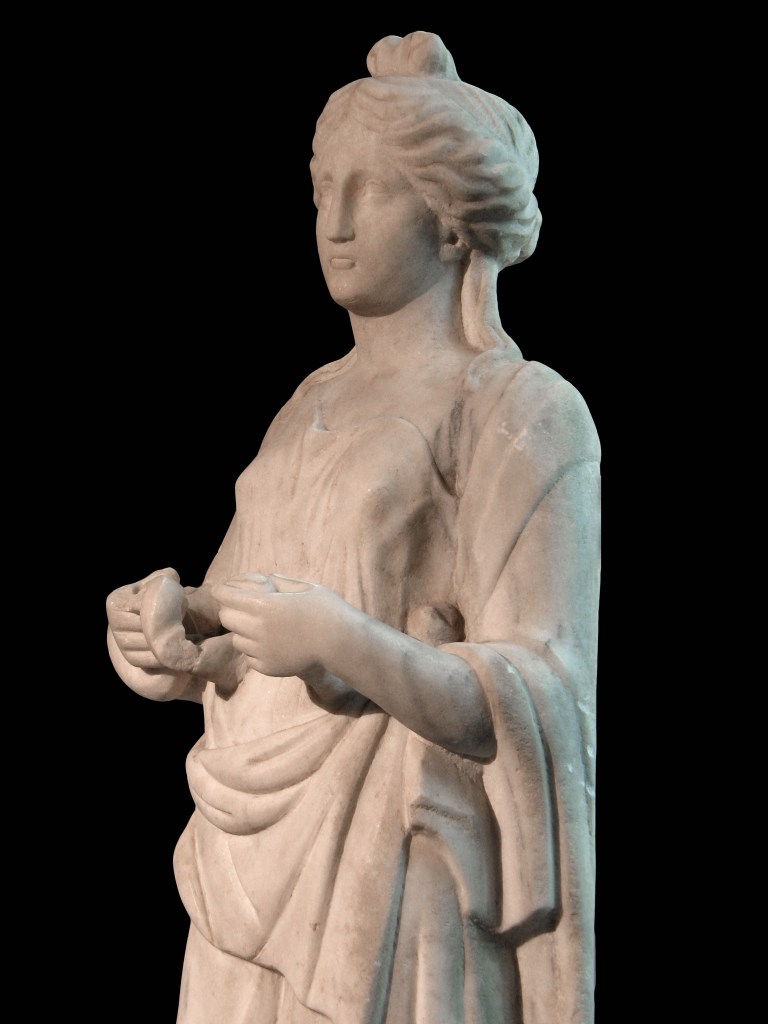
First, let me explain a little about Hellenism. Quite simply, “Hellenic” is just a synonym for “Greek.” Greek people can be known as Hellenes, and one of the first democracies was known as the Hellenic Republic. Greek government and culture was widely known in the ancient world and, when Alexander the Great (who was technically Macedonian) conquered much of the ancient world, including Israel, both the culture and the style of government of Greece spread with the empire. This influence is seen in the way that governments were organized, the language that people spoke, the types of art that became popular, the architecture that was used, and a host of other things as well.

But you still might ask why that matters if the empire that we find in the New Testament is Roman and not Greek. It matters because the Greek empire, in one form or another, was around for a long time and when the Romans finally became the dominant force, old political divisions of the Greek empire were still felt in the Roman empire. Even so, the Romans so admired Greek culture that they kept much of it. In the Roman empire, Greek was the language of business (and even in some military units), much of Roman government was modeled after the system used by the Greeks, and so was much of their art, philosophy, educational system, sporting events, and architecture. These two cultures were so tied together, and the Romans so influenced by Greek culture, that we often see them referred to not as Greek culture, or Roman culture separately, but as Greco-Roman culture collectively.

Because of their faith, their relationship with God, and their own unique history, Israel resisted some of these changes, but adopted others. Some crept in little by little, some were fought by religious leaders, but others, at least among the wealthy and political leaders, were adopted wholeheartedly. Learning about this cultural shift helps us to better grasp what happened between Malachi and Matthew and better understand the world that we enter as we read the New Testament. Even if these things aren’t described in the pages of scripture, their influence is felt everywhere on those pages. Learning about this inter-testamental history helps us to better understand the tensions between the rich and the poor, between the political leaders and the religious leaders, and between the various religious sects like the Pharisees, Sadducees, Essenes, and the new teachings of Jesus.

But history tells us more than that, and understanding history makes the stories of the New Testament richer, deeper, and more three-dimensional. Learning about the history of the intertestamental period (the time between Malachi and Matthew) helps us to see that King Herod was more three-dimensional than the tyrant that we see in a handful of verses in the gospels. This history tells us where Herod came from, who his family was, how he came to power, why he was so loyal to the Roman government, why his loyalties sometimes shifted, how Herod was politically astute in the extreme, and why he appears to be so incredibly paranoid when we meet him in the New Testament. And understanding Herod just scratches the surface because he and his family only really appear a few decades before Jesus. Before Herod and his father Antipater, there was an entire line of Jews that governed Israel known as the Hasmonean empire. And understanding that history explains more about Herod’s family and both why, and how, the Romans came to occupy, and then rule over Israel as well as how Herod conspired to murder the last of the Hasmoneans. This last thing also explains some of the ill will, and even outright hatred, that some Jews had for Herod.

As we read scripture, we become familiar with the Temple in Jerusalem, and many of us know that this was a magnificent engineering achievement of King Herod and possibly his crowning achievement. But what we don’t find in scripture is that the Temple in Jerusalem isn’t the only temple that Herod built. In fact, it isn’t the only temple that Herod built in Israel. Herod also built temples to Augustus, to Roma, and to Saturn in places like Caesarea, Sebaste in Samaria, Paneaus north of Galilee, and other Greek cities in Israel, as well as temples and municipal building projects in other countries of the Roman Empire. As a result, people across the Roman world knew of, and were grateful to Israel’s King Herod and, by extension, knew of, and were grateful to, the nation of Israel herself.

Understanding the history of the ancient world also helps us to understand the stories of the New Testament beyond the gospel stories. As we read Paul’s letters, and the stories of his travels, imprisonments, beatings, and trials, a knowledge of extra-biblical history helps us to understand why people sometimes listened to his preaching but at other times the crowds tried to kill him or the local authorities arrested and imprisoned him. We know from scripture that Paul was a Roman citizen, but history offers several possibilities surrounding how Paul, and his family, might have acquired Roman citizenship.  Likewise, connecting to my original point, while we know that Paul was well educated, what scholars still debate is just how much Greek (or Hellenizing) influence there was in Paul’s education. There are hints in Paul’s writings that might suggest an understanding, or at least the influence, of Greek philosophy and the structure used in public Greek and Roman debate. So, if even Paul, who described himself as a Jew among Jews, and a Pharisee among Pharisees felt the influence of Hellenism, then yes, it’s worth stretching ourselves to learn more about history outside of what we find in the pages of scripture.

Because… history matters.


Please LIKE and SHARE!

Click here to subscribe to Pastor John’s blog.

Click here if you would like to subscribe to Pastor John’s weekly messages.

Click here to visit Pastor John’s YouTube channel.


Five Thousand Years of Megiddo

Five Thousand Years of Megiddo

(and counting)

by John Partridge

A panoramic view from the top of Mount Megiddo

Whether you have read the New or the Old Testaments, you are likely to have encountered a story about the fortress of Megiddo. Its strategic location has already made it a place of importance in 3000 BCE, and long before the arrival of Joshua and the Israelites in 1400 BCE. As most ancient fortresses were, even into the Medieval period, Megiddo lies at the top of a rise that might be a big hill or a small mountain. That alone might not have made Megiddo a good location for a fortress, but its geographic location certainly did.

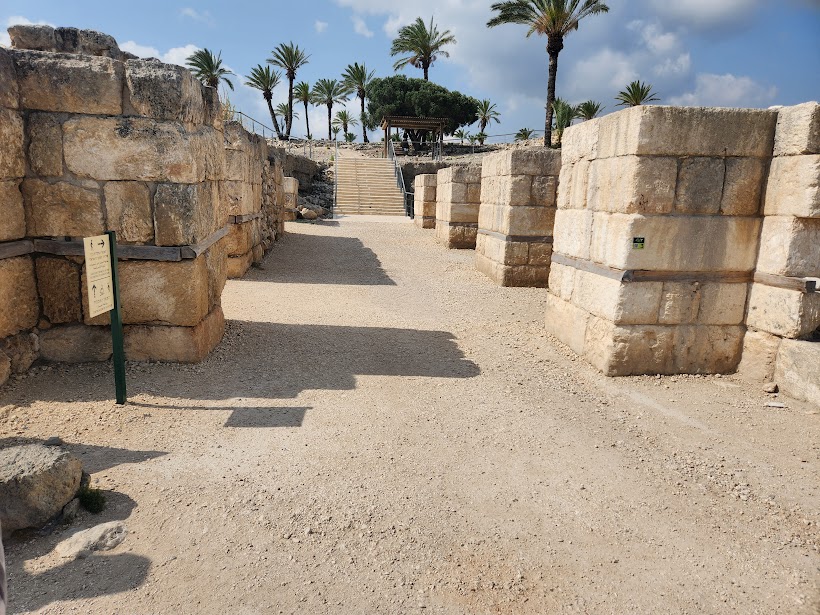
Iron Age City Gate (built under Solomon or Ahab)

The fortress, or more properly the historic succession of fortresses, overlooks the Jezreel valley, which is not only one of the most fertile plains in the Ancient Near East, but has within it, the Via Maris, the road that connected Egypt, Syria, Anatolia, and Mesopotamia which was important to many ancient empires including the Egyptians, Babylonians, Hittites, Assyrians, Israelites, Canaanites, and many others. And not only did Megiddo overlook this important highway, but it did also so in the place where the Via Maris narrowed through the pass at Mount Carmel on its way to the coastal plain along the Mediterranean Sea.

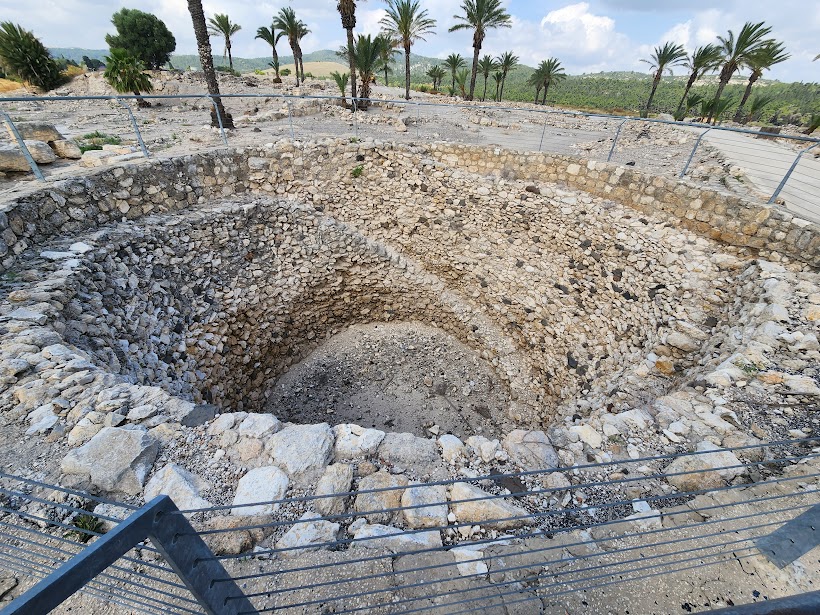
Granary

The archeological digs at Megiddo have unearthed a temple that was built by the early Canaanites, one of the largest structures in the entire Ancient Near East, as early as 3000 BCE. This was the place where Egyptian soldiers of Thutmose III fought between 1450 and 1400 BCE, and then Joshua and the Israelites between 1400 and 1375 BCE as seen in Joshua 12:21. Here, Solomon established one of his great chariot cities to stable his horses (1 Kings 4:12), and it was here that both King Ahaziah (2 Kings 9:27) and King Josiah (2 Kings 23:29) met their deaths. Much more recently, this was the place where British troops fought the Ottoman army during World War I and where the apostle John envisioned the great battle of Armageddon in Revelation 16:16 (Armageddon is a mistranslation of what John almost certainly wrote as “Har Megiddo,” meaning mountain, of Megiddo).

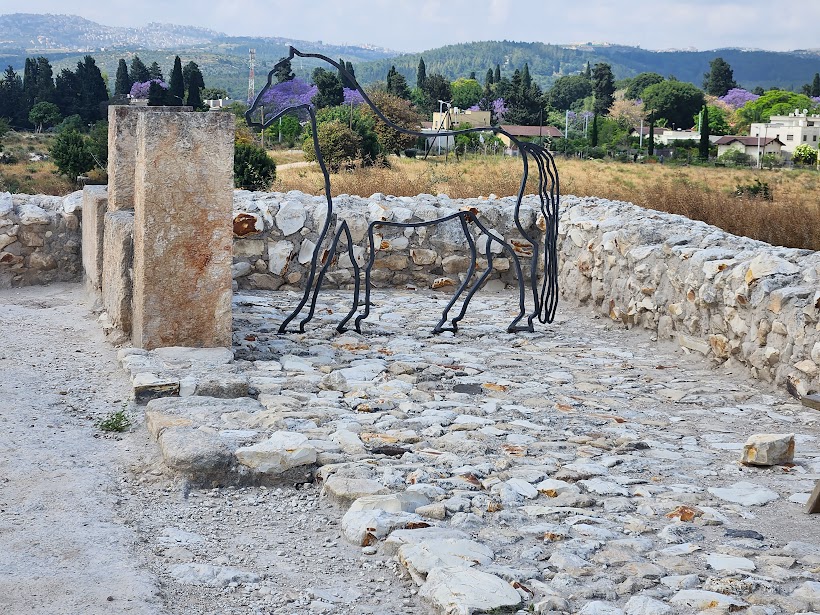
“Solomon’s stables”

In my recent trip to Israel, we walked through the ruins of Megiddo and saw the layers of the cities that had been built there over the course of thousands of years.  We saw the monumental city gates built in the Bronze Age by the Egyptians and in the Iron Age by either King Solomon or by King Ahab, the ancient temples, the buildings where Solomon’s horses were stabled (or which might have been warehouses), a granary silo that once stored the city’s supply of wheat, barley, or other grains, a monumental southern palace (once again dating to either Solomon or Ahab), and an amazing tunnel that connected the city to it’s spring outside the gates of city which protected it from invading armies.

Stairs to the spring tunnel
Tunnel to the spring outside the walls

The impressive views of the Jezreel Valley from the walls of Megiddo are amazing. Looking out over the valley, it is easy to imagine the battles that were fought here. One can easily picture invading armies marching along the valley toward this fortress and feel the quiet anticipation, or outright dread, of the soldiers watching from those walls. It is in these places that we not only learn history, but that history comes alive as you touch it and feel it with your hands as well as with your imagination and with your soul. And, having been in this place, having walked the paths of so many biblical figures, seen the walls and buildings where they lived and worked, and easily imagined what they might have looked like so many years ago, my understanding and appreciation of scripture has changed. No longer is Megiddo just a set piece in a story of long ago, but a real and tangible place that will forever change the way that I read history, and how I understand, interpret, and preach the stories of the Bible.


Please LIKE and SHARE!

Click here to subscribe to Pastor John’s blog.

Click here if you would like to subscribe to Pastor John’s weekly messages.

Click here to visit Pastor John’s YouTube channel.
Named by Destiny

Named by Destiny

December 27, 2020

by Pastor John Partridge

Isaiah 61:10-62:3                               Galatians 4:4-7                      Luke 2:22-40

There are certain events in history that become defining moments of whole nations, or even entire eras of history.  Some completely unknown, ancient person dared to experiment with the chemistry of molten metal in an attempt to make brass harder.   And, without ever realizing it, their success ushered in a new era of technology and warfare that we still refer to as the Bronze Age.   The coronation of Queen Victoria effectively named a hundred years of history, style, and culture that is still referred to as the Victorian Era.  In 230 BC, Ying Zheng unleashed the final campaigns of the Warring States period, conquered the remaining states nearby in the fall of 221 BC and unified what became known as the empire of Qin, or more commonly in English, China as it has been known for the last two thousand years. 

At 5:30 am, on July 16, 1945, 210 miles south of Los Alamos, New Mexico, on the barren plains of the Alamogordo Bombing Range, the United States Department of Defense triggered the explosion of a single device that released 18.6 kilotons of explosive power and marked the beginning, of what has been known ever since, as the Atomic Age.  There are many such moments that define history and many smaller moments that define each one of us.  We also find these moments in scripture.  These are moments that define generations of people, and ages of time.  In Isaiah 61:10 – 62:3, the prophet of God looks forward to a day that will become a turning point, and a defining moment, for the nation of Israel, for the entire world, and for all of us thousands of years later.  Isaiah said:

10 I delight greatly in the Lord;
    my soul rejoices in my God.
For he has clothed me with garments of salvation
    and arrayed me in a robe of his righteousness,
as a bridegroom adorns his head like a priest,
    and as a bride adorns herself with her jewels.
11 For as the soil makes the sprout come up
    and a garden causes seeds to grow,
so the Sovereign Lord will make righteousness
    and praise spring up before all nations.

62:1 For Zion’s sake I will not keep silent,
    for Jerusalem’s sake I will not remain quiet,
till her vindication shines out like the dawn,
    her salvation like a blazing torch.
The nations will see your vindication,
    and all kings your glory;
you will be called by a new name
    that the mouth of the Lord will bestow.
You will be a crown of splendor in the Lord’s hand,
    a royal diadem in the hand of your God.

Isaiah sees a day in his future when God changes the destiny of Israel.  God will dress the people in new clothing like a bride and groom are prepared for their wedding, and the entire nation of Israel will be lifted up, glorified in the eyes of the world, and vindicated after all her years of suffering and ridicule at the hands of nations like the Philistines, Babylon, Assyria, Persia, Greece, Rome, and others.  Isaiah sees a moment when all the nations of the world will bow down to Israel’s’ king and Israel will be so transformed that even its name will be changed to reflect its new destiny.

And then, in Luke 2:22-40, we see a moment that, however small it may first appear, is a defining moment for two senior citizen clergy persons, for one poor family from an unpopular village, and that moment became a light, a beacon, that is seen still today as a transformative moment in history for millions of believers.

22 When the time came for the purification rites required by the Law of Moses, Joseph and Mary took him to Jerusalem to present him to the Lord 23 (as it is written in the Law of the Lord, “Every firstborn male is to be consecrated to the Lord”), 24 and to offer a sacrifice in keeping with what is said in the Law of the Lord: “a pair of doves or two young pigeons.”

25 Now there was a man in Jerusalem called Simeon, who was righteous and devout. He was waiting for the consolation of Israel, and the Holy Spirit was on him. 26 It had been revealed to him by the Holy Spirit that he would not die before he had seen the Lord’s Messiah. 27 Moved by the Spirit, he went into the temple courts. When the parents brought in the child Jesus to do for him what the custom of the Law required, 28 Simeon took him in his arms and praised God, saying:

29 “Sovereign Lord, as you have promised, you may now dismissyour servant in peace.  30 For my eyes have seen your salvation, which you have prepared in the sight of all nations: 32 a light for revelation to the Gentiles, and the glory of your people Israel.”

33 The child’s father and mother marveled at what was said about him. 34 Then Simeon blessed them and said to Mary, his mother: “This child is destined to cause the falling and rising of many in Israel, and to be a sign that will be spoken against, 35 so that the thoughts of many hearts will be revealed. And a sword will pierce your own soul too.”

36 There was also a prophet, Anna, the daughter of Penuel, of the tribe of Asher. She was very old; she had lived with her husband seven years after her marriage, 37 and then was a widow until she was eighty-four. She never left the temple but worshiped night and day, fasting and praying. 38 Coming up to them at that very moment, she gave thanks to God and spoke about the child to all who were looking forward to the redemption of Jerusalem.

39 When Joseph and Mary had done everything required by the Law of the Lord, they returned to Galilee to their own town of Nazareth. 40 And the child grew and became strong; he was filled with wisdom, and the grace of God was on him.

God had promised Simeon that he would live to see the birth of God’s promised messiah.  For reasons that he may not have understood, he was drawn to the temple to serve with his tribe even though he could have been excused for his age.  And, at the moment that he saw Mary and Joseph, and took their baby into his arms, he knew that God had kept his promise and marveled at what God was about to do, and how this tiny infant was going to change the world.

And it didn’t only happen once.  Anna was a prophet and had lived in the temple since she had been widowed many decades earlier.  And she too, for reasons unknown to her, was drawn to the place where Simeon was with Mary, Joseph, and their baby.  And upon her arrival, she knew exactly who Jesus was, and who he would become.  This was a turning point in history.  Anna knew that from that moment on, Israel, and the world, was going to change.  God was beginning the process of redefining history just as Isaiah had seen and had prophesied. 

But two thousand years later, those moments still matter.  It wasn’t just the naming of a new age, or the birth of a new nation, or the discovery of a new powerful technology.  It was something much more than that.  Something far grander than that.  Something more pivotal to the lives of everyday people like us and in Galatians 4:4-7 The apostle Paul writes to explain it to his church this way:

But when the set time had fully come, God sent his Son, born of a woman, born under the law, to redeem those under the law, that we might receive adoption to sonship. Because you are his sons, God sent the Spirit of his Son into our hearts, the Spirit who calls out, “Abba, Father.” So you are no longer a slave, but God’s child; and since you are his child, God has made you also an heir.

Paul says that the impact of the messiah Jesus on history is much more than the fulfillment of prophecy or keeping God’s promise to two elderly clergy persons.  The impact of Jesus’ arrival means the offer of transformation to ordinary people like us.  It means an invitation to be dressed as though we are on our way to our own wedding, renamed, adopted as children by the creator of the universe, and loved so intimately that we call our creator “Abba” or in English, “Papa” or “Daddy.”  We were transformed in that moment two thousand years ago.  Because of that moment, we are no longer slaves but children of God and heirs to the kingdom of the creator of everything.

It is because of that moment that we are who we are.

It is because of that moment that we are invited to become the people of God’s imagination and vision.

It is because of that moment that God is at work transforming us into something greater than we can ever ask or imagine.

It is because of that moment that we can call ourselves, Christ-ians.

And now it’s up to us to live, and to love, as if that destiny matters.


You can find the video of this worship service here: https://youtu.be/eoPqCgB0YFs

Did you enjoy reading this?

Click here if you would like to subscribe to Pastor John’s weekly messages.

Click here to subscribe to Pastor John’s blog.

Click here to visit Pastor John’s YouTube channel.


*You have been reading a message presented at Christ United Methodist Church on the date noted at the top of the first page.  Rev. John Partridge is the pastor at Christ UMC in Alliance, Ohio.  Duplication of this message is a part of our Media ministry, if you have received a blessing in this way, we would love to hear from you.  Letters and donations in support of the Media ministry or any of our other projects may be sent to Christ United Methodist Church, 470 East Broadway Street, Alliance, Ohio 44601. These messages are available to any interested persons regardless of membership.  You may subscribe to these messages, in print or electronic formats, by writing to the address noted, or by contacting us at secretary@CUMCAlliance.org.  If you have questions, you can ask them in our discussion forum on Facebook (search for Pastor John Online).  These messages can also be found online at https://pastorpartridge.wordpress.com/. All Scripture references are from the New International Version unless otherwise noted.