
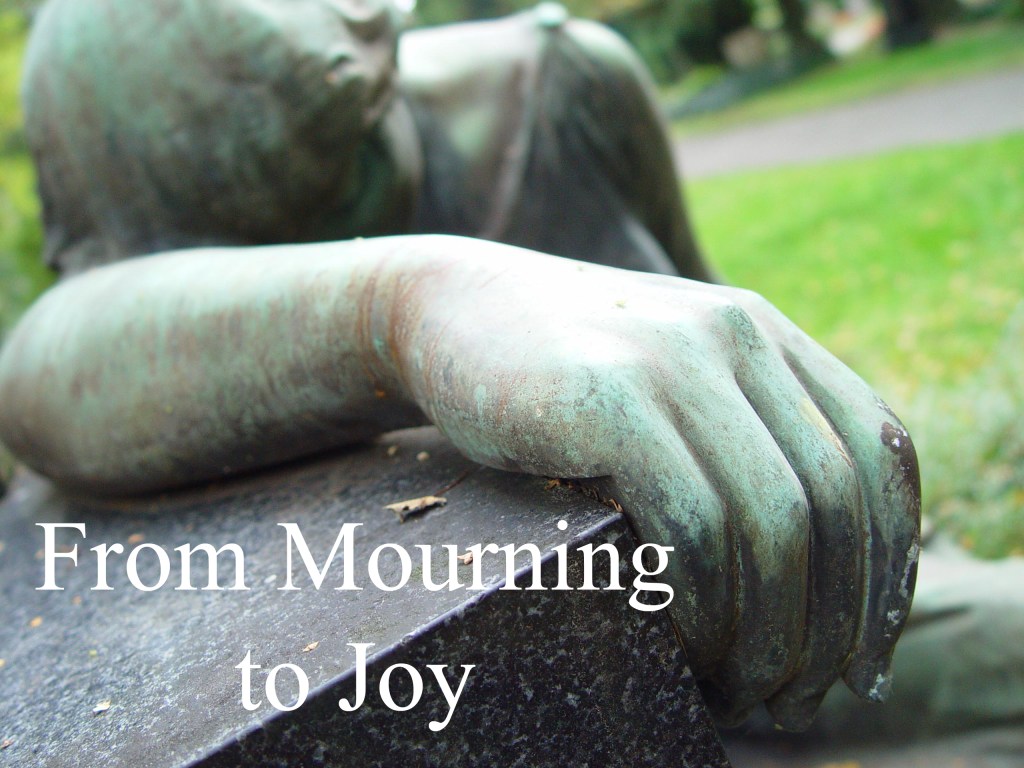
From Mourning to Joy

From Mourning to Joy

December 17, 2023*

By Pastor John Partridge

Isaiah 61:1-4, 8-11                 John 1:6-8, 19-28                          1 Thessalonians 5:16-24

On June second of 2022, seventeen-year-old Ethan Liming, the son of United Methodist Pastor Bill Liming, was beaten to death during an altercation at a basketball court in downtown Akron. This week we were notified that another of our East Ohio Conference colleagues, Beth Wilterdink, with whom Mike Greiner and I have served on the conference committee on camps and retreats, is mourning, with her husband and family, the loss of their barely two-year-old daughter Cora. I can read about these things, but I can’t begin to understand the pain and the grief that these families must feel.

But many of us have experienced our own kinds of loss. Some of you have lost children, many of us have lost parents or siblings. We each understand grief in our own way. And so, we have some insight into the lives of the people who heard God’s message through his prophet Isaiah. These were the people who had lost everything. They had lost sons, daughters, husbands, wives, brothers, sisters, parents, and grandparents, they had lost their nation and their freedom and had been carried off into captivity in Babylon. They were filled with grief. But God speaks to them through the writings of Isaiah and tells them that in the midst of their grief, there is good news. We hear these words in Isaiah 61:1-4, 8-11…

61:1 The Spirit of the Sovereign Lord is on me, because the Lord has anointed me
    to proclaim good news to the poor.
He has sent me to bind up the brokenhearted, to proclaim freedom for the captives
    and release from darkness for the prisoners,
to proclaim the year of the Lord’s favor and the day of vengeance of our God,
to comfort all who mourn,
    and provide for those who grieve in Zion— to bestow on them a crown of beauty
    instead of ashes, the oil of joy instead of mourning, and a garment of praise
    instead of a spirit of despair.
They will be called oaks of righteousness, a planting of the Lord for the display of his splendor.

They will rebuild the ancient ruins and restore the places long devastated;
they will renew the ruined cities that have been devastated for generations.

“For I, the Lord, love justice;I hate robbery and wrongdoing.
In my faithfulness I will reward my people and make an everlasting covenant with them.
Their descendants will be known among the nations and their offspring among the peoples.
All who see them will acknowledge that they are a people the Lord has blessed.”

10 I delight greatly in the Lord;my soul rejoices in my God.
For he has clothed me with garments of salvation and arrayed me in a robe of his righteousness,
as a bridegroom adorns his head like a priest, and as a bride adorns herself with her jewels.
11 For as the soil makes the sprout come up and a garden causes seeds to grow,
so the Sovereign Lord will make righteousness and praise spring up before all nations.

God says that there will be healing for the brokenhearted, release for prisoners, comfort for those who mourn, and God promises to transform the ashes of their grief into a crown of beauty. God promises to rebuild, restore, and renew, and to bring justice and faithfulness to replace their despair and loss. And in the end, God will use the nations of the world to raise up gardens of righteousness and praise.

In no way does God, or Isaiah, diminish the pain, loss, and grief that we experience today, God does not tell us to “get over it,” but God does promise that he will, one day, transform our grief into joy.

But, because John the Baptist had been quoting from the words of Isaiah, the priests and the leaders of Israel came out to the wilderness in John 1:6-8, 19-28 to ask if he was a resurrected Isaiah that God had sent to fulfill the promises that had been written so long ago.

There was a man sent from God whose name was John. He came as a witness to testify concerning that light, so that through him all might believe. He himself was not the light; he came only as a witness to the light.

19 Now this was John’s testimony when the Jewish leaders in Jerusalem sent priests and Levites to ask him who he was. 20 He did not fail to confess, but confessed freely, “I am not the Messiah.”

21 They asked him, “Then who are you? Are you Elijah?”

He said, “I am not.”

“Are you the Prophet?”

He answered, “No.”

22 Finally they said, “Who are you? Give us an answer to take back to those who sent us. What do you say about yourself?”

23 John replied in the words of Isaiah the prophet, “I am the voice of one calling in the wilderness, ‘Make straight the way for the Lord.’”

24 Now the Pharisees who had been sent 25 questioned him, “Why then do you baptize if you are not the Messiah, nor Elijah, nor the Prophet?”

26 “I baptize with water,” John replied, “but among you stands one you do not know. 27 He is the one who comes after me, the straps of whose sandals I am not worthy to untie.”

28 This all happened at Bethany on the other side of the Jordan, where John was baptizing.

But John says that he is not Isaiah, nor is he Elijah, nor is he the promised messiah. Instead, he has come to point to the Messiah, to announce his arrival, and to proclaim the fulfillment of God’s promises in Isaiah in the person of Jesus Christ.

But, knowing that Jesus is the Messiah, as we do, what does that mean for us today? What does that tell us about our grief, and our pain, and how we are to live our lives in the twenty-first century? In his letter to the church in Thessalonica, contained in 1 Thessalonians 5:16-24, Paul says this:

16 Rejoice always, 17 pray continually, 18 give thanks in all circumstances; for this is God’s will for you in Christ Jesus.

19 Do not quench the Spirit. 20 Do not treat prophecies with contempt 21 but test them all; hold on to what is good, 22 reject every kind of evil.

23 May God himself, the God of peace, sanctify you through and through. May your whole spirit, soul and body be kept blameless at the coming of our Lord Jesus Christ. 24 The one who calls you is faithful, and he will do it.

Paul says that God’s will for us is to live in anticipation of God’s final and ultimate victory. We are to live as if Christ has already returned, and God has already fulfilled his promises of rescue, rebuilding, restoration, renewal, and transformation. Rejoice always, pray continually, give thanks in all circumstances, test the prophecies of God to prove their truthfulness, reject every kind of evil, but hold on to all that is good.

In this world, we know that we will experience suffering, pain, grief, and death.

But one day God will transform our mourning into joy.

Until then…

…reject every kind of evil and…

                                    …hold on to what is good.


Please LIKE and SHARE!

Click here to subscribe to Pastor John’s blog.

Click here if you would like to subscribe to Pastor John’s weekly messages.

Click here to visit Pastor John’s YouTube channel.


*You have been reading a message presented at Christ United Methodist Church on the date noted at the top of the first page.  Rev. John Partridge is the pastor at Christ UMC in Alliance, Ohio.  Duplication of this message is a part of our Media ministry, if you have received a blessing in this way, we would love to hear from you.  Letters and donations in support of the Media ministry or any of our other projects may be sent to Christ United Methodist Church, 470 East Broadway Street, Alliance, Ohio 44601.  These messages are available to any interested persons regardless of membership.  You may subscribe to these messages, in print or electronic formats, by writing to the address noted, or by contacting us at secretary@CUMCAlliance.org.  These messages can also be found online at https://pastorpartridge.com .  All Scripture quotations, unless otherwise indicated, are taken from the Holy Bible, New International Version®, NIV®. Copyright ©1973, 1978, 1984, 2011 by Biblica, Inc.™ Used by permission of Zondervan. All rights reserved worldwide. www.zondervan.comThe “NIV” and “New International Version” are trademarks registered in the United States Patent and Trademark Office by Biblica, Inc.™

Sources of Suffering

Click here to listen to the podcast

Click here to watch the livestream: https://youtu.be/fM8SVM6jHnU


Sources of Suffering

October 02, 2022*

By Pastor John Partridge

Lamentations 1:1-6               Luke 17:5-10             2 Timothy 1:1-14

On January 1, 1970, George V. Higgins, while he was still employed as Assistant US Attorney, but who would eventually be described as the grand master of crime fiction, published his first crime novel “The Friends of Eddie Coyle.”  In that story, gun runner Jackie Brown famously said, “This life’s hard, but it’s harder if you’re stupid.”  That quote has often been misattributed to John Wayne, but there is no record of John Wayne, nor any of his movie characters, ever saying such a thing.  In any case, many of us have found this to be true.  “This life’s hard, but it’s harder if you’re stupid.”  Few, if any of us, have managed to always make good decisions, and while we have learned valuable lessons from them, those bad decisions often made our lives much more difficult and painful than they needed to be.  But, at the same time, sometimes life is hard because we made good decisions.  Changing careers, working as a student pastor, with a student pastor’s salary, going to school full-time, while raising three children was hard, despite being a good choice.  And many of you could describe similar choices and similar struggles.

But despite our experiences, and our past struggles, many people ask the question, “Why is there suffering?” Or “Why am I suffering?”  And while I don’t have the definitive answer that applies to all people for all time, this morning we’re going to read several stories which illustrate several kinds of sadness, sorrow, and suffering and maybe, along the way, we will find some of the answers to our questions about suffering. We begin this morning, in a place where we don’t often go, to the book of Lamentations.  A lamentation is defined as a “passionate expression of grief or sorrow” and so this book of scripture is the place where we find the mournful prayers of the people of Israel who have lost the war with the Babylonian army, been ripped from their homes, watched as their city and their temple were destroyed, enslaved, and dragged into Babylon to make a new life in captivity.  Not surprisingly, tears were shed, and God’s people asked why this had happened to them.  “Why are we here?”  “When will we go home?”  Will we ever go home?”  “Why did God allow this to happen?”  And “Why has God allowed us to suffer?”  We begin in Lamentations 1:1-6, where we hear these words:

1:1 How deserted lies the city,once so full of people!
How like a widow is she, who once was great among the nations!
She who was queen among the provinces has now become a slave.

2 Bitterly she weeps at night,tears are on her cheeks.
Among all her lovers there is no one to comfort her.
All her friends have betrayed her; they have become her enemies.

3 After affliction and harsh labor,Judah has gone into exile.
She dwells among the nations; she finds no resting place.
All who pursue her have overtaken her in the midst of her distress.

4 The roads to Zion mourn,for no one comes to her appointed festivals.
All her gateways are desolate, her priests groan,
her young women grieve, and she is in bitter anguish.

5 Her foes have become her masters;her enemies are at ease.
The Lord has brought her grief because of her many sins.
Her children have gone into exile, captive before the foe.

6 All the splendor has departed from Daughter Zion.
Her princes are like deer that find no pasture;
in weakness they have fled before the pursuer.

Not everyone was taken into captivity because farmers and laborers were needed tend the land, harvest crops, and send taxes and tribute to the nation of Babylon.  It was not in Babylon’s best interests to take everyone, and so, much like the takeover of the communists in China, they took, or killed, the king, the royalty, the leaders of the military, the government, the church, and anyone else who might lead and rally people together in rebellion.  To borrow an expression from our nation’s experience in Vietnam, what Babylon wanted was a pacified Israel that would obey the orders of Babylon’s king and pay their taxes.

The people who were left behind may have been almost as miserable as those who have been taken into captivity.  Every day they remembered.  They remembered what their cities had once been, they remembered how beautiful their temple had been, how busy the roads had been, how peaceful it was to go to the synagogue and hear the words of God read from the Torah scroll.  But now that was all gone.  The roads mourn in their emptiness, the city gates are broken and desolate.  The people are gone.  Their friends and allies abandoned them in their time of need.

But there is recognition of why this had happened to them.  Jeremiah might not have been popular when he came to Jerusalem to proclaim the words, warnings, and condemnation of God, but the people remembered what he, and other prophets had said.  They knew that their grief and their suffering had come about because they loved their sin and had turned their backs on God.  And now life was harder, infinitely more difficult, and filled with weeping, sadness, mourning, suffering, and pain because of the bad choices that they had made.

But we often twist the question and, rather than ask “why are we suffering?” we ask, “why isn’t God blessing us?” and essentially ask why God is shortchanging us for doing good or assume that we aren’t getting what we want, or aren’t getting the expected result of God’s blessing, because we don’t have enough faith.  That’s the question that the disciples are asking Jesus in Luke 17:5-10 when Jesus is telling them about the consequences of sin and the need for his followers to forgive others.

The apostles said to the Lord, “Increase our faith!”

He replied, “If you have faith as small as a mustard seed, you can say to this mulberry tree, ‘Be uprooted and planted in the sea,’ and it will obey you.

“Suppose one of you has a servant plowing or looking after the sheep. Will he say to the servant when he comes in from the field, ‘Come along now and sit down to eat’? Won’t he rather say, ‘Prepare my supper, get yourself ready and wait on me while I eat and drink; after that you may eat and drink’? Will he thank the servant because he did what he was told to do? 10 So you also, when you have done everything you were told to do, should say, ‘We are unworthy servants; we have only done our duty.’”

Jesus says that you don’t need a lot of faith because even a little bit of faith is a powerful thing.  The problem isn’t that we don’t have enough faith, the problem is that we expect God to bless us every time we do what we’re supposed to do.  We don’t expect our employer, or our boss, to thank us every time that we show up for work in the morning.  Rather than expecting God to pour out blessings on us for every little thing, our expectations should be, at minimum, that we will do the things that God has commanded us to do.

Let me say that again.

Our expectations should be, at minimum, that we will do the things that God has commanded us to do just as our employer expects that we will show up for work on time and do the job that we’ve been hired to do.  Doing the minimum doesn’t give us the right to expect bonuses and an abundance of praise and thanksgiving.  We shouldn’t expect God to bless us because we did half of what was expected. Doing the minimum is the least of what God expects from us.  Jesus said that servants are expected to do what servants do and at the end of the day simply acknowledge that “we have only done our duty.”

I’m sure that’s not the most encouraging thing that I’ve ever preached, nor is it the most encouraging thing that you’ve ever heard in church. 

But it gets worse.

In his second letter to his friend Timothy, the Apostle Paul explains that while God will empower us, and give us the tools, and the strength that we need to do what he has called us to do, even making the right choices, and doing the right thing, in the right way, for the right reasons, may still result in suffering.  In 2 Timothy 1:1-14, we hear Paul say this:

1:1 Paul, an apostle of Christ Jesus by the will of God, in keeping with the promise of life that is in Christ Jesus,

To Timothy, my dear son:

Grace, mercy and peace from God the Father and Christ Jesus our Lord.

I thank God, whom I serve, as my ancestors did, with a clear conscience, as night and day I constantly remember you in my prayers. Recalling your tears, I long to see you, so that I may be filled with joy. I am reminded of your sincere faith, which first lived in your grandmother Lois and in your mother Eunice and, I am persuaded, now lives in you also.

For this reason I remind you to fan into flame the gift of God, which is in you through the laying on of my hands. For the Spirit God gave us does not make us timid, but gives us power, love, and self-discipline. So do not be ashamed of the testimony about our Lord or of me his prisoner. Rather, join with me in suffering for the gospel, by the power of God. He has saved us and called us to a holy life—not because of anything we have done but because of his own purpose and grace. This grace was given us in Christ Jesus before the beginning of time, 10 but it has now been revealed through the appearing of our Savior, Christ Jesus, who has destroyed death and has brought life and immortality to light through the gospel. 11 And of this gospel I was appointed a herald, an apostle, and a teacher. 12 That is why I am suffering as I am. Yet this is no cause for shame, because I know whom I have believed, and am convinced that he is able to guard what I have entrusted to him until that day.

13 What you heard from me, keep as the pattern of sound teaching, with faith and love in Christ Jesus. 14 Guard the good deposit that was entrusted to you—guard it with the help of the Holy Spirit who lives in us.

Paul breaks down the ideas of faith and works for Timothy by saying at he knows Timothy has faith. Because he has faith, he knows that he has received the gift of the Spirit of God.  Because the Spirit of God does not make us timid, but gives us power, love, and self-discipline, then Timothy should not be afraid, ashamed, or embarrassed to tell the people around him about Jesus Christ or about Paul’s     imprisonment.  Instead of being embarrassed, Paul says that Timothy should join with him in suffering for the sake of the gospel message, which is, in Paul’s view, suffering by the power of God.  Paul says that God did not call us because we deserved it, or because we had great qualifications, or because we had any qualifications at all, God called us because we fit into his plan, for his own purposes, and God called us because he chose to pour out his grace into our lives.

In the end, we are like Paul.  We have been called to be the heralds, proclaimers, apostles, town criers, and the announcers of the gospel message and the good news of Jesus Christ.  But suffering has always been and, until the day of judgement, always will be a part of the human experience.  Sometimes life is hard, and we suffer because we’re stupid and we made poor choices.  Sometimes we suffer because we get so selfish and self-focused that we put God in second, or third, place.  And sometimes we suffer for all the right reasons.  We made the right choices, did the right things, the right way, for the right reasons, and suffered anyway.  The odds are good that most of us here have endured through some hard times and in this life, the odds are good that we’re not done.  Suffering is just a part of the human experience.  But, if we’re going to suffer, let it be because we’ve made the right choices, done the right things, the right way, and for the right reasons.  Let it be so, that when we suffer, we suffer for the cause of Jesus Christ and for his kingdom.  Let us busy ourselves answering his call, and doing his work, so that when the day comes, we cannot be accused of only doing half of what we were called to do but can instead proclaim that ‘We are unworthy servants; we have only done our duty.’”


Did you enjoy this?

Please LIKE and SHARE!

Click here to subscribe to Pastor John’s blog.

Click here if you would like to subscribe to Pastor John’s weekly messages.

Click here to visit Pastor John’s YouTube channel.


*You have been reading a message presented at Christ United Methodist Church on the date noted at the top of the first page.  Rev. John Partridge is the pastor at Christ UMC in Alliance, Ohio.  Duplication of this message is a part of our Media ministry, if you have received a blessing in this way, we would love to hear from you.  Letters and donations in support of the Media ministry or any of our other projects may be sent to Christ United Methodist Church, 470 East Broadway Street, Alliance, Ohio 44601.  These messages are available to any interested persons regardless of membership.  You may subscribe to these messages, in print or electronic formats, by writing to the address noted, or by contacting us at secretary@CUMCAlliance.org.  These messages can also be found online at https://pastorpartridge.com .  All Scripture references are from the New International Version unless otherwise noted.