Paradigm Proclamation

Paradigm Proclamation

March 28, 2024*

(Holy Thursday)

By Pastor John Partridge

Exodus 12:1-4, (5-10), 11-14             John 13:1-17, 31b-35            1 Corinthians 11:23-26

As we gather for the celebration of Holy Thursday, or Maundy Thursday, we remember the story of the last supper but also the history of the people of Israel and the tradition that was likely being celebrated by Jesus and the disciples. If the meal that we know as the last supper was, in fact, the celebration of remembrance for the exodus of Israel from Egypt, none of the gospel writers explicitly say so.  We can be sure that it was during the week of Passover because John’s gospel points to it being the day before the official Passover celebration. In any case, this is the reason that these two events are traditionally connected.

And so, tonight, as we read the scriptures that relate to these two events, I want to highlight a consistent theme that flows through all of them, and that theme, is the proclamation of God’s message through the way that his followers, in other words all of us gathered here, live their lives. We begin this evening with the story of Israel’s departure from Egypt and the beginning of their journey to freedom and we read that story in Exodus 12:1-4, 11-14:

12:1 The Lord said to Moses and Aaron in Egypt, “This month is to be for you the first month, the first month of your year. Tell the whole community of Israel that on the tenth day of this month each man is to take a lambfor his family, one for each household. If any household is too small for a whole lamb, they must share one with their nearest neighbor, having taken into account the number of people there are. You are to determine the amount of lamb needed in accordance with what each person will eat. 11 This is how you are to eat it: with your cloak tucked into your belt, your sandals on your feet and your staff in your hand. Eat it in haste; it is the Lord’s Passover.

12 “On that same night I will pass through Egypt and strike down every firstborn of both people and animals, and I will bring judgment on all the gods of Egypt. I am the Lord. 13 The blood will be a sign for you on the houses where you are, and when I see the blood, I will pass over you. No destructive plague will touch you when I strike Egypt.

14 “This is a day you are to commemorate; for the generations to come you shall celebrate it as a festival to the Lord—a lasting ordinance.

You will notice that God commands two groups of people, those in the time of Moses, and all the future descendants of that group of people. God declares that these are the instructions for the people, and then declares that this is a day that should be celebrated as a festival forever.

This is God’s paradigm proclamation in which God says that those who follow him should establish a new normal, and a new tradition, which shall be done both now and forever.

We see this again when Jesus meets with his disciples for what we now name as the last supper. We read that story in John’s gospel in John 13:1-17, 31b-35 where it says:

13:1 It was just before the Passover Festival. Jesus knew that the hour had come for him to leave this world and go to the Father. Having loved his own who were in the world, he loved them to the end.

The evening meal was in progress, and the devil had already prompted Judas, the son of Simon Iscariot, to betray Jesus. Jesus knew that the Father had put all things under his power, and that he had come from God and was returning to God; so he got up from the meal, took off his outer clothing, and wrapped a towel around his waist. After that, he poured water into a basin and began to wash his disciples’ feet, drying them with the towel that was wrapped around him.

He came to Simon Peter, who said to him, “Lord, are you going to wash my feet?”

Jesus replied, “You do not realize now what I am doing, but later you will understand.”

“No,” said Peter, “you shall never wash my feet.”

Jesus answered, “Unless I wash you, you have no part with me.”

“Then, Lord,” Simon Peter replied, “not just my feet but my hands and my head as well!”

10 Jesus answered, “Those who have had a bath need only to wash their feet; their whole body is clean. And you are clean, though not every one of you.” 11 For he knew who was going to betray him, and that was why he said not every one was clean.

12 When he had finished washing their feet, he put on his clothes and returned to his place. “Do you understand what I have done for you?” he asked them. 13 “You call me ‘Teacher’ and ‘Lord,’ and rightly so, for that is what I am. 14 Now that I, your Lord and Teacher, have washed your feet, you also should wash one another’s feet. 15 I have set you an example that you should do as I have done for you. 16 Very truly I tell you, no servant is greater than his master, nor is a messenger greater than the one who sent him. 17 Now that you know these things, you will be blessed if you do them.

31 Jesus said, “Now the Son of Man is glorified, and God is glorified in him. 32 If God is glorified in him, God will glorify the Son in himself, and will glorify him at once.

33 “My children, I will be with you only a little longer. You will look for me, and just as I told the Jews, so I tell you now: Where I am going, you cannot come.

34 “A new command I give you: Love one another. As I have loved you, so you must love one another. 35 By this everyone will know that you are my disciples, if you love one another.”

Jesus declared, in the setting of the last supper, another paradigm proclamation that all who would follow him should do, and remember, forever. The first of these is foot-washing. Most churches, including ours, see this as a figurative command that we should serve the people that we lead, the people that work alongside, and the people around us. But some churches, such as our brethren friends, periodically celebrate a literal foot-washing service at church because they understand this command to be both literal and figurative. In either case, service to others, especially service to those under your authority, is something that Christians should do as a matter of habit and have in mind, and live out by example, regularly and perpetually.

The second of these is to love one another. The love that the followers of Jesus Christ have for the people in their church, in their communities, and all the people around them should be a mark of distinction. Christians aren’t called to simply be kind in the way that everyone in a culture is expected to be kind and polite to one another. Christians are called to be so loving that people who don’t know you would guess that you are a Christian because your love for others is so far above what is ordinarily seen. Folks, I have to say that that is certainly a high bar and a demanding standard, but that is exactly what Jesus expects us to do.

The third thing that came out of Jesus’ last supper with his disciples isn’t found directly in his words, but in those of Paul and are found in his first letter to the church in Corinth in 1 Corinthians 11:23-26, where he says:

23 For I received from the Lord what I also passed on to you: The Lord Jesus, on the night he was betrayed, took bread, 24 and when he had given thanks, he broke it and said, “This is my body, which is for you; do this in remembrance of me.” 25 In the same way, after supper he took the cup, saying, “This cup is the new covenant in my blood; do this, whenever you drink it, in remembrance of me.” 26 For whenever you eat this bread and drink this cup, you proclaim the Lord’s death until he comes.

Obviously, this is the one that you all expected me to talk about tonight. Although Jesus never specified that the last supper was to be a lasting ordinance or as a perpetual remembrance, it didn’t take long at all for the disciples and the followers of Jesus to decide that he had implied it and that they must remember it just as the people of Israel remembered the Passover.

These things that I have referred to this evening as “paradigm proclamations” are the things that God has called us to do conscientiously, regularly, and faithfully to remind us of who we are, to remember where we came from, to be the kind of people that God wants us to be, and to reveal God’s love to the world. The celebration of the Passover was something that marked Jewish believers and Jewish families as being Jewish. Likewise, if we are to be faithful followers of Jesus Christ, the people around us should know that we regularly celebrate communion when we meet together, that we serve the people that we lead and treat them like we would want to be treated, that we are committed to serving the others, and that our love is so distinctive, so… excessive, that we stand out from the ordinary kindness of our culture.

When we say that we are the followers of Jesus Christ, these are the things to which we have committed ourselves.

And, if we’re honest, we have work to do if we want to meet those high standards.


Please LIKE and SHARE!

Click here to subscribe to Pastor John’s blog.

Click here if you would like to subscribe to Pastor John’s weekly messages.

Click here to visit Pastor John’s YouTube channel.


*You have been reading a message presented at Christ United Methodist Church on the date noted at the top of the first page.  Rev. John Partridge is the pastor at Christ UMC in Alliance, Ohio.  Duplication of this message is a part of our Media ministry, if you have received a blessing in this way, we would love to hear from you.  Letters and donations in support of the Media ministry or any of our other projects may be sent to Christ United Methodist Church, 470 East Broadway Street, Alliance, Ohio 44601.  These messages are available to any interested persons regardless of membership.  You may subscribe to these messages, in print or electronic formats, by writing to the address noted, or by contacting us at secretary@CUMCAlliance.org.  These messages can also be found online at https://pastorpartridge.com .  All Scripture quotations, unless otherwise indicated, are taken from the Holy Bible, New International Version®, NIV®. Copyright ©1973, 1978, 1984, 2011 by Biblica, Inc.™ Used by permission of Zondervan. All rights reserved worldwide. www.zondervan.comThe “NIV” and “New International Version” are trademarks registered in the United States Patent and Trademark Office by Biblica, Inc.™

What Do You Think You’re Doing?

What Do You Think You’re Doing?

March 24, 2024*

(Palm Sunday)

By Pastor John Partridge

Mark 11:1-11

Have you ever been caught doing something that you shouldn’t have been doing? For some of us it was something that we were told not to do, or something that we were doing wrong, or something that may have been unsafe, or just something that someone thought we shouldn’t have been doing or something that they thought someone else should have been doing. I’m sure that one of those things has happened to you. Whichever of those things happened, the person that caught you doing it may well have said something like, “Just what do you think that you are doing.” Or, if you were in the military, or in some industrial settings, there might have been one or more expletives inserted into that sentence for emphasis.

The point is, we’ve all been there. Moreover, we’ve all been there both as the person who is asked that question, and as the person asking the question. We’ve all caught our children, or our co-workers doing something that they shouldn’t have been doing, or at least something that we needed to know more about before we walked away. We’ve all been there. And that’s why the story just before the beginning of Jesus’ triumphal entry into Jerusalem is so memorable. In that story, Jesus sends two of his friends ahead to make some preparations and, in the middle of doing what Jesus told them to do, they get stopped, with a perfectly legitimate question that amounts to, “Just what do you guys think you are doing.” But it’s not just a question heard in the first century, it’s a question that flows down through history to us. But before we get to that, let’s begin by reading the story of Jesus’ triumphal entry contained in Mark 11:1-11 which says:

11:1 As they approached Jerusalem and came to Bethphage and Bethany at the Mount of Olives, Jesus sent two of his disciples, saying to them, “Go to the village ahead of you, and just as you enter it, you will find a colt tied there, which no one has ever ridden. Untie it and bring it here. If anyone asks you, ‘Why are you doing this?’ say, ‘The Lord needs it and will send it back here shortly.’”

They went and found a colt outside in the street, tied at a doorway. As they untied it, some people standing there asked, “What are you doing, untying that colt?” They answered as Jesus had told them to, and the people let them go. When they brought the colt to Jesus and threw their cloaks over it, he sat on it. Many people spread their cloaks on the road, while others spread branches they had cut in the fields. Those who went ahead and those who followed shouted,

“Hosanna!”

“Blessed is he who comes in the name of the Lord!”

10 “Blessed is the coming kingdom of our father David!”

“Hosanna in the highest heaven!”

11 Jesus entered Jerusalem and went into the temple courts. He looked around at everything, but since it was already late, he went out to Bethany with the Twelve.

If we flash back to the beginning of the story that we just read, we realize that Jesus fully anticipated that his friends would be asked what they were doing. Jesus told them exactly what was going to happen before it happened, and he told them how to answer the question. It happened, they answered, and it all worked out.  But what do we take away from the story? Typically, the thing that we talk about is how Jesus saw the future. Jesus knew that there would be an unridden colt tied up at the edge of town, Jesus knew that his friends would be questioned, and he knew what kind of answer would satisfy the owner of the house. Some folks will say that Jesus must have obviously pre-arranged these things but many of us will point out that there is no evidence of this in scripture and instead point to this as evidence of Jesus’ divinity.

But what else do we take away from the story?

Other than recognizing that Jesus was divine, what else can this story tell us, and what is it about this story that can make a difference to us as we live our lives in the twenty-first century?

For that, I want to take a minute to look at the role that is played by Jesus’ two friends and disciples. Our story doesn’t name them and for our purposes this morning it doesn’t matter because what I am suggesting is that these two men represent us in this story. As we consider that, let’s break down, step by step, what happened: These two men were walking with Jesus, minding their own business, when Jesus called them out and sent them forward with a mission. Before they left him, Jesus told them where to go, what to do, what would happen there, and how to answer any questions with which they might be presented. 

So far, that’s absolutely straightforward stuff.

But then what happened?

The disciples were obedient to Jesus, they went where Jesus told them to go, and they did exactly what Jesus told them to do, and then…

            …someone yells at them and asks them what the absolute heck they are doing.

Even if Jesus told them to expect that this would happen, this had to have an emotional impact on these two followers. They were in the place that they were supposed to be, they were doing exactly what Jesus had told them to do, and they are asked “Why are you here, and why are you doing that?” If this were an internet meme, the person asking that question would, without question, be described as a “Karen” that was butting in bothering the people who were only doing their job. But to be fair, it’s a question that any of us would ask if it was our horse or our property, or even our neighbor’s property. But from the perspective of the Jesus followers, they were just doing what they were told to do, and they get accosted for it.

Jesus knew all that before it happened, and that’s why he told his friends what to say, and that’s why it all worked out so that Jesus could ride that colt into Jerusalem.

But what does it mean for us? How does this story flow down through the church and through history in such a way that it matters to us? What is it in this story that connects to what we are doing in church and in ministry today?

It’s this: We talk a lot about listening for God’s voice and for God’s guidance. We talk about listening for God’s call upon our lives and upon the mission of the local church. We talk about these things, and we talk about them often, because they are important. But what happens when we do those things? What happens when we listen, we hear and feel God’s call, and we obey? What happens when we move in new directions, go to new places, and do new things?

If we learn anything from this story, we learn that even when we are fully obedient, even when we go where Jesus calls us to go, and do what Jesus calls us to do, things may not go perfectly or smoothly. Even when we are doing the work that God called us, and sent us, to do, people will stop us and ask us what the heck we are doing in that place. Opposition to our work is to be expected. Push back and criticism are to be expected.

But what we must also learn from the story is what should happen next. In the story, the disciples who were questioned did not stop doing what they were doing. The followers of Jesus did not give up. They did not allow the questions or the criticism to prevent them from doing what Jesus had sent them to do. They were asked a question, they answered that question, they continued doing what they were doing, they completed the mission, and Jesus entered the city just as the prophets of the Old Testament said that he would.

And we must be expected to have that same attitude. Once we spend the time to study scripture, to pray, and to listen for God’s voice, once we discern that Jesus is calling us to go to a new place, or to do something new, then we must expect that there will be naysayers who criticize us and who ask us what the heck we are doing. But when they do, we must not allow their questions or their criticism to prevent us from doing what Jesus sends us to do. We must, like the unnamed followers in the story, continue doing what we are doing until we have completed the mission so that Jesus can take the next step.

Too often, the church allows questions and criticism, from inside and out, to derail its mission.

But that is not the example that we have in scripture.

When we are asked what we are doing, we must give an answer. “We are doing what our master has called us to do.” And then continue doing our work until it has been completed.

Stay on task.

Finish the mission.

And trust that Jesus will take care of everything else.

Because it was the obedience of the disciples at the beginning, that led to the hosannas at the end.


Please LIKE and SHARE!

Click here to subscribe to Pastor John’s blog.

Click here if you would like to subscribe to Pastor John’s weekly messages.

Click here to visit Pastor John’s YouTube channel.


*You have been reading a message presented at Christ United Methodist Church on the date noted at the top of the first page.  Rev. John Partridge is the pastor at Christ UMC in Alliance, Ohio.  Duplication of this message is a part of our Media ministry, if you have received a blessing in this way, we would love to hear from you.  Letters and donations in support of the Media ministry or any of our other projects may be sent to Christ United Methodist Church, 470 East Broadway Street, Alliance, Ohio 44601.  These messages are available to any interested persons regardless of membership.  You may subscribe to these messages, in print or electronic formats, by writing to the address noted, or by contacting us at secretary@CUMCAlliance.org.  These messages can also be found online at https://pastorpartridge.com .  All Scripture quotations, unless otherwise indicated, are taken from the Holy Bible, New International Version®, NIV®. Copyright ©1973, 1978, 1984, 2011 by Biblica, Inc.™ Used by permission of Zondervan. All rights reserved worldwide. www.zondervan.comThe “NIV” and “New International Version” are trademarks registered in the United States Patent and Trademark Office by Biblica, Inc.™

Spring Cleaning

Spring Cleaning

April 2024

by Pastor John Partridge

By the time you read this, the calendar will say that Spring has finally arrived. Some spring flowers have already blossomed, and baseball season started on March 28th. This is the time when many people begin to think about spring cleaning, a time to wash windows, vacuum behind and under things that don’t normally get moved, and clear out a year’s worth (or more) of clothes that don’t fit and other accumulated clutter.

But what would it look like if we had a spiritual spring cleaning? Some activities might look a lot like the season of Lent when we reflect on our year, on our actions, on our inaction, and repent of our sins against God and against one another. But what else might this version of spring-cleaning look like?

Physical window washing removes accumulated dirt, grime, and the films that accumulate on the windows of our homes and automobiles so that we can see the world outside more clearly. But, just as dirt and grime accumulate on our physical windows, our personal biases and the misinformation that circulates so freely in the world around us colors our perception of the real world, and the people in it. Doing some spiritual window washing might require us to go out into the world, meet new people, make new acquaintances, and see new things. As I said in church recently, knowing just one homeless person by name, as a person, changes the way that we think about homelessness. Meeting the people who come to, and are supported by, the Red Bird Mission and its outreach centers, in person, changes how we think about the people of rural Kentucky. Making friends with the people in Harrisburg, Liberia, or meeting the school children that we support in Sierra Leone, helping with health clinics or building homes with my sister in Jamaica, or a thousand other experiences like that, will clear away our biases and make us see the world in a different way.

Spiritual vacuuming might mean that we take a close look at where we’ve been in the last year, looking under the “furniture” that we don’t usually move, considering the actions and the conversations that we’ve had, and… just maybe, cleaning up some of the messes that we left behind. Our friends and neighbors who work through any of the twelve step programs refer to this kind of cleaning as “making amends.” How do we clean up our messes? How do we apologize? How do we show the people that we’ve hurt that we are genuinely sorry?

And what about those clothes that have gone out of style and don’t fit us any longer? Don’t we have the same thing going on with some of our attitudes that we wear? Or the people who are a bad influence on us? Or the places that we hung out before we committed to following Jesus? Sometimes ridding ourselves of clothes that no longer fit is something that we need to do so that we aren’t distracted from the new path that we’ve chosen to follow.

As we begin spring, celebrate Easter, and do a little spring cleaning in our homes, we should probably take some time to consider the inside of ourselves as well.

What accumulated clutter do we need to leave behind?

Blessings,
Pastor John


Please LIKE and SHARE!

Click here to subscribe to Pastor John’s blog.

Click here if you would like to subscribe to Pastor John’s weekly messages.

Click here to visit Pastor John’s YouTube channel.

Given, Never Taken

Given, Never Taken

March 17, 2024*

By Pastor John Partridge

Jeremiah 31:31-34      John 12:20-33                        Hebrews 5:5-10

Being a veteran, as well as the father, brother, nephew, cousin, son, and grandson of veterans, and also the father of an active duty soldier, I notice military news, and a great deal of the t-shirts, pencil holders, wall plaques, keychains, challenge coins, and a host of other military branded merchandise that is marketed to soldiers, sailors, marines, coasties, airmen, veterans, and their families. There’s a lot of it, and I mean, a lot. But among all this “stuff,” one motto or catchphrase jumped out at me as I read the scriptures for this week. And that phrase, suitable for printing on t-shirts and wall plaques, is from the Marine Corps and says simply, “Earned, Never Given.” The implication is clear. No one gives away “honorary” awards that allow you to say that you are a marine. The only people who can say that, earned the right to do so.

But the scriptures that we will read this morning are the complete reverse of that idea… and in the best way imaginable.

We begin with the words of God contained in Jeremiah 31:31-34, where God announces that, just as he made a lasting covenant with Abraham, and what would become the people of Israel, God eventually intends to make a new covenant with Israel and Judah, the two nations that descended from, and who follow the God of, Abraham.

31 “The days are coming,” declares the Lord, “when I will make a new covenant
with the people of Israel and with the people of Judah.
32 It will not be like the covenant I made with their ancestors
when I took them by the hand to lead them out of Egypt,
because they broke my covenant, though I was a husband tothem,”
declares the Lord.
33 “This is the covenant I will make with the people of Israel after that time,” declares the Lord.
“I will put my law in their minds and write it on their hearts.
I will be their God, and they will be my people.
34 No longer will they teach their neighbor, or say to one another, ‘Know the Lord,’
because they will all know me, from the least of them to the greatest,”
declares the Lord.
“For I will forgive their wickedness and will remember their sins no more.”

In God’s covenant with Abraham, God set up commandments to obey and an entire system that included priests, tabernacles, altars, incense, and sacrifices that were all necessary for worship, repentance, and a right relationship with God. But through Jeremiah, God now declares that, because his people were unable to keep their part of their contract, that God intends to unveil a new covenant with his people that will be entirely different from the first one. In God’s new covenant, rather than the law being written in stone or on scrolls that were locked up in the temple, and only read and interpreted by the priesthood, God would instead write his law on the minds, and in the hearts, of his people so that everyone, from the least to the greatest, will have the same access to God as they seek forgiveness for their sins.

No longer would there be any suggestion that forgiveness was dependent upon what you could do, or what kind of sacrifice that you could afford, but instead it would be obvious to everyone that forgiveness was based entirely upon the love and the grace of God. Forgiveness was not something that you did, and not something that you earned, but something that was purely a gift from a loving God.

And we see something similar in the words of Jesus Christ contained in John 12:20-33, where it says:

20 Now there were some Greeks among those who went up to worship at the festival. 21 They came to Philip, who was from Bethsaida in Galilee, with a request. “Sir,” they said, “we would like to see Jesus.” 22 Philip went to tell Andrew; Andrew and Philip in turn told Jesus.

23 Jesus replied, “The hour has come for the Son of Man to be glorified. 24 Very truly I tell you, unless a kernel of wheat falls to the ground and dies, it remains only a single seed. But if it dies, it produces many seeds. 25 Anyone who loves their life will lose it, while anyone who hates their life in this world will keep it for eternal life. 26 Whoever serves me must follow me; and where I am, my servant also will be. My Father will honor the one who serves me.

27 “Now my soul is troubled, and what shall I say? ‘Father, save me from this hour’? No, it was for this very reason I came to this hour. 28 Father, glorify your name!”

Then a voice came from heaven, “I have glorified it, and will glorify it again.” 29 The crowd that was there, and heard it, said it had thundered; others said an angel had spoken to him.

30 Jesus said, “This voice was for your benefit, not mine. 31 Now is the time for judgment on this world; now the prince of this world will be driven out. 32 And I, when I am lifted upfrom the earth, will draw all people to myself.” 33 He said this to show the kind of death he was going to die.

Jesus says that the hour has come for him to be glorified, but it is not he that will do the glorifying but God. Moreover, Jesus goes on to say that even though God will glorify Jesus, the reason that Jesus had come to this point was for God to be glorified. This same formula applies to every follower of Jesus Christ. We do not do the glorifying or the honoring. God does. We are called to follow and to serve, and God will give honor to those who do.

Honor is given, not earned.

It is also worth noting that, like we heard last week with Moses lifting up the bronze snake in the wilderness, and the foreshadowing that we heard about Jesus being lifted up, in this passage, we hear Jesus use this language again when he says, “And I, when I am lifted up from the earth, will draw all people to myself.” Jesus knows that, like the bronze snake, his crucifixion will offer humanity a cure for the poison of sin and death, and become a symbol of healing and hope that will draw all people to the kingdom of God.

The language of honor being given and not earned is echoed once again in the words of the writer of Hebrews in Hebrews 5:5-10 where he says:

In the same way, Christ did not take on himself the glory of becoming a high priest. But God said to him,

“You are my Son; today I have become your Father.”

And he says in another place,

“You are a priest forever, in the order of Melchizedek.”

During the days of Jesus’ life on earth, he offered up prayers and petitions with fervent cries and tears to the one who could save him from death, and he was heard because of his reverent submission. Son though he was, he learned obedience from what he suffered and, once made perfect, he became the source of eternal salvation for all who obey him 10 and was designated by God to be high priest in the order of Melchizedek.

The writer of Hebrews, which may have been Barnabus or Apollos, emphasizes that Jesus did not take glory for himself, but that God gave glory to him. God describes Jesus as an eternal priest in the order of Melchizedek, and I want to take just a moment to explain that. Melchizedek appears in the story of Moses. Unlike many other people that appear in our Old Testament scriptures, there are no genealogies, birth story, or recorded death of Melchizedek. What is said, however, is that he was both priest and king of the nation of Salem, which may well be the territory that eventually became Jerusalem, and that Moses offered tithes to Melchizedek as he would to God. So, Moses recognized him as being from God, he was both priest and king, and legend grew up around the story that the appearance of Melchizedek may have been God in human flesh, that Melchizedek was immortal because his birth and death were not recorded, and so he is seen as “preconfiguring” Jesus as from God, eternal, immortal, and being both priest and king. I know that’s a lot, but all of that is what is implied by saying that Jesus was “a priest forever in the order of Melchizedek.”

But the writer of Hebrews makes the point that although Jesus offered up prayers, petitions, cries, and tears to God, the reason that he was heard, was not because of those things, but because he was obedient. Moreover, Jesus became the source of eternal salvation not for the people who love, believe, pray, petition, or cry but for the people who obey him.

We understand that in the military, the title of United States Marine, is earned and never given. But in the kingdom of God, the situation is reversed. Glory is only given by God, prayers are only answered by God, and salvation comes only as a gift of Jesus Christ. Following or not following is our choice, and obedience is our choice. But neither of those things works like a vending machine where payment goes in, and candy comes out.

While marines know that their title is something to be earned, to followers of Jesus Christ know that we cannot earn anything because glory, honor, salvation, rescue, and eternal life are gifts that can only be given by God.

The Marines may say that their title is “Earned, Never Given,” but the grace of God is always given, and never earned.


Please LIKE and SHARE!

Click here to subscribe to Pastor John’s blog.

Click here if you would like to subscribe to Pastor John’s weekly messages.

Click here to visit Pastor John’s YouTube channel.


*You have been reading a message presented at Christ United Methodist Church on the date noted at the top of the first page.  Rev. John Partridge is the pastor at Christ UMC in Alliance, Ohio.  Duplication of this message is a part of our Media ministry, if you have received a blessing in this way, we would love to hear from you.  Letters and donations in support of the Media ministry or any of our other projects may be sent to Christ United Methodist Church, 470 East Broadway Street, Alliance, Ohio 44601.  These messages are available to any interested persons regardless of membership.  You may subscribe to these messages, in print or electronic formats, by writing to the address noted, or by contacting us at secretary@CUMCAlliance.org.  These messages can also be found online at https://pastorpartridge.com .  All Scripture quotations, unless otherwise indicated, are taken from the Holy Bible, New International Version®, NIV®. Copyright ©1973, 1978, 1984, 2011 by Biblica, Inc.™ Used by permission of Zondervan. All rights reserved worldwide. www.zondervan.comThe “NIV” and “New International Version” are trademarks registered in the United States Patent and Trademark Office by Biblica, Inc.™

Finding Purpose (and Snakes)

Finding Purpose (and Snakes)

March 10, 2024*

By Pastor John Partridge

Numbers 21:4-9        John 3:14-21              Ephesians 2:1-10

Have you seen Raiders of the Lost Ark?

That was the original movie in which, Indiana Jones, an intrepid archaeologist, searches the world for ancient clues to the location of Israel’s lost Ark of the Covenant. In this movie, there is a climactic scene as Indy and his friend and guide Sallah, enter the Well of Souls where the Ark had been hidden several millennia ago. As Indy and Sallah look down into the room containing the ark, Sallah says, “Indy, why does the floor move?” And after Sallah gives Indiana Jones his torch, Indy says, “Snakes. Why’d it have to be snakes?” Although he has had a lifelong fear of snakes, Indy’s salvation, as it were, comes from the torches that they hold. With their flames, and little gasoline, they hold back the snakes until they can retrieve the Ark. Well, at least until the bad guys trap Indy in the pit and the torches burn out.

In any case, although Indiana Jones does not appear in today’s scripture, snakes, and the rescue of God’s people from those snakes, do. We begin this morning with the people of Israel on their journey from slavery in Egypt to freedom in the Promised Land. But along the way, they take a detour around the nation and the people of Edom who refuse to allow Israel to pass through. We join Moses and the people in Numbers 21:4-9, and hear these words:

They traveled from Mount Hor along the route to the Red Sea, to go around Edom. But the people grew impatient on the way; they spoke against God and against Moses, and said, “Why have you brought us up out of Egypt to die in the wilderness? There is no bread! There is no water! And we detest this miserable food!”

Then the Lord sent venomous snakes among them; they bit the people and many Israelites died. The people came to Moses and said, “We sinned when we spoke against the Lord and against you. Pray that the Lord will take the snakes away from us.” So, Moses prayed for the people.

The Lord said to Moses, “Make a snake and put it up on a pole; anyone who is bitten can look at it and live.” So Moses made a bronze snake and put it up on a pole. Then when anyone was bitten by a snake and looked at the bronze snake, they lived.

First, some of you are bound to ask, “Did God really send snakes to kill people?” And the answer to that is… maybe. To be clear, I’m not hedging my bets, it just that it isn’t necessarily all that clear cut. The people were whining and complaining and speaking out against God and against Moses, so yes, it’s definitely a possibility that God could have chosen to punish them and doing so really isn’t outside of our understanding of the nature of God. On the other hand, when we remember that the people of the Old Testament subscribed to a theology that assumed that anything that happened to you, whether that was good or bad, had been sent to you by God, then other possibilities also present themselves. If the same thing happened to us, or to Indiana Jones, today, we would say that we were traveling across the wilderness and encountered many snakes. And so, while it’s possible that God sent the snakes, it is also possible that they simply passed through a place that had many poisonous snakes. In either case, Israel’s understanding of God would have caused them to tell the story the way that we just read it, that God sent venomous snakes among them.

The important bit, however, is what happens next. The people come to Moses, repent of their sin against him and against God, and ask that Moses would pray for their deliverance so that God would take the snakes away from them. Moses does, but God does not take the snakes away. Instead, God offers a way for people who have been bitten to be rescued from death. All they had to do is to have faith in God and look toward the bronze snake that Moses had mounted on a pole in their camp. The salvation and rescue of God’s people was found in their faith in God, and their trust in the symbol that had been lifted up.

And that leads us directly to the teaching of Jesus that we find in John 3:14-21 when he says:

14 Just as Moses lifted up the snake in the wilderness, so the Son of Man must be lifted up, 15 that everyone who believes may have eternal life in him.”

16 For God so loved the world that he gave his one and only Son, that whoever believes in him shall not perish but have eternal life. 17 For God did not send his Son into the world to condemn the world, but to save the world through him. 18 Whoever believes in him is not condemned, but whoever does not believe stands condemned already because they have not believed in the name of God’s one and only Son. 19 This is the verdict: Light has come into the world, but people loved darkness instead of light because their deeds were evil. 20 Everyone who does evil hates the light, and will not come into the light for fear that their deeds will be exposed. 21 But whoever lives by the truth comes into the light, so that it may be seen plainly that what they have done has been done in the sight of God.

Jesus says that, like Moses “lifted up” the symbol of the snake in the wilderness, so must he, the Son of Man, be “lifted up.” It is likely that this is an intentional double meaning as “lifted up” means “exalted” as well as reflective of the bronze snake being lifted on a pole. Since Jesus often foretells his trial, crucifixion, and death, this may also be a foreshadowing of both the exaltation of Jesus and his physical lifting as his cross is put in place. But Jesus adds to the connection of the snakes in the wilderness, and says that just as the people were cured of their poison-induced illness when they had faith in the curative powers of the bronze snake, so too will those who put their faith in Jesus be cured of the poison of sin and death, and have eternal life. Whoever believes in Jesus will not be condemned before God, but those who do not believe have already been condemned.

And that lead us directly to Ephesians 2:1-10 where Paul uses that exact sort of imagery when he says that before we came to Jesus Christ, we were already dead:

2:1 As for you, you were dead in your transgressions and sins, in which you used to live when you followed the ways of this world and of the ruler of the kingdom of the air, the spirit who is now at work in those who are disobedient. All of us also lived among them at one time, gratifying the cravings of our flesh and following its desires and thoughts. Like the rest, we were by nature deserving of wrath. But because of his great love for us, God, who is rich in mercy, made us alive with Christ even when we were dead in transgressions—it is by grace you have been saved. And God raised us up with Christ and seated us with him in the heavenly realms in Christ Jesus, in order that in the coming ages he might show the incomparable riches of his grace, expressed in his kindness to us in Christ Jesus. For it is by grace you have been saved, through faith—and this is not from yourselves, it is the gift of God— not by works, so that no one can boast. 10 For we are God’s handiwork, created in Christ Jesus to do good works, which God prepared in advance for us to do.

Because, as Jesus taught, “whoever does not believe stands condemned already because they have not believed in the name of God’s one and only Son,” then Paul explains that before we came to faith in Christ we were, figuratively and spiritually, dead. Our selfish goals were centered on gratifying the cravings, desires, and thoughts of our human flesh. Those desires populate common phrases from our culture like “do whatever feels good,” “do whatever the heart wants,” “whoever has the most toys wins,” “the one with the most gold makes the rules,” “power corrupts,” “feeling are more important than facts,” and other similar sentiments. Selfishness is the basis of our human nature and that is why Paul says, “we were, by nature, deserving of wrath.”

We were, by our very nature, deserving of wrath, punishment, and death. But God, who is rich in mercy, made us alive with Christ and saved us through grace. Just like the bronze snake, Jesus was lifted up on the cross so that we could be raised up with him to the kingdom of God and his heavenly home.

But we’re not dead yet. Heaven may be our treasure and our future home, but as long as we are here, God still has a purpose for our lives. God didn’t save the people of Israel from snakes so that they could be idle, God saved them so that they could inhabit the Promised Land, be his people, establish a beachhead for God’s kingdom, and be a lighthouse of hope for the world. Likewise, God did not save us from sin and death so that we could sit back, drink margaritas, and look forward to our home in the sky, by and by.

As Paul said, we represent the craftsmanship and handiwork of God who created us to do good works. It isn’t good works that save us, but having put our faith in Jesus Christ, God has now, in advance, prepared work for us to do. Our mission, therefore, is twofold. First, dig into the bible, spend time in prayer and meditation, and figure out what it is that God is calling us to do, and what work God has prepared for us to do.

And second, once we figure out what that is…

                        …get busy and do it.


Please LIKE and SHARE!

Click here to subscribe to Pastor John’s blog.

Click here if you would like to subscribe to Pastor John’s weekly messages.

Click here to visit Pastor John’s YouTube channel.


*You have been reading a message presented at Christ United Methodist Church on the date noted at the top of the first page.  Rev. John Partridge is the pastor at Christ UMC in Alliance, Ohio.  Duplication of this message is a part of our Media ministry, if you have received a blessing in this way, we would love to hear from you.  Letters and donations in support of the Media ministry or any of our other projects may be sent to Christ United Methodist Church, 470 East Broadway Street, Alliance, Ohio 44601.  These messages are available to any interested persons regardless of membership.  You may subscribe to these messages, in print or electronic formats, by writing to the address noted, or by contacting us at secretary@CUMCAlliance.org.  These messages can also be found online at https://pastorpartridge.com .  All Scripture quotations, unless otherwise indicated, are taken from the Holy Bible, New International Version®, NIV®. Copyright ©1973, 1978, 1984, 2011 by Biblica, Inc.™ Used by permission of Zondervan. All rights reserved worldwide. www.zondervan.comThe “NIV” and “New International Version” are trademarks registered in the United States Patent and Trademark Office by Biblica, Inc.™

Death and Excuses

Death and Excuses

March 03, 2024*

(Community Evening Lenten Service)

By Pastor John Partridge

Luke 14:12-23

Have you filed your income tax forms yet?

I know that some of my friends have done so, and I know that my tax guy, and the accountants in our church are all well into their busy season, but while I always have good intentions, I usually procrastinate until April.

In any case, it is likely that all of us have heard at least a part of a letter from Benjamin Franklin to French scientist Jean-Baptiste Le Roy in November 1789, in which Franklin wrote, “Our new Constitution is now established, everything seems to promise it will be durable; but, in this world, nothing is certain except death and taxes.”

And this evening, just for the sake of argument, and as an excuse to borrow from Mr. Franklin, I suggest that we might also include excuses among those things that are certain and inevitable.  As such, let’s begin by reading Luke 14:12-23. But, as we do, I want you to notice that the excuses given appear to be in order of increasing acceptability. The first is as blatant as saying that you can’t go out because you planned to wash your hair (particularly bald as I am) but each successive excuse gets better. Luke writes:

12 Then Jesus said to his host, “When you give a luncheon or dinner, do not invite your friends, your brothers or sisters, your relatives, or your rich neighbors; if you do, they may invite you back and so you will be repaid. 13 But when you give a banquet, invite the poor, the crippled, the lame, the blind, 14 and you will be blessed. Although they cannot repay you, you will be repaid at the resurrection of the righteous.”

15 When one of those at the table with him heard this, he said to Jesus, “Blessed is the one who will eat at the feast in the kingdom of God.”

16 Jesus replied: “A certain man was preparing a great banquet and invited many guests. 17 At the time of the banquet he sent his servant to tell those who had been invited, ‘Come, for everything is now ready.’

18 “But they all alike began to make excuses. The first said, ‘I have just bought a field, and I must go and see it. Please excuse me.’

19 “Another said, ‘I have just bought five yoke of oxen, and I’m on my way to try them out. Please excuse me.’

20 “Still another said, ‘I just got married, so I can’t come.’

21 “The servant came back and reported this to his master. Then the owner of the house became angry and ordered his servant, ‘Go out quickly into the streets and alleys of the town and bring in the poor, the crippled, the blind and the lame.’

22 “‘Sir,’ the servant said, ‘what you ordered has been done, but there is still room.’

23 “Then the master told his servant, ‘Go out to the roads and country lanes and compel them to come in, so that my house will be full. 24 I tell you, not one of those who were invited will get a taste of my banquet.’”

The first excuse is just plain bad. It would be bad today, and it would have been just as bad in the first century. No one would buy a field without seeing it first. Such an excuse is only used to avoid the honesty of saying, “I don’t want to come.” The second excuse is only slightly better, though it is at least plausible. I can easily imagine that, while you might be able to look over the five oxen that you wanted to buy, you may not, before the sale was completed, have had the opportunity to yoke them as a team, take them out into your field, and see how they worked together, especially if they had not previously been worked together as a team. But still, this isn’t something that you couldn’t put off for a few days if you had any real desire to attend a banquet to which you had been invited.

The third excuse is rather good. Being a newlywed in Israel in the first century was an excuse for everything. Traditionally, in Israel’s history, for a year after being newly married you could not even be conscripted into the military at the king’s decree. Building your house, establishing your household, building a relationship with your new wife and her family, and bringing honor to your family by fathering a child was important and indispensable work.

But none of those excuses were found to be acceptable and the master who had invited them became angry and instead of people who had been thought of as friends and family, or as important and influential, he invited the poor, the crippled, the blind, the lame and anyone else that was typically forgotten, ignored, and left out in the cold. When even that did not fill his banquet hall, he sent his servants out to collect any farm family, indigent wanderer, homeless person, migrant worker, foreign born alien, and anyone else that they could find and bring them in to feast at his table.

The frightening part of this story is that it is about much more than excuses or taxes. It is a story about how ordinary people procrastinate or ignore the invitation of the creator of the universe. If we start at the end of the story and work backward to the beginning, we are reminded that Jesus started talking about a great banquet when someone mentioned feasting in the kingdom of God. And, before that, Jesus had been teaching that the people who can afford to invite others to dinner should be inviting the poor, the crippled, the blind, and the lame instead of other folks who are wealthy enough to reciprocate.

Taken together, we understand that the master of the banquet is the God of creation, and the original invitation was to the people we would think of as “the usual suspects.” They were the political leaders, the wealthy, the influential, the church and all the “respectable people” that one would expect to encounter at a banquet held by a king. But every one of them finds an excuse, and while the excuses range from incredibly lame to respectably good, none of them are found to be acceptable. And so, instead of filling the banquet hall with respectable people, God fills it with outcasts, sinners, drunks, cheaters, prostitutes, farmers, shepherds, indigent wanderers, homeless people, migrant workers, foreigners, and anyone else that would accept his invitation.

And, while that might be a little uncomfortable, many of us will accept that this is the message of Jesus Christ. The frightening part of that message is the part that is left unwritten and unsaid, and that is, what happens to the people who made excuses? You see, because we’ve remembered that the master of the banquet is God, and that God can, and does, invite anyone that he pleases, we must also remember that God’s banquet, in this story, stands in for God’s kingdom, and our eternity in it. The people who procrastinated and made excuses end up being too busy to accept God’s invitation to eternity and therefore spend their eternity somewhere else.

And so, we are left with two important lessons. First, do not procrastinate or make excuses. If you have not already decided to follow Jesus Christ and become a part of God’s kingdom, do not, under any circumstances, decide that you can hold off making that decision until tomorrow. You do not want God to find you busy doing something else, no matter how good, or how important that other thing might be. And second, for those of us who have already made that choice, and who already follow Jesus, then Jesus still teaches that our wealth, at whatever level that term applies, is to be used helping the people around us. If we can afford to invite our family and friends to dinner, we can just as easily afford to feed others. We are expected to treat the outcasts, sinners, drunks, cheaters, prostitutes, farmers, shepherds, indigent wanderers, homeless people, migrant workers, foreigners, and everyone else as if they were the people we care for and love.

God’s command to the followers of Jesus Christ, is to live as if our very lives were a sacrifice to God. We are commanded to love the lord our God with all our heart, with all our mind, with all our strength, and with all our soul. Our money, our health, our time, and everything that we have belongs to God, and we must use what God has given us to care for, and to witness to, the people around us. God’s command applies to everyone, and not just to the people who can repay us.

We must live our lives, and love the people around us, as if our faith really mattered.

No excuses.  


Please LIKE and SHARE!

Click here to subscribe to Pastor John’s blog.

Click here if you would like to subscribe to Pastor John’s weekly messages.

Click here to visit Pastor John’s YouTube channel.


*You have been reading a message presented at Christ United Methodist Church on the date noted at the top of the first page.  Rev. John Partridge is the pastor at Christ UMC in Alliance, Ohio.  Duplication of this message is a part of our Media ministry, if you have received a blessing in this way, we would love to hear from you.  Letters and donations in support of the Media ministry or any of our other projects may be sent to Christ United Methodist Church, 470 East Broadway Street, Alliance, Ohio 44601.  These messages are available to any interested persons regardless of membership.  You may subscribe to these messages, in print or electronic formats, by writing to the address noted, or by contacting us at secretary@CUMCAlliance.org.  These messages can also be found online at https://pastorpartridge.com .  All Scripture quotations, unless otherwise indicated, are taken from the Holy Bible, New International Version®, NIV®. Copyright ©1973, 1978, 1984, 2011 by Biblica, Inc.™ Used by permission of Zondervan. All rights reserved worldwide. www.zondervan.comThe “NIV” and “New International Version” are trademarks registered in the United States Patent and Trademark Office by Biblica, Inc.™
Sabbath and Sacrifice

Sabbath and Sacrifice

March 03, 2024U

By Pastor John Partridge

Deuteronomy 5:12-15           Mark 2:23 – 3:6                     2 Corinthians 4:5-12

How many of you have had to turn your computer, or your phone, or your printer, or some other electronic, or even mechanical, device, off and then back on again, to make it work the way that it’s supposed to work? All of us. Anne Lamott once said, “Almost anything will work again if you unplug it for a few minutes, including you.”

It’s a thoughtful sentiment, but Anne Lamott was hardly the first person to think about the value of turning us humans off and back on again. In fact, unplugging human beings, and then plugging them in again is the whole principle behind sabbath rest. Sabbath rest, of course, is an ancient idea, and, to understand that we need to go back to the beginning, to Deuteronomy 5:12-15, where we hear this command from God to his people:

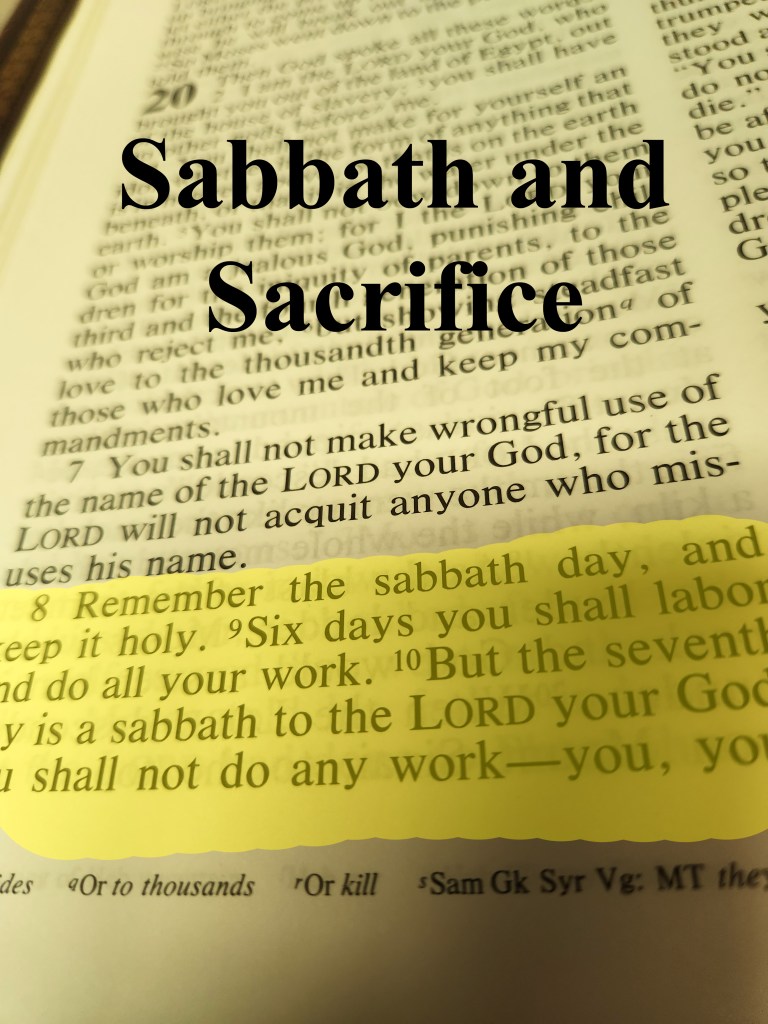
12 “Observe the Sabbath day by keeping it holy, as the Lord your God has commanded you. 13 Six days you shall labor and do all your work, 14 but the seventh day is a sabbath to the Lord your God. On it you shall not do any work, neither you, nor your son or daughter, nor your male or female servant, nor your ox, your donkey or any of your animals, nor any foreigner residing in your towns, so that your male and female servants may rest, as you do. 15 Remember that you were slaves in Egypt and that the Lord your God brought you out of there with a mighty hand and an outstretched arm. Therefore, the Lord your God has commanded you to observe the Sabbath day.

When we read this, we realize that there are two purposes behind God’s requirement of the sabbath day. The first of these is simply to rest, to unplug, and reset our bodies and minds so that we can start fresh again in a new week. And the second reason is to remember what God has done for us, to remember God’s mighty acts of rescue, redemption, and rescue, and to spend time honoring and worshiping our God. But, over time, the reason and rationale behind honoring the sabbath got confused. Because everyone recognized that the sabbath was important, the priests and other religious leaders made rules to help the people of Israel get it right. But along the way, the rules that they made, and the traditions that they established, became so important, that they were held to be of the same importance as God’s original commands. And that’s why Jesus gets into an argument with the Pharisees in Mark 2:23 – 3:6 where we hear this:

23 One Sabbath Jesus was going through the grain fields, and as his disciples walked along, they began to pick some heads of grain. 24 The Pharisees said to him, “Look, why are they doing what is unlawful on the Sabbath?”

25 He answered, “Have you never read what David did when he and his companions were hungry and in need? 26 In the days of Abiathar the high priest, he entered the house of God and ate the consecrated bread, which is lawful only for priests to eat. And he also gave some to his companions.”

27 Then he said to them, “The Sabbath was made for man, not man for the Sabbath. 28 So the Son of Man is Lord even of the Sabbath.”

3:1 Another time Jesus went into the synagogue, and a man with a shriveled hand was there. Some of them were looking for a reason to accuse Jesus, so they watched him closely to see if he would heal him on the Sabbath. Jesus said to the man with the shriveled hand, “Stand up in front of everyone.”

Then Jesus asked them, “Which is lawful on the Sabbath: to do good or to do evil, to save life or to kill?” But they remained silent.

He looked around at them in anger and, deeply distressed at their stubborn hearts, said to the man, “Stretch out your hand.” He stretched it out, and his hand was completely restored. Then the Pharisees went out and began to plot with the Herodians how they might kill Jesus.

Since the commandment to rest on the sabbath day required observant followers of God to refrain from work, it was natural that, over time, people wanted to know what exactly qualified as work. Moreover, after Israel had been sent into captivity in Babylon because of their unfaithfulness, the priests and other religious leaders wanted to write rules that would figuratively put fences around the commandments of God so that, if you were to follow their man-made rules, you would always be found to be in obedience to God’s commandments. Staying inside the fence, as it were, prevented you from even accidentally breaking a commandment.

The problem with this system was that, after a while, the rules that were intended to help obey the commandments became elevated to the same level of importance as the commandments themselves. And so, in this story, we find the disciples snapping off, and chewing on some uncooked heads of grain as they walked through the fields. But even though they exerted no energy other than lifting their hands to their mouths, according to the rules, what they had done was defined as harvesting, and harvesting was work. God’s commandment to observe the sabbath never said that you couldn’t eat, but the rules that had been written by generations of priests said that what they had done was sin (hint: it wasn’t).

And so, Jesus gives an example from scripture about how the great King David had done the same thing, and worse, and explained that God intended the sabbath to improve the lives of human beings and not to be an additional burden to them. Jesus had the same argument over healing a man who had suffered from what may well have been a birth defect. While healing was somehow defined as work, Jesus asked how doing good and undoing evil could possibly be wrong.

And that’s all well and good, but as we often ask… so what?

So, what if we know that God created a sabbath rest and a time of worship for the benefit of humanity?

So, what if we understand we shouldn’t define our sabbath rest too narrowly, and that doing good things on our day of rest is okay?

How does that make a difference to us as we live our lives?

Well, for that, let’s turn to Paul’s second letter to the church in Corinth for some clarity. But, as we read, this may not immediately sound like it is at all related to our understanding of sabbath. But it is, so bear with me until we finish, and I can unpack it a little. In 2 Corinthians 4:5-12, Paul says…

For what we preach is not ourselves, but Jesus Christ as Lord, and ourselves as your servants for Jesus’ sake. For God, who said, “Let light shine out of darkness,” made his light shine in our hearts to give us the light of the knowledge of God’s glory displayed in the face of Christ.

But we have this treasure in jars of clay to show that this all-surpassing power is from God and not from us. We are hard pressed on every side, but not crushed; perplexed, but not in despair; persecuted, but not abandoned; struck down, but not destroyed. 10 We always carry around in our body the death of Jesus, so that the life of Jesus may also be revealed in our body. 11 For we who are alive are always being given over to death for Jesus’ sake, so that his life may also be revealed in our mortal body. 12 So then, death is at work in us, but life is at work in you.

And again, I understand that this message of servanthood and persecution doesn’t immediately sound like it connects to our understanding of sabbath, but let’s look a little closer.  Paul reminds us that what we tell the world is not a message about us, it is a message about Jesus Christ, about how he came to bring light into a dark world, to display God’s glory, and to change hearts. Because of that, Paul says that we have the treasure of Jesus Christ in jars of clay.

Wait.

What does that mean?

Our explanation comes from what immediately follows, and that is a list of all the horrible things that have happened to them as messengers of the gospel. They were hard pressed, persecuted, and struck down, but while these things happened, and while they did experience abuse, pain, and suffering, they were not completely crushed, they did not despair, they did not feel as if they had been abandoned, and they were not destroyed. They themselves were carrying the message of Jesus Christ, but they knew that they were finite, fragile, and temporary vessels. More to the point, we, all of us, are like jars of clay. We are fragile vessels that contain the treasure of Jesus Christ.

We are fragile. Like clay we leak, we chip, we scratch, and we break. If God intended for us to contain his treasure, he would have stored it in something more durable like a stout treasure chest or a stone fortress. But he didn’t. The only way for us to preserve the treasure that we contain… is to share it with others.

Paul says that “we who are alive are always being given over to death for Jesus’s sake.” That means that we must be at work giving of ourselves, offering ourselves as a sacrifice to God, and sharing the good news of Jesus Christ. Death is at work in us because our time on earth is limited, and because the sacrifice of Jesus Christ is a part of who we are. But life is also at work in us through Jesus’ resurrection and his gift of eternal life to those who believe.

And so, if we look at it with Paul’s words in mind, sabbath is a time of rest and renewal when we remember who we are as we come together to worship our God, refill our leaky clay vessels, share our courage and strength with one another, share the Spirit of God that dwells within us, build one another up, equip one another, teach, learn, and grow, so that we can go back out into the world as a living sacrifice to Jesus Christ and to the kingdom of God.

Anne Lamott said, “Almost anything will work again if you unplug it for a few minutes, including you.”

And the truth of scripture tells us that she’s not wrong. Human beings were not designed or built to go non-stop, twenty-four hours a day, seven day a week, three hundred and sixty-five (or 366) days a year. The God of creation built us with a need for rest. Once every seven days he offers us a sabbath, a time to reset, restore, rest, and renew both physically and spiritually so that we can face the world, and all the evil in it, for another week.

Without rest, without sabbath, we are easily crushed, suffer despair, and feel abandoned and destroyed. Without sabbath, our fragile clay leaks and our faith weakens. Without sabbath, we are not prepared to live lives of sacrifice to God.

Simply put, without sabbath, and without rest, we cannot be the people that God wants, and needs, us to be.


Please LIKE and SHARE!

Click here to subscribe to Pastor John’s blog.

Click here if you would like to subscribe to Pastor John’s weekly messages.

Click here to visit Pastor John’s YouTube channel.


*You have been reading a message presented at Christ United Methodist Church on the date noted at the top of the first page.  Rev. John Partridge is the pastor at Christ UMC in Alliance, Ohio.  Duplication of this message is a part of our Media ministry, if you have received a blessing in this way, we would love to hear from you.  Letters and donations in support of the Media ministry or any of our other projects may be sent to Christ United Methodist Church, 470 East Broadway Street, Alliance, Ohio 44601.  These messages are available to any interested persons regardless of membership.  You may subscribe to these messages, in print or electronic formats, by writing to the address noted, or by contacting us at secretary@CUMCAlliance.org.  These messages can also be found online at https://pastorpartridge.com .  All Scripture quotations, unless otherwise indicated, are taken from the Holy Bible, New International Version®, NIV®. Copyright ©1973, 1978, 1984, 2011 by Biblica, Inc.™ Used by permission of Zondervan. All rights reserved worldwide. www.zondervan.comThe “NIV” and “New International Version” are trademarks registered in the United States Patent and Trademark Office by Biblica, Inc.™
Rulebreaker Jesus

Rulebreaker Jesus

February 25, 2024*

By Pastor John Partridge

Hosea 2:14-20            Mark 2:13-22                         2 Corinthians 3:1-6

What are Christians known for in our communities and in our world today?

In the first through the third centuries, Christians were not popular, and their critics often attacked them for the ways that the Christian community went against the prevailing culture and community standards. Christians (and Jews) were seen as atheists because they did not participate in holy day celebrations at the temples of various gods and goddesses, they were accused of practicing cannibalism for the sharing of communion, they were mocked for their belief in resurrection, for following and worshiping a criminal who had been crucified, and other ways that folks just found to be odd, irregular, unusual, and rude. But as much as Christians were criticized and even persecuted, their critics recognized that there were things for which Christians were known and remembered, and most of those things, at least today, would be thought of as good things.

David Bentley Hart, in his book “The Story of Christianity,” lists the characteristics of Christians that were used by pagan critics to describe early followers of Jesus. Christians were described as sober, gentle, faithful to their spouses without exploitation or abuse, caring for the poor, willing to nurse the gravely ill, even at significant risk to themselves, such as during a time of plague, and the ability to exhibit virtues such as self-control and courage, which were thought to be impossible for anyone who was poor or who was not philosophically trained.

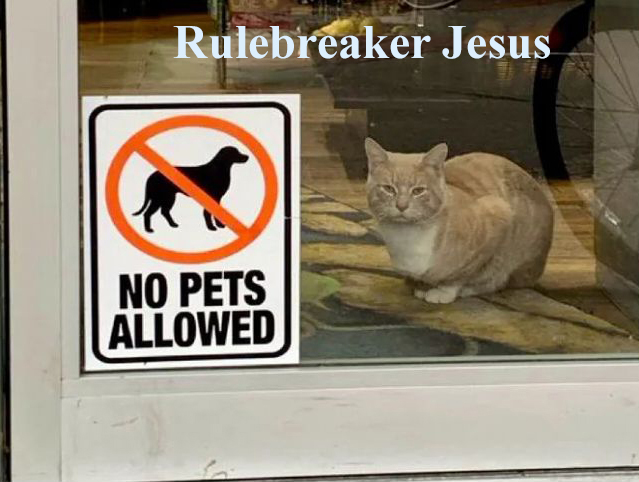
But even though Christianity’s critics may have grudgingly admitted that the movement had some positive points, and even though some of those we listed were presented as ridicule and not praise, Christians were still known, and often rejected, for the ways that their new religion made them break the rules of the culture and of the empire. But that shouldn’t surprise us when the founder of our movement, and the object of our worship, was, from the beginning, a ruler breaker. But before we get to that, let’s begin in the Old Testament book of Hosea in Hosea 2:14-20, where we hear God describing how he will win back a morally wandering Israel, and describe what he desires to provide for his people. God says…

14 “Therefore I am now going to allure her;
    I will lead her into the wilderness
    and speak tenderly to her.
15 There I will give her back her vineyards,
    and will make the Valley of Achor a door of hope.
There she will respond as in the days of her youth,
    as in the day she came up out of Egypt.

16 “In that day,” declares the Lord,
    “you will call me ‘my husband’;
    you will no longer call me ‘my master.’
17 I will remove the names of the Baals from her lips;
    no longer will their names be invoked.
18 In that day I will make a covenant for them
    with the beasts of the field, the birds in the sky
    and the creatures that move along the ground.
Bow and sword and battle
    I will abolish from the land,
    so that all may lie down in safety.
19 I will betroth you to me forever;
    I will betroth you in righteousness and justice,
    in love and compassion.
20 I will betroth you in faithfulness,
    and you will acknowledge the Lord
.

The story of Hosea is one in which Israel goes astray from God in a spectacular way and, through Hosea’s marriage to an unfaithful lady of the evening, God describes Israel as a prostitute who has sold herself for foreign gods. But here, God declares that he is going to win his bride back. God intends to allure her, speak tenderly to her, give her back her vineyards, and give her hope. Once again, Israel will return to God and forget the idols of her past so that God can give her a life of righteousness, justice, compassion, faithfulness, and peace. But those are the things that God has always wanted for his people. The problem has never been with God, it has been with the unfaithfulness of his people. And that is what is at the heart of the rule breaking Jesus that we meet in Mark 2:13-22. When the culture of God’s people, or any culture, values other things more than the things of God, then people of faith are compelled to break the rules. And that’s what we see as Jesus meets the tax collector Levi, who we also know as the disciple Matthew:

13 Once again Jesus went out beside the lake. A large crowd came to him, and he began to teach them. 14 As he walked along, he saw Levi, son of Alphaeus, sitting at the tax collector’s booth. “Follow me,” Jesus told him, and Levi got up and followed him.

15 While Jesus was having dinner at Levi’s house, many tax collectors and sinners were eating with him and his disciples, for there were many who followed him. 16 When the teachers of the law who were Pharisees saw him eating with the sinners and tax collectors, they asked his disciples: “Why does he eat with tax collectors and sinners?”

17 On hearing this, Jesus said to them, “It is not the healthy who need a doctor, but the sick. I have not come to call the righteous, but sinners.”

18 Now John’s disciples and the Pharisees were fasting. Some people came and asked Jesus, “How is it that John’s disciples and the disciples of the Pharisees are fasting, but yours are not?”

19 Jesus answered, “How can the guests of the bridegroom fast while he is with them? They cannot, so long as they have him with them. 20 But the time will come when the bridegroom will be taken from them, and on that day they will fast.

21 “No one sews a patch of unshrunk cloth on an old garment. Otherwise, the new piece will pull away from the old, making the tear worse. 22 And no one pours new wine into old wineskins. Otherwise, the wine will burst the skins, and both the wine and the wineskins will be ruined. No, they pour new wine into new wineskins.”

Jesus, in defiance of custom and propriety, sits down to dinner with a roomful of outsiders and outcasts, people that the religious leaders believe to be contemptable sinners and therefore a contaminating influence on people of good character. Worse, sharing a meal was seen as an intimate act that was only done with family, friends, and people of quality. In addition, Jesus is accused of ignoring a traditional time of fasting when the religious leaders and even the followers of John the Baptist are observing that cultural tradition.

But Jesus responds to the accusations and criticisms of the Pharisees by reminding them that what is appropriate sometimes varies. No one would expect wedding guests to fast regardless of the tradition of the religious leaders and Jesus equates his presence among his disciples as qualifying for the same kind of exemption. The comparison of the wineskins is the same sort of thing. New wineskins, made of sheepskin, can stretch when the new wine in them begins to ferment, but old wineskins have already stretched, and using them for new wine would only cause them to burst. And so, again, Jesus is reminding everyone that we don’t always adhere to strict rules, but instead make judgements on what is appropriate for the occasion.

But why does that matter to us?

Even though we are the followers of Jesus, he is not physically with us, so why are we having a discussion of what is, and is not, culturally appropriate?

And, in addition to the story of the first century church with which we began, we gain some focus as we read Paul’s letter to the church in Corinth in 2 Corinthians 3:1-6 as Paul explains how the people around us view our actions. Paul says…

3:1 Are we beginning to commend ourselves again? Or do we need, like some people, letters of recommendation to you or from you? You yourselves are our letter, written on our hearts, known and read by everyone. You show that you are a letter from Christ, the result of our ministry, written not with ink but with the Spirit of the living God, not on tablets of stone but on tablets of human hearts.

Such confidence we have through Christ before God. Not that we are competent in ourselves to claim anything for ourselves, but our competence comes from God. He has made us competent as ministers of a new covenant—not of the letter but of the Spirit; for the letter kills, but the Spirit gives life.

Paul describes us, the people of the church and the followers of Jesus Christ, as individual letters, from Jesus, to our communities and to the people around us. Many people will never read a bible, but they will read the life that you live. You are a sign to the community that tells the story of Jesus and the story of our church, and in you, and in us, they will read the story of Jesus and find the truth about our faith the work that we do. Paul says that “the letter kills, but the Spirit gives life.” And by this, Paul explains to the people of the church, that the message of Jesus isn’t all about following a strict interpretation of a bunch of rules, but instead is about a life that is lived in love.

What God wants is a life of righteousness, justice, compassion, faithfulness, and peace but far too often, when unbelievers read the story of Jesus that Christians live out in their lives, what they see is anger, prejudice, greed, violence, arrogance, abuse, and the admiration of, if not a complete alliance with, worldly power.

When Jesus broke the rules of his culture, he broke them so that he could show love and compassion to others. When the Christians of the first century behaved strangely, and broke the rules of their culture, they still earned the respect of their critics because they were sober, gentle, faithful to their spouses, cared for the poor, nursed the gravely ill even at risk to themselves, and exhibited virtues such as self-control and courage.

And so, we return to the question with which we began. What are Christians known for in our communities and in our world today?

Every day, the people around you, people that may never read a bible or set foot in a church, will read a letter from Jesus in the life that you live.

Will they read a message of love and compassion?

Or will they find something else?


Please LIKE and SHARE!

Click here to subscribe to Pastor John’s blog.

Click here if you would like to subscribe to Pastor John’s weekly messages.

Click here to visit Pastor John’s YouTube channel.


*You have been reading a message presented at Christ United Methodist Church on the date noted at the top of the first page.  Rev. John Partridge is the pastor at Christ UMC in Alliance, Ohio.  Duplication of this message is a part of our Media ministry, if you have received a blessing in this way, we would love to hear from you.  Letters and donations in support of the Media ministry or any of our other projects may be sent to Christ United Methodist Church, 470 East Broadway Street, Alliance, Ohio 44601.  These messages are available to any interested persons regardless of membership.  You may subscribe to these messages, in print or electronic formats, by writing to the address noted, or by contacting us at secretary@CUMCAlliance.org.  These messages can also be found online at https://pastorpartridge.com .  All Scripture quotations, unless otherwise indicated, are taken from the Holy Bible, New International Version®, NIV®. Copyright ©1973, 1978, 1984, 2011 by Biblica, Inc.™ Used by permission of Zondervan. All rights reserved worldwide. www.zondervan.comThe “NIV” and “New International Version” are trademarks registered in the United States Patent and Trademark Office by Biblica, In

The Intersection of Why and What

The Intersection of Why and What

February 22, 2024

by John Partridge


Here are two important questions:

  1. Why are we here?
  2. What are we doing about it?

Last fall, we had several strategic planning meetings. One of the things that grew out of those meetings was our new vision statement that you see at the top of our bulletin every week. But another was a conversation about why God has put us here, as Queen Esther would have said, “for such a time as this.” During the strategic planning meeting we asked two important questions. First, “What are the pressing needs of our community?” And second, “What are the strengths of our congregation?” Only when we answer the latter two questions, we will be able to answer the two questions that I asked at the beginning of this letter.

The needs that we listed in our meetings, with the input of many community leaders, were poverty, hunger, housing (including homelessness, blight, and high rents), lack of workforce and lack of jobs, safe places for youth, support for parents, mental health, drugs, and transportation. At the same time, we listed the strengths of our congregation as outreach, music, caring and compassionate congregation, generosity, education, leaders, organizers, our endowment, our connections and contacts, our physical plant/building and our adjoining lots used for both green space and the community garden.

That’s a lot.

But I want to keep these ideas in front of us rather than just allowing them to be an exercise that we once did and promptly forgot. Our community needs us, and our future depends upon us doing something about it.

And so, I’m inviting you all to think and dream about where these two lists intersect. What is the intersection of What we are, and what is needed? What is the intersection of “Why are we here?” and “What do the people around us need us to be and do?”

We really need you to do this.

Often, I ask these sorts of questions in our newsletter, and everyone seems to think that they are rhetorical questions (they are not). And I never get more than one or two answers, if any. But these questions need to be answered and I will be bringing them to our church boards for more discussion as we seek to find a new direction, purpose, and yes, a new strategic plan for our future.

But what might that look like?

From the list above, it could be many things, but here is an example based on something that we already do, and with which we already have some familiarity. Think about housing. Last week the Alliance chapter of Habitat for Humanity accepted applications for this year’s round of construction. Habitat will build or renovate three houses, but they had something like 150 applications. Yikes.  That number is mind blowing, but it gives us a glimpse of insight into the housing needs of our community.

So, what if, instead of raising money for three months, once every other year, for our share of the Apostle build, what if we raised money for twenty-four months? What if, instead of setting our goal at $5,000. We set a goal of $20,000 or even $150,000 (which is the cost of an entire Habitat house)?

What if, as some churches are doing in other states, we used some of our vacant land to build “tiny houses” to help get homeless people in our community under a roof, out of the weather, and help them move toward a better life?

What if our church bought and renovated one of the empty buildings in our city and created a multi-unit, low cost, rent-controlled, safe place, apartment complex?

These are all examples to help you dream. Some of them are big dreams. But honestly, given the resources, generosity, and leadership available in our congregation, I believe that, given enough time, any of them, or all of them, are possible for us to achieve if we decided to do so. But housing is just one of the needs that we listed.

What else might God be calling us to be or to do?

Why are we here?

What are we doing about it?


Please LIKE and SHARE!

Click here to subscribe to Pastor John’s blog.

Click here if you would like to subscribe to Pastor John’s weekly messages.

Click here to visit Pastor John’s YouTube channel.


Ultimate Water Rescue

Ultimate Water Rescue

February 18, 2024U

By Pastor John Partridge

Genesis 9:8-17           Mark 1:9-15               1 Peter 3:18-22

As human beings, our brains are funny things. We have perceptions and we make connections, and our memories are made in such a way that they are connected to our senses. It is said that if you study while listening to music, and you can replay that same music when you take a test, your recall is better than if you take the test without music. Likewise, certain smells trigger memories because those memories were made when we had that smell in our nostrils. The smell of a certain combination of bacon and eggs cooking in a cast iron pan will always transport me to my grandmother’s kitchen in Pennsylvania and the smell of chocolate fudge makes me think of my dad at Christmas.

I say all these things to ask this question: Where does your brain take you when you think about the ocean, or about water?  If you often spent summers at the beach, then you might think of the boardwalk or snow cones, or coney dogs, or tanning on your family’s big beach blanket. If you grew up sailing as some of my cousins did, or as Patti once did on Lake Huron, then you may think of boats, and coming about, and heeling hard over in a fair wind. But those memories may not be good ones if the ocean that you remember raged and tried its best to kill you. There’s an old saying that the sea must always be respected, or that one should never turn their back on the sea because the sea is a harsh mistress. The ocean can be beautiful one moment and trying to kill you in the next.

And this is how the memories of Israel, and the people of God were with their memories of water. There were many experiences with water in their national memory, and as a result, we still tell stories about water. And that’s why the writers of the New Testament use those memories to shape a new, institutional memory about how, and what, we should remember when we think of water. We begin in the book of Genesis at the end of the story of Noah and his ark. The water of the great flood had been deadly and Noah and his family, through the grace and the guidance of God, had barely escaped with their lives. In Genesis 9:8-17, we hear this: 

Then God said to Noah and to his sons with him: “I now establish my covenant with you and with your descendants after you 10 and with every living creature that was with you—the birds, the livestock and all the wild animals, all those that came out of the ark with you—every living creature on earth. 11 I establish my covenant with you: Never again will all life be destroyed by the waters of a flood; never again will there be a flood to destroy the earth.”

12 And God said, “This is the sign of the covenant I am making between me and you and every living creature with you, a covenant for all generations to come: 13 I have set my rainbow in the clouds, and it will be the sign of the covenant between me and the earth. 14 Whenever I bring clouds over the earth and the rainbow appears in the clouds, 15 I will remember my covenant between me and you and all living creatures of every kind. Never again will the waters become a flood to destroy all life. 16 Whenever the rainbow appears in the clouds, I will see it and remember the everlasting covenant between God and all living creatures of every kind on the earth.”

17 So God said to Noah, “This is the sign of the covenant I have established between me and all life on the earth.”

We all know the story. Humanity becomes so evil that God sees it as being unfixable, except for Noah and his family, and God brings a flood that covers the entire known world, and afterwards God promises Noah and his descendants that he will never again destroy all life with water. And so, in that way, water was, to the nation of Israel, both a memory of destruction but also a memory that God had provided care and rescue for his servants that had remained faithful. The next memory that we share this morning is from Mark 1:9-15, when Jesus was baptized in the Jordan River by John, and we hear this:

At that time Jesus came from Nazareth in Galilee and was baptized by John in the Jordan. 10 Just as Jesus was coming up out of the water, he saw heaven being torn open and the Spirit descending on him like a dove. 11 And a voice came from heaven: “You are my Son, whom I love; with you I am well pleased.”

12 At once the Spirit sent him out into the wilderness, 13 and he was in the wilderness forty days, being tempted by Satan. He was with the wild animals, and angels attended him.

14 After John was put in prison, Jesus went into Galilee, proclaiming the good news of God. 15 “The time has come,” he said. “The kingdom of God has come near. Repent and believe the good news!”

And so, for the followers of Jesus Christ, our memory of water is again a memory of rescue, the inauguration of the ministry of Jesus, a call for repentance, and the proclamation of the good news that the Kingdom of God had come to earth.

But so, what? What does that mean? How should we think about that? What should we do with those memories in our modern culture?

But of course, we are not the first people to ask those questions. As Peter wrote to the Gentile Christians in Asia minor in 1 Peter 3:18-22, he offers this interpretation of what we should do with these national and institutional memories, saying…       

18 For Christ also suffered once for sins, the righteous for the unrighteous, to bring you to God. He was put to death in the body but made alive in the Spirit. 19 After being made alive, he went and made proclamation to the imprisoned spirits— 20 to those who were disobedient long ago when God waited patiently in the days of Noah while the ark was being built. In it only a few people, eight in all, were saved through water, 21 and this water symbolizes baptism that now saves you also—not the removal of dirt from the body but the pledge of a clear conscience toward God. It saves you by the resurrection of Jesus Christ, 22 who has gone into heaven and is at God’s right hand—with angels, authorities, and powers in submission to him.

As a church, and as a people, what we should remember when we think about water, is that water has been, throughout scripture, in both the Old and the New Testaments, the vehicle that God used to bring about rescue. Noah was rescued through water. Moses and the people of Israel were rescued from the armies of Egypt by the parting of the Red Sea. Forty years later, Joshua led Israel into the Promised Land by crossing the Jordan River that was at flood stage during the Spring rains, but crosses on dry ground after the water “piled up” upstream. And, in the ultimate water rescue, Jesus marks the beginning of his ministry, calls for repentance, and proclaims the good news that the Kingdom of God had come to earth, after his baptism in the Jordan River.

As Peter said, we are to remember that water saves us, not by removing dirt from us, but by reminding us that we have a clear conscience before God because of the life, death, and resurrection of Jesus Christ, and because of our acceptance of that gift. Water saves us because it reminds us of our ultimate water rescue, the redemption and rescue that came to us in the person of Jesus Christ.

It’s exactly the kind of good news that hurting and struggling people in our world need right now.

The people around us really need to hear some good news.

How can we not share what we have?


Please LIKE and SHARE!

Click here to subscribe to Pastor John’s blog.

Click here if you would like to subscribe to Pastor John’s weekly messages.

Click here to visit Pastor John’s YouTube channel.


*You have been reading a message presented at Christ United Methodist Church on the date noted at the top of the first page.  Rev. John Partridge is the pastor at Christ UMC in Alliance, Ohio.  Duplication of this message is a part of our Media ministry, if you have received a blessing in this way, we would love to hear from you.  Letters and donations in support of the Media ministry or any of our other projects may be sent to Christ United Methodist Church, 470 East Broadway Street, Alliance, Ohio 44601.  These messages are available to any interested persons regardless of membership.  You may subscribe to these messages, in print or electronic formats, by writing to the address noted, or by contacting us at secretary@CUMCAlliance.org.  These messages can also be found online at https://pastorpartridge.com .  All Scripture quotations, unless otherwise indicated, are taken from the Holy Bible, New International Version®, NIV®. Copyright ©1973, 1978, 1984, 2011 by Biblica, Inc.™ Used by permission of Zondervan. All rights reserved worldwide. www.zondervan.comThe “NIV” and “New International Version” are trademarks registered in the United States Patent and Trademark Office by Biblica, Inc.™

Photo by jcsoup on Freeimages.com