A Promise Kept. But Why?

A Promise Kept. But Why?

(Christmas Eve)

December 24, 2024*

By Pastor John Partridge

Isaiah 9:2-7 Titus 2:11-14              Luke 2:1-14, (15-20)

We’ve had a great evening of celebration, and we all know that Christmas is a time of joy, wonder, gratitude, and thanksgiving. We give thanks for the coming of the Messiah, Jesus, who was and is the rescuer of the world. In the scriptures that were read this evening we heard God’s promise through the prophet Isaiah that the Messiah would bring light to the darkness, freedom to the captives, and peace to the world. When we turn on the news and we hear messages of missiles, bombs, bullets, and warfare around the world, and as our nation spends trillions of dollars to maintain the largest military ever seen on the face of the earth, hearing God’s promise that every warrior’s boot, and every blood-stained garment will be thrown into the fire is a powerful message. It is for us, just as hopeful, and just a powerful as it must have been for the people of Israel so many years ago. But God’s promise didn’t stop there. Isaiah continues by saying that the coming Messiah would take over the government, that he would govern in greatness, that the peace under his rule would never end, and that he would establish, and uphold, justice and righteousness forever. That sounds just as fantastic, impossible, and hopeful in the twenty first century as it must have sounded in in the time of Isaiah eight hundred years before the birth of Jesus.

But Luke tells the story about God keeping the promise that Isaiah had proclaimed. A story of how the savior, Israel’s messiah, had been born, how an angels had announced his arrival to lowly shepherds on a hillside rather than in the halls of the palace, and how an entire choir, a host of angels, had praised and given glory to God, and how, having heard the message, and seen for themselves, the shepherds became the first preachers, heralds, and missionaries and spread the word about the messiah’s arrival.

But why?

Why did these things happen? Why did God promise, and why did God keep his promise? Why did God go to all that effort? Why did God send his own son to earth? Why did God care?

And this evening we heard the answer from God in the words of Titus. It is because of God’s grace that he sent the Messiah. It was and is grace that offers rescue to the people of the world. It is grace that teaches us to say “no” to ungodliness and the passions of the world. It is grace that teaches us to live self-controlled, upright, and godly lives while the world spirals into selfishness, lust, greed, and depravity. And it is grace that empowers us as we wait for the fulfillment of our hope in the coming of Jesus Christ because it was Jesus who gave us the gift of himself to redeem us from wickedness, to rescue us from sin and death, and to purify us so that we could become his people. It was Jesus who gave himself so that we could become a people who were eager to do what is good.

The story is just as amazing, fantastic, impossible, hopeful, and wonderful as it has always been. And our mission is the same as that of the shepherds who heard the story from a host of angels on a hillside two thousand years ago. Let us go out from this place glorifying and praising God for all that we have heard and seen and tell the world the good news of our rescue, of God’s grace, and of Jesus’ gift.

Jesus is the greatest gift of all.

It isn’t a story that we could keep to ourselves, nor is it a story that we were ever intended to keep for ourselves. As the angels said, it is good news, of great joy…

…for all the people.

Merry Christmas.


Please LIKE and SHARE!

Click here to subscribe to Pastor John’s blog.

Click here if you would like to subscribe to Pastor John’s weekly messages.

Click here to visit Pastor John’s YouTube channel.


*You have been reading a message presented at Christ United Methodist Church on the date noted at the top of the first page.  Rev. John Partridge is the pastor at Christ UMC in Alliance, Ohio.  Duplication of this message is a part of our Media ministry, if you have received a blessing in this way, we would love to hear from you.  Letters and donations in support of the Media ministry or any of our other projects may be sent to Christ United Methodist Church, 470 East Broadway Street, Alliance, Ohio 44601.  These messages are available to any interested persons regardless of membership.  You may subscribe to these messages, in print or electronic formats, by writing to the address noted, or by contacting us at secretary@CUMCAlliance.org.  These messages can also be found online at https://pastorpartridge.com .  All Scripture quotations, unless otherwise indicated, are taken from the Holy Bible, New International Version®, NIV®. Copyright ©1973, 1978, 1984, 2011 by Biblica, Inc.™ Used by permission of Zondervan. All rights reserved worldwide. www.zondervan.comThe “NIV” and “New International Version” are trademarks registered in the United States Patent and Trademark Office by Biblica, Inc.™


Photo by bjearwicke on Freeimages.com

A Fool’s Errand

A Fool’s Errand

November 12, 2023*

By Pastor John Partridge

Joshua 24:1-3a, 14-25         Matthew 25:1-13 1 Thessalonians 4:13-18

A great many years ago and likely still today, scouts attending their first year at scout camp, like me, would be sent to another troop and instructed to ask to borrow their left-handed smoke exchanger. There were snipe hunts, of course, but even then, most scouts were wise enough not to fall for that one. In high school upperclassmen would try to sell elevator passes to the freshmen, and in the Army, soldiers might be sent to the motor pool for some blinker fluid or other imaginary or non-existent gadgets or parts. These sorts of adventures as well as other more serious, but equally impossible, tasks, can be referred to as being sent on a fool’s errand.

The dictionary definition is simply: a needless or profitless endeavor.

As silly as it might sound, being sent on a fool’s errand, or sending ourselves on one, can be deadly serious. In Shakespear’s Hamlet, Act 5, Scene 2, Prince Hamlet discovers that two of his friends, Rosencranz and Guildenstern, are a part of a plot to assassinate him, and so he secretly makes a change to the letters that they are carrying so that they will be executed when they arrive in England. They are on a fool’s errand. They now carry a sealed message that, when opened, will result in their deaths. And these are the sorts of serious fool’s errands that we find in today’s scriptures. There are two, and each is different, but in each we discover the necessity of making good choices so that we can avoid the most devastating foolishness. We begin by returning to the story of Joshua and the people of Israel as they have entered the Promised Land and now face a fork in the road at which they must choose the direction that their lives will take. In Joshua 24:1-3a, 14-25 we hear this:

24:1 Then Joshua assembled all the tribes of Israel at Shechem. He summoned the elders, leaders, judges, and officials of Israel, and they presented themselves before God.

Joshua said to all the people, “This is what the Lord, the God of Israel, says: ‘Long ago your ancestors, including Terah the father of Abraham and Nahor, lived beyond the Euphrates River and worshiped other gods. But I took your father Abraham from the land beyond the Euphrates and led him throughout Canaan and gave him many descendants.

14 “Now fear the Lord and serve him with all faithfulness. Throw away the gods your ancestors worshiped beyond the Euphrates River and in Egypt, and serve the Lord. 15 But if serving the Lord seems undesirable to you, then choose for yourselves this day whom you will serve, whether the gods your ancestors served beyond the Euphrates, or the gods of the Amorites, in whose land you are living. But as for me and my household, we will serve the Lord.”

16 Then the people answered, “Far be it from us to forsake the Lord to serve other gods! 17 It was the Lord our God himself who brought us and our parents up out of Egypt, from that land of slavery, and performed those great signs before our eyes. He protected us on our entire journey and among all the nations through which we traveled. 18 And the Lord drove out before us all the nations, including the Amorites, who lived in the land. We too will serve the Lord, because he is our God.”

19 Joshua said to the people, “You are not able to serve the Lord. He is a holy God; he is a jealous God. He will not forgive your rebellion and your sins. 20 If you forsake the Lord and serve foreign gods, he will turn and bring disaster on you and make an end of you, after he has been good to you.”

21 But the people said to Joshua, “No! We will serve the Lord.”

22 Then Joshua said, “You are witnesses against yourselves that you have chosen to serve the Lord.”

“Yes, we are witnesses,” they replied.

23 “Now then,” said Joshua, “throw away the foreign gods that are among you and yield your hearts to the Lord, the God of Israel.”

24 And the people said to Joshua, “We will serve the Lord our God and obey him.”

25 On that day Joshua made a covenant for the people, and there at Shechem he reaffirmed for them decrees and laws.

In the last forty years, Israel has escaped captivity in Egypt, been rescued by God from Egypt’s army, survived forty years fed by God’s hand in the wilderness, and now crossed the raging waters of a flooded Jordan River on dry ground. But now that they have arrived, they are faced with a choice. They can choose to either throw away all the gods that their parents brought with them from Egypt and serve God alone, or they can abandon God, take up the worship of the Amorite gods, blend in, merge, and disappear into the culture and the people that are already there. The second would be the easy choice. They would, effectively do as many people did, say that one god is as good as any other, and worship the god of the nations that were already in that place.

But the people of Israel, despite knowing that the first option is the harder of the two, choose to follow the God of Abraham, Issac, Jacob, and their forefathers. They choose to follow Yahweh because they have seen, with their own eyes, that the god of their ancestors is the real deal. Some of them were there when they crossed the Red Sea on dry ground, all of them had eaten the manna that God had provided in the wilderness, they had witnessed God’s protection from their enemies, and everyone there had watched the waters of the Jordan River pile up in a heap so that they could cross the river on dry ground. They knew that the God of Abraham and Moses was the real deal, and they knew that worshipping any other god was a fool’s errand. And so, they reaffirmed their commitment to follow God and to obey his decrees and laws.

And then, in the story of the ten virgins contained in Matthew 25:1-13, Jesus warns his followers that there is another way that we risk running a fool’s errand when he says…

25:1 “At that time the kingdom of heaven will be like ten virgins who took their lamps and went out to meet the bridegroom. Five of them were foolish and five were wise. The foolish ones took their lamps but did not take any oil with them. The wise ones, however, took oil in jars along with their lamps. The bridegroom was a long time in coming, and they all became drowsy and fell asleep.

“At midnight the cry rang out: ‘Here’s the bridegroom! Come out to meet him!’

“Then all the virgins woke up and trimmed their lamps. The foolish ones said to the wise, ‘Give us some of your oil; our lamps are going out.’

“‘No,’ they replied, ‘there may not be enough for both us and you. Instead, go to those who sell oil and buy some for yourselves.’

10 “But while they were on their way to buy the oil, the bridegroom arrived. The virgins who were ready went in with him to the wedding banquet. And the door was shut.

11 “Later the others also came. ‘Lord, Lord,’ they said, ‘open the door for us!’

12 “But he replied, ‘Truly I tell you, I don’t know you.’

13 “Therefore keep watch, because you do not know the day or the hour.

The tradition of the Jewish people was for the bride and groom to be betrothed, and then the young man would return to his family and begin the construction of a home for his new bride, often as an addition to his parent’s home. And, only after construction was completed would the groom return for his bride and carry her away to the wedding and the wedding banquet. Obviously, the construction of a home does not have an entirely predictable timeline. The groom is likely working for his father or at some other trade each day, and then working on his new home in the evening or as time permits. The size of the addition might vary, as would the availability of building materials, how much help he might get from his father, siblings, or extended family, as well as the cost of any materials and his ability to afford them. All that to say that no one really knew when the groom would return.

Certainly, rumors would swirl, and the bride would hear that the groom’s family had begun preparations for the wedding guests, but the specific day and time of the groom’s arrival was unknown. And so, ten virgins, bridesmaids, or other young women who hoped to accompany the bride to the wedding took lamps with them while they waited. But only five of the ten were truly prepared. They considered that they might be waiting for a while, and they brought along extra oil for their lamps so that they could keep watch all night long. And so, while half of them dashed off in search of more oil, the groom and his friends arrived, gathered up those who had been prepared, and departed for the wedding. Those who were unprepared got left behind. Their journey to retrieve more oil had become a fool’s errand.

Jesus says that this will be how things are on the day that he returns. The groom, Jesus, has gone to prepare a place for his bride, the church, and he has been gone a long time. There may well be rumors that forewarn the world of his return, but we must not be caught unprepared. We cannot say that “I will put my trust in him… later.” And we cannot say that we will do the work of God’s kingdom… later.” Because, on the day of his return, there will be no second chances. We must be prepared, and we must be caught doing his work on the day of his return. Failing to do so… is a fool’s errand.

It’s important that we get this right. Failure to get it right means working hard but only pursuing a fool’s errand. But getting it right has an entirely different outcome. In 1 Thessalonians 4:13-18 Paul says…

13 Brothers and sisters, we do not want you to be uninformed about those who sleep in death, so that you do not grieve like the rest of mankind, who have no hope. 14 For we believe that Jesus died and rose again, and so we believe that God will bring with Jesus those who have fallen asleep in him. 15 According to the Lord’s word, we tell you that we who are still alive, who are left until the coming of the Lord, will certainly not precede those who have fallen asleep. 16 For the Lord himself will come down from heaven, with a loud command, with the voice of the archangel and with the trumpet call of God, and the dead in Christ will rise first. 17 After that, we who are still alive and are left will be caught up together with them in the clouds to meet the Lord in the air. And so, we will be with the Lord forever. 18 Therefore encourage one another with these words.

Lately, many of us have felt that we have been attending far too many funerals. But although we experience grief because of the loss that we feel, when we say goodbye to our friends and family that know Jesus, we know that our goodbyes are temporary. Paul reminds us that the dead are not lost to us forever but only lie in the sleep of death until the day of Christ’s return, and on that day, the groundskeepers at our cemeteries will have a front row seat to the most amazing sight in all of history. The dead will rise, and then they, and all who remain alive in Christ, will follow them to join with Jesus and live with him forever.

This is our great hope.

Like the Israelites did as they entered the Promised Land, we remember the might acts of God that we have seen. We may not have witnessed the parting of the Red Sea, the daily sustenance provided by God’s manna, or the piling up of the waters of the Jordan River, but we have seen God provide in other ways. Each of us here can tell of times when God provided money to pay bills, or a shoulder to cry on, or a kind word, at just the right time, that changed our lives, or miraculous healings, or a frustrating delay that later prevented us from being in an automobile accident,. We each have our own stories, but like the Israelites, we know that following God, and following Jesus Christ, is the only path forward. Any other path…

…is a fool’s errand.


Please LIKE and SHARE!

Click here to subscribe to Pastor John’s blog.

Click here if you would like to subscribe to Pastor John’s weekly messages.

Click here to visit Pastor John’s YouTube channel.


*You have been reading a message presented at Christ United Methodist Church on the date noted at the top of the first page.  Rev. John Partridge is the pastor at Christ UMC in Alliance, Ohio.  Duplication of this message is a part of our Media ministry, if you have received a blessing in this way, we would love to hear from you.  Letters and donations in support of the Media ministry or any of our other projects may be sent to Christ United Methodist Church, 470 East Broadway Street, Alliance, Ohio 44601.  These messages are available to any interested persons regardless of membership.  You may subscribe to these messages, in print or electronic formats, by writing to the address noted, or by contacting us at secretary@CUMCAlliance.org.  These messages can also be found online at https://pastorpartridge.com .  All Scripture quotations, unless otherwise indicated, are taken from the Holy Bible, New International Version®, NIV®. Copyright ©1973, 1978, 1984, 2011 by Biblica, Inc.™ Used by permission of Zondervan. All rights reserved worldwide. www.zondervan.comThe “NIV” and “New International Version” are trademarks registered in the United States Patent and Trademark Office by Biblica, Inc.™

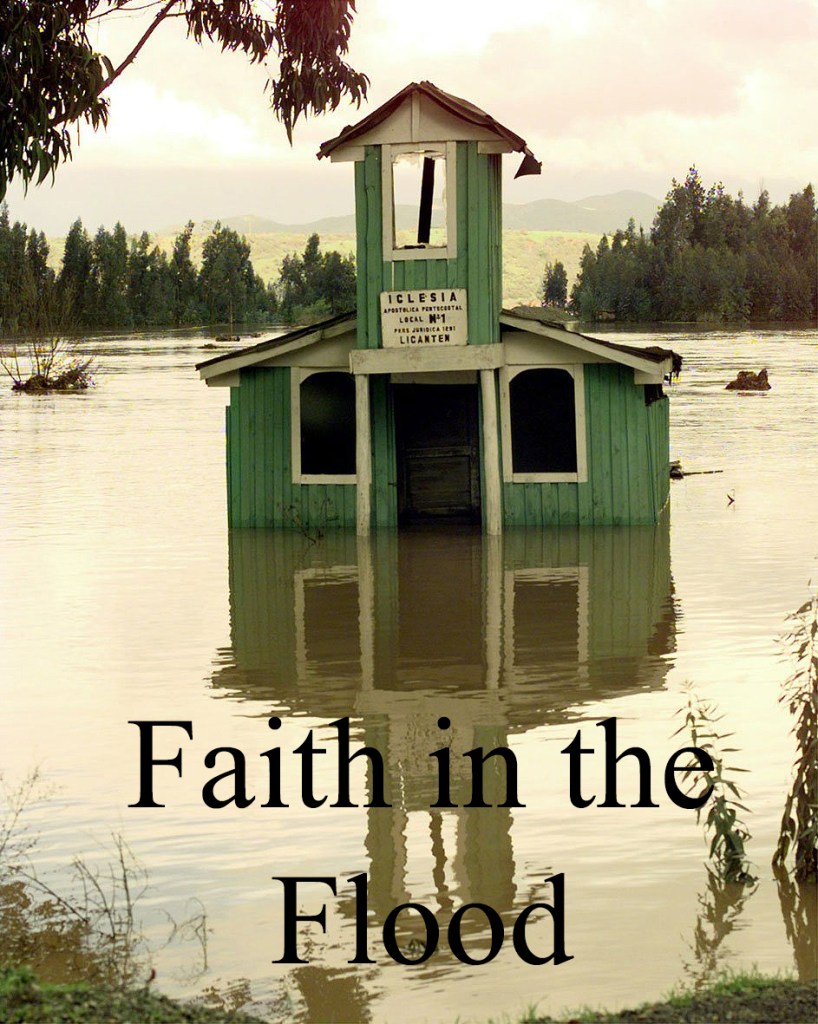
Faith in the Flood

Faith in the Flood

November 05, 2023*

By Pastor John Partridge

Joshua 3:7-17             Matthew 23:1-12                               1 Thessalonians 2:9-13

There is an old joke about a flood and a faithful saint of the church. The weather forecast was for torrential rains and flooding and people were advised to evacuate. But when two sheriff’s deputies came to the door of this faithful saint asking them to leave, they simply replied that “God will provide.” And so, the rains came, and the flood waters rose. Soon the first floor of their house was under water, and they moved all their valuables up to the second floor. About that time, a Boy Scout came by in a canoe and offered to carry them to safety, but they refused and simply said, “God will provide.” It continued to rain and to flood waters continued to rise, and soon, this faithful saint of the church was sitting on their roof. And, as they were sitting on their roof, the National Guard arrived in a helicopter and offered to lift them out of their distress, but they again declined saying, “God will provide.” Not long after that, the flood waters carried that saint away and, when they were welcomed at the pearly gates of heaven they cried out, “God, why didn’t you save me?” And God replied, “Well, I sent two sheriff’s deputies, a Boy Scout, and the National Guard. What more did you want?”

I have always liked that joke because it’s funny and because it points us toward one of the church’s common failures. Well-known Croatian theologian Miroslav Volf said, “There is something deeply hypocritical about praying for a problem you are unwilling to resolve.” The question isn’t whether our lives will have storms and floods, the question is what we will do when we face them. That is what we see in Joshua 3:7-17, because as the people of Israel prepare to cross the Jordan River into the Promised Land, Joshua commands the priests to take a step of faith… right into the middle of the flood.

And the Lord said to Joshua, “Today I will begin to exalt you in the eyes of all Israel, so they may know that I am with you as I was with Moses. Tell the priests who carry the ark of the covenant: ‘When you reach the edge of the Jordan’s waters, go and stand in the river.’”

Joshua said to the Israelites, “Come here and listen to the words of the Lord your God. 10 This is how you will know that the living God is among you and that he will certainly drive out before you the Canaanites, Hittites, Hivites, Perizzites, Girgashites, Amorites and Jebusites. 11 See, the ark of the covenant of the Lord of all the earth will go into the Jordan ahead of you. 12 Now then, choose twelve men from the tribes of Israel, one from each tribe. 13 And as soon as the priests who carry the ark of the Lord—the Lord of all the earth—set foot in the Jordan, its waters flowing downstream will be cut off and stand up in a heap.”

14 So when the people broke camp to cross the Jordan, the priests carrying the ark of the covenant went ahead of them. 15 Now the Jordan is at flood stage all during harvest. Yet as soon as the priests who carried the ark reached the Jordan and their feet touched the water’s edge, 16 the water from upstream stopped flowing. It piled up in a heap a great distance away, at a town called Adam in the vicinity of Zarethan, while the water flowing down to the Sea of the Arabah (that is, the Dead Sea) was completely cut off. So, the people crossed over opposite Jericho. 17 The priests who carried the ark of the covenant of the Lord stopped in the middle of the Jordan and stood on dry ground, while all Israel passed by until the whole nation had completed the crossing on dry ground.

The Jordan River is at flood stage and is a raging torrent. So violently does it flow that Jericho isn’t even watching this border as closely as they might because Baal is the god of rivers and storms, and this was the season that they could see his power and knew that he was protecting them. After the adventure with the spies, Israel almost certainly knew that as well. Further, as one of the two spies who had lived through the 40 years in the wilderness, Joshua was personally aware of this. Nonetheless, God commands Joshua to tell the priests who carry the arc of the covenant, to “go and stand in the river.” Just go and stand in the middle of the raging torrent of the harvest flood. Worse, the banks of the Jordan are often not gentle slopes but rapid drop-offs that would be invisible in the muddy floodwaters. I’m sure that those priests had some concerns, but they also had faith in God and faith in Joshua. With the weight of the ark on their shoulders, and almost no chance of catching themselves if they stumbled, the priests do as they were asked and boldly step into the rushing water.

And the water stopped.

As soon as their feet touched the water, the water stopped flowing and piled up in a heap upstream of them and, as the priests stood in the middle of the riverbed, the entire nation of Israel crossed the river on dry ground. The people of God, and especially those priests weighted down with the ark of covenant on their shoulders, didn’t just pray for God’s deliverance and their entry into the Promised Land, they acted on their faith, and they stepped out into the flood.

But the priests and the leaders of the church aren’t always that faithful and aren’t always the best example for people to follow. That was the case in Matthew 23:1-12 when Jesus tells the people to live their lives differently than Israel’s leaders.

23:1 Then Jesus said to the crowds and to his disciples: “The teachers of the law and the Pharisees sit in Moses’ seat. So you must be careful to do everything they tell you. But do not do what they do, for they do not practice what they preach. They tie up heavy, cumbersome loads and put them on other people’s shoulders, but they themselves are not willing to lift a finger to move them.

“Everything they do is done for people to see: They make their phylacterieswide and the tassels on their garments long; they love the place of honor at banquets and the most important seats in the synagogues; they love to be greeted with respect in the marketplaces and to be called ‘Rabbi’ by others.

“But you are not to be called ‘Rabbi,’ for you have one Teacher, and you are all brothers. And do not call anyone on earth ‘father,’ for you have one Father, and he is in heaven. 10 Nor are you to be called instructors, for you have one Instructor, the Messiah. 11 The greatest among you will be your servant. 12 For those who exalt themselves will be humbled, and those who humble themselves will be exalted.

Jesus says that although the teachers of the law and the Pharisees hold important leadership positions, and although the people must be careful to follow their instructions and do as the leaders teach, they should not live by the example that those leaders provide. Those leaders lived a life that was all about the show. They wore flashy religious vestments and large phylacteries, which were prayers or scriptures that were etched in silver, copper, or even on baked clay tablets. While rabbis routinely wore tassels on their robes, these leaders had to had bigger, and longer tassels then everyone else. And, whenever there was a banquet, or when they went to church, they had to have the most visible, and most important seats in the house so that everyone could see how important they were. But while they put on a good show, they didn’t live lives that demonstrated the things that they taught. Jesus said that the people who would be the greatest among them, would first be a servant to others. Following Jesus, honoring God, and living a life of faith wasn’t about looking good, it was all about having the humility to live a life that acted on faith and did the work of the kingdom of God.

That’s exactly the message that we hear Paul telling the people of the church in Thessalonica in his letter that we read in 1 Thessalonians 2:9-13 when he says…

Surely you remember, brothers and sisters, our toil and hardship; we worked night and day in order not to be a burden to anyone while we preached the gospel of God to you. 10 You are witnesses, and so is God, of how holy, righteous, and blameless we were among you who believed. 11 For you know that we dealt with each of you as a father deals with his own children, 12 encouraging, comforting, and urging you to live lives worthy of God, who calls you into his kingdom and glory.

13 And we also thank God continually because, when you received the word of God, which you heard from us, you accepted it not as a human word, but as it actually is, the word of God, which is indeed at work in you who believe.

Paul asks the people of the church to remember the example that he and his fellow missionaries provided for them as they lived among them. They worked, and they worked hard, day and night, so that they would not be a burden to the church, but they also lived lives that were holy, righteous, and blameless. They did not rule over them as some leaders do, but encouraged and comforted them, and treated them as if they were their own children so that they could urge them to live lives that were worthy of the God who called them into his kingdom. Paul says that he and his associates continually thank God because the people of the church not only received the word of God but allowed God to work through them. They didn’t just accept Jesus and have faith in Jesus, they lived out their faith through their actions.

The people of Israel had faith in God and believed that he would lead them into the Promised Land, but the evidence of that faith was visibly seen when the priests carrying the ark of the covenant boldly stepped forward into the raging flood waters of the Jordan River.

While Jesus acknowledged that the people should be obedient to their leaders, he also told them that in order to honor God, they had to do better. Rather putting on a good show, a true life of faith is a life that serves others and demonstrates God’s love through the actions of the believer.

And Paul says much the same thing. The proof of the message that they taught was found in the way that they lived, and the proof that the church had believed was seen, not in the words that they spoke or in the worship of their people, but in the work that they did among those who did not believe.

We may laugh at the imaginary saint of the church that prayed to God but ignored two sheriff’s deputies, a Boy Scout, and the National Guard, but the truth is that faith demands that we do more than pray.

Real faith is found in the actions of the church.

Real faith is when we roll up our sleeves and get to work.


Please LIKE and SHARE!

Click here to subscribe to Pastor John’s blog.

Click here if you would like to subscribe to Pastor John’s weekly messages.

Click here to visit Pastor John’s YouTube channel.


*You have been reading a message presented at Christ United Methodist Church on the date noted at the top of the first page.  Rev. John Partridge is the pastor at Christ UMC in Alliance, Ohio.  Duplication of this message is a part of our Media ministry, if you have received a blessing in this way, we would love to hear from you.  Letters and donations in support of the Media ministry or any of our other projects may be sent to Christ United Methodist Church, 470 East Broadway Street, Alliance, Ohio 44601.  These messages are available to any interested persons regardless of membership.  You may subscribe to these messages, in print or electronic formats, by writing to the address noted, or by contacting us at secretary@CUMCAlliance.org.  These messages can also be found online at https://pastorpartridge.com .  All Scripture quotations, unless otherwise indicated, are taken from the Holy Bible, New International Version®, NIV®. Copyright ©1973, 1978, 1984, 2011 by Biblica, Inc.™ Used by permission of Zondervan. All rights reserved worldwide. www.zondervan.comThe “NIV” and “New International Version” are trademarks registered in the United States Patent and Trademark Office by Biblica, Inc.™
Finding Nebo

Finding Nebo

October 29, 2023*

By Pastor John Partridge

Deuteronomy 34:1-12        Matthew 22:34-46         

1 Thessalonians 2:1-8

Many of us are, by now, familiar with the 2003 Pixar animated movie “Finding Nemo” in which Marlin, an overprotective, single, clown fish father, pursues his son, Nemo, across the dangers of the vast Pacific Ocean in hopes of rescuing him from the scuba divers that captured him. It’s a good story. But despite the similarity of the name in the title, Nemo is not what we are looking for. Our story for today begins with an ending. At the end of Moses’ life, knowing that he will never set foot in the Promised Land that he has pursued for most of his adult life, he finds himself, not in the Pacific Ocean with a small clownfish named Nemo, but at the top of a mountain named Nebo. And, in an odd sort of way, we discover that, as the followers of Jesus Christ, we too are spending ourselves in pursuit of finding Nebo. As I said before, we begin this morning with an ending in Deuteronomy 34:1-12 where it says:

34:1 Then Moses climbed Mount Nebo from the plains of Moab to the top of Pisgah, across from Jericho. There the Lord showed him the whole land—from Gilead to Dan, all of Naphtali, the territory of Ephraim and Manasseh, all the land of Judah as far as the Mediterranean Sea, the Negev and the whole region from the Valley of Jericho, the City of Palms, as far as Zoar. Then the Lord said to him, “This is the land I promised on oath to Abraham, Isaac, and Jacob when I said, ‘I will give it to your descendants.’ I have let you see it with your eyes, but you will not cross over into it.”

And Moses the servant of the Lord died there in Moab, as the Lord had said. He buried himin Moab, in the valley opposite Beth Peor, but to this day no one knows where his grave is. Moses was a hundred and twenty years old when he died, yet his eyes were not weak, nor his strength gone. The Israelites grieved for Moses in the plains of Moab thirty days, until the time of weeping and mourning was over.

Now Joshua, son of Nun, was filled with the spiritof wisdom because Moses had laid his hands on him. So, the Israelites listened to him and did what the Lord had commanded Moses.

10 Since then, no prophet has risen in Israel like Moses, whom the Lord knew face to face, 11 who did all those signs and wonders the Lord sent him to do in Egypt—to Pharaoh and to all his officials and to his whole land. 12 For no one has ever shown the mighty power or performed the awesome deeds that Moses did in the sight of all Israel.

When you make the journey to visit Israel, once the present violence ends and peace returns, you will find that Israel is surprisingly small. For us in the United States we can compare it in our minds knowing that Israel is smaller than Massachusetts and slightly smaller than New Jersey. If you could make a non-stop road trip along its main highway, you could travel its entire length in less than six hours. And so, while there is, perhaps, some exaggeration in the account that we read in Deuteronomy, probably not much. From the top of Mount Nebo, with good visibility, Moses would have seen a great deal of the Promised Land that Israel was about to inherit. But Moses wasn’t going. He had come this far, but his time on earth was finished and, although God allowed him to see the land of Israel, he would never cross the Jordan River and set his feet upon it. Instead, Moses would be buried somewhere in Moab on the slopes of Mount Nebo and make a different crossing into his heavenly inheritance with God. Moses never crossed over into the Promised Land, but Moses’ legacy was that he listened to the call of God, obeyed the instructions of God, and led his family, his tribe, his community, and his people into God’s promise.

But God’s promise to his people was about more than land. As Israel had struggled during their captivity in Egypt, they cried out to God for a rescuer that would carry them out of Egypt to freedom. And God heard the prayers of his people, and sent Moses to lead them out of Egypt, across the desert, through the years of wandering in the wilderness, and right the edge of the Promised Land. But throughout many years of suffering, in the land of Israel, under the yoke of other oppressive nations such as Babylon, Greece, Egypt, and Rome, the people of Israel again prayed to God and looked for a rescuer, a messiah, that would, once again, bring them freedom and prosperity. The seeds of that hope for a messiah were contained in the writings of the prophets, but it was not always understood how it would happen, or who the messiah would be. And that’s how Jesus can ask a question that stumped the biblical scholars of his day when they come to him to present a question with which they hope to test him in Matthew 22:34-46 where we read this:

34 Hearing that Jesus had silenced the Sadducees, the Pharisees got together. 35 One of them, an expert in the law, tested him with this question: 36 “Teacher, which is the greatest commandment in the Law?”

37 Jesus replied: “‘Love the Lord your God with all your heart and with all your soul and with all your mind.’ 38 This is the first and greatest commandment. 39 And the second is like it: ‘Love your neighbor as yourself.’ 40 All the Law and the Prophets hang on these two commandments.”

41 While the Pharisees were gathered together, Jesus asked them, 42 “What do you think about the Messiah? Whose son is he?”

“The son of David,” they replied.

43 He said to them, “How is it then that David, speaking by the Spirit, calls him ‘Lord’? For he says,

44 “‘The Lord said to my Lord:
    “Sit at my right hand
until I put your enemies
    under your feet.”’

45 If then David calls him ‘Lord,’ how can he be his son?” 46 No one could say a word in reply, and from that day on no one dared to ask him any more questions.

The puzzle that Jesus puts to the Pharisees is the kind of a problem that often causes us to get stuck in the twenty-first century. While Jesus’ question seems simple to us it was a serious problem to these biblical scholars because it required that they get past their own cultural biases to answer it. In a culturally patriarchal system of honor, it was understood that fathers were always greater in prestige and honor than their sons. If a grandfather or great-grandfather could have, somehow, come back from the dead, that elderly person would automatically become the head of an entire clan of his descendants and all his sons, grandsons, and everyone else would be expected to defer to them and honor them. But although the scholars know that the Messiah would be a living descendant of David, referred to as “the son of David,” their cultural bias prevents them from understanding how, in Psalm 110, David refers to his descendant as his Lord, and thereby gives his descendant honor and defers to him as someone greater than the greatest king that Israel ever had. The Pharisees could simply not understand how a son of David could be greater than David and so, they misunderstood what, and who, the messiah would be. For us, although we have our own cultural blind spots, we understand that Jesus was, and is, God’s promised Messiah, he is the son of David, and he is David’s lord because he is the son of God.

But, twenty-one centuries later, what does that mean for us? If we follow God as Moses did, and we accept Jesus as our lord, and follow him, then what why does all that matter? It matters because, like Moses, we are trying to find our mountain top, our Nebo, but like the Pharisees, we can’t quite figure out what that means. But Paul did, and he explains it to the church in Thessalonica in 1 Thessalonians 2:1-8, saying…

2:1 You know, brothers and sisters, that our visit to you was not without results. We had previously suffered and been treated outrageously in Philippi, as you know, but with the help of our God we dared to tell you his gospel in the face of strong opposition. For the appeal we make does not spring from error or impure motives, nor are we trying to trick you. On the contrary, we speak as those approved by God to be entrusted with the gospel. We are not trying to please people but God, who tests our hearts. You know we never used flattery, nor did we put on a mask to cover up greed—God is our witness. We were not looking for praise from people, not from you or anyone else, even though as apostles of Christ we could have asserted our authority. Instead, we were like young children among you.

Just as a nursing mother cares for her children, 8so we cared for you. Because we loved you so much, we were delighted to share with you not only the gospel of God but our lives as well.

Paul’s message is that life wasn’t perfect. Everyone knew that sometimes the lives of Paul and his associates had faced some significant suffering. They had been arrested, beaten, and thrown into prison on many occasions. But despite their suffering, with the help of God, they dared to continue telling others the story of the gospel regardless of the opposition that they faced. Their motivation wasn’t to trick anyone, to get rich, or for any other impure motive, but simply to share the message with which they had been entrusted by God. Their goal was to share the gospel, and their lives, with the people to whom God had led them.

Moses, Paul, Silas, Timothy, and many others were seeking to find their Nebo, to lead their family, their tribe, their community, and their people into God’s promise, which they now understood as the promise of Jesus Christ. And that’s the mission that has been passed down to us. Because we are the people who, like Paul, have been entrusted with the gospel, the people who have met Jesus, and who have believed in him and have put our trust in him, we too are seeking our Nebo. As we have been reminded on this All-Saints Day, our time on earth is short and won’t last forever and one day we too will cross over into God’s promise as Moses did, and as these saints of the church have done.

Our mission, our hope, and our calling is to lead our people to God’s promise through the message and the gospel of Jesus Christ…

…before it’s our turn to cross over.


Please LIKE and SHARE!

Click here to subscribe to Pastor John’s blog.

Click here if you would like to subscribe to Pastor John’s weekly messages.

Click here to visit Pastor John’s YouTube channel.


*You have been reading a message presented at Christ United Methodist Church on the date noted at the top of the first page.  Rev. John Partridge is the pastor at Christ UMC in Alliance, Ohio.  Duplication of this message is a part of our Media ministry, if you have received a blessing in this way, we would love to hear from you.  Letters and donations in support of the Media ministry or any of our other projects may be sent to Christ United Methodist Church, 470 East Broadway Street, Alliance, Ohio 44601.  These messages are available to any interested persons regardless of membership.  You may subscribe to these messages, in print or electronic formats, by writing to the address noted, or by contacting us at secretary@CUMCAlliance.org.  These messages can also be found online at https://pastorpartridge.com .  All Scripture quotations, unless otherwise indicated, are taken from the Holy Bible, New International Version®, NIV®. Copyright ©1973, 1978, 1984, 2011 by Biblica, Inc.™ Used by permission of Zondervan. All rights reserved worldwide. www.zondervan.comThe “NIV” and “New International Version” are trademarks registered in the United States Patent and Trademark Office by Biblica, Inc.™