

(Insert Your Name Here)

 (Insert Your Name Here)

December 24, 2023*

By Pastor John Partridge

2 Samuel 7:1-11, 16               Luke 1:26-38                          Romans 16:25-27

There is a scene in the 1978 movie, National Lampoon’s “Animal House,” where the new class of pledges for the Delta House are sworn into the fraternity. In it, they are asked to say “I… state your name… “and every single one of them says the words “state your name” instead of saying their name. And we all laughed because we all assume that everyone knows what to do in such a situation. Whenever we fill out forms for our schools, doctors, insurance companies, the Internal Revenue Service, retirement funds, and all sorts of other things, we encounter a box or a line that asks us for our name. At other times, we have been asked to include our names in a script where we take an oath of office, or are sworn into the military, or, in this case, a fraternity, we just include our own names where we are told to do so.

But as common as it is in our everyday lives, we often miss it when the same thing happens as we read scripture. And that’s a point that I want to make today. As we make our final preparations for Christmas tomorrow morning, it’s important for us to remember that we are included in the story of scripture. We aren’t everywhere, of course, because the story is about characters that are so familiar to us. This morning we will hear about King David, the prophet Nathan, the angel Gabriel, Elizabeth, Mary, the Apostle Paul, and… (insert your name here).

We begin with God’s words found in 2 Samuel 7:1-11, 16 where we hear God’s promise to King David given through his prophet Nathan:

7:1 After the king was settled in his palace and the Lord had given him rest from all his enemies around him, he said to Nathan the prophet, “Here I am, living in a house of cedar, while the ark of God remains in a tent.”

Nathan replied to the king, “Whatever you have in mind, go ahead and do it, for the Lord is with you.”

But that night the word of the Lord came to Nathan, saying:

“Go and tell my servant David, ‘This is what the Lord says: Are you the one to build me a house to dwell in? I have not dwelt in a house from the day I brought the Israelites up out of Egypt to this day. I have been moving from place to place with a tent as my dwelling. Wherever I have moved with all the Israelites, did I ever say to any of their rulers whom I commanded to shepherd my people Israel, “Why have you not built me a house of cedar?”’

“Now then, tell my servant David, ‘This is what the Lord Almighty says: I took you from the pasture, from tending the flock, and appointed you ruler over my people Israel. I have been with you wherever you have gone, and I have cut off all your enemies from before you. Now I will make your name great, like the names of the greatest men on earth. 10 And I will provide a place for my people Israel and will plant them so that they can have a home of their own and no longer be disturbed. Wicked people will not oppress them anymore, as they did at the beginning 11 and have done ever since the time I appointed leadersover my people Israel. I will also give you rest from all your enemies.

16 Your house and your kingdom will endure forever before me; your throne will be established forever.’”

David had finally become secure in his leadership of Israel. He has built a palace, united the twelve tribes, settled, and secured the borders with other nations, and at this moment he looks at the tent that houses God’s tabernacle and imagines that it is time to build a permanent dwelling place for the Ark of the Covenant and for Israel’s God. But God isn’t having any of that just yet. God’s words to David are that he is not the one who has been called to build God’s house. Instead, God reminds David of his roots and humble beginnings, how God brought David to this place, how God will place the name of David among the greatest men on the planet, and how God has plans that extend far beyond David’s lifetime. God promises that David’s family, and David’s kingdom will endure forever.

God’s message to David is, “Look how far you have come. Look at how far I have brought you. And I’m not even close to being done yet.”

And that leads us back to the Christmas story in Luke 1:26-38 where God sends the angel Gabriel to visit Mary and announce her pregnancy.

26 In the sixth month of Elizabeth’s pregnancy, God sent the angel Gabriel to Nazareth, a town in Galilee, 27 to a virgin pledged to be married to a man named Joseph, a descendant of David. The virgin’s name was Mary. 28 The angel went to her and said, “Greetings, you who are highly favored! The Lord is with you.”

29 Mary was greatly troubled at his words and wondered what kind of greeting this might be. 30 But the angel said to her, “Do not be afraid, Mary; you have found favor with God. 31 You will conceive and give birth to a son, and you are to call him Jesus. 32 He will be great and will be called the Son of the Most High. The Lord God will give him the throne of his father David, 33 and he will reign over Jacob’s descendants forever; his kingdom will never end.”

34 “How will this be,” Mary asked the angel, “since I am a virgin?”

35 The angel answered, “The Holy Spirit will come on you, and the power of the Most High will overshadow you. So, the holy one to be born will be calledthe Son of God. 36 Even Elizabeth your relative is going to have a child in her old age, and she who was said to be unable to conceive is in her sixth month. 37 For no word from God will ever fail.”

38 “I am the Lord’s servant,” Mary answered. “May your word to me be fulfilled.” Then the angel left her.

Mary wonders how this could happen. She knows where babies come from, but she also knows that she and Joseph have not yet slept together. Given that their two families do not live in the same town, the chances are good that she and Joseph rarely, if ever, see one another, and it’s quite possible that she hasn’t seen him at all since the contract was signed pledging them to be married. But as difficult as it is to believe, Mary accepts her role in this unfolding drama saying, “May your word to me be fulfilled.”

It is important to notice that Gabriel also affirms God’s promise to David, and Mary understands that she will be a part of the fulfillment of that promise. God promises that Mary’s son will inherit the throne of King David and become a part of a kingdom that will never end. And so, Mary clings to God’s promise. If God has come this far, over thousands of years, to fulfill his promise to David, Mary’s prayer is that God will do the same for his promise to her, saying, “May your word to me be fulfilled.”

But what does that have to do with us?

Where is the fill in the blank part?

And as we often do, we find the application in Romans 16:25-27, in the very last words of Paul’s letter to the church in Rome where he says…

25 Now to him who is able to establish you in accordance with my gospel, the message I proclaim about Jesus Christ, in keeping with the revelation of the mystery hidden for long ages past, 26 but now revealed and made known through the prophetic writings by the command of the eternal God, so that all the Gentiles might come to the obedience that comes fromfaith— 27 to the only wise God be glory forever through Jesus Christ! Amen.

And there it was. Did you hear it, or did you miss it?

Paul says that God has revealed his salvation, through his son Jesus Christ, through the writings of the prophets of Israel… so that… all the nations, or in another translation all the Gentiles, might come to obedience and faith. God says that the entire journey of the people of Israel, through Abraham, David, and to the Christmas story, Mary, Joseph, and Jesus, the entire story was commanded by God for the purpose of bringing hope to the world and calling the Gentiles, and all the nations of the world, to faith in Jesus.

That is where you can insert your name.

Paul said, “the message I proclaim about Jesus Christ, in keeping with the revelation of the mystery hidden for long ages past, 26 but now revealed and made known through the prophetic writings by the command of the eternal God, so that (insert your name here) might come to the obedience that comes fromfaith…”

But the story isn’t over.

The story wasn’t over when God brought David from herding sheep to unite the twelve tribes of Israel, and the story wasn’t over with the birth, life, death, and resurrection of Jesus. God did all these things so that all nations, and all people, might come to obedience and faith in Jesus Christ.

There is still work to do.

And God is calling each one of you, (insert your name here) to finish the job.


Please LIKE and SHARE!

Click here to subscribe to Pastor John’s blog.

Click here if you would like to subscribe to Pastor John’s weekly messages.

Click here to visit Pastor John’s YouTube channel.


*You have been reading a message presented at Christ United Methodist Church on the date noted at the top of the first page.  Rev. John Partridge is the pastor at Christ UMC in Alliance, Ohio.  Duplication of this message is a part of our Media ministry, if you have received a blessing in this way, we would love to hear from you.  Letters and donations in support of the Media ministry or any of our other projects may be sent to Christ United Methodist Church, 470 East Broadway Street, Alliance, Ohio 44601.  These messages are available to any interested persons regardless of membership.  You may subscribe to these messages, in print or electronic formats, by writing to the address noted, or by contacting us at secretary@CUMCAlliance.org.  These messages can also be found online at https://pastorpartridge.com .  All Scripture quotations, unless otherwise indicated, are taken from the Holy Bible, New International Version®, NIV®. Copyright ©1973, 1978, 1984, 2011 by Biblica, Inc.™ Used by permission of Zondervan. All rights reserved worldwide. www.zondervan.comThe “NIV” and “New International Version” are trademarks registered in the United States Patent and Trademark Office by Biblica, Inc.™

From Mourning to Joy

From Mourning to Joy

December 17, 2023*

By Pastor John Partridge

Isaiah 61:1-4, 8-11                 John 1:6-8, 19-28                          1 Thessalonians 5:16-24

On June second of 2022, seventeen-year-old Ethan Liming, the son of United Methodist Pastor Bill Liming, was beaten to death during an altercation at a basketball court in downtown Akron. This week we were notified that another of our East Ohio Conference colleagues, Beth Wilterdink, with whom Mike Greiner and I have served on the conference committee on camps and retreats, is mourning, with her husband and family, the loss of their barely two-year-old daughter Cora. I can read about these things, but I can’t begin to understand the pain and the grief that these families must feel.

But many of us have experienced our own kinds of loss. Some of you have lost children, many of us have lost parents or siblings. We each understand grief in our own way. And so, we have some insight into the lives of the people who heard God’s message through his prophet Isaiah. These were the people who had lost everything. They had lost sons, daughters, husbands, wives, brothers, sisters, parents, and grandparents, they had lost their nation and their freedom and had been carried off into captivity in Babylon. They were filled with grief. But God speaks to them through the writings of Isaiah and tells them that in the midst of their grief, there is good news. We hear these words in Isaiah 61:1-4, 8-11…

61:1 The Spirit of the Sovereign Lord is on me, because the Lord has anointed me
    to proclaim good news to the poor.
He has sent me to bind up the brokenhearted, to proclaim freedom for the captives
    and release from darkness for the prisoners,
to proclaim the year of the Lord’s favor and the day of vengeance of our God,
to comfort all who mourn,
    and provide for those who grieve in Zion— to bestow on them a crown of beauty
    instead of ashes, the oil of joy instead of mourning, and a garment of praise
    instead of a spirit of despair.
They will be called oaks of righteousness, a planting of the Lord for the display of his splendor.

They will rebuild the ancient ruins and restore the places long devastated;
they will renew the ruined cities that have been devastated for generations.

“For I, the Lord, love justice;I hate robbery and wrongdoing.
In my faithfulness I will reward my people and make an everlasting covenant with them.
Their descendants will be known among the nations and their offspring among the peoples.
All who see them will acknowledge that they are a people the Lord has blessed.”

10 I delight greatly in the Lord;my soul rejoices in my God.
For he has clothed me with garments of salvation and arrayed me in a robe of his righteousness,
as a bridegroom adorns his head like a priest, and as a bride adorns herself with her jewels.
11 For as the soil makes the sprout come up and a garden causes seeds to grow,
so the Sovereign Lord will make righteousness and praise spring up before all nations.

God says that there will be healing for the brokenhearted, release for prisoners, comfort for those who mourn, and God promises to transform the ashes of their grief into a crown of beauty. God promises to rebuild, restore, and renew, and to bring justice and faithfulness to replace their despair and loss. And in the end, God will use the nations of the world to raise up gardens of righteousness and praise.

In no way does God, or Isaiah, diminish the pain, loss, and grief that we experience today, God does not tell us to “get over it,” but God does promise that he will, one day, transform our grief into joy.

But, because John the Baptist had been quoting from the words of Isaiah, the priests and the leaders of Israel came out to the wilderness in John 1:6-8, 19-28 to ask if he was a resurrected Isaiah that God had sent to fulfill the promises that had been written so long ago.

There was a man sent from God whose name was John. He came as a witness to testify concerning that light, so that through him all might believe. He himself was not the light; he came only as a witness to the light.

19 Now this was John’s testimony when the Jewish leaders in Jerusalem sent priests and Levites to ask him who he was. 20 He did not fail to confess, but confessed freely, “I am not the Messiah.”

21 They asked him, “Then who are you? Are you Elijah?”

He said, “I am not.”

“Are you the Prophet?”

He answered, “No.”

22 Finally they said, “Who are you? Give us an answer to take back to those who sent us. What do you say about yourself?”

23 John replied in the words of Isaiah the prophet, “I am the voice of one calling in the wilderness, ‘Make straight the way for the Lord.’”

24 Now the Pharisees who had been sent 25 questioned him, “Why then do you baptize if you are not the Messiah, nor Elijah, nor the Prophet?”

26 “I baptize with water,” John replied, “but among you stands one you do not know. 27 He is the one who comes after me, the straps of whose sandals I am not worthy to untie.”

28 This all happened at Bethany on the other side of the Jordan, where John was baptizing.

But John says that he is not Isaiah, nor is he Elijah, nor is he the promised messiah. Instead, he has come to point to the Messiah, to announce his arrival, and to proclaim the fulfillment of God’s promises in Isaiah in the person of Jesus Christ.

But, knowing that Jesus is the Messiah, as we do, what does that mean for us today? What does that tell us about our grief, and our pain, and how we are to live our lives in the twenty-first century? In his letter to the church in Thessalonica, contained in 1 Thessalonians 5:16-24, Paul says this:

16 Rejoice always, 17 pray continually, 18 give thanks in all circumstances; for this is God’s will for you in Christ Jesus.

19 Do not quench the Spirit. 20 Do not treat prophecies with contempt 21 but test them all; hold on to what is good, 22 reject every kind of evil.

23 May God himself, the God of peace, sanctify you through and through. May your whole spirit, soul and body be kept blameless at the coming of our Lord Jesus Christ. 24 The one who calls you is faithful, and he will do it.

Paul says that God’s will for us is to live in anticipation of God’s final and ultimate victory. We are to live as if Christ has already returned, and God has already fulfilled his promises of rescue, rebuilding, restoration, renewal, and transformation. Rejoice always, pray continually, give thanks in all circumstances, test the prophecies of God to prove their truthfulness, reject every kind of evil, but hold on to all that is good.

In this world, we know that we will experience suffering, pain, grief, and death.

But one day God will transform our mourning into joy.

Until then…

…reject every kind of evil and…

                                    …hold on to what is good.


Please LIKE and SHARE!

Click here to subscribe to Pastor John’s blog.

Click here if you would like to subscribe to Pastor John’s weekly messages.

Click here to visit Pastor John’s YouTube channel.


*You have been reading a message presented at Christ United Methodist Church on the date noted at the top of the first page.  Rev. John Partridge is the pastor at Christ UMC in Alliance, Ohio.  Duplication of this message is a part of our Media ministry, if you have received a blessing in this way, we would love to hear from you.  Letters and donations in support of the Media ministry or any of our other projects may be sent to Christ United Methodist Church, 470 East Broadway Street, Alliance, Ohio 44601.  These messages are available to any interested persons regardless of membership.  You may subscribe to these messages, in print or electronic formats, by writing to the address noted, or by contacting us at secretary@CUMCAlliance.org.  These messages can also be found online at https://pastorpartridge.com .  All Scripture quotations, unless otherwise indicated, are taken from the Holy Bible, New International Version®, NIV®. Copyright ©1973, 1978, 1984, 2011 by Biblica, Inc.™ Used by permission of Zondervan. All rights reserved worldwide. www.zondervan.comThe “NIV” and “New International Version” are trademarks registered in the United States Patent and Trademark Office by Biblica, Inc.™

Alien Preparedness

Alien Preparedness

December 10, 2023*

By Pastor John Partridge

Isaiah 40:1-11                        Mark 1:1-8                             2 Peter 3:8-15

There is an old saying that says, “It doesn’t rain in the Army… it rains on the Army. It isn’t a particularly funny joke, but it’s a part of the dark humor that is often found while standing in the middle of a driving rainstorm. There is a similar saying in scouting, but because our scout motto is “Be Prepared,” the saying is changed to reflect that and says, “There is no bad weather in scouting, only scouts that are not prepared for the weather.” But that leads us to the title of today’s message, “Alien Preparedness.” No, this is not about preparing for an alien invasion or something that you might find on Ancient Aliens on the History Channel, but it is about preparedness.

My brother Dean used to point out that when we say we are “getting in shape” or that an athlete is “in shape,” it’s important to ask, “In shape for what?” No one doubts that NFL football players are in shape, but ask them to run a marathon, or race an Olympic swimmer, and suddenly, they are not ready because, despite all the physical conditioning that they have done, they are not prepared for that specific kind of physical competition. And so, when we say, like the scouts, that we must “Be Prepared,” we must also ask, “Prepared for what?”  When it is framed in that way, “Alien Preparedness” is not about preparing for an alien invasion, but to prepare for something you did not expect, or in a way that you hadn’t expected.

I am sure that’s still more than a little puzzling but hold on to that idea while we dive into our scriptures, and when we return to this later, I think it will be clearer.  We begin this morning with the words of the prophet Isaiah who speaks to Israel to tell of the imminent destruction of their nation at the hands of the Assyrian army but also speaks words of comfort and God’s promise that there would one day be restoration after Jerusalem’s destruction. We hear these words in Isaiah 40:1-11…

40:1 Comfort, comfort my people, says your God.
Speak tenderly to Jerusalem, and proclaim to her
that her hard service has been completed, that her sin has been paid for,
that she has received from the Lord’s hand double for all her sins.

A voice of one calling:
“In the wilderness prepare the way for the Lord,
make straight in the desert a highway for our God.
Every valley shall be raised up, every mountain and hill made low;
the rough ground shall become level, the rugged places a plain.
And the glory of the Lord will be revealed, and all people will see it together.
For the mouth of the Lord has spoken.”

A voice says, “Cry out.”
    And I said, “What shall I cry?”

“All people are like grass, and all their faithfulness is like the flowers of the field.
The grass withers and the flowers fall, because the breath of the Lord blows on them.
    Surely the people are grass.
The grass withers and the flowers fall, but the word of our God endures forever.”

You who bring good news to Zion, go up on a high mountain.
You who bring good news to Jerusalem,  lift up your voice with a shout,
lift it up, do not be afraid; say to the towns of Judah, “Here is your God!”
10 See, the Sovereign Lord comes with power, and he rules with a mighty arm.
See, his reward is with him, and his recompense accompanies him.
11 He tends his flock like a shepherd: He gathers the lambs in his arms
and carries them close to his heart; he gently leads those that have young.

Isaiah says that things are going to be terrible, and then worse than terrible, and then, just when they think that they are withering into death like the grass in summer, there will be a voice… one single voice… crying out in the desert to prepare for the arrival of their rescuer. Things will be terrible, but one day the rescuer will come. He will rule with a mighty arm, but he will tend his flock with gentleness like a shepherd.

And then, in the middle of the Roman occupation, as Israel once again prayed for God’s rescue, the voice of John the Baptizer is heard in the wilderness and Mark remembers, and quotes the words of Isaiah in Mark 1:1-8 saying…

1:1 The beginning of the good news about Jesus the Messiah, the Son of God, as it is written in Isaiah the prophet:

“I will send my messenger ahead of you,
    who will prepare your way”—
“a voice of one calling in the wilderness,
‘Prepare the way for the Lord,
    make straight paths for him.’”

And so John the Baptist appeared in the wilderness, preaching a baptism of repentance for the forgiveness of sins. The whole Judean countryside and all the people of Jerusalem went out to him. Confessing their sins, they were baptized by him in the Jordan River. John wore clothing made of camel’s hair, with a leather belt around his waist, and he ate locusts and wild honey. And this was his message: “After me comes the one more powerful than I, the straps of whose sandals I am not worthy to stoop down and untie. I baptize you with water, but he will baptize you with the Holy Spirit.”

John declares that God’s promised rescuer has come, and the people had better be prepared.

But what does that mean? How should the people prepare? We know that John’s message was one of repentance and called people to repent of their sins and recommit their lives to following God. But is that all there is to it? What kind of preparations are required for us in the twenty-first century as we remember John’s message and prepare ourselves for Jesus’ return. And that’s where Peter steps in to remind us of John’s message and apply it to our daily lives in the here and now. In 2 Peter 3:8-15 we hear this message about our future:

But do not forget this one thing, dear friends: With the Lord a day is like a thousand years, and a thousand years are like a day. The Lord is not slow in keeping his promise, as some understand slowness. Instead, he is patient with you, not wanting anyone to perish, but everyone to come to repentance.

10 But the day of the Lord will come like a thief. The heavens will disappear with a roar; the elements will be destroyed by fire, and the earth and everything done in it will be laid bare.

11 Since everything will be destroyed in this way, what kind of people ought you to be? You ought to live holy and godly lives 12 as you look forward to the day of God and speed its coming. That day will bring about the destruction of the heavens by fire, and the elements will melt in the heat. 13 But in keeping with his promise we are looking forward to a new heaven and a new earth, where righteousness dwells.

14 So then, dear friends, since you are looking forward to this, make every effort to be found spotless, blameless and at peace with him. 15 Bear in mind that our Lord’s patience means salvation, just as our dear brother Paul also wrote you with the wisdom that God gave him.

And this is where we find the alien preparation. This is not making sure to pack a raincoat, or warm winter clothes, and it’s more than just John’s message of repentance and baptism. This is, quite literally, preparation for the end of the world. The heavens will disappear, the earth will be destroyed, and the elements themselves will be melted in the heat of God’s judgement. On that day, God will make good on his promise to bring peace and justice, and from the ruins of this world will create a new heaven and a new earth filled with righteousness.

But how can we prepare for such a thing? What will be required of us? What must we do to be ready? And Peter’s answer is not so different from that of John the Baptizer. Repent, make straight paths for him, make every effort to live lives that are blameless so that your lives can be at peace with Jesus Christ by doing everything that he taught and modelled for us.

We absolutely must get this right.

Because we are not just preparing for the arrival of our rescuer and king.

We are, quite literally, preparing for the end of the world.


Please LIKE and SHARE!

Click here to subscribe to Pastor John’s blog.

Click here if you would like to subscribe to Pastor John’s weekly messages.

Click here to visit Pastor John’s YouTube channel.


*You have been reading a message presented at Christ United Methodist Church on the date noted at the top of the first page.  Rev. John Partridge is the pastor at Christ UMC in Alliance, Ohio.  Duplication of this message is a part of our Media ministry, if you have received a blessing in this way, we would love to hear from you.  Letters and donations in support of the Media ministry or any of our other projects may be sent to Christ United Methodist Church, 470 East Broadway Street, Alliance, Ohio 44601.  These messages are available to any interested persons regardless of membership.  You may subscribe to these messages, in print or electronic formats, by writing to the address noted, or by contacting us at secretary@CUMCAlliance.org.  These messages can also be found online at https://pastorpartridge.com .  All Scripture quotations, unless otherwise indicated, are taken from the Holy Bible, New International Version®, NIV®. Copyright ©1973, 1978, 1984, 2011 by Biblica, Inc.™ Used by permission of Zondervan. All rights reserved worldwide. www.zondervan.comThe “NIV” and “New International Version” are trademarks registered in the United States Patent and Trademark Office by Biblica, Inc.™

Faithful, Trustworthy, and Wide Awake

Faithful, Trustworthy, and Wide Awake

November 19, 2023*

By Pastor John Partridge

Judges 4:1-7               Matthew 25:14-30                             1 Thessalonians 5:1-11

This week our nation sets aside a day to celebrate Thanksgiving. We will gather with family, probably eat too much, likely gain a little weight, and hopefully pause for a few moments to consider those things for which we have to be grateful, to whom we should be grateful for those things, and give thanks for what we have been given. This morning’s message is not specifically a Thanksgiving message. Instead, this morning’s message looks at three stories of faith and thanksgiving, but each is different from the other. None of them specifically mention thanksgiving, or giving thanks, or gratitude, but the idea is found there all the same.

We begin with the story of Deborah the prophet, the undisputed leader of Israel during this part of the period of the Judges. During that period, Israel would wander from God, and then, in times of trouble and distress, cry out for God’s help, follow one of God’s leaders, grow close to God again, and then repeat the cycle… over and over again. And so, in Judges 4:1-7, we read this:

4:1 Again the Israelites did evil in the eyes of the Lord, now that Ehud was dead. So the Lord sold them into the hands of Jabin king of Canaan, who reigned in Hazor. Sisera, the commander of his army, was based in Harosheth Haggoyim. Because he had nine hundred chariots fitted with iron and had cruelly oppressed the Israelites for twenty years, they cried to the Lord for help.

Now Deborah, a prophet, the wife of Lappidoth, was leading Israel at that time. She held court under the Palm of Deborah between Ramah and Bethel in the hill country of Ephraim, and the Israelites went up to her to have their disputes decided. She sent for Barak son of Abinoam from Kedesh in Naphtali and said to him, “The Lord, the God of Israel, commands you: ‘Go, take with you ten thousand men of Naphtali and Zebulun and lead them up to Mount Tabor. I will lead Sisera, the commander of Jabin’s army, with his chariots and his troops to the Kishon River and give him into your hands.’”

Ehud had rescued Israel from their domination by the king of Moab, but now that Ehud had died, Israel had again fallen away from God. This time, it was the Canaanites who began to oppress Israel, with Sisera as the commander of their army. The wealth of Canaan was displayed in their ownership of nine hundred chariots and their widespread use of iron during a time, during the Bronze Age, when bronze was the common metal used in weapons and tools. Steel had not yet been invented and iron was relatively rare and expensive. Canaan’s possession of nine hundred chariots fitted with iron was a display of wealth, power, and superior technology.

Horses were, and are, expensive to maintain, and Israel had very few, and no chariots at all. They wouldn’t have any until hundreds of years later in the time of King Solomon. But Deborah was smart, and this passage is evidence that she knew a thing or two about military tactics. Chariots are great weapons on the plains but not so good on rough terrain or mountains where they can’t maneuver. And so, her plan was to send an Israelite army of ten thousand to the top of Mount Tabor, and then draw Sisera and his chariots to the river at the bottom of that same mountain. In so doing, she created a battle in which the chariots have a difficult time maneuvering, can’t easily retreat across the river, and are forced to fight a superior force that is fighting from the high ground.

But the point that I want to make is that when much of Israel fell away from God, Deborah remained faithful. Deborah’s way of giving thanks to God is found in her faithfulness. She remembered what God had done, and she remained faithful to God, even when many others did not. And it was her thankfulness, and her faithfulness, that saved her entire nation.

We find an entirely different story of thanksgiving in Jesus’ parable of the ungrateful and unfaithful servant in Matthew 25:14-30. Once again, Jesus is telling a story of what things will be like on the day of judgement and says this:

 14 “Again, it will be like a man going on a journey, who called his servants and entrusted his wealth to them. 15 To one he gave five bags of gold, to another two bags, and to another one bag, each according to his ability. Then he went on his journey. 16 The man who had received five bags of gold went at once and put his money to work and gained five bags more. 17 So also, the one with two bags of gold gained two more. 18 But the man who had received one bag went off, dug a hole in the ground and hid his master’s money.

19 “After a long time the master of those servants returned and settled accounts with them. 20 The man who had received five bags of gold brought the other five. ‘Master,’ he said, ‘you entrusted me with five bags of gold. See, I have gained five more.’

21 “His master replied, ‘Well done, good and faithful servant! You have been faithful with a few things; I will put you in charge of many things. Come and share your master’s happiness!’

22 “The man with two bags of gold also came. ‘Master,’ he said, ‘you entrusted me with two bags of gold; see, I have gained two more.’

23 “His master replied, ‘Well done, good and faithful servant! You have been faithful with a few things; I will put you in charge of many things. Come and share your master’s happiness!’

24 “Then the man who had received one bag of gold came. ‘Master,’ he said, ‘I knew that you are a hard man, harvesting where you have not sown and gathering where you have not scattered seed. 25 So I was afraid and went out and hid your gold in the ground. See, here is what belongs to you.’

26 “His master replied, ‘You wicked, lazy servant! So you knew that I harvest where I have not sown and gather where I have not scattered seed? 27 Well then, you should have put my money on deposit with the bankers, so that when I returned I would have received it back with interest.

28 “‘So take the bag of gold from him and give it to the one who has ten bags. 29 For whoever has will be given more, and they will have an abundance. Whoever does not have, even what they have will be taken from them. 30 And throw that worthless servant outside, into the darkness, where there will be weeping and gnashing of teeth.’

We could say all kinds of things about our relationships with employers and employees and most of these that would likely be wrong… if we didn’t first remember that Jesus began this series of illustrations by saying “the kingdom of heaven will be like…” And so, as we read this parable, we must remember that the man who went on a journey is God, or perhaps Jesus, and the servants to whom he entrusted his wealth, are us. Next, it is important to note that the wealth entrusted to these servants is not a small amount. The New International translation obscures this by measuring the gold by the “bagful”, which I dislike, but other translations are only a little more helpful by using the original measure of “talents.”

This is one of those cases when reading the footnotes is helpful. A “Talent” is a measure of weight, and one talent is approximately 75 pounds. When we measure gold, we measure by the Troy ounce and there are 12 Troy ounces per pound. I checked at the beginning of this week and the current spot price of gold is $1,941.96 per ounce. That means that, in today’s dollars, each talent, or “bag” of gold would be worth $1,747,764, three talents are $5.2 million, and five talents are $8.7 million. I think it’s worth doing the math so that we understand that this is not chump change. These are sizable investments and even the servant who is given one talent has been entrusted with a lot of cash. Clearly, all three of these servants were highly trusted and believed to be capable of handling these substantial investments.

You may not be able to do much with a few tens of thousands of dollars, but there are a lot of investment options $1.7 million. You can buy land, buy businesses, hire caravans, start your own business, invest in other people’s businesses, or, as the man said upon his return, the very least that you could do is put it on deposit with the bank and collect interest.

But he didn’t. The unfaithful servant did nothing. He did zero work. He did no planning. There is no evidence that he asked for help. He only thought of himself. And, chances are, even though he didn’t spend the gold, he continued to draw his salary or otherwise live off the wealth of his master. And these are the reasons that the servant was, and is, considered to be untrustworthy and unfaithful.

It is also important to note that when Jesus says, “Whoever does not have, even what they have will be taken from them” he is not talking about the poor. He is talking about those that have buried what they have been given. Faithful servants demonstrate their faith, and their thankfulness, by being trustworthy.

We find our last example of thanksgiving in 1 Thessalonians 5:1-11 as Paul writes to the church in Thessalonica, where he says:

5:1 Now, brothers and sisters, about times and dates we do not need to write to you, for you know very well that the day of the Lord will come like a thief in the night. While people are saying, “Peace and safety,” destruction will come on them suddenly, as labor pains on a pregnant woman, and they will not escape.

But you, brothers and sisters, are not in darkness so that this day should surprise you like a thief. You are all children of the light and children of the day. We do not belong to the night or to the darkness. So then, let us not be like others, who are asleep, but let us be awake and sober. For those who sleep, sleep at night, and those who get drunk, get drunk at night. But since we belong to the day, let us be sober, putting on faith and love as a breastplate, and the hope of salvation as a helmet. For God did not appoint us to suffer wrath but to receive salvation through our Lord Jesus Christ. 10 He died for us so that, whether we are awake or asleep, we may live together with him. 11 Therefore encourage one another and build each other up, just as in fact you are doing.

In this short passage, Paul has three pieces of advice for the church. First, always live and act as if everyone can see you. Second, don’t sleepwalk through life. And third, always encourage one another and build each other up.

And so, what did we hear about thankfulness today?

First, Like Deborah, demonstrate your thankfulness to God by being faithful even when your culture and all the people around you are losing their faith.

Second, like the two faithful servants, demonstrate your thankfulness for what God has given you by being trustworthy and using whatever it is that God has given you, whether that is talent, money, skill, education, perseverance, compassion, love, health, or anything else. Do not bury the gifts that God has given you, but always use God’s gifts to expand his kingdom.

And third, demonstrate your thankfulness by being awake. Never sleepwalk through life. Every minute of every day, act as if the world is watching. And remember that life is hard. You aren’t the only person with problems so always encourage the people around you, encourage the people in your church and in your family of faith. Instead of being critical, do whatever you can, whenever you can, to build each other up.

I hope that you will think about these things as we gather with family and friends and sit around our Thanksgiving tables this week.


Please LIKE and SHARE!

Click here to subscribe to Pastor John’s blog.

Click here if you would like to subscribe to Pastor John’s weekly messages.

Click here to visit Pastor John’s YouTube channel.


*You have been reading a message presented at Christ United Methodist Church on the date noted at the top of the first page.  Rev. John Partridge is the pastor at Christ UMC in Alliance, Ohio.  Duplication of this message is a part of our Media ministry, if you have received a blessing in this way, we would love to hear from you.  Letters and donations in support of the Media ministry or any of our other projects may be sent to Christ United Methodist Church, 470 East Broadway Street, Alliance, Ohio 44601.  These messages are available to any interested persons regardless of membership.  You may subscribe to these messages, in print or electronic formats, by writing to the address noted, or by contacting us at secretary@CUMCAlliance.org.  These messages can also be found online at https://pastorpartridge.com .  All Scripture quotations, unless otherwise indicated, are taken from the Holy Bible, New International Version®, NIV®. Copyright ©1973, 1978, 1984, 2011 by Biblica, Inc.™ Used by permission of Zondervan. All rights reserved worldwide. www.zondervan.comThe “NIV” and “New International Version” are trademarks registered in the United States Patent and Trademark Office by Biblica, Inc.™
A Fool’s Errand

A Fool’s Errand

November 12, 2023*

By Pastor John Partridge

Joshua 24:1-3a, 14-25         Matthew 25:1-13 1 Thessalonians 4:13-18

A great many years ago and likely still today, scouts attending their first year at scout camp, like me, would be sent to another troop and instructed to ask to borrow their left-handed smoke exchanger. There were snipe hunts, of course, but even then, most scouts were wise enough not to fall for that one. In high school upperclassmen would try to sell elevator passes to the freshmen, and in the Army, soldiers might be sent to the motor pool for some blinker fluid or other imaginary or non-existent gadgets or parts. These sorts of adventures as well as other more serious, but equally impossible, tasks, can be referred to as being sent on a fool’s errand.

The dictionary definition is simply: a needless or profitless endeavor.

As silly as it might sound, being sent on a fool’s errand, or sending ourselves on one, can be deadly serious. In Shakespear’s Hamlet, Act 5, Scene 2, Prince Hamlet discovers that two of his friends, Rosencranz and Guildenstern, are a part of a plot to assassinate him, and so he secretly makes a change to the letters that they are carrying so that they will be executed when they arrive in England. They are on a fool’s errand. They now carry a sealed message that, when opened, will result in their deaths. And these are the sorts of serious fool’s errands that we find in today’s scriptures. There are two, and each is different, but in each we discover the necessity of making good choices so that we can avoid the most devastating foolishness. We begin by returning to the story of Joshua and the people of Israel as they have entered the Promised Land and now face a fork in the road at which they must choose the direction that their lives will take. In Joshua 24:1-3a, 14-25 we hear this:

24:1 Then Joshua assembled all the tribes of Israel at Shechem. He summoned the elders, leaders, judges, and officials of Israel, and they presented themselves before God.

Joshua said to all the people, “This is what the Lord, the God of Israel, says: ‘Long ago your ancestors, including Terah the father of Abraham and Nahor, lived beyond the Euphrates River and worshiped other gods. But I took your father Abraham from the land beyond the Euphrates and led him throughout Canaan and gave him many descendants.

14 “Now fear the Lord and serve him with all faithfulness. Throw away the gods your ancestors worshiped beyond the Euphrates River and in Egypt, and serve the Lord. 15 But if serving the Lord seems undesirable to you, then choose for yourselves this day whom you will serve, whether the gods your ancestors served beyond the Euphrates, or the gods of the Amorites, in whose land you are living. But as for me and my household, we will serve the Lord.”

16 Then the people answered, “Far be it from us to forsake the Lord to serve other gods! 17 It was the Lord our God himself who brought us and our parents up out of Egypt, from that land of slavery, and performed those great signs before our eyes. He protected us on our entire journey and among all the nations through which we traveled. 18 And the Lord drove out before us all the nations, including the Amorites, who lived in the land. We too will serve the Lord, because he is our God.”

19 Joshua said to the people, “You are not able to serve the Lord. He is a holy God; he is a jealous God. He will not forgive your rebellion and your sins. 20 If you forsake the Lord and serve foreign gods, he will turn and bring disaster on you and make an end of you, after he has been good to you.”

21 But the people said to Joshua, “No! We will serve the Lord.”

22 Then Joshua said, “You are witnesses against yourselves that you have chosen to serve the Lord.”

“Yes, we are witnesses,” they replied.

23 “Now then,” said Joshua, “throw away the foreign gods that are among you and yield your hearts to the Lord, the God of Israel.”

24 And the people said to Joshua, “We will serve the Lord our God and obey him.”

25 On that day Joshua made a covenant for the people, and there at Shechem he reaffirmed for them decrees and laws.

In the last forty years, Israel has escaped captivity in Egypt, been rescued by God from Egypt’s army, survived forty years fed by God’s hand in the wilderness, and now crossed the raging waters of a flooded Jordan River on dry ground. But now that they have arrived, they are faced with a choice. They can choose to either throw away all the gods that their parents brought with them from Egypt and serve God alone, or they can abandon God, take up the worship of the Amorite gods, blend in, merge, and disappear into the culture and the people that are already there. The second would be the easy choice. They would, effectively do as many people did, say that one god is as good as any other, and worship the god of the nations that were already in that place.

But the people of Israel, despite knowing that the first option is the harder of the two, choose to follow the God of Abraham, Issac, Jacob, and their forefathers. They choose to follow Yahweh because they have seen, with their own eyes, that the god of their ancestors is the real deal. Some of them were there when they crossed the Red Sea on dry ground, all of them had eaten the manna that God had provided in the wilderness, they had witnessed God’s protection from their enemies, and everyone there had watched the waters of the Jordan River pile up in a heap so that they could cross the river on dry ground. They knew that the God of Abraham and Moses was the real deal, and they knew that worshipping any other god was a fool’s errand. And so, they reaffirmed their commitment to follow God and to obey his decrees and laws.

And then, in the story of the ten virgins contained in Matthew 25:1-13, Jesus warns his followers that there is another way that we risk running a fool’s errand when he says…

25:1 “At that time the kingdom of heaven will be like ten virgins who took their lamps and went out to meet the bridegroom. Five of them were foolish and five were wise. The foolish ones took their lamps but did not take any oil with them. The wise ones, however, took oil in jars along with their lamps. The bridegroom was a long time in coming, and they all became drowsy and fell asleep.

“At midnight the cry rang out: ‘Here’s the bridegroom! Come out to meet him!’

“Then all the virgins woke up and trimmed their lamps. The foolish ones said to the wise, ‘Give us some of your oil; our lamps are going out.’

“‘No,’ they replied, ‘there may not be enough for both us and you. Instead, go to those who sell oil and buy some for yourselves.’

10 “But while they were on their way to buy the oil, the bridegroom arrived. The virgins who were ready went in with him to the wedding banquet. And the door was shut.

11 “Later the others also came. ‘Lord, Lord,’ they said, ‘open the door for us!’

12 “But he replied, ‘Truly I tell you, I don’t know you.’

13 “Therefore keep watch, because you do not know the day or the hour.

The tradition of the Jewish people was for the bride and groom to be betrothed, and then the young man would return to his family and begin the construction of a home for his new bride, often as an addition to his parent’s home. And, only after construction was completed would the groom return for his bride and carry her away to the wedding and the wedding banquet. Obviously, the construction of a home does not have an entirely predictable timeline. The groom is likely working for his father or at some other trade each day, and then working on his new home in the evening or as time permits. The size of the addition might vary, as would the availability of building materials, how much help he might get from his father, siblings, or extended family, as well as the cost of any materials and his ability to afford them. All that to say that no one really knew when the groom would return.

Certainly, rumors would swirl, and the bride would hear that the groom’s family had begun preparations for the wedding guests, but the specific day and time of the groom’s arrival was unknown. And so, ten virgins, bridesmaids, or other young women who hoped to accompany the bride to the wedding took lamps with them while they waited. But only five of the ten were truly prepared. They considered that they might be waiting for a while, and they brought along extra oil for their lamps so that they could keep watch all night long. And so, while half of them dashed off in search of more oil, the groom and his friends arrived, gathered up those who had been prepared, and departed for the wedding. Those who were unprepared got left behind. Their journey to retrieve more oil had become a fool’s errand.

Jesus says that this will be how things are on the day that he returns. The groom, Jesus, has gone to prepare a place for his bride, the church, and he has been gone a long time. There may well be rumors that forewarn the world of his return, but we must not be caught unprepared. We cannot say that “I will put my trust in him… later.” And we cannot say that we will do the work of God’s kingdom… later.” Because, on the day of his return, there will be no second chances. We must be prepared, and we must be caught doing his work on the day of his return. Failing to do so… is a fool’s errand.

It’s important that we get this right. Failure to get it right means working hard but only pursuing a fool’s errand. But getting it right has an entirely different outcome. In 1 Thessalonians 4:13-18 Paul says…

13 Brothers and sisters, we do not want you to be uninformed about those who sleep in death, so that you do not grieve like the rest of mankind, who have no hope. 14 For we believe that Jesus died and rose again, and so we believe that God will bring with Jesus those who have fallen asleep in him. 15 According to the Lord’s word, we tell you that we who are still alive, who are left until the coming of the Lord, will certainly not precede those who have fallen asleep. 16 For the Lord himself will come down from heaven, with a loud command, with the voice of the archangel and with the trumpet call of God, and the dead in Christ will rise first. 17 After that, we who are still alive and are left will be caught up together with them in the clouds to meet the Lord in the air. And so, we will be with the Lord forever. 18 Therefore encourage one another with these words.

Lately, many of us have felt that we have been attending far too many funerals. But although we experience grief because of the loss that we feel, when we say goodbye to our friends and family that know Jesus, we know that our goodbyes are temporary. Paul reminds us that the dead are not lost to us forever but only lie in the sleep of death until the day of Christ’s return, and on that day, the groundskeepers at our cemeteries will have a front row seat to the most amazing sight in all of history. The dead will rise, and then they, and all who remain alive in Christ, will follow them to join with Jesus and live with him forever.

This is our great hope.

Like the Israelites did as they entered the Promised Land, we remember the might acts of God that we have seen. We may not have witnessed the parting of the Red Sea, the daily sustenance provided by God’s manna, or the piling up of the waters of the Jordan River, but we have seen God provide in other ways. Each of us here can tell of times when God provided money to pay bills, or a shoulder to cry on, or a kind word, at just the right time, that changed our lives, or miraculous healings, or a frustrating delay that later prevented us from being in an automobile accident,. We each have our own stories, but like the Israelites, we know that following God, and following Jesus Christ, is the only path forward. Any other path…

…is a fool’s errand.


Please LIKE and SHARE!

Click here to subscribe to Pastor John’s blog.

Click here if you would like to subscribe to Pastor John’s weekly messages.

Click here to visit Pastor John’s YouTube channel.


*You have been reading a message presented at Christ United Methodist Church on the date noted at the top of the first page.  Rev. John Partridge is the pastor at Christ UMC in Alliance, Ohio.  Duplication of this message is a part of our Media ministry, if you have received a blessing in this way, we would love to hear from you.  Letters and donations in support of the Media ministry or any of our other projects may be sent to Christ United Methodist Church, 470 East Broadway Street, Alliance, Ohio 44601.  These messages are available to any interested persons regardless of membership.  You may subscribe to these messages, in print or electronic formats, by writing to the address noted, or by contacting us at secretary@CUMCAlliance.org.  These messages can also be found online at https://pastorpartridge.com .  All Scripture quotations, unless otherwise indicated, are taken from the Holy Bible, New International Version®, NIV®. Copyright ©1973, 1978, 1984, 2011 by Biblica, Inc.™ Used by permission of Zondervan. All rights reserved worldwide. www.zondervan.comThe “NIV” and “New International Version” are trademarks registered in the United States Patent and Trademark Office by Biblica, Inc.™

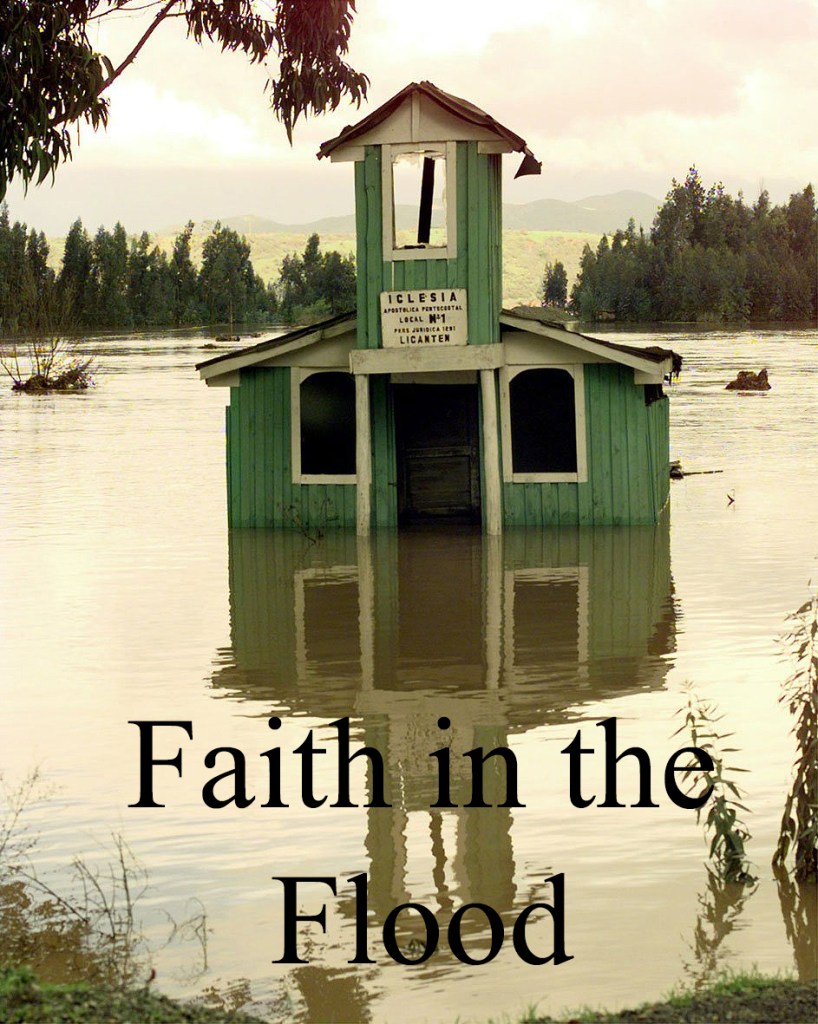
Faith in the Flood

Faith in the Flood

November 05, 2023*

By Pastor John Partridge

Joshua 3:7-17             Matthew 23:1-12                               1 Thessalonians 2:9-13

There is an old joke about a flood and a faithful saint of the church. The weather forecast was for torrential rains and flooding and people were advised to evacuate. But when two sheriff’s deputies came to the door of this faithful saint asking them to leave, they simply replied that “God will provide.” And so, the rains came, and the flood waters rose. Soon the first floor of their house was under water, and they moved all their valuables up to the second floor. About that time, a Boy Scout came by in a canoe and offered to carry them to safety, but they refused and simply said, “God will provide.” It continued to rain and to flood waters continued to rise, and soon, this faithful saint of the church was sitting on their roof. And, as they were sitting on their roof, the National Guard arrived in a helicopter and offered to lift them out of their distress, but they again declined saying, “God will provide.” Not long after that, the flood waters carried that saint away and, when they were welcomed at the pearly gates of heaven they cried out, “God, why didn’t you save me?” And God replied, “Well, I sent two sheriff’s deputies, a Boy Scout, and the National Guard. What more did you want?”

I have always liked that joke because it’s funny and because it points us toward one of the church’s common failures. Well-known Croatian theologian Miroslav Volf said, “There is something deeply hypocritical about praying for a problem you are unwilling to resolve.” The question isn’t whether our lives will have storms and floods, the question is what we will do when we face them. That is what we see in Joshua 3:7-17, because as the people of Israel prepare to cross the Jordan River into the Promised Land, Joshua commands the priests to take a step of faith… right into the middle of the flood.

And the Lord said to Joshua, “Today I will begin to exalt you in the eyes of all Israel, so they may know that I am with you as I was with Moses. Tell the priests who carry the ark of the covenant: ‘When you reach the edge of the Jordan’s waters, go and stand in the river.’”

Joshua said to the Israelites, “Come here and listen to the words of the Lord your God. 10 This is how you will know that the living God is among you and that he will certainly drive out before you the Canaanites, Hittites, Hivites, Perizzites, Girgashites, Amorites and Jebusites. 11 See, the ark of the covenant of the Lord of all the earth will go into the Jordan ahead of you. 12 Now then, choose twelve men from the tribes of Israel, one from each tribe. 13 And as soon as the priests who carry the ark of the Lord—the Lord of all the earth—set foot in the Jordan, its waters flowing downstream will be cut off and stand up in a heap.”

14 So when the people broke camp to cross the Jordan, the priests carrying the ark of the covenant went ahead of them. 15 Now the Jordan is at flood stage all during harvest. Yet as soon as the priests who carried the ark reached the Jordan and their feet touched the water’s edge, 16 the water from upstream stopped flowing. It piled up in a heap a great distance away, at a town called Adam in the vicinity of Zarethan, while the water flowing down to the Sea of the Arabah (that is, the Dead Sea) was completely cut off. So, the people crossed over opposite Jericho. 17 The priests who carried the ark of the covenant of the Lord stopped in the middle of the Jordan and stood on dry ground, while all Israel passed by until the whole nation had completed the crossing on dry ground.

The Jordan River is at flood stage and is a raging torrent. So violently does it flow that Jericho isn’t even watching this border as closely as they might because Baal is the god of rivers and storms, and this was the season that they could see his power and knew that he was protecting them. After the adventure with the spies, Israel almost certainly knew that as well. Further, as one of the two spies who had lived through the 40 years in the wilderness, Joshua was personally aware of this. Nonetheless, God commands Joshua to tell the priests who carry the arc of the covenant, to “go and stand in the river.” Just go and stand in the middle of the raging torrent of the harvest flood. Worse, the banks of the Jordan are often not gentle slopes but rapid drop-offs that would be invisible in the muddy floodwaters. I’m sure that those priests had some concerns, but they also had faith in God and faith in Joshua. With the weight of the ark on their shoulders, and almost no chance of catching themselves if they stumbled, the priests do as they were asked and boldly step into the rushing water.

And the water stopped.

As soon as their feet touched the water, the water stopped flowing and piled up in a heap upstream of them and, as the priests stood in the middle of the riverbed, the entire nation of Israel crossed the river on dry ground. The people of God, and especially those priests weighted down with the ark of covenant on their shoulders, didn’t just pray for God’s deliverance and their entry into the Promised Land, they acted on their faith, and they stepped out into the flood.

But the priests and the leaders of the church aren’t always that faithful and aren’t always the best example for people to follow. That was the case in Matthew 23:1-12 when Jesus tells the people to live their lives differently than Israel’s leaders.

23:1 Then Jesus said to the crowds and to his disciples: “The teachers of the law and the Pharisees sit in Moses’ seat. So you must be careful to do everything they tell you. But do not do what they do, for they do not practice what they preach. They tie up heavy, cumbersome loads and put them on other people’s shoulders, but they themselves are not willing to lift a finger to move them.

“Everything they do is done for people to see: They make their phylacterieswide and the tassels on their garments long; they love the place of honor at banquets and the most important seats in the synagogues; they love to be greeted with respect in the marketplaces and to be called ‘Rabbi’ by others.

“But you are not to be called ‘Rabbi,’ for you have one Teacher, and you are all brothers. And do not call anyone on earth ‘father,’ for you have one Father, and he is in heaven. 10 Nor are you to be called instructors, for you have one Instructor, the Messiah. 11 The greatest among you will be your servant. 12 For those who exalt themselves will be humbled, and those who humble themselves will be exalted.

Jesus says that although the teachers of the law and the Pharisees hold important leadership positions, and although the people must be careful to follow their instructions and do as the leaders teach, they should not live by the example that those leaders provide. Those leaders lived a life that was all about the show. They wore flashy religious vestments and large phylacteries, which were prayers or scriptures that were etched in silver, copper, or even on baked clay tablets. While rabbis routinely wore tassels on their robes, these leaders had to had bigger, and longer tassels then everyone else. And, whenever there was a banquet, or when they went to church, they had to have the most visible, and most important seats in the house so that everyone could see how important they were. But while they put on a good show, they didn’t live lives that demonstrated the things that they taught. Jesus said that the people who would be the greatest among them, would first be a servant to others. Following Jesus, honoring God, and living a life of faith wasn’t about looking good, it was all about having the humility to live a life that acted on faith and did the work of the kingdom of God.

That’s exactly the message that we hear Paul telling the people of the church in Thessalonica in his letter that we read in 1 Thessalonians 2:9-13 when he says…

Surely you remember, brothers and sisters, our toil and hardship; we worked night and day in order not to be a burden to anyone while we preached the gospel of God to you. 10 You are witnesses, and so is God, of how holy, righteous, and blameless we were among you who believed. 11 For you know that we dealt with each of you as a father deals with his own children, 12 encouraging, comforting, and urging you to live lives worthy of God, who calls you into his kingdom and glory.

13 And we also thank God continually because, when you received the word of God, which you heard from us, you accepted it not as a human word, but as it actually is, the word of God, which is indeed at work in you who believe.

Paul asks the people of the church to remember the example that he and his fellow missionaries provided for them as they lived among them. They worked, and they worked hard, day and night, so that they would not be a burden to the church, but they also lived lives that were holy, righteous, and blameless. They did not rule over them as some leaders do, but encouraged and comforted them, and treated them as if they were their own children so that they could urge them to live lives that were worthy of the God who called them into his kingdom. Paul says that he and his associates continually thank God because the people of the church not only received the word of God but allowed God to work through them. They didn’t just accept Jesus and have faith in Jesus, they lived out their faith through their actions.

The people of Israel had faith in God and believed that he would lead them into the Promised Land, but the evidence of that faith was visibly seen when the priests carrying the ark of the covenant boldly stepped forward into the raging flood waters of the Jordan River.

While Jesus acknowledged that the people should be obedient to their leaders, he also told them that in order to honor God, they had to do better. Rather putting on a good show, a true life of faith is a life that serves others and demonstrates God’s love through the actions of the believer.

And Paul says much the same thing. The proof of the message that they taught was found in the way that they lived, and the proof that the church had believed was seen, not in the words that they spoke or in the worship of their people, but in the work that they did among those who did not believe.

We may laugh at the imaginary saint of the church that prayed to God but ignored two sheriff’s deputies, a Boy Scout, and the National Guard, but the truth is that faith demands that we do more than pray.

Real faith is found in the actions of the church.

Real faith is when we roll up our sleeves and get to work.


Please LIKE and SHARE!

Click here to subscribe to Pastor John’s blog.

Click here if you would like to subscribe to Pastor John’s weekly messages.

Click here to visit Pastor John’s YouTube channel.


*You have been reading a message presented at Christ United Methodist Church on the date noted at the top of the first page.  Rev. John Partridge is the pastor at Christ UMC in Alliance, Ohio.  Duplication of this message is a part of our Media ministry, if you have received a blessing in this way, we would love to hear from you.  Letters and donations in support of the Media ministry or any of our other projects may be sent to Christ United Methodist Church, 470 East Broadway Street, Alliance, Ohio 44601.  These messages are available to any interested persons regardless of membership.  You may subscribe to these messages, in print or electronic formats, by writing to the address noted, or by contacting us at secretary@CUMCAlliance.org.  These messages can also be found online at https://pastorpartridge.com .  All Scripture quotations, unless otherwise indicated, are taken from the Holy Bible, New International Version®, NIV®. Copyright ©1973, 1978, 1984, 2011 by Biblica, Inc.™ Used by permission of Zondervan. All rights reserved worldwide. www.zondervan.comThe “NIV” and “New International Version” are trademarks registered in the United States Patent and Trademark Office by Biblica, Inc.™

Finding Nebo

Finding Nebo

October 29, 2023*

By Pastor John Partridge

Deuteronomy 34:1-12        Matthew 22:34-46         

1 Thessalonians 2:1-8

Many of us are, by now, familiar with the 2003 Pixar animated movie “Finding Nemo” in which Marlin, an overprotective, single, clown fish father, pursues his son, Nemo, across the dangers of the vast Pacific Ocean in hopes of rescuing him from the scuba divers that captured him. It’s a good story. But despite the similarity of the name in the title, Nemo is not what we are looking for. Our story for today begins with an ending. At the end of Moses’ life, knowing that he will never set foot in the Promised Land that he has pursued for most of his adult life, he finds himself, not in the Pacific Ocean with a small clownfish named Nemo, but at the top of a mountain named Nebo. And, in an odd sort of way, we discover that, as the followers of Jesus Christ, we too are spending ourselves in pursuit of finding Nebo. As I said before, we begin this morning with an ending in Deuteronomy 34:1-12 where it says:

34:1 Then Moses climbed Mount Nebo from the plains of Moab to the top of Pisgah, across from Jericho. There the Lord showed him the whole land—from Gilead to Dan, all of Naphtali, the territory of Ephraim and Manasseh, all the land of Judah as far as the Mediterranean Sea, the Negev and the whole region from the Valley of Jericho, the City of Palms, as far as Zoar. Then the Lord said to him, “This is the land I promised on oath to Abraham, Isaac, and Jacob when I said, ‘I will give it to your descendants.’ I have let you see it with your eyes, but you will not cross over into it.”

And Moses the servant of the Lord died there in Moab, as the Lord had said. He buried himin Moab, in the valley opposite Beth Peor, but to this day no one knows where his grave is. Moses was a hundred and twenty years old when he died, yet his eyes were not weak, nor his strength gone. The Israelites grieved for Moses in the plains of Moab thirty days, until the time of weeping and mourning was over.

Now Joshua, son of Nun, was filled with the spiritof wisdom because Moses had laid his hands on him. So, the Israelites listened to him and did what the Lord had commanded Moses.

10 Since then, no prophet has risen in Israel like Moses, whom the Lord knew face to face, 11 who did all those signs and wonders the Lord sent him to do in Egypt—to Pharaoh and to all his officials and to his whole land. 12 For no one has ever shown the mighty power or performed the awesome deeds that Moses did in the sight of all Israel.

When you make the journey to visit Israel, once the present violence ends and peace returns, you will find that Israel is surprisingly small. For us in the United States we can compare it in our minds knowing that Israel is smaller than Massachusetts and slightly smaller than New Jersey. If you could make a non-stop road trip along its main highway, you could travel its entire length in less than six hours. And so, while there is, perhaps, some exaggeration in the account that we read in Deuteronomy, probably not much. From the top of Mount Nebo, with good visibility, Moses would have seen a great deal of the Promised Land that Israel was about to inherit. But Moses wasn’t going. He had come this far, but his time on earth was finished and, although God allowed him to see the land of Israel, he would never cross the Jordan River and set his feet upon it. Instead, Moses would be buried somewhere in Moab on the slopes of Mount Nebo and make a different crossing into his heavenly inheritance with God. Moses never crossed over into the Promised Land, but Moses’ legacy was that he listened to the call of God, obeyed the instructions of God, and led his family, his tribe, his community, and his people into God’s promise.

But God’s promise to his people was about more than land. As Israel had struggled during their captivity in Egypt, they cried out to God for a rescuer that would carry them out of Egypt to freedom. And God heard the prayers of his people, and sent Moses to lead them out of Egypt, across the desert, through the years of wandering in the wilderness, and right the edge of the Promised Land. But throughout many years of suffering, in the land of Israel, under the yoke of other oppressive nations such as Babylon, Greece, Egypt, and Rome, the people of Israel again prayed to God and looked for a rescuer, a messiah, that would, once again, bring them freedom and prosperity. The seeds of that hope for a messiah were contained in the writings of the prophets, but it was not always understood how it would happen, or who the messiah would be. And that’s how Jesus can ask a question that stumped the biblical scholars of his day when they come to him to present a question with which they hope to test him in Matthew 22:34-46 where we read this:

34 Hearing that Jesus had silenced the Sadducees, the Pharisees got together. 35 One of them, an expert in the law, tested him with this question: 36 “Teacher, which is the greatest commandment in the Law?”

37 Jesus replied: “‘Love the Lord your God with all your heart and with all your soul and with all your mind.’ 38 This is the first and greatest commandment. 39 And the second is like it: ‘Love your neighbor as yourself.’ 40 All the Law and the Prophets hang on these two commandments.”

41 While the Pharisees were gathered together, Jesus asked them, 42 “What do you think about the Messiah? Whose son is he?”

“The son of David,” they replied.

43 He said to them, “How is it then that David, speaking by the Spirit, calls him ‘Lord’? For he says,

44 “‘The Lord said to my Lord:
    “Sit at my right hand
until I put your enemies
    under your feet.”’

45 If then David calls him ‘Lord,’ how can he be his son?” 46 No one could say a word in reply, and from that day on no one dared to ask him any more questions.

The puzzle that Jesus puts to the Pharisees is the kind of a problem that often causes us to get stuck in the twenty-first century. While Jesus’ question seems simple to us it was a serious problem to these biblical scholars because it required that they get past their own cultural biases to answer it. In a culturally patriarchal system of honor, it was understood that fathers were always greater in prestige and honor than their sons. If a grandfather or great-grandfather could have, somehow, come back from the dead, that elderly person would automatically become the head of an entire clan of his descendants and all his sons, grandsons, and everyone else would be expected to defer to them and honor them. But although the scholars know that the Messiah would be a living descendant of David, referred to as “the son of David,” their cultural bias prevents them from understanding how, in Psalm 110, David refers to his descendant as his Lord, and thereby gives his descendant honor and defers to him as someone greater than the greatest king that Israel ever had. The Pharisees could simply not understand how a son of David could be greater than David and so, they misunderstood what, and who, the messiah would be. For us, although we have our own cultural blind spots, we understand that Jesus was, and is, God’s promised Messiah, he is the son of David, and he is David’s lord because he is the son of God.

But, twenty-one centuries later, what does that mean for us? If we follow God as Moses did, and we accept Jesus as our lord, and follow him, then what why does all that matter? It matters because, like Moses, we are trying to find our mountain top, our Nebo, but like the Pharisees, we can’t quite figure out what that means. But Paul did, and he explains it to the church in Thessalonica in 1 Thessalonians 2:1-8, saying…

2:1 You know, brothers and sisters, that our visit to you was not without results. We had previously suffered and been treated outrageously in Philippi, as you know, but with the help of our God we dared to tell you his gospel in the face of strong opposition. For the appeal we make does not spring from error or impure motives, nor are we trying to trick you. On the contrary, we speak as those approved by God to be entrusted with the gospel. We are not trying to please people but God, who tests our hearts. You know we never used flattery, nor did we put on a mask to cover up greed—God is our witness. We were not looking for praise from people, not from you or anyone else, even though as apostles of Christ we could have asserted our authority. Instead, we were like young children among you.

Just as a nursing mother cares for her children, 8so we cared for you. Because we loved you so much, we were delighted to share with you not only the gospel of God but our lives as well.

Paul’s message is that life wasn’t perfect. Everyone knew that sometimes the lives of Paul and his associates had faced some significant suffering. They had been arrested, beaten, and thrown into prison on many occasions. But despite their suffering, with the help of God, they dared to continue telling others the story of the gospel regardless of the opposition that they faced. Their motivation wasn’t to trick anyone, to get rich, or for any other impure motive, but simply to share the message with which they had been entrusted by God. Their goal was to share the gospel, and their lives, with the people to whom God had led them.

Moses, Paul, Silas, Timothy, and many others were seeking to find their Nebo, to lead their family, their tribe, their community, and their people into God’s promise, which they now understood as the promise of Jesus Christ. And that’s the mission that has been passed down to us. Because we are the people who, like Paul, have been entrusted with the gospel, the people who have met Jesus, and who have believed in him and have put our trust in him, we too are seeking our Nebo. As we have been reminded on this All-Saints Day, our time on earth is short and won’t last forever and one day we too will cross over into God’s promise as Moses did, and as these saints of the church have done.

Our mission, our hope, and our calling is to lead our people to God’s promise through the message and the gospel of Jesus Christ…

…before it’s our turn to cross over.


Please LIKE and SHARE!

Click here to subscribe to Pastor John’s blog.

Click here if you would like to subscribe to Pastor John’s weekly messages.

Click here to visit Pastor John’s YouTube channel.


*You have been reading a message presented at Christ United Methodist Church on the date noted at the top of the first page.  Rev. John Partridge is the pastor at Christ UMC in Alliance, Ohio.  Duplication of this message is a part of our Media ministry, if you have received a blessing in this way, we would love to hear from you.  Letters and donations in support of the Media ministry or any of our other projects may be sent to Christ United Methodist Church, 470 East Broadway Street, Alliance, Ohio 44601.  These messages are available to any interested persons regardless of membership.  You may subscribe to these messages, in print or electronic formats, by writing to the address noted, or by contacting us at secretary@CUMCAlliance.org.  These messages can also be found online at https://pastorpartridge.com .  All Scripture quotations, unless otherwise indicated, are taken from the Holy Bible, New International Version®, NIV®. Copyright ©1973, 1978, 1984, 2011 by Biblica, Inc.™ Used by permission of Zondervan. All rights reserved worldwide. www.zondervan.comThe “NIV” and “New International Version” are trademarks registered in the United States Patent and Trademark Office by Biblica, Inc.™

The Tax Trap

The Tax Trap

October 22, 2023*

By Pastor John Partridge

Exodus 33:12-23                    Matthew 22:15-22                             1 Thessalonians 1:1-10

Leadership is intimidating.

That is to say, leadership can be intimidating if you have the humility to pause and think about the impact of what you are doing.

The first time that I recall having any real leadership was in the early 1990’s when I had returned to my Army Reserve unit from my advanced training in my MOS (Military Occupational Specialty) and was expected to lead one of the monthly classes that were held to keep everyone fresh on our required skills. Since I had so recently returned from training, I was therefore the most qualified to teach one or two of the classes. I was still a Private First Class, and I had sergeants, staff sergeants, and just about everyone else in “my” classroom for fifteen minutes. As I continued to do this over the years, my rank, and my skills, advanced and I became more comfortable doing it.

But then on July 4th, 2004, I stood in front of the gathered people of the Johnsville United Methodist Church for the first time as their pastor. This was, once again, entirely new and, at that time, despite being over 40 years old, I had very little training as a pastor. But, once again, with time, experience, and more training, leading God’s people became a little easier.

But regardless of whether it was in the early 1990’s or in 2004, I always knew that I wasn’t alone. There were senior noncommissioned officers who could help me if I stumbled while I was teaching classes in my reserve unit, and in every church that I have served, there have always been patient, competent, congregations, volunteers, and staff to help me do what I do. Leadership is always intimidating, but the idea of leading… alone… would be terrifying.

But that is exactly what is foremost in Moses’ mind as he has a conversation with God in Exodus 33:12-23.

12 Moses said to the Lord, “You have been telling me, ‘Lead these people,’ but you have not let me know whom you will send with me. You have said, ‘I know you by name and you have found favor with me.’ 13 If you are pleased with me, teach me your ways so I may know you and continue to find favor with you. Remember that this nation is your people.”

14 The Lord replied, “My Presence will go with you, and I will give you rest.”

15 Then Moses said to him, “If your Presence does not go with us, do not send us up from here. 16 How will anyone know that you are pleased with me and with your people unless you go with us? What else will distinguish me and your people from all the other people on the face of the earth?”

17 And the Lord said to Moses, “I will do the very thing you have asked, because I am pleased with you, and I know you by name.”

18 Then Moses said, “Now show me your glory.”

19 And the Lord said, “I will cause all my goodness to pass in front of you, and I will proclaim my name, the Lord, in your presence. I will have mercy on whom I will have mercy, and I will have compassion on whom I will have compassion. 20 But,” he said, “you cannot see my face, for no one may see me and live.”

21 Then the Lord said, “There is a place near me where you may stand on a rock. 22 When my glory passes by, I will put you in a cleft in the rock and cover you with my hand until I have passed by. 23 Then I will remove my hand and you will see my back; but my face must not be seen.”

The first thing out of Moses’ mouth is, “I can’t do this alone.” Those aren’t his exact words, but that is clearly the idea when he says, “whom will you send with me?” And God’s response is, I will go with you, and I will give you rest. God promises that his presence will be so tangibly real, that Moses will never feel as if he is alone and he will be comforted, and be able to sleep at night, because he knows that he is not alone.

Why does that matter?

Well, if you are in any kind of leadership position, you can find comfort in that. But there are other reasons that we’ll get to in a few minutes.

Next, we come to yet another story of the Pharisees trying to trick Jesus into saying something stupid that would either be a criminal offense or would be offensive and reduce his popularity with the people. There’s some back story to this that helps us make sense of that, but we’ll cross that bridge when we come to it. For now, let’s look at this story from Matthew 22:15-22:

15 Then the Pharisees went out and laid plans to trap him in his words. 16 They sent their disciples to him along with the Herodians. “Teacher,” they said, “we know that you are a man of integrity and that you teach the way of God in accordance with the truth. You aren’t swayed by others because you pay no attention to who they are. 17 Tell us then, what is your opinion? Is it right to pay the imperial taxto Caesar or not?”

18 But Jesus, knowing their evil intent, said, “You hypocrites, why are you trying to trap me? 19 Show me the coin used for paying the tax.” They brought him a denarius, 20 and he asked them, “Whose image is this? And whose inscription?”

21 “Caesar’s,” they replied.

Then he said to them, “So give back to Caesar what is Caesar’s, and to God what is God’s.”

22 When they heard this, they were amazed. So, they left him and went away.

This was the tax trap. First, you will note that the Pharisees don’t come to see Jesus in person. Instead, they send their lackeys that are less well-known so that Jesus might not recognize this as a trap, and second, they send along with them the Herodians. Which may cause us to ask, who the heck were the Herodians? And that’s a good question that the bible doesn’t answer very well, but which history does. We know that the ruler of Israel at the time of Jesus’ birth had been Herod the Great, and the current ruler was one of his sons, Herod Antipas. And so, the Herodians were Jews, who had sold out to the Romans, to the culture of the Romans, and to the plan that Herod had for their nation. To make a connection to the United States of the twenty-first century, these were the people who were more interested in conforming to the culture of Hollywood, and to their political party than they were in conforming to the laws of Moses and the prophets. They were born Jews but were culturally Roman. The plan clearly was that if Jesus said that good Jews shouldn’t pay Roman taxes, which was a prominent idea in some Jewish circles, then the Herodians would charge Jesus with a crime. The argument in some Jewish circles was that because Rome was immoral and acted counter to the beliefs of Israel, that paying taxes to Rome was therefore immoral. Further, because Rome circulated coinage that bore graven images that were prohibited by scripture, that using such coinage was sinful and a corrupting influence.

But Jesus’ interpretation was different.

Jesus said that if Ceasar’s face was on the coin, then pay Ceasar what was due to Ceasar, but pay to God what belonged to God. In Jesus’ interpretation, the scriptures demanded that faithful people should follow God with all their heart, with all their soul, with all their mind, and with all their strength. That is what was owed to God. It is your choices and your morality that are important.

Hold on to that idea because we’re going to come back to that in a minute, but this connects us to Paul’s message to the church in Thessalonica that we hear in 1 Thessalonians 1:1-10:

1:1 Paul, Silas,and Timothy,

To the church of the Thessalonians in God the Father and the Lord Jesus Christ:

Grace and peace to you.

We always thank God for all of you and continually mention you in our prayers. We remember before our God and Father your work produced by faith, your labor prompted by love, and your endurance inspired by hope in our Lord Jesus Christ.

For we know, brothers and sistersloved by God, that he has chosen you, because our gospel came to you not simply with words but also with power, with the Holy Spirit and deep conviction. You know how we lived among you for your sake. You became imitators of us and of the Lord, for you welcomed the message in the midst of severe suffering with the joy given by the Holy Spirit. And so you became a model to all the believers in Macedonia and Achaia. The Lord’s message rang out from you not only in Macedonia and Achaia—your faith in God has become known everywhere. Therefore, we do not need to say anything about it, for they themselves report what kind of reception you gave us. They tell how you turned to God from idols to serve the living and true God, 10 and to wait for his Son from heaven, whom he raised from the dead—Jesus, who rescues us from the coming wrath.

What Paul says is important, but I also think that how Paul said it is important.  You will note that Paul does not simply say that we remember you because of your work, your labor, and your endurance. What Paul says is that we remember you to God because of the work that we have seen in you that was produced by faith, because of the labor that you have done that was prompted by love, and by the endurance that you have shown that was inspired by hope. This is the work that God is doing because his people love him with all their heart, with all their soul, with all their mind and with all their strength. They are doing the work of the kingdom because of their faith, because of their love, and because of their hope and not because it was what was culturally expected, or because of some other sense of ethical, moral, or cultural obligation. When we remember James’ teaching that faith is revealed by works, this is that. Faith came first, but because the people had faith, it inspired them to work, labor, and hope.

So, how do we tie this all together and make sense of it?

Jesus’ challenge to the tax trap points us toward self-reflection in several directions. Two thousand years ago the fear was that taxes, especially using money with graven images on it, was a corrupting influence that faithful Jews should avoid. But Jesus says that it isn’t. Paying taxes isn’t inherently sinful, nor are we automatically guilty of the sinful or immoral acts of the government. Of course, this is held in tension with several other scriptures that say that we will, as a people, be held responsible for the sins of our nation. There’s no way we have the time to even try to sort that out so I’m not even going to try.

But our point of personal self-reflection and struggle is to remember that a sinful government doesn’t necessarily corrupt us personally. But the reverse is also true, such that the righteous acts of government do not make us personally righteous. It is a good thing for the government to feed the poor, but the Roman government did that. It is a good thing for the government to care for the elderly and a host of other things, but none of the things that the government does, relieves us of doing the things that God has commanded us to do. Whether our government is good or evil, we are still obligated to feed the hungry, clothe the naked, care for the widows and orphans, speak for the immigrants and the voiceless, and to do the work of the kingdom of God. On the day that we stand in judgement before God, we will be judged by what we have done, and what we have left undone and that includes how we voted, and when we chose not to vote.

But the second point of connection here is that, like Moses, and like the pastor of a church, God knows that we cannot do all these things alone. We are a part of a community of faith. We can do great things, sometimes impossible things, because we work together… and because God promises to go with us.

We are not alone.


Please LIKE and SHARE!

Click here to subscribe to Pastor John’s blog.

Click here if you would like to subscribe to Pastor John’s weekly messages.

Click here to visit Pastor John’s YouTube channel.


*You have been reading a message presented at Christ United Methodist Church on the date noted at the top of the first page.  Rev. John Partridge is the pastor at Christ UMC in Alliance, Ohio.  Duplication of this message is a part of our Media ministry, if you have received a blessing in this way, we would love to hear from you.  Letters and donations in support of the Media ministry or any of our other projects may be sent to Christ United Methodist Church, 470 East Broadway Street, Alliance, Ohio 44601.  These messages are available to any interested persons regardless of membership.  You may subscribe to these messages, in print or electronic formats, by writing to the address noted, or by contacting us at secretary@CUMCAlliance.org.  These messages can also be found online at https://pastorpartridge.com .  All Scripture quotations, unless otherwise indicated, are taken from the Holy Bible, New International Version®, NIV®. Copyright ©1973, 1978, 1984, 2011 by Biblica, Inc.™ Used by permission of Zondervan. All rights reserved worldwide. www.zondervan.comThe “NIV” and “New International Version” are trademarks registered in the United States Patent and Trademark Office by Biblica, Inc.™

Addicted to… Rules?

Addicted to Rules

October 08, 2023*

By Pastor John Partridge

Exodus 20:1-4, 7-9, 12-20                 Matthew 21:33-46                             Philippians 3:4b-14

In 1985 radio stations everywhere were playing the debut of Robert Palmer’s new hit song, Addicted to Love. That song will be familiar to those of us in a particular age group, but it begins like this:

The lights are on, but you’re not home
Your mind is not your own
Your heart sweats, your body shakes
Another kiss is what it takes
You can’t sleep, you can’t eat
There’s no doubt, you’re in deep
Your throat is tight, you can’t breathe
Another kiss is all you need.

Whoa, you like to think that you’re immune to the stuff, oh yeah
It’s closer to the truth to say you can’t get enough
You know you’re gonna have to face it, you’re addicted to love.

Robert Palmer may have taken a certain amount of artistic license, but just this week I had a conversation with a friend about how some people simply can’t stand to live alone, and that can lead them to making bad choices and being in a relationship with someone who isn’t good for them, and sometimes one bad relationship after another.

Addiction, of any kind, even an addition to something that is normally good, can be a bad thing. Addiction, even to something good, takes things too far and winds up being harmful. And that’s one of the things that we will find as we read and think about today’s scriptures. We begin with what God intended for good, the ten commandments. Most of these commandments are regarded as good things, even by people who do not share our faith, and even by people who have no faith at all. Prohibitions against theft, murder, adultery, and false witness, just to name a few, are almost inarguably good things. But can such prohibitions go too far? Before we get into that, let’s begin at the beginning and just read the words of Exodus 20:1-4, 7-9, 12-20.

20:1 And God spoke all these words:

“I am the Lord your God, who brought you out of Egypt, out of the land of slavery.

“You shall have no other gods before me.

“You shall not make for yourself an image in the form of anything in heaven above or on the earth beneath or in the waters below.

“You shall not misuse the name of the Lord your God, for the Lord will not hold anyone guiltless who misuses his name.

“Remember the Sabbath day by keeping it holy. Six days you shall labor and do all your work,

12 “Honor your father and your mother, so that you may live long in the land the Lord your God is giving you.

13 “You shall not murder.

14 “You shall not commit adultery.

15 “You shall not steal.

16 “You shall not give false testimony against your neighbor.

17 “You shall not covet your neighbor’s house. You shall not covet your neighbor’s wife, or his male or female servant, his ox or donkey, or anything that belongs to your neighbor.”

18 When the people saw the thunder and lightning and heard the trumpet and saw the mountain in smoke, they trembled with fear. They stayed at a distance 19 and said to Moses, “Speak to us yourself and we will listen. But do not have God speak to us or we will die.”

20 Moses said to the people, “Do not be afraid. God has come to test you, so that the fear of God will be with you to keep you from sinning.”

Saying things like, “don’t take things that don’t belong to you,” “don’t murder or hurt other people, or that it’s not good to even wish you had the nice things that your neighbor has,” are not that controversial. Even honoring your parents, when they deserve it, is something that most of us can generally agree on. But we can understand why people who do not share our faith, or who don’t believe in God, would take issue with rules about gods, idols, taking God’s name in vain, or keeping the sabbath. Other than those rules that are specific to our worship of our God, I think most people would agree that these are reasonable rules and, in fact, most of these rules end up being codified in the laws of cities, states, and nations around the world.

But that’s where the trouble starts. Or, perhaps, if we think of it another way, perhaps that’s where the addiction starts. In an attempt to ensure that the people of Israel would always follow these ten rules, the leaders of Israel wrote more rules that regulated life, or put fences around the rules, so that people wouldn’t, even accidentally, break these ten commandments. (pause) But even that wasn’t enough for some people. After Israel had been carried into captivity in Babylon for seventy years, returned to Israel, and rebuilt their nation, the leaders began to understand that their exile had been caused by Israel’s disobedience to God. And so, at some point, the people that we know as the Pharisees in the time of the New Testament accumulated an even longer list of rules that built fences around the fences that had been built around the rules. And while some of the Pharisees were legitimately trying to keep Israel on the straight and narrow and stay close to God, others began to become more devoted to the rules than they were to the God they were supposed to worship.  And it was exactly that sort of thing that had the Pharisees up in arms about the popularity that Jesus had with the common people and the background to exchanges such as the one we find in Matthew 21:33-46, (which immediately follows our passage from last week in which Jesus said that Prostitutes and tax collectors were getting into heaven before the Pharisees)where we hear Jesus say:

33 “Listen to another parable: There was a landowner who planted a vineyard. He put a wall around it, dug a winepress in it and built a watchtower. Then he rented the vineyard to some farmers and moved to another place. 34 When the harvest time approached, he sent his servants to the tenants to collect his fruit.

35 “The tenants seized his servants; they beat one, killed another, and stoned a third. 36 Then he sent other servants to them, more than the first time, and the tenants treated them the same way. 37 Last of all, he sent his son to them. ‘They will respect my son,’ he said.

38 “But when the tenants saw the son, they said to each other, ‘This is the heir. Come, let’s kill him and take his inheritance.’ 39 So they took him and threw him out of the vineyard and killed him.

40 “Therefore, when the owner of the vineyard comes, what will he do to those tenants?”

41 “He will bring those wretches to a wretched end,” they replied, “and he will rent the vineyard to other tenants, who will give him his share of the crop at harvest time.”

42 Jesus said to them, “Have you never read in the Scriptures:

“‘The stone the builders rejected
    has become the cornerstone;
the Lord has done this,
    and it is marvelous in our eyes’?

43 “Therefore I tell you that the kingdom of God will be taken away from you and given to a people who will produce its fruit. 44 Anyone who falls on this stone will be broken to pieces; anyone on whom it falls will be crushed.”

45 When the chief priests and the Pharisees heard Jesus’ parables, they knew he was talking about them. 46 They looked for a way to arrest him, but they were afraid of the crowd because the people held that he was a prophet.

One of the first things that we should probably notice is that Jesus may very well be foretelling his own death in this parable since it isn’t hard to understand that as the son of God, he is the son of the landowner of Israel. The second thing to notice is that, even though the priests and the Pharisees may not have understood Jesus’ allusion to being the son of the landowner, they clearly understood that he was talking about them and that they were the ungrateful tenants in the story. Everyone understood that Jesus was accusing Israel’s leadership of not giving to God what was expected and due. The accusation is clear that the leaders had violated several of the commandments, that they had put themselves ahead of God, that they had made money, power, and influence into an idol, and that they were, generally, unfaithful.

The contrast to the priests and the Pharisees is found in the life of Paul, after his encounter with Jesus on the road to Damascus. After Paul’s conversion, he sees the rules, and his former addiction to the rules, in an entirely different light. In Philippians 3:4b-14 he says…

If someone else thinks they have reasons to put confidence in the flesh, I have more: circumcised on the eighth day, of the people of Israel, of the tribe of Benjamin, a Hebrew of Hebrews; in regard to the law, a Pharisee; as for zeal, persecuting the church; as for righteousness based on the law, faultless.

But whatever were gains to me I now consider loss for the sake of Christ. What is more, I consider everything a loss because of the surpassing worth of knowing Christ Jesus my Lord, for whose sake I have lost all things. I consider them garbage, that I may gain Christ and be found in him, not having a righteousness of my own that comes from the law, but that which is through faith inChrist—the righteousness that comes from God on the basis of faith. 10 I want to know Christ—yes, to know the power of his resurrection and participation in his sufferings, becoming like him in his death, 11 and so, somehow, attaining to the resurrection from the dead.

12 Not that I have already obtained all this, or have already arrived at my goal, but I press on to take hold of that for which Christ Jesus took hold of me. 13 Brothers and sisters, I do not consider myself yet to have taken hold of it. But one thing I do: Forgetting what is behind and straining toward what is ahead, 14 I press on toward the goal to win the prize for which God has called me heavenward in Christ Jesus.

Paul was a Pharisee. He followed the rules, he was born into the right kind of family, went to the right kind of schools with the right kind of teachers, he, and his family, followed all the prescribed rituals, he dedicated his life to enforcing the rules, he hunted down Jews who had chosen to follow Jesus and prosecuted, and imprisoned them for their failure to follow the rules. He was there watching the coats of the men who stoned Stepehen in Jerusalem and, I think we can safely say, that he was addicted to the rules. But, after he met Jesus, his addiction was broken, and he saw the rules in an entirely different light. I don’t want you to misunderstand, Paul still followed most of those rules. He still thought that they were an important part of his faith, but the rules were no longer an addiction, and they were no longer something that was more important than faith. His addiction, and the value that he once put on the rules, money, power, and influence, he now valued no more than garbage. In fact, the word that we translate as “garbage” is the name of the valley below Jerusalem where the sewers emptied, where dead animals were thrown, and where the remains of sacrifices were burned. It was a place of disgusting filth and that was the value that Paul now placed on his former addiction.

Addiction, of any kind, even an addition to something that is normally good, takes things too far and winds up being harmful, and that’s true whether you’re addicted to love, rules, tradition, sex, money, power, politics, authority, fame, fortune, comfort, prestige, sports, hobbies, family, or anything else that you might put ahead of God.

God said ““I am the Lord your God… You shall have no other gods beforeme.”

Even if those gods seem like good things, we cannot put them ahead of God.

It’s important that we get it right.


Please LIKE and SHARE!

Click here to subscribe to Pastor John’s blog.

Click here if you would like to subscribe to Pastor John’s weekly messages.

Click here to visit Pastor John’s YouTube channel.


*You have been reading a message presented at Christ United Methodist Church on the date noted at the top of the first page.  Rev. John Partridge is the pastor at Christ UMC in Alliance, Ohio.  Duplication of this message is a part of our Media ministry, if you have received a blessing in this way, we would love to hear from you.  Letters and donations in support of the Media ministry or any of our other projects may be sent to Christ United Methodist Church, 470 East Broadway Street, Alliance, Ohio 44601.  These messages are available to any interested persons regardless of membership.  You may subscribe to these messages, in print or electronic formats, by writing to the address noted, or by contacting us at secretary@CUMCAlliance.org.  These messages can also be found online at https://pastorpartridge.com .  All Scripture quotations, unless otherwise indicated, are taken from the Holy Bible, New International Version®, NIV®. Copyright ©1973, 1978, 1984, 2011 by Biblica, Inc.™ Used by permission of Zondervan. All rights reserved worldwide. www.zondervan.comThe “NIV” and “New International Version” are trademarks registered in the United States Patent and Trademark Office by Biblica, Inc.™

Is The Lord Among Us… Or Not?

Complaints and Test Questions

October 01, 2023*

By Pastor John Partridge

Exodus 17:1-7                        Matthew 21:23-32                             Philippians 2:1-13

Have you ever had a time in your life that you just wondered what God was up to? I’m thinking about a time in your life when things were weird, difficult, or nearly impossible, and you wondered why you were there, why God was allowing those things to happen, or how those things could possibly fit into God’s plan for your life. There is a curse in Deuteronomy 28:23 that calls up an image of the heavens being made of bronze so that prayers just bounce off without reaching God and some of us have had times that felt like that too, that our prayers went nowhere and remained unanswered. And, because we have passed through difficult times, we appreciate the pain and the struggle of others that are facing those trials today. And that’s why, as much as we spoke last week about the whining and complaining of the Israelites in the desert, we completely understand how they might struggle with a lack of faith when facing that kind of hardship. It is during these difficult times that we ask hard questions and that’s exactly what God’s people did in Exodus 17:1-7.

17:1 The whole Israelite community set out from the Desert of Sin, traveling from place to place as the Lord commanded. They camped at Rephidim, but there was no water for the people to drink. So they quarreled with Moses and said, “Give us water to drink.”

Moses replied, “Why do you quarrel with me? Why do you put the Lord to the test?”

But the people were thirsty for water there, and they grumbled against Moses. They said, “Why did you bring us up out of Egypt to make us and our children and livestock die of thirst?”

Then Moses cried out to the Lord, “What am I to do with these people? They are almost ready to stone me.”

The Lord answered Moses, “Go out in front of the people. Take with you some of the elders of Israel and take in your hand the staff with which you struck the Nile, and go. I will stand there before you by the rock at Horeb. Strike the rock, and water will come out of it for the people to drink.” So, Moses did this in the sight of the elders of Israel. And he called the place Massah [which means testing] and Meribah [which means quarrelling] because the Israelites quarreled and because they tested the Lord saying, “Is the Lord among us or not?”

Is the Lord among us… or not?

If we’re honest, that’s a question that we have asked before, personally, as a church, and as a denomination.

Is the Lord among us… or not?

During our personal struggles with divorce, drugs, alcohol, physical or emotional abuse, unemployment, the loss of loved ones, physical illness, mental illness, depression, and a host of other things, we may well have asked ourselves if God had forgotten us. As we have watched our denomination tear itself apart, we may have asked if we had gone so far wrong that God no longer cared, and certainly, as a church that once worshiped hundreds every Sunday, and that had to build an education wing just to make room for all their children, at some point, or at many points along the road to having only fifty in worship some Sundays, we have probably asked… Is the Lord among us… or not?

But you will notice that the story of God’s people did not end when they asked the question. The story didn’t end in the desert, but neither did God miraculously rescue them before they had spent forty years in the desert and learned a few things about faith and trust. Despite their questions, and despite their struggles, God never abandoned his people, and we have confidence that God has not, and will not, abandon us either.

But in Matthew 21:23-32, the chief priest and the elders asked Jesus a different sort of question.

23 Jesus entered the temple courts, and, while he was teaching, the chief priests and the elders of the people came to him. “By what authority are you doing these things?” they asked. “And who gave you this authority?”

24 Jesus replied, “I will also ask you one question. If you answer me, I will tell you by what authority I am doing these things. 25 John’s baptism—where did it come from? Was it from heaven, or of human origin?”

They discussed it among themselves and said, “If we say, ‘From heaven,’ he will ask, ‘Then why didn’t you believe him?’ 26 But if we say, ‘Of human origin’—we are afraid of the people, for they all hold that John was a prophet.”

27 So they answered Jesus, “We don’t know.”

Then he said, “Neither will I tell you by what authority I am doing these things.

28 “What do you think? There was a man who had two sons. He went to the first and said, ‘Son, go and work today in the vineyard.’

29 “‘I will not,’ he answered, but later he changed his mind and went.

30 “Then the father went to the other son and said the same thing. He answered, ‘I will, sir,’ but he did not go.

31 “Which of the two did what his father wanted?”

“The first,” they answered.

Jesus said to them, “Truly I tell you, the tax collectors and the prostitutes are entering the kingdom of God ahead of you. 32 For John came to you to show you the way of righteousness, and you did not believe him, but the tax collectors and the prostitutes did. And even after you saw this, you did not repent and believe him.

Do you see the difference in the kind of question that the elders are asking in comparison to the question that God’s people were asking in the story of Exodus? In Exodus they just wanted to know if God had abandoned them, but here, the priests and the elders are asking “who gave you permission” to say the things that you are saying? They aren’t concerned about God being with Jesus as much as they are concerned about power structures, and who gave permission. Worse, having asked the question, the elders are so concerned about how the people would react to their answer, that they refuse to answer Jesus’ question at all. For them, politics, power, and appearances are more important than honesty and integrity. And when Jesus sees that, he tells a parable that reveals the truth. Because the elders of the church love politics and power more than they love God, the tax collectors, prostitutes, and other outcasts who repent are moving up the line and entering the kingdom of God ahead of them because the outcasts understood that a life of obedience to God was more important than money, power, politics, or appearances.

This understanding is the key to the message of Paul that we find in Philippians 2:1-13 when he says…

2:1 Therefore if you have any encouragement from being united with Christ, if any comfort from his love, if any common sharing in the Spirit, if any tenderness and compassion, then make my joy complete by being like-minded, having the same love, being one in spirit and of one mind. Do nothing out of selfish ambition or vain conceit. Rather, in humility value others above yourselves, not looking to your own interests but each of you to the interests of the others.

In your relationships with one another, have the same mindset as Christ Jesus:

Who, being in very nature God,
    did not consider equality with God something to be used to his own advantage;
rather, he made himself nothing
    by taking the very nature of a servant,
    being made in human likeness.
And being found in appearance as a man,
    he humbled himself
    by becoming obedient to death—
        even death on a cross!

Therefore God exalted him to the highest place
    and gave him the name that is above every name,
10 that at the name of Jesus every knee should bow,
    in heaven and on earth and under the earth,
11 and every tongue acknowledge that Jesus Christ is Lord,
    to the glory of God the Father.

12 Therefore, my dear friends, as you have always obeyed—not only in my presence, but now much more in my absence—continue to work out your salvation with fear and trembling, 13 for it is God who works in you to will and to act in order to fulfill his good purpose.

Paul says that he would be filled with joy if the church would just work together, love together, and look to the interests of others rather than their own.  The key to a healthy church, and to healthy relationships is to have the same mindset as Jesus, to live and to love like Jesus. We work out our salvation by allowing God to work in us and through us.  God works in us as he transforms us into the likeness of Christ, and through us as he works in the world to accomplish his mission and purpose.

Despite our questions, despite our struggles, and despite our complaining, we have confidence that God has not, and will not, abandon us. But we must fight against our culture and the way that we are told that world works, and remember that a life of obedience to God is more important than money, power, politics, or keeping up appearances. Our goal is not to be important, influential, powerful, famous, rich, or to be adored and admired. Our goal is to be obedient so that God can transform us into his image, and work through us for the transformation of the world.


Please LIKE and SHARE!

Click here to subscribe to Pastor John’s blog.

Click here if you would like to subscribe to Pastor John’s weekly messages.

Click here to visit Pastor John’s YouTube channel.


*You have been reading a message presented at Christ United Methodist Church on the date noted at the top of the first page.  Rev. John Partridge is the pastor at Christ UMC in Alliance, Ohio.  Duplication of this message is a part of our Media ministry, if you have received a blessing in this way, we would love to hear from you.  Letters and donations in support of the Media ministry or any of our other projects may be sent to Christ United Methodist Church, 470 East Broadway Street, Alliance, Ohio 44601.  These messages are available to any interested persons regardless of membership.  You may subscribe to these messages, in print or electronic formats, by writing to the address noted, or by contacting us at secretary@CUMCAlliance.org.  These messages can also be found online at https://pastorpartridge.com .  All Scripture quotations, unless otherwise indicated, are taken from the Holy Bible, New International Version®, NIV®. Copyright ©1973, 1978, 1984, 2011 by Biblica, Inc.™ Used by permission of Zondervan. All rights reserved worldwide. www.zondervan.comThe “NIV” and “New International Version” are trademarks registered in the United States Patent and Trademark Office by Biblica, Inc.™