Immigration: A Christian Dilemma


    Should we build a wall at the border, or should we let everyone through?  As I scroll through my social media feeds, I see posts by friends that seem to support both extremes.  Some say that, as a matter of security, out nation must seal the border.  Others say that as a matter of Christian compassion, we must care for the foreigners among us and allow them in. 
So what should a faithful Christian believe?
Is there a “right” answer?
Honestly, I don’t know. 
    What I do know, is that both extremes miss the mark.  I recognize that both “sides” are represented by people of faith who believe in the message of the gospel.  But at the same time, each group ignores vital and valid points that are made by the other.
    In the interests of full disclosure, I am the product of an immigrant family.  My grandparents came here from Germany, as did my Mother-in-law.  Our family is certainly sympathetic to the cause of immigrants.  But even so, I understand that the discussion pulls us in different directions.
Here are some points of discussion worth considering:
1)      As followers of God, we are called to be the voice for the voiceless (Proverbs 31:8) as well as to care for the foreigners among us (Exodus 22, Jeremiah 22, Ezekiel 22, Zechariah 7)
2)      There are limited resources with which to care for them and a limited number of volunteers who can provide care.
3)     Border crossings that avoid official checkpoints, cross deserts and other  inhospitable territory.  As a result, men, women and children die crossing the border.
4)      Unscrupulous people, who are hired to guide others across the border, often abandon their charges or sell them into various forms of human trafficking.
5)      Whenever the chance of success is higher, or the rewards for success become greater, more people attempt to cross the border.
6)      Is it fair, or just, to those who are following the law and applying for proper documentation, to allow undocumented immigrants to flow across the border?
7)      Is it fair, or just, for native born citizens to compete for employment against undocumented migrants?
8)      There are valid local and national security concerns related to some of the people who are crossing the border.  Is it justice to put others at risk by allowing known criminals into the country without a background check?
   Clearly, we are called to be compassionate and to care for the foreigners among us, but the most compassionate, caring, and just thing to do may not be found at either extreme.  Building walls and returning undocumented migrants results in injustice, but opening the floodgates and allowing everyone in creates a different kind of injustice.  Making it easier to cross the border will increase the number of people who die crossing it.  And the failure to regulate who is crossing, will drive migrants into the hands of human traffickers. 
    When the waiting list for legal documentation can drag on for years, how are those applicants harmed by migrants who are given such documentation after crossing the border in the dark of night?
    We have seen similar waves of immigration.  There were waves of Irish, Germans, Czechs, Chinese, Vietnamese, and others.  Perhaps with this wave of immigrants from Central America, we might reconsider an old idea.  What if we built a new “Ellis Island” on our border with Mexico?  It would be a place where migrants would be welcomed, cared for, and kept safe, but also a place where they could be documented, we could conduct background checks, and verify that they met other requirements. 
    At Ellis Island, migrants were tested for disease, and were required to provide documentation that they had employment and a place to live in their new country.  While most migrants passed through Ellis Island in a day or two, my grandfather was detained for a week because the man who was supposed to verify his employment was delayed.  He was finally approved for entry after that man sent a telegram which verified his status.
Once again, I don’t know what the answer is.  Most likely, there is no single answer.

But each extreme carries us toward injustice. 
Justice and compassion demand that we try to find a way between these conflicting demands. 

—————————————————————————————————

To receive email updates to the Crossfusion blog, click here.



Methodists vs. Catholics? (Part 2)

Question: Methodists vs. Catholics? (Part 2)

This is Part 2 of a two part series answering two separate but similar questions, “What is so different about the Catholic Church?” and, “Why is there so much tension between the Methodist and the Catholic Church?”

Part one can be found here: Methodist vs. Catholics? (Part 1)

—-

    Since there were already hundreds of Methodist lay preachers in the colonies, John Wesley begged his bishop to ordain some of them so that the members of the church could have access to communion.
The bishop refused.
    Eventually, John Wesley took it upon himself to ordain Thomas Coke as a bishop (even though he technically did not have that authority), who then travelled to the colonies and ordained Francis Asbury.  In this way, the Methodist Church was born.  No one intended for the Methodist movement to become a church, but it did.  As a result, the Methodist Church structure, belief and doctrine are similar to the Church of England (which today is known as the Episcopal Church in the United States).  We are not a congregational organization, but an ecclesiastical one, which means we have a hierarchy where pastors answer to a bishop.
    Because of the way that our church has separated from the Catholic Church, our structures and beliefs, although quite different, are also sometimes strikingly similar.  Even so, there was a lot of bad blood between the reformers (like Martin Luther) and the Popes.  Remember that in that era, the Pope controlled the Holy Roman Emperor who, in turn, controlled the Army.
    In those days, there was no separation of church and state.  For generations, anyone who even hinted at problems within the church could be arrested, their property seized, they could be tortured or even put to death for believing anything different than what they were told.  Nations who chose (actually their kings chose) to become Protestant, were attacked by the Empire’s Army.  For hundreds of years, wears were fought between Catholics and Protestants.  In the 30 Years War (1618-1648), part of Germany fought against other parts of Germany with support thrown in from the kings of France and Spain, as well as from the Empire.  During that time, 25-40% of the entire German population was killed.
    There was also much bloodshed in England.  Although Catholics and Protestants often got along with one another, their rulers were not so kind.  As England’s Kings and Queens changed from Catholic to Protestant and back again, everyone, including the priests, were forced to convert.  Those who did not, were forced from their homes or worse.  There was much bloodshed on all sides.
    In any case, by the time of John Wesley, there were bad feelings between the Church of England and the Catholic Church.  This is evident in John Wesley’s writings as well as Catholic writings of the time.  But today, 200 years later, those bad feelings have faded and Catholics and Protestants get along quite well (particularly here in the United States).  Technically, according to some Catholic doctrine, anyone who is not a part of the “official” church of Saint Peter is going to hell.  For our part, we deny several key Catholic doctrines and emphasize that salvation if through grace alone where the Catholic Church believes that both grace and works are required.
    Despite our differences, we there are a great many similarities.  We have a similar structure (although we do not have any “rank” higher than bishop and we do not have a Pope).  We have bishops who are in charge of particular geographical areas, and we have one set of rules that govern all of our churches.
    Today the “bad blood’ that once existed isn’t what it used to be.  Most of us have both Catholics and Protestants mixed among our families and our friends and many Catholics and Protestants are married to one another.  I had a professor in seminary that did his doctoral studies in a Catholic University.  There have even been times that modern theologians, now having the benefit of being a few hundred years distant, suggest that Protestants might reconsider some of the Catholic teachings that were thrown out during the Reformation.  Recently, the Pope has invited evangelical leaders to be his guests in Rome to discuss how we might work together.
    During my last pastorate, I became friends with Monsignor Mark Froelich who was the local parish priest.  He and I were the only people in town who were members of both the Kiwanis and the Rotary clubs and so we had lunch together twice each week (and it didn’t hurt that he was a Cleveland Indians fan).  I think we are finding that our differences may now be less than they were when our churches split during the Reformation.
    In the end when we consider what the differences are between the Methodist Church and the Catholic Church, the answer is both, “A lot” and, “Not much.”

Part One of this series can be found here: Methodist vs. Catholics? (Part 1)

 Note: I asked our youth to write down any questions that they had about faith, the church, or life in general.  This is a part of that series.


Did you enjoy reading this?


Other questions and answers in this series can be found here: Ask the Pastor

Click here to subscribe to this blog.

Click here if you would like to subscribe to Pastor John’s weekly messages.

Click here to visit Pastor John’s YouTube channel.


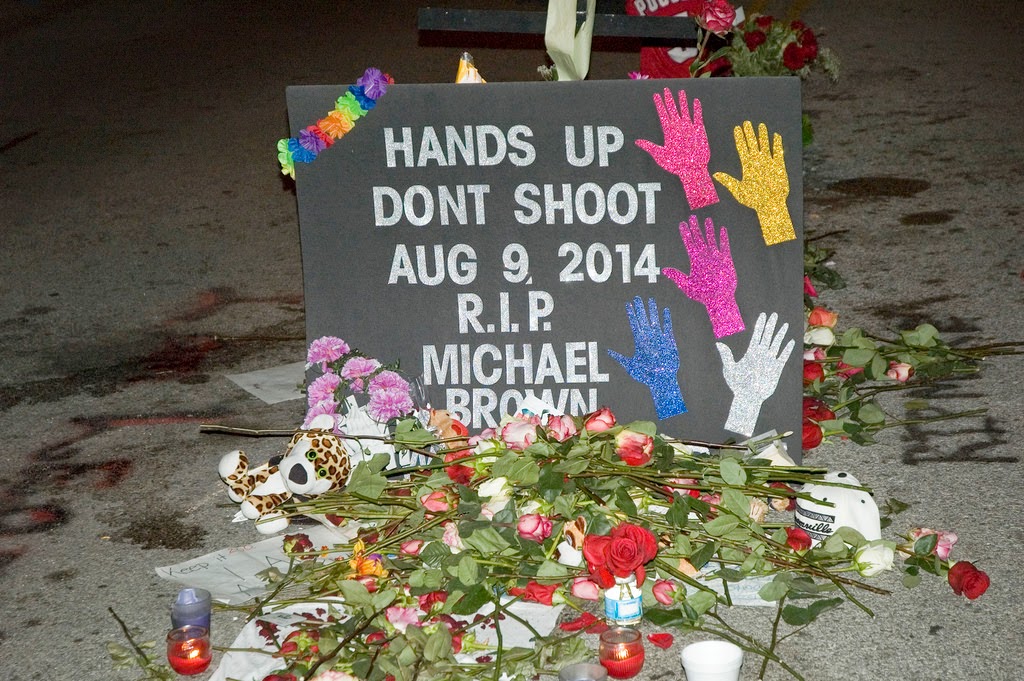
Ten (or more) Lessons from Ferguson


    Recently I read an article by Jeremy Smith, in United Methodist Insight, in which he wondered why more  clergy did not speak out on the events of Ferguson, Missouri.  In the article, Smith insists that when we don’t speak out about injustice, we make it seem that we aren’t responsible for things that happen far away from us.  In his words, “When I don’t speak up, I help turn the response into a pocket and not a whole garment of the human experience crying out for justice. “  He’s right of course, but I have a hard time speaking out about events like those in Ferguson because I am so personally ignorant, confused and conflicted by them.
    I’m a white guy and I grew up with the privileges that come with that.  Our family was far from wealthy, but I haven’t suffered from the subtle or overt discrimination that my non-white friends did.  I have not been pulled over by the police for “Driving While Black.”  I have no idea what that must be like. 
    I know that because I am white I do not fully appreciate all of the issues in play in the mess that is Ferguson, MO nor do I feel the impact of those events personally, as people of color undoubtedly do.  I know that anything I say about these events will lack understanding.   But Jeremy Smith is right, keeping silent allows injustice to continue and so I feel like I have to say something. 
    As followers of Jesus Christ we are called to stand against injustice, and there has been plenty on every side.  Not long ago, a colleague of mine posted a link to an article (to which I will not provide a link) that was so filled with hatred of hate and racism that it became hateful and racist itself.  In opposing racism, it named anyone who disagreed, for any reason, or for any principle, as a racist.  That sort of language is unhelpful and it doesn’t help any of us to think clearly.

    So here are ten lessons that we can learn from the mess that is sorting itself out (and will be for years) in Ferguson, MO:

1)      There is never an excuse to hate someone whose skin is a different color, simply because their skin is different color.  It isn’t okay to hate someone because they are black but neither is it okay to hate someone because they are not.
2)      In a town that has a population with a majority of African Americans, it is inconceivable that the police department can’t find African American recruits or that the imbalance should be so substantial.  As I understand it, the federal government is investigating this disparity, and they should.
3)      When there is injustice it should be okay to protest that injustice. Peacefully.

4)       Protests about injustice should not devolve into riots in which property is destroyed and innocents are put in the hospital, and worse.
5)      It’s not okay to use injustice as an excuse to cause injustice.
6)      It’s not okay to hurt someone who is on your side, just because they are the wrong color.
7)      It’s not okay (nor is it helpful) to destroy the businesses that have supported an abused community to make the point that the community has been abused.
8)      To say that it’s NOT okay doesn’t go far enough, it is flat out wrong, offensive, and even criminal, for the police department to try to disperse a riot by showing up dressed and equipped for a war.  Uniforms and weapons of war have no place on our streets.  I have no idea why anyone thought that showing up with M-16’s and armored personnel carriers was going to bring peace.
9)      While it is important, even necessary, for the media to have access to the story and for the story to get a wide distribution, there is a point at which the media becomesthe story.  From several stories that I read, from several very different media outlets, a point was reached when most citizens had gone home and rioters appeared, many from out of town, simply because the media was there.  I don’t know how we could, and we probably can’t and shouldn’t place restrictions on media access, but when the media’s presence makes the violence worse, something needs to be done.  Perhaps the media outlets themselves can agree on some sort of code of conduct, or organize a media pool as is often done in wartime, to share stories and prevent an area from being mobbed by reporters.
10)   As to who is guilty in the original event that triggered this mess, I have to admit that the conflicting reports in the media make me unsure.  A young man is dead and shouldn’t be.  I don’t know who is at fault, but I am sure that a careful investigation is needed.  I am also sure that the Ferguson Police are not the ones who should do the investigating.  In Ohio, it is standard procedure for accusations against social workers to be investigated by a neighboring (outside) social service agency.  Perhaps police departments ought to do the same with any officer involved shooting.
    Ultimately, there is plenty of fault to go around.  Ferguson may not be a “Perfect Storm” where everything went wrong, but a whole lot still went wrong.  The police got it wrong, the protestors got it wrong, the media got it wrong, and probably a few others as well.  But in every case, we, the people of God, the church, need to find a way to fight against injustice. 
All injustice. 
    We need to speak up against institutional racism.  We need to speak out against a police force that is preparing and equipping to fight a war against its own citizens.  We need to speak out against rioters who overshadow legitimate protestors and also against a media machine that makes problems worse instead of better.
    As followers of Jesus Christ, we are called to be salt and light to the world.  We are called to stand against injustice.  We are supposed to be doing all we can to make things better.
    The events of Ferguson, MO make it clear that no matter where we live, regardless of our race, we have a LOT of work to do.

—————————————————————————————————

To have Crossfusion delivered directly to your email, click here.

Trust is a Big Deal


    Have you ever had one of those “Duh!” moments when things start to make sense for the first time? But there are also moments when we read scripture and we completely miss important things because we assume that the people in the Bible were just like us.  In our scripture lesson this week, we read the story of Moses leading the people of Israel through the dry path God had created in the depths of the Red Sea.  But after the chariots, horsemen and soldiers of Egypt’s army are drowned, we read these verses in Exodus 14:30-31:
That day the Lord saved Israel from the hands of the Egyptians, and Israel saw the Egyptians lying dead on the shore.  And when the Israelites saw the mighty hand of the Lord displayed against the Egyptians, the people feared the Lord and put their trust in him and in Moses his servant.
    Most of us read this and think, “So what? They trusted God. God is trustworthy. Duh.”  And, because we assume that the people of Israel were just like us, we completely miss what a big deal this really was.
    We have lived our lives in possession of the entire Old Testament as well as the New Testament.  For many of us, there has never really been much doubt that God was trustworthy, even when we weren’t sure that God was real.  But the people of the Exodus did not know what we know.  The world that they lived in, and the gods that they knew, were very different.
    In the story of the Exodus, despite coming from the family of Abraham, Isaac, and Jacob, the Israelites had lived in the land of Egypt for 400 years.  At that time, they did not have a formal system of worship, or priesthood, they had stories.  The stories of their forefathers had been passed down to them from generation to generation, and even though the stories were magnificent, they lived in a world with very different stories.
    The Egyptians, like the Romans and the Greeks of the New Testament, were polytheists.  They believed, not in the one God of Israel, but in a collection of gods that were far from trustworthy.  The gods warred with one another through human agents and tens of thousands died for their amusement.  The gods of the Egyptians were capricious; they did what they wanted, when they wanted, often without any guiding morality.  To the gods, humans were little more than playthings and to humans, the gods were to be feared and not trusted.
    And so when the people of Israel saw that the God of Abraham had used his great power, not only to provide a means for them to escape their slavery, but to destroy those who sought to kill them, they saw, many for the first time, that their God was different.  Finally, the stories began to make sense.  They realized that the God of Abraham, Isaac, Jacob and Joseph was different than the gods of the Egyptians. 
They realized that the God of Israel could be trusted.
And trust really is a big deal.

—————————————————————————————————

To have Crossfusion delivered directly to your email, click here.

Who Watches the Supplies? – A Football Meditation


    In the books of first and second Samuel we read the story of King David.  Many of us have heard stories about David, but there is at least one that we don’t often remember.  In 1 Samuel 30, we find David and 600 men who had just returned from fighting alongside Achish the king of the Philistines.  As they return home they discover that the Amalekites had raided their town, captured their wives (including two of David’s wives), their children, their livestock, as well as anything of value.  After consulting with their priest to find the will of God, David pursues the Amalekite raiding party.
    As they hurry to catch up to the raiders however, David finds that two hundred of his men are too exhausted to continue and so he leaves them behind with all their gear, supplies and what is left of their town.  David and the four hundred remaining men pursue the Amalekite raiding party and find them celebrating over all the loot that they had plundered.  David and his men attack and fight with the Amalekites from dusk that day, until the end of the following day, defeat them, and recapture every single animal, personal belonging, wife and family member.
    But when they return to their camp, the troublemakers began to stir things up.  They argued with David that the two hundred men who were left behind should not receive any of the plunder because they didn’t fight to get it.  They argued that these men should get their families back, but receive no share of the loot and plunder that they had taken from the Amalekites.
    David fights back.  David makes an argument that is important to every single one of us and one that is important to each of you on the football field.  David said:
“No, my brothers, you must not do that with what the Lord has given us. He has protected us and delivered into our hands the raiding party that came against us. 24 Who will listen to what you say? The share of the man who stayed with the supplies is to be the same as that of him who went down to the battle. All will share alike.” 25 David made this a statute and ordinance for Israel from that day to this.
    It is important to remember that when you win, it isn’t just the superstars and the heroes that win the game.  Every member of your team had a part, Every coach, every water boy, every trainer, every teacher you ever had who helped you to earn the grades you needed to play ball, it took the guy on the sidelines who sprained his ankle before the season started, every football booster, every friend who gave you a ride home from practice, every relative, every parent, and every brother or sister that comes to watch you play.  As David said, these are the people who “watch the supplies” for you. 
    When you win, it isn’t just because of the guy who threw the touchdown pass, or who caught the interception, or who made the big tackle.  Your victory didn’t come because of the superstars; it took every single one of you. 
And that includes the people who just watch the supplies.

—————————————————————————————————

To have Crossfusion delivered directly to your email, click here.

Youth Questions: What is Communion? Why do we do it like that?


Note: I asked our youth to write down any questions that they had about faith, the church, or life in general.  This is a part of that series.
 

Question: Why do we do communion the way that we do?

    Before we talk about how we “do” communion, we ought to talk about what it is, and why we do it.  The gospels of Matthew, Mark, and Luke (Luke 22 is a good example) all tell the story of the Last Supper.  This was the Passover meal that everyone in Israel shared together every year to remember God rescuing them from slavery in Egypt.  In some ways, this meal was a lot like some of our families celebrate Thanksgiving.  Often a lot of the same people were together, if you were anywhere close to home you usually met with your family, and every year there were traditions, speeches, and toasts that everyone had memorized.
    This particular meal was the last big meal the disciples had together before Jesus was arrested and crucified and Jesus was the host.  But during the meal and he did some really unusual things that the disciples didn’t understand (until later).
    First, when Jesus broke the bread, instead of saying what everyone usually said, Jesus said this is “my body” broken for you.  Later, during the second toast of the evening, Jesus completely changed the script.  Instead of saying the usual Passover speech, Jesus said, “This cup is the new covenant in my blood, which is poured out for you.” This toast had all sorts of connections to Jewish culture, from being a reference to the first Covenant that God made with Abraham, to having amazing similarities to the toast where a Jewish groom seals a contract (a new covenant) to return and marry his bride.  The disciples were understandably confused by this because it didn’t fit with Passover.  It all made sense to them later though after Jesus ascended into heaven and they began to understand that Jesus was the bridegroom and the church was to be the “bride of Christ” after his return.
    In any case, when Jesus broke the bread and drank from the cup Jesus asked his followers to “do this in remembrance of me.”  And so, just as the Jews celebrated the Passover every year to remember what God had done for them, we celebrate communion as we remember what Christ has done for us and also remember that Christ is coming back.
    But returning to the original question, there are lots of ways to “do” (we usually prefer to say “share”) communion.  We can have communion by intinction, in which we tear a piece of bread off of a loaf and dip it in a common cup.  In some cases, people all drink out of a common cup, but because of concerns about unintentionally sharing germs, that method is not often used today.  We also share with little pieces of bread and tiny cups, or with unleavened bread (which might be flat breads like pita bread or something like saltine crackers).  For very large groups there are plastic cups that include a small wafer of “bread” under a foil seal and a cup of juice under a second foil seal.  In that way, the ushers only have to pass out one basket that includes both of the communion elements.  At one large youth gathering I heard about, they wanted to share communion but didn’t have enough bread and juice so they used potato chips and cola (there are some theological problems with this, but their hearts were in the right place).


Did you enjoy reading this?


Other questions and answers in this series can be found here: Ask the Pastor

Click here to subscribe to this blog.

Click here if you would like to subscribe to Pastor John’s weekly messages.

Click here to visit Pastor John’s YouTube channel.


What is Faith?


I have a faith problem.
    Don’t worry, I haven’t lost my faith.  Sure, I have occasional doubts, but wrestling with doubt is normal and even healthy.  No, the problem that I have with faith is with how believers and unbelievers misuse, misunderstand, misappropriate, and even abuse the word (and the definition of) faith.
    More than once, I have listened as atheists or others have mocked the followers of God claiming that having faith is belief in the absence of evidence.  Defined this way, faith becomes the opposite of rational thinking.  Believing with the utter absence of evidence is nothing more than wishful thinking.  If this were the definition of faith, then Christians (and other people of faith) would be held up as fools. 
Thankfully, it isn’t.
    Likewise, I have heard well-intentioned believers misuse, and even abuse, the word “faith.”  Far too often, when spiritual conversations get sticky and honest questions get difficult, Sunday school teachers, Bible study leaders, and even pastors have been heard to say, “Well, you just have to have faith.”  In some cases, this might be reassuring, but if a student or seeker has asked a thoughtful, although difficult, question this sort of answer is nothing short of spiritual malpractice. 
    Faith does not believe, “because I said so” or because God doesn’t allow difficult questions.  Our beliefs are both rational and explainable.  For a teacher to dismiss difficult questions by telling a student that “you just have to have faith” instead of finding a real answer is just lazy. 
    I admit that there are difficult questions that connect us to the great mysteries of Scripture.  But even in the mystery it is a disservice to put off those with honest questions by saying “you just have to have faith.”  An honest answer in these cases often means admitting that we just don’t know. 
So what isfaith?
The Merriam-Webster dictionary defines it this way-
: strong belief or trust in someone or something
: belief in the existence of God: strong religious feelings or beliefs
: a system of religious beliefs
    While two of these are specific to the followers of God, I think that the first definition is entirely sufficient.  We shouldn’t think that faith is belief without evidence, but know that faith is the trust that one has in the unknown because of the knowledge and experience that one has in the known.
Here’s what I mean. 
    I trust (have faith) that my brother will pick me up at the airport even though he is over an hour late, not because of something mindless, but because he has never failed to do what he said that he would do.  In all the years that I have known, and lived with, my brother, in all the times that I have trusted him with money, with my most private secrets, with picking me up from the airport, or anything else, he has never (okay, rarely) failed to do what he said that he would do or to be where he said he would be.  If he is an hour late picking me up at the airport, I am far more likely to be worried that something has happened to him than to worry that he is not coming.
    Our faith in God is (or should be) like that.  We aren’t hoping that there will be pie in the sky by and by just because the preacher told us so.  Our faith in God comes from the relationship that we have built over time.  We met God, we spoke with God, we read stories that told us about his nature and his character, and we began to trust him.  As we began to trust God we began to witness and experience his grace, mercy, and love for us, and as we did, we began to trust him more.  Over time, many of us have seen some amazing things, we shared those experiences with others and our faith grew stronger.  I have seen God do things that medical doctors thought was impossible, I have spoken with those who have seen other impossible things, and I have also seen God open doors and change hearts so that we could adopt each of our children. 
    Those of us who believe, do so because we have, over time, developed a lasting relationship built on trust.  We trust God because he has proven himself to be trustworthy.  Because of the trust that we have built through the things that we have seen, we can trust God in the things that we have not yet seen.
This trust is what we call faith.  

Answer the Phone!


    What would you think if one of your friends complained that you never called or spent time together?  Even though you saw this friend on the street or at work, both of you felt that you needed more.  But now, whenever you saw one another, you heard complaints.  Finally, encouraged by the complaints, you called your friend and there was no answer.  You sent a text message, but received no reply.  Still hearing complaints, you eventually begin calling and texting at all hours of the day and night (sometimes knowing that your friend was certainly at home) and still, there was no answer.  During this time, you set aside money so that you could take your friend out to eat… but there was no answer.
What would you think of your friend?
What would you thing of their complaints?
    Often we complain that we have not heard from God, that God seems far away, or that we have not seen God at work.  But despite our complaints, we fill every waking hour listening to music, radio, watching television, playing video games, with Facebook, Twitter, and all manner of other distractions with no time left for silence.
The psalmist wrote, “Be still, and know that I am God.”
How often do we embrace the silence?  
How often are we simply still?  
When God calls, are we so surrounded by noise and distraction that we don’t even notice?
How often do we listen?
Are youthe friend that isn’t answering the phone?

A Great Cloud of Witnesses


What does it mean to be surrounded by a “cloud” of witnesses? 
    Not long ago I was preaching on Jesus’ answer to the Sadducees in regard to the existence of life after death.  In Luke 20:27-38, Jesus reminds them that Moses called God, “the God of Abraham, and the God of Isaac, and the God of Jacob.”  Jesus implies that it would be foolish to say such a thing in the present tense if they were not, presently, alive.  Jesus said, “He is not the God of the dead, but of the living, for to him all are alive.”
The Apostle Paul described life as a sporting event in which we are called to give our best, saying,
Therefore, since we are surrounded by such a great cloud of witnesses, let us throw off everything that hinders and the sin that so easily entangles. And let us run with perseverance the race marked out for us…” (Hebrews 12:1)
    Paul expands on the idea of resurrection and the afterlife to remind the church that those who are alive in the next world are watching those of us who remain in this one.  Paul specifically refers to the prophets, saints, and martyrs but it isn’t difficult to imagine that this also includes all of those who have always loved us and cared for us, but who no longer remain among the living of this world.  I know that my grandmother prayed for me nearly every single day of her life and I have no reason to imagine that she has stopped doing so today.
Let me share a mental picture that I have found meaningful.  Have you ever held a newborn baby, yours, or your grandchild, niece or nephew for the very first time?  Do you remember how that made you feel?  It is a magnificent feeling.   Hold on to that feeling.  Now, imagine the moment when you first arrive in the next world, right after you have “crossed over” and passed through Saint Peter’s pearly gates, right after you’ve met Jesus face to face, or however you might image your arrival.  Now, you see, standing before you, a group of people.  Some you know, but many you do not.  In the front are your parents, lost children, and dear friends, but there are many more, perhaps hundreds, even thousands of faces that you do not know.  As you embrace your family and your friends, your father, or perhaps your grandfather, takes you by the hand and says, “There is someone here, that I have wanted you to meet for a very long time.” And he turns to a an unfamiliar face and says, “This is myfather” or “This is my grandfather.”  And then, for hours on end, they in turn introduce you to their fathers, and their wives, and their children, allof whom have known you since you were born, and have been watching you grow, and have been praying for you that Jesus would watch over you and guard your steps. 
    And the feeling that you have is the feeling of holding that newborn child in your arms, multiplied by ten thousand, or more.
    Every moment of your life that you were in trouble, every moment when you faced difficult choices, every moment when you needed prayer, all of these hundreds and thousands of friends and family who love you, were watching and praying for you.
   Think of this, when we walk outside in a heavy fog, that moment when the clouds lay upon the surface of the earth, we are not near the cloud, or next to the cloud, we are completely engulfed and surrounded by the cloud.
    This is the picture that Paul draws for us.  With every choice that we make, with every success or failure, with every crisis or ordinary day, we can imagine that this cloud of people who love us, family and friends, surround us, watch over us, and pray for us.
    Because our God is the god of the living and not the dead, we are constantly watched over by those who love us, care for us, and who are, even now, praying for us.  Paul says that because we are surrounded by this “great cloud of witnesses” we should cast aside everything that is holding us back and have the confidence to forge ahead into the unknown toward whatever God has placed in our path.  

May we all have the courage to “run with perseverance the race marked out for us…”

Why I Would Argue for the Earliest Definition of Life


    In my last two blogs, “Abortion: Pro-Life/Pro-Choice Both Right?”and “Abortion: Why Both Sides Will Lose in the Supreme Court (Again)” I explained why the 1973 Roe v. Wade decision was not a clear win for either pro-choice or for pro-life supporters and why I thought that both sides would once again be disappointed if a modern Supreme Court consented to review the case. 
    But while my reading of the Supreme Court’s Roe v. Wade decision, modern medicine, and our current political climate lead me to believe that a review of Roe would not be substantially different than it was in 1973, I do think that there are compelling reasons that argue for a dramatic change.  Instead of beginning with biblical, theological or doctrinal reasons (which I obviously have), let’s begin with reason and logic. 
    As I have explained, Roe v. Wade was a decision that attempted to find a balance between two rights guaranteed by the Constitution, a right to privacy on the part of the mother, and a right to life on the part of the infant.  In my reading of the court’s ruling, it seems that there was never a question that both rights existed and the both deserved to be protected.  The question was, if two rights are in conflict, which has a superior claim and when (or if) does that superiority change?  I have a right to privacy in my own home, but if I were to commit criminal acts, particularly those that harmed other human beings, my right to privacy is superseded by the other person’s right to life and liberty.  This delineation is well accepted as both moral and legal.  This same question, when brought into the realm of abortion, becomes a question of a) is a pre-born infant a human being, and if yes, b) when does it become one?  The Supreme Court answers to these questions in 1973 were a) yes, and b) at the earliest point at which the infant is viable (with medical intervention).
    In 1973 the womb was something of a “black box.”  We knew that an infant developed in the mother’s womb and developed from a fertilized egg, we had all sorts of microscope slides and fetuses in jars that had been aborted at various stages of development.  What we didn’t have were the spectacular images that we have today.  Today expectant parents can sit in the office of their OB/GYN and see live 3D images of their child.  They can see that preborn infant scratch its nose, cough, sneeze, and suck its thumb.  So real are these images, that 78% of women who were considering abortion changed their minds after they had seen them.
    I’m not saying we were ignorant in 1973 and we are now “enlightened,” but what we know and what we have learned, seem to make it much harder to draw a line in the sand and say that “this” is a person with Constitutional rights, and a moment earlier “that” was not a person.  Does an infant become a person because it’s larger than it was yesterday?  If so, do tall people have more rights than short people, or do adults have a stronger right to life than children?  Does it suddenly become a person because it is no longer in the womb?  The human rights of any other “person” do not change based on location.  A person in Detroit, Michigan has no more or less rights than a person in rural China.  Location cannot, logically, convey basic human rights or take them away.  Is a preborn infant not a person because it is dependent upon its mother?  If so, then do adults on life support surrender their right to life?  We are all, in one way or another, dependent upon others for our lives.  Simply because an infant needs its mother cannot imply that it somehow has fewer rights than an infant only days or weeks older.  At other times in history, groups of people were declared a separate “class” of human being so that their rights could be denied, Jews, Gypsies, Blacks, and others.  Can we, in good conscience, declare a group of human beings, with measurable human DNA, to be a separate “class” of humans that are not entitled to human rights? 
    Biblically speaking, we know that God loves all of his children equally.  All human beings are of sacred worth.  The redemption of every person on earth was purchased by Jesus Christ at the cost of his own life.  We cannot gamble that God cares more about an infant more today, simply because yesterday it was in the womb and today it is not, or because today it is one day older than yesterday.
    I have heard various arguments from the position that Old Testament references did not consider an infant to be a “person” under the law until after it was born.  While this is arguable on a number of points, it assumes that people who lived four thousand years ago could have known any differently.  Asking this question would seem to place an unfair moral burden on ancient cultures.  How would any culture with little understanding of fetal development, no ability to detect a fetal heartbeat, no ultrasound, and no modern medical understanding of neural development have fairly ruled that a preborn infant is equal to one who independently draws breath?  Their decision on personhood was, much as it was in 1973, based upon viability.
    Please understand that I value my privacy as much or more than anyone, but regardless of my feelings or personal opinion, privacy has always taken a backseat to more important rights, and the right to life is among these.   Legally, I understand that declaring an infant to be a person too early can create other difficulties, such as the potential for criminal investigations against women who have miscarriages and certainly I understand those who struggle with knowing at what point an infant ought to be considered to be a person, especially in the earliest stages of development.    For me, however, I have few such doubts.  I believe that morals, logic and scripture declare in chorus that an infant is a person, and if an infant is a person at any point, it must be one from the very beginning.
To me, these arguments seem reasonable and logically sound.  If you can find error in the logic, I am interested in hearing your viewpoint.
———–