

Testing Love

Testing Love

June 30, 2024*

By Pastor John Partridge

2 Samuel 1:1, 17-27               Mark 5:21-43             2 Corinthians 8:7-15

We hear the words “I love you” often. We hear them from our loved ones, we hear them on television and in the movies, and we hear the word “love” thrown around by churches, ministry groups, rescue groups, and even government officials in an almost constant stream.

But what if love came with a test?

What would it look like if there was a test to determine if love was real? Is there a way for us to tell if the people who throw around the word “love” really do love, or if they are only using the word to manipulate and to appear to be something more than they really are?

And, although on the surface it may appear that our scriptures for today are not connected, as we dig a little deeper what we find is that they all reveal the truth about the love of the people in them. We begin once again with the story of David. In this passage from 2 Samuel 1:1, 17-27, David learns that King Saul, and his son Jonathan, David’s best, and closest, friend, have died in battle. This is the moment that David knows that Saul will no longer hunt for him, or send his entire army to hunt for him, so that he could be captured and put to death, the moment that David learns that he is no longer a fugitive. This is the moment that David realizes that his anointing as the king of Israel by the prophet Samuel might finally become a reality. But as these realities come into his mind, this is how David reacts:

1:1 After the death of Saul, David returned from striking down the Amalekites and stayed in Ziklag two days.

17 David took up this lament concerning Saul and his son Jonathan, 18 and he ordered that the people of Judah be taught this lament of the bow (it is written in the Book of Jashar):

19 “A gazellelies slain on your heights, Israel.
    How the mighty have fallen!

20 “Tell it not in Gath,
    proclaim it not in the streets of Ashkelon,
lest the daughters of the Philistines be glad,
    lest the daughters of the uncircumcised rejoice.

21 “Mountains of Gilboa,
    may you have neither dew nor rain,
    may no showers fall on your terraced fields.
For there the shield of the mighty was despised,
    the shield of Saul—no longer rubbed with oil.

22 “From the blood of the slain, from the flesh of the mighty,
the bow of Jonathan did not turn back, the sword of Saul did not return unsatisfied.
23 Saul and Jonathan—
    in life they were loved and admired, and in death they were not parted.
They were swifter than eagles, they were stronger than lions.

24 “Daughters of Israel, weep for Saul,
who clothed you in scarlet and finery,
    who adorned your garments with ornaments of gold.

25 “How the mighty have fallen in battle!
    Jonathan lies slain on your heights.
26 I grieve for you, Jonathan my brother;
    you were very dear to me.
Your love for me was wonderful,
    more wonderful than that of women.

27 “How the mighty have fallen!
    The weapons of war have perished!”

Rather than rejoice over the end of being hunted or looking forward to finally having a chance at becoming king, rather than cursing the man who expended so much effort in trying to destroy him… David mourns. David weeps over the loss of his best friend but also over the loss of Israel’s greatest warrior and admired king. Despite Saul’s madness and his persecution of David, David never stopped loving him as his friend and mentor or stopped admiring him and respecting him as Israel’s king.

This is the moment that tests David’s sincerity, and we see that David didn’t just use the word “love” because it was politically expedient or momentarily popular, David’s tears and songs of mourning reveal that his love for both Saul and Jonathan was real.

Curiously, there are two stories, which we have heard and read many times, from the Gospel of Mark, which illustrate this same sort of test for the sincerity of love, trust, and faith and we read these stories this morning from Mark 5:21-43, where it says:

21 When Jesus had again crossed over by boat to the other side of the lake, a large crowd gathered around him while he was by the lake. 22 Then one of the synagogue leaders, named Jairus, came, and when he saw Jesus, he fell at his feet. 23 He pleaded earnestly with him, “My little daughter is dying. Please come and put your hands on her so that she will be healed and live.” 24 So Jesus went with him.

A large crowd followed and pressed around him. 25 And a woman was there who had been subject to bleeding for twelve years. 26 She had suffered a great deal under the care of many doctors and had spent all she had, yet instead of getting better she grew worse. 27 When she heard about Jesus, she came up behind him in the crowd and touched his cloak, 28 because she thought, “If I just touch his clothes, I will be healed.” 29 Immediately her bleeding stopped and she felt in her body that she was freed from her suffering.

30 At once Jesus realized that power had gone out from him. He turned around in the crowd and asked, “Who touched my clothes?”

31 “You see the people crowding against you,” his disciples answered, “and yet you can ask, ‘Who touched me?’”

32 But Jesus kept looking around to see who had done it. 33 Then the woman, knowing what had happened to her, came, and fell at his feet and, trembling with fear, told him the whole truth. 34 He said to her, “Daughter, your faith has healed you. Go in peace and be freed from your suffering.”

35 While Jesus was still speaking, some people came from the house of Jairus, the synagogue leader. “Your daughter is dead,” they said. “Why bother the teacher anymore?”

36 Overhearing what they said, Jesus told him, “Don’t be afraid; just believe.”

37 He did not let anyone follow him except Peter, James, and John the brother of James. 38 When they came to the home of the synagogue leader, Jesus saw a commotion, with people crying and wailing loudly. 39 He went in and said to them, “Why all this commotion and wailing? The child is not dead but asleep.” 40 But they laughed at him.

After he put them all out, he took the child’s father and mother and the disciples who were with him, and went in where the child was. 41 He took her by the hand and said to her, “Talitha koum!” (which means “Little girl, I say to you, get up!”). 42 Immediately the girl stood up and began to walk around (she was twelve years old). At this they were completely astonished. 43 He gave strict orders not to let anyone know about this, and told them to give her something to eat.

First, Jesus meets Jairus, one of the synagogue leaders, or archisynagōgon, who was a powerful and influential man. Far from our thinking that he was the local church lay leader, because there was no such thing as the separation of church, state, or culture, the archisynagogon was the church lay leader, mayor, city administrator, community organizer, and cultural ambassador all rolled up in one person, at least as far as their Roman overlords allowed. But when his daughter was dying, Jairus didn’t go to a rabbi, or to the temple authorities, or to some Roman government official, he came to see Jesus. And when people told him that it was too late, and that his daughter was already dead, Jesus encouraged him to “just believe,” and, despite the laughter of his family and friends who understood that death was permanent and that resurrection was impossible, his love for his daughter allowed him to trust Jesus anyway.

Likewise, after searching for twelve years and seeing every doctor, shaman, healer, and charlatan that she could find, and after spending every penny that she ever had, this poor suffering woman, rather than giving up, thought that she would try one more time. Despite being classified as unclean and being prohibited from coming in contact with “normal” people, she sneaks in from behind everyone, and reaches through the crowd just so that she can touch the fringe on Jesus’ outer garment. When she was tested, there was nothing fake about this poor woman’s suffering nor was there anything fake about her faith.

And I want you to keep those stories in your mind as we read Paul’s words in 2 Corinthians 8:7-15 because Paul understands that sometimes people, and churches, sometimes give lip-service to love. We say that we love Jesus, but we don’t act like it, and we say that we love the people around us, because we know that we’re supposed to, but when push comes to shove, we don’t act very much like we love them. Paul says…

But since you excel in everything—in faith, in speech, in knowledge, in complete earnestness and in the love, we have kindled in you—see that you also excel in this grace of giving.

I am not commanding you, but I want to test the sincerity of your love by comparing it with the earnestness of others. For you know the grace of our Lord Jesus Christ, that though he was rich, yet for your sake he became poor, so that you through his poverty might become rich.

10 And here is my judgment about what is best for you in this matter. Last year you were the first not only to give but also to have the desire to do so. 11 Now finish the work, so that your eager willingness to do it may be matched by your completion of it, according to your means. 12 For if the willingness is there, the gift is acceptable according to what one has, not according to what one does not have.

13 Our desire is not that others might be relieved while you are hard pressed, but that there might be equality. 14 At the present time your plenty will supply what they need, so that in turn their plenty will supply what you need. The goal is equality, 15 as it is written: “The one who gathered much did not have too much, and the one who gathered little did not have too little.”

Paul says that the people in the churches of Corinth are fantastic. They have strong faith, vast knowledge, they are earnest in the things that they do and in the love that they began when they first heard the stories of the gospel.

But Paul wants to test the sincerity of their love.

Paul wants to make sure that they aren’t just giving lip-service to love without really acting like they love. Paul wants to test their love by comparing their earnestness, their passion, against the earnestness and passion of others. He points out that when there was a need, the church in Corinth was the first to step up and give to meet the need, but now Paul asks if their love will compel them to finish what they started. The test, Paul says, isn’t that they should give until they themselves are in need, but that they should give from their abundance until those in need become their equals.

That is quite a test… and it asks a lot of us.

The test of love isn’t just to feed the hungry, but to give from our abundance, not just to feed the poor for a day, but to help the poor, and lift them up, until the poor become our equals. That isn’t a once and done kind of a thing. Like Paul wrote to the Corinthian Christians, you should be loving enough that your eager willingness to do a project may be matched by your completion of it.

Starting a project to help others is a good thing.

But finishing that project is the real test of love.

That’s asking a lot.

But real love isn’t cheap, and we might wonder…

…will our love pass the test?


*You have been reading a message presented at Christ United Methodist Church on the date noted at the top of the first page.  Rev. John Partridge is the pastor at Christ UMC in Alliance, Ohio.  Duplication of this message is a part of our Media ministry, if you have received a blessing in this way, we would love to hear from you.  Letters and donations in support of the Media ministry or any of our other projects may be sent to Christ United Methodist Church, 470 East Broadway Street, Alliance, Ohio 44601.  These messages are available to any interested persons regardless of membership.  You may subscribe to these messages, in print or electronic formats, by writing to the address noted, or by contacting us at secretary@CUMCAlliance.org.  These messages can also be found online at https://pastorpartridge.com .  All Scripture quotations, unless otherwise indicated, are taken from the Holy Bible, New International Version®, NIV®. Copyright ©1973, 1978, 1984, 2011 by Biblica, Inc.™ Used by permission of Zondervan. All rights reserved worldwide. www.zondervan.comThe “NIV” and “New International Version” are trademarks registered in the United States Patent and Trademark Office by Biblica, Inc.™

Photo by Comstock on Freeimages.com

Death and Excuses

Death and Excuses

March 03, 2024*

(Community Evening Lenten Service)

By Pastor John Partridge

Luke 14:12-23

Have you filed your income tax forms yet?

I know that some of my friends have done so, and I know that my tax guy, and the accountants in our church are all well into their busy season, but while I always have good intentions, I usually procrastinate until April.

In any case, it is likely that all of us have heard at least a part of a letter from Benjamin Franklin to French scientist Jean-Baptiste Le Roy in November 1789, in which Franklin wrote, “Our new Constitution is now established, everything seems to promise it will be durable; but, in this world, nothing is certain except death and taxes.”

And this evening, just for the sake of argument, and as an excuse to borrow from Mr. Franklin, I suggest that we might also include excuses among those things that are certain and inevitable.  As such, let’s begin by reading Luke 14:12-23. But, as we do, I want you to notice that the excuses given appear to be in order of increasing acceptability. The first is as blatant as saying that you can’t go out because you planned to wash your hair (particularly bald as I am) but each successive excuse gets better. Luke writes:

12 Then Jesus said to his host, “When you give a luncheon or dinner, do not invite your friends, your brothers or sisters, your relatives, or your rich neighbors; if you do, they may invite you back and so you will be repaid. 13 But when you give a banquet, invite the poor, the crippled, the lame, the blind, 14 and you will be blessed. Although they cannot repay you, you will be repaid at the resurrection of the righteous.”

15 When one of those at the table with him heard this, he said to Jesus, “Blessed is the one who will eat at the feast in the kingdom of God.”

16 Jesus replied: “A certain man was preparing a great banquet and invited many guests. 17 At the time of the banquet he sent his servant to tell those who had been invited, ‘Come, for everything is now ready.’

18 “But they all alike began to make excuses. The first said, ‘I have just bought a field, and I must go and see it. Please excuse me.’

19 “Another said, ‘I have just bought five yoke of oxen, and I’m on my way to try them out. Please excuse me.’

20 “Still another said, ‘I just got married, so I can’t come.’

21 “The servant came back and reported this to his master. Then the owner of the house became angry and ordered his servant, ‘Go out quickly into the streets and alleys of the town and bring in the poor, the crippled, the blind and the lame.’

22 “‘Sir,’ the servant said, ‘what you ordered has been done, but there is still room.’

23 “Then the master told his servant, ‘Go out to the roads and country lanes and compel them to come in, so that my house will be full. 24 I tell you, not one of those who were invited will get a taste of my banquet.’”

The first excuse is just plain bad. It would be bad today, and it would have been just as bad in the first century. No one would buy a field without seeing it first. Such an excuse is only used to avoid the honesty of saying, “I don’t want to come.” The second excuse is only slightly better, though it is at least plausible. I can easily imagine that, while you might be able to look over the five oxen that you wanted to buy, you may not, before the sale was completed, have had the opportunity to yoke them as a team, take them out into your field, and see how they worked together, especially if they had not previously been worked together as a team. But still, this isn’t something that you couldn’t put off for a few days if you had any real desire to attend a banquet to which you had been invited.

The third excuse is rather good. Being a newlywed in Israel in the first century was an excuse for everything. Traditionally, in Israel’s history, for a year after being newly married you could not even be conscripted into the military at the king’s decree. Building your house, establishing your household, building a relationship with your new wife and her family, and bringing honor to your family by fathering a child was important and indispensable work.

But none of those excuses were found to be acceptable and the master who had invited them became angry and instead of people who had been thought of as friends and family, or as important and influential, he invited the poor, the crippled, the blind, the lame and anyone else that was typically forgotten, ignored, and left out in the cold. When even that did not fill his banquet hall, he sent his servants out to collect any farm family, indigent wanderer, homeless person, migrant worker, foreign born alien, and anyone else that they could find and bring them in to feast at his table.

The frightening part of this story is that it is about much more than excuses or taxes. It is a story about how ordinary people procrastinate or ignore the invitation of the creator of the universe. If we start at the end of the story and work backward to the beginning, we are reminded that Jesus started talking about a great banquet when someone mentioned feasting in the kingdom of God. And, before that, Jesus had been teaching that the people who can afford to invite others to dinner should be inviting the poor, the crippled, the blind, and the lame instead of other folks who are wealthy enough to reciprocate.

Taken together, we understand that the master of the banquet is the God of creation, and the original invitation was to the people we would think of as “the usual suspects.” They were the political leaders, the wealthy, the influential, the church and all the “respectable people” that one would expect to encounter at a banquet held by a king. But every one of them finds an excuse, and while the excuses range from incredibly lame to respectably good, none of them are found to be acceptable. And so, instead of filling the banquet hall with respectable people, God fills it with outcasts, sinners, drunks, cheaters, prostitutes, farmers, shepherds, indigent wanderers, homeless people, migrant workers, foreigners, and anyone else that would accept his invitation.

And, while that might be a little uncomfortable, many of us will accept that this is the message of Jesus Christ. The frightening part of that message is the part that is left unwritten and unsaid, and that is, what happens to the people who made excuses? You see, because we’ve remembered that the master of the banquet is God, and that God can, and does, invite anyone that he pleases, we must also remember that God’s banquet, in this story, stands in for God’s kingdom, and our eternity in it. The people who procrastinated and made excuses end up being too busy to accept God’s invitation to eternity and therefore spend their eternity somewhere else.

And so, we are left with two important lessons. First, do not procrastinate or make excuses. If you have not already decided to follow Jesus Christ and become a part of God’s kingdom, do not, under any circumstances, decide that you can hold off making that decision until tomorrow. You do not want God to find you busy doing something else, no matter how good, or how important that other thing might be. And second, for those of us who have already made that choice, and who already follow Jesus, then Jesus still teaches that our wealth, at whatever level that term applies, is to be used helping the people around us. If we can afford to invite our family and friends to dinner, we can just as easily afford to feed others. We are expected to treat the outcasts, sinners, drunks, cheaters, prostitutes, farmers, shepherds, indigent wanderers, homeless people, migrant workers, foreigners, and everyone else as if they were the people we care for and love.

God’s command to the followers of Jesus Christ, is to live as if our very lives were a sacrifice to God. We are commanded to love the lord our God with all our heart, with all our mind, with all our strength, and with all our soul. Our money, our health, our time, and everything that we have belongs to God, and we must use what God has given us to care for, and to witness to, the people around us. God’s command applies to everyone, and not just to the people who can repay us.

We must live our lives, and love the people around us, as if our faith really mattered.

No excuses.  


Please LIKE and SHARE!

Click here to subscribe to Pastor John’s blog.

Click here if you would like to subscribe to Pastor John’s weekly messages.

Click here to visit Pastor John’s YouTube channel.


*You have been reading a message presented at Christ United Methodist Church on the date noted at the top of the first page.  Rev. John Partridge is the pastor at Christ UMC in Alliance, Ohio.  Duplication of this message is a part of our Media ministry, if you have received a blessing in this way, we would love to hear from you.  Letters and donations in support of the Media ministry or any of our other projects may be sent to Christ United Methodist Church, 470 East Broadway Street, Alliance, Ohio 44601.  These messages are available to any interested persons regardless of membership.  You may subscribe to these messages, in print or electronic formats, by writing to the address noted, or by contacting us at secretary@CUMCAlliance.org.  These messages can also be found online at https://pastorpartridge.com .  All Scripture quotations, unless otherwise indicated, are taken from the Holy Bible, New International Version®, NIV®. Copyright ©1973, 1978, 1984, 2011 by Biblica, Inc.™ Used by permission of Zondervan. All rights reserved worldwide. www.zondervan.comThe “NIV” and “New International Version” are trademarks registered in the United States Patent and Trademark Office by Biblica, Inc.™

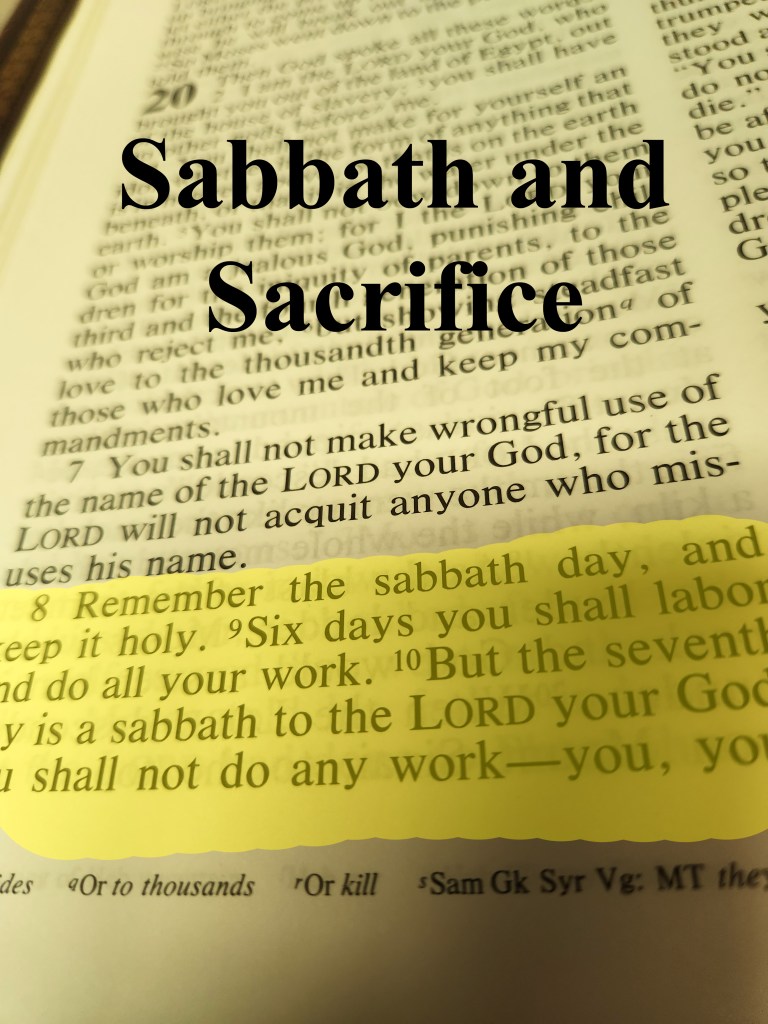
Sabbath and Sacrifice

Sabbath and Sacrifice

March 03, 2024U

By Pastor John Partridge

Deuteronomy 5:12-15           Mark 2:23 – 3:6                     2 Corinthians 4:5-12

How many of you have had to turn your computer, or your phone, or your printer, or some other electronic, or even mechanical, device, off and then back on again, to make it work the way that it’s supposed to work? All of us. Anne Lamott once said, “Almost anything will work again if you unplug it for a few minutes, including you.”

It’s a thoughtful sentiment, but Anne Lamott was hardly the first person to think about the value of turning us humans off and back on again. In fact, unplugging human beings, and then plugging them in again is the whole principle behind sabbath rest. Sabbath rest, of course, is an ancient idea, and, to understand that we need to go back to the beginning, to Deuteronomy 5:12-15, where we hear this command from God to his people:

12 “Observe the Sabbath day by keeping it holy, as the Lord your God has commanded you. 13 Six days you shall labor and do all your work, 14 but the seventh day is a sabbath to the Lord your God. On it you shall not do any work, neither you, nor your son or daughter, nor your male or female servant, nor your ox, your donkey or any of your animals, nor any foreigner residing in your towns, so that your male and female servants may rest, as you do. 15 Remember that you were slaves in Egypt and that the Lord your God brought you out of there with a mighty hand and an outstretched arm. Therefore, the Lord your God has commanded you to observe the Sabbath day.

When we read this, we realize that there are two purposes behind God’s requirement of the sabbath day. The first of these is simply to rest, to unplug, and reset our bodies and minds so that we can start fresh again in a new week. And the second reason is to remember what God has done for us, to remember God’s mighty acts of rescue, redemption, and rescue, and to spend time honoring and worshiping our God. But, over time, the reason and rationale behind honoring the sabbath got confused. Because everyone recognized that the sabbath was important, the priests and other religious leaders made rules to help the people of Israel get it right. But along the way, the rules that they made, and the traditions that they established, became so important, that they were held to be of the same importance as God’s original commands. And that’s why Jesus gets into an argument with the Pharisees in Mark 2:23 – 3:6 where we hear this:

23 One Sabbath Jesus was going through the grain fields, and as his disciples walked along, they began to pick some heads of grain. 24 The Pharisees said to him, “Look, why are they doing what is unlawful on the Sabbath?”

25 He answered, “Have you never read what David did when he and his companions were hungry and in need? 26 In the days of Abiathar the high priest, he entered the house of God and ate the consecrated bread, which is lawful only for priests to eat. And he also gave some to his companions.”

27 Then he said to them, “The Sabbath was made for man, not man for the Sabbath. 28 So the Son of Man is Lord even of the Sabbath.”

3:1 Another time Jesus went into the synagogue, and a man with a shriveled hand was there. Some of them were looking for a reason to accuse Jesus, so they watched him closely to see if he would heal him on the Sabbath. Jesus said to the man with the shriveled hand, “Stand up in front of everyone.”

Then Jesus asked them, “Which is lawful on the Sabbath: to do good or to do evil, to save life or to kill?” But they remained silent.

He looked around at them in anger and, deeply distressed at their stubborn hearts, said to the man, “Stretch out your hand.” He stretched it out, and his hand was completely restored. Then the Pharisees went out and began to plot with the Herodians how they might kill Jesus.

Since the commandment to rest on the sabbath day required observant followers of God to refrain from work, it was natural that, over time, people wanted to know what exactly qualified as work. Moreover, after Israel had been sent into captivity in Babylon because of their unfaithfulness, the priests and other religious leaders wanted to write rules that would figuratively put fences around the commandments of God so that, if you were to follow their man-made rules, you would always be found to be in obedience to God’s commandments. Staying inside the fence, as it were, prevented you from even accidentally breaking a commandment.

The problem with this system was that, after a while, the rules that were intended to help obey the commandments became elevated to the same level of importance as the commandments themselves. And so, in this story, we find the disciples snapping off, and chewing on some uncooked heads of grain as they walked through the fields. But even though they exerted no energy other than lifting their hands to their mouths, according to the rules, what they had done was defined as harvesting, and harvesting was work. God’s commandment to observe the sabbath never said that you couldn’t eat, but the rules that had been written by generations of priests said that what they had done was sin (hint: it wasn’t).

And so, Jesus gives an example from scripture about how the great King David had done the same thing, and worse, and explained that God intended the sabbath to improve the lives of human beings and not to be an additional burden to them. Jesus had the same argument over healing a man who had suffered from what may well have been a birth defect. While healing was somehow defined as work, Jesus asked how doing good and undoing evil could possibly be wrong.

And that’s all well and good, but as we often ask… so what?

So, what if we know that God created a sabbath rest and a time of worship for the benefit of humanity?

So, what if we understand we shouldn’t define our sabbath rest too narrowly, and that doing good things on our day of rest is okay?

How does that make a difference to us as we live our lives?

Well, for that, let’s turn to Paul’s second letter to the church in Corinth for some clarity. But, as we read, this may not immediately sound like it is at all related to our understanding of sabbath. But it is, so bear with me until we finish, and I can unpack it a little. In 2 Corinthians 4:5-12, Paul says…

For what we preach is not ourselves, but Jesus Christ as Lord, and ourselves as your servants for Jesus’ sake. For God, who said, “Let light shine out of darkness,” made his light shine in our hearts to give us the light of the knowledge of God’s glory displayed in the face of Christ.

But we have this treasure in jars of clay to show that this all-surpassing power is from God and not from us. We are hard pressed on every side, but not crushed; perplexed, but not in despair; persecuted, but not abandoned; struck down, but not destroyed. 10 We always carry around in our body the death of Jesus, so that the life of Jesus may also be revealed in our body. 11 For we who are alive are always being given over to death for Jesus’ sake, so that his life may also be revealed in our mortal body. 12 So then, death is at work in us, but life is at work in you.

And again, I understand that this message of servanthood and persecution doesn’t immediately sound like it connects to our understanding of sabbath, but let’s look a little closer.  Paul reminds us that what we tell the world is not a message about us, it is a message about Jesus Christ, about how he came to bring light into a dark world, to display God’s glory, and to change hearts. Because of that, Paul says that we have the treasure of Jesus Christ in jars of clay.

Wait.

What does that mean?

Our explanation comes from what immediately follows, and that is a list of all the horrible things that have happened to them as messengers of the gospel. They were hard pressed, persecuted, and struck down, but while these things happened, and while they did experience abuse, pain, and suffering, they were not completely crushed, they did not despair, they did not feel as if they had been abandoned, and they were not destroyed. They themselves were carrying the message of Jesus Christ, but they knew that they were finite, fragile, and temporary vessels. More to the point, we, all of us, are like jars of clay. We are fragile vessels that contain the treasure of Jesus Christ.

We are fragile. Like clay we leak, we chip, we scratch, and we break. If God intended for us to contain his treasure, he would have stored it in something more durable like a stout treasure chest or a stone fortress. But he didn’t. The only way for us to preserve the treasure that we contain… is to share it with others.

Paul says that “we who are alive are always being given over to death for Jesus’s sake.” That means that we must be at work giving of ourselves, offering ourselves as a sacrifice to God, and sharing the good news of Jesus Christ. Death is at work in us because our time on earth is limited, and because the sacrifice of Jesus Christ is a part of who we are. But life is also at work in us through Jesus’ resurrection and his gift of eternal life to those who believe.

And so, if we look at it with Paul’s words in mind, sabbath is a time of rest and renewal when we remember who we are as we come together to worship our God, refill our leaky clay vessels, share our courage and strength with one another, share the Spirit of God that dwells within us, build one another up, equip one another, teach, learn, and grow, so that we can go back out into the world as a living sacrifice to Jesus Christ and to the kingdom of God.

Anne Lamott said, “Almost anything will work again if you unplug it for a few minutes, including you.”

And the truth of scripture tells us that she’s not wrong. Human beings were not designed or built to go non-stop, twenty-four hours a day, seven day a week, three hundred and sixty-five (or 366) days a year. The God of creation built us with a need for rest. Once every seven days he offers us a sabbath, a time to reset, restore, rest, and renew both physically and spiritually so that we can face the world, and all the evil in it, for another week.

Without rest, without sabbath, we are easily crushed, suffer despair, and feel abandoned and destroyed. Without sabbath, our fragile clay leaks and our faith weakens. Without sabbath, we are not prepared to live lives of sacrifice to God.

Simply put, without sabbath, and without rest, we cannot be the people that God wants, and needs, us to be.


Please LIKE and SHARE!

Click here to subscribe to Pastor John’s blog.

Click here if you would like to subscribe to Pastor John’s weekly messages.

Click here to visit Pastor John’s YouTube channel.


*You have been reading a message presented at Christ United Methodist Church on the date noted at the top of the first page.  Rev. John Partridge is the pastor at Christ UMC in Alliance, Ohio.  Duplication of this message is a part of our Media ministry, if you have received a blessing in this way, we would love to hear from you.  Letters and donations in support of the Media ministry or any of our other projects may be sent to Christ United Methodist Church, 470 East Broadway Street, Alliance, Ohio 44601.  These messages are available to any interested persons regardless of membership.  You may subscribe to these messages, in print or electronic formats, by writing to the address noted, or by contacting us at secretary@CUMCAlliance.org.  These messages can also be found online at https://pastorpartridge.com .  All Scripture quotations, unless otherwise indicated, are taken from the Holy Bible, New International Version®, NIV®. Copyright ©1973, 1978, 1984, 2011 by Biblica, Inc.™ Used by permission of Zondervan. All rights reserved worldwide. www.zondervan.comThe “NIV” and “New International Version” are trademarks registered in the United States Patent and Trademark Office by Biblica, Inc.™
Wealth, Power, and Equality

Power, Wealth, and Equality

June 27, 2021*

By Pastor John Partridge

2 Samuel 1:1, 17-27               Mark 5:21-43             2 Corinthians 8:7-15

I have two words for us to consider today. 

Wealth… and Power.

Those two words bring with them a whole host of emotions, ideas, thoughts, and baggage of all sorts.  There are elements of our culture and our politics that divisively try to convince us that we should hate people who are rich, which others try to convince us to hate the poor.  We are told that the problems of the poor are caused because the poor are lazy.  But any of us who know poor people, or who have been poor people, certainly know different.  Most poor people work hard. 

We are told that the rich are lazy and make all their money on the backs of the poor.  But the truth is quite different.  Only 21 percent of millionaires received an inheritance of any kind, only 3 percent of millionaires inherited a million dollars, and 84 percent of millionaires inherited less than $100,000.  Some time ago, I heard that the number one vehicle driven by millionaires wasn’t some fancy sports car but was instead the Ford F-150 pickup truck.  What does that mean?  It means that almost every millionaire that you might ever meet, worked for a living, made their money for themselves, and probably still works, and sweats, for a living. 

But that really isn’t my point.  My point is that hating the poor, or envying the rich, isn’t what Jesus has called us to do.  Wealth isn’t a sin, and poverty isn’t a curse.  Likewise, political power, or the lack of it, isn’t necessarily a bad thing.  The part where we get in trouble, is when we begin to use our wealth and power in the wrong ways.  Scripture is filled with stories about money and power, and this morning we’re going to read two or three examples and look at some of God’s instruction on how we are supposed to use what we have for the good of everyone, and for the good of God’s kingdom.

We begin this morning in 2 Samuel 1:1, 17-27, where we hear of the end of King Saul’s life, David’s grief, and learn a thing or two about integrity, honor, and being a godly example.

1:1 After the death of Saul, David returned from striking down the Amalekites and stayed in Ziklag two days.

17 David took up this lament concerning Saul and his son Jonathan, 18 and he ordered that the people of Judah be taught this lament of the bow (it is written in the Book of Jashar):

19 “A gazelle[an ancient symbol for a dignitary or important person] lies slain on your heights, Israel.
    How the mighty have fallen!

20 “Tell it not in Gath, proclaim it not in the streets of Ashkelon,
lest the daughters of the Philistines be glad, lest the daughters of the uncircumcised rejoice.

21 “Mountains of Gilboa, may you have neither dew nor rain, may no showers fall on your terraced fields. For there, the shield of the mighty was despised, the shield of Saul—no longer rubbed with oil.

22 “From the blood of the slain, from the flesh of the mighty, the bow of Jonathan did not turn back,
    the sword of Saul did not return unsatisfied.
23 Saul and Jonathan— in life they were loved and admired, and in death they were not parted.
They were swifter than eagles, they were stronger than lions.

24 “Daughters of Israel, weep for Saul, who clothed you in scarlet and finery,
    who adorned your garments with ornaments of gold.

25 “How the mighty have fallen in battle! Jonathan lies slain on your heights.
26 I grieve for you, Jonathan my brother; you were very dear to me.
Your love for me was wonderful, more wonderful than that of women.

27 “How the mighty have fallen! The weapons of war have perished!”

David grieves for the loss of Saul and his son Jonathan and not just because Jonathan was David’s best friend.  David writes a song, or story of lament and ordered that it be taught to the entire nation.  David declares Saul and Jonathan to the national heroes and pours out honor on their memories, despite the years that Saul had pursued and hunted David.  Saul had often sent the entire army out into the wilderness so that he could find David and kill him. 

But even when David was alone in a dark cave with Saul and had the opportunity to kill him, David refused and gave Saul honor instead.  Even though David had already been anointed as king by God’s prophet, David refused to bring dishonor upon himself, or upon Saul and his family, by taking God’s judgement into his own hands.  And in this story, we see that even though Saul was dead, and even though David would soon be given Saul’s throne and become the king of Judah and a united nation of Israel, David still chooses the path of honor, integrity, and godliness.

And today’s passage in Mark 5:21-43 gives us several more examples in the actions of Jesus and the people in search of miracles. 

21 When Jesus had again crossed over by boat to the other side of the lake, a large crowd gathered around him while he was by the lake. 22 Then one of the synagogue leaders, named Jairus, came, and when he saw Jesus, he fell at his feet. 23 He pleaded earnestly with him, “My little daughter is dying. Please come and put your hands on her so that she will be healed and live.” 24 So Jesus went with him.

A large crowd followed and pressed around him. 25 And a woman was there who had been subject to bleeding for twelve years. 26 She had suffered a great deal under the care of many doctors and had spent all she had, yet instead of getting better she grew worse. 27 When she heard about Jesus, she came up behind him in the crowd and touched his cloak, 28 because she thought, “If I just touch his clothes, I will be healed.” 29 Immediately her bleeding stopped, and she felt in her body that she was freed from her suffering.

30 At once Jesus realized that power had gone out from him. He turned around in the crowd and asked, “Who touched my clothes?”

31 “You see the people crowding against you,” his disciples answered, “and yet you can ask, ‘Who touched me?’”

32 But Jesus kept looking around to see who had done it. 33 Then the woman, knowing what had happened to her, came, and fell at his feet and, trembling with fear, told him the whole truth. 34 He said to her, “Daughter, your faith has healed you. Go in peace and be freed from your suffering.”

35 While Jesus was still speaking, some people came from the house of Jairus, the synagogue leader. “Your daughter is dead,” they said. “Why bother the teacher anymore?”

36 Overhearing what they said, Jesus told him, “Don’t be afraid; just believe.”

37 He did not let anyone follow him except Peter, James, and John the brother of James. 38 When they came to the home of the synagogue leader, Jesus saw a commotion, with people crying and wailing loudly. 39 He went in and said to them, “Why all this commotion and wailing? The child is not dead but asleep.” 40 But they laughed at him.

After he put them all out, he took the child’s father and mother, and the disciples who were with him, and went in where the child was. 41 He took her by the hand and said to her, “Talitha koum!” (which means “Little girl, I say to you, get up!”). 42 Immediately the girl stood up and began to walk around (she was twelve years old). At this they were completely astonished. 43 He gave strict orders not to let anyone know about this and told them to give her something to eat.

There are several people here that are worth mentioning.  The first that we encounter is the woman who suffered from a bleeding disorder.  Whatever it was had caused her great suffering for more than a decade.  She had gone from one doctor to another, one witch doctor to another, each one tried their own medical experiment, and each one was happy to take more of her money, until she was poor but still suffering.  In desperation, she sets out to find Jesus, thinking perhaps that Jesus was such a great healer, such a great man of God, that if she could just touch him, she would be healed.  And that is exactly what happened.  She reaches through the crush of the crowd to touch Jesus’ shirt.  Some translations say it was only the “hem” of his garment and some have said that the Greek word that is used here is more accurately translated into English not as “hem” but as “fringe,” the dangly threads that would hand from a Jewish man’s clothing.  And she is healed.

The woman touches the barest edge of Jesus’ clothing… and is healed.

But Jesus feels it.  Jesus feels the power of God flow through him and into… somebody.  And once Jesus meets the woman, he declares that it was her great faith that has healed her, and he releases her to go in peace and freedom from her suffering.

But while Jesus was stopped, the child he had been asked to heal had died.  But when Jesus is told that she is dead, he goes there anyway.  But it is important to consider the girl’s father.  We are told that he was a synagogue leader.  From our reading, we know that the synagogue leaders were typically skeptical of Jesus’ power, but Jairus has nowhere else to turn.  His daughter is at death’s door, and he is willing to sacrifice his reputation, his position, and his power to save her.  Similarly, Jesus had every reason to say no to one more religious leader after so many of them had tried to trap him, humiliate him, and worse.  But Jesus honors the man, follows him home, and brings his daughter back from the dead.

But why?

Why did Jesus act this way?  And why does it matter?

And in answer, we turn to Paul’s letter of 2 Corinthians 8:7-15 where he explains this way:

But since you excel in everything—in faith, in speech, in knowledge, in complete earnestness, and in the love we have kindled in you—see that you also excel in this grace of giving.

I am not commanding you, but I want to test the sincerity of your love by comparing it with the earnestness of others. For you know the grace of our Lord Jesus Christ, that though he was rich, yet for your sake he became poor, so that you through his poverty might become rich.

10 And here is my judgment about what is best for you in this matter. Last year you were the first not only to give but also to have the desire to do so. 11 Now finish the work, so that your eager willingness to do it may be matched by your completion of it, according to your means. 12 For if the willingness is there, the gift is acceptable according to what one has, not according to what one does not have.

13 Our desire is not that others might be relieved while you are hard pressed, but that there might be equality. 14 At the present time your plenty will supply what they need, so that in turn their plenty will supply what you need. The goal is equality, 15 as it is written: “The one who gathered much did not have too much, and the one who gathered little did not have too little.”

Paul says that Jesus became poor for us, that through Jesus’ poverty, we have become rich.  Jesus was powerful, but through grace, chose to share that power with the people around him, and with us.  Jesus shared his power to bring healing to the woman who suffered even though she was poor, and Jesus shared his power to bring life to Jairus’ daughter even though he had every right to be suspicious of Jairus’ intensions.  Jesus had power, and by his actions, showed us that the proper use of power is to share it to help the people around us.

Paul said that if we excel, in faith, in speech, in knowledge, in earnestness, in passion, or in love, then we must also excel in giving.  Whatever God has chosen to bless us with, we are called to share that wealth with others just as Jesus did.  Our assignment, therefore, is to carry on the work of Jesus, to continue the mission that he began, to seek and to save the lost children of God’s kingdom.  Whomever has much is to share with those who have little.  Sometimes we may be on the giving end, and sometimes we may be on the receiving end.  The goal, Paul says, is equality such that no one has too much, and no one has too little.


Did you enjoy reading this?

Click here to subscribe to Pastor John’s blog.

Click here if you would like to subscribe to Pastor John’s weekly messages.

Click here to visit Pastor John’s YouTube channel.

You can find the video of this worship service here: https://youtu.be/puOgtxjA8SA


*You have been reading a message presented at Christ United Methodist Church on the date noted at the top of the first page.  Rev. John Partridge is the pastor at Christ UMC in Alliance, Ohio.  Duplication of this message is a part of our Media ministry, if you have received a blessing in this way, we would love to hear from you.  Letters and donations in support of the Media ministry or any of our other projects may be sent to Christ United Methodist Church, 470 East Broadway Street, Alliance, Ohio 44601. These messages are available to any interested persons regardless of membership.  You may subscribe to these messages, in print or electronic formats, by writing to the address noted, or by contacting us at secretary@CUMCAlliance.org.  If you have questions, you can ask them in our discussion forum on Facebook (search for Pastor John Online).  These messages can also be found online at https://pastorpartridge.wordpress.com/. All Scripture references are from the New International Version unless otherwise noted.