Culture Wars and Christianity

Christianity: Rooted in Culture Wars

September 2024

by John Partridge

While you might not have the time to read the paper that I wrote last semester (and what is likely to become a part of a book next spring), what follows is an important excerpt. Working through several chapters of Matthew, I detail how our knowledge of modern archaeology and history adds to our understanding and gives depth to scripture. Below, I discuss how Christianity, from its birth, has been no stranger to culture wars and what we should learn from that.


When we read Jesus’ caution that “No one can serve two masters,” in Matthew 6:24, we find that our study of history expands our understanding beyond the surface meaning. Many of us have tried to please two bosses or have otherwise been pulled between our loyalties to work, family, and faith, but Roman Palestine, and Galilee in particular, felt many of these pressures, each demanding that they choose them as their master. At the time of Jesus, the rule of King Herod and Rome was less than 70 years old.  But there were institutions, buildings, and cultural memories of the earlier Hasmonean dynasty under which Israel was free and independent.

The Hasmonean dynasty had emphasized, and even required, an adherence to a more traditional Jewish culture and religion, but with the fall of the Hasmoneans, the rise of Herod the Great, and Israel’s subjugation by the Roman Empire, things were changing. There were changes in clothing style, architecture, language, art, and language, and all these changes were often seen as an incredible culture war between the traditional Jewish culture, and the newer Greco-Roman culture, known as Hellenism. Hellenism, of course, was not entirely new. It had begun generations earlier with the conquest of Pompey and the Greeks (in 63 BCE), even before the Hasmoneans rose to power, but was now, under Herod and the Romans, an increasingly strong influence.

While upper Galilee retained a traditional Jewish culture, lower Galilee, with the presence of the Greco-Roman cities of Sepphoris and Tiberias, as well as its proximity to Hippos on the opposite shore of the lake, was seen as having made a greater degree of accommodation to Hellenism. Israel’s elites, including the chief priests and much of Jerusalem with them, adopted Roman culture to fit in, to get ahead, and to win favor. This influence of Hellenism triggered strong emotions, and this is the tension that we see in passages such as Matthew 6:20.

Further, when we remember that ninety percent of Roman Palestine lived at a subsistence level or below, we see Jesus’ instruction in a different light when he says, “’So, do not worry, saying what shall we eat?’ or ‘What shall we drink?’ or ‘What shall we wear?’ For the pagans run after these things, and your heavenly father knows that you need them. But seek first his kingdom and his righteousness, and all these things will be given to you as well” (Matt 6:31-33). With this in mind, we not only understand that Jesus is teaching his listeners that they should make God’s kingdom a priority in their lives, but to people who were so poor that they often struggled to eat, or to drink, or wear, much of anything at all, Jesus was offering hope.

The people from rural villages in Galilee were insulated from Greco-Roman influence but they saw wealthy landowners, priests and other elites who were trying to fit into Roman culture, and they saw how that caused them to match what the Romans were eating, drinking, and wearing. But Jesus’ message was that conforming to Roman culture was not important and that it was not a curse to be so poor that they could not afford those things. His message was that God remembered them, knew what they needed, and would provide for them if they remained faithful and pursued righteousness instead of chasing after wealth and culture.

This was more than offering empty hope. The message of Jesus was that people should follow the law and live lives of moral integrity but also that they should be filled with compassion for one another. Rather than just watching out for themselves, or for their immediate and extended family, which was often the norm, Jesus and his disciples teach, and model, a life in which they all care for one another. Moreover, Jesus says that God sees them and cares for them in real life and not only on a spiritual level. God’s love for his children is not as a distant and disinterested observer, but as a father who cares for his children in tangible and physical ways saying, “ask and it will be given to you” (Matt 7:7) and “your Father in heaven gives good gifts to those who ask him!” (Matt 7:11)


That’s just a sample from my paper, but the takeaway for all of us is that Christianity was born in the middle of an enormous culture war. What we see today is not new. But the message of scripture is still the same. No man can serve two masters, the people of the church should care for one another rather than only looking out for themselves, and God still loves us, not just spiritually or metaphysically, but deeply, tangibly, and physically.

Much has changed in two thousand years and times will continue to change with each generation.

But God’s love for us never changes.


Please LIKE and SHARE!

Click here to subscribe to Pastor John’s blog.

Click here if you would like to subscribe to Pastor John’s weekly messages.

Click here to visit Pastor John’s YouTube channel.

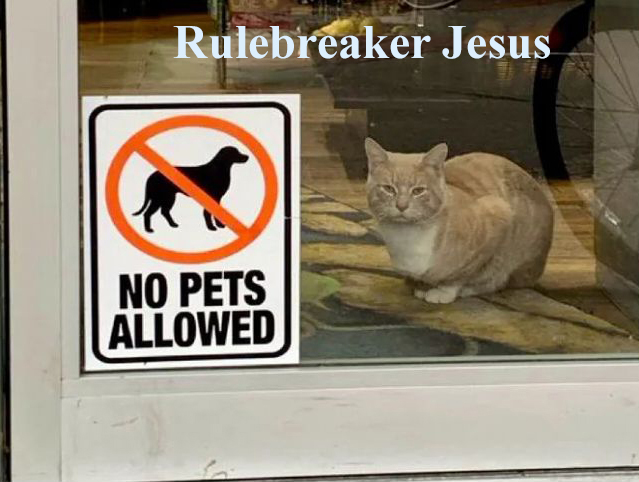
Rulebreaker Jesus

Rulebreaker Jesus

February 25, 2024*

By Pastor John Partridge

Hosea 2:14-20            Mark 2:13-22                         2 Corinthians 3:1-6

What are Christians known for in our communities and in our world today?

In the first through the third centuries, Christians were not popular, and their critics often attacked them for the ways that the Christian community went against the prevailing culture and community standards. Christians (and Jews) were seen as atheists because they did not participate in holy day celebrations at the temples of various gods and goddesses, they were accused of practicing cannibalism for the sharing of communion, they were mocked for their belief in resurrection, for following and worshiping a criminal who had been crucified, and other ways that folks just found to be odd, irregular, unusual, and rude. But as much as Christians were criticized and even persecuted, their critics recognized that there were things for which Christians were known and remembered, and most of those things, at least today, would be thought of as good things.

David Bentley Hart, in his book “The Story of Christianity,” lists the characteristics of Christians that were used by pagan critics to describe early followers of Jesus. Christians were described as sober, gentle, faithful to their spouses without exploitation or abuse, caring for the poor, willing to nurse the gravely ill, even at significant risk to themselves, such as during a time of plague, and the ability to exhibit virtues such as self-control and courage, which were thought to be impossible for anyone who was poor or who was not philosophically trained.

But even though Christianity’s critics may have grudgingly admitted that the movement had some positive points, and even though some of those we listed were presented as ridicule and not praise, Christians were still known, and often rejected, for the ways that their new religion made them break the rules of the culture and of the empire. But that shouldn’t surprise us when the founder of our movement, and the object of our worship, was, from the beginning, a ruler breaker. But before we get to that, let’s begin in the Old Testament book of Hosea in Hosea 2:14-20, where we hear God describing how he will win back a morally wandering Israel, and describe what he desires to provide for his people. God says…

14 “Therefore I am now going to allure her;
    I will lead her into the wilderness
    and speak tenderly to her.
15 There I will give her back her vineyards,
    and will make the Valley of Achor a door of hope.
There she will respond as in the days of her youth,
    as in the day she came up out of Egypt.

16 “In that day,” declares the Lord,
    “you will call me ‘my husband’;
    you will no longer call me ‘my master.’
17 I will remove the names of the Baals from her lips;
    no longer will their names be invoked.
18 In that day I will make a covenant for them
    with the beasts of the field, the birds in the sky
    and the creatures that move along the ground.
Bow and sword and battle
    I will abolish from the land,
    so that all may lie down in safety.
19 I will betroth you to me forever;
    I will betroth you in righteousness and justice,
    in love and compassion.
20 I will betroth you in faithfulness,
    and you will acknowledge the Lord
.

The story of Hosea is one in which Israel goes astray from God in a spectacular way and, through Hosea’s marriage to an unfaithful lady of the evening, God describes Israel as a prostitute who has sold herself for foreign gods. But here, God declares that he is going to win his bride back. God intends to allure her, speak tenderly to her, give her back her vineyards, and give her hope. Once again, Israel will return to God and forget the idols of her past so that God can give her a life of righteousness, justice, compassion, faithfulness, and peace. But those are the things that God has always wanted for his people. The problem has never been with God, it has been with the unfaithfulness of his people. And that is what is at the heart of the rule breaking Jesus that we meet in Mark 2:13-22. When the culture of God’s people, or any culture, values other things more than the things of God, then people of faith are compelled to break the rules. And that’s what we see as Jesus meets the tax collector Levi, who we also know as the disciple Matthew:

13 Once again Jesus went out beside the lake. A large crowd came to him, and he began to teach them. 14 As he walked along, he saw Levi, son of Alphaeus, sitting at the tax collector’s booth. “Follow me,” Jesus told him, and Levi got up and followed him.

15 While Jesus was having dinner at Levi’s house, many tax collectors and sinners were eating with him and his disciples, for there were many who followed him. 16 When the teachers of the law who were Pharisees saw him eating with the sinners and tax collectors, they asked his disciples: “Why does he eat with tax collectors and sinners?”

17 On hearing this, Jesus said to them, “It is not the healthy who need a doctor, but the sick. I have not come to call the righteous, but sinners.”

18 Now John’s disciples and the Pharisees were fasting. Some people came and asked Jesus, “How is it that John’s disciples and the disciples of the Pharisees are fasting, but yours are not?”

19 Jesus answered, “How can the guests of the bridegroom fast while he is with them? They cannot, so long as they have him with them. 20 But the time will come when the bridegroom will be taken from them, and on that day they will fast.

21 “No one sews a patch of unshrunk cloth on an old garment. Otherwise, the new piece will pull away from the old, making the tear worse. 22 And no one pours new wine into old wineskins. Otherwise, the wine will burst the skins, and both the wine and the wineskins will be ruined. No, they pour new wine into new wineskins.”

Jesus, in defiance of custom and propriety, sits down to dinner with a roomful of outsiders and outcasts, people that the religious leaders believe to be contemptable sinners and therefore a contaminating influence on people of good character. Worse, sharing a meal was seen as an intimate act that was only done with family, friends, and people of quality. In addition, Jesus is accused of ignoring a traditional time of fasting when the religious leaders and even the followers of John the Baptist are observing that cultural tradition.

But Jesus responds to the accusations and criticisms of the Pharisees by reminding them that what is appropriate sometimes varies. No one would expect wedding guests to fast regardless of the tradition of the religious leaders and Jesus equates his presence among his disciples as qualifying for the same kind of exemption. The comparison of the wineskins is the same sort of thing. New wineskins, made of sheepskin, can stretch when the new wine in them begins to ferment, but old wineskins have already stretched, and using them for new wine would only cause them to burst. And so, again, Jesus is reminding everyone that we don’t always adhere to strict rules, but instead make judgements on what is appropriate for the occasion.

But why does that matter to us?

Even though we are the followers of Jesus, he is not physically with us, so why are we having a discussion of what is, and is not, culturally appropriate?

And, in addition to the story of the first century church with which we began, we gain some focus as we read Paul’s letter to the church in Corinth in 2 Corinthians 3:1-6 as Paul explains how the people around us view our actions. Paul says…

3:1 Are we beginning to commend ourselves again? Or do we need, like some people, letters of recommendation to you or from you? You yourselves are our letter, written on our hearts, known and read by everyone. You show that you are a letter from Christ, the result of our ministry, written not with ink but with the Spirit of the living God, not on tablets of stone but on tablets of human hearts.

Such confidence we have through Christ before God. Not that we are competent in ourselves to claim anything for ourselves, but our competence comes from God. He has made us competent as ministers of a new covenant—not of the letter but of the Spirit; for the letter kills, but the Spirit gives life.

Paul describes us, the people of the church and the followers of Jesus Christ, as individual letters, from Jesus, to our communities and to the people around us. Many people will never read a bible, but they will read the life that you live. You are a sign to the community that tells the story of Jesus and the story of our church, and in you, and in us, they will read the story of Jesus and find the truth about our faith the work that we do. Paul says that “the letter kills, but the Spirit gives life.” And by this, Paul explains to the people of the church, that the message of Jesus isn’t all about following a strict interpretation of a bunch of rules, but instead is about a life that is lived in love.

What God wants is a life of righteousness, justice, compassion, faithfulness, and peace but far too often, when unbelievers read the story of Jesus that Christians live out in their lives, what they see is anger, prejudice, greed, violence, arrogance, abuse, and the admiration of, if not a complete alliance with, worldly power.

When Jesus broke the rules of his culture, he broke them so that he could show love and compassion to others. When the Christians of the first century behaved strangely, and broke the rules of their culture, they still earned the respect of their critics because they were sober, gentle, faithful to their spouses, cared for the poor, nursed the gravely ill even at risk to themselves, and exhibited virtues such as self-control and courage.

And so, we return to the question with which we began. What are Christians known for in our communities and in our world today?

Every day, the people around you, people that may never read a bible or set foot in a church, will read a letter from Jesus in the life that you live.

Will they read a message of love and compassion?

Or will they find something else?


Please LIKE and SHARE!

Click here to subscribe to Pastor John’s blog.

Click here if you would like to subscribe to Pastor John’s weekly messages.

Click here to visit Pastor John’s YouTube channel.


*You have been reading a message presented at Christ United Methodist Church on the date noted at the top of the first page.  Rev. John Partridge is the pastor at Christ UMC in Alliance, Ohio.  Duplication of this message is a part of our Media ministry, if you have received a blessing in this way, we would love to hear from you.  Letters and donations in support of the Media ministry or any of our other projects may be sent to Christ United Methodist Church, 470 East Broadway Street, Alliance, Ohio 44601.  These messages are available to any interested persons regardless of membership.  You may subscribe to these messages, in print or electronic formats, by writing to the address noted, or by contacting us at secretary@CUMCAlliance.org.  These messages can also be found online at https://pastorpartridge.com .  All Scripture quotations, unless otherwise indicated, are taken from the Holy Bible, New International Version®, NIV®. Copyright ©1973, 1978, 1984, 2011 by Biblica, Inc.™ Used by permission of Zondervan. All rights reserved worldwide. www.zondervan.comThe “NIV” and “New International Version” are trademarks registered in the United States Patent and Trademark Office by Biblica, In

Blessings, Weeds, and Suffering

Blessings, Weeds, and Suffering

July 19, 2020*

By Pastor John Partridge


 Genesis 28:10-19a                 Romans 8:12-25                     Matthew 13:24-30, 36-43

If we can’t have church, how can we be the church?

If I am a member of the church, is there something that I should be doing for the church?

Can my faith in Jesus help me to understand, or even just to cope, with the craziness and suffering that is going on because of the Coronavirus (or anything else)?

In the middle of the chaos caused by the Coronavirus, some of the questions that gets kicked around revolve around the church.  What should the church be doing?  What should its members be doing?  Does our faith in Jesus Christ make any difference in how we ought to respond to the world, to the news, or to our leadership?  And, while I certainly don’t have all the answers, and we surely won’t have time to talk about all of the possibilities, or all of the relevant scriptures, today’s lectionary passages are enough to give us plenty to think about.  We begin in Genesis 28:10-19a, where Jacob has an encounter with the God of his father Isaac and his grandfather Abraham and in which God reiterates a blessing that he had promised to Abraham, and by doing so reemphasizes that the promise had not only been passed down to him, but that it would continue pass through his descendants.

10 Jacob left Beersheba and set out for Harran. 11 When he reached a certain place, he stopped for the night because the sun had set. Taking one of the stones there, he put it under his head and lay down to sleep. 12 He had a dream in which he saw a stairway resting on the earth, with its top reaching to heaven, and the angels of God were ascending and descending on it. 13 There above it stood the Lord, and he said: “I am the Lord, the God of your father Abraham and the God of Isaac. I will give you and your descendants the land on which you are lying. 14 Your descendants will be like the dust of the earth, and you will spread out to the west and to the east, to the north and to the south. All peoples on earth will be blessed through you and your offspring. 15 I am with you and will watch over you wherever you go, and I will bring you back to this land. I will not leave you until I have done what I have promised you.”

16 When Jacob awoke from his sleep, he thought, “Surely the Lord is in this place, and I was not aware of it.” 17 He was afraid and said, “How awesome is this place! This is none other than the house of God; this is the gate of heaven.”

18 Early the next morning Jacob took the stone he had placed under his head and set it up as a pillar and poured oil on top of it. 19 He called that place Bethel.

God meets Jacob and he promises that he will give the land, upon which he sleeps, to Jacob and to his descendants.  But more than that, God promises that those descendants would multiply, spread out in all directions, and become so numerous that God’s blessing would flow through them and into the entire world.  Of course, as Christians, we believe that not only has this prophecy been fulfilled by the growth and expansion of the Jewish nation, but also specifically through Jacob’s descendant Jesus.  And therefore, from our perspective, the blessing of God flows through Jacob, down to Jesus, and through Jesus, flows into the world of today… through us.

But so, what?  Why does that matter?  What difference does it make if we are numbered among the descendants of God’s blessing to Abraham, Isaac, and Jacob?  It matters, and it makes a difference, because the world is also full of weeds.  What do I mean by weeds?  Listen to what Jesus had to say in the parable found in Matthew 13:24-30, 36-43:

24 Jesus told them another parable: “The kingdom of heaven is like a man who sowed good seed in his field. 25 But while everyone was sleeping, his enemy came and sowed weeds among the wheat, and went away. 26 When the wheat sprouted and formed heads, then the weeds also appeared.

27 “The owner’s servants came to him and said, ‘Sir, didn’t you sow good seed in your field? Where then did the weeds come from?’

28 “‘An enemy did this,’ he replied.

“The servants asked him, ‘Do you want us to go and pull them up?’

29 “‘No,’ he answered, ‘because while you are pulling the weeds, you may uproot the wheat with them. 30 Let both grow together until the harvest. At that time, I will tell the harvesters: First collect the weeds and tie them in bundles to be burned; then gather the wheat and bring it into my barn.’”

 36 Then he left the crowd and went into the house. His disciples came to him and said, “Explain to us the parable of the weeds in the field.”

37 He answered, “The one who sowed the good seed is the Son of Man. 38 The field is the world, and the good seed stands for the people of the kingdom. The weeds are the people of the evil one, 39 and the enemy who sows them is the devil. The harvest is the end of the age, and the harvesters are angels.

40 “As the weeds are pulled up and burned in the fire, so it will be at the end of the age. 41 The Son of Man will send out his angels, and they will weed out of his kingdom everything that causes sin and all who do evil. 42 They will throw them into the blazing furnace, where there will be weeping and gnashing of teeth. 43 Then the righteous will shine like the sun in the kingdom of their Father. Whoever has ears, let them hear.

Jesus says that the kingdom of heaven, in other words, the world in which we live, is like a field that has been planted.  The good seed is the people of the kingdom of God and that seed was planted by Jesus.  The weeds are the people who are controlled, or manipulated, or deceived, by the evil one, the enemy of God.  In the fields, and in the world, and even in the church, it can be almost impossible to tell the difference between the weeds and the wheat.  But as the plants mature, it becomes obvious what kind of fruit they will bear.  This is a story about God’s judgement at the end of time.  Jesus says that the angels will know which people are bearing good fruit and which are weeds and that the weeds will be pulled out, sorted, and separated from the good fruit, and burned in the fire.  As we have seen in other passages, when we become mature, we will be known, and judged, by what kind of fruit we produce.

But what does that have to do with being the descendants of Jacob, and the followers of Jesus?

The “So what” question is answered by Paul in Romans 8 and there he also explains what our faith matters in times when life is difficult, during pandemics, or worse. (Romans 8:12-25)

12 Therefore, brothers and sisters, we have an obligation—but it is not to the flesh, to live according to it. 13 For if you live according to the flesh, you will die; but if by the Spirit you put to death the misdeeds of the body, you will live.

14 For those who are led by the Spirit of God are the children of God. 15 The Spirit you received does not make you slaves, so that you live in fear again; rather, the Spirit you received brought about your adoption to sonship. And by him we cry, “Abba, Father.” 16 The Spirit himself testifies with our spirit that we are God’s children. 17 Now if we are children, then we are heirs—heirs of God and co-heirs with Christ, if indeed we share in his sufferings in order that we may also share in his glory.

 18 I consider that our present sufferings are not worth comparing with the glory that will be revealed in us. 19 For the creation waits in eager expectation for the children of God to be revealed. 20 For the creation was subjected to frustration, not by its own choice, but by the will of the one who subjected it, in hope 21 that[h] the creation itself will be liberated from its bondage to decay and brought into the freedom and glory of the children of God.

22 We know that the whole creation has been groaning as in the pains of childbirth right up to the present time. 23 Not only so, but we ourselves, who have the firstfruits of the Spirit, groan inwardly as we wait eagerly for our adoption to sonship, the redemption of our bodies. 24 For in this hope we were saved. But hope that is seen is no hope at all. Who hopes for what they already have? 25 But if we hope for what we do not yet have, we wait for it patiently.

Paul says that, as the church, we do not have an obligation to live well or to pursue comfort and the satisfaction of our fleshly desires.  But we do have an obligation to live according to the Spirit, to live as if our faith really mattered, to do the things that Jesus taught, be the kind of people that Jesus has called us to be, and to do the work that that Jesus has called us to do.  Paul reminds us that we are God’s children.  We are the adopted sons and daughters of the family of God.  We are the heirs, the inheritors, of God’s blessing, and co-heirs with Jesus.  But being heirs with Jesus means that we not only share in God’s riches and glory, but that we also share in the suffering of Jesus.

The present suffering of this world, our present suffering in this world, no matter how bad things get (and Paul was absolutely, intimately, familiar with just how bad things could get), simply do not compare to the glory that we will see as our reward and as our inheritance.  But for the present, we live in a creation that is the frustrated, tangled, twisted, perverted, and corrupted reality of the creator’s perfect creation.  Yes, we are enduring the chaos caused by the Coronavirus.  Yes, our culture is in turmoil.  Yes, our own denomination is tearing itself apart.  Yes, there is unemployment, and suffering.  Yes, our lives are chaotic, unsettled, and uncertain.  But Paul, and the people of his time, and his world, knew chaos and suffering too.  We live in this present, but like Paul and the church that he knew, we live with the hope that creation will one day be redeemed, rescued, and liberated from its bondage to decay.  We look forward to the day when, not only the world, but we too will be redeemed and made perfect.

Through Jesus, we are the descendants of Jacob, and the inheritors of God’s blessing.  And while we live in a world that is filled with weeds, enemies, frustrations, disasters, bad governments, and outright evil, we look forward to something so much better that we are able to look past the suffering of the present and into a future filled with glory and light.  But while we are here, in this present time, we have an obligation to be and to do.  We are called to live according to the Spirit of God, to be the kind of people that Jesus called us to be, to live the way that Jesus lived, and to do the work that Jesus did.  We are called to live lives that look like Jesus, lives that reveal Jesus to the people around us, to love the people around us like Jesus did, and to do the work that Jesus did.  Yes, the fields are full of weeds, but until the time comes for the harvesters to separate the weeds from the wheat, our calling is to nurture the seeds that have been scattered.  Those seeds surround us in our families, in our community, in our places of employment, and everywhere we go.  Many of those seeds can still be saved.

Although we aren’t meeting together in a church building, we have never stopped being the church.  Every day, whenever, and wherever we can, we must look for opportunities to be Jesus to the world.  We must do what we can to relieve the suffering that we see; and help the people around us who are struggling in any way that we can.

Despite the chaos that surrounds us, we must keep moving forward. 

This week look for ways that you can help.  Send a card, call, donate food, mow someone’s grass, buy groceries for an unemployed neighbor, maybe even pay somebody’s rent.  In big ways or small ways, let us answer the call to show the love of Jesus to those around us.

And let us keep our eyes…

…on hope.


Have a great week everybody.


You can find the video of this worship service here: https://youtu.be/Y8cHcw79Uuo

Did you enjoy reading this?

Click here if you would like to subscribe to Pastor John’s weekly messages.

Click here to subscribe to Pastor John’s blog.

Click here to visit Pastor John’s YouTube channel.


*You have been reading a message presented at Christ United Methodist Church on the date noted at the top of the first page.  Rev. John Partridge is the pastor at Christ UMC in Alliance, Ohio.  Duplication of this message is a part of our Media ministry, if you have received a blessing in this way, we would love to hear from you.  Letters and donations in support of the Media ministry or any of our other projects may be sent to Christ United Methodist Church, 470 East Broadway Street, Alliance, Ohio 44601. These messages are available to any interested persons regardless of membership.  You may subscribe to these messages, in print or electronic formats, by writing to the address noted, or by contacting us at secretary@CUMCAlliance.org.  If you have questions, you can ask them in our discussion forum on Facebook (search for Pastor John Online).  These messages can also be found online at https://pastorpartridge.wordpress.com/. All Scripture references are from the New International Version unless otherwise noted.

Finding Hope in a Doomed Culture

Finding Hope in a Doomed Culture

September 29, 2019*

By Pastor John Partridge

Jeremiah 32:1-3a, 6-15                     1 Timothy 6:6-19                   Luke 16:19-31


It’s often obvious.

All we have to do is turn on the television or radio, open a newspaper, or go to the movies.

It seems as if Hollywood and the people who entertain us, are always finding ways to push the boundaries of what is acceptable.  Language that used to get a movie banned from theaters is now heard during primetime in our living rooms.  Where television programs once required that married couples be shown sleeping in single beds, we now see the stars of today’s shows hopping from bed to bed as if marriage vows and morality meant nothing.  But while we watch the boundaries of moral acceptability being pushed back in our own culture, we should also remember that none of this is new.

With few exceptions, nearly every culture on earth has, on one way or another, taken a stand against the instructions, commands, and desires of God.  When scripture points generically at cities like Rome, Sodom, and Babylon, it focuses on cultures that are fundamentally at odds with how God has called his people to live.  Whenever God’s people, then or now, become so entangled with that culture, they are drawn away from God’s will for their lives, and inexorably pulled away from God himself.  And, while God isn’t calling us to withdraw from the world to the degree that we see the Amish community doing, we are called to stand up to our culture and plant a flag to designate a different way of life.  Likewise, there is no need for us to despair that our culture is leading us all into condemnation, destruction, and hell.

There is hope.

That is exactly the message that God sends to the people of Judah through the prophet Jeremiah in Jeremiah 32:1-3a, 6-15Here, although Jeremiah has prophesied about the destruction of the city and everyone is beginning to realize that the Babylonian army will soon break down the gates of the city, and although people are beginning to despair for their future, God also sends a message of hope for the future.

32:1 This is the word that came to Jeremiah from the Lord in the tenth year of Zedekiah king of Judah, which was the eighteenth year of Nebuchadnezzar. The army of the king of Babylon was then besieging Jerusalem, and Jeremiah the prophet was confined in the courtyard of the guard in the royal palace of Judah.

Now Zedekiah king of Judah had imprisoned him there, saying, “Why do you prophesy as you do?

Jeremiah said, “The word of the Lord came to me: Hanamel son of Shallum your uncle is going to come to you and say, ‘Buy my field at Anathoth, because as nearest relative it is your right and duty to buy it.’

“Then, just as the Lord had said, my cousin Hanamel came to me in the courtyard of the guard and said, ‘Buy my field at Anathoth in the territory of Benjamin. Since it is your right to redeem it and possess it, buy it for yourself.’

“I knew that this was the word of the Lord; so I bought the field at Anathoth from my cousin Hanamel and weighed out for him seventeen shekels of silver. 10 I signed and sealed the deed, had it witnessed, and weighed out the silver on the scales. 11 I took the deed of purchase—the sealed copy containing the terms and conditions, as well as the unsealed copy— 12 and I gave this deed to Baruch son of Neriah, the son of Mahseiah, in the presence of my cousin Hanamel and of the witnesses who had signed the deed and of all the Jews sitting in the courtyard of the guard.

13 “In their presence I gave Baruch these instructions: 14 ‘This is what the Lord Almighty, the God of Israel, says: Take these documents, both the sealed and unsealed copies of the deed of purchase, and put them in a clay jar so they will last a long time. 15 For this is what the Lord Almighty, the God of Israel, says: Houses, fields and vineyards will again be bought in this land.’

When the enemy is at the gates, and the people could feel destruction and the judgement of God breathing down their necks, everyone knew that this was the time that people should be getting their affairs in order.  This was a time when people were locked inside the city walls for protection and they were more worried about being able to afford food to eat than how much land they owned.  And so, as an example to everyone, God calls Jeremiah to meet his cousin Hanamel in the city gate and buy the family farm that his Uncle Shallum is trying to sell.  And God’s word to Jeremiah, and to the people of Judah, is that there is a future.  Despite the enemy at the gate, God declares that the nations of Israel and Judah will have a future, that peace will return, that their government will one day be reestablished, and that houses, land, vineyards, and farms will one day be bought and sold again.  And, quite possibly, within the lifetime of Jeremiah and some of the people who were there to stand as witnesses.

In the middle of despair, God delivers hope.

Perhaps one of the greatest disconnects between our culture and the morality of God, is the way in which we view money.  In just about every television show, movie, commercial, magazine, or advertisement we are repeatedly told that being rich is the goal of life.  Nearly every waking moment of our lives we are told that we should aspire to acquire more money, more things, more stuff, more power, and that more is always better no matter what the cost to ourselves, to our families, or to the people around us.  But that isn’t at all what scripture teaches or what God wants.  Last week, we were reminded that we cannot serve both God and money, and Paul expands on that teaching in 1 Timothy 6:6-19, where we hear these words:

But godliness with contentment is great gain. For we brought nothing into the world, and we can take nothing out of it. But if we have food and clothing, we will be content with that. Those who want to get rich fall into temptation and a trap and into many foolish and harmful desires that plunge people into ruin and destruction. 10 For the love of money is a root of all kinds of evil. Some people, eager for money, have wandered from the faith and pierced themselves with many griefs.

11 But you, man of God, flee from all this, and pursue righteousness, godliness, faith, love, endurance and gentleness. 12 Fight the good fight of the faith. Take hold of the eternal life to which you were called when you made your good confession in the presence of many witnesses. 13 In the sight of God, who gives life to everything, and of Christ Jesus, who while testifying before Pontius Pilate made the good confession, I charge you 14 to keep this command without spot or blame until the appearing of our Lord Jesus Christ, 15 which God will bring about in his own time—God, the blessed and only Ruler, the King of kings and Lord of lords, 16 who alone is immortal and who lives in unapproachable light, whom no one has seen or can see. To him be honor and might forever. Amen.

17 Command those who are rich in this present world not to be arrogant nor to put their hope in wealth, which is so uncertain, but to put their hope in God, who richly provides us with everything for our enjoyment. 18 Command them to do good, to be rich in good deeds, and to be generous and willing to share. 19 In this way they will lay up treasure for themselves as a firm foundation for the coming age, so that they may take hold of the life that is truly life.

In complete contrast to the messages that we get from all over our culture every day, Paul says that those who want to get rich fall into a trap and into many foolish desires that plunge people into ruin and destruction.  While money itself is neither good nor evil, it is the love of money that lies at the root of all kinds of evil.  People who are eager for money, and who pursue it recklessly, have wandered away from their faith in God and have been responsible for causing their own grief and pain.

Rather than pursuing money, we are called to pursue what is right and godly, to seek faith, love, endurance and gentleness.  If you have money, don’t allow yourself to be proud of having it, or to put your confidence and hope for the future in the fact that you have it.  Instead, put your hope in the God who gives us everything that we have.  Rather than trusting in your money, use it to do good for others and be willing to share what you have.  It is in using what we have for God and for others that builds the foundation for our life in eternity.

In Jesus’ parable about the rich man and the beggar Lazarus in Luke 16:19-31, we see an example that could easily be teleported to our own culture, and even to our own neighborhood, and still make complete sense.  Most of us could easily change the names in Jesus’ story to the familiar names of modern-day news stories, and everything in it would still make complete sense.

19 “There was a rich man who was dressed in purple and fine linen and lived in luxury every day. 20 At his gate was laid a beggar named Lazarus, covered with sores 21 and longing to eat what fell from the rich man’s table. Even the dogs came and licked his sores.

22 “The time came when the beggar died and the angels carried him to Abraham’s side. The rich man also died and was buried. 23 In Hades, where he was in torment, he looked up and saw Abraham far away, with Lazarus by his side. 24 So he called to him, ‘Father Abraham, have pity on me and send Lazarus to dip the tip of his finger in water and cool my tongue, because I am in agony in this fire.’

25 “But Abraham replied, ‘Son, remember that in your lifetime you received your good things, while Lazarus received bad things, but now he is comforted here and you are in agony. 26 And besides all this, between us and you a great chasm has been set in place, so that those who want to go from here to you cannot, nor can anyone cross over from there to us.’

27 “He answered, ‘Then I beg you, father, send Lazarus to my family, 28 for I have five brothers. Let him warn them, so that they will not also come to this place of torment.’

29 “Abraham replied, ‘They have Moses and the Prophets; let them listen to them.’

30 “‘No, father Abraham,’ he said, ‘but if someone from the dead goes to them, they will repent.’

31 “He said to him, ‘If they do not listen to Moses and the Prophets, they will not be convinced even if someone rises from the dead.’”

Imagine the rich man living in what we would now think of as a gated community, or a walled compound, such as those that many of our rich, famous, and powerful entertainers, businesspeople, and politicians live in today.  For months, perhaps for years, the poor man lived outside the gates, but where the rich man could see him and knew about him.  The poor man sat and begged every day, but never once did the rich man share anything that he had, not even the scraps leftover from his dinner table.  But after their deaths, the condemnation that the rich man receives from Abraham is that he had received good things during his life but shared none of them with Lazarus.  So convinced are the rich and the powerful of the rightness, and the moral superiority of their wealth, that Jesus says they cannot be convinced of their error even if the dead came back to life to warn them.

Listening to the call and the teaching of our culture will lead us to pain, suffering, ruin, destruction, and doom.  We are deceived by the siren calls of pleasure, wealth, and power.  But, if we are to find hope in a culture that increasingly filled with desperation, despair, and hopelessness, then we must remember the commands of God. 

We are not to use God and serve money, but rather to use money and serve God.

If we are to find hope, and to share that hope with the world, then we must remember our calling as the people of God and as the followers of Jesus Christ.  We are called to use what we have, to share what we have been given, so that we may draw closer to one another, closer to those around us, and closer to God.  Otherwise, if listen too closely to our culture, if we allow our desires and our selfishness to control us, the money, and the things, that we have, will draw us, bit by bit, away from God and toward a destruction, and doom, of our own creation.


Did you enjoy reading this?

Click here if you would like to subscribe to Pastor John’s weekly messages.

Click here to subscribe to Pastor John’s blog.

Click here to visit Pastor John’s YouTube channel.


*You have been reading a message presented at Christ United Methodist Church on the date noted at the top of the first page.  Rev. John Partridge is the pastor at Christ UMC in Alliance, Ohio.  Duplication of this message is a part of our Media ministry, if you have received a blessing in this way, we would love to hear from you.  Letters and donations in support of the Media ministry or any of our other projects may be sent to Christ United Methodist Church, 470 East Broadway Street, Alliance, Ohio 44601. These messages are available to any interested persons regardless of membership.  You may subscribe to these messages, in print or electronic formats, by writing to the address noted, or by contacting us at secretary@CUMCAlliance.org  These messages can also be found online at https://pastorpartridge.com/. All Scripture references are from the New International Version unless otherwise noted.

Trust is a Big Deal


    Have you ever had one of those “Duh!” moments when things start to make sense for the first time? But there are also moments when we read scripture and we completely miss important things because we assume that the people in the Bible were just like us.  In our scripture lesson this week, we read the story of Moses leading the people of Israel through the dry path God had created in the depths of the Red Sea.  But after the chariots, horsemen and soldiers of Egypt’s army are drowned, we read these verses in Exodus 14:30-31:
That day the Lord saved Israel from the hands of the Egyptians, and Israel saw the Egyptians lying dead on the shore.  And when the Israelites saw the mighty hand of the Lord displayed against the Egyptians, the people feared the Lord and put their trust in him and in Moses his servant.
    Most of us read this and think, “So what? They trusted God. God is trustworthy. Duh.”  And, because we assume that the people of Israel were just like us, we completely miss what a big deal this really was.
    We have lived our lives in possession of the entire Old Testament as well as the New Testament.  For many of us, there has never really been much doubt that God was trustworthy, even when we weren’t sure that God was real.  But the people of the Exodus did not know what we know.  The world that they lived in, and the gods that they knew, were very different.
    In the story of the Exodus, despite coming from the family of Abraham, Isaac, and Jacob, the Israelites had lived in the land of Egypt for 400 years.  At that time, they did not have a formal system of worship, or priesthood, they had stories.  The stories of their forefathers had been passed down to them from generation to generation, and even though the stories were magnificent, they lived in a world with very different stories.
    The Egyptians, like the Romans and the Greeks of the New Testament, were polytheists.  They believed, not in the one God of Israel, but in a collection of gods that were far from trustworthy.  The gods warred with one another through human agents and tens of thousands died for their amusement.  The gods of the Egyptians were capricious; they did what they wanted, when they wanted, often without any guiding morality.  To the gods, humans were little more than playthings and to humans, the gods were to be feared and not trusted.
    And so when the people of Israel saw that the God of Abraham had used his great power, not only to provide a means for them to escape their slavery, but to destroy those who sought to kill them, they saw, many for the first time, that their God was different.  Finally, the stories began to make sense.  They realized that the God of Abraham, Isaac, Jacob and Joseph was different than the gods of the Egyptians. 
They realized that the God of Israel could be trusted.
And trust really is a big deal.

—————————————————————————————————

To have Crossfusion delivered directly to your email, click here.