
Joshua 24:1-3a, 14-25 Matthew 25:1-13 1 Thessalonians 4:13-18
If you have ever made a major, life changing decision, then you understand that doing so is often a part of a process. Yes, there are times when circumstances compel us to do things on the fly and navigate by the seat of our pants, but deep thought and careful planning are normally the hallmarks of major decisions. Few of us asked, or agreed, to be married until after we had thought a great deal about whether doing so was a good idea. Likewise, buying a house is normally preceded by thoughtful consideration of what criteria needed to be met, what neighborhood, what style, what price, is the school system good, does it meet the needs of my present and future family, and so on. And then, having made such a major decision, then there is more planning, how will we pay the loan, how will we move from our present home, when will we file a change of address with the Post Office, banks, and credit cards? And through the process, especially depending on how well the planning went, we will have feelings. Those feelings may be negative or positive. We will be worried and anxious or hopeful and happy. Or something in between, or all those feelings at the same time.
Thus, since it is a major, life-changing decision, we should not be surprised to find that choosing to follow God often follows that same process and results in many of the same feelings. We find that process at work as Joshua stands before the gathered people of Israel and demands that they make a choice to follow the God of Abraham, Isaac, and Moses. Before the people of Israel cross the Jordan River into the land that God had promised, Joshua wants to ensure that no one can claim that they didn’t know what they were doing, that they were just going with the flow, that someone else had decided for them, or that they had somehow just drifted into a responsibility that they didn’t want. We read that story in Joshua 24:1-3a, 14-25:
24:1 Then Joshua assembled all the tribes of Israel at Shechem. He summoned the elders, leaders, judges, and officials of Israel, and they presented themselves before God.
2 Joshua said to all the people, “This is what the Lord, the God of Israel, says: ‘Long ago your ancestors, including Terah the father of Abraham and Nahor, lived beyond the Euphrates River and worshiped other gods. 3 But I took your father Abraham from the land beyond the Euphrates and led him throughout Canaan and gave him many descendants.
14 “Now fear the Lord and serve him with all faithfulness. Throw away the gods your ancestors worshiped beyond the Euphrates River and in Egypt, and serve the Lord. 15 But if serving the Lord seems undesirable to you, then choose for yourselves this day whom you will serve, whether the gods your ancestors served beyond the Euphrates, or the gods of the Amorites, in whose land you are living. But as for me and my household, we will serve the Lord.”
16 Then the people answered, “Far be it from us to forsake the Lord to serve other gods! 17 It was the Lord our God himself who brought us and our parents up out of Egypt, from that land of slavery, and performed those great signs before our eyes. He protected us on our entire journey and among all the nations through which we traveled. 18 And the Lord drove out before us all the nations, including the Amorites, who lived in the land. We too will serve the Lord, because he is our God.”
19 Joshua said to the people, “You are not able to serve the Lord. He is a holy God; he is a jealous God. He will not forgive your rebellion and your sins. 20 If you forsake the Lord and serve foreign gods, he will turn and bring disaster on you and make an end of you, after he has been good to you.”
21 But the people said to Joshua, “No! We will serve the Lord.”
22 Then Joshua said, “You are witnesses against yourselves that you have chosen to serve the Lord.”
“Yes, we are witnesses,” they replied.
23 “Now then,” said Joshua, “throw away the foreign gods that are among you and yield your hearts to the Lord, the God of Israel.”
24 And the people said to Joshua, “We will serve the Lord our God and obey him.”
25 On that day Joshua made a covenant for the people, and there at Shechem he reaffirmed for them decrees and laws. 26 And Joshua recorded these things in the Book of the Law of God. Then he took a large stone and set it up there under the oak near the holy place of the Lord.
Joshua’s speech leads the people through several stages. First, everyone stops what they are doing and gathers in one place to hear him speak. Second, Joshual asks them to consider the idea that their ancestors, prior to Abraham, worshiped other gods, and some of them had done so during their time as slaves in Egypt as well. Because Moses’ offer of freedom was made to every slave that lived in Egypt, not every person that followed him may have been a genetic descendant of Abraham. The people of Israel were now multiethnic and multiracial and now was the moment for them to consider the faith of their ancestors, the faith of their past, and what life had been like since they had followed Moses.
Third, Joshua asks the people to set aside whatever faith and worship their ancestors may have had and decide for themselves whom they will worship. No one is compelled to follow the God of Abraham, Isaac, Jacob, and Moses. Every person is free to leave and live their life as they please. And finally, Joshua pushes back and tells the people that they cannot worship God because they are too rebellious and sinful. Joshua warns them that choosing to follow God could bring disaster upon them if they turn away from him and later follow foreign gods. In this, Joshua presses the people to be certain before they make their choice.
After this, the people make their choice to follow God and Joshua uses legal language declaring that, as if they were giving their testimony in court, they now stand as witnesses, against themselves and against one another, to the decision and to the oath, that they have now made. And the people agree that this is so. But having made a choice to do something is only the beginning and not the end. There are steps that come after our choice has been made and Jesus presses us to understand that when he tells the parable of the foolish virgins in Matthew 25:1-13, saying:
25:1 “At that time the kingdom of heaven will be like ten virgins who took their lamps and went out to meet the bridegroom. 2 Five of them were foolish and five were wise. 3 The foolish ones took their lamps but did not take any oil with them. 4 The wise ones, however, took oil in jars along with their lamps. 5 The bridegroom was a long time in coming, and they all became drowsy and fell asleep.
6 “At midnight, the cry rang out: ‘Here’s the bridegroom! Come out to meet him!’
7 “Then all the virgins woke up and trimmed their lamps. 8 The foolish ones said to the wise, ‘Give us some of your oil; our lamps are going out.’
9 “‘No,’ they replied, ‘there may not be enough for both us and you. Instead, go to those who sell oil and buy some for yourselves.’
10 “But while they were on their way to buy the oil, the bridegroom arrived. The virgins who were ready went in with him to the wedding banquet. And the door was shut.
11 “Later the others also came. ‘Lord, Lord,’ they said, ‘open the door for us!’
12 “But he replied, ‘Truly I tell you, I don’t know you.’
13 “Therefore, keep watch, because you do not know the day or the hour.
In this case, all ten of the virgins had chosen to attend the wedding. They had worked through the steps to arrive at that decision, but even having made that choice, half of them missed another step. They failed to prepare. Five of these young ladies assumed that when they went out to wait for the arrival of the bridegroom, that he would arrive shortly. But that didn’t happen. For whatever reason, the bridegroom took longer to get there than they had hoped, and so they waited, in the dark, longer than they expected. And when five of them went out in search of more oil for their lamps, the bridegroom came and they missed their opportunity to attend the wedding.
Now, we understand that in the real world, friends of the bride would be let into the wedding feast even if they showed up late. But Jesus isn’t telling us a parable to explain how the real-world works. In a series of parables in which Jesus is describing what will happen in the end times when he returns to earth to judge the people of the world, he begins this parable by saying “at that time, the kingdom of heaven will be like…” And so, we must remind ourselves that while a bride might be expected to open the doors and let her friends in after the wedding feast had started, that is not what we should expect at the time of Jesus’ return. There will only be one chance. And those who are unprepared will not get in.
But our decision to follow Jesus, our planning, and preparation are not for nothing. Our generation is not alone in wondering if we have been deceived, or if we have only been wasting our time coming to church, worshiping, and abstaining from things that our culture says are normal, or fun, or profitable. The followers of Jesus in the first century had the same questions. Even if Christianity was legal, failing to worship at the temples and celebrations of the Roman gods came at a price. Being seen as unusual could cost you business and social contacts. On top of that, since many people had expected Jesus to return in their lifetimes, they worried about their friends and family who had died before them. And this is why Paul writes to reassure them in 1 Thessalonians 4:13-18 when he says:
13 Brothers and sisters, we do not want you to be uninformed about those who sleep in death, so that you do not grieve like the rest of mankind, who have no hope. 14 For we believe that Jesus died and rose again, and so we believe that God will bring with Jesus those who have fallen asleep in him. 15 According to the Lord’s word, we tell you that we who are still alive, who are left until the coming of the Lord, will certainly not precede those who have fallen asleep. 16 For the Lord himself will come down from heaven, with a loud command, with the voice of the archangel and with the trumpet call of God, and the dead in Christ will rise first. 17 After that, we who are still alive and are left will be caught up together with them in the clouds to meet the Lord in the air. And so, we will be with the Lord forever. 18 Therefore encourage one another with these words.
Paul explains that nothing out of the ordinary as happened. People get sick, they grow old, and they die. But because those people chose to follow Jesus Christ, they have not been forgotten. Like us, they considered the message, they decided to follow Jesus, they planned, they prepared, they lived their lives honoring God and following the teachings of Jesus, but now that they had died, they were not forgotten. It was as if they had only gone ahead. On the day that the trumpet sounds and Jesus returns to earth, the dead in Christ will rise first and the living will join them in triumph and celebration.
Following Jesus demands something from us. Joshua told the people of Israel the same thing. When we make the decision to follow God, we must expect that our decision will come at a price. When we choose to follow him, we know that Jesus will expect us to change the way that we live, and to follow his teaching and example. But even if we live out our lives without witnessing Jesus’ return, we do not lose heart.
Because, in death, as well as in life, the message of Jesus is a message that is filled with…
…hope.
Please LIKE and SHARE!
Click here to subscribe to Pastor John’s blog.
Click here if you would like to subscribe to Pastor John’s weekly messages.
Click here to visit Pastor John’s YouTube channel.
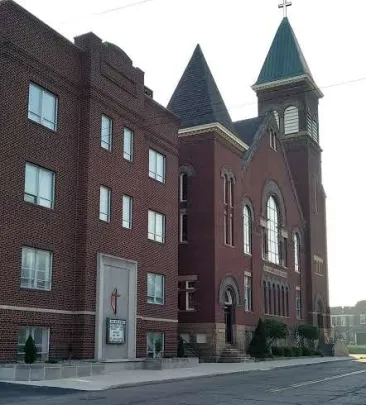
*You have been reading a message presented at Christ United Methodist Church on the date noted at the top of the first page. Rev. John Partridge is the pastor at Christ UMC in Alliance, Ohio. Duplication of this message is a part of our Media ministry, if you have received a blessing in this way, we would love to hear from you. Letters and donations in support of the Media ministry or any of our other projects may be sent to Christ United Methodist Church, 470 East Broadway Street, Alliance, Ohio 44601. These messages are available to any interested persons regardless of membership. You may subscribe to these messages, in print or electronic formats, by writing to the address noted, or by contacting us at secretary@CUMCAlliance.org. These messages can also be found online at https://pastorpartridge.com . All Scripture quotations, unless otherwise indicated, are taken from the Holy Bible, New International Version®, NIV®. Copyright ©1973, 1978, 1984, 2011 by Biblica, Inc.™ Used by permission of Zondervan. All rights reserved worldwide. www.zondervan.comThe “NIV” and “New International Version” are trademarks registered in the United States Patent and Trademark Office by Biblica, Inc.™


