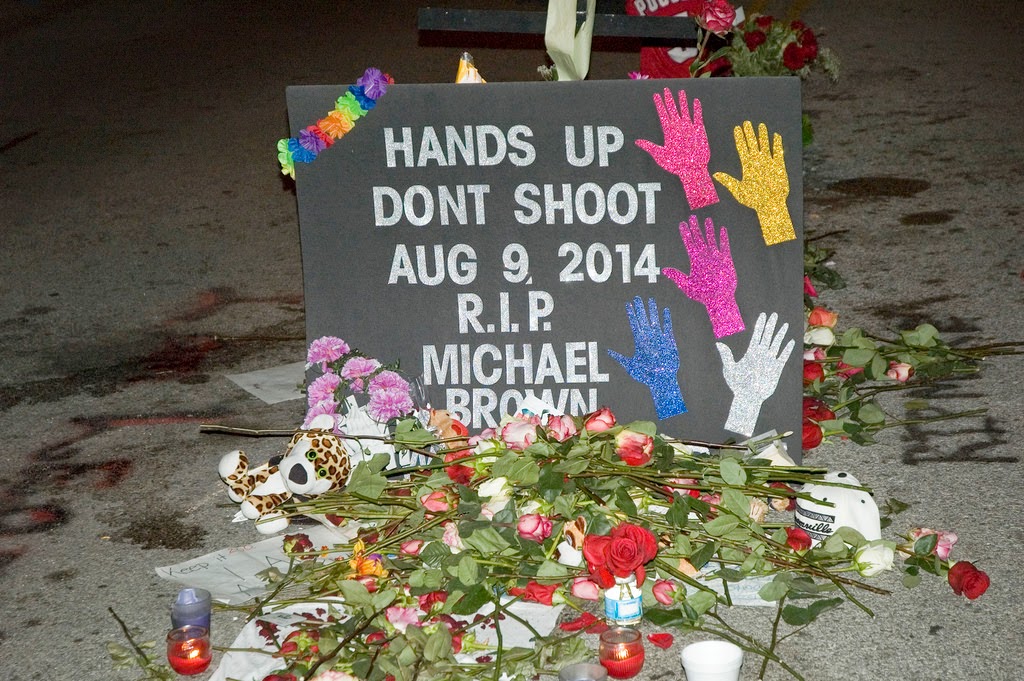
Ten (or more) Lessons from Ferguson


    Recently I read an article by Jeremy Smith, in United Methodist Insight, in which he wondered why more  clergy did not speak out on the events of Ferguson, Missouri.  In the article, Smith insists that when we don’t speak out about injustice, we make it seem that we aren’t responsible for things that happen far away from us.  In his words, “When I don’t speak up, I help turn the response into a pocket and not a whole garment of the human experience crying out for justice. “  He’s right of course, but I have a hard time speaking out about events like those in Ferguson because I am so personally ignorant, confused and conflicted by them.
    I’m a white guy and I grew up with the privileges that come with that.  Our family was far from wealthy, but I haven’t suffered from the subtle or overt discrimination that my non-white friends did.  I have not been pulled over by the police for “Driving While Black.”  I have no idea what that must be like. 
    I know that because I am white I do not fully appreciate all of the issues in play in the mess that is Ferguson, MO nor do I feel the impact of those events personally, as people of color undoubtedly do.  I know that anything I say about these events will lack understanding.   But Jeremy Smith is right, keeping silent allows injustice to continue and so I feel like I have to say something. 
    As followers of Jesus Christ we are called to stand against injustice, and there has been plenty on every side.  Not long ago, a colleague of mine posted a link to an article (to which I will not provide a link) that was so filled with hatred of hate and racism that it became hateful and racist itself.  In opposing racism, it named anyone who disagreed, for any reason, or for any principle, as a racist.  That sort of language is unhelpful and it doesn’t help any of us to think clearly.

    So here are ten lessons that we can learn from the mess that is sorting itself out (and will be for years) in Ferguson, MO:

1)      There is never an excuse to hate someone whose skin is a different color, simply because their skin is different color.  It isn’t okay to hate someone because they are black but neither is it okay to hate someone because they are not.
2)      In a town that has a population with a majority of African Americans, it is inconceivable that the police department can’t find African American recruits or that the imbalance should be so substantial.  As I understand it, the federal government is investigating this disparity, and they should.
3)      When there is injustice it should be okay to protest that injustice. Peacefully.

4)       Protests about injustice should not devolve into riots in which property is destroyed and innocents are put in the hospital, and worse.
5)      It’s not okay to use injustice as an excuse to cause injustice.
6)      It’s not okay to hurt someone who is on your side, just because they are the wrong color.
7)      It’s not okay (nor is it helpful) to destroy the businesses that have supported an abused community to make the point that the community has been abused.
8)      To say that it’s NOT okay doesn’t go far enough, it is flat out wrong, offensive, and even criminal, for the police department to try to disperse a riot by showing up dressed and equipped for a war.  Uniforms and weapons of war have no place on our streets.  I have no idea why anyone thought that showing up with M-16’s and armored personnel carriers was going to bring peace.
9)      While it is important, even necessary, for the media to have access to the story and for the story to get a wide distribution, there is a point at which the media becomesthe story.  From several stories that I read, from several very different media outlets, a point was reached when most citizens had gone home and rioters appeared, many from out of town, simply because the media was there.  I don’t know how we could, and we probably can’t and shouldn’t place restrictions on media access, but when the media’s presence makes the violence worse, something needs to be done.  Perhaps the media outlets themselves can agree on some sort of code of conduct, or organize a media pool as is often done in wartime, to share stories and prevent an area from being mobbed by reporters.
10)   As to who is guilty in the original event that triggered this mess, I have to admit that the conflicting reports in the media make me unsure.  A young man is dead and shouldn’t be.  I don’t know who is at fault, but I am sure that a careful investigation is needed.  I am also sure that the Ferguson Police are not the ones who should do the investigating.  In Ohio, it is standard procedure for accusations against social workers to be investigated by a neighboring (outside) social service agency.  Perhaps police departments ought to do the same with any officer involved shooting.
    Ultimately, there is plenty of fault to go around.  Ferguson may not be a “Perfect Storm” where everything went wrong, but a whole lot still went wrong.  The police got it wrong, the protestors got it wrong, the media got it wrong, and probably a few others as well.  But in every case, we, the people of God, the church, need to find a way to fight against injustice. 
All injustice. 
    We need to speak up against institutional racism.  We need to speak out against a police force that is preparing and equipping to fight a war against its own citizens.  We need to speak out against rioters who overshadow legitimate protestors and also against a media machine that makes problems worse instead of better.
    As followers of Jesus Christ, we are called to be salt and light to the world.  We are called to stand against injustice.  We are supposed to be doing all we can to make things better.
    The events of Ferguson, MO make it clear that no matter where we live, regardless of our race, we have a LOT of work to do.

—————————————————————————————————

To have Crossfusion delivered directly to your email, click here.

No, Mr. Oswalt, We Are Not All Good


    After the bombs exploded during the Boston Marathon, Patton Oswalt (from television sitcom the King of Queens) wrote a Facebook post that was quickly recopied and reposted around the world.  He said,
 “The good outnumber you, and we always will.” 
    This is a wonderful sentiment because Oswalt has already noticed that many people were running toward the explosion and not away from it.  People were not afraid as much as they were motivated to help those who had been hurt.  Finding this spirit and attitude in the American people is noteworthy and worthwhile.  I’m proud that we are not easily intimidated.  But after thinking about this, I realized that there was something bothering me.  Over time, I realized that ‘something’ was this: The good may outnumber the bad, but evil is never as far away as we would hope.
    I don’t mean to say that every human being is evil, but most of us are not as good as we like to imagine ourselves.  As hundreds of law enforcement officers were hunting down the bomber who was hiding in a boat stored in someone’s back yard, Patton Oswalt declares that most of us are good.  But are we?  After the bomber’s photograph had been discovered on surveillance tapes and distributed all around the world, what if he had been discovered sitting in a neighborhood bar or in some other public place?  I don’t mean, what would happen if the police discovered him, I mean, what would have happened if you or I were sitting at our neighborhood watering hole watching television and realized that the guy sitting next to us was the bomber we just saw on the news?
    Today, more than a month after the bombing, the chances are good that we would detain him until the police could arrive.  However, if he had been discovered in a public place the day after the bombing, it may well have been to coroner that came to get him instead of the police.
    Last month when Amanda Berry and the other girls were discovered in Cleveland, their rescuer, Charles Ramsey said something like, ‘It’s a good thing I didn’t know what he was doing next door or I would have gone over there with a baseball bat and it would be me the police were taking to jail.’
    I am a teacher of mercy, grace and forgiveness but if someone were to rape or murder a member of my family, they would probably be safer with the police.  That wouldn’t be the most Christian reaction, but I’m not sure how well I could control myself under those circumstances.
    Don’t get me wrong.  I’m just as inspired as you are by police, firefighters and others who run toward danger instead of away from it.  I’m glad that there are good people in the world who will rush to help a neighbor and that we come together as communities to help one another.
All I’m saying is this: We are not all good. 
There is darkness inside every one of us.
More often than not, the distance between good and evil is not nearly as great as we think.

Called to a Different Path


“Do not go where the path may lead, go instead where there is no path and leave a trail.” – Ralph Waldo Emerson 

    I am a Cleveland Indians fan.  I follow the Indians, not because they their winning record (obviously), but by accident of geography. I grew up in Northeast Ohio, went to high school in Akron, and my first job after college sent me to Cleveland for ten years.  As a Cleveland fan, Boston is considered to be an evil empire second only to the New York Yankees.  This week’s attack on the Boston Marathon (a very different thing than baseball) stirs in me the sort of protective feelings that siblings have for one another.  Feelings such as, “Nobody messes with my brother but me.” We don’t yet know who committed this horror, but the reaction of most Americans is, like mine, anger.  This is, I think, a natural and instinctive reaction, but a dangerous one as well.  As Christians, we need to carefully gauge our reactions so that our emotions do not draw us away from the path we have been called to follow.
    Anger is not evil.  Nor is it wrong or sinful to feel angry, but how we allow anger to motivate us, in what direction we allow anger to push us, may well be.  Anger over the attack on Pearl Harbor drew the United States into a war with Japan.  Anger over the attacks of September 11th provided support for wars against Iraq and Afghanistan.  These may, or may not, be proper if we judge them as a means of seeking justice or resisting aggression, but we cross a line when we allow hatred and revenge to become our motivation.
    As a follower of Jesus Christ, I do not believe, as some of my friends do, that we have been called to a path of non-violence or pacifism.  I do believe, however, that we have been called to a different path, a direction different than our instincts alone would lead us.
    In Leviticus, a book often noted for its violence, we find a warning that revenge will lead us astray.
“Do not seek revenge or bear a grudge against anyone among your people, but love your neighbor as yourself. I am the Lord.”  Leviticus 19:18
 
    But what if the perpetrator of this horror is not “among our people” but someone else?  Well, Jesus had something to say about that…
27 “But to you who are listening I say: Love your enemies, do good to those who hate you, 28 bless those who curse you, pray for those who mistreat you. 29 If someone slaps you on one cheek, turn to them the other also. If someone takes your coat, do not withhold your shirt from them. 30 Give to everyone who asks you, and if anyone takes what belongs to you, do not demand it back. 31 Do to others as you would have them do to you.
    This is hard.  Jesus wants us to do good to people who insist upon doing us harm.  Why?  Every fiber of my being wants to hit back when I am hit, to hurt the guy that hurts my family and to put the smack-down whoever did this thing to the people of Boston.  But that isn’t what Jesus had in mind.  Our calling is to a different path.  If you read the rest of the passage I just interrupted we get a few more details…
 “If you love those who love you, what credit is that to you? Even sinners love those who love them. 33 And if you do good to those who are good to you, what credit is that to you? Even sinners do that. 34 And if you lend to those from whom you expect repayment, what credit is that to you? Even sinners lend to sinners, expecting to be repaid in full. 35 But love your enemies, do good to them, and lend to them without expecting to get anything back. Then your reward will be great, and you will be children of the Most High, because he is kind to the ungrateful and wicked. 36 Be merciful, just as your Father is merciful. – Luke 6:27-28
    This is hard.  Why should we do good to those who seek to harm us?  Why should we be merciful?  Because we are called to follow a different path, a radical path, a path that calls us to love not only those who love us back, but everyone, whether they love us or not.  We are called to love the way that Jesus loved.
    Paul echoes these same feelings in his letter to the church in Rome and summarizes it by saying, “Do not be overcome by evil, but overcome evil with good.” (Romans 12:21)
    I don’t think that any of this means that we cannot protect ourselves or seek justice, only that we must guard ourselves from seeking revenge and retribution instead of justice, and being driven by hatred and vengeance instead of mercy and compassion.  
This isn’t the place our instincts would lead us.
We are called to follow a different path.

Do Not Lose Heart


    Americans are a resilient bunch.  Throughout our history we have been known to roll with the punches.  Our fights with the British roamed halfway across the continent from 1776 until 1812.  During the American Civil War between 600,000 and 700,000 lives were lost, then more through other wars including a devastating attack at Pearl Harbor and the more recent attacks in September 11, 2001.  While we have always come back after such horror, it is difficult for us to grapple with death on our home soil.  It has been a long time since 1812, but we understood that we were at war with England and the English, generally, only fought those who chose to fight.  Pearl Harbor was hard but it was, at least, an attack on a military target.  September 11th was different.  It shook us and caused many to begin looking for revenge.   Many joined the military to be a part of finding the perpetrators or at least to do something to be a part of our national defense.  
    After September 11th most everyone expected that there would be more of the same.  We knew we were in a “War on Terror” and so we expected that there would be more frequent attacks on American citizens and on American soil.  It is a huge credit to law enforcement and military personnel across the country and around the world that nearly all of the expected attacks since 2001 were discovered and averted before they could be carried out.  Until now…
    With this latest attack during the Boston Marathon many of our feelings revert to what we felt on September 11th.  At this time we do not know anything about the attacker(s), who they are, or where they are from, or why they did what they did.  We heard that a suspect has been arrested but that too, was premature.  We want revenge, we want retribution and a few may feel that somehow we should run away, or give up fighting.  Any of these responses will cause us to lose our way.  As Christians we are called to something different, to follow a different path.  Today I specifically want to speak to those who are frightened by these events.
    In scripture our temptation to surrender because of our fear is referred to as losing heart.  It is ‘heart’ that makes us who we are and what we are, it is ‘heart’ that makes us move forward in the face of fear.  In Hebrews 12 we are encouraged, when times are hard, to consider all that Jesus endured for us, “Consider him who endured such opposition from sinners, so that you will not grow weary and lose heart.” (Hebrews 12:3)  The prophet Jeremiah offers similar advice, especially in times like this, saying…
 “Do not lose heart or be afraid
    when rumors are heard in the land;
one rumor comes this year, another the next,
    rumors of violence in the land
    and of ruler against ruler.”
(Jeremiah 51:46)
    Remember that we are citizens of two nations, one is an earthly kingdom ruled by men, and the other an eternal kingdom ruled by the creator of the universe.  Our King has not forgotten us.  The Savior of the world still cares for us and watches over us.  Jesus knows your limits.  He knows how much you can take.  Find comfort and reassurance in knowing that even though…
He will not quarrel or cry out;
    no one will hear his voice in the streets.
20 A bruised reed he will not break,
    and a smoldering wick he will not snuff out,
till he has brought justice through to victory.
21 In his name the nations will put their hope.” (Matthew 12:19-21)
A bruised reed he will not break.  
A smoldering wick he will not snuff out.  
He knows what you need… and how you feel.
He hears your prayers and he understands your fear.

Are You Afraid?

Are you afraid?   
    Every day we open the newspaper or we turn on the radio or the television and we hear bad news.  Our economy is not in great shape.  Our government is spending more than it can afford.  Unemployment is at near historic levels and showing no sign of getting better soon.  We hear reports of doom and gloom almost constantly. 
How has this constant barrage of bad news affected you?
    As I have been reading reports from churches and other charities across the country the reports seem to share a common thread.  Fear.  After listening to the constant cries of disaster and doom people begin to grow afraid for their future.  When people are afraid, they begin to act in ways that reflect their fear.  When we are afraid, we become far more conservative financially, our worries for the future cause us to spend less, pay down credit cards and even save a little more in the bank.  When we are afraid, sometimes without even being consciously aware of it, we pull back and prepare for a rainy day; we are, as a society, waiting for the other shoe to drop.  This mentality is widespread.  The stock markets react violently to even the tiniest piece of bad news and only hesitantly move forward when there is good news.  Retail sales and other measures of consumer spending are not especially good at least partially because people are not confident of how things will be next month, or next year.  People are afraid.
The funny thing is that most of us have no real reason to be afraid.  
    Most of us have the same jobs that we had last year and the year before that.  Many of us have continued to get the same sorts of raises that we have always gotten.  Except for what we seem to be spending on gasoline, our expenses are not significantly changed from what we have been accustomed to for a long time.  Obviously there are exceptions.  One of my brothers has been out of work for more than two years and he is not alone.  Many folks are hurting.  The rest of us however, are living pretty much the same lives that we were living before the recession began several years ago.  For us, our fear has little or no basis in reality.  We are afraid, only because the evening news seems to tell us that we should be and something about that is not right.  

Why should we act as if we are afraid if we have no real reason to actually be afraid?

    As Christians we have another, even better, reason to resist this kind of fear.  Our fear seems to come from our worries about what the President or the Congress will or will not do.  Our fear seems to come from our worries about the economy and other things far outside out control or understanding.  Instead of allowing these worrisome times to make us afraid, we should remember who is in control.  Psalm 20:7 reminds us that “Some trust in chariots and some in horses, but we trust in the name of the LORD our God.”  And if we even momentarily considered putting our trust in our bank accounts or in our government, Job is there to remind us that “What they trust in is fragile what they rely on is a spider’s web.  They lean on the web, but it gives way; they cling to it, but it does not hold.”  Nahum 1:7 tells us that “The LORD is good, a refuge in times of trouble. He cares for those who trust in him.”  Just because we are people of faith, does not mean that we are immune to fear, but the when fear springs up inside of us we remember this: “When I am afraid, I put my trust in you.  In God, whose word I praise, in God I trust and am not afraid.  What can mere mortals do to me?” (Psalm 56:3-4)
    As followers of Jesus Christ we are called to put our trust in him and not in the fluctuations of economies and governments that we cannot control.  All of these things are under his command and it is our job to trust in him.  Daniel was literally thrown to the lions but we should remember that “when Daniel was lifted from the den, no wound was found on him, because he had trusted in his God.” (Daniel 6:23) 
    We hear bad news every day and honestly, I have begun to listen to the news less often because of it.  I am not hiding from the truth, but I don’t need to be constantly beaten with it either.  I hope that you will remember that we have no need to fear.  Whenever we are tempted to be afraid, we need to ask ourselves a single important question…
Who do you trust?