

Promise Fulfilled… and Expanded

Promise Fulfilled… and Expanded

(Fourth Sunday of Advent)

December 21, 2025*

By Pastor John Partridge

Isaiah 7:10-16                        Romans 1:1-7             Matthew 1:18-25

Today we celebrate the fourth Sunday in Advent, the Sunday that we remember Love. In previous weeks we have often spoken of God’s message of hope and the faithfulness of God demonstrated to us by the way in which he keeps his promises. But as we read the scriptures for today, what we discover is that God has not only fulfilled his promises to his people, but that his love is so amazing that he expanded and extended that fulfillment in a way that his people, and the world, never expected. We begin this morning by reading the promise of God given through his prophet Isaiah both to the people of God in the time of King Ahaz, eight hundred years before the birth of Jesus, and to future generations and beyond. Reading from Isaiah 7:10-16, we hear this:

10 Again the Lord spoke to Ahaz, 11“Ask the Lord your God for a sign, whether in the deepest depths or in the highest heights.”

12 But Ahaz said, “I will not ask; I will not put the Lord to the test.”

13 Then Isaiah said, “Hear now, you house of David! Is it not enough to try the patience of humans? Will you try the patience of my God also? 14 Therefore the Lord himself will give youa sign: The virginwill conceive and give birth to a son, and will call him Immanuel. 15 He will be eating curds and honey when he knows enough to reject the wrong and choose the right, 16 for before the boy knows enough to reject the wrong and choose the right, the land of the two kings you dread will be laid waste.

God’s promise to King Ahaz wasn’t just a future promise of a messiah eight hundred years in his future, but may have been fulfilled in the normal pregnancy of Isaiah’s daughter. It was a short enough time that, although at least eight or nine months in the future, Ahaz could find comfort in knowing that it would not be long before the threat of the two kings he feared would end. But that promise was always understood to be something more than just a baby that would be born in a year or so. God’s people read this and had long understood that it was about something more, about a rescuer that would come long after the time of Isaiah and King Ahaz, but about a messiah that would rescue Israel and its people forever.

And it is this understanding that that anchors the words of the apostle Matthew as he tells the story of Jesus’ birth in Matthew 1:18-25:

18 This is how the birth of Jesus the Messiah came about: His mother Mary was pledged to be married to Joseph, but before they came together, she was found to be pregnant through the Holy Spirit. 19 Because Joseph her husband, was faithful to the law, and yetdid not want to expose her to public disgrace, he had in mind to divorce her quietly.

20 But after he had considered this, an angel of the Lord appeared to him in a dream and said, “Joseph son of David, do not be afraid to take Mary home as your wife, because what is conceived in her is from the Holy Spirit. 21 She will give birth to a son, and you are to give him the name Jesus, because he will save his people from their sins.”

22 All this took place to fulfill what the Lord had said through the prophet: 23 “The virgin will conceive and give birth to a son, and they will call him Immanuel” (which means “God with us”).

24 When Joseph woke up, he did what the angel of the Lord had commanded him and took Mary home as his wife. 25 But he did not consummate their marriage until she gave birth to a son. And he gave him the name Jesus.

By connecting his description of Mary’s pregnancy with the prophecy of Isaiah, Matthew declares to the world that the prophecy that had long been believed to be about Israel’s promised messiah had finally been fulfilled in a more permanent way than it had been in the time of King Ahaz. Matthew’s declaration is that the time had come for God to rescue Israel and his people forever. It is for that reason, Matthew declares, that the rest of his story, what we now know as the gospel message of the book of Matthew, is something that was of the utmost importance.

But even that doesn’t go far enough. As we read Paul’s letter to the church in Rome, we hear him point to the ancient messianic prophecies of the prophets and their fulfillment in the life, death, and resurrection of Jesus Christ, but then we also hear him declare the great expansion of God’s grace. In Romans 1:1-7, we hear this:

1:1Paul, a servant of Christ Jesus, called to be an apostle and set apart for the gospel of God— the gospel he promised beforehand through his prophets in the Holy Scriptures regarding his Son, who as to his earthly lifewas a descendant of David, and who through the Spirit of holiness was appointed the Son of God in powerby his resurrection from the dead: Jesus Christ our Lord. Through him we received grace and apostleship to call all the Gentiles to the obedience that comes fromfaith for his name’s sake. And you also are among those Gentiles who are called to belong to Jesus Christ.

To all in Rome who are loved by God and called to be his holy people:

Grace and peace to you from God our Father and from the Lord Jesus Christ.

Paul begins by reminding everyone that the gospel, the story of the Jesus’ birth, life, death, and resurrection, was a story that had been promised throughout the ages by God’s prophets. But Paul goes on to say that through Jesus, God has expanded on the message of the prophets and opened the doors of his grace and apostleship to all of the people that weren’t Jewish, to all of the Gentiles, so that all the people in all the world might come to obedience and faith in Jesus. Paul then reminds the people reading that letter, the people of the church in Rome, that they are among the Gentiles that are called to belong to Jesus, but then the big shoe drops. Paul then says that everyone in Rome is loved by God and is called to join his holy people.

And that’s a big deal.

In Christian circles, because of its power, its politics, its corruption, its polytheistic religions, its historic hostility towards Israel and the Jewish people, and the lingering cultural hatred ingrained Rome’s treatment of Jesus and the entirety of the Jewish people, Rome was often described as evil and cast as the bad guy. In Revelation 17:5, John goes as far as to describe Rome as “Babylon the great mother of prostitutes and of the abominations of the earth.” But Paul flips the script and reminds the people of the church that despite the things that Rome and its people have done, God still loves every one of them and calls them to join his family.

For thousands of years, the prophets of Israel told the people about God’s promises of a coming messiah.

And, with the coming of Jesus, his birth, life, death, and resurrection, God gave flesh to the words of the prophets and fulfilled his promises to his people. But God’s love was bigger than what could be contained in the words of his prophets and the coming of Jesus expanded on God’s grace and mercy, and invited the entire world to become the people, and the apostles of Israel’s God. Even those who God’s people often had thought of as being the most evil and corrupt were told that God loved them and was calling them to become his holy people.

As we celebrate Christmas this week, we are reminded that, like the people of Rome, we are among the Gentiles that are being called to belong to Jesus. And, like the people of Rome, there is no one on the face of the earth, that is so evil, or so corrupt, or so wrong in their present religion or beliefs, that God doesn’t love them.

As he has since the time of Jesus, God is calling the people of the entire world, with no exclusions, to become beloved and holy members of his family… if they will only hear his call and come to obedience and faith in his son Jesus Christ.

There are people that you know that desperately need to hear this.

Let’s make every effort to tell them.

Because that is the mission to which God has called us.


Please LIKE and SHARE!

Click here to subscribe to Pastor John’s blog.

Click here if you would like to subscribe to Pastor John’s weekly messages.

Click here to visit Pastor John’s YouTube channel.


*You have been reading a message presented at Christ United Methodist Church on the date noted at the top of the first page.  Rev. John Partridge is the pastor at Christ UMC in Alliance, Ohio.  Duplication of this message is a part of our Media ministry, if you have received a blessing in this way, we would love to hear from you.  Letters and donations in support of the Media ministry or any of our other projects may be sent to Christ United Methodist Church, 470 East Broadway Street, Alliance, Ohio 44601.  These messages are available to any interested persons regardless of membership.  You may subscribe to these messages, in print or electronic formats, by writing to the address noted, or by contacting us at secretary@CUMCAlliance.org.  These messages can also be found online at https://pastorpartridge.com .  All Scripture quotations, unless otherwise indicated, are taken from the Holy Bible, New International Version®, NIV®. Copyright ©1973, 1978, 1984, 2011 by Biblica, Inc.™ Used by permission of Zondervan. All rights reserved worldwide. www.zondervan.comThe “NIV” and “New International Version” are trademarks registered in the United States Patent and Trademark Office by Biblica, Inc.™


Promise, Proof, Patience

Promise, Proof, Patience

(Third Sunday of Advent)

December 14, 2025*

By Pastor John Partridge

Isaiah 35:1-10                        James 5:7-10              Matthew 11:2-11

At the end of last week’s service, we remembered that there is more to the meaning of peace than the absence of war. It is, instead, a place of comfort and an absence of stress and conflict such that we can have peace even in the midst of war. But this week, as we celebrate the third Sunday of Advent, we celebrate joy. But again, what is joy? We talk a lot about joy, especially during the Advent and Christmas seasons, and a great many works of art and music reference or speak openly of joy. Ludwig van Beethoven wrote the Ode to Joy in which he describes joy as a beautiful spark of divinity and a daughter of Elysium, the hymn, Joyful, Joyful We Adore Thee, which is also known as the Hymn of Joy, says that all the works of God surround him with joy. All of these teach that joy comes from the power that God has demonstrated, the character of who God is, the love that God has shown to his creation, and the faithfulness that God has demonstrated in keeping his promises. Much of what we read and remember during the seasons of Advent and Christmas focus on that, on the fulfillment of God’s promises to his people. And that is what we see in our scriptures as we begin this morning by reading the promises of God given to his people through the prophet Isaiah in Isaiah 35:1-10 where we hear these words:

35:1 The desert and the parched land will be glad;
    the wilderness will rejoice and blossom.
Like the crocus, it will burst into bloom;
    it will rejoice greatly and shout for joy.
The glory of Lebanon will be given to it,
    the splendor of Carmel and Sharon;
they will see the glory of the Lord,
    the splendor of our God.

Strengthen the feeble hands,
    steady the knees that give way;
say to those with fearful hearts,
    “Be strong, do not fear;
your God will come,
    he will come with vengeance;
with divine retribution
    he will come to save you.”

Then will the eyes of the blind be opened
    and the ears of the deaf unstopped.
Then will the lame leap like a deer,
    and the mute tongue shout for joy.
Water will gush forth in the wilderness
    and streams in the desert.
The burning sand will become a pool,
    the thirsty ground bubbling springs.
In the haunts where jackals once lay,
    grass and reeds and papyrus will grow.

And a highway will be there;
    it will be called the Way of Holiness;
    it will be for those who walk on that Way.
The unclean will not journey on it;
    wicked fools will not go about on it.
No lion will be there,
    nor any ravenous beast;
    they will not be found there.
But only the redeemed will walk there,
10     and those the Lord has rescued will return.
They will enter Zion with singing;
    everlasting joy will crown their heads.
Gladness and joy will overtake them,
    and sorrow and sighing will flee away.

God says that the desert will bloom, Israel will become as green and as verdant as the nation of Lebanon which supplied much of the ancient world with the massive cedar timbers that were used to build temples and other important buildings. He says that the eyes of the blind would be opened, the deaf would hear, the lame would be healed, the mute would speak, and Israel would become a place of safety and holiness. And it is precisely those promises that we hear Jesus lift up when John the Baptist began to have doubts and sent his disciples to ask if Jesus is really the Messiah that God had promised. We find that story in the words of Matthew in Matthew 11:2-11 when he says:

When John, who was in prison, heard about the deeds of the Messiah, he sent his disciples to ask him, “Are you the one who is to come, or should we expect someone else?”

Jesus replied, “Go back and report to John what you hear and see: The blind receive sight, the lame walk, those who have leprosyare cleansed, the deaf hear, the dead are raised, and the good news is proclaimed to the poor. Blessed is anyone who does not stumble on account of me.”

As John’s disciples were leaving, Jesus began to speak to the crowd about John: “What did you go out into the wilderness to see? A reed swayed by the wind? If not, what did you go out to see? A man dressed in fine clothes? No, those who wear fine clothes are in kings’ palaces. Then what did you go out to see? A prophet? Yes, I tell you, and more than a prophet. 10 This is the one about whom it is written:

“‘I will send my messenger ahead of you,
    who will prepare your way before you.’

11 Truly I tell you, among those born of women there has not risen anyone greater than John the Baptist; yet whoever is least in the kingdom of heaven is greater than he.

When John asks if Jesus is the Messiah that God had promised, Jesus points back to the words of Isaiah and simply says, “Go back and report… what you hear and see.” The blind see, the deaf hear, the lame walk, the incurable is cured, the dead are raised, and the good news of God even reaches the poor. After John’s disciples leave to give him the message, Jesus goes on to say that the mission of John the Baptist had been exactly what the prophet Malachi had foretold, to prepare the way for the arrival of the Messiah.

“‘I will send my messenger ahead of you,
    who will prepare your way before you.’
(Malachi 3:1)

Jesus says that if there is any doubt that he is the Messiah, then just look at the proof the everyone could see with their own eyes. Jesus was doing the things that God’s prophets had predicted hundreds of years earlier. But not all of them. Some of the things that God promised through Isaiah did not come to pass in the time of Jesus and have not yet happened in our own time. This was understood in the first century as much as it is today. Israel had not yet achieved the greatness that Isaiah described, the desert has not yet been transformed, and Jerusalem is not yet a place of safety and holiness. But as God’s people considered these things, the Apostle James encouraged them by saying that just because it had not happened yet, didn’t mean that it wasn’t going to happen. In James 5:7-10 he said:

Be patient, then, brothers and sisters, until the Lord’s coming. See how the farmer waits for the land to yield its valuable crop, patiently waiting for the autumn and spring rains. You too, be patient and stand firm, because the Lord’s coming is near. Don’t grumble against one another, brothers and sisters, or you will be judged. The Judge is standing at the door!

10 Brothers and sisters, as an example of patience in the face of suffering, take the prophets who spoke in the name of the Lord.

James, and the people of the first century understood that while Jesus had not fulfilled all of God’s promises during his time on earth, that he had fulfilled enough to prove that he was the Messiah and would fulfill the remaining promises upon his return. Until then, James said, be patient. Just as farmers must be patient as they wait for a crop that they have planted, we must have faith in the process and wait. We must be patient and stand firm in our faith and trust in God’s character. And as we wait, we must treat each other well and not grumble and complain about what other siblings in Christ are doing or how they do it. James understood the truth that many of those in the church in the first century, and in the twenty-first century, did not have a great life. Many of those who believed in Jesus Christ had endured suffering and few of us can escape suffering as we live our lives upon the earth. As such, James points to the prophets themselves, nearly all of whom suffered even after answering the call to speak for God. But even in their suffering, they were patient because they knew that God would be victorious over evil and they trusted their lives, their futures, their descendants, and their eternity in God’s hands.

The message of joy that we hear during the season of Advent is that our God is faithful and always keeps his promises. He has proven his faithfulness in the life, death, and resurrection of his son, Jesus, and we are called to be patient as we endure the suffering and struggle of our lives on earth until the return of Jesus Christ, and his final victory over sin and death.

In the stories of scripture, and in the stories of Christmas, we have seen the evidence of God’s faithfulness…

…and we are filled with joy.


Please LIKE and SHARE!

Click here to subscribe to Pastor John’s blog.

Click here if you would like to subscribe to Pastor John’s weekly messages.

Click here to visit Pastor John’s YouTube channel.


*You have been reading a message presented at Christ United Methodist Church on the date noted at the top of the first page.  Rev. John Partridge is the pastor at Christ UMC in Alliance, Ohio.  Duplication of this message is a part of our Media ministry, if you have received a blessing in this way, we would love to hear from you.  Letters and donations in support of the Media ministry or any of our other projects may be sent to Christ United Methodist Church, 470 East Broadway Street, Alliance, Ohio 44601.  These messages are available to any interested persons regardless of membership.  You may subscribe to these messages, in print or electronic formats, by writing to the address noted, or by contacting us at secretary@CUMCAlliance.org.  These messages can also be found online at https://pastorpartridge.com .  All Scripture quotations, unless otherwise indicated, are taken from the Holy Bible, New International Version®, NIV®. Copyright ©1973, 1978, 1984, 2011 by Biblica, Inc.™ Used by permission of Zondervan. All rights reserved worldwide. www.zondervan.comThe “NIV” and “New International Version” are trademarks registered in the United States Patent and Trademark Office by Biblica, Inc.™
(Insert Your Name Here)

 (Insert Your Name Here)

December 24, 2023*

By Pastor John Partridge

2 Samuel 7:1-11, 16               Luke 1:26-38                          Romans 16:25-27

There is a scene in the 1978 movie, National Lampoon’s “Animal House,” where the new class of pledges for the Delta House are sworn into the fraternity. In it, they are asked to say “I… state your name… “and every single one of them says the words “state your name” instead of saying their name. And we all laughed because we all assume that everyone knows what to do in such a situation. Whenever we fill out forms for our schools, doctors, insurance companies, the Internal Revenue Service, retirement funds, and all sorts of other things, we encounter a box or a line that asks us for our name. At other times, we have been asked to include our names in a script where we take an oath of office, or are sworn into the military, or, in this case, a fraternity, we just include our own names where we are told to do so.

But as common as it is in our everyday lives, we often miss it when the same thing happens as we read scripture. And that’s a point that I want to make today. As we make our final preparations for Christmas tomorrow morning, it’s important for us to remember that we are included in the story of scripture. We aren’t everywhere, of course, because the story is about characters that are so familiar to us. This morning we will hear about King David, the prophet Nathan, the angel Gabriel, Elizabeth, Mary, the Apostle Paul, and… (insert your name here).

We begin with God’s words found in 2 Samuel 7:1-11, 16 where we hear God’s promise to King David given through his prophet Nathan:

7:1 After the king was settled in his palace and the Lord had given him rest from all his enemies around him, he said to Nathan the prophet, “Here I am, living in a house of cedar, while the ark of God remains in a tent.”

Nathan replied to the king, “Whatever you have in mind, go ahead and do it, for the Lord is with you.”

But that night the word of the Lord came to Nathan, saying:

“Go and tell my servant David, ‘This is what the Lord says: Are you the one to build me a house to dwell in? I have not dwelt in a house from the day I brought the Israelites up out of Egypt to this day. I have been moving from place to place with a tent as my dwelling. Wherever I have moved with all the Israelites, did I ever say to any of their rulers whom I commanded to shepherd my people Israel, “Why have you not built me a house of cedar?”’

“Now then, tell my servant David, ‘This is what the Lord Almighty says: I took you from the pasture, from tending the flock, and appointed you ruler over my people Israel. I have been with you wherever you have gone, and I have cut off all your enemies from before you. Now I will make your name great, like the names of the greatest men on earth. 10 And I will provide a place for my people Israel and will plant them so that they can have a home of their own and no longer be disturbed. Wicked people will not oppress them anymore, as they did at the beginning 11 and have done ever since the time I appointed leadersover my people Israel. I will also give you rest from all your enemies.

16 Your house and your kingdom will endure forever before me; your throne will be established forever.’”

David had finally become secure in his leadership of Israel. He has built a palace, united the twelve tribes, settled, and secured the borders with other nations, and at this moment he looks at the tent that houses God’s tabernacle and imagines that it is time to build a permanent dwelling place for the Ark of the Covenant and for Israel’s God. But God isn’t having any of that just yet. God’s words to David are that he is not the one who has been called to build God’s house. Instead, God reminds David of his roots and humble beginnings, how God brought David to this place, how God will place the name of David among the greatest men on the planet, and how God has plans that extend far beyond David’s lifetime. God promises that David’s family, and David’s kingdom will endure forever.

God’s message to David is, “Look how far you have come. Look at how far I have brought you. And I’m not even close to being done yet.”

And that leads us back to the Christmas story in Luke 1:26-38 where God sends the angel Gabriel to visit Mary and announce her pregnancy.

26 In the sixth month of Elizabeth’s pregnancy, God sent the angel Gabriel to Nazareth, a town in Galilee, 27 to a virgin pledged to be married to a man named Joseph, a descendant of David. The virgin’s name was Mary. 28 The angel went to her and said, “Greetings, you who are highly favored! The Lord is with you.”

29 Mary was greatly troubled at his words and wondered what kind of greeting this might be. 30 But the angel said to her, “Do not be afraid, Mary; you have found favor with God. 31 You will conceive and give birth to a son, and you are to call him Jesus. 32 He will be great and will be called the Son of the Most High. The Lord God will give him the throne of his father David, 33 and he will reign over Jacob’s descendants forever; his kingdom will never end.”

34 “How will this be,” Mary asked the angel, “since I am a virgin?”

35 The angel answered, “The Holy Spirit will come on you, and the power of the Most High will overshadow you. So, the holy one to be born will be calledthe Son of God. 36 Even Elizabeth your relative is going to have a child in her old age, and she who was said to be unable to conceive is in her sixth month. 37 For no word from God will ever fail.”

38 “I am the Lord’s servant,” Mary answered. “May your word to me be fulfilled.” Then the angel left her.

Mary wonders how this could happen. She knows where babies come from, but she also knows that she and Joseph have not yet slept together. Given that their two families do not live in the same town, the chances are good that she and Joseph rarely, if ever, see one another, and it’s quite possible that she hasn’t seen him at all since the contract was signed pledging them to be married. But as difficult as it is to believe, Mary accepts her role in this unfolding drama saying, “May your word to me be fulfilled.”

It is important to notice that Gabriel also affirms God’s promise to David, and Mary understands that she will be a part of the fulfillment of that promise. God promises that Mary’s son will inherit the throne of King David and become a part of a kingdom that will never end. And so, Mary clings to God’s promise. If God has come this far, over thousands of years, to fulfill his promise to David, Mary’s prayer is that God will do the same for his promise to her, saying, “May your word to me be fulfilled.”

But what does that have to do with us?

Where is the fill in the blank part?

And as we often do, we find the application in Romans 16:25-27, in the very last words of Paul’s letter to the church in Rome where he says…

25 Now to him who is able to establish you in accordance with my gospel, the message I proclaim about Jesus Christ, in keeping with the revelation of the mystery hidden for long ages past, 26 but now revealed and made known through the prophetic writings by the command of the eternal God, so that all the Gentiles might come to the obedience that comes fromfaith— 27 to the only wise God be glory forever through Jesus Christ! Amen.

And there it was. Did you hear it, or did you miss it?

Paul says that God has revealed his salvation, through his son Jesus Christ, through the writings of the prophets of Israel… so that… all the nations, or in another translation all the Gentiles, might come to obedience and faith. God says that the entire journey of the people of Israel, through Abraham, David, and to the Christmas story, Mary, Joseph, and Jesus, the entire story was commanded by God for the purpose of bringing hope to the world and calling the Gentiles, and all the nations of the world, to faith in Jesus.

That is where you can insert your name.

Paul said, “the message I proclaim about Jesus Christ, in keeping with the revelation of the mystery hidden for long ages past, 26 but now revealed and made known through the prophetic writings by the command of the eternal God, so that (insert your name here) might come to the obedience that comes fromfaith…”

But the story isn’t over.

The story wasn’t over when God brought David from herding sheep to unite the twelve tribes of Israel, and the story wasn’t over with the birth, life, death, and resurrection of Jesus. God did all these things so that all nations, and all people, might come to obedience and faith in Jesus Christ.

There is still work to do.

And God is calling each one of you, (insert your name here) to finish the job.


Please LIKE and SHARE!

Click here to subscribe to Pastor John’s blog.

Click here if you would like to subscribe to Pastor John’s weekly messages.

Click here to visit Pastor John’s YouTube channel.


*You have been reading a message presented at Christ United Methodist Church on the date noted at the top of the first page.  Rev. John Partridge is the pastor at Christ UMC in Alliance, Ohio.  Duplication of this message is a part of our Media ministry, if you have received a blessing in this way, we would love to hear from you.  Letters and donations in support of the Media ministry or any of our other projects may be sent to Christ United Methodist Church, 470 East Broadway Street, Alliance, Ohio 44601.  These messages are available to any interested persons regardless of membership.  You may subscribe to these messages, in print or electronic formats, by writing to the address noted, or by contacting us at secretary@CUMCAlliance.org.  These messages can also be found online at https://pastorpartridge.com .  All Scripture quotations, unless otherwise indicated, are taken from the Holy Bible, New International Version®, NIV®. Copyright ©1973, 1978, 1984, 2011 by Biblica, Inc.™ Used by permission of Zondervan. All rights reserved worldwide. www.zondervan.comThe “NIV” and “New International Version” are trademarks registered in the United States Patent and Trademark Office by Biblica, Inc.™

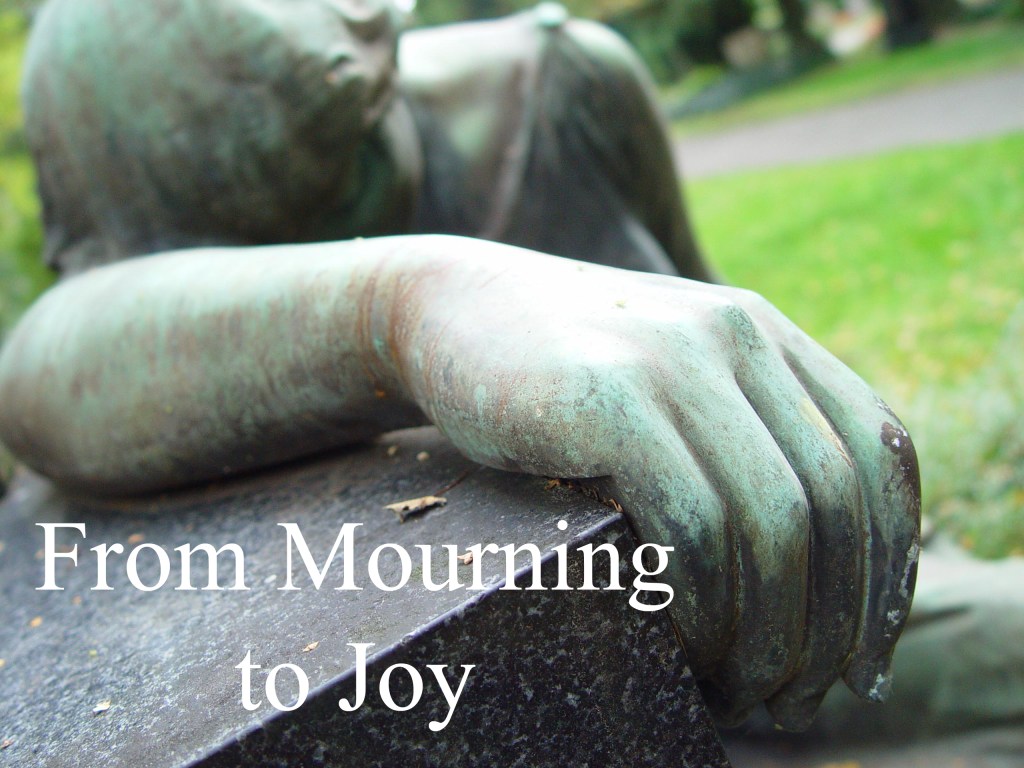
From Mourning to Joy

From Mourning to Joy

December 17, 2023*

By Pastor John Partridge

Isaiah 61:1-4, 8-11                 John 1:6-8, 19-28                          1 Thessalonians 5:16-24

On June second of 2022, seventeen-year-old Ethan Liming, the son of United Methodist Pastor Bill Liming, was beaten to death during an altercation at a basketball court in downtown Akron. This week we were notified that another of our East Ohio Conference colleagues, Beth Wilterdink, with whom Mike Greiner and I have served on the conference committee on camps and retreats, is mourning, with her husband and family, the loss of their barely two-year-old daughter Cora. I can read about these things, but I can’t begin to understand the pain and the grief that these families must feel.

But many of us have experienced our own kinds of loss. Some of you have lost children, many of us have lost parents or siblings. We each understand grief in our own way. And so, we have some insight into the lives of the people who heard God’s message through his prophet Isaiah. These were the people who had lost everything. They had lost sons, daughters, husbands, wives, brothers, sisters, parents, and grandparents, they had lost their nation and their freedom and had been carried off into captivity in Babylon. They were filled with grief. But God speaks to them through the writings of Isaiah and tells them that in the midst of their grief, there is good news. We hear these words in Isaiah 61:1-4, 8-11…

61:1 The Spirit of the Sovereign Lord is on me, because the Lord has anointed me
    to proclaim good news to the poor.
He has sent me to bind up the brokenhearted, to proclaim freedom for the captives
    and release from darkness for the prisoners,
to proclaim the year of the Lord’s favor and the day of vengeance of our God,
to comfort all who mourn,
    and provide for those who grieve in Zion— to bestow on them a crown of beauty
    instead of ashes, the oil of joy instead of mourning, and a garment of praise
    instead of a spirit of despair.
They will be called oaks of righteousness, a planting of the Lord for the display of his splendor.

They will rebuild the ancient ruins and restore the places long devastated;
they will renew the ruined cities that have been devastated for generations.

“For I, the Lord, love justice;I hate robbery and wrongdoing.
In my faithfulness I will reward my people and make an everlasting covenant with them.
Their descendants will be known among the nations and their offspring among the peoples.
All who see them will acknowledge that they are a people the Lord has blessed.”

10 I delight greatly in the Lord;my soul rejoices in my God.
For he has clothed me with garments of salvation and arrayed me in a robe of his righteousness,
as a bridegroom adorns his head like a priest, and as a bride adorns herself with her jewels.
11 For as the soil makes the sprout come up and a garden causes seeds to grow,
so the Sovereign Lord will make righteousness and praise spring up before all nations.

God says that there will be healing for the brokenhearted, release for prisoners, comfort for those who mourn, and God promises to transform the ashes of their grief into a crown of beauty. God promises to rebuild, restore, and renew, and to bring justice and faithfulness to replace their despair and loss. And in the end, God will use the nations of the world to raise up gardens of righteousness and praise.

In no way does God, or Isaiah, diminish the pain, loss, and grief that we experience today, God does not tell us to “get over it,” but God does promise that he will, one day, transform our grief into joy.

But, because John the Baptist had been quoting from the words of Isaiah, the priests and the leaders of Israel came out to the wilderness in John 1:6-8, 19-28 to ask if he was a resurrected Isaiah that God had sent to fulfill the promises that had been written so long ago.

There was a man sent from God whose name was John. He came as a witness to testify concerning that light, so that through him all might believe. He himself was not the light; he came only as a witness to the light.

19 Now this was John’s testimony when the Jewish leaders in Jerusalem sent priests and Levites to ask him who he was. 20 He did not fail to confess, but confessed freely, “I am not the Messiah.”

21 They asked him, “Then who are you? Are you Elijah?”

He said, “I am not.”

“Are you the Prophet?”

He answered, “No.”

22 Finally they said, “Who are you? Give us an answer to take back to those who sent us. What do you say about yourself?”

23 John replied in the words of Isaiah the prophet, “I am the voice of one calling in the wilderness, ‘Make straight the way for the Lord.’”

24 Now the Pharisees who had been sent 25 questioned him, “Why then do you baptize if you are not the Messiah, nor Elijah, nor the Prophet?”

26 “I baptize with water,” John replied, “but among you stands one you do not know. 27 He is the one who comes after me, the straps of whose sandals I am not worthy to untie.”

28 This all happened at Bethany on the other side of the Jordan, where John was baptizing.

But John says that he is not Isaiah, nor is he Elijah, nor is he the promised messiah. Instead, he has come to point to the Messiah, to announce his arrival, and to proclaim the fulfillment of God’s promises in Isaiah in the person of Jesus Christ.

But, knowing that Jesus is the Messiah, as we do, what does that mean for us today? What does that tell us about our grief, and our pain, and how we are to live our lives in the twenty-first century? In his letter to the church in Thessalonica, contained in 1 Thessalonians 5:16-24, Paul says this:

16 Rejoice always, 17 pray continually, 18 give thanks in all circumstances; for this is God’s will for you in Christ Jesus.

19 Do not quench the Spirit. 20 Do not treat prophecies with contempt 21 but test them all; hold on to what is good, 22 reject every kind of evil.

23 May God himself, the God of peace, sanctify you through and through. May your whole spirit, soul and body be kept blameless at the coming of our Lord Jesus Christ. 24 The one who calls you is faithful, and he will do it.

Paul says that God’s will for us is to live in anticipation of God’s final and ultimate victory. We are to live as if Christ has already returned, and God has already fulfilled his promises of rescue, rebuilding, restoration, renewal, and transformation. Rejoice always, pray continually, give thanks in all circumstances, test the prophecies of God to prove their truthfulness, reject every kind of evil, but hold on to all that is good.

In this world, we know that we will experience suffering, pain, grief, and death.

But one day God will transform our mourning into joy.

Until then…

…reject every kind of evil and…

                                    …hold on to what is good.


Please LIKE and SHARE!

Click here to subscribe to Pastor John’s blog.

Click here if you would like to subscribe to Pastor John’s weekly messages.

Click here to visit Pastor John’s YouTube channel.


*You have been reading a message presented at Christ United Methodist Church on the date noted at the top of the first page.  Rev. John Partridge is the pastor at Christ UMC in Alliance, Ohio.  Duplication of this message is a part of our Media ministry, if you have received a blessing in this way, we would love to hear from you.  Letters and donations in support of the Media ministry or any of our other projects may be sent to Christ United Methodist Church, 470 East Broadway Street, Alliance, Ohio 44601.  These messages are available to any interested persons regardless of membership.  You may subscribe to these messages, in print or electronic formats, by writing to the address noted, or by contacting us at secretary@CUMCAlliance.org.  These messages can also be found online at https://pastorpartridge.com .  All Scripture quotations, unless otherwise indicated, are taken from the Holy Bible, New International Version®, NIV®. Copyright ©1973, 1978, 1984, 2011 by Biblica, Inc.™ Used by permission of Zondervan. All rights reserved worldwide. www.zondervan.comThe “NIV” and “New International Version” are trademarks registered in the United States Patent and Trademark Office by Biblica, Inc.™

Neighbors Know?

Neighbors Know?

January 22, 2023*

By Pastor John Partridge

Isaiah 9:1-4                Matthew 4:12-23                   1 Corinthians 1:10-18

Patti and I have a friend who was once talking to his next-door neighbor on his phone while searching for a particular kitchen gadget.  His neighbor, looking out her kitchen window, which window was opposite his kitchen window, and only six or eight feet away, told him, on the phone, in which drawer he would find the thing for which he was looking.  Yikes.  Our friend and his wife bought a curtain for their kitchen window the very next day and they moved to a suburban neighborhood with much larger lots as soon as they were financially able to do so.

Obviously, that’s an unusual occurrence, but few of us could argue that our neighbors probably know things about us that few other people know.  They see us come and go, they know our schedules, they know when lights in certain rooms typically are turned on and off, they notice when we aren’t home and when our schedules change from our normal habits.  I am almost certain that many of your neighbors know that you are here this morning and that you typically go to church on Sunday mornings because they’ve seen you leave and return, and probably noticed that you were dressed for the occasion.  But what else have your neighbors noticed?  That’s a loaded question that I want you to think about while we consider our scriptures for this morning.  We begin in Isaiah 9:1-4, where we hear God’s prophet share yet another prophecy about the future messiah.

9:1 Nevertheless, there will be no more gloom for those who were in distress. In the past he humbled the land of Zebulun and the land of Naphtali, but in the future, he will honor Galilee of the nations, by the Way of the Sea, beyond the Jordan—

The people walking in darkness have seen a great light;
on those living in the land of deep darkness
    a light has dawned.
You have enlarged the nation and increased their joy;
they rejoice before you as people rejoice at the harvest,
as warriors rejoice when dividing the plunder.
For as in the day of Midian’s defeat, you have shattered
the yoke that burdens them, the bar across their shoulders,
    the rod of their oppressor.

In a moment, we will hear many of these same words reflected in the gospel of Matthew, but before we do, notice that God says that the messiah’s arrival will be as if the sun had dawned on a dark and dreary world. Light would come to darkness, joy would come to sadness, enemies would be shattered, oppression would be thrown off, and burdens would be lifted.  And by quoting extensively from that passage in Isaiah, Matthew proclaims that Jesus was that messiah, that the new day Isaiah spoke of had finally dawned, that the light had come, and that the future was already looking brighter.  Matthew 4:12-23 says,

12 When Jesus heard that John had been put in prison, he withdrew to Galilee. 13 Leaving Nazareth, he went and lived in Capernaum, which was by the lake in the area of Zebulun and Naphtali— 14 to fulfill what was said through the prophet Isaiah:

15 “Land of Zebulun and land of Naphtali,
    the Way of the Sea, beyond the Jordan,
    Galilee of the Gentiles—
16 the people living in darkness
    have seen a great light;
on those living in the land of the shadow of death
    a light has dawned.”

17 From that time on Jesus began to preach, “Repent, for the kingdom of heaven has come near.”

18 As Jesus was walking beside the Sea of Galilee, he saw two brothers, Simon called Peter and his brother Andrew. They were casting a net into the lake, for they were fishermen. 19 “Come, follow me,” Jesus said, “and I will send you out to fish for people.” 20 At once they left their nets and followed him.

21 Going on from there, he saw two other brothers, James, son of Zebedee and his brother John. They were in a boat with their father Zebedee, preparing their nets. Jesus called them, 22 and immediately they left the boat and their father and followed him.

23 Jesus went throughout Galilee, teaching in their synagogues, proclaiming the good news of the kingdom, and healing every disease and sickness among the people.

Matthew begins by quoting enough of the passage that we read from Isaiah, that every Jew who read, or heard his words would immediately recognize it as a messianic prophecy, but in doing so, Matthew connects Isaiah’s description with Jesus, and therefore identifies Jesus as the promised messiah.  But next, Matthew says, “From that time on Jesus began to preach, “Repent, for the kingdom of heaven has come near.””

A light had dawned.  Hope was reborn.  The Spirit of God, working from within the body of Jesus Christ, was at work in the world… and people noticed.  When Jesus said, “Follow me,” Simon and Andrew, and James, and John, dropped what they were doing, walked away from their jobs, away from their family businesses and away from their families that depended on them and followed Jesus.  And Jesus travelled across the region of Galilee teaching, healing, and proclaiming the news that the rescue of God’s people had come.

When the Spirit of God came, people noticed. 

And, as odd as it may seem, I think that is at the core of what Paul is trying to say in his first letter to the church in Corinth.  The people in the church weren’t getting along, and Paul’s criticism is that their division is getting in the way of what God was trying to do among them. (1 Corinthians 1:10-18) Paul said:

10 I appeal to you, brothers and sisters, in the name of our Lord Jesus Christ, that all of you agree with one another in what you say and that there be no divisions among you, but that you be perfectly united in mind and thought. 11 My brothers and sisters, some from Chloe’s household have informed me that there are quarrels among you. 12 What I mean is this: One of you says, “I follow Paul”; another, “I follow Apollos”; another, “I follow Cephas”; still another, “I follow Christ.”

13 Is Christ divided? Was Paul crucified for you? Were you baptized in the name of Paul? 14 I thank God that I did not baptize any of you except Crispus and Gaius, 15 so no one can say that you were baptized in my name. 16 (Yes, I also baptized the household of Stephanas; beyond that, I don’t remember if I baptized anyone else.) 17 For Christ did not send me to baptize, but to preach the gospel—not with wisdom and eloquence, lest the cross of Christ be emptied of its power.

18 For the message of the cross is foolishness to those who are perishing, but to us who are being saved it is the power of God.

Paul’s point is that we should be united in purpose and not be divided in ways that distract us, and distract our neighbors, from our primary mission of spreading the good news of the gospel of Jesus Christ.  To those of us who have heard, and have accepted him, that message carries the power of God.  This is the power that was seen, and felt without words, by the disciples that Jesus called and by the people who came from all over the region of Galilee to hear Jesus teach, preach, and heal.

But, as we have been discussing for the last several weeks, this is also the same Spirit of God that came upon you on the day of your baptism, that lives within you, and that goes with you everywhere you go.  And, just as people noticed, and felt, the presence of the Spirit of God in Jesus, and in the disciples, they are going to notice that same spirit in each one of us.  Your neighbors may not know where you keep your gravy boat, but they do know things about you.  You can bet that they know whether you go to church on Sunday, they know if church attendance is an occasional or a regular thing, and they know if the way that you live your life reflects the teachings of scripture even if they’ve never opened a Bible.

The problem that Paul was addressing in the church at Corinth was that internal division and arguing was distracting the followers of Jesus Christ from their mission, and at the same time was disguising the Spirit of God from the people around them.  Like us, Paul knew that the people in the church weren’t perfect, but his encouragement then, and now, is for the people of the church, for us, to do better.  Your neighbors, your friends, and the people around you know things, and notice things about you.  They notice when you mow the lawn two days later than usual, they notice when you forget to take the trash to the curb, they notice when you’re caring for your grand-dogs, and they’re going to notice the Spirit of God that lives within you.

The kingdom of heaven has come near… because it lives in each of you.

Our mission is to do the best we can not to disguise his Spirit and screw up what God is doing.

And so, the question we need to ask ourselves is this:

Do your neighbors know?

And if not, why not?


Did you enjoy this?

Please LIKE and SHARE!

Click here to subscribe to Pastor John’s blog.

Click here if you would like to subscribe to Pastor John’s weekly messages.

Click here to visit Pastor John’s YouTube channel.


*You have been reading a message presented at Christ United Methodist Church on the date noted at the top of the first page.  Rev. John Partridge is the pastor at Christ UMC in Alliance, Ohio.  Duplication of this message is a part of our Media ministry, if you have received a blessing in this way, we would love to hear from you.  Letters and donations in support of the Media ministry or any of our other projects may be sent to Christ United Methodist Church, 470 East Broadway Street, Alliance, Ohio 44601.  These messages are available to any interested persons regardless of membership.  You may subscribe to these messages, in print or electronic formats, by writing to the address noted, or by contacting us at secretary@CUMCAlliance.org.  These messages can also be found online at https://pastorpartridge.com .  All Scripture quotations, unless otherwise indicated, are taken from the Holy Bible, New International Version®, NIV®. Copyright ©1973, 1978, 1984, 2011 by Biblica, Inc.™ Used by permission of Zondervan. All rights reserved worldwide. www.zondervan.comThe “NIV” and “New International Version” are trademarks registered in the United States Patent and Trademark Office by Biblica, Inc.™

The Ghost of Baptism Past

The Ghost of Baptism Past

January 15, 2023*

(Baptism of the Lord)

By Pastor John Partridge

Isaiah 42:1-9              Matthew 3:13-17                   Acts 10:34-43

In Charles Dickens’ 1843 novella A Christmas Carol, Ebeneezer Scrooge is visited by three spirits over the course of an evening.  These visits, by the ghosts of Christmas past, present, and future, serve to remind Mr. Scrooge about the real meaning of Christmas, and of life, rather than his miserly devotion to the accumulation of wealth at all costs.  In a way, today’s message borrows from that format as we visit scriptures from before, during, and after the life of Jesus Christ, that tell us something about the deeper meanings of baptism in our past, our present, and in our future.  We begin with God’s promise of his spirit, eight centuries before Jesus’ birth, found in Isaiah 42:1-9.

42:1 “Here is my servant, whom I uphold,
    my chosen one in whom I delight;
I will put my Spirit on him,
    and he will bring justice to the nations.
He will not shout or cry out,
    or raise his voice in the streets.
A bruised reed he will not break,
    and a smoldering wick he will not snuff out.
In faithfulness he will bring forth justice;
    he will not falter or be discouraged
till he establishes justice on earth.
    In his teaching the islands will put their hope.”

This is what God the Lord says—
the Creator of the heavens, who stretches them out,
    who spreads out the earth with all that springs from it,
    who gives breath to its people,
    and life to those who walk on it:
“I, the Lord, have called you in righteousness;
    I will take hold of your hand.
I will keep you and will make you
    to be a covenant for the people
    and a light for the Gentiles,
to open eyes that are blind,
    to free captives from prison
    and to release from the dungeon those who sit in darkness.

“I am the Lord; that is my name!
    I will not yield my glory to another
    or my praise to idols.
See, the former things have taken place,
    and new things I declare;
before they spring into being
    I announce them to you.”

Isaiah says that the coming messiah will be filled with God’s spirit and bring justice to the world but will be so gentle that he will not do any further damage the most fragile among us.  Moreover, God will not only call his people to right living, but will hold their hands, call the Gentiles to become a part of his family, and will rescue those who are imprisoned by jailers or by their infirmities.

Last week we talked about how God would use the Messiah to open the doors of his kingdom to the Gentiles, but for our purposes this morning, take a moment to notice how Isaiah declares the promise to put God’s spirit in and upon the Messiah that he would send.  And with that in mind, we move forward to the moment of Jesus’ baptism, and the moment when God fulfills that promise in Matthew 3:13-17.

13 Then Jesus came from Galilee to the Jordan to be baptized by John. 14 But John tried to deter him, saying, “I need to be baptized by you, and do you come to me?”

15 Jesus replied, “Let it be so now; it is proper for us to do this to fulfill all righteousness.” Then John consented.

16 As soon as Jesus was baptized, he went up out of the water. At that moment heaven was opened, and he saw the Spirit of God descending like a dove and alighting on him. 17 And a voice from heaven said, “This is my Son, whom I love; with him I am well pleased.”

Jesus tells John that he has chosen to be baptized even though he, as the perfect messiah, had no actual need of baptism.  Rather, Jesus chooses to be baptized because it is necessary to fulfill God’s promises that the Messiah would be called to righteousness and to model obedience to God for all who would follow him.  And the moment that he rises out of the waters of the Jordan River, the heavens open, the Spirit of God descends, lands upon Jesus, and God audibly proclaims this love for, and his satisfaction with, Jesus and the work that he is doing.

But if the words of Isaiah speak about the spirit of baptism past, and the Spirit of God at the Jordan River appears as the spirit of baptism in Jesus’ present, then what does that leave us for the spirit of baptism future?  For that, let us jump ahead another few years to a month or two after Jesus’ resurrection and ascension, and we find Peter as he speaks to a gathering international crowd, Jews, and Gentiles from across the known world, on the day of Pentecost in Acts 10:34-43.

34 Then Peter began to speak: “I now realize how true it is that God does not show favoritism 35 but accepts from every nation the one who fears him and does what is right. 36 You know the message God sent to the people of Israel, announcing the good news of peace through Jesus Christ, who is Lord of all. 37 You know what has happened throughout the province of Judea, beginning in Galilee after the baptism that John preached— 38 how God anointed Jesus of Nazareth with the Holy Spirit and power, and how he went around doing good and healing all who were under the power of the devil, because God was with him.

39 “We are witnesses of everything he did in the country of the Jews and in Jerusalem. They killed him by hanging him on a cross, 40 but God raised him from the dead on the third day and caused him to be seen. 41 He was not seen by all the people, but by witnesses whom God had already chosen—by us who ate and drank with him after he rose from the dead. 42 He commanded us to preach to the people and to testify that he is the one whom God appointed as judge of the living and the dead. 43 All the prophets testify about him that everyone who believes in him receives forgiveness of sins through his name.”

Paul’s point is that God anointed Jesus with the Holy Spirit and then appointed us to follow in his footsteps.  When we choose to follow Jesus, are baptized, and join God’s family as the brothers and sisters of Jesus, we, like Jesus, are baptized and filled with the Spirit of God.  We are therefore empowered by God, to go out into the world and do the work of Jesus Christ and the work of God’s kingdom.  Jesus commands us to preach to the people his future, and of our present, to tell them that Jesus is the one whom they will face on the day of judgement, that it is Jesus about whom the prophets were writing, and that forgiveness comes to everyone who believes in him and puts their faith in him.

In the story, A Christmas Carol, the overnight experience with the three spirits of Christmas past, present, and future, transformed Ebeneezer Scrooge and changed the direction of his entire life.  As the followers of Jesus Christ, our experience with the Spirit of God through baptism, past, present, and future, is similarly transformational.  Just as the spirits did in A Christmas Carol, God does not intend to leave us in the same sorry state in which he found us.  Baptism is a transformational moment when we receive the anointing and the presence of the Spirit of God, and we are commanded by Jesus Christ to be his witnesses, to share the good news with the people around us so that they too can be rescued and adopted into God’s family.

Ebeneezer Scrooge wasn’t visited by the spirits of Christmas so that he could stay the same miserable creature that he always was.  Likewise, we were not baptized to that we could stay the same as we were and do the things we had always done.  Our baptism is transformational. 

God does not intend for us to stay the same.

God intends for us to change the world.


Did you enjoy this?

Please LIKE and SHARE!

Click here to subscribe to Pastor John’s blog.

Click here if you would like to subscribe to Pastor John’s weekly messages.

Click here to visit Pastor John’s YouTube channel.


*You have been reading a message presented at Christ United Methodist Church on the date noted at the top of the first page.  Rev. John Partridge is the pastor at Christ UMC in Alliance, Ohio.  Duplication of this message is a part of our Media ministry, if you have received a blessing in this way, we would love to hear from you.  Letters and donations in support of the Media ministry or any of our other projects may be sent to Christ United Methodist Church, 470 East Broadway Street, Alliance, Ohio 44601.  These messages are available to any interested persons regardless of membership.  You may subscribe to these messages, in print or electronic formats, by writing to the address noted, or by contacting us at secretary@CUMCAlliance.org.  These messages can also be found online at https://pastorpartridge.com .  All Scripture quotations, unless otherwise indicated, are taken from the Holy Bible, New International Version®, NIV®. Copyright ©1973, 1978, 1984, 2011 by Biblica, Inc.™ Used by permission of Zondervan. All rights reserved worldwide. www.zondervan.comThe “NIV” and “New International Version” are trademarks registered in the United States Patent and Trademark Office by Biblica, Inc.™

Hidden Knowledge

Worship service live stream: https://youtu.be/KLDg65hiMqU

Sermon only: https://youtu.be/vcZ29fLNsxM

Two Minute Benediction – “The Explosion of Epiphany” https://youtu.be/QHE4D8cyeNA

Hidden Knowledge Podcast
The Explosion of Epiphany

Hidden Knowledge

January 08, 2023*

(Epiphany)

By Pastor John Partridge

Isaiah 60:1-6              Matthew 2:1-12                     Ephesians 3:1-12

If you watch the headlines, or start surfing the internet, you will occasionally see fantastic headlines or posts in the comment sections of your friend’s posts, claiming that the church is repressing the truth, that there are banned books, deliberate conspiracies of secrecy, and all sorts of hidden knowledge.  Over the centuries and millennia, many groups have launched new heresies, cults, and religions claiming that they had access to hidden knowledge that no one else could obtain.  In every case, their claims are heaping piles of hogwash. 

While I was in seminary there were several times when the tabloid style headlines claimed that there was some new revelation from a “newly discovered” or “hidden” gospel that had recently come to light, and our professors would just tiredly point out that the artifact in question had been known to theologians for centuries and that dozens of books had already been written about it.  The early church fathers, in the first centuries after Jesus, repeatedly fought against sects that preached that they alone held secret knowledge and every time, what they really held was some misinterpretation of scripture that everyone already knew about.

But in today’s scripture, Paul seems to claim that there is indeed secret knowledge about Jesus.  Or that there was, past tense, secret knowledge.  Or maybe he just seems to be saying that, and we need to slow down and read it again more carefully.  In any case, before we get to Paul, let’s back up eight hundred years, and listen to the prophet Isaiah in this passage from Isaiah 60:1-6, where he says:

60:1 “Arise, shine, for your light has come,
    and the glory of the Lord rises upon you.
See, darkness covers the earth
    and thick darkness is over the peoples,
but the Lord rises upon you
    and his glory appears over you.
Nations will come to your light,
    and kings to the brightness of your dawn.

“Lift up your eyes and look about you:
    All assemble and come to you;
your sons come from afar,
    and your daughters are carried on the hip.
Then you will look and be radiant,
    your heart will throb and swell with joy;
the wealth on the seas will be brought to you,
    to you the riches of the nations will come.
Herds of camels will cover your land,
    young camels of Midian and Ephah.
And all from Sheba will come,
    bearing gold and incense
    and proclaiming the praise of the Lord.

Isaiah tells of a day when God will send a light into a world that is filled with darkness, a king so filled with the glory of God that nations and kings will flock to worship him and to listen to him.  But think about what he said for just a moment.  Yahweh was the God of Israel, the God of Abraham, Isaac, and Jacob.  He was the God of one family who made up the twelve tribes of Israel, but Isaiah says that a king is coming who will be so great, that other kings, and other nations will bow down and worship him.  These would, by necessity, represent people who were not family, who were not sons and daughters of Abraham, and who were not, therefore, Jewish at all.  That represents a significant change from the status quo of a people who traditionally looked down on, and avoided, Gentiles as much as possible.  But then comes the Christmas story, the birth story of Jesus, and in Matthew 2:1-12, we hear the first fulfillment of Isaiah’s words:

2:1 After Jesus was born in Bethlehem in Judea, during the time of King Herod, Magifrom the east came to Jerusalem and asked, “Where is the one who has been born king of the Jews? We saw his star when it rose and have come to worship him.”

When King Herod heard this he was disturbed, and all Jerusalem with him. When he had called together all the people’s chief priests and teachers of the law, he asked them where the Messiah was to be born. “In Bethlehem in Judea,” they replied, “for this is what the prophet has written:

“‘But you, Bethlehem, in the land of Judah,
    are by no means least among the rulers of Judah;
for out of you will come a ruler
    who will shepherd my people, Israel.’”

Then Herod called the Magi secretly and found out from them the exact time the star had appeared. He sent them to Bethlehem and said, “Go and search carefully for the child. As soon as you find him, report to me, so that I too may go and worship him.”

After they had heard the king, they went on their way, and the star they had seen when it rose went ahead of them until it stopped over the place where the child was. 10 When they saw the star, they were overjoyed. 11 On coming to the house, they saw the child with his mother Mary, and they bowed down and worshiped him. Then they opened their treasures and presented him with gifts of gold, frankincense, and myrrh. 12 And having been warned in a dream not to go back to Herod, they returned to their country by another route.

Magi, high ranking government officials representing at least one foreign government, travel to Bethlehem to deliver gifts and worship the new king that they saw foretold in the stars.  We retell this story every Christmas, and it seems so familiar that it has become ordinary.  But the familiarity of the story causes us to forget how big a deal this really was.  These men were not Jews, or members of the twelve tribes of Israel, in any way the children of Abraham.  They were foreigners, strangers, outsiders, and Gentiles.  Jesus was barely old enough to walk when, through him, God had already begun to use him to fulfill the promises of scripture and to invite the outsiders and foreigners into his family.  And after Jesus’ life, death, and resurrection, that fulfillment explodes into the world as we can see in the words of the Apostle Paul in Ephesians 3:1-12:

3:1 For this reason I, Paul, the prisoner of Christ Jesus for the sake of you Gentiles—

Surely you have heard about the administration of God’s grace that was given to me for you, that is, the mystery made known to me by revelation, as I have already written briefly. In reading this, then, you will be able to understand my insight into the mystery of Christ, which was not made known to people in other generations as it has now been revealed by the Spirit to God’s holy apostles and prophets. This mystery is that through the gospel the Gentiles are heirs together with Israel, members together of one body, and sharers together in the promise in Christ Jesus.

I became a servant of this gospel by the gift of God’s grace given me through the working of his power. Although I am less than the least of all the Lord’s people, this grace was given me: to preach to the Gentiles the boundless riches of Christ, and to make plain to everyone the administration of this mystery, which for ages past was kept hidden in God, who created all things. 10 His intent was that now, through the church, the manifold wisdom of God should be made known to the rulers and authorities in the heavenly realms, 11 according to his eternal purpose that he accomplished in Christ Jesus our Lord. 12 In him and through faith in him we may approach God with freedom and confidence.

And here is where Paul discusses the mystery of faith that was revealed to him.  It wasn’t some sort of “secret knowledge” or any information that had been hidden in code in the Hebrew alphabet, or the writings of scripture.  The mystery was that Jesus did exactly what God had told everyone that the Messiah would do.  Jesus was the agent, rescuer and king of his people that invited the outsiders, the outcasts, and the foreigners into Abraham’s family just as Isaiah had written.  The mystery really wasn’t what God did, or that he did it, because through Isaiah and his other prophets, God had made it abundantly clear that these were his intentions all along.  The mystery of history was how God would bring fulfillment to these scriptures.  The revelation was that God chose to do these things through Jesus Christ. 

Paul’s great calling was to share the good news of Jesus Christ with the Gentiles, but also to connect the dots that had been written by the prophets and show the Jews that this was what God had intended all along.  The big deal that we miss in the Christmas story is that, for us, the climax isn’t the birth of Jesus, the Messiah of the children of Abraham.  The big deal is the arrival of the magi who announce to the world that the doors have been opened to the Gentiles.  The arrival of the magi is the moment in scripture where God fulfills his promise to invite the outcasts, outsiders, and foreigners to be adopted into the family of Abraham and be grafted into his family tree.

The big deal in the story of magi, is that this is the moment when the story really matters to us because the moment that those outsiders, outcasts, foreigners, and Gentiles are invited in, is the moment when you and I become a part of the Christmas story, and the moment when we were invited to become a part of God’s family.


Did you enjoy this?

Please LIKE and SHARE!

Click here to subscribe to Pastor John’s blog.

Click here if you would like to subscribe to Pastor John’s weekly messages.

Click here to visit Pastor John’s YouTube channel.


*You have been reading a message presented at Christ United Methodist Church on the date noted at the top of the first page.  Rev. John Partridge is the pastor at Christ UMC in Alliance, Ohio.  Duplication of this message is a part of our Media ministry, if you have received a blessing in this way, we would love to hear from you.  Letters and donations in support of the Media ministry or any of our other projects may be sent to Christ United Methodist Church, 470 East Broadway Street, Alliance, Ohio 44601.  These messages are available to any interested persons regardless of membership.  You may subscribe to these messages, in print or electronic formats, by writing to the address noted, or by contacting us at secretary@CUMCAlliance.org.  These messages can also be found online at https://pastorpartridge.com .  All Scripture quotations, unless otherwise indicated, are taken from the Holy Bible, New International Version®, NIV®. Copyright ©1973, 1978, 1984, 2011 by Biblica, Inc.™ Used by permission of Zondervan. All rights reserved worldwide. www.zondervan.comThe “NIV” and “New International Version” are trademarks registered in the United States Patent and Trademark Office by Biblica, Inc.™