The Unlikely, Improbable, and Impossible

The Unlikely, Improbable, and Impossible

July 07, 2024*

By Pastor John Partridge

2 Samuel 5:1-5, 9-10              Mark 6:1-13               2 Corinthians 12:2-10

If you look at today’s sermon title, you will see three words of interest: Unlikely, Improbable, and Impossible. So, what, you might ask, is the difference? And to describe the difference, at least for us to have a starting point, let me give you some examples.

First, although I can, technically, choose to retire, or outright quit, any time that I want to do so, it is unlikely that I will do so anytime in the next couple of years. Although I can, I am not likely to do so unless something significant were to change. Second, since I have been here at Christ Church for six years, and have been in ministry for twenty, and the bishop of the East Ohio Conference has never once set foot in my church on a Sunday morning, it is improbable that our bishop would unexpectedly arrive to worship with us this morning. It is, of course, possible, since our bishop can choose to attend church anywhere that she wants to, but given our experience, it is improbable that it would happen today. And finally, since she lacks the ability to speak in a human language, it is impossible for our German Shepherd, Natasha, to arrive at church and preach today’s sermon. It isn’t just that it is unlikely for Patti to drive, or even walk, Natasha to church on a Sunday morning, or that it is improbable that Natasha would have any interest in preaching, but since she cannot speak English, let alone with any significant vocabulary, we understand that such a thing would be impossible.

Looking at these words from another perspective, Arthur Conan Doyle through his character, Dr. Watson, once asked Sherlock Holmes how he could have reached his conclusion and solved the mystery from the few facts that were in evidence. In answer, Sherlock famously said, “Once you eliminate the impossible, whatever remains, no matter how improbable, must be the truth.”

And so, with the impossible in mind, let us return once again to the story of Israel’s great King David. You will remember that in our scripture lesson last week, we read of the death of King Saul, and the subsequent mourning of David and the entire nation of Israel. But this week, we see something new as both the tribes of Israel, and the tribe of Judah, come together to anoint David as their king. This didn’t happen right away. After the death of Saul and Jonathan, the southern tribe of Judah anointed David as their king, but the northern tribes of Israel followed Saul’s surviving son, Ishbaal. What followed was something like a civil war with tensions and violence between the two, but finally Ishbaal was assassinated by two of his own officers, who were later put to death by David for Ishbaal’s murder. But after the death of Ishbaal, we come to 2 Samuel 5:1-10 and hear this:

5:1 All the tribes of Israel came to David at Hebron and said, “We are your own flesh and blood. In the past, while Saul was king over us, you were the one who led Israel on their military campaigns. And the Lord said to you, ‘You will shepherd my people Israel, and you will become their ruler.’”

When all the elders of Israel had come to King David at Hebron, the king made a covenant with them at Hebron before the Lord, and they anointed David king over Israel.

David was thirty years old when he became king, and he reigned forty years. In Hebron he reigned over Judah seven years and six months, and in Jerusalem he reigned over all Israel and Judah thirty-three years.

The king and his men marched to Jerusalem to attack the Jebusites, who lived there. The Jebusites said to David, “You will not get in here; even the blind and the lame can ward you off.” They thought, “David cannot get in here.” Nevertheless, David captured the fortress of Zion—which is the City of David.

On that day David had said, “Anyone who conquers the Jebusites will have to use the water shaft to reach those ‘lame and blind’ who are David’s enemies.” That is why they say, “The ‘blind and lame’ will not enter the palace.”

David then took up residence in the fortress and called it the City of David. He built up the area around it, from the terracesinward. 10 And he became more and more powerful, because the Lord God Almighty was with him.

And thus, in this short reading, we see David being anointed for the third time, the first when he was a young man about 15 years of age by the prophet Samuel, again by the tribe of Judah after the death of Saul, and now by the other 11 tribes as Israel returns to what is referred to as the United Monarchy when all 12 tribes joined together. That journey, from shepherd boy to king, was seen, even by David’s family, as impossible. And yet, because God was in it, the impossible became reality. Next, was the story of how the united nation of Israel, captured the city of Jerusalem, which was so well constructed, and so well defended, that it was thought to be impossible to capture. And yet, Israel does so.

Still more impossibilities become reality in the account of Jesus and the disciples found in Mark 6:1-13 where we hear this:

6:1 Jesus left there and went to his hometown, accompanied by his disciples. When the Sabbath came, he began to teach in the synagogue, and many who heard him were amazed.

“Where did this man get these things?” they asked. “What’s this wisdom that has been given him? What are these remarkable miracles he is performing? Isn’t this the carpenter? Isn’t this Mary’s son and the brother of James, Joseph, Judas, and Simon? Aren’t his sisters here with us?” And they took offense at him.

Jesus said to them, “A prophet is not without honor except in his own town, among his relatives and in his own home.” He could not do any miracles there, except lay his hands on a few sick people and heal them. He was amazed at their lack of faith.

Then Jesus went around teaching from village to village. Calling the Twelve to him, he began to send them out two by two and gave them authority over impure spirits.

These were his instructions: “Take nothing for the journey except a staff—no bread, no bag, no money in your belts. Wear sandals but not an extra shirt. 10 Whenever you enter a house, stay there until you leave that town. 11 And if any place will not welcome you or listen to you, leave that place, and shake the dust off your feet as a testimony against them.”

12 They went out and preached that people should repent. 13 They drove out many demons, and anointed many sick people with oil, and healed them.

First, as Jesus preaches in his hometown, the people are offended that Jesus preaches with wisdom and authority because they cannot imagine that someone that they know could possess such amazing gifts from God. They knew, or at least they believed, that such a thing was impossible. Such things just didn’t happen. But it did.

Second, as Jesus sends his disciples out to preach, teach, and cast out demons in the surrounding villages, he takes particular care that none of them are equipped with anything that could support them in their work. They took a walking stick, but no money, no food, no change of clothing, and not even an empty sack that they might use to save leftovers. The result was that they did what was humanly impossible. They preached without education, they drove out demons, and they healed the sick. In other words, they did things that only God could do and by doing so, demonstrated that God was with them.

And that is exactly the point that Paul makes about his own ministry, as well as ours in 2 Corinthians 12:2-10. Rather than protest, as many of us do, that we can’t do this thing, or that thing because we aren’t properly educated, or haven’t had time to prepare, or that we don’t have enough money, or some other excuse, Paul says that our weaknesses are exactly the point. He says…

I know a man in Christ who fourteen years ago was caught up to the third heaven. Whether it was in the body or out of the body I do not know—God knows. And I know that this man—whether in the body or apart from the body I do not know, but God knows— was caught up to paradise and heard inexpressible things, things that no one is permitted to tell. I will boast about a man like that, but I will not boast about myself, except about my weaknesses. Even if I should choose to boast, I would not be a fool, because I would be speaking the truth. But I refrain, so no one will think more of me than is warranted by what I do or say, or because of these surpassingly great revelations. Therefore, in order to keep me from becoming conceited, I was given a thorn in my flesh, a messenger of Satan, to torment me. Three times I pleaded with the Lord to take it away from me. But he said to me, “My grace is sufficient for you, for my power is made perfect in weakness.” Therefore, I will boast all the more gladly about my weaknesses, so that Christ’s power may rest on me. 10 That is why, for Christ’s sake, I delight in weaknesses, in insults, in hardships, in persecutions, in difficulties. For when I am weak, then I am strong.

Paul says that all sorts of unlikely, improbable, and impossible things happened to him and the only explanation that he can offer is, much like Sherlock Holmes, having eliminated the impossible, the only reasonable conclusion that is left is the truth that God must have done it.

For the youngest son, of an unimportant man, from an unimportant tribe, to become the king, was impossible but David did it.

For anyone to capture Jerusalem, was physically, militarily, tactically, geographically, and topographically impossible but Israel did it.

For the son of a carpenter, without the benefit of higher education, to preach, teach, heal, and cast out demons was impossible, but Jesus did it.

For uneducated fishermen and the other followers of Jesus to go into the countryside without food, or clothing, or any assistance at all, and to preach, teach, cast out demons, and heal the sick was impossible, but the disciples did it.

For Paul to accomplish what he did, in the face of insults, hardships, persecutions, arrests, beatings, and imprisonment was impossible, but he did it.

Too often we focus on what we think we need to do the job, but our God delights in our weakness because it is in our shortcomings where the world sees God pulling the strings behind the curtain. We don’t need faith when we see the Cleveland Clinic heal people, armed with thousands of doctors, and tens of millions of dollars in laboratories, technicians, tools, machines, and other medical whiz-bangery. But watch an ordinary lay person, lay hands on a sick person, pray, and bring about their healing, and we stand amazed because we know that we have witnessed the hand of God.

We are all called by God to do his work and, regardless of who we are, or how unprepared we might feel, we must act and do what God is calling us to do. Because, at the end of the day, we see God most clearly when, with his help, we accomplish the unlikely, the improbable, and the impossible.

________________________________________________

Please LIKE and SHARE!

Click here to subscribe to Pastor John’s blog.

Click here if you would like to subscribe to Pastor John’s weekly messages.

Click here to visit Pastor John’s YouTube channel.


*You have been reading a message presented at Christ United Methodist Church on the date noted at the top of the first page.  Rev. John Partridge is the pastor at Christ UMC in Alliance, Ohio.  Duplication of this message is a part of our Media ministry, if you have received a blessing in this way, we would love to hear from you.  Letters and donations in support of the Media ministry or any of our other projects may be sent to Christ United Methodist Church, 470 East Broadway Street, Alliance, Ohio 44601.  These messages are available to any interested persons regardless of membership.  You may subscribe to these messages, in print or electronic formats, by writing to the address noted, or by contacting us at secretary@CUMCAlliance.org.  These messages can also be found online at https://pastorpartridge.com .  All Scripture quotations, unless otherwise indicated, are taken from the Holy Bible, New International Version®, NIV®. Copyright ©1973, 1978, 1984, 2011 by Biblica, Inc.™ Used by permission of Zondervan. All rights reserved worldwide. www.zondervan.comThe “NIV” and “New International Version” are trademarks registered in the United States Patent and Trademark Office by Biblica, Inc.™

Photo by mwookie on Freeimages.com

Testing Love

Testing Love

June 30, 2024*

By Pastor John Partridge

2 Samuel 1:1, 17-27               Mark 5:21-43             2 Corinthians 8:7-15

We hear the words “I love you” often. We hear them from our loved ones, we hear them on television and in the movies, and we hear the word “love” thrown around by churches, ministry groups, rescue groups, and even government officials in an almost constant stream.

But what if love came with a test?

What would it look like if there was a test to determine if love was real? Is there a way for us to tell if the people who throw around the word “love” really do love, or if they are only using the word to manipulate and to appear to be something more than they really are?

And, although on the surface it may appear that our scriptures for today are not connected, as we dig a little deeper what we find is that they all reveal the truth about the love of the people in them. We begin once again with the story of David. In this passage from 2 Samuel 1:1, 17-27, David learns that King Saul, and his son Jonathan, David’s best, and closest, friend, have died in battle. This is the moment that David knows that Saul will no longer hunt for him, or send his entire army to hunt for him, so that he could be captured and put to death, the moment that David learns that he is no longer a fugitive. This is the moment that David realizes that his anointing as the king of Israel by the prophet Samuel might finally become a reality. But as these realities come into his mind, this is how David reacts:

1:1 After the death of Saul, David returned from striking down the Amalekites and stayed in Ziklag two days.

17 David took up this lament concerning Saul and his son Jonathan, 18 and he ordered that the people of Judah be taught this lament of the bow (it is written in the Book of Jashar):

19 “A gazellelies slain on your heights, Israel.
    How the mighty have fallen!

20 “Tell it not in Gath,
    proclaim it not in the streets of Ashkelon,
lest the daughters of the Philistines be glad,
    lest the daughters of the uncircumcised rejoice.

21 “Mountains of Gilboa,
    may you have neither dew nor rain,
    may no showers fall on your terraced fields.
For there the shield of the mighty was despised,
    the shield of Saul—no longer rubbed with oil.

22 “From the blood of the slain, from the flesh of the mighty,
the bow of Jonathan did not turn back, the sword of Saul did not return unsatisfied.
23 Saul and Jonathan—
    in life they were loved and admired, and in death they were not parted.
They were swifter than eagles, they were stronger than lions.

24 “Daughters of Israel, weep for Saul,
who clothed you in scarlet and finery,
    who adorned your garments with ornaments of gold.

25 “How the mighty have fallen in battle!
    Jonathan lies slain on your heights.
26 I grieve for you, Jonathan my brother;
    you were very dear to me.
Your love for me was wonderful,
    more wonderful than that of women.

27 “How the mighty have fallen!
    The weapons of war have perished!”

Rather than rejoice over the end of being hunted or looking forward to finally having a chance at becoming king, rather than cursing the man who expended so much effort in trying to destroy him… David mourns. David weeps over the loss of his best friend but also over the loss of Israel’s greatest warrior and admired king. Despite Saul’s madness and his persecution of David, David never stopped loving him as his friend and mentor or stopped admiring him and respecting him as Israel’s king.

This is the moment that tests David’s sincerity, and we see that David didn’t just use the word “love” because it was politically expedient or momentarily popular, David’s tears and songs of mourning reveal that his love for both Saul and Jonathan was real.

Curiously, there are two stories, which we have heard and read many times, from the Gospel of Mark, which illustrate this same sort of test for the sincerity of love, trust, and faith and we read these stories this morning from Mark 5:21-43, where it says:

21 When Jesus had again crossed over by boat to the other side of the lake, a large crowd gathered around him while he was by the lake. 22 Then one of the synagogue leaders, named Jairus, came, and when he saw Jesus, he fell at his feet. 23 He pleaded earnestly with him, “My little daughter is dying. Please come and put your hands on her so that she will be healed and live.” 24 So Jesus went with him.

A large crowd followed and pressed around him. 25 And a woman was there who had been subject to bleeding for twelve years. 26 She had suffered a great deal under the care of many doctors and had spent all she had, yet instead of getting better she grew worse. 27 When she heard about Jesus, she came up behind him in the crowd and touched his cloak, 28 because she thought, “If I just touch his clothes, I will be healed.” 29 Immediately her bleeding stopped and she felt in her body that she was freed from her suffering.

30 At once Jesus realized that power had gone out from him. He turned around in the crowd and asked, “Who touched my clothes?”

31 “You see the people crowding against you,” his disciples answered, “and yet you can ask, ‘Who touched me?’”

32 But Jesus kept looking around to see who had done it. 33 Then the woman, knowing what had happened to her, came, and fell at his feet and, trembling with fear, told him the whole truth. 34 He said to her, “Daughter, your faith has healed you. Go in peace and be freed from your suffering.”

35 While Jesus was still speaking, some people came from the house of Jairus, the synagogue leader. “Your daughter is dead,” they said. “Why bother the teacher anymore?”

36 Overhearing what they said, Jesus told him, “Don’t be afraid; just believe.”

37 He did not let anyone follow him except Peter, James, and John the brother of James. 38 When they came to the home of the synagogue leader, Jesus saw a commotion, with people crying and wailing loudly. 39 He went in and said to them, “Why all this commotion and wailing? The child is not dead but asleep.” 40 But they laughed at him.

After he put them all out, he took the child’s father and mother and the disciples who were with him, and went in where the child was. 41 He took her by the hand and said to her, “Talitha koum!” (which means “Little girl, I say to you, get up!”). 42 Immediately the girl stood up and began to walk around (she was twelve years old). At this they were completely astonished. 43 He gave strict orders not to let anyone know about this, and told them to give her something to eat.

First, Jesus meets Jairus, one of the synagogue leaders, or archisynagōgon, who was a powerful and influential man. Far from our thinking that he was the local church lay leader, because there was no such thing as the separation of church, state, or culture, the archisynagogon was the church lay leader, mayor, city administrator, community organizer, and cultural ambassador all rolled up in one person, at least as far as their Roman overlords allowed. But when his daughter was dying, Jairus didn’t go to a rabbi, or to the temple authorities, or to some Roman government official, he came to see Jesus. And when people told him that it was too late, and that his daughter was already dead, Jesus encouraged him to “just believe,” and, despite the laughter of his family and friends who understood that death was permanent and that resurrection was impossible, his love for his daughter allowed him to trust Jesus anyway.

Likewise, after searching for twelve years and seeing every doctor, shaman, healer, and charlatan that she could find, and after spending every penny that she ever had, this poor suffering woman, rather than giving up, thought that she would try one more time. Despite being classified as unclean and being prohibited from coming in contact with “normal” people, she sneaks in from behind everyone, and reaches through the crowd just so that she can touch the fringe on Jesus’ outer garment. When she was tested, there was nothing fake about this poor woman’s suffering nor was there anything fake about her faith.

And I want you to keep those stories in your mind as we read Paul’s words in 2 Corinthians 8:7-15 because Paul understands that sometimes people, and churches, sometimes give lip-service to love. We say that we love Jesus, but we don’t act like it, and we say that we love the people around us, because we know that we’re supposed to, but when push comes to shove, we don’t act very much like we love them. Paul says…

But since you excel in everything—in faith, in speech, in knowledge, in complete earnestness and in the love, we have kindled in you—see that you also excel in this grace of giving.

I am not commanding you, but I want to test the sincerity of your love by comparing it with the earnestness of others. For you know the grace of our Lord Jesus Christ, that though he was rich, yet for your sake he became poor, so that you through his poverty might become rich.

10 And here is my judgment about what is best for you in this matter. Last year you were the first not only to give but also to have the desire to do so. 11 Now finish the work, so that your eager willingness to do it may be matched by your completion of it, according to your means. 12 For if the willingness is there, the gift is acceptable according to what one has, not according to what one does not have.

13 Our desire is not that others might be relieved while you are hard pressed, but that there might be equality. 14 At the present time your plenty will supply what they need, so that in turn their plenty will supply what you need. The goal is equality, 15 as it is written: “The one who gathered much did not have too much, and the one who gathered little did not have too little.”

Paul says that the people in the churches of Corinth are fantastic. They have strong faith, vast knowledge, they are earnest in the things that they do and in the love that they began when they first heard the stories of the gospel.

But Paul wants to test the sincerity of their love.

Paul wants to make sure that they aren’t just giving lip-service to love without really acting like they love. Paul wants to test their love by comparing their earnestness, their passion, against the earnestness and passion of others. He points out that when there was a need, the church in Corinth was the first to step up and give to meet the need, but now Paul asks if their love will compel them to finish what they started. The test, Paul says, isn’t that they should give until they themselves are in need, but that they should give from their abundance until those in need become their equals.

That is quite a test… and it asks a lot of us.

The test of love isn’t just to feed the hungry, but to give from our abundance, not just to feed the poor for a day, but to help the poor, and lift them up, until the poor become our equals. That isn’t a once and done kind of a thing. Like Paul wrote to the Corinthian Christians, you should be loving enough that your eager willingness to do a project may be matched by your completion of it.

Starting a project to help others is a good thing.

But finishing that project is the real test of love.

That’s asking a lot.

But real love isn’t cheap, and we might wonder…

…will our love pass the test?


*You have been reading a message presented at Christ United Methodist Church on the date noted at the top of the first page.  Rev. John Partridge is the pastor at Christ UMC in Alliance, Ohio.  Duplication of this message is a part of our Media ministry, if you have received a blessing in this way, we would love to hear from you.  Letters and donations in support of the Media ministry or any of our other projects may be sent to Christ United Methodist Church, 470 East Broadway Street, Alliance, Ohio 44601.  These messages are available to any interested persons regardless of membership.  You may subscribe to these messages, in print or electronic formats, by writing to the address noted, or by contacting us at secretary@CUMCAlliance.org.  These messages can also be found online at https://pastorpartridge.com .  All Scripture quotations, unless otherwise indicated, are taken from the Holy Bible, New International Version®, NIV®. Copyright ©1973, 1978, 1984, 2011 by Biblica, Inc.™ Used by permission of Zondervan. All rights reserved worldwide. www.zondervan.comThe “NIV” and “New International Version” are trademarks registered in the United States Patent and Trademark Office by Biblica, Inc.™

Photo by Comstock on Freeimages.com

Pentecost and the Politics of Pain

Pentecost and the Politics of Pain

(Pentecost)

May 19, 2024*

By Pastor John Partridge

John 15:26-16:15                   Acts 2:1-21                 Romans 8:22-27

If you have any empathy at all and have watched the news at any time in the last several years, you just might despair for the state of our planet and its people. The United States is struggling with issues of race more than 150 years after the Civil War. South Africa continues to grapple with their racial issues thirty years after the end of Apartheid.  Russia remains intent upon regaining control of Ukraine and other nations over which it once held sway during the years of the Soviet Union. Israel and Hamas continue to fight one another with far reaching calamity in an enormous city filled with civilians. Genocidal acts continue to be perpetrated against Christians and their churches in Nigeria. China continues to persecute ethnic minorities, Christians, and anyone else that might be perceived as a thread to the communist party. Venezuela’s political conflict has so utterly crashed its economy that people are said to be eating rats, pigeons, and dogs to survive. And, unfortunately, that’s just the beginning. The more we read about what is going on, the more we weep over the state of our planet.

But surely it will get better, right? Or maybe we’re just in a bad place at this present moment and it goes in some kind of cycle. And, while that might seem to be true locally, I don’t know that such a thing has ever been true when we look at the world as a whole unless, of course, we simply go back to a time when there weren’t many people at all, but even then life, and survival, was often simply brutal.

That’s a harsh assessment, but is there any good news?

Of course there is. But before we get to the good news, let’s look at the promise that Jesus made to his disciples after the resurrection but before his ascension into heaven. For that, let’s begin with Jesus’ own words carried to us by the Apostle John in John 15:26-16:15, where Jesus says:

26 “When the Advocate comes, whom I will send to you from the Father—the Spirit of truth who goes out from the Father—he will testify about me. 27 And you also must testify, for you have been with me from the beginning.

16:1 “All this I have told you so that you will not fall away. They will put you out of the synagogue; in fact, the time is coming when anyone who kills you will think they are offering a service to God. They will do such things because they have not known the Father or me. I have told you this, so that when their time comes you will remember that I warned you about them. I did not tell you this from the beginning because I was with you, but now I am going to him who sent me. None of you asks me, ‘Where are you going?’ Rather, you are filled with grief because I have said these things. But very truly I tell you, it is for your good that I am going away. Unless I go away, the Advocate will not come to you; but if I go, I will send him to you. When he comes, he will prove the world to be in the wrong about sin and righteousness and judgment: about sin, because people do not believe in me; 10 about righteousness, because I am going to the Father, where you can see me no longer; 11 and about judgment, because the prince of this world now stands condemned.

12 “I have much more to say to you, more than you can now bear. 13 But when he, the Spirit of truth, comes, he will guide you into all the truth. He will not speak on his own; he will speak only what he hears, and he will tell you what is yet to come. 14 He will glorify me because it is from me that he will receive what he will make known to you. 15 All that belongs to the Father is mine. That is why I said the Spirit will receive from me what he will make known to you.”

Jesus foretells of his return to heaven but promises that when he goes, he will send the Spirit of God, the Advocate, to earth in his place. The Advocate, Jesus says, will prove to the world that they were wrong about sin and righteousness, and wrong about judgement. The Spirit will also guide the followers of Jesus toward the truth. That doesn’t mean that Christians will have any sort of monopoly on truth, but that, over time, as we follow him, we will move away from falsehood and closer to the truth.

These are important promises, not only because our world seems to be broken and we need to have some good news, but because both individually and collectively we find that its far too easy to wander into half-truths, falsehood, fake news, propaganda, and delusion and we need help to stay focused and guided toward the truth. But as important as Jesus’ promise was, perhaps even more important is the fulfillment of that promise on the day of Pentecost that we see in Acts 2:1-21, which says:

2:1 When the day of Pentecost came, they were all together in one place. Suddenly a sound like the blowing of a violent wind came from heaven and filled the whole house where they were sitting. They saw what seemed to be tongues of fire that separated and came to rest on each of them. All of them were filled with the Holy Spirit and began to speak in other tonguesas the Spirit enabled them.

Now there were staying in Jerusalem God-fearing Jews from every nation under heaven. When they heard this sound, a crowd came together in bewilderment, because each one heard their own language being spoken. Utterly amazed, they asked: “Aren’t all these who are speaking Galileans? Then how is it that each of us hears them in our native language? Parthians, Medes and Elamites; residents of Mesopotamia, Judea and Cappadocia, Pontus and Asia, 10 Phrygia and Pamphylia, Egypt and the parts of Libya near Cyrene; visitors from Rome 11 (both Jews and converts to Judaism); Cretans and Arabs—we hear them declaring the wonders of God in our own tongues!” 12 Amazed and perplexed, they asked one another, “What does this mean?”

13 Some, however, made fun of them and said, “They have had too much wine.”

14 Then Peter stood up with the Eleven, raised his voice and addressed the crowd: “Fellow Jews and all of you who live in Jerusalem, let me explain this to you; listen carefully to what I say. 15 These people are not drunk, as you suppose. It’s only nine in the morning! 16 No, this is what was spoken by the prophet Joel:

17 “‘In the last days, God says,
    I will pour out my Spirit on all people.
Your sons and daughters will prophesy, your young men will see visions,
    your old men will dream dreams.
18 Even on my servants, both men and women,
    I will pour out my Spirit in those days, and they will prophesy.
19 I will show wonders in the heavens above and signs on the earth below,
    blood and fire and billows of smoke. 20 The sun will be turned to darkness
    and the moon to blood before the coming of the great and glorious day of the Lord.
21 And everyone who calls on the name of the Lord will be saved.

Jesus returns to his home in heaven and, in fulfillment of his promise, sends the Spirit of God to earth and in a visible and unmistakable way, the Spirit arrives and enters into the disciples and other followers of Jesus Christ that were waiting for its arrival. Jews from all over the known world had gathered in Jerusalem to celebrate a Jewish holy day, and all of them heard the disciples preaching in their own unique languages and dialects.

This begins the fulfillment of the promise that Jesus made, but it is not the complete fulfillment. An undeniable miracle happens in full view of hundreds of unbelievers and the world sees that the power of God lives in the message of Jesus and the disciples. But has this proven the wrong of sin to the entire world? No. And has it guided them to the truth? Not everyone.

And what about the darkness and evil that we see throughout history and in the world in which we now live? It is obvious that pain and suffering and the politics that often perpetuate it haven’t gone away. And so, it’s fair to ask, “What role does the Spirit have in the world?” “What role does the church, and its members have?”, and “What does God expects of us?” We gain insight into these questions from the words of Paul in his letter to the church in Rome found in Romans 8:22-27 where he says:

22 We know that the whole creation has been groaning as in the pains of childbirth right up to the present time. 23 Not only so, but we ourselves, who have the firstfruits of the Spirit, groan inwardly as we wait eagerly for our adoption to sonship, the redemption of our bodies. 24 For in this hope we were saved. But hope that is seen is no hope at all. Who hopes for what they already have? 25 But if we hope for what we do not yet have, we wait for it patiently.

26 In the same way, the Spirit helps us in our weakness. We do not know what we ought to pray for, but the Spirit himself intercedes for us through wordless groans. 27 And he who searches our hearts knows the mind of the Spirit, because the Spirit intercedes for God’s people in accordance with the will of God.

Paul openly admits that all of creation groans as if it were in labor and giving birth because of the pain, suffering, injustice, darkness, and evil that is in the world. In short, the world sucks. But amid that groaning of creation is the inward groaning and anticipation of our adoption, redemption, and a new life in God’s recreated and perfect world that is yet to come. Although we live in a world that is suffering and broken, we have hope in what is yet to come. And as we wait patiently in hope, the Spirit of God helps us in all our weaknesses, all our shortcomings, all our faults, and all the places that we just… aren’t enough. Even when we are so frightened, frustrated, angry, confused, irritated, broken, hurt, suffering, or otherwise unable to find words to pray, the Spirit of God intercedes for us and interprets our groans, and the feelings of our hearts, puts words to them, and carries those prayers to the throne of God.

Despite the constant barrage of unwelcome news and the politics of pain, the good news of Pentecost is that God is with us, that God loves us, cares for us, intercedes for us, and even puts words to our prayers of groaning even when we can’t find words for ourselves. In a world full of suffering and pain, the clear message of scripture is filled with hope because it tells us that…

… we… are not… alone.


Please LIKE and SHARE!

Click here to subscribe to Pastor John’s blog.

Click here if you would like to subscribe to Pastor John’s weekly messages.

Click here to visit Pastor John’s YouTube channel.


*You have been reading a message presented at Christ United Methodist Church on the date noted at the top of the first page.  Rev. John Partridge is the pastor at Christ UMC in Alliance, Ohio.  Duplication of this message is a part of our Media ministry, if you have received a blessing in this way, we would love to hear from you.  Letters and donations in support of the Media ministry or any of our other projects may be sent to Christ United Methodist Church, 470 East Broadway Street, Alliance, Ohio 44601.  These messages are available to any interested persons regardless of membership.  You may subscribe to these messages, in print or electronic formats, by writing to the address noted, or by contacting us at secretary@CUMCAlliance.org.  These messages can also be found online at https://pastorpartridge.com .  All Scripture quotations, unless otherwise indicated, are taken from the Holy Bible, New International Version®, NIV®. Copyright ©1973, 1978, 1984, 2011 by Biblica, Inc.™ Used by permission of Zondervan. All rights reserved worldwide. www.zondervan.comThe “NIV” and “New International Version” are trademarks registered in the United States Patent and Trademark Office by Biblica, Inc.™

Ownership. Relationship. Commitment.

Ownership. Relationship. Commitment.

April 28, 2024*

By Pastor John Partridge

John 10:11-18                        Acts 4:5-12                 1 John 3:16-24

Have you ever driven a rental car? You can never be too sure about rental cars because, although they are usually new, people often drive them in ways that you would not drive your family car. I’ve heard stories about rental cars being destroyed because there are often no repercussions if you pay for the insurance in advance. Military vehicles are often in a comparable situation, although destroying them is punishable, it is not all uncommon for young soldiers to take vehicles off-road, bury them to the axles in mud, or worse, and just generally drive them… shall we say… harshly. Though in some cases, the motor sergeant is going to own you for a while.

There is a saying, “Drive it like you stole it” that might be applied to both rental cars and military vehicles. At the heart of this discussion is the issue of ownership. Ownership of the car makes a difference. If those same young soldiers spent several years working at the local fast food franchise to buy their own car, and then did a lot of their own labor to fix it up and add after-factory accessories and bling to it, the odds are good that they would drive that car in a vastly different way than a rental car or military motor pool vehicle.

Ownership makes a difference in many things. And it is that principle that we find at the core of our story this morning in John 10:11-18 when Jesus says…

11 “I am the good shepherd. The good shepherd lays down his life for the sheep. 12 The hired hand is not the shepherd and does not own the sheep. So, when he sees the wolf coming, he abandons the sheep and runs away. Then the wolf attacks the flock and scatters it. 13 The man runs away because he is a hired hand and cares nothing for the sheep.

14 “I am the good shepherd; I know my sheep and my sheep know me— 15 just as the Father knows me and I know the Father—and I lay down my life for the sheep. 16 I have other sheep that are not of this sheep pen. I must bring them also. They too will listen to my voice, and there shall be one flock and one shepherd. 17 The reason my Father loves me is that I lay down my life—only to take it up again. 18 No one takes it from me, but I lay it down of my own accord. I have authority to lay it down and authority to take it up again. This command I received from my Father.”

Jesus said, “I am the good shepherd” and not a hired hand. The difference between the good shepherd who lays down his life for his sheep, and the hired hand who runs away and allows the flock to be scattered, is ownership. The flock belongs to Jesus, and not only does he protect it and preserve it with his life, but he has a relationship with his sheep. He knows everything about his sheep, and they know him. And because they know him, and they trust him, they listen to his voice and follow his commands. And that illustration is accurate. Before we went into ministry, Patti and I had seven acres and, at one time, two sheep. Every day I let them out of the barn in the morning and they ran out to the pasture to graze. But every evening I opened the door to their stall, and then the barn door, and as soon as I called them, they ran in. If it was anybody but Patti or I, they didn’t come because they didn’t know them.

Ownership, and relationships, make a difference.

And so, when Peter and John are detained, if not arrested, and brought before the elders to make an accounting for the lame man that they healed at the temple gate, they don’t take the credit for anything, but instead point to the good shepherd. Let’s read the story in Acts 4:5-12:

The next day the rulers, the elders and the teachers of the law met in Jerusalem. Annas the high priest was there, and so were Caiaphas, John, Alexander, and others of the high priest’s family. They had Peter and John brought before them and began to question them: “By what power or what name did you do this?”

Then Peter, filled with the Holy Spirit, said to them: “Rulers and elders of the people! If we are being called to account today for an act of kindness shown to a man who was lame and are being asked how he was healed, 10 then know this, you and all the people of Israel: It is by the name of Jesus Christ of Nazareth, whom you crucified but whom God raised from the dead, that this man stands before you healed. 11 Jesus is

“‘the stone you builders rejected, which has become the cornerstone.’

12 Salvation is found in no one else, for there is no other name under heaven given to mankind by which we must be saved.”

Peter and John knew the good shepherd and had a relationship with him. And so, as his followers, or as John Bunyan said it in Pilgrim’s Progress, as under-shepherds, they knew from where their authority and power had come and gave credit and testimony to Jesus for the healing of the lame man who had begged at the gate to the temple.

But why? And why does knowing why matter to us? And how does knowing inform us, and instruct us, about how we should live our lives today? The Apostle John understood that these are legitimate questions, and they were questions that the church was asking two thousand years ago just as we ask them today. And that’s why we find John’s answer to the first century church, and to us, in 1 John 3:16-24, when he explains that…

16 This is how we know what love is: Jesus Christ laid down his life for us. And we ought to lay down our lives for our brothers and sisters. 17 If anyone has material possessions and sees a brother or sister in need but has no pity on them, how can the love of God be in that person? 18 Dear children, let us not love with words or speech but with actions and in truth.

19 This is how we know that we belong to the truth and how we set our hearts at rest in his presence: 20 If our hearts condemn us, we know that God is greater than our hearts, and he knows everything. 21 Dear friends, if our hearts do not condemn us, we have confidence before God 22 and receive from him anything we ask, because we keep his commands and do what pleases him. 23 And this is his command: to believe in the name of his Son, Jesus Christ, and to love one another as he commanded us. 24 The one who keeps God’s commands lives in him, and he in them. And this is how we know that he lives in us: We know it by the Spirit he gave us.

Jesus said that he was the good shepherd, because the shepherd has ownership of his sheep, and is willing to lay down his life to protect them. Jesus did just that. He laid down his life so that we could be rescued from sin and death. Building on that, John makes the point that if Jesus laid down his life for us, then we should be ready to lay down our lives for our brothers and sisters. If the followers of Jesus Christ are blessed enough to have money, cars, houses, and other material possessions, and have no pity for brothers and sisters that are in need, then how can we believe that the love of God is in them at all? Love, John says, isn’t about the words that we say, but in the actions that we take. Love isn’t saying that we care about the poor, or giving speeches about how much we love them. Love is making sure that they have food, clothing, and a place to live.

John says that “the one who keeps God’s commands lives in him, and he in them. And this is how we know that he lives in us: We know it by the Spirit he gave us.” If we love God, if the Spirit of God truly lives in us, then we will keep God’s commandments, do the things that God asks us to do, and love the people around us in the way that Jesus loved them. The abridged version is that if we truly believe, then we will use what we have, to take action and love the people around us by caring for their needs.

Jesus is the good shepherd. He has ownership and is not a hired hand, so he was willing to lay down his life for his sheep. But a good shepherd also has a relationship with their sheep. He knows them, and they know him. And because we have a relationship with Jesus, as our good shepherd, we have made a commitment to follow him, to obey him, and to love the world the way that Jesus loved.

Love is not words; love is an action.

How will you show the people of your community the love of Jesus today?

That is a question we should ask ourselves every day, and every time we see people who are struggling.

How will we show them the love of Jesus today?


Please LIKE and SHARE!

Click here to subscribe to Pastor John’s blog.

Click here if you would like to subscribe to Pastor John’s weekly messages.

Click here to visit Pastor John’s YouTube channel.


*You have been reading a message presented at Christ United Methodist Church on the date noted at the top of the first page.  Rev. John Partridge is the pastor at Christ UMC in Alliance, Ohio.  Duplication of this message is a part of our Media ministry, if you have received a blessing in this way, we would love to hear from you.  Letters and donations in support of the Media ministry or any of our other projects may be sent to Christ United Methodist Church, 470 East Broadway Street, Alliance, Ohio 44601.  These messages are available to any interested persons regardless of membership.  You may subscribe to these messages, in print or electronic formats, by writing to the address noted, or by contacting us at secretary@CUMCAlliance.org.  These messages can also be found online at https://pastorpartridge.com .  All Scripture quotations, unless otherwise indicated, are taken from the Holy Bible, New International Version®, NIV®. Copyright ©1973, 1978, 1984, 2011 by Biblica, Inc.™ Used by permission of Zondervan. All rights reserved worldwide. www.zondervan.comThe “NIV” and “New International Version” are trademarks registered in the United States Patent and Trademark Office by Biblica, Inc.™

Photo by Sarej on Freeimages.com

Paradigm Proclamation

Paradigm Proclamation

March 28, 2024*

(Holy Thursday)

By Pastor John Partridge

Exodus 12:1-4, (5-10), 11-14             John 13:1-17, 31b-35            1 Corinthians 11:23-26

As we gather for the celebration of Holy Thursday, or Maundy Thursday, we remember the story of the last supper but also the history of the people of Israel and the tradition that was likely being celebrated by Jesus and the disciples. If the meal that we know as the last supper was, in fact, the celebration of remembrance for the exodus of Israel from Egypt, none of the gospel writers explicitly say so.  We can be sure that it was during the week of Passover because John’s gospel points to it being the day before the official Passover celebration. In any case, this is the reason that these two events are traditionally connected.

And so, tonight, as we read the scriptures that relate to these two events, I want to highlight a consistent theme that flows through all of them, and that theme, is the proclamation of God’s message through the way that his followers, in other words all of us gathered here, live their lives. We begin this evening with the story of Israel’s departure from Egypt and the beginning of their journey to freedom and we read that story in Exodus 12:1-4, 11-14:

12:1 The Lord said to Moses and Aaron in Egypt, “This month is to be for you the first month, the first month of your year. Tell the whole community of Israel that on the tenth day of this month each man is to take a lambfor his family, one for each household. If any household is too small for a whole lamb, they must share one with their nearest neighbor, having taken into account the number of people there are. You are to determine the amount of lamb needed in accordance with what each person will eat. 11 This is how you are to eat it: with your cloak tucked into your belt, your sandals on your feet and your staff in your hand. Eat it in haste; it is the Lord’s Passover.

12 “On that same night I will pass through Egypt and strike down every firstborn of both people and animals, and I will bring judgment on all the gods of Egypt. I am the Lord. 13 The blood will be a sign for you on the houses where you are, and when I see the blood, I will pass over you. No destructive plague will touch you when I strike Egypt.

14 “This is a day you are to commemorate; for the generations to come you shall celebrate it as a festival to the Lord—a lasting ordinance.

You will notice that God commands two groups of people, those in the time of Moses, and all the future descendants of that group of people. God declares that these are the instructions for the people, and then declares that this is a day that should be celebrated as a festival forever.

This is God’s paradigm proclamation in which God says that those who follow him should establish a new normal, and a new tradition, which shall be done both now and forever.

We see this again when Jesus meets with his disciples for what we now name as the last supper. We read that story in John’s gospel in John 13:1-17, 31b-35 where it says:

13:1 It was just before the Passover Festival. Jesus knew that the hour had come for him to leave this world and go to the Father. Having loved his own who were in the world, he loved them to the end.

The evening meal was in progress, and the devil had already prompted Judas, the son of Simon Iscariot, to betray Jesus. Jesus knew that the Father had put all things under his power, and that he had come from God and was returning to God; so he got up from the meal, took off his outer clothing, and wrapped a towel around his waist. After that, he poured water into a basin and began to wash his disciples’ feet, drying them with the towel that was wrapped around him.

He came to Simon Peter, who said to him, “Lord, are you going to wash my feet?”

Jesus replied, “You do not realize now what I am doing, but later you will understand.”

“No,” said Peter, “you shall never wash my feet.”

Jesus answered, “Unless I wash you, you have no part with me.”

“Then, Lord,” Simon Peter replied, “not just my feet but my hands and my head as well!”

10 Jesus answered, “Those who have had a bath need only to wash their feet; their whole body is clean. And you are clean, though not every one of you.” 11 For he knew who was going to betray him, and that was why he said not every one was clean.

12 When he had finished washing their feet, he put on his clothes and returned to his place. “Do you understand what I have done for you?” he asked them. 13 “You call me ‘Teacher’ and ‘Lord,’ and rightly so, for that is what I am. 14 Now that I, your Lord and Teacher, have washed your feet, you also should wash one another’s feet. 15 I have set you an example that you should do as I have done for you. 16 Very truly I tell you, no servant is greater than his master, nor is a messenger greater than the one who sent him. 17 Now that you know these things, you will be blessed if you do them.

31 Jesus said, “Now the Son of Man is glorified, and God is glorified in him. 32 If God is glorified in him, God will glorify the Son in himself, and will glorify him at once.

33 “My children, I will be with you only a little longer. You will look for me, and just as I told the Jews, so I tell you now: Where I am going, you cannot come.

34 “A new command I give you: Love one another. As I have loved you, so you must love one another. 35 By this everyone will know that you are my disciples, if you love one another.”

Jesus declared, in the setting of the last supper, another paradigm proclamation that all who would follow him should do, and remember, forever. The first of these is foot-washing. Most churches, including ours, see this as a figurative command that we should serve the people that we lead, the people that work alongside, and the people around us. But some churches, such as our brethren friends, periodically celebrate a literal foot-washing service at church because they understand this command to be both literal and figurative. In either case, service to others, especially service to those under your authority, is something that Christians should do as a matter of habit and have in mind, and live out by example, regularly and perpetually.

The second of these is to love one another. The love that the followers of Jesus Christ have for the people in their church, in their communities, and all the people around them should be a mark of distinction. Christians aren’t called to simply be kind in the way that everyone in a culture is expected to be kind and polite to one another. Christians are called to be so loving that people who don’t know you would guess that you are a Christian because your love for others is so far above what is ordinarily seen. Folks, I have to say that that is certainly a high bar and a demanding standard, but that is exactly what Jesus expects us to do.

The third thing that came out of Jesus’ last supper with his disciples isn’t found directly in his words, but in those of Paul and are found in his first letter to the church in Corinth in 1 Corinthians 11:23-26, where he says:

23 For I received from the Lord what I also passed on to you: The Lord Jesus, on the night he was betrayed, took bread, 24 and when he had given thanks, he broke it and said, “This is my body, which is for you; do this in remembrance of me.” 25 In the same way, after supper he took the cup, saying, “This cup is the new covenant in my blood; do this, whenever you drink it, in remembrance of me.” 26 For whenever you eat this bread and drink this cup, you proclaim the Lord’s death until he comes.

Obviously, this is the one that you all expected me to talk about tonight. Although Jesus never specified that the last supper was to be a lasting ordinance or as a perpetual remembrance, it didn’t take long at all for the disciples and the followers of Jesus to decide that he had implied it and that they must remember it just as the people of Israel remembered the Passover.

These things that I have referred to this evening as “paradigm proclamations” are the things that God has called us to do conscientiously, regularly, and faithfully to remind us of who we are, to remember where we came from, to be the kind of people that God wants us to be, and to reveal God’s love to the world. The celebration of the Passover was something that marked Jewish believers and Jewish families as being Jewish. Likewise, if we are to be faithful followers of Jesus Christ, the people around us should know that we regularly celebrate communion when we meet together, that we serve the people that we lead and treat them like we would want to be treated, that we are committed to serving the others, and that our love is so distinctive, so… excessive, that we stand out from the ordinary kindness of our culture.

When we say that we are the followers of Jesus Christ, these are the things to which we have committed ourselves.

And, if we’re honest, we have work to do if we want to meet those high standards.


Please LIKE and SHARE!

Click here to subscribe to Pastor John’s blog.

Click here if you would like to subscribe to Pastor John’s weekly messages.

Click here to visit Pastor John’s YouTube channel.


*You have been reading a message presented at Christ United Methodist Church on the date noted at the top of the first page.  Rev. John Partridge is the pastor at Christ UMC in Alliance, Ohio.  Duplication of this message is a part of our Media ministry, if you have received a blessing in this way, we would love to hear from you.  Letters and donations in support of the Media ministry or any of our other projects may be sent to Christ United Methodist Church, 470 East Broadway Street, Alliance, Ohio 44601.  These messages are available to any interested persons regardless of membership.  You may subscribe to these messages, in print or electronic formats, by writing to the address noted, or by contacting us at secretary@CUMCAlliance.org.  These messages can also be found online at https://pastorpartridge.com .  All Scripture quotations, unless otherwise indicated, are taken from the Holy Bible, New International Version®, NIV®. Copyright ©1973, 1978, 1984, 2011 by Biblica, Inc.™ Used by permission of Zondervan. All rights reserved worldwide. www.zondervan.comThe “NIV” and “New International Version” are trademarks registered in the United States Patent and Trademark Office by Biblica, Inc.™

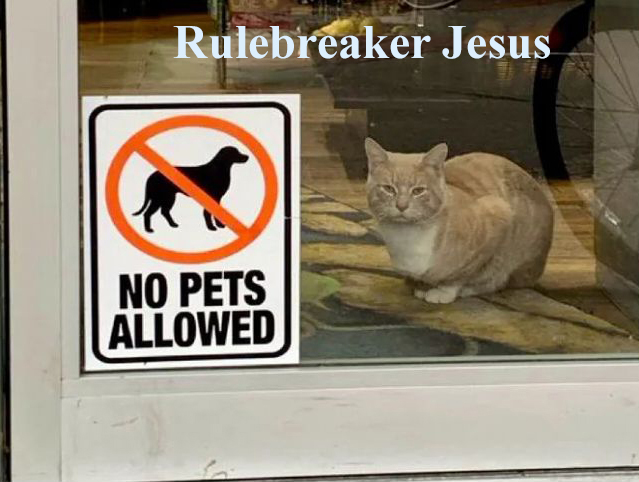
Rulebreaker Jesus

Rulebreaker Jesus

February 25, 2024*

By Pastor John Partridge

Hosea 2:14-20            Mark 2:13-22                         2 Corinthians 3:1-6

What are Christians known for in our communities and in our world today?

In the first through the third centuries, Christians were not popular, and their critics often attacked them for the ways that the Christian community went against the prevailing culture and community standards. Christians (and Jews) were seen as atheists because they did not participate in holy day celebrations at the temples of various gods and goddesses, they were accused of practicing cannibalism for the sharing of communion, they were mocked for their belief in resurrection, for following and worshiping a criminal who had been crucified, and other ways that folks just found to be odd, irregular, unusual, and rude. But as much as Christians were criticized and even persecuted, their critics recognized that there were things for which Christians were known and remembered, and most of those things, at least today, would be thought of as good things.

David Bentley Hart, in his book “The Story of Christianity,” lists the characteristics of Christians that were used by pagan critics to describe early followers of Jesus. Christians were described as sober, gentle, faithful to their spouses without exploitation or abuse, caring for the poor, willing to nurse the gravely ill, even at significant risk to themselves, such as during a time of plague, and the ability to exhibit virtues such as self-control and courage, which were thought to be impossible for anyone who was poor or who was not philosophically trained.

But even though Christianity’s critics may have grudgingly admitted that the movement had some positive points, and even though some of those we listed were presented as ridicule and not praise, Christians were still known, and often rejected, for the ways that their new religion made them break the rules of the culture and of the empire. But that shouldn’t surprise us when the founder of our movement, and the object of our worship, was, from the beginning, a ruler breaker. But before we get to that, let’s begin in the Old Testament book of Hosea in Hosea 2:14-20, where we hear God describing how he will win back a morally wandering Israel, and describe what he desires to provide for his people. God says…

14 “Therefore I am now going to allure her;
    I will lead her into the wilderness
    and speak tenderly to her.
15 There I will give her back her vineyards,
    and will make the Valley of Achor a door of hope.
There she will respond as in the days of her youth,
    as in the day she came up out of Egypt.

16 “In that day,” declares the Lord,
    “you will call me ‘my husband’;
    you will no longer call me ‘my master.’
17 I will remove the names of the Baals from her lips;
    no longer will their names be invoked.
18 In that day I will make a covenant for them
    with the beasts of the field, the birds in the sky
    and the creatures that move along the ground.
Bow and sword and battle
    I will abolish from the land,
    so that all may lie down in safety.
19 I will betroth you to me forever;
    I will betroth you in righteousness and justice,
    in love and compassion.
20 I will betroth you in faithfulness,
    and you will acknowledge the Lord
.

The story of Hosea is one in which Israel goes astray from God in a spectacular way and, through Hosea’s marriage to an unfaithful lady of the evening, God describes Israel as a prostitute who has sold herself for foreign gods. But here, God declares that he is going to win his bride back. God intends to allure her, speak tenderly to her, give her back her vineyards, and give her hope. Once again, Israel will return to God and forget the idols of her past so that God can give her a life of righteousness, justice, compassion, faithfulness, and peace. But those are the things that God has always wanted for his people. The problem has never been with God, it has been with the unfaithfulness of his people. And that is what is at the heart of the rule breaking Jesus that we meet in Mark 2:13-22. When the culture of God’s people, or any culture, values other things more than the things of God, then people of faith are compelled to break the rules. And that’s what we see as Jesus meets the tax collector Levi, who we also know as the disciple Matthew:

13 Once again Jesus went out beside the lake. A large crowd came to him, and he began to teach them. 14 As he walked along, he saw Levi, son of Alphaeus, sitting at the tax collector’s booth. “Follow me,” Jesus told him, and Levi got up and followed him.

15 While Jesus was having dinner at Levi’s house, many tax collectors and sinners were eating with him and his disciples, for there were many who followed him. 16 When the teachers of the law who were Pharisees saw him eating with the sinners and tax collectors, they asked his disciples: “Why does he eat with tax collectors and sinners?”

17 On hearing this, Jesus said to them, “It is not the healthy who need a doctor, but the sick. I have not come to call the righteous, but sinners.”

18 Now John’s disciples and the Pharisees were fasting. Some people came and asked Jesus, “How is it that John’s disciples and the disciples of the Pharisees are fasting, but yours are not?”

19 Jesus answered, “How can the guests of the bridegroom fast while he is with them? They cannot, so long as they have him with them. 20 But the time will come when the bridegroom will be taken from them, and on that day they will fast.

21 “No one sews a patch of unshrunk cloth on an old garment. Otherwise, the new piece will pull away from the old, making the tear worse. 22 And no one pours new wine into old wineskins. Otherwise, the wine will burst the skins, and both the wine and the wineskins will be ruined. No, they pour new wine into new wineskins.”

Jesus, in defiance of custom and propriety, sits down to dinner with a roomful of outsiders and outcasts, people that the religious leaders believe to be contemptable sinners and therefore a contaminating influence on people of good character. Worse, sharing a meal was seen as an intimate act that was only done with family, friends, and people of quality. In addition, Jesus is accused of ignoring a traditional time of fasting when the religious leaders and even the followers of John the Baptist are observing that cultural tradition.

But Jesus responds to the accusations and criticisms of the Pharisees by reminding them that what is appropriate sometimes varies. No one would expect wedding guests to fast regardless of the tradition of the religious leaders and Jesus equates his presence among his disciples as qualifying for the same kind of exemption. The comparison of the wineskins is the same sort of thing. New wineskins, made of sheepskin, can stretch when the new wine in them begins to ferment, but old wineskins have already stretched, and using them for new wine would only cause them to burst. And so, again, Jesus is reminding everyone that we don’t always adhere to strict rules, but instead make judgements on what is appropriate for the occasion.

But why does that matter to us?

Even though we are the followers of Jesus, he is not physically with us, so why are we having a discussion of what is, and is not, culturally appropriate?

And, in addition to the story of the first century church with which we began, we gain some focus as we read Paul’s letter to the church in Corinth in 2 Corinthians 3:1-6 as Paul explains how the people around us view our actions. Paul says…

3:1 Are we beginning to commend ourselves again? Or do we need, like some people, letters of recommendation to you or from you? You yourselves are our letter, written on our hearts, known and read by everyone. You show that you are a letter from Christ, the result of our ministry, written not with ink but with the Spirit of the living God, not on tablets of stone but on tablets of human hearts.

Such confidence we have through Christ before God. Not that we are competent in ourselves to claim anything for ourselves, but our competence comes from God. He has made us competent as ministers of a new covenant—not of the letter but of the Spirit; for the letter kills, but the Spirit gives life.

Paul describes us, the people of the church and the followers of Jesus Christ, as individual letters, from Jesus, to our communities and to the people around us. Many people will never read a bible, but they will read the life that you live. You are a sign to the community that tells the story of Jesus and the story of our church, and in you, and in us, they will read the story of Jesus and find the truth about our faith the work that we do. Paul says that “the letter kills, but the Spirit gives life.” And by this, Paul explains to the people of the church, that the message of Jesus isn’t all about following a strict interpretation of a bunch of rules, but instead is about a life that is lived in love.

What God wants is a life of righteousness, justice, compassion, faithfulness, and peace but far too often, when unbelievers read the story of Jesus that Christians live out in their lives, what they see is anger, prejudice, greed, violence, arrogance, abuse, and the admiration of, if not a complete alliance with, worldly power.

When Jesus broke the rules of his culture, he broke them so that he could show love and compassion to others. When the Christians of the first century behaved strangely, and broke the rules of their culture, they still earned the respect of their critics because they were sober, gentle, faithful to their spouses, cared for the poor, nursed the gravely ill even at risk to themselves, and exhibited virtues such as self-control and courage.

And so, we return to the question with which we began. What are Christians known for in our communities and in our world today?

Every day, the people around you, people that may never read a bible or set foot in a church, will read a letter from Jesus in the life that you live.

Will they read a message of love and compassion?

Or will they find something else?


Please LIKE and SHARE!

Click here to subscribe to Pastor John’s blog.

Click here if you would like to subscribe to Pastor John’s weekly messages.

Click here to visit Pastor John’s YouTube channel.


*You have been reading a message presented at Christ United Methodist Church on the date noted at the top of the first page.  Rev. John Partridge is the pastor at Christ UMC in Alliance, Ohio.  Duplication of this message is a part of our Media ministry, if you have received a blessing in this way, we would love to hear from you.  Letters and donations in support of the Media ministry or any of our other projects may be sent to Christ United Methodist Church, 470 East Broadway Street, Alliance, Ohio 44601.  These messages are available to any interested persons regardless of membership.  You may subscribe to these messages, in print or electronic formats, by writing to the address noted, or by contacting us at secretary@CUMCAlliance.org.  These messages can also be found online at https://pastorpartridge.com .  All Scripture quotations, unless otherwise indicated, are taken from the Holy Bible, New International Version®, NIV®. Copyright ©1973, 1978, 1984, 2011 by Biblica, Inc.™ Used by permission of Zondervan. All rights reserved worldwide. www.zondervan.comThe “NIV” and “New International Version” are trademarks registered in the United States Patent and Trademark Office by Biblica, In

Alien Preparedness

Alien Preparedness

December 10, 2023*

By Pastor John Partridge

Isaiah 40:1-11                        Mark 1:1-8                             2 Peter 3:8-15

There is an old saying that says, “It doesn’t rain in the Army… it rains on the Army. It isn’t a particularly funny joke, but it’s a part of the dark humor that is often found while standing in the middle of a driving rainstorm. There is a similar saying in scouting, but because our scout motto is “Be Prepared,” the saying is changed to reflect that and says, “There is no bad weather in scouting, only scouts that are not prepared for the weather.” But that leads us to the title of today’s message, “Alien Preparedness.” No, this is not about preparing for an alien invasion or something that you might find on Ancient Aliens on the History Channel, but it is about preparedness.

My brother Dean used to point out that when we say we are “getting in shape” or that an athlete is “in shape,” it’s important to ask, “In shape for what?” No one doubts that NFL football players are in shape, but ask them to run a marathon, or race an Olympic swimmer, and suddenly, they are not ready because, despite all the physical conditioning that they have done, they are not prepared for that specific kind of physical competition. And so, when we say, like the scouts, that we must “Be Prepared,” we must also ask, “Prepared for what?”  When it is framed in that way, “Alien Preparedness” is not about preparing for an alien invasion, but to prepare for something you did not expect, or in a way that you hadn’t expected.

I am sure that’s still more than a little puzzling but hold on to that idea while we dive into our scriptures, and when we return to this later, I think it will be clearer.  We begin this morning with the words of the prophet Isaiah who speaks to Israel to tell of the imminent destruction of their nation at the hands of the Assyrian army but also speaks words of comfort and God’s promise that there would one day be restoration after Jerusalem’s destruction. We hear these words in Isaiah 40:1-11…

40:1 Comfort, comfort my people, says your God.
Speak tenderly to Jerusalem, and proclaim to her
that her hard service has been completed, that her sin has been paid for,
that she has received from the Lord’s hand double for all her sins.

A voice of one calling:
“In the wilderness prepare the way for the Lord,
make straight in the desert a highway for our God.
Every valley shall be raised up, every mountain and hill made low;
the rough ground shall become level, the rugged places a plain.
And the glory of the Lord will be revealed, and all people will see it together.
For the mouth of the Lord has spoken.”

A voice says, “Cry out.”
    And I said, “What shall I cry?”

“All people are like grass, and all their faithfulness is like the flowers of the field.
The grass withers and the flowers fall, because the breath of the Lord blows on them.
    Surely the people are grass.
The grass withers and the flowers fall, but the word of our God endures forever.”

You who bring good news to Zion, go up on a high mountain.
You who bring good news to Jerusalem,  lift up your voice with a shout,
lift it up, do not be afraid; say to the towns of Judah, “Here is your God!”
10 See, the Sovereign Lord comes with power, and he rules with a mighty arm.
See, his reward is with him, and his recompense accompanies him.
11 He tends his flock like a shepherd: He gathers the lambs in his arms
and carries them close to his heart; he gently leads those that have young.

Isaiah says that things are going to be terrible, and then worse than terrible, and then, just when they think that they are withering into death like the grass in summer, there will be a voice… one single voice… crying out in the desert to prepare for the arrival of their rescuer. Things will be terrible, but one day the rescuer will come. He will rule with a mighty arm, but he will tend his flock with gentleness like a shepherd.

And then, in the middle of the Roman occupation, as Israel once again prayed for God’s rescue, the voice of John the Baptizer is heard in the wilderness and Mark remembers, and quotes the words of Isaiah in Mark 1:1-8 saying…

1:1 The beginning of the good news about Jesus the Messiah, the Son of God, as it is written in Isaiah the prophet:

“I will send my messenger ahead of you,
    who will prepare your way”—
“a voice of one calling in the wilderness,
‘Prepare the way for the Lord,
    make straight paths for him.’”

And so John the Baptist appeared in the wilderness, preaching a baptism of repentance for the forgiveness of sins. The whole Judean countryside and all the people of Jerusalem went out to him. Confessing their sins, they were baptized by him in the Jordan River. John wore clothing made of camel’s hair, with a leather belt around his waist, and he ate locusts and wild honey. And this was his message: “After me comes the one more powerful than I, the straps of whose sandals I am not worthy to stoop down and untie. I baptize you with water, but he will baptize you with the Holy Spirit.”

John declares that God’s promised rescuer has come, and the people had better be prepared.

But what does that mean? How should the people prepare? We know that John’s message was one of repentance and called people to repent of their sins and recommit their lives to following God. But is that all there is to it? What kind of preparations are required for us in the twenty-first century as we remember John’s message and prepare ourselves for Jesus’ return. And that’s where Peter steps in to remind us of John’s message and apply it to our daily lives in the here and now. In 2 Peter 3:8-15 we hear this message about our future:

But do not forget this one thing, dear friends: With the Lord a day is like a thousand years, and a thousand years are like a day. The Lord is not slow in keeping his promise, as some understand slowness. Instead, he is patient with you, not wanting anyone to perish, but everyone to come to repentance.

10 But the day of the Lord will come like a thief. The heavens will disappear with a roar; the elements will be destroyed by fire, and the earth and everything done in it will be laid bare.

11 Since everything will be destroyed in this way, what kind of people ought you to be? You ought to live holy and godly lives 12 as you look forward to the day of God and speed its coming. That day will bring about the destruction of the heavens by fire, and the elements will melt in the heat. 13 But in keeping with his promise we are looking forward to a new heaven and a new earth, where righteousness dwells.

14 So then, dear friends, since you are looking forward to this, make every effort to be found spotless, blameless and at peace with him. 15 Bear in mind that our Lord’s patience means salvation, just as our dear brother Paul also wrote you with the wisdom that God gave him.

And this is where we find the alien preparation. This is not making sure to pack a raincoat, or warm winter clothes, and it’s more than just John’s message of repentance and baptism. This is, quite literally, preparation for the end of the world. The heavens will disappear, the earth will be destroyed, and the elements themselves will be melted in the heat of God’s judgement. On that day, God will make good on his promise to bring peace and justice, and from the ruins of this world will create a new heaven and a new earth filled with righteousness.

But how can we prepare for such a thing? What will be required of us? What must we do to be ready? And Peter’s answer is not so different from that of John the Baptizer. Repent, make straight paths for him, make every effort to live lives that are blameless so that your lives can be at peace with Jesus Christ by doing everything that he taught and modelled for us.

We absolutely must get this right.

Because we are not just preparing for the arrival of our rescuer and king.

We are, quite literally, preparing for the end of the world.


Please LIKE and SHARE!

Click here to subscribe to Pastor John’s blog.

Click here if you would like to subscribe to Pastor John’s weekly messages.

Click here to visit Pastor John’s YouTube channel.


*You have been reading a message presented at Christ United Methodist Church on the date noted at the top of the first page.  Rev. John Partridge is the pastor at Christ UMC in Alliance, Ohio.  Duplication of this message is a part of our Media ministry, if you have received a blessing in this way, we would love to hear from you.  Letters and donations in support of the Media ministry or any of our other projects may be sent to Christ United Methodist Church, 470 East Broadway Street, Alliance, Ohio 44601.  These messages are available to any interested persons regardless of membership.  You may subscribe to these messages, in print or electronic formats, by writing to the address noted, or by contacting us at secretary@CUMCAlliance.org.  These messages can also be found online at https://pastorpartridge.com .  All Scripture quotations, unless otherwise indicated, are taken from the Holy Bible, New International Version®, NIV®. Copyright ©1973, 1978, 1984, 2011 by Biblica, Inc.™ Used by permission of Zondervan. All rights reserved worldwide. www.zondervan.comThe “NIV” and “New International Version” are trademarks registered in the United States Patent and Trademark Office by Biblica, Inc.™

Addicted to… Rules?

Addicted to Rules

October 08, 2023*

By Pastor John Partridge

Exodus 20:1-4, 7-9, 12-20                 Matthew 21:33-46                             Philippians 3:4b-14

In 1985 radio stations everywhere were playing the debut of Robert Palmer’s new hit song, Addicted to Love. That song will be familiar to those of us in a particular age group, but it begins like this:

The lights are on, but you’re not home
Your mind is not your own
Your heart sweats, your body shakes
Another kiss is what it takes
You can’t sleep, you can’t eat
There’s no doubt, you’re in deep
Your throat is tight, you can’t breathe
Another kiss is all you need.

Whoa, you like to think that you’re immune to the stuff, oh yeah
It’s closer to the truth to say you can’t get enough
You know you’re gonna have to face it, you’re addicted to love.

Robert Palmer may have taken a certain amount of artistic license, but just this week I had a conversation with a friend about how some people simply can’t stand to live alone, and that can lead them to making bad choices and being in a relationship with someone who isn’t good for them, and sometimes one bad relationship after another.

Addiction, of any kind, even an addition to something that is normally good, can be a bad thing. Addiction, even to something good, takes things too far and winds up being harmful. And that’s one of the things that we will find as we read and think about today’s scriptures. We begin with what God intended for good, the ten commandments. Most of these commandments are regarded as good things, even by people who do not share our faith, and even by people who have no faith at all. Prohibitions against theft, murder, adultery, and false witness, just to name a few, are almost inarguably good things. But can such prohibitions go too far? Before we get into that, let’s begin at the beginning and just read the words of Exodus 20:1-4, 7-9, 12-20.

20:1 And God spoke all these words:

“I am the Lord your God, who brought you out of Egypt, out of the land of slavery.

“You shall have no other gods before me.

“You shall not make for yourself an image in the form of anything in heaven above or on the earth beneath or in the waters below.

“You shall not misuse the name of the Lord your God, for the Lord will not hold anyone guiltless who misuses his name.

“Remember the Sabbath day by keeping it holy. Six days you shall labor and do all your work,

12 “Honor your father and your mother, so that you may live long in the land the Lord your God is giving you.

13 “You shall not murder.

14 “You shall not commit adultery.

15 “You shall not steal.

16 “You shall not give false testimony against your neighbor.

17 “You shall not covet your neighbor’s house. You shall not covet your neighbor’s wife, or his male or female servant, his ox or donkey, or anything that belongs to your neighbor.”

18 When the people saw the thunder and lightning and heard the trumpet and saw the mountain in smoke, they trembled with fear. They stayed at a distance 19 and said to Moses, “Speak to us yourself and we will listen. But do not have God speak to us or we will die.”

20 Moses said to the people, “Do not be afraid. God has come to test you, so that the fear of God will be with you to keep you from sinning.”

Saying things like, “don’t take things that don’t belong to you,” “don’t murder or hurt other people, or that it’s not good to even wish you had the nice things that your neighbor has,” are not that controversial. Even honoring your parents, when they deserve it, is something that most of us can generally agree on. But we can understand why people who do not share our faith, or who don’t believe in God, would take issue with rules about gods, idols, taking God’s name in vain, or keeping the sabbath. Other than those rules that are specific to our worship of our God, I think most people would agree that these are reasonable rules and, in fact, most of these rules end up being codified in the laws of cities, states, and nations around the world.

But that’s where the trouble starts. Or, perhaps, if we think of it another way, perhaps that’s where the addiction starts. In an attempt to ensure that the people of Israel would always follow these ten rules, the leaders of Israel wrote more rules that regulated life, or put fences around the rules, so that people wouldn’t, even accidentally, break these ten commandments. (pause) But even that wasn’t enough for some people. After Israel had been carried into captivity in Babylon for seventy years, returned to Israel, and rebuilt their nation, the leaders began to understand that their exile had been caused by Israel’s disobedience to God. And so, at some point, the people that we know as the Pharisees in the time of the New Testament accumulated an even longer list of rules that built fences around the fences that had been built around the rules. And while some of the Pharisees were legitimately trying to keep Israel on the straight and narrow and stay close to God, others began to become more devoted to the rules than they were to the God they were supposed to worship.  And it was exactly that sort of thing that had the Pharisees up in arms about the popularity that Jesus had with the common people and the background to exchanges such as the one we find in Matthew 21:33-46, (which immediately follows our passage from last week in which Jesus said that Prostitutes and tax collectors were getting into heaven before the Pharisees)where we hear Jesus say:

33 “Listen to another parable: There was a landowner who planted a vineyard. He put a wall around it, dug a winepress in it and built a watchtower. Then he rented the vineyard to some farmers and moved to another place. 34 When the harvest time approached, he sent his servants to the tenants to collect his fruit.

35 “The tenants seized his servants; they beat one, killed another, and stoned a third. 36 Then he sent other servants to them, more than the first time, and the tenants treated them the same way. 37 Last of all, he sent his son to them. ‘They will respect my son,’ he said.

38 “But when the tenants saw the son, they said to each other, ‘This is the heir. Come, let’s kill him and take his inheritance.’ 39 So they took him and threw him out of the vineyard and killed him.

40 “Therefore, when the owner of the vineyard comes, what will he do to those tenants?”

41 “He will bring those wretches to a wretched end,” they replied, “and he will rent the vineyard to other tenants, who will give him his share of the crop at harvest time.”

42 Jesus said to them, “Have you never read in the Scriptures:

“‘The stone the builders rejected
    has become the cornerstone;
the Lord has done this,
    and it is marvelous in our eyes’?

43 “Therefore I tell you that the kingdom of God will be taken away from you and given to a people who will produce its fruit. 44 Anyone who falls on this stone will be broken to pieces; anyone on whom it falls will be crushed.”

45 When the chief priests and the Pharisees heard Jesus’ parables, they knew he was talking about them. 46 They looked for a way to arrest him, but they were afraid of the crowd because the people held that he was a prophet.

One of the first things that we should probably notice is that Jesus may very well be foretelling his own death in this parable since it isn’t hard to understand that as the son of God, he is the son of the landowner of Israel. The second thing to notice is that, even though the priests and the Pharisees may not have understood Jesus’ allusion to being the son of the landowner, they clearly understood that he was talking about them and that they were the ungrateful tenants in the story. Everyone understood that Jesus was accusing Israel’s leadership of not giving to God what was expected and due. The accusation is clear that the leaders had violated several of the commandments, that they had put themselves ahead of God, that they had made money, power, and influence into an idol, and that they were, generally, unfaithful.

The contrast to the priests and the Pharisees is found in the life of Paul, after his encounter with Jesus on the road to Damascus. After Paul’s conversion, he sees the rules, and his former addiction to the rules, in an entirely different light. In Philippians 3:4b-14 he says…

If someone else thinks they have reasons to put confidence in the flesh, I have more: circumcised on the eighth day, of the people of Israel, of the tribe of Benjamin, a Hebrew of Hebrews; in regard to the law, a Pharisee; as for zeal, persecuting the church; as for righteousness based on the law, faultless.

But whatever were gains to me I now consider loss for the sake of Christ. What is more, I consider everything a loss because of the surpassing worth of knowing Christ Jesus my Lord, for whose sake I have lost all things. I consider them garbage, that I may gain Christ and be found in him, not having a righteousness of my own that comes from the law, but that which is through faith inChrist—the righteousness that comes from God on the basis of faith. 10 I want to know Christ—yes, to know the power of his resurrection and participation in his sufferings, becoming like him in his death, 11 and so, somehow, attaining to the resurrection from the dead.

12 Not that I have already obtained all this, or have already arrived at my goal, but I press on to take hold of that for which Christ Jesus took hold of me. 13 Brothers and sisters, I do not consider myself yet to have taken hold of it. But one thing I do: Forgetting what is behind and straining toward what is ahead, 14 I press on toward the goal to win the prize for which God has called me heavenward in Christ Jesus.

Paul was a Pharisee. He followed the rules, he was born into the right kind of family, went to the right kind of schools with the right kind of teachers, he, and his family, followed all the prescribed rituals, he dedicated his life to enforcing the rules, he hunted down Jews who had chosen to follow Jesus and prosecuted, and imprisoned them for their failure to follow the rules. He was there watching the coats of the men who stoned Stepehen in Jerusalem and, I think we can safely say, that he was addicted to the rules. But, after he met Jesus, his addiction was broken, and he saw the rules in an entirely different light. I don’t want you to misunderstand, Paul still followed most of those rules. He still thought that they were an important part of his faith, but the rules were no longer an addiction, and they were no longer something that was more important than faith. His addiction, and the value that he once put on the rules, money, power, and influence, he now valued no more than garbage. In fact, the word that we translate as “garbage” is the name of the valley below Jerusalem where the sewers emptied, where dead animals were thrown, and where the remains of sacrifices were burned. It was a place of disgusting filth and that was the value that Paul now placed on his former addiction.

Addiction, of any kind, even an addition to something that is normally good, takes things too far and winds up being harmful, and that’s true whether you’re addicted to love, rules, tradition, sex, money, power, politics, authority, fame, fortune, comfort, prestige, sports, hobbies, family, or anything else that you might put ahead of God.

God said ““I am the Lord your God… You shall have no other gods beforeme.”

Even if those gods seem like good things, we cannot put them ahead of God.

It’s important that we get it right.


Please LIKE and SHARE!

Click here to subscribe to Pastor John’s blog.

Click here if you would like to subscribe to Pastor John’s weekly messages.

Click here to visit Pastor John’s YouTube channel.


*You have been reading a message presented at Christ United Methodist Church on the date noted at the top of the first page.  Rev. John Partridge is the pastor at Christ UMC in Alliance, Ohio.  Duplication of this message is a part of our Media ministry, if you have received a blessing in this way, we would love to hear from you.  Letters and donations in support of the Media ministry or any of our other projects may be sent to Christ United Methodist Church, 470 East Broadway Street, Alliance, Ohio 44601.  These messages are available to any interested persons regardless of membership.  You may subscribe to these messages, in print or electronic formats, by writing to the address noted, or by contacting us at secretary@CUMCAlliance.org.  These messages can also be found online at https://pastorpartridge.com .  All Scripture quotations, unless otherwise indicated, are taken from the Holy Bible, New International Version®, NIV®. Copyright ©1973, 1978, 1984, 2011 by Biblica, Inc.™ Used by permission of Zondervan. All rights reserved worldwide. www.zondervan.comThe “NIV” and “New International Version” are trademarks registered in the United States Patent and Trademark Office by Biblica, Inc.™

Confident Submission

Confident Submission

April 07, 2023*

(Good Friday)

By Pastor John Partridge

Hebrews 4:14-16; 5:7-9                    Isaiah 52:13 – 53:12

When you do the things that you do, are you sure, are you certain, are you confident?

When we drive our cars, are we confident in our ability to navigate, to drive defensively, and to arrive safely at our destination?  When we go to work, are we confident, because of our education, skill, and experience, that we can do whatever our employers ask of us?

But how are you at submission?

Those of us who are married likely were asked a question like this:

“Will you love her, comfort her, honor and keep her, in sickness and in health, and forsaking all others, be faithful to her?”

And we said, “I will.”

But there in the middle, where it said, “honor and keep him or her” in years past, might well have been worded to say, that we should submit to one another.  Now, we just say that we should “honor” one another, but the meaning is the same.  We honor our spouses by valuing their opinion, submitting to them, and doing the things that they want to do instead of the things that we want to do.  Of course, that has to be a two-way street.  Life is all about balance.

For that reason, at least in the case of our spouses, we are often both comfortable, and confident, in our submission.  We are accustomed to the give and take of a healthy relationship.  Sometimes our spouses do things because we like them, and sometimes we do things that may not be our favorite things, just because we know that our spouse likes them and because it makes them happy.

And it is this kind of healthy obedience and submission that I think we see in the description of the coming Messiah that we find in Isaiah 52 and 53.  It’s worth reading.  I’m not going to take the time to read all of it this evening, but in it we hear things like:

52:13 See, my servant will act wisely he will be raised and lifted up and highly exalted.
14 Just as there were many who were appalled at him, his appearance was so disfigured beyond that of any human being and his form marred beyond human likeness.

He was despised and rejected by mankind, a man of suffering, and familiar with pain.
Like one from whom people hide their faces he was despised, and we held him in low esteem.

Surely he took up our pain and bore our suffering,
yet we considered him punished by God, stricken by him, and afflicted.
But he was pierced for our transgressions, he was crushed for our iniquities;
the punishment that brought us peace was on him, and by his wounds we are healed.
We all, like sheep, have gone astray, each of us has turned to our own way;
and the Lord has laid on him the iniquity of us all.

He was oppressed and afflicted, yet he did not open his mouth;
he was led like a lamb to the slaughter, and as a sheep before its shearers is silent,
    so he did not open his mouth.

 9 He was assigned a grave with the wicked, and with the rich in his death,
though he had done no violence, nor was any deceit in his mouth.

12 Therefore I will give him a portion among the great, and he will divide the spoils with the strong,
because he poured out his life unto death, and was numbered with the transgressors.
For he bore the sin of many, and made intercession for the transgressors.

That was the kind of person that Israel expected as their Messiah, and that’s the kind of person that we meet in the person of Jesus Christ.  The writer of Hebrews, in Hebrews 4:14-16; 5:7-9 says this:

4:14 Therefore, since we have a great high priest who has ascended into heaven, Jesus the Son of God, let us hold firmly to the faith we profess. 15 For we do not have a high priest who is unable to empathize with our weaknesses, but we have one who has been tempted in every way, just as we are—yet he did not sin. 16 Let us then approach God’s throne of grace with confidence, so that we may receive mercy and find grace to help us in our time of need.

During the days of Jesus’ life on earth, he offered up prayers and petitions with fervent cries and tears to the one who could save him from death, and he was heard because of his reverent submission. Son though he was, he learned obedience from what he suffered and, once made perfect, he became the source of eternal salvation for all who obey him 10 and was designated by God to be high priest in the order of Melchizedek.

God heard the prayers of Jesus because of his obedience and reverent submission.  Jesus knew exactly what waited for him in Jerusalem and he went anyway.  Jesus knew that the members of the Sanhedrin were conspiring to kill him, but he went anyway.  He knew that the path that lay in front of him was filled with suffering, pain, and death, but he went anyway.  He did not turn aside from God’s will, he did not swerve, he did not flinch from his calling because he was confident in God, confident in the will of God, and confident in his submission to God.

The writer of Hebrews said, 4:14 Therefore, since we have a great high priest who has ascended into heaven, Jesus the Son of God, let us hold firmly to the faith we profess.

God asks for our submission.

Can we do any less?


Please LIKE and SHARE!

Click here to subscribe to Pastor John’s blog.

Click here if you would like to subscribe to Pastor John’s weekly messages.

Click here to visit Pastor John’s YouTube channel.


*You have been reading a message presented at First Christian Church in Alliance, Ohio on the date noted at the top of the first page.  Rev. John Partridge is the pastor at Christ UMC in Alliance, Ohio.  Duplication of this message is a part of our Media ministry, if you have received a blessing in this way, we would love to hear from you.  Letters and donations in support of the Media ministry or any of our other projects may be sent to Christ United Methodist Church, 470 East Broadway Street, Alliance, Ohio 44601.  These messages are available to any interested persons regardless of membership.  You may subscribe to these messages, in print or electronic formats, by writing to the address noted, or by contacting us at secretary@CUMCAlliance.org.  These messages can also be found online at https://pastorpartridge.com .  All Scripture quotations, unless otherwise indicated, are taken from the Holy Bible, New International Version®, NIV®. Copyright ©1973, 1978, 1984, 2011 by Biblica, Inc.™ Used by permission of Zondervan. All rights reserved worldwide. www.zondervan.comThe “NIV” and “New International Version” are trademarks registered in the United States Patent and Trademark Office by Biblica, Inc.™

What Should We Remember?

Click here to listen to the podcast

Click here to watch the sermon: https://youtu.be/hrQ0XQN1qtA


What Should We Remember?

April 06, 2023*

(Holy Thursday)

By Pastor John Partridge

Exodus 12:1-4, 11-14                         John 13:1-17, 31b-35            1 Corinthians 11:23-26

Even a cursory glance at our history books reminds us that there are a great many things that we are supposed to remember.  We have been told that we should “Remember the Alamo,” “Remember the Maine,” “Remember the Lusitania,” remember Pearl Harbor, remember 9-11, and those don’t even count the movies that asked us to “Remember the Titans,” or political slogans like “Remember the Dreamers.”  Probably a good percentage of the people in this room could not tell me why we’re supposed to remember the Maine and even less what we should remember about the Lusitania even though most of those things happened less than 100 years ago and all of them happened within the last 200 years.

But some of the things that we are called upon to remember in church happened two thousand years ago, and others closer to 3500 years ago.  So, what is it that we should remember?  Specifically, as it relates to Holy Week and Easter, the first, and oldest, of these things is found in the story of Passover and the rescue of the people of Israel from their slavery in Egypt, roughly speaking depending on whether you believe in an early or a late date, around 1300 BCE.  We find God’s command to remember that event in Exodus 12:1-4, 11-14.

12:1 The Lord said to Moses and Aaron in Egypt, “This month is to be for you the first month, the first month of your year. Tell the whole community of Israel that on the tenth day of this month each man is to take a lambfor his family, one for each household. If any household is too small for a whole lamb, they must share one with their nearest neighbor, having taken into account the number of people there are. You are to determine the amount of lamb needed in accordance with what each person will eat.

11 This is how you are to eat it: with your cloak tucked into your belt, your sandals on your feet and your staff in your hand. Eat it in haste; it is the Lord’s Passover.

12 “On that same night I will pass through Egypt and strike down every firstborn of both people and animals, and I will bring judgment on all the gods of Egypt. I am the Lord. 13 The blood will be a sign for you on the houses where you are, and when I see the blood, I will pass over you. No destructive plague will touch you when I strike Egypt.

14 “This is a day you are to commemorate; for the generations to come you shall celebrate it as a festival to the Lord—a lasting ordinance.

After Israel is rescued from eight hundred years of slavery in Egypt, God commands them to celebrate that rescue every year so that they can remember it forever.

But then, more than a thousand years later, while Jesus and his disciples were celebrating Passover, Jesus gave them a new thing to remember.  We find that command in the story found in John 13:1-17, 31b-35.

13:1 It was just before the Passover Festival. Jesus knew that the hour had come for him to leave this world and go to the Father. Having loved his own who were in the world, he loved them to the end.

The evening meal was in progress, and the devil had already prompted Judas, the son of Simon Iscariot, to betray Jesus. Jesus knew that the Father had put all things under his power, and that he had come from God and was returning to God; so he got up from the meal, took off his outer clothing, and wrapped a towel around his waist. After that, he poured water into a basin and began to wash his disciples’ feet, drying them with the towel that was wrapped around him.

He came to Simon Peter, who said to him, “Lord, are you going to wash my feet?”

Jesus replied, “You do not realize now what I am doing, but later you will understand.”

“No,” said Peter, “you shall never wash my feet.”

Jesus answered, “Unless I wash you, you have no part with me.”

“Then, Lord,” Simon Peter replied, “not just my feet but my hands and my head as well!”

10 Jesus answered, “Those who have had a bath need only to wash their feet; their whole body is clean. And you are clean, though not every one of you.” 11 For he knew who was going to betray him, and that was why he said not every one was clean.

12 When he had finished washing their feet, he put on his clothes and returned to his place. “Do you understand what I have done for you?” he asked them. 13 “You call me ‘Teacher’ and ‘Lord,’ and rightly so, for that is what I am. 14 Now that I, your Lord and Teacher, have washed your feet, you also should wash one another’s feet. 15 I have set you an example that you should do as I have done for you. 16 Very truly I tell you, no servant is greater than his master, nor is a messenger greater than the one who sent him. 17 Now that you know these things, you will be blessed if you do them.

31 Jesus said, “Now the Son of Man is glorified, and God is glorified in him. 32 If God is glorified in him, God will glorify the Son in himself, and will glorify him at once.

33 “My children, I will be with you only a little longer. You will look for me, and just as I told the Jews, so I tell you now: Where I am going, you cannot come.

34 “A new command I give you: Love one another. As I have loved you, so you must love one another. 35 By this everyone will know that you are my disciples, if you love one another.”

Jesus didn’t repeal God’s command to remember Passover, he added to it.  Jesus said that just as they remembered God’s grace and the rescue of Israel from slavery, his followers should always remember how much he loved them.  But the way that they should remember his love was to love the people around them the way that Jesus had loved, to love with such an extravagant love, that everyone would know that they were his followers.

But that wasn’t the only thing that Jesus asked them to remember.  In 1 Corinthians 11:23-26, the Apostle Paul remembers something else that Jesus wanted his people to remember forever.  Paul says…

23 For I received from the Lord what I also passed on to you: The Lord Jesus, on the night he was betrayed, took bread, 24 and when he had given thanks, he broke it and said, “This is my body, which is for you; do this in remembrance of me.” 25 In the same way, after supper he took the cup, saying, “This cup is the new covenant in my blood; do this, whenever you drink it, in remembrance of me.” 26 For whenever you eat this bread and drink this cup, you proclaim the Lord’s death until he comes.

And so, much like “Remember the Alamo,” but far more urgent and enduring, God commands us to remember. What God wants us to remember is that although it took longer than they expected, God never stopped loving his people and rescued them from their slavery and distress.  God wants us to remember that his Son loved the people around him, and us, with an extravagant kind of love.  Jesus calls all of us who follow him to remember how much he loved, and calls us to love the people around us with the same extravagant, costly, even life-threatening love with which Jesus loved.  And finally, in place of sharing an annual Passover meal, Jesus asks us to regularly share this meal, the Eucharist, or communion, to remind us of all these things.  We share this meal together to remember the life, death, resurrection, and crazy, extravagant, costly, love of Jesus Christ and to remember that the love with which Jesus loved us, is the love to which he calls us to love others.

And that, is what we are supposed to remember.


Please LIKE and SHARE!

Click here to subscribe to Pastor John’s blog.

Click here if you would like to subscribe to Pastor John’s weekly messages.

Click here to visit Pastor John’s YouTube channel.


*You have been reading a message presented at Christ United Methodist Church on the date noted at the top of the first page.  Rev. John Partridge is the pastor at Christ UMC in Alliance, Ohio.  Duplication of this message is a part of our Media ministry, if you have received a blessing in this way, we would love to hear from you.  Letters and donations in support of the Media ministry or any of our other projects may be sent to Christ United Methodist Church, 470 East Broadway Street, Alliance, Ohio 44601.  These messages are available to any interested persons regardless of membership.  You may subscribe to these messages, in print or electronic formats, by writing to the address noted, or by contacting us at secretary@CUMCAlliance.org.  These messages can also be found online at https://pastorpartridge.com .  All Scripture quotations, unless otherwise indicated, are taken from the Holy Bible, New International Version®, NIV®. Copyright ©1973, 1978, 1984, 2011 by Biblica, Inc.™ Used by permission of Zondervan. All rights reserved worldwide. www.zondervan.comThe “NIV” and “New International Version” are trademarks registered in the United States Patent and Trademark Office by Biblica, Inc.™