

Focus Determines Destination

Focus Determines Destination

October 26, 2025*

By Pastor John Partridge

Joel 2:23-32                Luke 18:9-14              2 Timothy 4:6-8, 16-18

All of us drive. Most of us drive automobiles, but some of the younger people in the room ride bicycles. For my illustration this morning, either works. Imagine that there is no traffic and you are going down the road as fast as you can. Now imagine closing your eyes.

Even the idea can be terrifying.

If you were forced to drive without being able to see, you wouldn’t go far.

Now imagine that you can, and must drive, but while you can see, your vision is significantly impaired. If you need glasses to drive, imagine what it would be like if your glasses were broken and you had to drive anyway. The worse our vision, the slower we are likely to drive, and we would certainly avoid some of the main highways in favor of less traveled back roads for an additional safety measure even if it slowed our travel even more. But the worse our vision gets, the more likely it is that we wouldn’t even arrive at our chosen destination at all. At some point, we would choose a place of safety at the home of a friend, or even the parking lot of a random business, where we would stop and phone a friend or family member for help.

When we think in terms of driving, or even walking, when we can’t see well, it seems obvious how important our focus is to reach our destination. But our journey through life, whether that is our family life, our career life, or our spiritual life, depends upon our focus just as much. It has been said, regarding our careers or education, that if you don’t know where you want to go, you will go somewhere, but not necessarily where you want. It’s silly, but it makes a point. Similarly, the Cheshire Cat in “Alice in Wonderland” said, “If you don’t much care where you are going, then it doesn’t matter which way you go.” Regardless of whether it is our career, family life, or our spiritual life, if we have a destination in mind, then we must resolutely keep our focus on our goal.

After the people of Israel and Judah had been devastated by a series of locust swarms, they were, not surprisingly, filled with despair and worried about their future. They wondered what had become of their dreams, aspirations, and goals but as they worried, God sent a message through the prophet Joel that had much to do with how they chose to focus their lives. As we read this message in Joel 2:23-32, we will find that we can read it in two parts. The first is a promise to the people of the ancient nation of Israel, and the second is a promise both to them, and to all of us who have come afterward. God said:

23 Be glad, people of Zion, rejoice in the Lord your God,
for he has given you the autumn rains because he is faithful.
He sends you abundant showers, both autumn and spring rains, as before.
24 The threshing floors will be filled with grain;
    the vats will overflow with new wine and oil.

25 “I will repay you for the years the locusts have eaten—
    the great locust and the young locust,
    the other locusts and the locust swarm—
my great army that I sent among you.
26 You will have plenty to eat, until you are full, and you will praise the name of the Lord your God,
    who has worked wonders for you; never again will my people be shamed.
27 Then you will know that I am in Israel, that I am the Lord your God,
    and that there is no other;
never again will my people be shamed.

28 “And afterward, I will pour out my Spirit on all people.
Your sons and daughters will prophesy, your old men will dream dreams,
    your young men will see visions.
29 Even on my servants, both men and women, I will pour out my Spirit in those days.
30 I will show wonders in the heavens and on the earth,
    blood and fire and billows of smoke.
31 The sun will be turned to darkness and the moon to blood
    before the coming of the great and dreadful day of the Lord.
32 And everyone who calls on the name of the Lord will be saved;
for on Mount Zion and in Jerusalem there will be deliverance,
    as the Lord has said, even among the survivors whom the Lord calls.

In the first half of our reading, God tells his people that there is hope for a brighter future, that what was lost will one day be restored to them despite the famine, starvation, and death that they had witnessed. And in the second half, God tells his people, and all who follow, that after he has restored his people to their nation, God is going to do something new. Rather than sending his spirit occasionally to selected prophets or people in dreams and visions, God will send his spirit into all his people so that everyone will be given gifts of the spirit. While there will still be wonders and disasters to be seen in the world, everyone who calls upon the name of the Lord will be delivered.

But still, even though God will send his spirit to live in all his people, there are still ways that we can take the wrong path and find ourselves off the road and stuck deep in the weeds. In Luke 18:9-14 Jesus tells a parable that illustrates how and where we must keep our focus.

To some who were confident of their own righteousness and looked down on everyone else, Jesus told this parable: 10 “Two men went up to the temple to pray, one a Pharisee and the other a tax collector. 11 The Pharisee stood by himself and prayed: ‘God, I thank you that I am not like other people—robbers, evildoers, adulterers—or even like this tax collector. 12 I fast twice a week and give a tenth of all I get.’

13 “But the tax collector stood at a distance. He would not even look up to heaven, but beat his breast and said, ‘God, have mercy on me, a sinner.’

14 “I tell you that this man, rather than the other, went home justified before God. For all those who exalt themselves will be humbled, and those who humble themselves will be exalted.”

Because there were people in the room who were full of themselves and overconfident in their own abilities, religiosity, and righteousness, Jesus goes out of his way to point out that overconfidence and arrogance is a trap that causes us to lose focus and wander from the truth. In Jesus’ parable, the first man was full of himself and prayed to God focused entirely on himself, saying ‘I’ four times. Never once did this man ask for forgiveness, or for aid, or to say thank you for what he had been given, or anything. His entire prayer was filled with bragging about what he had done. But the second man was entirely different. His prayer focused entirely on God. He recognized his shortcomings, failure, and sin, and simply asked God for mercy. Jesus then goes on to say that only the second man was justified before God while the first man was on a path that would surely see him humbled before God.

In contrast, before Paul’s death, we hear his summary of his life and ministry as he writes to his spiritual son, Timothy in 2 Timothy 4:6-8, 16-18. Paul says:

For I am already being poured out like a drink offering, and the time for my departure is near. I have fought the good fight, I have finished the race, I have kept the faith. Now there is in store for me the crown of righteousness, which the Lord, the righteous Judge, will award to me on that day—and not only to me, but also to all who have longed for his appearing.

16 At my first defense, no one came to my support, but everyone deserted me. May it not be held against them. 17 But the Lord stood at my side and gave me strength, so that through me the message might be fully proclaimed and all the Gentiles might hear it. And I was delivered from the lion’s mouth. 18 The Lord will rescue me from every evil attack and will bring me safely to his heavenly kingdom. To him be glory for ever and ever. Amen.

Paul knows that the end is near and that he will soon die. He says that his life is being emptied as his life is being poured out like a pitcher of water or wine. But as he faces the end of his life, he knows that he has done the best that he could. He fought the good fight, finished the race, and kept true to his faith in God. For that, Paul knows, that he will be awarded with righteousness on the day of judgement. Paul also says that even when he stood alone, and was abandoned by friends, family, coworkers in the church, and everyone else, he continued to do his best to share the message of Jesus Christ with the people around him even though they didn’t even believe in the same God. Paul knew that until God called him home, that same God would rescue him from every sort of evil because Paul had kept the faith and had done his best to accomplish the mission on which God had sent him.

Paul never lost his focus on what was important even when everything, and everyone, stood against him. And because Paul had kept his focus on the path to which he had been called, he knew that he would safely arrive at his destination and be rewarded by God when he got there.

While every follower of Jesus receives the gift of God’s spirit, if we want to arrive at the destination to which we are called, we must keep our focus on the path ahead with humility and persistence. Because, just like driving on the highway, if we lose our focus, we can take the wrong path and find ourselves off the road and stuck in deep weeds.

Because, in the end, our focus will determine our destination.


Please LIKE and SHARE!

Click here to subscribe to Pastor John’s blog.

Click here if you would like to subscribe to Pastor John’s weekly messages.

Click here to visit Pastor John’s YouTube channel.


*You have been reading a message presented at Christ United Methodist Church on the date noted at the top of the first page.  Rev. John Partridge is the pastor at Christ UMC in Alliance, Ohio.  Duplication of this message is a part of our Media ministry, if you have received a blessing in this way, we would love to hear from you.  Letters and donations in support of the Media ministry or any of our other projects may be sent to Christ United Methodist Church, 470 East Broadway Street, Alliance, Ohio 44601.  These messages are available to any interested persons regardless of membership.  You may subscribe to these messages, in print or electronic formats, by writing to the address noted, or by contacting us at secretary@CUMCAlliance.org.  These messages can also be found online at https://pastorpartridge.com .  All Scripture quotations, unless otherwise indicated, are taken from the Holy Bible, New International Version®, NIV®. Copyright ©1973, 1978, 1984, 2011 by Biblica, Inc.™ Used by permission of Zondervan. All rights reserved worldwide. www.zondervan.comThe “NIV” and “New International Version” are trademarks registered in the United States Patent and Trademark Office by Biblica, Inc.™

Worthwhile? Or Worthy?

Worthwhile? Or Worthy?

October 05, 2025*

By Pastor John Partridge

Lamentations 1:1-6               Luke 17:5-10              2 Timothy 1:1-14

How do you greet your friends at church? Or any of your other friends outside of church?

It’s common to say something like “Hi! How are you?” or “Hey. How are you?” But we all know that’s a superficial question. Occasionally, among close friends, I’ve been known to take a hard look at their facial expressions and their general demeanor, and follow that up with, “No, how are you… really?” And that is the question that brings out a bit more honesty, requires a little more thought, often takes longer to answer.

But one question that John Wesley often asked, was “How is it with your soul?” That too, is a deeper question than, “Hey. How are you?” Not only does this question probe with some of the depth of “How are you really?” but it also asks for some thought about how we are spiritually. How is it with your soul asks about your physical and emotional condition, but it also requires some thought about our faith and our relationship with God.

As we read and think about our scriptures for today, we will find that our discussion is, in some ways, similar to the discussions that we’ve had for the last two weeks. But, like “How is it with your soul?” our discussion will require us think more deeply about our faith before we’re done. We begin this week by reading a prayer of mourning from the book of Lamentations as God’s people grapple with what it means physically, emotionally, and spiritually, to have been conquered by the nation of Babylon, to have lost the city of Jerusalem, and to have witnessed, cruelty, destruction, and death on a scale that they could likely not have imagined previously. (Lamentations 1:1-6)

1:1How deserted lies the city,
    once so full of people!
How like a widow is she,
    who once was great among the nations!
She who was queen among the provinces
    has now become a slave.

2 Bitterly she weeps at night,
    tears are on her cheeks.
Among all her lovers
    there is no one to comfort her.
All her friends have betrayed her;
    they have become her enemies.

3 After affliction and harsh labor,
    Judah has gone into exile.
She dwells among the nations;
    she finds no resting place.
All who pursue her have overtaken her
    in the midst of her distress.

4 The roads to Zion mourn,
    for no one comes to her appointed festivals.
All her gateways are desolate,
    her priests groan,
her young women grieve,
    and she is in bitter anguish.

5 Her foes have become her masters;
    her enemies are at ease.
The Lord has brought her grief
    because of her many sins.
Her children have gone into exile,
    captive before the foe.

6 All the splendor has departed
    from Daughter Zion.
Her princes are like deer
    that find no pasture;
in weakness they have fled
    before the pursuer.

The nation of Judah mourns all that was lost but the writer, traditionally thought to be the prophet Jeremiah, also notes that all of Judah’s allies, all her false gods, and all her false hope have abandoned her. He says that the even the roads mourn because no one comes to her appointed festivals, meaning that the practice of the religion of Yahweh has ceased. But the writer admits that God has brought this tragedy upon his people because of the sins that they had committed, and the princes of Judah have fled their pursuers like deer that flee from their hunters.

When we read the words of Jeremiah, we imagine that if we could ask the nation of Judah, “How is it with your soul,” Jeremiah would answer by saying that Judah was cowardly, hungry, sinful, and faithless.

But the disciples of Jesus knew the history of their people. They knew that God had sometimes judged their nation because of their faithlessness, and the current occupation of their nation by Rome raised some of the same questions. Would God allow us to be free if we had more faith? Is the Roman occupation a sign that God is displeased with our faithfulness? How can we have more faith? And in that environment, we can, perhaps, understand a little better why the disciples ask Jesus, in Luke 17:5-10, how they can be more faithful, or, more correctly, the disciples ask Jesus to simply give them more faith.

The apostles said to the Lord, “Increase our faith!”

He replied, “If you have faith as small as a mustard seed, you can say to this mulberry tree, ‘Be uprooted and planted in the sea,’ and it will obey you.

“Suppose one of you has a servant plowing or looking after the sheep. Will he say to the servant when he comes in from the field, ‘Come along now and sit down to eat’? Won’t he rather say, ‘Prepare my supper, get yourself ready and wait on me while I eat and drink; after that you may eat and drink’? Will he thank the servant because he did what he was told to do? 10 So you also, when you have done everything you were told to do, should say, ‘We are unworthy servants; we have only done our duty.’”

The first thing that I thought of when I read that first verse, “Increase our faith!” is that the disciples should have known that there’s no shortcut to increasing our faith. Much as praying that God would grant us patience, often results in God leading us into places that force us to be patient, I have always believed that praying for more faith results in finding ourselves in places that demand more faith from us. And, while it is possible that the disciples understood that Jesus’ reply is still surprising. When Jesus says, “If you have faith as small as a mustard seed…” he is telling his disciples that it isn’t necessary to have a lot of faith. Even a tiny amount of faith in an all-powerful creator God is so immensely powerful that we should be able to command a tree to uproot itself and grow in the ocean. And Jesus’ parable about the servant and his master tells us that being worthy of God is no more difficult than doing the things that we have been asked to do.

Paul says something similar as he writes to his protégé in 2 Timothy 1:1-14 when he says:

1:1 Paul, an apostle of Christ Jesus by the will of God, in keeping with the promise of life that is in Christ Jesus,

To Timothy, my dear son:

Grace, mercy and peace from God the Father and Christ Jesus our Lord.

I thank God, whom I serve, as my ancestors did, with a clear conscience, as night and day I constantly remember you in my prayers. Recalling your tears, I long to see you, so that I may be filled with joy. I am reminded of your sincere faith, which first lived in your grandmother Lois and in your mother Eunice and, I am persuaded, now lives in you also.

For this reason I remind you to fan into flame the gift of God, which is in you through the laying on of my hands. For the Spirit God gave us does not make us timid, but gives us power, love, and self-discipline. So do not be ashamed of the testimony about our Lord or of me his prisoner. Rather, join with me in suffering for the gospel, by the power of God. He has saved us and called us to a holy life—not because of anything we have done but because of his own purpose and grace. This grace was given us in Christ Jesus before the beginning of time, 10 but it has now been revealed through the appearing of our Savior, Christ Jesus, who has destroyed death and has brought life and immortality to light through the gospel. 11 And of this gospel I was appointed a herald and an apostle and a teacher. 12 That is why I am suffering as I am. Yet this is no cause for shame, because I know whom I have believed, and am convinced that he is able to guard what I have entrusted to him until that day.

13 What you heard from me, keep as the pattern of sound teaching, with faith and love in Christ Jesus. 14 Guard the good deposit that was entrusted to you—guard it with the help of the Holy Spirit who lives in us.

Paul reminds Timothy that he not only serves God but does so with a clear conscience and remembers Timothy in his prayers.  Moreover, Paul remembers Timothy’s faith, but not just because the faith of Timothy’s mother and grandmother had made an impression on him, but because Paul had witnessed Timothy as he had lived out his faith in front of him. Paul then encourages Timothy to “fan into flame the gift of God” which I take to mean that he is encouraging Timothy, not just to sit back and rest in the gift of faith that he had been given, but to actively work to exercise and to increase it.

Paul then returns to his other point that he serves God with a clear conscience as he tells Timothy not to be ashamed of the testimony of Jesus Christ or the fact of Paul’s imprisonment. He reminds Timothy, and us, that God saved us and has called us to this life because of his own purpose and grace and because of that, Paul’s suffering was no cause for shame. Paul believed in Jesus Christ and trusted him to guard his path and his future until the day we meet at the foot of God’s throne. The key, Paul says, is to remember the teaching that he has been given and the life and faith that Paul, Jesus, and everyone who has invested themselves in us have modeled and demonstrated for us in their own lives.

And so, we have several clues that will aid us in answering the question “How is it with your soul?” First, there are consequences for living a life that is sinful and faithless. Second, that there is no shortcut to increasing our faith but also that even a tiny amount of faith in an omnipotent creator God is immensely powerful. Third, if we desire to be worthy of the gifts that God has given to us, being worthy of God is no more difficult than doing the things that we have been asked to do. Fourth, although the gift of faith has been given to us, we must still actively put in the hard work necessary to exercise and to increase it. And finally, we should never be ashamed of the testimony of Jesus Christ and that we should always remember the things that we have been taught by Jesus, Paul, and all those who have modeled and demonstrated a life of faith alongside of us.

Answering the question, “How is it with your soul?” is much harder than “Hey! How are you?” but it is also far more important. It is important for each one of us to occasionally put thought into how we are doing, how we are living, and how we are growing in our faith and in our obedience to Jesus Christ.

So…

How is it with your soul?


Please LIKE and SHARE!

Click here to subscribe to Pastor John’s blog.

Click here if you would like to subscribe to Pastor John’s weekly messages.

Click here to visit Pastor John’s YouTube channel.


*You have been reading a message presented at Christ United Methodist Church on the date noted at the top of the first page.  Rev. John Partridge is the pastor at Christ UMC in Alliance, Ohio.  Duplication of this message is a part of our Media ministry, if you have received a blessing in this way, we would love to hear from you.  Letters and donations in support of the Media ministry or any of our other projects may be sent to Christ United Methodist Church, 470 East Broadway Street, Alliance, Ohio 44601.  These messages are available to any interested persons regardless of membership.  You may subscribe to these messages, in print or electronic formats, by writing to the address noted, or by contacting us at secretary@CUMCAlliance.org.  These messages can also be found online at https://pastorpartridge.com .  All Scripture quotations, unless otherwise indicated, are taken from the Holy Bible, New International Version®, NIV®. Copyright ©1973, 1978, 1984, 2011 by Biblica, Inc.™ Used by permission of Zondervan. All rights reserved worldwide. www.zondervan.comThe “NIV” and “New International Version” are trademarks registered in the United States Patent and Trademark Office by Biblica, Inc.™

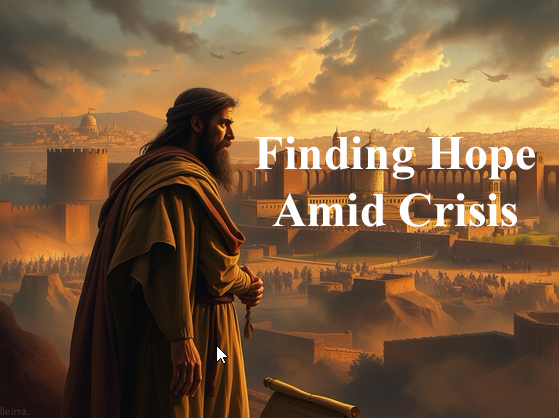
Finding Hope Amid Crisis

Finding Hope Amid Crisis

September 28, 2025*

By Pastor John Partridge

Jeremiah 32:1-3a, 6-15                     Luke 16:19-31                        1 Timothy 6:6-19

There is a curse that dates to the early 19th century that says, “May you live in interesting times.” For most of us, whether we want to admit it or not, boring is good. Boring lives are predictable. Interesting times tend to be filled with tumult, unpredictability, stress, rapid change, crises, and unpleasantness. Despite being interesting, life is not as enjoyable as it might be when we spend our time worrying about war, violence, pestilence, disease, political upheaval, inflation, healthcare, financial ruin, death, and destruction. In comparison, boring predictability is much more likely to allow us to find happiness and contentment. But that wasn’t the world in which the prophet Jeremiah found himself. Jeremiah had been born into a world that was facing one of his nation’s greatest upheavals and was called by God to bring messages of warning and hope to his people. As we read our first scripture, we find the army of Babylon at the gates of Jerusalem and God’s people filled with fear and despair. But into this pit of worry, we hear God bring his people a word of hope for the future (Jeremiah 32:1-3a, 6-15).

32:1 This is the word that came to Jeremiah from the Lord in the tenth year of Zedekiah king of Judah, which was the eighteenth year of Nebuchadnezzar. The army of the king of Babylon was then besieging Jerusalem, and Jeremiah the prophet was confined in the courtyard of the guard in the royal palace of Judah.

Now Zedekiah king of Judah had imprisoned him there, saying, “Why do you prophesy as you do? You say, ‘This is what the Lord says: I am about to give this city into the hands of the king of Babylon, and he will capture it.

Jeremiah said, “The word of the Lord came to me: Hanamel son of Shallum your uncle is going to come to you and say, ‘Buy my field at Anathoth, because as nearest relative it is your right and duty to buy it.’

“Then, just as the Lord had said, my cousin Hanamel came to me in the courtyard of the guard and said, ‘Buy my field at Anathoth in the territory of Benjamin. Since it is your right to redeem it and possess it, buy it for yourself.’

“I knew that this was the word of the Lord; so I bought the field at Anathoth from my cousin Hanamel and weighed out for him seventeen shekelsof silver. 10 I signed and sealed the deed, had it witnessed, and weighed out the silver on the scales. 11 I took the deed of purchase—the sealed copy containing the terms and conditions, as well as the unsealed copy— 12 and I gave this deed to Baruch son of Neriah, the son of Mahseiah, in the presence of my cousin Hanamel and of the witnesses who had signed the deed and of all the Jews sitting in the courtyard of the guard.

13 “In their presence I gave Baruch these instructions: 14 ‘This is what the Lord Almighty, the God of Israel, says: Take these documents, both the sealed and unsealed copies of the deed of purchase, and put them in a clay jar so they will last a long time. 15 For this is what the Lord Almighty, the God of Israel, says: Houses, fields and vineyards will again be bought in this land.’

Although everyone in Jerusalem was worrying and wondering what tomorrow would bring, and whether they might even live to see the sunrise, God brings a message of hope through the simple act of selling a small plot of land. It is likely that in a city under siege, food was becoming scarce and expensive and many things that were normally valuable were becoming useless and cheap. After all, when you are hungry, you can’t eat gold or jewels. And so, in a similar way, Jeremiah’s uncle comes to him in hopes of selling him a field outside the city, that neither of them might ever see again simply because the money that he would get from Jeremiah might buy him enough food for another day or two. In such a situation, you might ordinarily expect that Jeremiah would be completely uninterested and would prefer to keep his money so that he could buy his own food. But God calls Jeremiah in advance and commands him to buy the field from his uncle as a sign to the people of Jerusalem that there is hope for the future. Through the transfer of property, and the sealing away of the documentation, God declares that there will be a time, within the lifetime of Jeremiah, that God’s people will return to Jerusalem and the houses, fields, and vineyards will again be bought and sold. God’s message of hope is that despite the interesting, horrifying, and violent days ahead of them, a stable and boring life of normality will one day return.

But the reality was that many of the people inside the walls of Jerusalem would not live to see a new day. The violence and destruction of Jerusalem’s siege would claim many lives and still more would not live long enough to return from their captivity in Babylon.  But aside from ancient violence, death is an everyday reality for all of us. Life is short in the best of times, and we are all painfully aware of our mortality. And in Luke 16:19-31, Jesus gives us a warning about how we should live so that we can be with him when we reach the end of this life. Jesus said:

19 “There was a rich man who was dressed in purple and fine linen and lived in luxury every day. 20 At his gate was laid a beggar named Lazarus, covered with sores 21 and longing to eat what fell from the rich man’s table. Even the dogs came and licked his sores.

22 “The time came when the beggar died and the angels carried him to Abraham’s side. The rich man also died and was buried. 23 In Hades, where he was in torment, he looked up and saw Abraham far away, with Lazarus by his side. 24 So he called to him, ‘Father Abraham, have pity on me and send Lazarus to dip the tip of his finger in water and cool my tongue, because I am in agony in this fire.’

25 “But Abraham replied, ‘Son, remember that in your lifetime you received your good things, while Lazarus received bad things, but now he is comforted here, and you are in agony. 26 And besides all this, between us and you a great chasm has been set in place, so that those who want to go from here to you cannot, nor can anyone cross over from there to us.’

27 “He answered, ‘Then I beg you, father, send Lazarus to my family, 28 for I have five brothers. Let him warn them, so that they will not also come to this place of torment.’

29 “Abraham replied, ‘They have Moses and the Prophets; let them listen to them.’

30 “‘No, father Abraham,’ he said, ‘but if someone from the dead goes to them, they will repent.’

31 “He said to him, ‘If they do not listen to Moses and the Prophets, they will not be convinced even if someone rises from the dead.’”

First, I want to note that despite this being a parable, Jesus speaks of hell as if it is real. This is important to remember when we hear voices in our culture that say that there is no such thing. If Jesus said that hell is real, then I must believe that it is. Second, the clear message of this parable is that we each have choices to make in this life that cannot be undone in the next and we must live our lives in such a way that we end up on the right side of the chasm that separates comfort from torment. Third, even before his death and resurrection, Jesus was clear that some people will never be convinced of the truth regardless of the evidence presented.

In an odd sort of way, the message of Jesus is like that of Jeremiah. There is hope for our future, but we must seek to make good choices if we want to reach a place of comfort.

But if that is the case, then how do we do that? How do we make good choices? And what kind of choices are good? And as we often do, we find help in the guidance that Paul sent to his friend Timothy in his letter (1 Timothy 6:6-19) where he says:

But godliness with contentment is great gain. For we brought nothing into the world, and we can take nothing out of it. But if we have food and clothing, we will be content with that. Those who want to get rich fall into temptation and a trap and into many foolish and harmful desires that plunge people into ruin and destruction. 10 For the love of money is a root of all kinds of evil. Some people, eager for money, have wandered from the faith and pierced themselves with many griefs.

11 But you, man of God, flee from all this, and pursue righteousness, godliness, faith, love, endurance, and gentleness. 12 Fight the good fight of the faith. Take hold of the eternal life to which you were called when you made your good confession in the presence of many witnesses. 13 In the sight of God, who gives life to everything, and of Christ Jesus, who while testifying before Pontius Pilate made the good confession, I charge you 14 to keep this command without spot or blame until the appearing of our Lord Jesus Christ, 15 which God will bring about in his own time—God, the blessed and only Ruler, the King of kings and Lord of lords, 16 who alone is immortal and who lives in unapproachable light, whom no one has seen or can see. To him be honor and might forever. Amen.

17 Command those who are rich in this present world not to be arrogant nor to put their hope in wealth, which is so uncertain, but to put their hope in God, who richly provides us with everything for our enjoyment. 18 Command them to do good, to be rich in good deeds, and to be generous and willing to share. 19 In this way they will lay up treasure for themselves as a firm foundation for the coming age, so that they may take hold of the life that is truly life.

Paul says that godliness and contentment are good things to which we should aspire but that we should be content with what we have. Whenever we begin to desire more, when we aspire to become rich, we are tempted to do things that are both foolish and harmful and those things have caused the ruin and destruction of many lives. The love of money has led many people to wander from their faith and caused themselves no end of suffering. Instead, Paul says, the followers of God are called to flee from that sort of temptation and to instead pursue righteousness, godliness, faith, love, endurance, and gentleness. Paul charges Timothy, and all of us, to keep the command to fight the good fight of faith.

It is important to note that Paul does not say that the rich are automatically doomed simply because they are rich, especially because we are citizens of one of the richest nations in the history of the world. Instead, Paul instructs the followers of Jesus Christ to command those who are rich to do what is right. Paul says that the rich should not be so arrogant that they put their hope in wealth, which can be lost so easily, but to put their hope in God who richly provides us with all that we need and with everything for our enjoyment. Rich and poor alike should do good, be rich in good deeds, be generous and willing to share. When we do these things, we store treasure for ourselves in our future home and take hold of the things that are truly life giving.

No matter what crisis we face, we are never without hope but some of the choices that we make in this life cannot be undone in the next. Some people will never be convinced of the truth regardless of the evidence presented, but each of us must spend our lives in pursuit of what is good. We must seek godliness, and be content with what we have, resist the temptation to desire wealth at the expense of everything else, and instead pursue righteousness, godliness, faith, love, and gentleness. Be rich in good deeds, do good, be generous with what you have, and be willing to share with those who are in need.

If we do these things, we will increase our enjoyment in this life, draw others to the truth of Jesus Christ, and store up treasure for ourselves in the next.


Please LIKE and SHARE!

Click here to subscribe to Pastor John’s blog.

Click here if you would like to subscribe to Pastor John’s weekly messages.

Click here to visit Pastor John’s YouTube channel.


*You have been reading a message presented at Christ United Methodist Church on the date noted at the top of the first page.  Rev. John Partridge is the pastor at Christ UMC in Alliance, Ohio.  Duplication of this message is a part of our Media ministry, if you have received a blessing in this way, we would love to hear from you.  Letters and donations in support of the Media ministry or any of our other projects may be sent to Christ United Methodist Church, 470 East Broadway Street, Alliance, Ohio 44601.  These messages are available to any interested persons regardless of membership.  You may subscribe to these messages, in print or electronic formats, by writing to the address noted, or by contacting us at secretary@CUMCAlliance.org.  These messages can also be found online at https://pastorpartridge.com .  All Scripture quotations, unless otherwise indicated, are taken from the Holy Bible, New International Version®, NIV®. Copyright ©1973, 1978, 1984, 2011 by Biblica, Inc.™ Used by permission of Zondervan. All rights reserved worldwide. www.zondervan.comThe “NIV” and “New International Version” are trademarks registered in the United States Patent and Trademark Office by Biblica, Inc.™

Coming Soon!

Click here to listen to the podcast

Click here to watch the recorded livestream: https://youtu.be/psvtD_P47Lc
Or click here to skip straight to the sermon: https://youtu.be/05dgjGhOKY4

Children’s message: How is Jesus like a steam locomotive? https://youtu.be/iHXcL3eD4O0

This week’s challenge: What does it mean to “be prepared in season and out of season”? https://youtu.be/wL-8uCk8TAw


Coming Soon!

October 23, 2022*

By Pastor John Partridge

Jeremiah 31:27-34                 Luke 18:1-8                2 Timothy 3:14 – 4:5

For those of us who grew up going to real movie theaters, as well as possibly the Netflix generation in a different format, we remember the movie posters and the movie trailers that would run, interspersed with commercials for popcorn, candy, and soft drinks, for fifteen minutes before the movie started.  And the banner under which all these appeared was, “Coming Soon.”  “Coming Soon” was meant to inform us that something amazing, spectacular, and wonderful was about to happen and build our anticipation and desire to see it when it came to town.  This was, I think, especially true for the golden age movie serials as well as the Star Wars type movies that were patterned after them.  Coming soon, is a phrase that is designed to get our attention, to take our focus, of only for a moment, away from our present troubles and busyness, and look forward to the future and the appearance of something new.

And, although we won’t find the words “Coming Soon” anywhere in scripture, the idea that it represents is a common theme of the prophets, Jesus, and the gospel writers alike.  We heard the words in the scriptures that Susan used last week, and I’m going to use some of those same scriptures this morning but will look at them from a different direction.  The first words that we heard last week from the prophet Jeremiah, and will hear again this week, compare almost exactly to the modern usage of “Coming Soon.”  In Jeremiah 31:27-34, we hear…

“The days are coming,” declares the Lord… doesn’t that sound a lot like “Coming soon?”

27 “The days are coming,” declares the Lord, “when I will plant the kingdoms of Israel and Judah with the offspring of people and of animals. 28 Just as I watched over them to uproot and tear down, and to overthrow, destroy and bring disaster, so I will watch over them to build and to plant,” declares the Lord. 29 “In those days people will no longer say,

‘The parents have eaten sour grapes,
    and the children’s teeth are set on edge.’

30 Instead, everyone will die for their own sin; whoever eats sour grapes—their own teeth will be set on edge.

31 “The days are coming,” declares the Lord,
    “when I will make a new covenant
with the people of Israel
    and with the people of Judah.
32 It will not be like the covenant
    I made with their ancestors
when I took them by the hand
    to lead them out of Egypt,
because they broke my covenant,
    though I was a husband tothem,”
declares the Lord.
33 “This is the covenant I will make with the people of Israel
    after that time,” declares the Lord.
“I will put my law in their minds
    and write it on their hearts.
I will be their God,
    and they will be my people.
34 No longer will they teach their neighbor,
    or say to one another, ‘Know the Lord,’
because they will all know me,
    from the least of them to the greatest,”
declares the Lord.
“For I will forgive their wickedness
    and will remember their sins no more.”

God announces through Jeremiah that something new is coming.  The days are coming, when God will once again plant his people, kingdoms, and nations and watch over them as they rebuild.  In those days, as we heard last week, everyone will be held responsible for their own sin because… in those days, in the days that are coming soon, God will make a new covenant with his people that will be different from the covenant that he made with them when he led them out of slavery in Egypt.  This will be a new covenant, a new contract, a new promise that God will write upon the minds and hearts of his people.  It will be a new day, a new era, and a new relationship between God and his people.  And that day is… coming soon. 

No matter how you translate it, whether you say, “the days are coming,” or “coming soon,” or “I will…” God presses his people to look forward, to look past their present suffering, to put their trust in God, and look toward the future.  And in the parable that we heard last week, and again this week, this is very much what Jesus is doing as well as we hear these words in Luke 18:1-8:

18:1 Then Jesus told his disciples a parable to show them that they should always pray and not give up. He said: “In a certain town there was a judge who neither feared God nor cared what people thought. And there was a widow in that town who kept coming to him with the plea, ‘Grant me justice against my adversary.’

“For some time he refused. But finally, he said to himself, ‘Even though I don’t fear God or care what people think, yet because this widow keeps bothering me, I will see that she gets justice, so that she won’t eventually come and attack me!’”

And the Lord said, “Listen to what the unjust judge says. And will not God bring about justice for his chosen ones, who cry out to him day and night? Will he keep putting them off? I tell you; he will see that they get justice, and quickly. However, when the Son of Man comes, will he find faith on the earth?”

God promises to bring justice to his people who cry out to him, but Jesus encourages us not to stop, to continue praying, to continue to cry out to God for justice, because prayer is the expression of our faith.  Prayer is a mechanism by which we shift our focus, look past our present condition, and look forward, because fundamentally, prayer is an expression of our faith in God and our hope for the future.

But… as we hold on to our faith, and as we look toward the future, how do we live, love, and care for the people around us… today?  These are exactly the kind of questions that Paul answers in his second letter to his protégé Timothy as we hear these words in 2 Timothy 3:14 – 4:5:

14 But as for you, continue in what you have learned and have become convinced of, because you know those from whom you learned it, 15 and how from infancy you have known the Holy Scriptures, which are able to make you wise for salvation through faith in Christ Jesus. 16 All Scripture is God-breathed and is useful for teaching, rebuking, correcting, and training in righteousness, 17 so that the servant of Godmay be thoroughly equipped for every good work.

4:1 In the presence of God and of Christ Jesus, who will judge the living and the dead, and in view of his appearing and his kingdom, I give you this charge: Preach the word; be prepared in season and out of season; correct, rebuke, and encourage—with great patience and careful instruction. For the time will come when people will not put up with sound doctrine. Instead, to suit their own desires, they will gather around them a great number of teachers to say what their itching ears want to hear. They will turn their ears away from the truth and turn aside to myths. But you, keep your head in all situations, endure hardship, do the work of an evangelist, discharge all the duties of your ministry.

What should we do today?  We should continue to do the things that we’ve been taught to do, to teach the things that we’ve been convinced of by the Spirit of Jesus Christ and continue in our faith.  We should continue to study scripture, and use it to teach, rebuke, correct, and train others in righteousness so that the people of God might be fully equipped for every good work.

Paul’s charge, or assignment, to Timothy carries forward to each of us two thousand years later.  Preach the word, be prepared, at all times, to tell the gospel story and the message of salvation and rescue.  Correct, rebuke, and encourage, and offer instruction, but do these things with great care and patience so that the message that we bring is the message of scripture and not just a modern interpretation that resonates with our culture and makes us feel good.  Keep your head, stay calm… no matter what, endure hardship, do the work of an evangelist, and be in ministry, at all times, to all the people around you.

Paul’s instruction to Timothy, much like the words of Jeremiah and the parable of Jesus, remind us that the day is coming, and coming soon, when we will all stand in judgement.  Our mission is not to get bogged down in the troubles of today, but to look forward past our present troubled and divisive times, to look past our present condition, and live, love, teach, preach, correct, rebuke, and encourage so that we can bring as many of our neighbors, friends, coworkers, and classmates into the gates of heaven as we possibly can.

No one can know the day or the hour of Christ’s return, but just as God’s people were called in the time of Jeremiah, and just as they were in the time of Jesus and Paul, we are called to look forward, to look past our present struggles, to put our trust in God, and look toward the future.  Because even if we don’t know when he’s coming, we know that he is… coming soon.


Did you enjoy this? Please LIKE and SHARE!

Click here to subscribe to Pastor John’s blog.

Click here if you would like to subscribe to Pastor John’s weekly messages by email. Click here to watch our worship services on Pastor John’s YouTube channel.


*You have been reading a message presented at Christ United Methodist Church on the date noted at the top of the first page.  Rev. John Partridge is the pastor at Christ UMC in Alliance, Ohio.  Duplication of this message is a part of our Media ministry, if you have received a blessing in this way, we would love to hear from you.  Letters and donations in support of the Media ministry or any of our other projects may be sent to Christ United Methodist Church, 470 East Broadway Street, Alliance, Ohio 44601.  These messages are available to any interested persons regardless of membership.  You may subscribe to these messages, in print or electronic formats, by writing to the address noted, or by contacting us at secretary@CUMCAlliance.org.  These messages can also be found online at https://pastorpartridge.com .  All Scripture references are from the New International Version unless otherwise noted.