

Finding Hope Amid Crisis

Finding Hope Amid Crisis

September 28, 2025*

By Pastor John Partridge

Jeremiah 32:1-3a, 6-15                     Luke 16:19-31                        1 Timothy 6:6-19

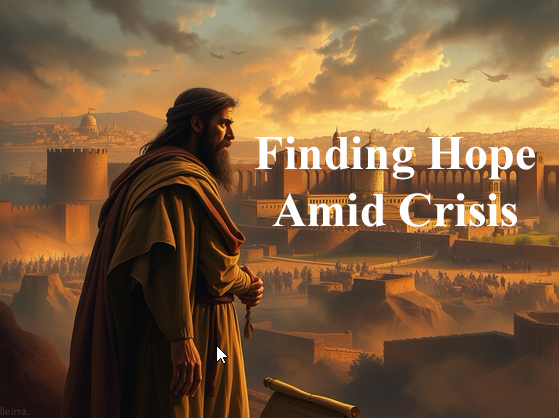
There is a curse that dates to the early 19th century that says, “May you live in interesting times.” For most of us, whether we want to admit it or not, boring is good. Boring lives are predictable. Interesting times tend to be filled with tumult, unpredictability, stress, rapid change, crises, and unpleasantness. Despite being interesting, life is not as enjoyable as it might be when we spend our time worrying about war, violence, pestilence, disease, political upheaval, inflation, healthcare, financial ruin, death, and destruction. In comparison, boring predictability is much more likely to allow us to find happiness and contentment. But that wasn’t the world in which the prophet Jeremiah found himself. Jeremiah had been born into a world that was facing one of his nation’s greatest upheavals and was called by God to bring messages of warning and hope to his people. As we read our first scripture, we find the army of Babylon at the gates of Jerusalem and God’s people filled with fear and despair. But into this pit of worry, we hear God bring his people a word of hope for the future (Jeremiah 32:1-3a, 6-15).

32:1 This is the word that came to Jeremiah from the Lord in the tenth year of Zedekiah king of Judah, which was the eighteenth year of Nebuchadnezzar. The army of the king of Babylon was then besieging Jerusalem, and Jeremiah the prophet was confined in the courtyard of the guard in the royal palace of Judah.

Now Zedekiah king of Judah had imprisoned him there, saying, “Why do you prophesy as you do? You say, ‘This is what the Lord says: I am about to give this city into the hands of the king of Babylon, and he will capture it.

Jeremiah said, “The word of the Lord came to me: Hanamel son of Shallum your uncle is going to come to you and say, ‘Buy my field at Anathoth, because as nearest relative it is your right and duty to buy it.’

“Then, just as the Lord had said, my cousin Hanamel came to me in the courtyard of the guard and said, ‘Buy my field at Anathoth in the territory of Benjamin. Since it is your right to redeem it and possess it, buy it for yourself.’

“I knew that this was the word of the Lord; so I bought the field at Anathoth from my cousin Hanamel and weighed out for him seventeen shekelsof silver. 10 I signed and sealed the deed, had it witnessed, and weighed out the silver on the scales. 11 I took the deed of purchase—the sealed copy containing the terms and conditions, as well as the unsealed copy— 12 and I gave this deed to Baruch son of Neriah, the son of Mahseiah, in the presence of my cousin Hanamel and of the witnesses who had signed the deed and of all the Jews sitting in the courtyard of the guard.

13 “In their presence I gave Baruch these instructions: 14 ‘This is what the Lord Almighty, the God of Israel, says: Take these documents, both the sealed and unsealed copies of the deed of purchase, and put them in a clay jar so they will last a long time. 15 For this is what the Lord Almighty, the God of Israel, says: Houses, fields and vineyards will again be bought in this land.’

Although everyone in Jerusalem was worrying and wondering what tomorrow would bring, and whether they might even live to see the sunrise, God brings a message of hope through the simple act of selling a small plot of land. It is likely that in a city under siege, food was becoming scarce and expensive and many things that were normally valuable were becoming useless and cheap. After all, when you are hungry, you can’t eat gold or jewels. And so, in a similar way, Jeremiah’s uncle comes to him in hopes of selling him a field outside the city, that neither of them might ever see again simply because the money that he would get from Jeremiah might buy him enough food for another day or two. In such a situation, you might ordinarily expect that Jeremiah would be completely uninterested and would prefer to keep his money so that he could buy his own food. But God calls Jeremiah in advance and commands him to buy the field from his uncle as a sign to the people of Jerusalem that there is hope for the future. Through the transfer of property, and the sealing away of the documentation, God declares that there will be a time, within the lifetime of Jeremiah, that God’s people will return to Jerusalem and the houses, fields, and vineyards will again be bought and sold. God’s message of hope is that despite the interesting, horrifying, and violent days ahead of them, a stable and boring life of normality will one day return.

But the reality was that many of the people inside the walls of Jerusalem would not live to see a new day. The violence and destruction of Jerusalem’s siege would claim many lives and still more would not live long enough to return from their captivity in Babylon.  But aside from ancient violence, death is an everyday reality for all of us. Life is short in the best of times, and we are all painfully aware of our mortality. And in Luke 16:19-31, Jesus gives us a warning about how we should live so that we can be with him when we reach the end of this life. Jesus said:

19 “There was a rich man who was dressed in purple and fine linen and lived in luxury every day. 20 At his gate was laid a beggar named Lazarus, covered with sores 21 and longing to eat what fell from the rich man’s table. Even the dogs came and licked his sores.

22 “The time came when the beggar died and the angels carried him to Abraham’s side. The rich man also died and was buried. 23 In Hades, where he was in torment, he looked up and saw Abraham far away, with Lazarus by his side. 24 So he called to him, ‘Father Abraham, have pity on me and send Lazarus to dip the tip of his finger in water and cool my tongue, because I am in agony in this fire.’

25 “But Abraham replied, ‘Son, remember that in your lifetime you received your good things, while Lazarus received bad things, but now he is comforted here, and you are in agony. 26 And besides all this, between us and you a great chasm has been set in place, so that those who want to go from here to you cannot, nor can anyone cross over from there to us.’

27 “He answered, ‘Then I beg you, father, send Lazarus to my family, 28 for I have five brothers. Let him warn them, so that they will not also come to this place of torment.’

29 “Abraham replied, ‘They have Moses and the Prophets; let them listen to them.’

30 “‘No, father Abraham,’ he said, ‘but if someone from the dead goes to them, they will repent.’

31 “He said to him, ‘If they do not listen to Moses and the Prophets, they will not be convinced even if someone rises from the dead.’”

First, I want to note that despite this being a parable, Jesus speaks of hell as if it is real. This is important to remember when we hear voices in our culture that say that there is no such thing. If Jesus said that hell is real, then I must believe that it is. Second, the clear message of this parable is that we each have choices to make in this life that cannot be undone in the next and we must live our lives in such a way that we end up on the right side of the chasm that separates comfort from torment. Third, even before his death and resurrection, Jesus was clear that some people will never be convinced of the truth regardless of the evidence presented.

In an odd sort of way, the message of Jesus is like that of Jeremiah. There is hope for our future, but we must seek to make good choices if we want to reach a place of comfort.

But if that is the case, then how do we do that? How do we make good choices? And what kind of choices are good? And as we often do, we find help in the guidance that Paul sent to his friend Timothy in his letter (1 Timothy 6:6-19) where he says:

But godliness with contentment is great gain. For we brought nothing into the world, and we can take nothing out of it. But if we have food and clothing, we will be content with that. Those who want to get rich fall into temptation and a trap and into many foolish and harmful desires that plunge people into ruin and destruction. 10 For the love of money is a root of all kinds of evil. Some people, eager for money, have wandered from the faith and pierced themselves with many griefs.

11 But you, man of God, flee from all this, and pursue righteousness, godliness, faith, love, endurance, and gentleness. 12 Fight the good fight of the faith. Take hold of the eternal life to which you were called when you made your good confession in the presence of many witnesses. 13 In the sight of God, who gives life to everything, and of Christ Jesus, who while testifying before Pontius Pilate made the good confession, I charge you 14 to keep this command without spot or blame until the appearing of our Lord Jesus Christ, 15 which God will bring about in his own time—God, the blessed and only Ruler, the King of kings and Lord of lords, 16 who alone is immortal and who lives in unapproachable light, whom no one has seen or can see. To him be honor and might forever. Amen.

17 Command those who are rich in this present world not to be arrogant nor to put their hope in wealth, which is so uncertain, but to put their hope in God, who richly provides us with everything for our enjoyment. 18 Command them to do good, to be rich in good deeds, and to be generous and willing to share. 19 In this way they will lay up treasure for themselves as a firm foundation for the coming age, so that they may take hold of the life that is truly life.

Paul says that godliness and contentment are good things to which we should aspire but that we should be content with what we have. Whenever we begin to desire more, when we aspire to become rich, we are tempted to do things that are both foolish and harmful and those things have caused the ruin and destruction of many lives. The love of money has led many people to wander from their faith and caused themselves no end of suffering. Instead, Paul says, the followers of God are called to flee from that sort of temptation and to instead pursue righteousness, godliness, faith, love, endurance, and gentleness. Paul charges Timothy, and all of us, to keep the command to fight the good fight of faith.

It is important to note that Paul does not say that the rich are automatically doomed simply because they are rich, especially because we are citizens of one of the richest nations in the history of the world. Instead, Paul instructs the followers of Jesus Christ to command those who are rich to do what is right. Paul says that the rich should not be so arrogant that they put their hope in wealth, which can be lost so easily, but to put their hope in God who richly provides us with all that we need and with everything for our enjoyment. Rich and poor alike should do good, be rich in good deeds, be generous and willing to share. When we do these things, we store treasure for ourselves in our future home and take hold of the things that are truly life giving.

No matter what crisis we face, we are never without hope but some of the choices that we make in this life cannot be undone in the next. Some people will never be convinced of the truth regardless of the evidence presented, but each of us must spend our lives in pursuit of what is good. We must seek godliness, and be content with what we have, resist the temptation to desire wealth at the expense of everything else, and instead pursue righteousness, godliness, faith, love, and gentleness. Be rich in good deeds, do good, be generous with what you have, and be willing to share with those who are in need.

If we do these things, we will increase our enjoyment in this life, draw others to the truth of Jesus Christ, and store up treasure for ourselves in the next.


Please LIKE and SHARE!

Click here to subscribe to Pastor John’s blog.

Click here if you would like to subscribe to Pastor John’s weekly messages.

Click here to visit Pastor John’s YouTube channel.


*You have been reading a message presented at Christ United Methodist Church on the date noted at the top of the first page.  Rev. John Partridge is the pastor at Christ UMC in Alliance, Ohio.  Duplication of this message is a part of our Media ministry, if you have received a blessing in this way, we would love to hear from you.  Letters and donations in support of the Media ministry or any of our other projects may be sent to Christ United Methodist Church, 470 East Broadway Street, Alliance, Ohio 44601.  These messages are available to any interested persons regardless of membership.  You may subscribe to these messages, in print or electronic formats, by writing to the address noted, or by contacting us at secretary@CUMCAlliance.org.  These messages can also be found online at https://pastorpartridge.com .  All Scripture quotations, unless otherwise indicated, are taken from the Holy Bible, New International Version®, NIV®. Copyright ©1973, 1978, 1984, 2011 by Biblica, Inc.™ Used by permission of Zondervan. All rights reserved worldwide. www.zondervan.comThe “NIV” and “New International Version” are trademarks registered in the United States Patent and Trademark Office by Biblica, Inc.™

Finding Purpose (and Snakes)

Finding Purpose (and Snakes)

March 10, 2024*

By Pastor John Partridge

Numbers 21:4-9        John 3:14-21              Ephesians 2:1-10

Have you seen Raiders of the Lost Ark?

That was the original movie in which, Indiana Jones, an intrepid archaeologist, searches the world for ancient clues to the location of Israel’s lost Ark of the Covenant. In this movie, there is a climactic scene as Indy and his friend and guide Sallah, enter the Well of Souls where the Ark had been hidden several millennia ago. As Indy and Sallah look down into the room containing the ark, Sallah says, “Indy, why does the floor move?” And after Sallah gives Indiana Jones his torch, Indy says, “Snakes. Why’d it have to be snakes?” Although he has had a lifelong fear of snakes, Indy’s salvation, as it were, comes from the torches that they hold. With their flames, and little gasoline, they hold back the snakes until they can retrieve the Ark. Well, at least until the bad guys trap Indy in the pit and the torches burn out.

In any case, although Indiana Jones does not appear in today’s scripture, snakes, and the rescue of God’s people from those snakes, do. We begin this morning with the people of Israel on their journey from slavery in Egypt to freedom in the Promised Land. But along the way, they take a detour around the nation and the people of Edom who refuse to allow Israel to pass through. We join Moses and the people in Numbers 21:4-9, and hear these words:

They traveled from Mount Hor along the route to the Red Sea, to go around Edom. But the people grew impatient on the way; they spoke against God and against Moses, and said, “Why have you brought us up out of Egypt to die in the wilderness? There is no bread! There is no water! And we detest this miserable food!”

Then the Lord sent venomous snakes among them; they bit the people and many Israelites died. The people came to Moses and said, “We sinned when we spoke against the Lord and against you. Pray that the Lord will take the snakes away from us.” So, Moses prayed for the people.

The Lord said to Moses, “Make a snake and put it up on a pole; anyone who is bitten can look at it and live.” So Moses made a bronze snake and put it up on a pole. Then when anyone was bitten by a snake and looked at the bronze snake, they lived.

First, some of you are bound to ask, “Did God really send snakes to kill people?” And the answer to that is… maybe. To be clear, I’m not hedging my bets, it just that it isn’t necessarily all that clear cut. The people were whining and complaining and speaking out against God and against Moses, so yes, it’s definitely a possibility that God could have chosen to punish them and doing so really isn’t outside of our understanding of the nature of God. On the other hand, when we remember that the people of the Old Testament subscribed to a theology that assumed that anything that happened to you, whether that was good or bad, had been sent to you by God, then other possibilities also present themselves. If the same thing happened to us, or to Indiana Jones, today, we would say that we were traveling across the wilderness and encountered many snakes. And so, while it’s possible that God sent the snakes, it is also possible that they simply passed through a place that had many poisonous snakes. In either case, Israel’s understanding of God would have caused them to tell the story the way that we just read it, that God sent venomous snakes among them.

The important bit, however, is what happens next. The people come to Moses, repent of their sin against him and against God, and ask that Moses would pray for their deliverance so that God would take the snakes away from them. Moses does, but God does not take the snakes away. Instead, God offers a way for people who have been bitten to be rescued from death. All they had to do is to have faith in God and look toward the bronze snake that Moses had mounted on a pole in their camp. The salvation and rescue of God’s people was found in their faith in God, and their trust in the symbol that had been lifted up.

And that leads us directly to the teaching of Jesus that we find in John 3:14-21 when he says:

14 Just as Moses lifted up the snake in the wilderness, so the Son of Man must be lifted up, 15 that everyone who believes may have eternal life in him.”

16 For God so loved the world that he gave his one and only Son, that whoever believes in him shall not perish but have eternal life. 17 For God did not send his Son into the world to condemn the world, but to save the world through him. 18 Whoever believes in him is not condemned, but whoever does not believe stands condemned already because they have not believed in the name of God’s one and only Son. 19 This is the verdict: Light has come into the world, but people loved darkness instead of light because their deeds were evil. 20 Everyone who does evil hates the light, and will not come into the light for fear that their deeds will be exposed. 21 But whoever lives by the truth comes into the light, so that it may be seen plainly that what they have done has been done in the sight of God.

Jesus says that, like Moses “lifted up” the symbol of the snake in the wilderness, so must he, the Son of Man, be “lifted up.” It is likely that this is an intentional double meaning as “lifted up” means “exalted” as well as reflective of the bronze snake being lifted on a pole. Since Jesus often foretells his trial, crucifixion, and death, this may also be a foreshadowing of both the exaltation of Jesus and his physical lifting as his cross is put in place. But Jesus adds to the connection of the snakes in the wilderness, and says that just as the people were cured of their poison-induced illness when they had faith in the curative powers of the bronze snake, so too will those who put their faith in Jesus be cured of the poison of sin and death, and have eternal life. Whoever believes in Jesus will not be condemned before God, but those who do not believe have already been condemned.

And that lead us directly to Ephesians 2:1-10 where Paul uses that exact sort of imagery when he says that before we came to Jesus Christ, we were already dead:

2:1 As for you, you were dead in your transgressions and sins, in which you used to live when you followed the ways of this world and of the ruler of the kingdom of the air, the spirit who is now at work in those who are disobedient. All of us also lived among them at one time, gratifying the cravings of our flesh and following its desires and thoughts. Like the rest, we were by nature deserving of wrath. But because of his great love for us, God, who is rich in mercy, made us alive with Christ even when we were dead in transgressions—it is by grace you have been saved. And God raised us up with Christ and seated us with him in the heavenly realms in Christ Jesus, in order that in the coming ages he might show the incomparable riches of his grace, expressed in his kindness to us in Christ Jesus. For it is by grace you have been saved, through faith—and this is not from yourselves, it is the gift of God— not by works, so that no one can boast. 10 For we are God’s handiwork, created in Christ Jesus to do good works, which God prepared in advance for us to do.

Because, as Jesus taught, “whoever does not believe stands condemned already because they have not believed in the name of God’s one and only Son,” then Paul explains that before we came to faith in Christ we were, figuratively and spiritually, dead. Our selfish goals were centered on gratifying the cravings, desires, and thoughts of our human flesh. Those desires populate common phrases from our culture like “do whatever feels good,” “do whatever the heart wants,” “whoever has the most toys wins,” “the one with the most gold makes the rules,” “power corrupts,” “feeling are more important than facts,” and other similar sentiments. Selfishness is the basis of our human nature and that is why Paul says, “we were, by nature, deserving of wrath.”

We were, by our very nature, deserving of wrath, punishment, and death. But God, who is rich in mercy, made us alive with Christ and saved us through grace. Just like the bronze snake, Jesus was lifted up on the cross so that we could be raised up with him to the kingdom of God and his heavenly home.

But we’re not dead yet. Heaven may be our treasure and our future home, but as long as we are here, God still has a purpose for our lives. God didn’t save the people of Israel from snakes so that they could be idle, God saved them so that they could inhabit the Promised Land, be his people, establish a beachhead for God’s kingdom, and be a lighthouse of hope for the world. Likewise, God did not save us from sin and death so that we could sit back, drink margaritas, and look forward to our home in the sky, by and by.

As Paul said, we represent the craftsmanship and handiwork of God who created us to do good works. It isn’t good works that save us, but having put our faith in Jesus Christ, God has now, in advance, prepared work for us to do. Our mission, therefore, is twofold. First, dig into the bible, spend time in prayer and meditation, and figure out what it is that God is calling us to do, and what work God has prepared for us to do.

And second, once we figure out what that is…

                        …get busy and do it.


Please LIKE and SHARE!

Click here to subscribe to Pastor John’s blog.

Click here if you would like to subscribe to Pastor John’s weekly messages.

Click here to visit Pastor John’s YouTube channel.


*You have been reading a message presented at Christ United Methodist Church on the date noted at the top of the first page.  Rev. John Partridge is the pastor at Christ UMC in Alliance, Ohio.  Duplication of this message is a part of our Media ministry, if you have received a blessing in this way, we would love to hear from you.  Letters and donations in support of the Media ministry or any of our other projects may be sent to Christ United Methodist Church, 470 East Broadway Street, Alliance, Ohio 44601.  These messages are available to any interested persons regardless of membership.  You may subscribe to these messages, in print or electronic formats, by writing to the address noted, or by contacting us at secretary@CUMCAlliance.org.  These messages can also be found online at https://pastorpartridge.com .  All Scripture quotations, unless otherwise indicated, are taken from the Holy Bible, New International Version®, NIV®. Copyright ©1973, 1978, 1984, 2011 by Biblica, Inc.™ Used by permission of Zondervan. All rights reserved worldwide. www.zondervan.comThe “NIV” and “New International Version” are trademarks registered in the United States Patent and Trademark Office by Biblica, Inc.™
Sabbath and Sacrifice

Sabbath and Sacrifice

March 03, 2024U

By Pastor John Partridge

Deuteronomy 5:12-15           Mark 2:23 – 3:6                     2 Corinthians 4:5-12

How many of you have had to turn your computer, or your phone, or your printer, or some other electronic, or even mechanical, device, off and then back on again, to make it work the way that it’s supposed to work? All of us. Anne Lamott once said, “Almost anything will work again if you unplug it for a few minutes, including you.”

It’s a thoughtful sentiment, but Anne Lamott was hardly the first person to think about the value of turning us humans off and back on again. In fact, unplugging human beings, and then plugging them in again is the whole principle behind sabbath rest. Sabbath rest, of course, is an ancient idea, and, to understand that we need to go back to the beginning, to Deuteronomy 5:12-15, where we hear this command from God to his people:

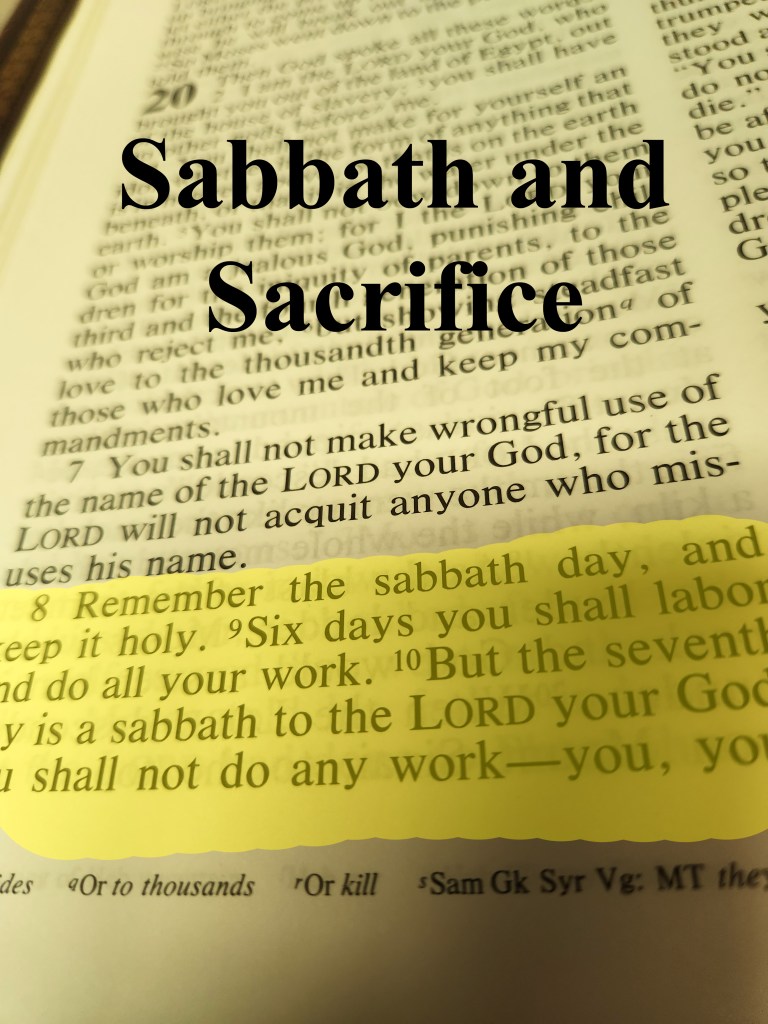
12 “Observe the Sabbath day by keeping it holy, as the Lord your God has commanded you. 13 Six days you shall labor and do all your work, 14 but the seventh day is a sabbath to the Lord your God. On it you shall not do any work, neither you, nor your son or daughter, nor your male or female servant, nor your ox, your donkey or any of your animals, nor any foreigner residing in your towns, so that your male and female servants may rest, as you do. 15 Remember that you were slaves in Egypt and that the Lord your God brought you out of there with a mighty hand and an outstretched arm. Therefore, the Lord your God has commanded you to observe the Sabbath day.

When we read this, we realize that there are two purposes behind God’s requirement of the sabbath day. The first of these is simply to rest, to unplug, and reset our bodies and minds so that we can start fresh again in a new week. And the second reason is to remember what God has done for us, to remember God’s mighty acts of rescue, redemption, and rescue, and to spend time honoring and worshiping our God. But, over time, the reason and rationale behind honoring the sabbath got confused. Because everyone recognized that the sabbath was important, the priests and other religious leaders made rules to help the people of Israel get it right. But along the way, the rules that they made, and the traditions that they established, became so important, that they were held to be of the same importance as God’s original commands. And that’s why Jesus gets into an argument with the Pharisees in Mark 2:23 – 3:6 where we hear this:

23 One Sabbath Jesus was going through the grain fields, and as his disciples walked along, they began to pick some heads of grain. 24 The Pharisees said to him, “Look, why are they doing what is unlawful on the Sabbath?”

25 He answered, “Have you never read what David did when he and his companions were hungry and in need? 26 In the days of Abiathar the high priest, he entered the house of God and ate the consecrated bread, which is lawful only for priests to eat. And he also gave some to his companions.”

27 Then he said to them, “The Sabbath was made for man, not man for the Sabbath. 28 So the Son of Man is Lord even of the Sabbath.”

3:1 Another time Jesus went into the synagogue, and a man with a shriveled hand was there. Some of them were looking for a reason to accuse Jesus, so they watched him closely to see if he would heal him on the Sabbath. Jesus said to the man with the shriveled hand, “Stand up in front of everyone.”

Then Jesus asked them, “Which is lawful on the Sabbath: to do good or to do evil, to save life or to kill?” But they remained silent.

He looked around at them in anger and, deeply distressed at their stubborn hearts, said to the man, “Stretch out your hand.” He stretched it out, and his hand was completely restored. Then the Pharisees went out and began to plot with the Herodians how they might kill Jesus.

Since the commandment to rest on the sabbath day required observant followers of God to refrain from work, it was natural that, over time, people wanted to know what exactly qualified as work. Moreover, after Israel had been sent into captivity in Babylon because of their unfaithfulness, the priests and other religious leaders wanted to write rules that would figuratively put fences around the commandments of God so that, if you were to follow their man-made rules, you would always be found to be in obedience to God’s commandments. Staying inside the fence, as it were, prevented you from even accidentally breaking a commandment.

The problem with this system was that, after a while, the rules that were intended to help obey the commandments became elevated to the same level of importance as the commandments themselves. And so, in this story, we find the disciples snapping off, and chewing on some uncooked heads of grain as they walked through the fields. But even though they exerted no energy other than lifting their hands to their mouths, according to the rules, what they had done was defined as harvesting, and harvesting was work. God’s commandment to observe the sabbath never said that you couldn’t eat, but the rules that had been written by generations of priests said that what they had done was sin (hint: it wasn’t).

And so, Jesus gives an example from scripture about how the great King David had done the same thing, and worse, and explained that God intended the sabbath to improve the lives of human beings and not to be an additional burden to them. Jesus had the same argument over healing a man who had suffered from what may well have been a birth defect. While healing was somehow defined as work, Jesus asked how doing good and undoing evil could possibly be wrong.

And that’s all well and good, but as we often ask… so what?

So, what if we know that God created a sabbath rest and a time of worship for the benefit of humanity?

So, what if we understand we shouldn’t define our sabbath rest too narrowly, and that doing good things on our day of rest is okay?

How does that make a difference to us as we live our lives?

Well, for that, let’s turn to Paul’s second letter to the church in Corinth for some clarity. But, as we read, this may not immediately sound like it is at all related to our understanding of sabbath. But it is, so bear with me until we finish, and I can unpack it a little. In 2 Corinthians 4:5-12, Paul says…

For what we preach is not ourselves, but Jesus Christ as Lord, and ourselves as your servants for Jesus’ sake. For God, who said, “Let light shine out of darkness,” made his light shine in our hearts to give us the light of the knowledge of God’s glory displayed in the face of Christ.

But we have this treasure in jars of clay to show that this all-surpassing power is from God and not from us. We are hard pressed on every side, but not crushed; perplexed, but not in despair; persecuted, but not abandoned; struck down, but not destroyed. 10 We always carry around in our body the death of Jesus, so that the life of Jesus may also be revealed in our body. 11 For we who are alive are always being given over to death for Jesus’ sake, so that his life may also be revealed in our mortal body. 12 So then, death is at work in us, but life is at work in you.

And again, I understand that this message of servanthood and persecution doesn’t immediately sound like it connects to our understanding of sabbath, but let’s look a little closer.  Paul reminds us that what we tell the world is not a message about us, it is a message about Jesus Christ, about how he came to bring light into a dark world, to display God’s glory, and to change hearts. Because of that, Paul says that we have the treasure of Jesus Christ in jars of clay.

Wait.

What does that mean?

Our explanation comes from what immediately follows, and that is a list of all the horrible things that have happened to them as messengers of the gospel. They were hard pressed, persecuted, and struck down, but while these things happened, and while they did experience abuse, pain, and suffering, they were not completely crushed, they did not despair, they did not feel as if they had been abandoned, and they were not destroyed. They themselves were carrying the message of Jesus Christ, but they knew that they were finite, fragile, and temporary vessels. More to the point, we, all of us, are like jars of clay. We are fragile vessels that contain the treasure of Jesus Christ.

We are fragile. Like clay we leak, we chip, we scratch, and we break. If God intended for us to contain his treasure, he would have stored it in something more durable like a stout treasure chest or a stone fortress. But he didn’t. The only way for us to preserve the treasure that we contain… is to share it with others.

Paul says that “we who are alive are always being given over to death for Jesus’s sake.” That means that we must be at work giving of ourselves, offering ourselves as a sacrifice to God, and sharing the good news of Jesus Christ. Death is at work in us because our time on earth is limited, and because the sacrifice of Jesus Christ is a part of who we are. But life is also at work in us through Jesus’ resurrection and his gift of eternal life to those who believe.

And so, if we look at it with Paul’s words in mind, sabbath is a time of rest and renewal when we remember who we are as we come together to worship our God, refill our leaky clay vessels, share our courage and strength with one another, share the Spirit of God that dwells within us, build one another up, equip one another, teach, learn, and grow, so that we can go back out into the world as a living sacrifice to Jesus Christ and to the kingdom of God.

Anne Lamott said, “Almost anything will work again if you unplug it for a few minutes, including you.”

And the truth of scripture tells us that she’s not wrong. Human beings were not designed or built to go non-stop, twenty-four hours a day, seven day a week, three hundred and sixty-five (or 366) days a year. The God of creation built us with a need for rest. Once every seven days he offers us a sabbath, a time to reset, restore, rest, and renew both physically and spiritually so that we can face the world, and all the evil in it, for another week.

Without rest, without sabbath, we are easily crushed, suffer despair, and feel abandoned and destroyed. Without sabbath, our fragile clay leaks and our faith weakens. Without sabbath, we are not prepared to live lives of sacrifice to God.

Simply put, without sabbath, and without rest, we cannot be the people that God wants, and needs, us to be.


Please LIKE and SHARE!

Click here to subscribe to Pastor John’s blog.

Click here if you would like to subscribe to Pastor John’s weekly messages.

Click here to visit Pastor John’s YouTube channel.


*You have been reading a message presented at Christ United Methodist Church on the date noted at the top of the first page.  Rev. John Partridge is the pastor at Christ UMC in Alliance, Ohio.  Duplication of this message is a part of our Media ministry, if you have received a blessing in this way, we would love to hear from you.  Letters and donations in support of the Media ministry or any of our other projects may be sent to Christ United Methodist Church, 470 East Broadway Street, Alliance, Ohio 44601.  These messages are available to any interested persons regardless of membership.  You may subscribe to these messages, in print or electronic formats, by writing to the address noted, or by contacting us at secretary@CUMCAlliance.org.  These messages can also be found online at https://pastorpartridge.com .  All Scripture quotations, unless otherwise indicated, are taken from the Holy Bible, New International Version®, NIV®. Copyright ©1973, 1978, 1984, 2011 by Biblica, Inc.™ Used by permission of Zondervan. All rights reserved worldwide. www.zondervan.comThe “NIV” and “New International Version” are trademarks registered in the United States Patent and Trademark Office by Biblica, Inc.™

Trading Gold for Beans

Click here to listen to the podcast

Click here to watch the livestream: https://youtu.be/gcjdfIeBugc


Trading Gold for Beans

August 28, 2022*

By Pastor John Partridge

Jeremiah 2:4-13                     Luke 14:1, 7-14                      Hebrews 13:1-8, 15-16

In the story of Jack and the Beanstalk, the hero, a young boy named Jack is sent to the market, by his mother, to sell their cow that has stopped giving milk.  On the way to town, Jack is convinced to sell the family cow, not for gold, but for three magical beans.  On the surface, at least in the story, Jack has made a terrible bargain and has been fleeced and bamboozled by the bean dealer.  But again, in the story, it turns out that the beans really are magical and offer Jack a pathway to his adventure in the kingdom of the Giant and his golden goose.

But what happens in reality?  How often do hucksters and scoundrels convince our elderly to buy the modern equivalent of magic beans and rob them of their retirement funds?  How often do unscrupulous investment advisors line their pockets at the expense of unwise or overly trusting investors?  Or how often do we see internet pop-up ads selling products that just seem too good to be true?  It seems that too often, trusting people are hoodwinked into selling their gold in exchange for piles of worthless beans that aren’t even magical.

And curiously, that is what is at the root of God’s accusation against his people that we find in Jeremiah 2:4-13.  God says that his people have walked away from him and abandoned the gold that he had in exchange for worthless piles of beans.  Jeremiah said…

Hear the word of the Lord, you descendants of Jacob, all you clans of Israel.

This is what the Lord says:

“What fault did your ancestors find in me, that they strayed so far from me?
They followed worthless idols and became worthless themselves.
They did not ask, ‘Where is the Lord, who brought us up out of Egypt
and led us through the barren wilderness, through a land of deserts and ravines,
a land of drought and utter darkness, a land where no one travels and no one lives?’
I brought you into a fertile land to eat its fruit and rich produce.
But you came and defiled my land and made my inheritance detestable.
The priests did not ask, ‘Where is the Lord?’
Those who deal with the law did not know me; the leaders rebelled against me.
The prophets prophesied by Baal, following worthless idols.

“Therefore I bring charges against you again,” declares the Lord.
    “And I will bring charges against your children’s children.
10 Cross over to the coasts of Cyprus and look, send to Kedar and observe closely;
    see if there has ever been anything like this:
11 Has a nation ever changed its gods? (Yet they are not gods at all.)
But my people have exchanged their glorious God for worthless idols.
12 Be appalled at this, you heavens, and shudder with great horror,” declares the Lord.
13 “My people have committed two sins:
They have forsaken me, the spring of living water,
and have dug their own cisterns, broken cisterns that cannot hold water.

God wonders why his people started to drift.  The ancestors of Israel began to stray from God, followed worthless idols and never thought to ask what happened to the God and to the faith that led them across deserts and through the Red Sea.  God gave them an incredible inheritance that they could enjoy and pass on their children, but the people defiled the land and ruined it.  The priests never stopped to ask what happened to God, the theologians and the church leaders either didn’t know God at all or actively rebelled against him and the prophets of Israel sold out to what was popular and prophesied for Baal instead.

God tells his people that they are free to look anywhere they want and try to find another country that has abandoned their gods and they won’t find any even though the gods of other countries are no more than stone statues.  God is appalled and heaven in horrified.  God’s people have traded rivers of life-giving water for broken, leaking, clay pools of foul, stagnant, green water.

They traded piles of gold for a handful of ordinary beans.

In a similar lesson found in Luke 14:1, 7-14, Jesus shares a story that tells us how we tell the difference between gold and beans as we go about the busyness of our daily lives.  Luke says…

14:1 One Sabbath, when Jesus went to eat in the house of a prominent Pharisee, he was being carefully watched.

When he noticed how the guests picked the places of honor at the table, he told them this parable: “When someone invites you to a wedding feast, do not take the place of honor, for a person more distinguished than you may have been invited. If so, the host who invited both of you will come and say to you, ‘Give this person your seat.’ Then, humiliated, you will have to take the least important place. 10 But when you are invited, take the lowest place, so that when your host comes, he will say to you, ‘Friend, move up to a better place.’ Then you will be honored in the presence of all the other guests. 11 For all those who exalt themselves will be humbled, and those who humble themselves will be exalted.”

12 Then Jesus said to his host, “When you give a luncheon or dinner, do not invite your friends, your brothers or sisters, your relatives, or your rich neighbors; if you do, they may invite you back and so you will be repaid. 13 But when you give a banquet, invite the poor, the crippled, the lame, the blind, 14 and you will be blessed. Although they cannot repay you, you will be repaid at the resurrection of the righteous.”

Our lives are filled with opportunities to collect wealth for ourselves.  Some of those opportunities allow us to store up gold, and others cause us to expend our time and our energy and end the day with little more than a handful of beans.  Jesus says that you do not gain from what you take, you gain from what you are given, and by what you give.  Throwing a party and inviting a house full of influential friends, who will, later, invite you back, gains you nothing.  Money, power, and influence will evaporate before your casket closes.  But offering a banquet to the poor, the crippled, the lame, the blind, and for those who are unable to care for themselves, that deposits gold into your account in God’s heavenly treasury.

Similarly, the writer of Hebrews offers us a list of things that we do in life that earn us gold rather than beans.  In Hebrews 13:1-8, 15-16, he says:

13:1 Keep on loving one another as brothers and sisters. Do not forget to show hospitality to strangers, for by so doing some people have shown hospitality to angels without knowing it. Continue to remember those in prison as if you were together with them in prison, and those who are mistreated as if you yourselves were suffering.

Marriage should be honored by all, and the marriage bed kept pure, for God will judge the adulterer and all the sexually immoral. Keep your lives free from the love of money and be content with what you have, because God has said,

“Never will I leave you;
    never will I forsake you.”

So we say with confidence,

“The Lord is my helper; I will not be afraid.
    What can mere mortals do to me?”

Remember your leaders, who spoke the word of God to you. Consider the outcome of their way of life and imitate their faith. Jesus Christ is the same yesterday and today and forever.

15 Through Jesus, therefore, let us continually offer to God a sacrifice of praise—the fruit of lips that openly profess his name. 16 And do not forget to do good and to share with others, for with such sacrifices God is pleased.

Without specifically calling out bankers, or businesspeople, or farmers, or anyone else who work to earn an income, the writer of Hebrews tell us that some activities are better, in the eyes of God, than others.  Loving the people around you, and not just family members, is a good thing.  Inviting strangers into your home because they need a place to stay, is a good thing.  Caring for people who are in prison and people who are mistreated, as if you were suffering alongside of them, is a good thing.  Honoring your marriage and staying true to that one person to whom you are married, is a good thing and so is insulating yourself from greed and envy simply by being content with what you already have.

And one of the best reasons we have, to be content with what we have, is that what we have… is a God who loves us, cares for us, and will never leave us or abandon us.  What we have is a loving God who is constantly beside us to give us strength, encouragement, patience, and comfort so that we can rest in his care and not worry about what our bosses, our bullies, or anyone else can do to us.

We are also encouraged to remember the pastors and people of our past who taught us the word of God and modeled the Christian life for us.  Think about how their lives influenced others, how their faithfulness was a blessing to others, and how their every day lives made the lives of others easier, better, more fulfilling, and sometimes even made the difference in their survival.  Let us remember those people, imitate their faith, and thereby live a life that is pleasing to God and to Jesus Christ.  Don’t just give the occasional gift of cash, give sacrificially, not of cash, but give sacrificially of your praise to God.  Live your life in such a way that you do good for the people around you and share what you have with others rather than hoarding it all for yourself.  God knows that sometimes your giving is a sacrifice, but it is with these sacrifices that God is pleased.

Our culture constantly bombards us with offers to trade our gold for a handful of completely unremarkable, non-magical, ordinary beans.  Our culture worships money, power, greed, influence, sex, the accumulation of possessions, politics, and all sorts of other idols.  We are tempted to run for the front of the line, to grab the best seats, and inflate our own importance.  But in God’s equation, we gain not by what we take, but by what we give.  We gain when we care for those who have no one to care for them.  We gain when we share what we have with those who have less than we do, or who have none of what we have.  We gain when we do good for people who may never be able to do good to us in return and give to those who cannot afford to repay us.

Our culture urges us to keep what we have and to build bigger barns, and bigger houses, to store even more of our abundance.  But God says that we store up real treasure when we swim against the current of our culture, when we love one another, when we welcome the stranger, care for those in prison, soothe the wounds of the mistreated, remain faithful to our spouses, and insulate ourselves from greed and envy by remaining content with what we have.

Our culture surrounds us with voices that shout louder every day and encourage us to get with the program and trade our gold for worthless beans.

Don’t fall for it.

There are no magic beans.

There is no beanstalk and no giant.

There is no golden goose.

But there is a loving God who is waiting to reward us with the gold that we have stored up for ourselves in the vaults, storehouses, and the treasury of heaven.

Don’t let our culture steal your eternity.


Did you enjoy this?

Please LIKE and SHARE!

Click here to subscribe to Pastor John’s blog.

Click here if you would like to subscribe to Pastor John’s weekly messages.

Click here to visit Pastor John’s YouTube channel.


*You have been reading a message presented at Christ United Methodist Church on the date noted at the top of the first page.  Rev. John Partridge is the pastor at Christ UMC in Alliance, Ohio.  Duplication of this message is a part of our Media ministry, if you have received a blessing in this way, we would love to hear from you.  Letters and donations in support of the Media ministry or any of our other projects may be sent to Christ United Methodist Church, 470 East Broadway Street, Alliance, Ohio 44601.  These messages are available to any interested persons regardless of membership.  You may subscribe to these messages, in print or electronic formats, by writing to the address noted, or by contacting us at secretary@CUMCAlliance.org.  These messages can also be found online at https://pastorpartridge.com .  All Scripture references are from the New International Version unless otherwise noted.