
Near-Sighted Death
August 04, 2019*
By Pastor John Partridge
Ecclesiastes 1:2, 12-14; 2:17-23 Colossians 3:1-11 Luke 12:13-21
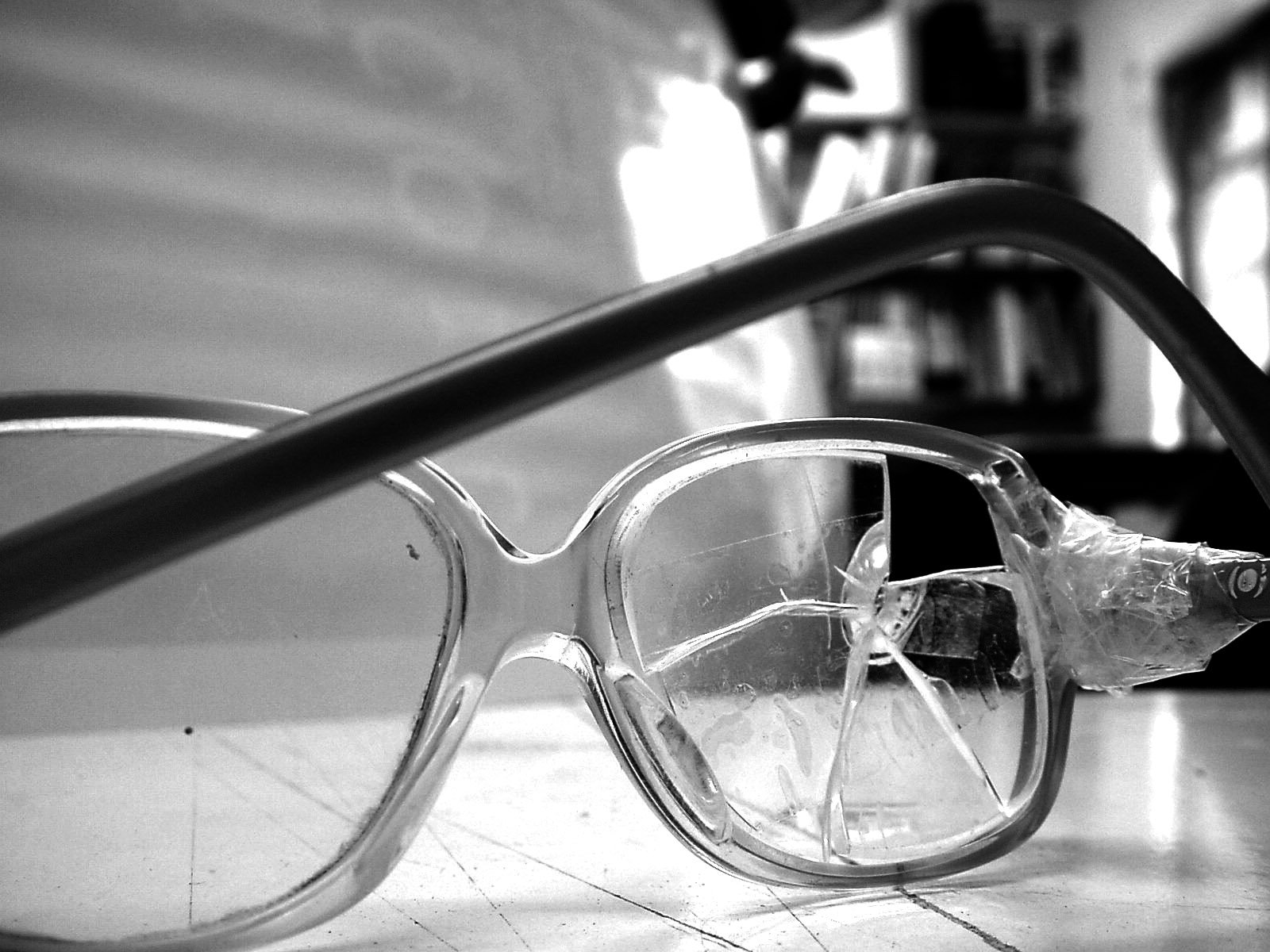 How many of you wear glasses or contact lenses?
Of those, are you near-sighted? Or far-sighted? If you forget which-is-which, just remember that if you can read without glasses, you are near-sighted and if you can drive a car without glasses, you are far-sighted.
Those of us who wear glasses are constantly aware that driving without our glasses would be dangerous to ourselves and others. Even the Bureau of Motor Vehicles thinks so and they put a restriction on our driver’s license that declares it to be a legal offense to drive without our glasses.
But although we know that near-sightedness can be dangerous, that isn’t the kind of near-sightedness that we need to talk about. Although it might be described as near-sightedness, the vision problem that we are warned about in scripture is an entirely different, and far more widespread, problem than the one that can be corrected with eyeglasses.
We begin this morning with a reading from the book of Ecclesiastes, a book that was likely written by the wise King Solomon, but as we read it, we quickly discover that Solomon must have been in a very dark emotional place while he was writing. (Ecclesiastes 1:2, 12-14; 2:17-23)
1:2 “Meaningless! Meaningless!”
says the Teacher.
“Utterly meaningless!
Everything is meaningless.”
1:12 I, the Teacher, was king over Israel in Jerusalem. 13 I applied my mind to study and to explore by wisdom all that is done under the heavens. What a heavy burden God has laid on mankind! 14 I have seen all the things that are done under the sun; all of them are meaningless, a chasing after the wind.
2:17 So I hated life, because the work that is done under the sun was grievous to me. All of it is meaningless, a chasing after the wind. 18 I hated all the things I had toiled for under the sun, because I must leave them to the one who comes after me. 19 And who knows whether that person will be wise or foolish? Yet they will have control over all the fruit of my toil into which I have poured my effort and skill under the sun. This too is meaningless. 20 So my heart began to despair over all my toilsome labor under the sun. 21 For a person may labor with wisdom, knowledge and skill, and then they must leave all they own to another who has not toiled for it. This too is meaningless and a great misfortune. 22 What do people get for all the toil and anxious striving with which they labor under the sun? 23 All their days their work is grief and pain; even at night their minds do not rest. This too is meaningless.
Up until the end of our reading, Solomon is focused entirely on what the world can give him. The word the he often repeats is, “meaningless” and, in Hebrew, this can be understood to mean something that is empty, futile, or transient. Solomon knows that everything that he, and his father, have worked so hard to accomplish will one day be left to someone else who may, or may not, care about him, his goals, his values, or his legacy. But this is what you see when your vision sees no further than your own mortality. This is a deadly kind of near-sightedness. But in the verses and chapters beyond these, Solomon begins to understand that finding meaning in this life depends entirely on understanding that there is something, and someone, that is greater than ourselves. Finding meaning depends on understanding that there is more to life than just sixty or eighty years of this mortal life.
In Luke 12:13-21, Jesus encounters a man who is struggling with the same problem and provides a prescription for the deadly near-sightedness of our fleshly humanity.
13 Someone in the crowd said to him, “Teacher, tell my brother to divide the inheritance with me.”
14 Jesus replied, “Man, who appointed me a judge or an arbiter between you?” 15 Then he said to them, “Watch out! Be on your guard against all kinds of greed; life does not consist in an abundance of possessions.”
16 And he told them this parable: “The ground of a certain rich man yielded an abundant harvest. 17 He thought to himself, ‘What shall I do? I have no place to store my crops.’
18 “Then he said, ‘This is what I’ll do. I will tear down my barns and build bigger ones, and there I will store my surplus grain. 19 And I’ll say to myself, “You have plenty of grain laid up for many years. Take life easy; eat, drink and be merry.”’
20 “But God said to him, ‘You fool! This very night your life will be demanded from you. Then who will get what you have prepared for yourself?’
21 “This is how it will be with whoever stores up things for themselves but is not rich toward God.”
Someone in the crowd asks Jesus to arbitrate a dispute between him and his brother. This wouldn’t necessarily be out of line because it’s conceivable that rabbis might occasionally do such things. But Jesus isn’t interested because he has far more important issues to address than whether, or not, one brother is dividing his father’s estate “fairly.” The person in the crowd is basically saying that he isn’t getting enough of the money for which his father had worked and toiled. Worrying about how large your inheritance is, or how much stuff you have, or how much money you have in the bank, is the kind of greedy, near-sighted thinking that Jesus cautions us to guard against.
In Jesus’ parable, a rich man keeps building bigger barns in which to store stuff so that he can continue to accumulate more rather than sharing what he has with the poor or donating even a portion of it to the church, or to any other cause. Jesus echoes Solomon by saying, once you are dead, “then who will get what you have prepared for yourself?” Does your wealth bring you meaning if you’re dead? Life is meaningless for whomever stores things up for themselves.
A life of meaning only comes when we share our riches with God and with others.
But besides sharing our stuff with God, how do we, as followers of Jesus Christ, live lives of meaning every day? In Colossians 3:1-11, Paul explains it this way:
3:1 Since, then, you have been raised with Christ, set your hearts on things above, where Christ is, seated at the right hand of God. 2 Set your minds on things above, not on earthly things. 3 For you died, and your life is now hidden with Christ in God. 4 When Christ, who is your life, appears, then you also will appear with him in glory.
5 Put to death, therefore, whatever belongs to your earthly nature: sexual immorality, impurity, lust, evil desires and greed, which is idolatry. 6 Because of these, the wrath of God is coming. 7 You used to walk in these ways, in the life you once lived. 8 But now you must also rid yourselves of all such things as these: anger, rage, malice, slander, and filthy language from your lips. 9 Do not lie to each other, since you have taken off your old self with its practices 10 and have put on the new self, which is being renewed in knowledge in the image of its Creator. 11 Here there is no Gentile or Jew, circumcised or uncircumcised, barbarian, Scythian, slave or free, but Christ is all, and is in all.
Living a life that is meaningful and rich toward God is more than just sharing our stuff or sharing our money, it’s a lifestyle that is far-sighted instead of near-sighted. Instead of focusing on our 60 or 80 years of mortal life, focus instead on a life lived for eternity. Realize that our entire lives on earth are just an instant compared to the forever that comes next. Realize that people who are different from us, people from the other side of the tracks, from different social and economic circumstances than ours, people who like different music, people that live on the other side of the planet from us, who speak different languages, and who have a different color skin, may well be our next door neighbors, co-workers, mentors, and friends when we move into our new homes in heaven.
Living a life that is meaningful and rich toward God is beginning your eternity now, by putting to death those things that are near-sighted and focused on your own personal satisfaction, and pleasure such as sexual immorality, impurity, lust, evil desires and greed, which is idolatry. Paul says that greed isn’t just bad, but greed is, in fact, idolatry because greed puts money and self in the place of God. Get rid of anger, rage, malice, slander, filthy language, and lies so that you can become more like the person that God created you to be, and the person that you will one day become.
Setting your sights only on your life on earth is a near-sighted recipe for destruction, meaninglessness, and death. Instead, we must set our sights on God, on eternity, and a life in heaven that will be lived alongside people of every tribe, every nation, and every language. To live a life of meaning, we must be a people who are far-sighted. Because, by seeing the distant and eternal future, we can put today’s problems, fears, social tension, injustice, needs, wants, desires, and everyday ordinary decisions of every kind in their proper perspective.
May we all live deeply meaningful lives that are rich toward God in every way.
Did you enjoy reading this?
Click here if you would like to subscribe to Pastor John’s weekly messages.
Click here to subscribe to Pastor John’s blog.
Click here to visit Pastor John’s YouTube channel.
 Pete and Emily Brewer couldn’t figure out why anyone would want to interview them or hear their story, but I am confident that you won’t hear another story quite like it.
 We were cold.
But would be hot almost within the hour.
The fog was still liftng from the mountan valleys as we walked to breakfast just after dawn. There was a chill in the air and several of us had spent a fitful night tryig to keep warm in our tents. But as we walked to breakfast, we were also aware that soon, almost within the hour, the sun wouold rise above the mountains and temperatures would rise enough to make us sweat.
And so, as each of us dressed that morning, we had made choices. We were all faced with the same facts, but each of us had made different choices. One had long sleeves and long pants, another long sleeves and shorts, another long pants and short sleeves, and still another both short pants and sleeves. Would we be comfortablly warm now, and cold later? Or cold now, and comfortable later? Each of us knew that our choice was transient.
Discomfort was inevitable.
We were choosing the form of our discomfort.
And it was so ordinary that no one gave it a second thought.
But in other situations we seem shocked by it… and we shouldn`t be.
We wonder why migrants would choose to come across our border when they know that the journey is arduous, that the “coyotes” that guide them vicious, rape ordinary, and often detention when caught. The thing is, many are aware of the dangers before they begin but, when faced with daily violence, death and mayhem at home, they’ve chosen the most comfortable discomfort. The discomfort they face at home seems endless and unsolvable, but the discomfort on the road to citizenship, or even residence, in a foreign country seems like a light of hope at the end of a dark tunnel.
We wonder why young people who grew up in the church, and who believe that life begins in the womb, still sometimes choose to end that life through abortion. But often these young people, married and unmarried, are faced with impossible choices, none of which are good. While we may not agree with their choices, we should understand that they are choosing their discomfort. When every possible choice seems to be a path of pain, they must choose which path of pain seems ever so lightly less painful.
We wonder why people who have few posessions and little money make choices that seem wasteful and foolish. But they are doing the same thing. They are choosing their discomfort. It can easily be understood that although none of their choices are good, they choose a path that offers a little joy, however transient.
We wonder why our friends choose to vote for candidates that do not represent their values, or who are known to act in ways that are contrary to the interests of the voters. But the same principle applies. It is often the case that voters are fully aware of the candidate’s failings, faults, and voting patterns. But, believing that the other candidates are just as flawed, or who violate their conscience in other ways, the voters are compelled to choose their discomfort.
Which path of pain seems the most bearable?
Which uncomfortable choice offers a chance at hope?
I didn`t laugh at my friends on the way to breakfast because I understood that each of us, in our own way, was choosing the uncomfortable path that we though offered the least discomfort.
If we can understand that, then shouldn’t we extend the same grace to others who are making harder, more painful choices between their available paths of discomfort?
Isn’t that what Jesus taught us?
Each of us must make choices that guide us through paths of discomfort.
We should have the grace to allow others to do the same.
Friends…
…always choose grace.
We were cold.
But would be hot almost within the hour.
The fog was still liftng from the mountan valleys as we walked to breakfast just after dawn. There was a chill in the air and several of us had spent a fitful night tryig to keep warm in our tents. But as we walked to breakfast, we were also aware that soon, almost within the hour, the sun wouold rise above the mountains and temperatures would rise enough to make us sweat.
And so, as each of us dressed that morning, we had made choices. We were all faced with the same facts, but each of us had made different choices. One had long sleeves and long pants, another long sleeves and shorts, another long pants and short sleeves, and still another both short pants and sleeves. Would we be comfortablly warm now, and cold later? Or cold now, and comfortable later? Each of us knew that our choice was transient.
Discomfort was inevitable.
We were choosing the form of our discomfort.
And it was so ordinary that no one gave it a second thought.
But in other situations we seem shocked by it… and we shouldn`t be.
We wonder why migrants would choose to come across our border when they know that the journey is arduous, that the “coyotes” that guide them vicious, rape ordinary, and often detention when caught. The thing is, many are aware of the dangers before they begin but, when faced with daily violence, death and mayhem at home, they’ve chosen the most comfortable discomfort. The discomfort they face at home seems endless and unsolvable, but the discomfort on the road to citizenship, or even residence, in a foreign country seems like a light of hope at the end of a dark tunnel.
We wonder why young people who grew up in the church, and who believe that life begins in the womb, still sometimes choose to end that life through abortion. But often these young people, married and unmarried, are faced with impossible choices, none of which are good. While we may not agree with their choices, we should understand that they are choosing their discomfort. When every possible choice seems to be a path of pain, they must choose which path of pain seems ever so lightly less painful.
We wonder why people who have few posessions and little money make choices that seem wasteful and foolish. But they are doing the same thing. They are choosing their discomfort. It can easily be understood that although none of their choices are good, they choose a path that offers a little joy, however transient.
We wonder why our friends choose to vote for candidates that do not represent their values, or who are known to act in ways that are contrary to the interests of the voters. But the same principle applies. It is often the case that voters are fully aware of the candidate’s failings, faults, and voting patterns. But, believing that the other candidates are just as flawed, or who violate their conscience in other ways, the voters are compelled to choose their discomfort.
Which path of pain seems the most bearable?
Which uncomfortable choice offers a chance at hope?
I didn`t laugh at my friends on the way to breakfast because I understood that each of us, in our own way, was choosing the uncomfortable path that we though offered the least discomfort.
If we can understand that, then shouldn’t we extend the same grace to others who are making harder, more painful choices between their available paths of discomfort?
Isn’t that what Jesus taught us?
Each of us must make choices that guide us through paths of discomfort.
We should have the grace to allow others to do the same.
Friends…
…always choose grace.

 Pastor Partridge